fbpx

May 28, 2021

Former ADL Head Says He’s Canceling NYT Subscription Over Front Page “Blood Libel”

Abraham Foxman, the director emeritus of the Anti-Defamation League, tweeted on May 28 that he is canceling his New York Times subscription because the paper printed a “blood libel” on their front page.

The May 28 print edition of the Times featured several photos of children in the Gaza Strip who were killed in the recent Israel-Hamas conflict, as well as two children in Israel who died. The headline read: “They Were Just Children.” The story itself, which was published online on May 26, highlights the at least 67 dead Gazan children and the two Israeli children. “Israel blames Hamas for the high civilian death toll in Gaza because the group fires rockets and conducts military operations from civilian areas,” the article stated. “Israel’s critics cite the death toll as evidence that Israel’s strikes were indiscriminate and disproportionate.”

It also states that a couple of the Gaza children “may have been killed when Palestinian militants fired a rocket at Israel that fell short.”

https://twitter.com/evanchill/status/1398324699306893315?s=20

“I am cancelling my subscription to NYTimes,” Foxman tweeted. “I grew up in America on the NYT—I delivered the NYT to my classmates—I learned civics—democracy and all the news ‘fit to print’ for 65 years but no more. Today’s blood libel of Israel and the Jewish people on the front page is enough.”


Newsweek Deputy Opinion Editor Batya Ungar-Sargon replied to Foxman, “Me too.”

Associate Dean and Director of Global Social Action Agenda at the Simon Wiesenthal Center Rabbi Abraham Cooper told the Journal that he too is canceling his subscription to The New York Times, saying that the front page is “libelous against the Jewish state and that they do it amidst a tsunami of antisemitic attacks by pro-Hamas forces across the United States… it’s beyond the pale.” He added that the Times has gone from “being the paper of record for the United States of America – the world’s greatest democracy – to becoming the newspaper of record for Hamas.”

Others on Twitter defended the Times.

“Blood libel is about the accusation that Jews kill Christian children for ritual purposes, not about how a sovereign state acts in war,” Rabbi Jill Jacobs, executive director of Tr’uah: The Rabbinic Call for Human Rights tweeted in response to Foxman. “It is not antisemitic to show pictures of Palestinian—and Israeli btw—children killed in the war, both by Israel & by Hamas.”

Palestinian writer Yousef Munayyer called Foxman’s tweet “a good example of how antisemitism smears are used to silence dissent and police the discourse around Palestine” and added in a subsequent tweet, “For years Palestinians have been reduced to nameless, faceless statistics in the reporting about their killings at the hands of the Israeli military. If the minute they are humanized, even in the simplest way, you start screaming antisemitism then something is wrong with you.”


The Times did not respond to the Journal’s request for comment.

The Times was criticized for other coverage of the recent Israel-Hamas conflict earlier this week. Ben Shapiro tweeted that for the main image of an op-ed by a Palestinian writer, the Times used a map of Israel that is “so bad that MSNBC, which used the image in 2015, had to retract it and admit it was factually incorrect.” New York Times Deputy Opinion Editor Patrick Healy said in a statement that the map helped “illustrate [the author’s] arguments.”


“It’s a phony map,” Cooper told the Journal. “Anybody with a 12th grade education would know it was called the Palestinian Mandate, and the Palestinian Post was talking to the Palestinians. You know who they were? Jews!”

Gilead Ini, senior research for the Committee for Accuracy in Middle East Reporting and Analysis (CAMERA), accused the Times of burying “readers in an avalanche of anti-Israel Guest Essays.”

Former ADL Head Says He’s Canceling NYT Subscription Over Front Page “Blood Libel” Read More »

Pico-Robertson Synagogue and Kosher Restaurant Targeted with Vandalism

Young Israel of Century City (YICC) is reeling from a May 28 incident involving an unidentified individual throwing a cinderblock at its synagogue’s window.

The incident occurred around 1 a.m. on May 28, according to a YICC representative.

Security camera footage captured an individual throwing the object at the synagogue—located at Pico boulevard and Rexford drive—but the synagogue’s leadership was not able to identify the person.

The object did not cause any damage to the synagogue window because the windows are shatterproof.

The individual also threw an object at Pat’s Restaurant, located one block away at Pico and Glenville drive. On Friday, one of the windows of the kosher restaurant was boarded up. Pat’s Restaurant is currently closed, with the restaurant operating in a parking lot across the street due to the pandemic.

On Friday, a few hours before Shabbat, YICC held a press conference at the synagogue with YICC Rabbi Elazar Muskin and Simon Wiesenthal Center Rabbi Marvin Hier, among others, attending.

The synagogue’s leadership believe the incident, which occurred amidst a spike in hate incidents targeting Jews across the country, was a hate crime.

According to the YICC spokesperson, the individual targeted Pat’s first, then went westbound down an alley behind YICC before throwing another object at YICC. The individual brought along the cinderblock object, which he threw and bounced off the window, the YICC representative said.

Muskin told the Journal that the cinder block was “a good 10-pound piece of concrete.” He added that it “sure smells” like a hate crime.

“He chose the most well-known kosher restaurant in the city, and he chose a prominent synagogue, and it was premeditated because he was carrying this box with cement. So he knows what he is doing.”
— Rabbi Elazar Muskin

“If you are just interested in vandalism, why not go to another store?” Muskin asked. “He chose the most well-known kosher restaurant in the city, and he chose a prominent synagogue, and it was premeditated because he was carrying this box with cement. So he knows what he is doing.”

A spokesperson for the Los Angeles Police Department told the Journal that the matter is currently being investigated and they have no further information at this time.

In a statement to the Journal, City Councilmember Paul Koretz called the vandalism “hateful and aggressive” and “absolutely abhorrent.”

“We must continue to remain vigilant and have situational awareness to keep our communities safe. We will not tolerate any form [of] hate or antisemitism to rip apart the fabric of our society that we have worked so hard to build,” Koretz said.

Rabbi Marvin Hier, Dean and Founder of the Simon Wiesenthal Center, said in a statement that Simon Wiesenthal told him in 1977 that he lived in Vienna because “If you’re studying malaria, you have to find out where the mosquitos are. When you’re studying anti-Semitism, you have to live in Vienna where the Nazis are.” Hier believes that if Wiesenthal were alive today, “he would live in the United States of America – that’s where the haters live and anti-Semitism is flourishing. Anti-Semitism has now become America’s greatest hate pandemic and we terribly need to find a vaccine that really reflects America’s human dignity.”

Associate Dean and Director of Global Social Action Agenda at the Simon Wiesenthal Center Rabbi Abraham Cooper told the Journal that he commends President Joe Biden for “his very strong statement today against the tsunami of antisemitism” but condemns “with the exception of Paul Koretz, the silence of the City Council of Los Angeles and our other elected political leaders who haven’t said anything. They can’t bring themselves to say the A-word, that this is antisemitism, and that this is the importation of the Hamas war to the streets of LA.”

If Los Angeles elected officials don’t start speaking out and taking on antisemitism, Cooper said, “it signals to the pro-Palestinian thugs and the others that it’s open season on the Jews.”

“There is an epidemic of antisemitism in America today and Los Angeles is among its epicenter,” American Jewish Committee Regional Director Richard Hirschhaut said in a statement. “A cinder block hurled at the window of a synagogue and a brick thrown through the window of a kosher restaurant, captured on video, are irrefutably crimes motivated by hate. We call upon the LAPD to fully investigate these cowardly acts and further elevate its protection of an understandably anxious community. The perpetrators of antisemitic hate crime must know that they cannot act with impunity.”

Muskin said that the synagogue is still planning to hold Shabbat services on May 29. “We are determined to continue. We are not going to let these guys win.”

Ed note: This story has been updated to reflect additional information.

Pico-Robertson Synagogue and Kosher Restaurant Targeted with Vandalism Read More »

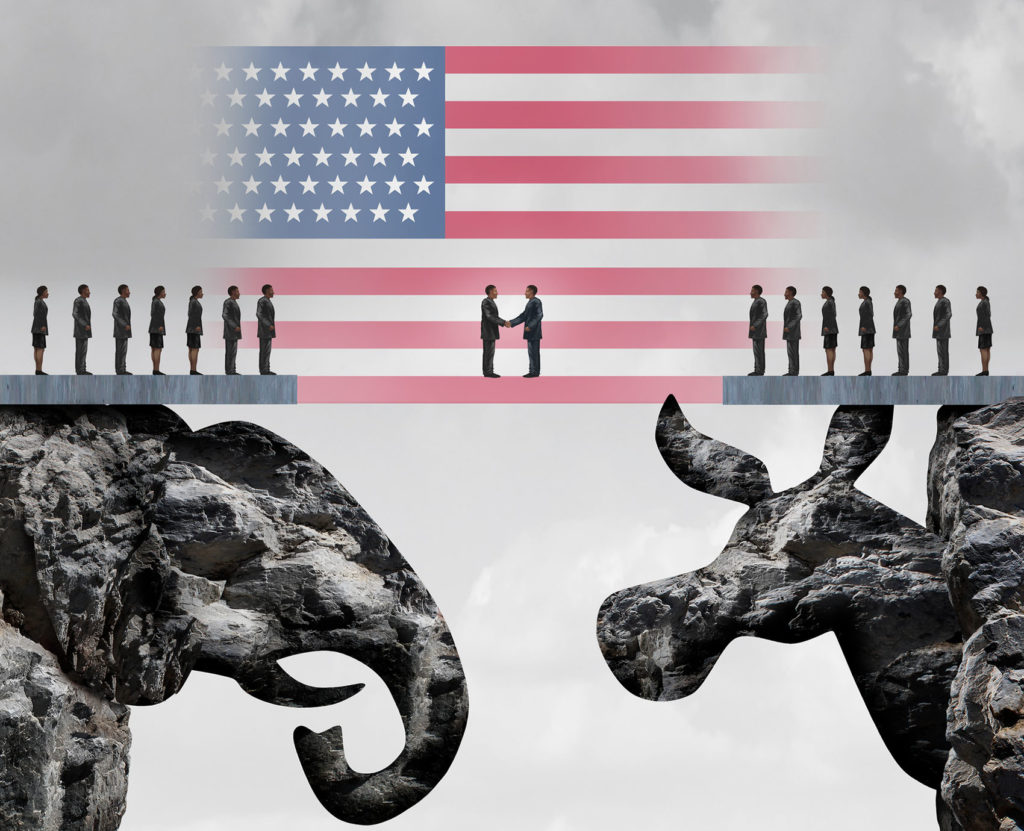
Can Civil Discourse Prevent Our Second Civil War?

To read Part 1, 2, 3, 4 and 5 in this series, click here, here, here, here and here.

Both the Jewish tradition and the American way reject uniformity of thought.

Our religious texts and traditions prioritize study through argument. A Talmudic disagreement may not find resolution in the text, but both sides are richer for having engaged in the dispute. Likewise, our political economy benefits from robust democratic debate, while science and invention progress through evidence-based inquiry and discovery that consistently demand fresh thinking and exploration.

We aspire to set aside ideological bias in the pursuit of truth. We work to honor context, nuance, and open-mindedness. The mind that never changes or corrects is one to which we might say “never-mind.”

Society flourishes in an environment in which mutual respect for ideological differences is an accepted norm. Without these shared values, we run the risk of a division so deep it splits the foundation.

Unfortunately, sincerely held disagreements among Americans are so prevalent that we have become increasingly polarized, cornering ourselves into a state of contempt and a level of mutual antipathy with predictable and problematic consequences.

Our Disputes Are Real

A concise list of our culture wars and ideological battles might include:

Religious Civilization vs. The Secular Ideal

Is our human nature inherently good, bad, and/or requiring of divine moral authority?

Do our natural rights come from God or is government the source of our liberty?

Are traditional distinctions (God and humankind, men and women, humanity and nature) true and relevant?

Nationalism vs. Globalism

Did the God of Genesis move us forward from family and tribe to the idea of the nation as the best organization to fulfill our destiny?

Shall the nation-state model, successful since the Treaty of Westphalia (1648) ended Europe’s religious wars, continue or give way to a new era of global governance?

Free Market Economics vs. Statism

Was Karl Marx in error to reject Jewish law, which promoted private property guided by behavioral responsibility and charity, in favor of his attempt to impose an international worker’s movement?

Does a highly taxed and regulated citizenry reduce incentives for innovation and achievement?

Security Deterrence vs. Appeasement

Must we re-learn in every generation the necessity of peace through strength?  What lessons do we carry forward from the examples of two British Prime Ministers:  Neville Chamberlain’s pronouncement of “peace in our time” and Winston Churchill’s proclamation that “we shall never surrender”?

Race Blind vs. Race Conscious

Does Abraham Lincoln merit our deep respect as the Great Emancipator and our nation’s final founding father, or should his statue be torn down along with other important, but flawed, historical figures?

Has Martin Luther King, Jr.’s dream of brotherhood and judging ourselves based on character rather than skin color been eclipsed by race-conscious victimhood?

Are we are a nation of equality under the law or reparations and revenge?

Justice vs. Social Justice

Is justice blind?  Shall the law favor neither the rich man nor the poor man?  Or does the equity imperative prioritize favored groups and, for example, the rejection of mathematics as systemically racist?

At times in our American past, our disunity has descended into insurrection, rebellion, riot, assassination, and even civil war.

Before we devolve into separation and divorce, and perhaps even more political violence, let us consider three strategies for reconciliation and re-commitment to the motto of the United States of America, e pluribus unum — out of many, one.

Stop the Name-Calling

Imagine a political culture in which politicians were not rewarded for demonizing their opponents. Both Republicans and Democrats play to their base, rushing into extremist rhetoric and partisanship through the use of war rooms, nuclear options, impeachment, and the politics of personal destruction.

President Trump’s policies may have been successful, but his popularity never rose above 50% due to his verbal assaults. He attacked the war record of John McCain, a Navy pilot who spent years under torture and captivity while remaining loyal to his shipmates and his country, by claiming “real heroes don’t get shot down.” He crudely insulted journalist Megyn Kelly, asserting “you could see there was blood coming out of her eyes, blood coming out of her wherever.”

The political and media left certainly have their way with insults, too, frequently calling their opponents deplorable, Neanderthals, white supremacists, domestic terrorists, and, that old stand-by, racists.

One commonplace rhetorical bomb used by the political class is analogizing to the Holocaust. The frequent online use of memes connecting an issue or dispute to the Holocaust is now categorized as proof of Godwin’s Law, which asserts that as a discussion on the internet grows, the likelihood of someone being compared to Hitler or the Nazis increases. Some have sought to claim that whoever sinks first into this comparison loses the debate at hand.

The use of Nazi analogies and reductio ad Hitlerum is especially vulgar because of the unspeakable human suffering perpetrated by the Nazi regime and collaborators. An insult meant to degrade a political opponent offends all Nazi victims and those who cared for them, liberated them, or remember them.

Stand by Your Principles

Disagreeing without resorting to insult requires a certain level of smarts and good faith. It does not mean one must abandon strongly-held beliefs or pretend there is agreement where none exists.

While some object to the use of “whataboutism,” (the response to a claim of wrongdoing by a political opponent by pointing out the same behavior or worse on their side) it can be a truthful and effective way to point out hypocrisy. This is consistent with the shared sentiment, across the political aisle, by all those who object to “rules for thee, not for me.”

Whataboutism is the use of comparison in the search for clarity and truth, and it can be a legitimate attempt to demand that others argue in good faith. Likewise, the casual dismissal of a challenge by comparison can be an attempt to shut down speech. If the comparison is not apt, dismissing the challenge is a fair retort.  But the claim that argument by whataboutism is illegitimate per se is simply a way to end debate by suppressing examination.

Americans have a reputation for being open-minded, perhaps to a fault, given that historically we have seen the power that demagogues, seeking to exploit this collective trait, can hold over mainstream Americans. But the dominant American sensibility is more moderate than the loudest, angriest voices from far- left and right margins might demand.

Demagogues from right to left that have temporarily held sway over segments of Americans include Father Coughlin, Theodore Bilbo, Huey Long, Joseph McCarthy, George Wallace, Al Sharpton, and Louis Farrakhan among others. But over time, the American people have tended to self-correct in order to hold the middle, demanding that our politics not swing too far right or left.

The Compassion of Unknowing

Rabbi Irwin Kula is the President of CLAL, the National Jewish Center for Learning and Leadership, and Co-Founder and Co-Editor of The Wisdom Daily website. He sees our time as deeply complex and challenged by technological change. Our response to modern stresses has been to double-down on our ideologies and perspectives, blaming opponents and fiercely defending our own inherited philosophies.

Kula believes we need “an ethics of unknowing” to relieve ourselves (aggrieved conservatives and utopian progressives) of our righteousness and apocalyptic thinking. Our certainty masks our unconscious uncertainty, turning opinion into aggression. We might choose instead to model self-awareness, courage, and curiosity. Humility not hubris.

Today, some on both sides of the red-blue / right-left battles have given up on the idea of American liberal democracy.  Both are increasingly suspicious of and angry at their opponents.

“Hard conservatives see fighting cultural degeneracy and some fetishized version of freedom as more important than the American liberal democracy and hard liberals see identitarian inequity and some fetishized version of justice as more important than the America liberal democracy,” says Kula, “and both sides have become aggressive and increasingly dangerous in some reaction-formation toxic dance.”

He continues:

“We need to expand our own truth horizons. But moderates have become so powerless — philosophically, conceptually, psychologically, and spiritually — that we have ceded the public culture, news media, and political discourse to the extremes. At this moment it is more threatening psychologically for moderates to grapple with the partial truth of moderates from the other side than to support or downplay or pander to extremes on their own side. Until moderate liberals and moderate conservatives are willing to risk everything from status to money, from reputation to elected office, from being cancelled to being vilified for heresy/selling out etc. nothing can get better.”

Rabbi Kula offers two rules for all conservative and liberal political and religious leaders who still have faith in The American Experiment (or The Jewish People).

First: “Only criticize extremists in your own group. In a polarized society extremes can’t hold each other accountable, rather they tend to bully the moderates in their own group and demonize those in other groups. Moderates can hold their own extremes accountable.”

And second:

“In every argument with a moderate from the other side we should start by listening very carefully and locating one insight/truth, however partial and on whatever level —factually, conceptually, psychologically — of the other side that just may be right AND one opinion, view, or fragment of thought that we have that might just be wrong. As moderates incorporate the partial truths of the other side, extremes lose their resonance. Let’s do this in the name of the American experiment and as an expression of faith in the rule of law, reason, and conversation. Let’s model this for a year — allow this method of discourse to trump our desire for power and let’s see where we are.”

Americans have recovered from disunity and civil strife in the past: the Federalists and Anti-Federalists of our founding, the North and the South in the Civil War, and the cultural conflicts of the turbulent 1960s Civil Rights and Vietnam War eras.

Today’s tensions have already spilled over into violence. Before we take up arms against our political opponents, let’s make one big push to turn political enmity into a more respectful engagement of voices.


Larry Greenfield is a Fellow of The Claremont Institute for the Study of Statesmanship & Political Philosophy.

The Speech Project is an initiative of the Jewish Journal that brings together some of the most compelling voices from across the political spectrum to address the topic of free speech. In a cultural moment where civil liberties often seem to be under siege, we encourage freedom of expression, independent thinking, and personal choice. The articles, podcasts, books, and other resources you’ll find here all challenge the growing illiberalism of our time in their pursuit of balance and authenticity.

Can Civil Discourse Prevent Our Second Civil War? Read More »

Biden Condemns “Despicable” Antisemitic Attacks

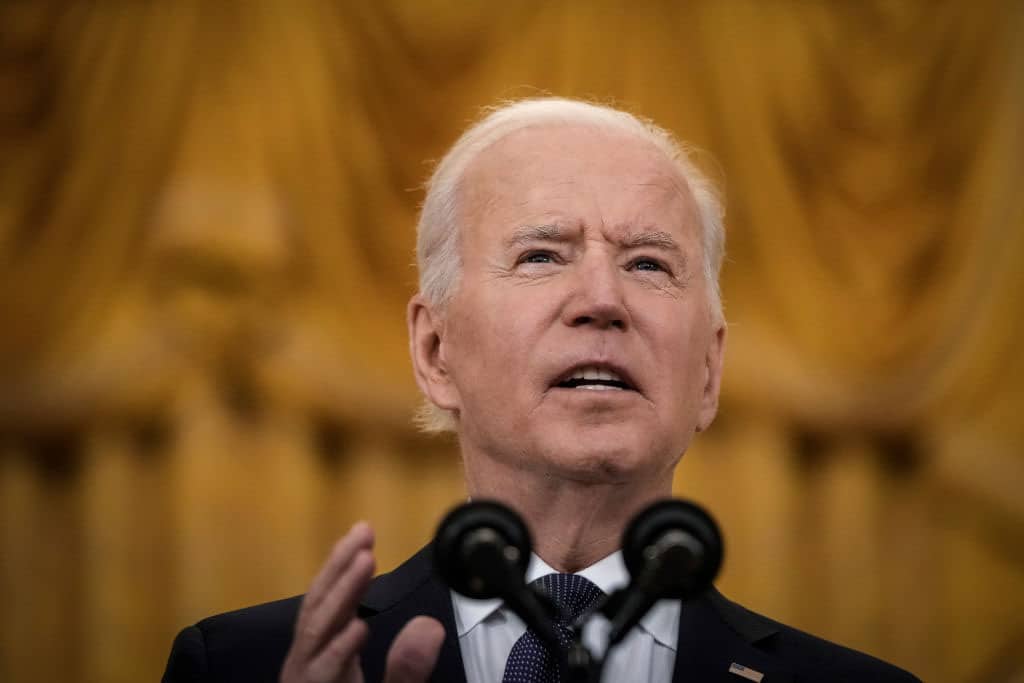
President Joe Biden issued a statement on May 28 condemning the “despicable” rise in antisemitic attacks.

The statement read: “We have seen a brick thrown through window of a Jewish-owned business in Manhattan, a swastika carved into the door of a synagogue in Salt Lake City, families threatened outside a restaurant in Los Angeles, and museums in Florida and Alaska, dedicated to celebrating Jewish life and culture and remembering the Holocaust, vandalized with anti-Jewish messages.

“These attacks are despicable, unconscionable, un-American, and they must stop.”

He added that “the Department of Justice will be deploying all of the tools at its disposal to combat hate crimes” and that May is Jewish American Heritage Month. “We honor Jewish Americans who have inextricably woven their experience and their accomplishments into the fabric of our national identity; overcoming the pain of history, and helping lead our struggle for a more fair, just, and tolerant society. Let us all take up that work and create a nation that stands for, and stands up for, the dignity and safety of all of our people.”

Jewish groups lauded Biden’s statement.

“Thanks @POTUS for standing with the American Jewish community and opposing #antisemitism in all forms,” Anti-Defamation League CEO Jonathan Greenblatt tweeted. “Now @WhiteHouse must appoint a Jewish liaison, name a Special Envoy on Global Antisemitism, and increase Nonprofit Security Grants program.”


 The American Jewish Committee similarly tweeted, “Thank you, @POTUS, for condemning the inexcusable rise in antisemitism over the last few weeks and taking active steps to combat it. We must work together to stop antisemitism. We call on all people of good will to join us in this important work.”

Earlier in the day, a Time magazine article noted that the Biden administration had held two meetings with Jewish leaders earlier in the week “after a public call for action” from various Jewish organizations. The article added that some “leaders are still waiting to ensure the rhetoric condemning the attacks spurs actual policy changes,” quoting Public Policy for the Orthodox Union Executive Director Nathan Diament as saying, “Statements are important, but they are not sufficient.”

The Times also cited a May 20 ADL report stating that antisemitic incidents have “increased by 75% during the 11-day conflict between Israel and Hamas,” quoting Greenblatt as saying, “We’re not seeing an uptick; we’re seeing a tidal wave.”

Biden Condemns “Despicable” Antisemitic Attacks Read More »

Rutgers Apologizes for Statement Condemning Antisemitism

Rutgers University–New Brunswick issued an apology on May 27 over its statement the day prior condemning antisemitism.

According to The Daily Caller and Reason Magazine, Chancellor Christopher J. Molloy and Provost and Executive Vice Chancellor for Research and Academic Affairs Francine Conway said in their apology that their initial statement condemning antisemitism “failed to communicate support for our Palestinian community members. We sincerely apologize for the hurt that this message has caused.” “Our diversity must be supported by equity, inclusion, antiracism, and the condemnation of all forms of bigotry and hatred, including anti-Semitism and Islamophobia. As we grow in our personal and institutional understanding, we will take the lesson learned here to heart, and pledge our commitment to doing better. We will work to regain your trust, and make sure that our communications going forward are much more sensitive and balanced.”

Malloy and Conway’s initial statement said that they were “saddened by and greatly concerned about the sharp rise in hostile sentiments and anti-Semitic violence in the United States. Recent incidents of hate directed toward Jewish members of our community again remind us of what history has to teach us.” They added that there has been “increasing violence between Israeli forces and Hamas in the Middle East leading to the deaths of children and adults and mass displacement of citizens in the Gaza region and the loss of lives in Israel.”

“This recent resurgence of anti-Semitism demands that we again call out and denounce acts of hate and prejudice against members of the Jewish community and any other targeted and oppressed groups on our campus and in our community. Our commitment to creating a safe learning environment that is inclusive of difference requires that we hold ourselves and each other accountable for our behaviors.”

After the initial statement was released, Rutgers Students for Justice in Palestine (SJP) wrote in an Instagram post that they were “deeply concerned” about the statement. “The Chancellor and Provost’s statement exclusively addressing antisemitism comes during a time when Israel’s occupation of Palestine is finally receiving widespread criticism, and despite mentioning the ‘deaths of children and adults and mass displacement citizens in the Gaza region,’ conveniently ignores the extent to which Palestinians have been brutalized by Israel’s occupation and bombing of Gaza.” They claimed that there haven’t been any reported instances of antisemitism against the Rutgers community since the escalation between Israel and Hamas, prompting the SJP chapter to accuse the university of deflecting from “financially supporting the Israeli state, and thus its human rights abuses and occupation of Palestine.” Rutgers SJP also accused the university of trivializing racism by also including condemnations of hatred against Asians, Hindus, Muslims and Indigenous peoples in their statement and criticized the university for not mentioning Palestinians.

“We therefore demand an apology from Chancellor Molloy and Provost Conway for dismissing the voices and visibility of Palestinians and allies.”


View this post on Instagram


A post shared by Rutgers NB SJP (@sjprutgersnb)

Jewish groups denounced the university’s apology. Associate Dean and Director of Global Social Action Agenda at the Simon Wiesenthal Center Rabbi Abraham Cooper told the Journal that the apology was a “complete and utter disgrace.” “That’s not leadership; that’s appeasement of people who support the destruction of the state of Israel. It’s an appeasement of all of those forces that have embraced the Hamas talking points.”

He added that the apology is symptomatic of a broader problem among “elite schools” not having “the guts to apply” their diversity, inclusion and freedom of speech policies “on behalf of Jewish students as well, and we’re seeing the results all over the country. The only way attacks against Jews will stop will be if our non-Jewish institutions… send a signal [that] there’s a price to pay for antisemitism.”

StandWithUs co-founder and CEO Roz Rothstein similarly said in a statement to the Journal, “It is very unfortunate that after releasing a statement denouncing antisemitism, the Chancellor of Rutgers University caved to pressure from Students for Justice in Palestine (SJP) and ‘apologized.’ SJP’s complaint was that in his condemnation of antisemitism, the Chancellor did not also demonize and blame Israel alone for the suffering of Palestinians. Condemning antisemitism and expressing a commitment to support Jewish students on campus is not anti-Palestinian and to portray it as such is vile.

“While the Israeli-Palestinian conflict is not happening on the Rutgers campus or in the surrounding area, antisemitism is a very real and immediate threat to Jewish students. Rutgers should make clear that they do not apologize for condemning antisemitism at a time of rising violence, vandalism, and harassment targeted at Jews everywhere.”

Stop Antisemitism Director Liora Rez called the university’s apology “pathetic” and “spineless.” “Until the University administration makes it perfectly clear their school has a zero-tolerance policy for Jew hatred, we call on all Jewish alumni to immediately cease donations and high school seniors to remove this school from their prospectus lists.”

Anti-Defamation League (ADL) New York / New Jersey Regional Director Scott Richman also said in a statement to the Journal, “Conflating Jewish people or institutions with the crisis in the Middle East is a dangerous and harmful mistake that hurts more than just Jews and is deeply antisemitic. Antisemitism, regardless of politics, is harmful, and must be addressed in order to prevent it from becoming normalize.

“That said, we share a common goal of wanting to provide a safe and inclusive community for all students, and we deeply value our work and relationship with the Rutgers community. We will continue to offer ADL resources to work together toward that goal.”

The university did not respond to the Journal’s request for comment.

This article has been updated.

Rutgers Apologizes for Statement Condemning Antisemitism Read More »

Hamas vs. Israel: Who Won?

From a conventional military standpoint, there is no question: Israel won, hands down. The barrage of rockets Hamas rained down over Israel (more than 4,000) could be considered a giant waste of resources. They did not even dent Israel’s military capabilities, caused few casualties, and did nothing to advance Hamas’s primary cause: the establishment of a Palestinian state. Arguably, the campaign massively backfired in that Israel inflicted tremendous damage on Gaza, with buildings destroyed, tunnels collapsed and lives lost.

But from another standpoint—terrorism—Hamas’s campaign was brilliantly successful.

But first, we need to define terrorism, and for that, I’m going to rely on Thomas Perry Thornton’s classic 1964 essay, “Terror as a Weapon of Political Agitation,” the first to analyze terrorism as a “rational tool,” as opposed to the act of “the mad and the bad,” to use a nineteenth-century description of anarchists and Irish nationalists. Terrorism’s distinguishing characteristic is “its extranormal quality; that is terror lies beyond the norms of violent political agitation that are accepted by a given society.”

By that definition, Hamas’s tactic—lobbing thousands of unguided rockets into Israel—definitely qualifies as terrorism. Odd as it may sound, there are rules to warfare, and civilians are supposed to be out of bounds (as much as possible). Obviously, launching rockets into cities to land randomly is “beyond the norms” of conventional warfare.

So why did Hamas respond as they did? Surely they knew that their rocket campaign would not damage the Israeli military, that the Iron Dome system would intercept most of their rockets, and that Israel would respond with overwhelming force. Surely they knew that storing and firing weapons from densely populated areas, including, hospitals, schools, and mosques, would lead to Israel’s striking supposedly off-limits targets as well as civilian casualties.

Several reasons explain Hamas’ actions.

First, one of terrorism’s primary goals is “to make life unendurable for the enemy,” to quote Brian Crozier (who also coined the phrase, “Terrorism is a weapon of the weak”). That clearly happened. Every time Hamas launched a barrage, the sirens went off and Israelis rushed into bomb shelters. While the damage in property and lives caused by Hamas’s attacks was relatively small, Hamas nonetheless created a widespread atmosphere of fear that made everyday life impossible. One could never be far from a bomb shelter, because one never knew when and where a rocket might land.

Second, terrorism is not so much a military tactic as a pubic relations tool. The point is not to kill as many of the enemy as possible, but to broadcast a message, to tell their side of the story. By that standard, Hamas’s bombing campaign succeeded brilliantly.

Terrorism is not so much a military tactic as a pubic relations tool. The point is not to kill as many of the enemy as possible, but to broadcast a message, to tell their side of the story. By that standard, Hamas’s bombing campaign succeeded brilliantly.

In 2020, Donald Trump’s son-in-law, Jared Kushner, put forward a peace plan that all but ignored the Palestinian question, and Netanyahu was more than happy to play along. For a while, Kushner’s strategy seemed to work with the four Arab states (the United Arab Emirates, Bahrain, Sudan and Morocco) that established diplomatic relations with Israel. The greater danger posed by Iran seemed to eclipse the Palestinian issue, allowing Netanyahu to continue establishing settlements in the West Bank without interference.

But the eleven-day rocket barrage from Hamas radically changed that calculation by placing the Palestinian question front and center. The world’s attention was now rivetted on Gaza, not on Iran and its supposed nuclear ambitions.  For eleven days, the fight between the Palestinians and Israel was the lead story for The New York Times, the Washington Post, CNN, The Guardian, and other media outlets, and nearly every story featured a section on Palestinian grievances.

Even further, the world sided with Hamas. To give a few examples, comedian and pundit, John Oliver, delivered a lengthy tirade against Israel, repeatedly accusing the state of war crimes while ignoring Hamas’s indiscriminate rocket fire. Turkey’s President Recep Tayyip Erdogan said that he was “furious” at Israel airstrikes but neglected to mention what caused them. A Facebook ad from Amnesty International features a photo of an Israeli bomb going off in Gaza and promotes their campaign “for an IMMEDIATE end to arms sales to Israel” (but says nothing about Hamas’s own arms). Statement after statement from higher education across the world denounced Israel and supported Hamas in equal measure.  Faculty from 19 North Carolina colleges and universities “strongly condemn[ed] Israeli attacks on historic Palestine” and expressed their “solidarity with the Palestinian people in their just struggle for liberation.” Students from Goldsmiths University, London, condemned “the escalating violence committed by Israeli Occupation forces on Palestinian citizens of Gaza” (again, without mentioning Hamas’s indiscriminate bombing).

Now that a ceasefire has taken effect, world leaders have unanimously said that resolving the conflict is their first priority. United Nations Secretary-General António Guterres tweeted that Israeli and Palestinian leaders “have a responsibility beyond the restoration of calm to start a serious dialogue to address the root causes of the conflict.” President Joe Biden reiterated that he remains “committed” to the two-state solution because it is “the only way to ensure Israel’s future as a Jewish and democratic state and, of course, the only way to give the Palestinians the state to which they’re entitled.”  Secretary of State Antony Blinken has just embarked on a diplomatic mission to rebuild ties with Palestinians.

So Hamas’s terror campaign not only got the world’s attention; it has the world’s sympathies. Their narrative dominates. But there’s more.

So Hamas’s terror campaign not only got the world’s attention; it has the world’s sympathies. Their narrative dominates. But there’s more.

Hamas’s terror campaign also unleashed a wave of antisemitism. Across the world, Jews have been attacked by people supposedly outraged by Israel’s actions in Gaza. In North London, a caravan went through a Jewish neighborhood with someone shouting “F— the Jews! Rape their daughters!” Numerous synagogues in the United States have been vandalized (e.g., Tucson, Salt Lake City, and Skokie). In Germany, an orthodox Jew who is idly standing in front of museum is kicked by a man while the person recording the incident laughs.

In “Munich”, Stephen Spielberg’s movie about the 1972 Olympics Massacre, a Palestinian terrorist says that their goal is to “make the whole planet unsafe for Jews.” That is exactly what the Hamas terror barrages have done: they have gone beyond enlisting sympathy for the Palestinian cause to unleashing a wave of hatred against Jews to the point where many Jews no longer feel safe publicly acknowledging their religion.

The problem Israel needs to confront is that terrorism cannot be defeated militarily. In every conflict between David and Goliath, between conventional and asymmetric warfare, asymmetric David always wins, partly because terrorism’s larger goal is not military victory, but narrative dominance. If Israel is to survive, the country’s leaders need to change their strategy, because using overwhelming force just isn’t working.


Peter C. Herman’s books include “Unspeakable: Literature and Terrorism from the Gunpowder Plot to 9/11,” and “Critical Contexts: Terrorism and Literature.” His opinion pieces have appeared in Newsweek, Salon, Areo, Inside Higher Ed, and Times of San Diego. 

Hamas vs. Israel: Who Won? Read More »

To Be Continued

Answering the final question of a questionnaire with paradoxical transcendence
jihad survivor Salman Rushdie said the greatest of all his achievements was,
amazingly, “to have continued”,
like Jacob when an angel sinewed
his thigh while he defeated it, which was his greatest feat because
it proved to his descendants he’d achieved, despite deadly opposition, independence.
to be or not to be a question that he would conclude
for the benefit of his descendants:  to be continued.

In “Bugbears and other delicacies: Salman Rushdie tilts at the windmill of autofiction, Claire Lowdon writes, reviewing Languages of Truth: Essays 2003–2020 by Salman Rushdie. He is asked : “What do you consider your greatest achievement?” and replies, “To have continued.”

Gershon Hepner

5/27/21


Gershon Hepner is a poet who has written over 25,000 poems on subjects ranging from music to literature, politics to Torah. He grew up in England and moved to Los Angeles in 1976.  Using his varied interests and experiences, he has authored dozens of papers in medical and academic journals, and authored “Legal Friction: Law, Narrative, and Identity Politics in Biblical Israel.” He can be reached at gershonhepner@gmail.com.

To Be Continued Read More »

With Kids’ Mental Health Suffering Due to Pandemic, Jewish Experts Step Up Help

When New York was caught in the midst of a brutal wave of COVID-19 last spring, the daily death toll reaching as high as 800, the stress for many Orthodox Jewish schoolchildren was overwhelming.

They were catching the coronavirus in high numbers. And their parents or grandparents were frequently falling ill — many subsequently died or developed long-haul symptoms.

Now, a year on, that trauma hasn’t subsided.

“That was very hard for children to live with,” said psychologist Norman Blumenthal, director of the trauma, bereavement and crisis response team at Ohel Children’s Home and Family Services.

“We told them we understand how they feel. Sometimes, if they are really beset by guilt, we try to give them something to do to honor their parent or grandparent. We might also have them undertake a religious practice to honor” the deceased.

Ohel, a nonprofit partner of UJA-Federation of New York, is one of four Jewish organizations participating in a program called Partners in Caring that brings mental health services to students and their families in Jewish day schools and yeshivas in New York City, Westchester County and Long Island.

Those services had been in place before COVID-19 struck — UJA-Federation had created Partners in Caring in the aftermath of the 9/11 attacks in 2001 to support unmet mental health needs — making it easier to respond quickly when the pandemic arrived.

In March 2020, when schools in New York state suspended in-person instruction in an effort to slow the spread of the coronavirus, UJA-Federation began meeting weekly with the mental health professionals in schools to understand what was happening in the community, what the needs were and how to address them.

“We were hearing about grief and loss,” said Meredith Zylberberg, who oversees UJA’s mental health portfolio. “From March through June [2020] those agencies told us how overwhelming it was having to shift to virtual learning at their current level of funding. That was a determining factor in our decision to add more funding to those agencies.”

In total, UJA-Federation sent an extra $750,000 to four agencies dealing with child mental health: Ohel, the Jewish Board of Family and Children’s Services, Westchester Jewish Community Services and the Jewish Childcare Association.

Mental health problems have soared during the pandemic, especially among the young.

“We are seeing a dramatic increase in suicide among children and adolescents,” Blumenthal said. “Suicide is the third most common death for teenagers following accidents and cancer.”

The director of Ohel’s children’s services, Tzivia Reiter, helped create a COVID Resilience Workbook to help teachers understand children’s concerns, express those feelings through art or writing, and develop coping skills.

“Through the various activity pages, the children develop self-regulation skills, a critical tool to help them cope with adversity,” Reiter said.

One of the most common mental health challenges has been children dealing with the death of a parent or grandparent from COVID. Anna Kalinkina, a social worker and program coordinator for Partners in Caring at the Jewish Child Care Association, said she worked with a high school student whose parents were both on ventilators with the virus.

“I Zoomed with the boy and I spoke with him on the phone to provide emotional support,” she said.

The mother recovered but his father died. The association has provided the family with financial support.

Virtual schooling posed its own challenges for families, including heightened sibling rivalries, family tension and stress from parents losing their jobs. Many families struggled with financial problems, insufficient food and too few computers in the family.

“The pandemic caused alarming rises in the rates of depression, grief and suicidal ideation in youth and adults,” said Brenda Haas, a social worker with Westchester Jewish Community Services.

One silver lining of the pandemic, Haas said, is there appears to be less stigma now about seeking help for mental health.

“People are noticing and sharing more about their mental health challenges,” she said, noting May is Mental Health Awareness Month, “and it has never been as significant.”

Students are not the only ones in need of mental health. Educators and administrators also are asking for assistance, said Rivka Nissel, team director at the Jewish Board’s Seymour Askin Counseling Center in Brooklyn.

“Working with adults in the schools has become more necessary due to COVID,” Nissel said. “If the teaching staff is stressed, overwhelmed or experiencing trauma, it is difficult for them to contain it and model emotional wellness to their students. The adults in the system have asked for more support in the past year than they did two years ago.”

The Jewish Board has 15 mental health therapists providing more than 200 hours of service to about 2,000 students aged 5-18 in 13 Brooklyn yeshivas. Another 175 students receive ongoing psychotherapy in the board’s four satellite clinics.

Because nine of the 13 ultra-Orthodox yeshivas in the Jewish Board’s network did not use Zoom for remote learning, classes were held by telephone, and mental health professionals “had to be flexible and creative” in offering counseling by phone, Nissel said.

Now, as adults and teenagers are vaccinated, mental health professionals will continue to be on the case, helping people transition to the new normal.

“We will go through a healing process as we come out of hibernation,” Haas said.

With Kids’ Mental Health Suffering Due to Pandemic, Jewish Experts Step Up Help Read More »

What My Uncles’ Suicides Taught Me

My mother sobbed behind a locked door in a far, dark corner of our Mojave Desert home one fall afternoon.

“Mom!” I yelled, my dainty knuckles banging on her bedroom door till they hurt. “What’s going on?”

At 7 years old, I knew this was uncharacteristic behavior even for my sometimes moody mother.

“Leave me alone,” I heard her say between sobs as I jiggled the doorknob.

My mother had just gotten a phone call.

When she finally emerged after what seemed like hours—her hazel eyes puffy and somber— she revealed that her favorite brother had died. Her handsome younger sibling, the one she likened to a young Kirk Douglas, was 33.

My uncle Victor had shot himself in a Chicago hotel room.

It took me decades to piece together some of the details of my uncle’s life and death from my Egyptian-Jewish family. Victor was a smart, confident youth in Cairo who enjoyed teasing my mother by locking her in the bathroom, sneaking out with her to the cinema to watch Westerns, and dreaming of a better life in America.

My mother and uncle were among seven siblings of their large, religious family headed by their hard-working father, a jeweler and amateur cantor, and his wife. My mother managed to leave Egypt with her older brother—and her father’s blessing—when she was 21 years old. With the rise of then-Egyptian President Gamal Abdul Nasser’s fiery brand of Arab nationalism, Cairo had lost much of its cosmopolitan flair. Its Jewish population, along with my mother’s prospects for finding a nice Jewish husband, were dwindling by the day.

Victor had pleaded to join his siblings, but my grandfather urged him to stay in the country a while longer. He adored Victor and didn’t know when he and my grandmother would be able to see him again.

Victor yielded to his father’s wishes and days before he was due to leave Egypt, he was ensnared by the ugly tentacles of war.

Victor yielded to his father’s wishes and days before he was due to leave Egypt, he was ensnared by the ugly tentacles of war.

The first time my uncle tried to kill himself was after Egyptian authorities detained him during Israel’s Six Day War in 1967 with Egypt, Syria, and Jordan. He, along with other Jewish men in Egypt up to age 65, were held in prison camps for at least two years. While told their detention was for their own protection, they were clearly viewed as enemies and potential collaborators with Israel.

Though lesser known, this dark chapter in Egyptian history was not unlike the shameful detention of Japanese-Americans in the Western United States during World War II. In both cases, residents and citizens were singled out and held captive because their ethnicity or religion presumably linked them to an “enemy” country.

The Jews in Egypt who were rounded up during the Six Day War talked of being crammed into rooms so tightly that they had to sleep head to toe. They included store clerks, entrepreneurs and college students. They spoke of being forced to crawl around on their elbows and knees over sand until they bled. They recalled prison leaders who openly admired Hitler’s murderous Nazi regime and threatened their detainees with a similar fate. Perhaps the uncertainty and fear would drive anyone mad.

After my uncle was released from detention in his early 20s, the scars of his internal struggle evident on his left wrist, he immigrated to America but was never the same. He was noticeably withdrawn around family and struggled to hold down a job in the Land of Opportunity, the same land he had dreamed about living in since he was a young boy.

The more I learned about my family, the more I wondered how much my uncle’s suicide in 1980 was a result of his horrible and unjust circumstances. Was he an overlooked casualty of Arab nationalism or the intractable Arab-Israeli conflict, or did mental illness lurk in our family?

I eventually learned that my uncle wasn’t the only one in our large family to suffer from persecution in his native Cairo or from his own troubled mind.

Another of my mother’s relatives was placed on psychiatric medication before he died of natural causes in his 40s. He, too, had been the target of antisemitism, once beaten severely on the streets of Cairo.

And a few years ago, after a boisterous Passover Seder at my parents’ home where we feasted on lamb, stuffed grape leaves and almond macaroons, a cousin revealed another suicide in the family. My mom’s uncle Albert, who reportedly had a gambling problem, swallowed poison—something akin to Clorox or Drano—to end his life in Cairo. He immediately regretted his decision.

“He went to his brother, a doctor, and asked him to reverse the poison,” our cousin said.  “His brother tried to reverse it but then he died in his arms.”

Albert, who died at the age of 20, before my mother was born, never met his unborn child. His son was born the next month and died tragically at the age of 2,. I don’t know much about his life beyond these sparse details. But the year was 1933 and Egypt was still reeling from the Great Depression. He may have been a victim of circumstance more than anything else.

For my part, I recall sitting in my seventh-grade science class as a brace-faced and nerdy pre-teen in Barstow feeling so awkward and such intense hatred for myself that I wanted to die. I didn’t even know why.

That scene made sense when I was diagnosed with ADHD around my 40th birthday, something that’s more recognizable today and harder to identify in females.

That scene made sense when I was diagnosed with ADHD around my 40th birthday, something that’s more recognizable today and harder to identify in females.

The first time I walked into an ADHD support group in a Sherman Oaks Denny’s, I felt as if I had just landed on a different planet—one that was clearly my own. As we took turns sharing and celebrating our wins for the week over greasy burgers, towering ice cream shakes and crispy fries under the guidance of a petite, firebrand therapist known as “Dr. B,” I knew that I had found more than a support group. I had found a family.

Through the ups and downs in my life, I’ve had the luxury of going to therapists and life coaches and to dear friends with whom I could have raw and honest conversations. It pains me to know that my deceased relatives did not have that same acceptance or support system.

Because May is Mental Health Awareness Month, I’m keenly aware that my uncles lived in a time, place and culture in which such challenges were rarely discussed. How did victims of persecution, addiction and circumstance cope in conservative and religious societies where mental health issues were largely taboo? Would my uncles still be alive today if they hadn’t been discriminated against as a religious minority? Would they be alive now if they had been born into a different culture or at a time when mental health care was less stigmatized?

The idea that mental illness afflicts only a small fraction of people or families is a myth. Almost half of U.S. adults—46 percent—will experience a mental disorder during their lifetime, according to a 2005 study in the Archives of General Psychiatry.

Every country struggles with its own brand of injustice that can negatively impact mental health. In the U.S., racism, social injustices and other forms of discrimination might push someone who is struggling—or just anyone—over the edge. While my parents are immigrants from Egypt, I have fair skin and hazel eyes and have avoided some of the discrimination that others cannot avoid. But I am acutely aware of the psychological and physiological tolls that social inequities can take on people.

By sharing their stories, I hope to honor my uncle, Victor, and my great uncle, Albert. I also acknowledge their persecution and their pain.

When I look at old black-and-white photos of my handsome Uncle Victor and my striking Uncle Albert, I can’t help but wonder how all our lives might have been different if only their circumstances had been different.

If I could speak to my late uncles now, I would tell them this: I’m so sorry you went through what you did. I’m so sorry that we couldn’t help you when you needed it the most.

Most of all, I promise you this: I will not be silent. I will use my voice to help shatter oppressive and harmful stereotypes, stigmas, and taboos that exist even in 21st-century America. Because both silence and stigma can be deadly.

And if my own pain ever becomes so intense that I may want to die, I will remember you and reach out for help. And when I sense that pain in others, I will do what I can to get them the help they need. Not simply because I can, but because you, in your final moments, could not.

Note: If you need emotional support or are in crisis, please call the National Suicide Prevention Lifeline at 1-800-273-8255.


Brenda Gazzar is a Southern California-based freelance writer working on a memoir about her stints studying and working in the Middle East to better understand her Egyptian-Jewish family.

What My Uncles’ Suicides Taught Me Read More »