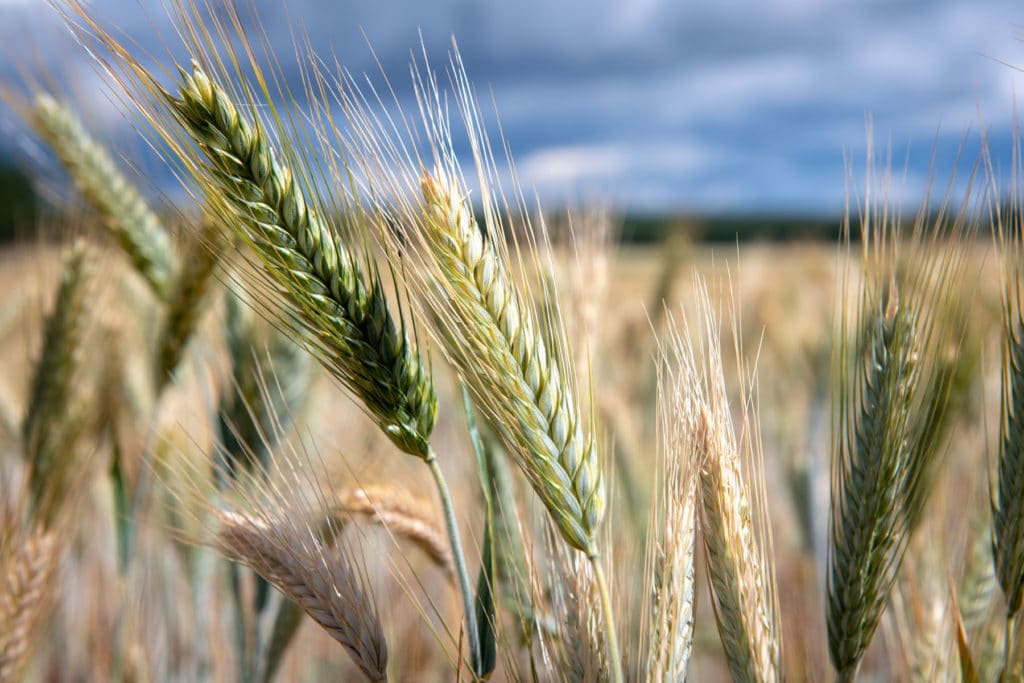
Special for Shavuot: Although the Green Revolution brought wheat production to its highest capacity, it slashed wheat’s genetic diversity making it less resilient to climate change stressors. An Israeli initiative may be wheat’s best shot at genetic restoration.
For thousands of years, the Shavuot holiday has marked the season of the grain harvest in the Land of Israel. During the first and second temple period in Jerusalem, special bread made from the harvested wheat was offered as a kind of agricultural tithe to commemorate the occasion, and to this day our fields are still filled with this yellowish and highly sought-after crop.
Since then, wheat has become a major food staple in today’s society, and the demand for it has done nothing but grow as a result of human population increases. To meet this demand, modern wheat varieties began being developed during the 1950s in what became misleadingly dubbed as the “Green Revolution”.
“After World War II, in the 1950s, there was a worldwide fear of famine,” explains Sivan Frankin, a doctoral student at the Volcani Institute and the Faculty of Agriculture. “People saw the surge in population growth, especially in developing countries, and assumed that if hunger ended there would be no wars.”The assumption that a full stomach would eliminate the need for wars did not exactly stand the test of time, but it led scientists and researchers to explore and develop new ways to increase wheat yields. One such agronomist who accomplished this was Dr. Norman Borlaug who was most well-known for crossbreeding the semi-dwarf Japanese wheat variety, Norin-10, with a high-yielding American variety, Brevor-14, creating a new semi-dwarf, disease-resistant wheat variety adapted to both tropical and sub-tropical climates.
From the 1960s, wheat production and yields rose dramatically around the world, and by 1970, Borlaug’s discovery earned him the Nobel Peace Prize. Today, around 770 million metric tons of wheat are produced every year from a little more than 215 million hectares of cultivated agricultural land to satisfy our universal craving for bread. No other crop in the world is given that much harvested area to grow. And with global consumption estimated to rise by 2% each year, projections indicate 822 million metric tons of wheat will be produced annually by 2025-26.
There’s a Tradeoff
While bread and other wheat related products remains a very integral and central part of our diet, the wheat sprouting in our fields today is much different from the variety that filled them just a few decades prior. Although the favoring of high-yielding, elite varieties of wheat over the genetically diverse traditional varieties proved successful in the short-term, its long-term environmental effects have been the subject of much criticism. Beyond the critiques ranging from the emergence of large-scale monoculture, the expansion of deforestation, the increase in GHG emissions from farm machinery, and the intensification of resource inputs like water, fertilizer, and pesticides, the worldwide spread of Borlaug’s wheat variety prompted an overwhelming reduction in the genetic diversity of wheat.
Therefore, in the light of the climate crisis, the very agricultural revolution that brought our civilization to where it is today may very well be the cause of its own downfall. In the effort to avoid this worst-case scenario, the Israeli initiative “Land of Wheat” is working to collect and preserve traditional and local wheat varieties to enable the continued prosperity of modern wheat for future generations.
“We went through a very fast process in just a number of years in which we transitioned from the traditional cultivation of thousands of wheat varieties to the cultivation of just a few modern varieties, albeit excellent and high in yield, but very similar in terms of their genetic profile,” says Frankin.
It may not seem as blatantly obvious as the consequences of deforestation, for instance, but the decline in the genetic diversity of wheat species is highly problematic in light of the changes currently taking place in the world.
“The world population continues to grow, and it is expected to reach 9 billion people by 2050, yet our areas for agriculture are not expanding, rather they are shrinking. And to top it off, we live in a reality of climate change,” says Dr. Roi Ben-David, Director of Agricultural Research at the Volcani Institute. “Without genetic variation, we won’t be able to continue to change and improve wheat from year to year to meet the growing demand.”
Because modern wheat varieties share many genetic similarities with each other, Dr. Ben-David touts the necessity to return to the basics—to the original, traditional, and diverse varieties that once flourished.
“While these original varieties on their own can’t compete with modern varieties, if we conduct proper research, we can locate interesting and useful traits within them that are relevant to cultivation, instill these traits in modern varieties, and hopefully increase yields,” he says.
Thank the Botanists
There’s just one minor problem: traditional wheat varieties can no longer be found out in the fields. “These varieties have disappeared because no one saw fit to preserve them,” says Prof. Avi Perevolotsky, of the Department of Field Crops and Natural Resources at the Institute of Plant Sciences at the Volcani Center.
Nevertheless, the need to continue to improve wheat diversity is particularly urgent because the threats to wheat today are numerous and varied. These include the changes in humidity, precipitation patterns, temperature, nutrient availability, as well as pests and crop diseases like wheat rust. According to Ben-David, the general estimate is that for any increase in global temperature there will be a 6% damage to wheat yields.
Fortunately, however, a number of visionaries understood the importance of conservation and independently conducted collection campaigns. Thanks to them, we now have unique local species that were almost extinct.
“There were emergency collections in Israel long before the state was established,” explains Dr. Einav Mayzlish-Gati of the Center for Genetic Resources and Seed Quality at the Volcani Institute. “Aaron Aaronson knew to preserve and send Israeli genetic material to seed banks around the world, and the Russian biologist Nikolai Vavilov, who founded the first seed bank in St. Petersburg, visited Israel in 1926 and collected a range of local varieties.”
“One of the last emergency collections in Israel was conducted in the 1980s by Yaakov Matitya, who worked at the Volcani Institute. He conducted collection trips throughout the country from the Golan Heights through Judea and Samaria to Sinai and documented the uses and traditions behind all the wheat varieties he came across in neat little notebooks,” she adds.
Returning Local Varieties to Israel
In 2015, alongside many other partners and colleagues, Dr. Mayzlish-Gati, Dr. Ben-David and Bizi Goldberg, an independent consultant in the field of traditional wheat, established the “Land of Wheat” project designed to restore and preserve Israel’s local and traditional wheat varieties. The project is funded by the Ministry of Agriculture, the Ministry of Jerusalem and Heritage, the Israel Heritage Foundation, the Chief Scientist of the Ministry of Agriculture, the Organization of Segment Workers, and the Yad Hanadiv Foundation.
“We contacted the seed banks and returned a large part of the local seed diversity to Israel, so that there would be a designated and available collection of traditional wheat varieties,” says Dr. Mayzlish-Gati. “We keep the seeds in optimal conditions—temperatures of -20°C—so that they can be used in the future when we need them. It could be today, tomorrow, or decades from now.”
Sivan Frankin emphasized that this genetic stockpile can provide ample food security. “It will be available to wheat researchers from now on for the cultivation and improvement of future wheat varieties.”
Some of the wheat varieties are even being planted in our fields through a community partnership with artisan bakers, kindergartens, community gardens, and schools who grow them for culinary and educational purposes.
Flavors from Another Decade
The restoration of traditional varieties not only enriches the genetic diversity of wheat, but also revives long lost flavors, which would have otherwise completely disappeared. “A genetic diversity of wheat also entails a culinary variety of flavors and textures,” says Prof. Avi Levy of the Department of Plant and Environmental Sciences at the Weizmann Institute of Science.
“Yaakov Matitya’s notebooks have a really accurate description of the texture of the wheat doughs and which ones were intended for bulgur or pitas—we’re talking about some amazing descriptions,” Frankin adds enthusiastically. “The restoration of decades old flavor profiles from wheat diversity presents an added value to our work.”
But wheat is not the only crop suffering from limited and fragile genetic diversity. “The process that took place in wheat also happened in many other crops with the transition to modern cultivation and with the depletion of traditional biodiversity,” says Dr. Mayzlish-Gati. These other crops, which have primarily transitioned to being grown in greenhouses, include watermelons, zucchini, and various herbs.
Following the success of the “Land of Wheat” project, more and more crops are being considered for preservation for the sake of heritage and genetic diversity. Too often do large volumes of crops die off due to a singular disease, pest, or weather condition. Without ample genetic diversity, instances of resistance and options for long-term sustainability are simply lost. By preserving this diversity, farmers can return resilience to the crops and cultivate resistant agricultural varieties to ultimately secure global food supplies.
ZAVIT – Science and the Environment News Agency