fbpx

May 6, 2021

I Bought a House — A poem for Parsha Behar-Bechukotai

And when a man sells a residential house
in a walled city, its redemption may take place

until the completion of the year of its sale
-Leviticus 25:29

And the property laws are already getting complicated
when we don’t own anything yet, except the shoes
on our feet on this dirt at the foot of the mountain.

I think of this as I work in my socks in this house
on a mountain – The ink on the paperwork which
brought me here – still wet.

There are teams of propertyists exhuming the i’s
for their dots. The government has already told me
I’m on their list. They hope to see me soon.

My bank account keeps telling me it’s going to
need another signature before it releases funds to
procure new chairs; and I wonder, what was wrong

with the chairs we left at the other place?
I hope to live the full thirty years to see this through.
Before the bank claims their jubilee inheritance.

But the mirror has already shown me hair that’s
not the color of my youth – and some of it has
permanently left the building.

I haven’t said anything to my doctors, but they
keep sending precautionary emails wondering
if everything is okay.

It may have been a mistake buying a house with stairs.
I keep seeing myself at the bottom of them
a broken coffee mug nearby – the cats wondering

who’s going to put food in the bowls now?
So, launching into a thirty-year commitment
at my advanced state, was nobody’s best plan.

These systems we make – The word ownership
was constructed by humans. The Earth pays it no mind.
In a billion years (probably less the way this is going)

all the papers we’ve ever signed will have
burned away – All the poems we’ve written
no one left to reject them.


God Wrestler: a poem for every Torah Portion by Rick LupertLos Angeles poet Rick Lupert created the Poetry Super Highway (an online publication and resource for poets), and hosted the Cobalt Cafe weekly poetry reading for almost 21 years. He’s authored 25 collections of poetry, including “God Wrestler: A Poem for Every Torah Portion“, “I’m a Jew, Are You” (Jewish themed poems) and “Feeding Holy Cats” (Poetry written while a staff member on the first Birthright Israel trip), and most recently “The Tokyo-Van Nuys Express” (Poems written in Japan – Ain’t Got No Press, August 2020) and edited the anthologies “Ekphrastia Gone Wild”, “A Poet’s Haggadah”, and “The Night Goes on All Night.” He writes the daily web comic “Cat and Banana” with fellow Los Angeles poet Brendan Constantine. He’s widely published and reads his poetry wherever they let him.

I Bought a House — A poem for Parsha Behar-Bechukotai Read More »

The Environmental Cost of Israel’s Wars

It’s no surprise to learn that Israel has had a historically contentious relationship with its Middle Eastern neighbors. In fact, the country has had to take military action to defend itself in every decade since Israel’s establishment in 1948.

After eight recognized wars, two attempted Palestinian insurrections, and a series of armed conflicts with the Arab nations, factual data and analytical information about those disputes like operation details, casualty counts, and the fluctuating political chain of events, are not particularly difficult to find.

As the battleground for said conflicts, what kind of toll has Israel’s environment and heritage sites taken? This is important because understanding the environmental cost of past war efforts gives us a glimpse into what to environmental expectations we should have if conflicts such as this continue to occur.

Upheaving Terrain

There is no doubt that the wars in Israel left their marks on both the land and ancient antiquity sites that adorn the country’s landscapes from the Golan Heights to Eilat. According to geomorphologist Dr. Yoel Roskin, Director of the Laboratory for Geomorphology and Portable Luminescence at the University of Haifa and former senior field research officer in the IDF, most of the damage in Israel is the result of walls, fences, and border crossings and not necessarily of the fighting itself.

“During the Yom Kippur War, building barbed wire, outposts, and fences on the Bar-Lev Line affected the environment as it created waste,” he says. “In the 1990s, the removal of huge amounts of rock and the lifting of huge embankments on the Egyptian side of fence generated significant amounts of waste onto the environment. And between 2010 and 2013, Israel built a new fence that affected the environment similarly but also prevented animals who inhabited the region to cross it.”

Roskin also describes the separation fence in Judea and Samaria and along the Lebanese border as a landscape hazard, which is a problematic buffer for the wildlife in the area. Unlike the Israelis, the Lebanese allow hunting in their territory, and due to the fence, animals cannot escape to the south.

In terms of combat-related damages, militaristic campaigns against Hamas within Israel’s agricultural periphery of Gaza during the Second Intifada also significantly impacted the natural terrain of the environment. During the winter rainy season, armored tracked vehicles and large spare parts made of tin often reportedly sank in the muddy terrain, and they were later found to have altered the topography and soil drainage patterns. Roskin noted the difficulty surrounding their removal.

Fortifying Ancient Sites

Dr. Yossi Bordovich, head of the Heritage Department at the Nature and Parks Authority, cites several examples of damage to archeological sites brought about by military clashes.

“During the War of Independence, firing positions and trenches were built around the Yehiam Fortress in the northern Galilee,” he says. “It is clear that this changed the nature of the site, and this is just one example. Any stone structure that could have been fortified, even if it was ancient, immediately became a military post.”

Digging trenches is another common operation affecting archaeologically significant sites in places like Tel Kedesh and Susita in the north. “During the excavation of trenches, the penetration into archeological strata is evident in almost every site within Israel’s boundaries,” says Bordovich.

On the other side of this coin, however, these excavation measures became useful for animals. “For example, in Qasr el Yahud on the banks of the Jordan River, many of the trenches have become habitats and nests for bats,” he adds.

This is compounded by the fact that Israeli conflicts mainly took place in remote areas relatively far from populated centers, which made natural rehabilitation both rather quick. But this was also partially due to the less destructive weaponry Israel and its enemies were using compared to other unrelated wars outside of the country.

“In the Golan Heights, for example, the effects of the wars are not seen on the ground per say,” says Roskin. “In Europe, there are huge fields of craters that were created by bombs during the world wars. Here we have ‘finer’ wars in a sense.”

Dangerous ‘Nature Reserves’

The extensive closures of territories in Israel to the public sometimes results in the preservation of nature. “In the Jordan Valley, for example, there are certain areas that are publicly restricted, which has inadvertently led to a kind of ‘nature reserve’ being created,” says Roskin.

Abandoned minefields in Israel also similarly reflect this occurrence. According to the Ministry of Defense, there are 200,000 dunams (around 50,000 acres) of minefields in Israel where half of that area is deemed essential for national security purposes, whereas the other half is defined as non-essential. Although mines pose an obvious and clear risk to human life, they deter and exclude human presence from the area, giving rise to de facto nature reserves.

But there is still cause for concern as the head of the Defense Ministry’s Information and Management Division explained in an interview with Israel’s N12 news company, “It would be true to say that as a mine ages, it becomes more and more sensitive. It is also true to say that, over time, some of the mines won’t work due to weather damage, but most of them are still very dangerous.”

Monitor Collateral Damage

Even when conflicts are smaller in scale, the impact of the defense system and its activity is evident in Israel’s soil and ecology. Recently, the State Comptroller published a report that views the IDF’s training areas on land, which among other things, criticized the damage and lack of restoration to training areas and several sites of antiquity in the north.

“It is important to have control over IDF activity—to have a body that monitors and surveys its territories while gathering research that takes into account the impact the military has on the environment in which its operating,” says Roskin. “As far as I know, there is no body that does this on a comprehensive level.”

At the end of the day, protecting against hostile threats and incursions is of course the top priority when it comes to defending Israel’s national security. However, it is still important to be aware of the collateral damage war contributes to our environment so that restoration efforts can be best directed and efficiently performed should such conflicts arise again.

ZAVIT – Science and the Environment News Agency

The Environmental Cost of Israel’s Wars Read More »

KKL-JNF Releases Never-before-seen Photos of Jerusalem

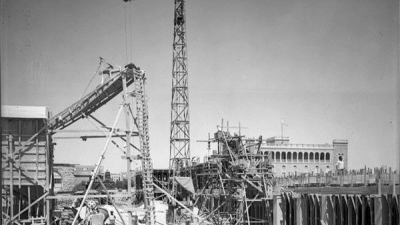
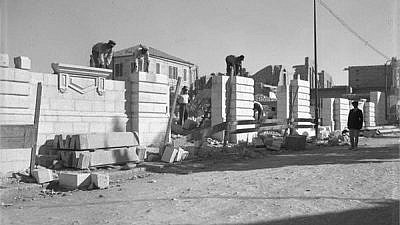
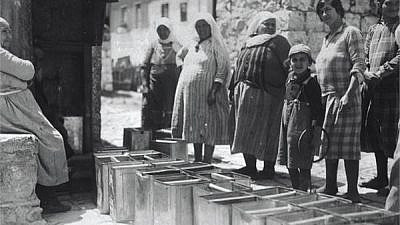
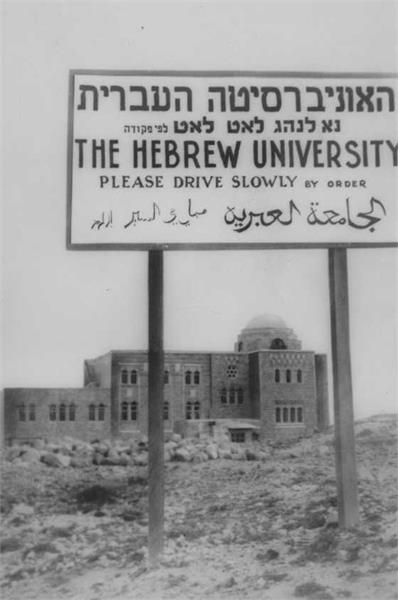
In honor of the 54th anniversary of Israel’s liberation of Jerusalem in the Six-Day War, Keren Kayemeth LeIsrael-Jewish National Fund (KKL-JNF) has released four photos from the days of the British Mandate before the establishment of the Jewish state.

The pictures, of iconic buildings and monuments in their early stages of planning and construction, were taken during a time when Jewish immigrants from around the world were just starting to settle in the Holy City, in homes made of Jerusalem stone.

The King David Hotel, one of the most iconic structures in Jerusalem, in its early construction days, 1929. Peaking behind it is the Jerusalem Pontifical Biblical Institute. Credit: Yosef Shwig/KKL-JNF archives.

The iconic Edison movie theater, which hosted world-famous musicians, such as Umm Kulthum, Farid al-Atrash, Jascha Heifetz and others, in its early construction stages, 1929. Credit: Yosef Shwig/KKL-JNF archives.

Water distributed to Jerusalemites from locally manufactured containers made of aluminum to prevent rusting, 1931. Credit: Yaacov Ben Dov/KKL-JNF archives.

The Hebrew University on Mount Scopus, co-established by world-renowned German-born theoretical physicist Albert Einstein, who later became a member of its board of governors, 1935. Credit: Zoltan Kruger/KKL-JNF archives.

“Throughout its 120 years of existence, KKL-JNF has been capturing Israel’s vistas—its people, villages, ceremonies, etc.—with the crown jewel being Jerusalem. … The above-documented treasures are stored in a unique photo archive, which documents the Zionist enterprise in its full glory,” says the head of KKL-JNF photo archive Efrat Sinai.

“As we approach Jerusalem Day, Keren Kayemeth LeIsrael – Jewish National Fund, through a global remote tree-planting campaign, set out to connect the Jewish communities of the world, with the wonder that is the city of Jerusalem, marking 54 years since its reunification,” added Ronnie Vinnikov, chief development officer of KKL-JNF. “These remarkable photos provide a fascinating glimpse into the life of Jewish communities in Jerusalem in those days that were the cornerstone for more Jewish communities soon to come.”

KKL-JNF Releases Never-before-seen Photos of Jerusalem Read More »

European Council Advises Relaxing Coronavirus Travel Restrictions for Israeli Tourists

The European Council on Thursday added Israel to the list of countries for which E.U. members are recommended to gradually begin lifting coronavirus-related travel restrictions.

Other countries on the list currently include Australia, New Zealand, Rwanda, Singapore, South Korea, Thailand and China, though the latter’s place on the list is “subject to confirmation of reciprocity,” the Council said in a statement. The list will be reviewed every two weeks.

The recommendation is not legally binding, and individual E.U. member states are not obligated to implement it.

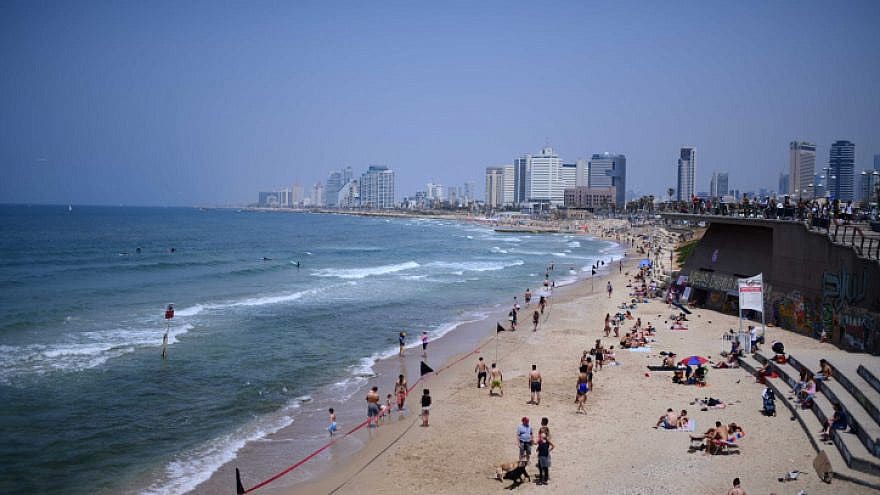
Also on Thursday, the Tel Aviv Municipality released a statement declaring the city “ready for the return of international tourists” and “promising a safe and exceptional urban experience for new and returning visitors alike.”

“Incoming tourism is an integral part of the identity of Tel Aviv-Yafo, and I am excited to host you again soon,” said Tel Aviv Mayor Ron Huldai. “Your safety and health are a top priority for the city’s entire tourism industry. Alongside international-standard service and hospitality, we will do everything to ensure that you have fun and return home safely,” he added.

Israeli Tourism Minister Orit Farkash-Hacohen announced on April 27 that Israel will begin admitting a limited number of vaccinated groups to enter the country toward the end of May, with the aim of fully reopening to all vaccinated travelers in July.

European Council Advises Relaxing Coronavirus Travel Restrictions for Israeli Tourists Read More »

Israel’s Military Veterans Demand Reform and Rehabilitation

(The Media Line) Hundreds of Israeli veterans, many wounded in combat or suffering from post-traumatic stress disorder, attempted to enter the nation’s parliament building and confronted police in the streets of Jerusalem on Wednesday.

Veterans, their families and dozens of activists were protesting the government’s announcement on Tuesday that it had failed to secure the compensations and funds promised to the groups last month.

The long-awaited reform, meant to allocate hundreds of millions of shekels to disabled veterans and those suffering from combat-related trauma, has been stuck for years in legislative pipelines. It recently captured headlines when ex-soldier Itzik Saidian lit himself on fire in front of a veterans agency office in early April.

Saidian, who for years had not received the required financial support from the agency, remains in critical condition. He has quickly become the face of the protest movement.

Shortly after the horrific incident, Prime Minister Binyamin Netanyahu met with veterans representatives, promising to lead a comprehensive overhaul of the system for veterans and come up with the needed money within two weeks.

But on Tuesday, just before the deadline set by the prime minister was due to expire, the Finance Ministry admitted its budget talks with the Defense Ministry over the much-anticipated reform had imploded.

They should be ashamed of themselves. It’s disgraceful. The government sent us to fight and defend our country, and then it stabs us in the back when the time comes to take care of us.

“We are here to tell our members of Knesset: You are injuring us a second time with your indifference,” Avi, a 62-year-old veteran who took part in Wednesday’s demonstration, told The Media Line.

“They should be ashamed of themselves. It’s disgraceful. The government sent us to fight and defend our country, and then it stabs us in the back when the time comes to take care of us,” he said.

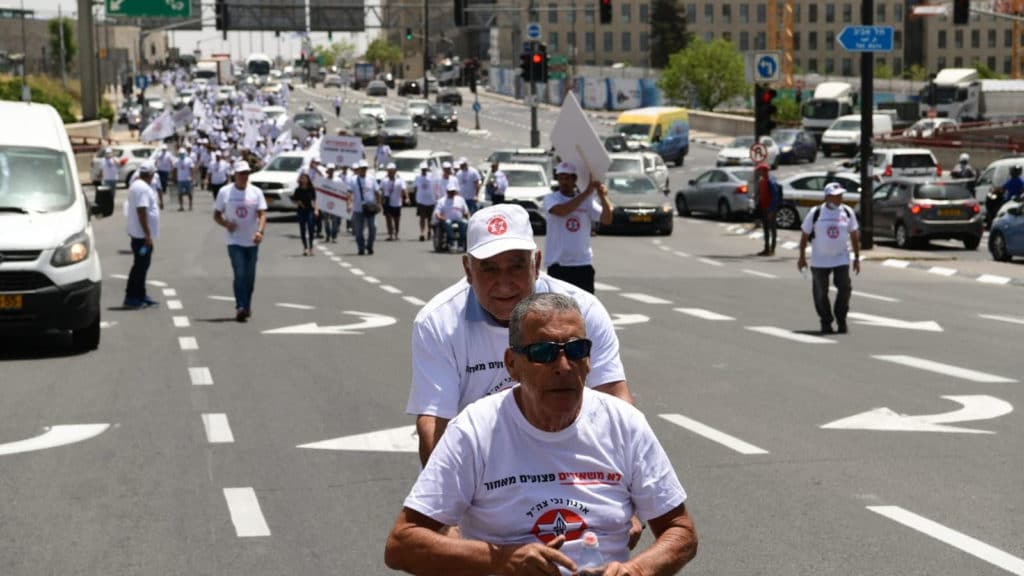
Israel police remove a protesting veteran from blocking a Jerusalem street during protests on May 5, 2021. (IDF Disabled Veterans Organization)

Reuven, another veteran participating in the protests in the capital, warned that his friends “would not rest until justice is done.”

“We’ve waited long enough. We’re tired of empty promises,” he told The Media Line. “People are dying, people are hurting, what could be more important than helping soldiers who are injured, physically and mentally?”

The large rally in front of the Knesset eventually split into several groups, with hundreds of protesters setting off on a march through the city streets, blocking roads and causing huge delays and traffic jams.

The rest remained near parliament, waiting for the meeting between Idan Kliman, head of the IDF Disabled Veterans Organization, and Finance Minister Israel Katz to end.

“We had an excellent talk,” Kliman told reporters upon exiting the building. “The minister compromised as much as he could, we’re very pleased with how it went.”

“He promised us that tomorrow the government will convene and approve the reform, the technical details will be settled by them, that’s not our problem,” he added.

We’ve waited long enough. We’re tired of empty promises. People are dying, people are hurting, what could be more important than helping soldiers who are injured, physically and mentally?

A Defense Ministry official earlier Wednesday blamed his colleagues in the Finance Ministry for the budget fiasco, saying Netanyahu and his fellow party member Katz had “lied to our veterans, and they bear the full responsibility for not passing the reform.”

“Discussions were held, decisions were made, but those two chose to back off and desert,” the official was quoted as saying by Israel’s Channel 12 news.

The main point of contention between the ministries remains who will foot the bill, with the Defense Ministry demanding the Finance Ministry provide the required 350 million shekels, or over $107 million, and vice versa.

“The ‘plan’ that the Defense Ministry presented, without consulting other government offices and without showing how to pay for it, is totally impractical,” Katz said on Tuesday after word of the negotiations’ collapse got out.

Over 100,000 Israelis are considered either disabled or suffering from PTSD due to their military service.

Israel’s Military Veterans Demand Reform and Rehabilitation Read More »

Tlaib Criticized for Tweeting Retracted Story of Israeli Settlers “Burning” Palestinian Land

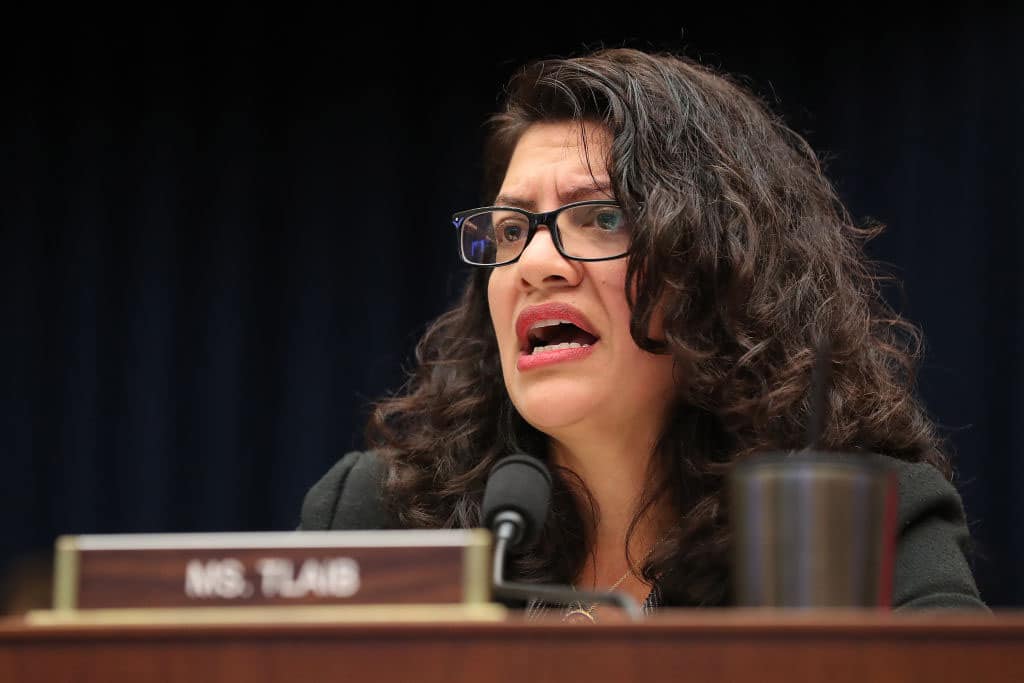
Representative Rashida Tlaib (D-MI) is being criticized on Twitter for sharing a since-retracted story accusing Israeli settlers of burning Palestinian land.

Tlaib tweeted on May 5, “Stealing Palestinian homes and burning their lands. The actions of an apartheid state. We cannot stand by and watch this happen. @SecBlinken, billions of U.S. taxpayers dollars support Netanyahu’s government and this racist violence. We must condemn this swiftly.”

In a subsequent tweet, she linked to a story from Middle East Eye, a London-based outlet that has reported ties to the Muslim Brotherhood and Hamas, alleging that Israeli settlers burned farmland in Burin, a Palestinian West Bank village.

However, The Jerusalem Post reported that both the Samaria Regional Council and the Israeli Defense Forces (IDF) have claimed that it was Palestinians who set the farmland ablaze, and Israeli settlers came to help put out the fires; altercations later broke out between the settlers and the Palestinians. B’Tselem, the Israeli human rights organization, was among those who first claimed the fires were sparked by settlers, but it later retracted their claim and said in a statement they are reexamining the claims. Consequently, the Samaria Regional Council said they planned to sue B’Tselem for defamation.

“.@RashidaTlaib, you shared a falsehood about Israeli Jews setting fire to Palestinian fields,” the American Jewish Committee tweeted. “This ugly claim has been retracted. You’re a member of Congress. Take down your tweet. Or is it okay to perpetuate untruths when they fit your policy agenda?”


George Washington University student Blake Flayton, an avowed progressive Zionist, tweeted to Tlaib, “You want to raise awareness about settler violence? Please do. But you’re a sitting congresswoman sharing retracted news. Please delete.”


Ari Ingel, director of Creative Community For Peace, tweeted to Tlaib that Breaking the Silence, an Israeli NGO consisting of veteran IDF soldiers, was, like B’Tselem, among those that first claimed that Israeli settlers set the fires. But the executive director of Breaking the Silence has since clarified that “it may have actually been Palestinian youths who set the fires,” Ingel noted.

Stop Antisemitism also tweeted, “A Palestinian terrorist MURDERED a 19 year old Jewish student. Comments on that or do you prefer to remain on your lie filled apartheid rant that has been debunked by the U.S. [Department] of State?”

Stop Antisemitism was referencing Yehuda Guetta, who was shot and killed by a Palestinian terrorist in a drive-by shooting on May 2. Guetta had been studying religious seminary in the Itamar settlement. Two other students were also injured in the attack.

Tlaib Criticized for Tweeting Retracted Story of Israeli Settlers “Burning” Palestinian Land Read More »

Unscrolled, Behar-Bechukotai: A Number of Harvests

In Parashat Behar-Bechukotai, God commands Moses concerning the agricultural and economic arrangements to be practiced in promised land. The Israelites are to reap and sow for six years, and in the seventh year, they are to let the land rest. The fiftieth year, after the completion of seven of these cycles, will be a “Jubilee” year. Debts will be forgiven and slaves freed. Land will be remitted to its original owners.

The Israelites are not to sell land permanently, for it isn’t truly theirs to sell. “The land is Mine,” God reminds them. “You are but strangers residing with me.” (Leviticus 25:23). One must therefore set the price of land according to the amount of time until the next Jubilee year. After all, it is not really land that one is selling but rather “a number of harvests” (Ibid 25:16).

These are radical commandments. God’s vision is for an economy of impermanence, one in which all ownership is borrowing. In many ways it sounds utopic — an antidote to our modern world, in which wealth is seized and hoarded by the few while the land is exploited nonstop for resources.

But for all its revolutionary potential, impermanence can be a terrifying notion. That which is fleeting reminds us inevitably of that which is most fleeting of all — life itself. As Moses says in Psalm 90, “We spend our years like a sigh. The span of our life is seventy years, or, given the strength, eighty years; but the best of them are trouble and sorrow. They pass by speedily, and we are in darkness.” (Psalms 90:9).

This is the only psalm whose authorship is attributed to Moses himself. Throughout the Torah, his subjective voice is muted — subsumed into the flow of the divine words being channeled through him. As a prophet he is present, but as a man, he is silent. Here, in Psalm 90, his voice is recovered. Through these words we can know Moses as Moses knew himself. We find him vulnerable and afraid, weary from life but unready to die.

As a prophet, Moses is present, but as a man, he is silent.

If we had to guess as to when in his prophetic career he wrote this psalm, it would be a safe bet to say that it was sometime during the Book of Numbers. After all, that’s when most of his troubles will befall him. That’s when his closest kin, Miriam and Aaron, will pass away. And that’s when God will condemn him to die without ever entering the holy land.

But it is also possible to imagine that the writing of Psalm 90 took place right here, in Parashat Behar-Bechukotai.

There are different traditions about how Moses received the Torah. Some say that he received it scroll by scroll, writing down the story of the Israelites in real-time as it unfolded. But there are also those who say that Moses received the entire Torah, from beginning to end, on Mount Sinai.

If we accept this second scenario, then it would be during this week’s parashah, the last parashah dealing with the Sinai revelation, that Moses would complete the writing of the Torah. With the whole story of his life set thusly before him, he would be able to see with Godlike perspective how fleeting and painful the life of man is. As the Talmud relates, “The Holy One, Blessed be He, dictated, and Moses wrote with tears” (Bava Batra 15a).

Perhaps, then, it was here that Moses turned away from writing God’s words in order to pen his small poem. After all, at the heart of these laws of land and commerce is a truth about our mortal condition, our vulnerability, our impermanence.

Like the land, our lives are ours to borrow, not to own. They are short. They contain both suffering and joy, and the best we can hope for is a fair balance. They are an unknown “number of harvests,” a quantity of winters and springtimes, new and full moons, goings to bed and risings up —  entrusted to our stewardship for the blink of an eye.


Matthew Schultz is the author of the essay collection “What Came Before” (2020). He is a rabbinical student at Hebrew College in Newton, Massachusetts.

Unscrolled, Behar-Bechukotai: A Number of Harvests Read More »

Rosner’s Torah Talk: Behar-Bechukotai with Jessica Dell-Era

Jessica Dell’Era is a senior rabbinical student at the Jewish Theological Seminary, where she is completing her Masters in Sacred Music through the Cantorial School alongside her rabbinic ordination. She aspires to use music, curiosity, and compassion to help others find meaning in their Jewish life. She grew up in the San Francisco Bay Area and holds a BA in Dramaturgy from Pomona College and an MA in Education from the University of California Berkeley. In her previous career, she taught Spanish bilingual 3rd-6th grades in public school, working with immigrant and first-generation Latinx families.

This week’s Torah portion – Parashat Behar/Bechokotai (Leviticus 25:1-27:34) – talks about Sabbatical and Jubilee years, regulations concerning commerce and the redemption of slaves. It also contains a description of the rewards for observing God’s commandments and the series of punishments that will face Israel if they choose to disregard them. The Torah then discusses different types of gifts given to the Temple, and the animal tithe.

Previous Torah Talks on the Parsha

Rabbi Asher Lopatin

Rabbi Danny Burkeman

Rabbi Tuvia Brander

Rabbi David Greenstein

Rabbi Michael Wasserman


Rosner’s Torah Talk: Behar-Bechukotai with Jessica Dell-Era Read More »

Let Me Ascend the Mountain of the Lord

I know many people are saddened over the tragedy that occurred on Mt. Meron in Israel. What it was like for those who were there. What did they feel? What were they thinking? Those who attend the yearly religious event carry certain spiritual assumptions and ideas that animate their lives. Some of those concepts are distant from many American Jews. The poem below tries to imagine it from an attendee’s perspective and to provide a context and perspective that can open up the meaning of Mt. Meron to a wider audience.

Here’s a glossary of words that appear in the poem:

Rabbi Shimon Bar Yohai: Early mystic and Talmudic figure who is buried on Mt. Meron where the stampede occurred.
Bubbe: Grandma
Muhter: Mother
Neshama: soul
Kedushah: holiness
Yiddin: Jews
Pagum: defective, flawed
Avinu she’bashamayim: Our Father in Heaven
Kiddush Hashem: a death that sanctifies God’s name 

Let Me Ascend the Mountain of the Lord

Let me ascend the mountain of the Lord.
Let me gather with my people.
Let me sense his soul, Shimon bar Yohai,
On Mount Meron
At this time of holy pilgrimage.

He taught us that life is not what it seems.
Beneath the surface of the ordinary,
Existence pulses
Torah flows
A river of insight
A promise of eternity
The blessing of Shimon bar Yohai.

His neshama blazed with kedushah.
He was a conduit of divine flow.
In the words of the Zohar,
He left us a map back to the heavens.

This is why I climb the mountain each year.
That is why I risk in a time of pandemic
To gather with my people
To sing and dance and sit by the bonfire.

All of life is ablaze with God
And I need to feel that outpouring of divine grace.
Let me be part of this infinite flow.
Let me feel restored after a darkened year
When we huddled in our apartments
Forbidden to gather,
To do what Yiddin do.

But then something went wrong.
Someone slipped, and then another.
Our bodies tumbled into each other.
Fear and cries,
Panic pressed in on us.
Like in the crowded boxcar that took away my Bubbe,
When my Muhter was just a girl,
Their hands clasped for the last time.

Was there a flaw in our service?
Were we pagum in our joy?

I carried out my neighbor
Lifeless in my arms.
My ears ring with grief,
My heart is heavy.

Avinu She’bashamayim,
Gather up their souls,
They died for You, kiddush hashem,
On Mt. Meron on the thirty third day
When all we wanted
Was to be close to You
To ascend Your mountain
To live with joy.


David Kosak is the senior rabbi of Congregation Neveh Shalom, in Portland, Oregon.

Let Me Ascend the Mountain of the Lord Read More »

A Moment in Time: Why Were You Not More Like Zusia?

Dear all,

I turned around the other day to witness a very sweet site. Eli was wearing his daddy’s shoe. As cute as it was, it made me think about times when people say, “I have big shoes to fill.”

The truth is … the only shoes we need to fill in life are our own.

There is a story about the Chassidic Master, Zusia. As he lay on his deathbed, he was crying. His students asked, “Reb Zusia, why are you so sad?”

Zusia responded, “I know that when I go to heaven, God will NOT ask me why I wasn’t more like Moses or King Solomon. No …. God will ask, ‘Why were you not more like Zusia?’”

Friends, fill your own shoes, create your own path, inspire others through your goodness, and at every moment in time, live your destiny, not someone else’s.

(And if you want to try on other shoes, fab! Just make sure they are at least a fun pair!)

With love and Shalom,

Rabbi Zach Shapiro

A Moment in Time: Why Were You Not More Like Zusia? Read More »