fbpx

April 21, 2021

On Earth Day, Environmentalists Warn Red Sea Coral Reefs ‘Under Severe Threat’

(The Media Line) A plan to transport crude oil from the Persian Gulf to Europe has put Israel’s renowned coral reefs “under severe threat,” according to environmentalists, and could also cause untold damage to the tourism industry in the region.

Israel and the United Arab Emirates recently signed a deal to bring Emirati crude oil via tanker to a pipeline in the Red Sea port city of Eilat, a popular tourist destination in southern Israel. The area is home to world-renowned coral reefs and marine wildlife.

The Europe Asia Pipeline Co. (EAPC), which is controlled by Israel, signed a memorandum of understanding in October with the UAE-based MED-RED Land Bridge to transport oil from the Gulf to Europe. Tankers are slated to transport oil from the Persian Gulf to a terminal in Eilat; from there the oil would continue its journey via an aging overland pipeline that runs all the way to Ashkelon on the Mediterranean Sea coast. Ships would then carry the black gold to European markets.

Ahead of Earth Day, marked annually on April 22, environmentalists and scientists have cautioned against such a move and say that it could lead to devastating ecological and economic consequences.

“The Israeli government has to put a stop to this project,” Maya Jacobs, CEO of the Zalul Environmental Association, which works to protect Israel’s seas and rivers, told The Media Line. “They need to understand that the amount of money they will receive in exchange is not high enough to justify the catastrophic threat not only to the environment,” but also to Eilat, Aqaba in Jordan and Egypt’s North Sinai coast.

“These are three places that are reliant on marine tourism,” she said. “It will wipe out the hundreds of millions – if not billions – of dollars that hotels and airports have invested in favor of one project that is not being managed carefully. Everything will go down the drain.”

According to Zalul, a growing number of oil tankers have been making their way to Eilat in recent months following the Israel-UAE deal. Up to 120 tankers carrying some 7.9 billion gallons of crude oil or other oil byproducts will be permitted to use the EAPC port in Eilat on an annual basis.

Zalul attempted, unsuccessfully, to reach out to Egyptian representatives; however, the NGO did manage to contact officials in Jordan to discuss the pressing issue.

“Jordan agreed to speak with us and told us they were very worried about [the tankers], but because Saudi Arabia is also planning to transport oil through the Red Sea and they don’t want to fight with the Saudis, they then refused to make a public statement,” Jacobs said.

It will wipe out the hundreds of millions – if not billions – of dollars that hotels and airports have invested in favor of one project that is not being managed carefully. Everything will go down the drain.

Zalul has cobbled together a coalition of 25 environmental groups to ensure the coral reefs’ preservation. The coalition is lobbying both the Israeli and the US governments to prevent the oil agreement from moving forward. It also recently penned a letter to John Kerry, the US special presidential envoy for climate change, warning him of the likelihood of an oil spill disaster in the Gulf of Aqaba.

Hundreds of scientists also have spoken out against transforming Eilat into an oil hub.

Prof. Nadav Shashar, a marine biologist who heads the Marine Biology and Biotechnology program at Ben-Gurion University of the Negev’s Eilat campus, called the plan “a very severe threat to the coral reefs.”

“In the 1970s and 1980s, Eilat experienced very severe oil pollution before the Suez Canal opened,” he told The Media Line, noting that studies later showed that, in the decades since, the reefs have yet to fully recover.

Shashar is currently leading a project for BGU to transform an old jetty into an artificial coral reef with the help of 3D-printed structures made out of clay. The team is working together with local ceramics artist Ruth Hazi to design habitats for fish.

“It’s pretty sophisticated because you have to decide what kinds of structures you want to add, you do some planning and designing of the structure itself, and then you do 3D printing,” Shashar explained.

A scientist installs an artificial reef structure near Eilat. (Boaz Samorai)

To combat reef degradation, Shashar and his team have developed various 3D-printed coral structures over the years. So far, marine animals have responded well to these innovative artificial habitats.

“Some of the structures are small but the fish go and sleep in them even if they don’t fit,” he said. “They keep on coming. So far it’s a success.”

Scientists believe that 70% to 90% of all the coral reefs around the globe will disappear by the mid-21st century as a direct result of climate change and pollution. The world is on track to warm by nearly 3 degrees Celsius, or 5.4 degrees Fahrenheit, by the end of the century, according to data from the international Climate Tracker organization.

Recent research from Bar-Ilan University’s Prof. Maoz Fine showed that coral reefs in the Northern Red Sea and the Gulf of Aqaba appear to have a higher tolerance for temperature increases in the seawater when compared with reefs in other parts of the world.

The Red Sea corals’ unique resilience could help scientists uncover new ways of preserving other distressed reefs.

On Earth Day, Environmentalists Warn Red Sea Coral Reefs ‘Under Severe Threat’ Read More »

On Cancel Culture

A couple of thoughts on cancel culture.

Yes, I’m about to go there.

Three weeks ago, meditation teacher Tara Brach nearly ruined her career.

Why? She included a Woody Allen quote in one of her lectures.

The internet mob, ever vengeful and quick, descended on her, fangs out, claws drawn and threatened her with immediate cancellation. People swooned, fainted, were triggered by the mere mention of Woody Allen’s name.

Ms. Brach, ever gentle, promptly made a trembling, tearful apology.

She never meant to cause harm. She was dreadfully, frantically, painfully, horribly sorry to have “inadverntently caused so much pain” by including the quote of a man who probably-we- don’t- know- for –sure- but- honestly- we- think- he- did- abuse his daughter but either way he is creepy and we don’t like him and it is all besides the point because WOODY ALLEN IS CANCELLED.

Before anyone clutches their pearls: 1)YES I believe in accountability and consequences. We all should. There is no excuse not to. 2) Hate speech is not free speech. Free speech ends the second you incite violence.

But the problem here is two-fold:

1) The Fox news crowd, and the GOP, in general, consistently conflates consequences with cancel culture. The latest example of this being the comment by Tucker Carlsen, who claimed on Fox News, that Derek Chauvin being sent to jail for torturing and murdering George Floyd, is somehow cancel culture. Let’s all sane humans agree this bit of evil is not what we are talking about here.

2) Our worship of genius and star power causes us to gloss over serious crimes, especially in obituaries that minimize their damage and focus heavily on their glorious work: this is disrespectful to victims, and, no, I don’t buy it.

So, I am not talking about that.

People who exploit their power by sexually harming/manipulating others, making racist, anti-LGTBQ, mysogonistic comments, do not deserve to hold those positions of power anymore. They should be removed from those positions and/or jailed where appropriate.

But cancel culture does something more insidious.

Cancel culture says that not only should the Wrong Ones be removed from their jobs: but ideally, they should also be kicked off the planet earth. AND GIVEN NO PATH BACK. I don’t mean no way back to their power positions—that, they have forfeited, forever. But I mean, also no path back to exisiting as a human on planet earth. They are to be thoroughly alienated, isolated from friends, family, etc, shamed so profoundly that they can never—must never—be permitted to find redemption.

In no one’s book, in no ones religion, can this possibly be seen as just.

To be clear: I won’t personally be buying or listening to any James Levine DVD’s or Michael Jackson CD’s. Because I’d rather listen to artists who were not pedophiles.

Also: I loved Woody Allen’s early works. I also think he is deeply creepy, and his films have sucked for the last 10 years. I won’t be spending any more money seeing them.

But should other people should become radio-active because they publically admit to still liking his films? Or because they quote his work, in passing, should that threaten a person’s entire career?

What happened to Tara Brach is not an isolated exception.

Au contraire, it is cancel culture at its most glorified.

It is group think. Pack mentality, mob mentality at its finest.

There is progress, friends. There is accountability.

This ain’t it.

On Cancel Culture Read More »

Too B*tchy?

“Ugh, is this too b*tchy?”

A few months ago, I received an email from a lawyer. She had been agonizing over hitting send to a junior associate for over 20 mins… to check in on a document that was already two hours late.

A rising star at one of the most respected firms in the world and fresh off a major promotion, this lawyer is the picture of leadership. Yet here she was, wondering if her email to one of her direct reports on an urgent matter was “nice enough” and not “too b*tchy.”

She had written it (and then rewritten it) what felt like 100 times to make sure it was direct, but not abrasive. Firm, but nice, but not too soft because this was still urgent.

As women we often feel like we have to thread the needle between being warm and likeable, and being viewed as effective, capable leaders. That’s why every email we send can feel like a litmus test.

Every email we send can feel like a litmus test.

In fact, it says everything about our patriarchal system and its myriad of double standards that so many of us have internalized the daily “is this too b*tchy?” question as a cornerstone of our communication.

You can be capable, effective and not b*tchy. Here are five ways to do that when it comes to writing better emails:

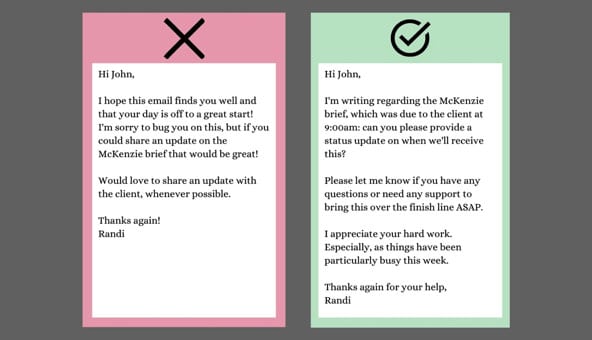
  1. BLOT: The average reader only spends 11 seconds per email. That’s why it’s imperative to make your opening sentence the most important sentence. Yet we often bungle this in our internal communication. Instead of starting your email with “I hope this email finds you well,” start with your BLOT: bottom line on top. In our lawyer’s case, that could have simply meant “I’m writing to check-in regarding the status of the McKenzie brief.” If you’re worried about the lack of pleasantries coming across as rude (or b*tchy), I invite you to…
  2. Rethink your pleasantries: Starting your emails with “I hope this email finds you well” often rang hollow in The Before Times. Taking up that precious top-of-email real estate in a raging pandemic and in a time of racial reckoning isn’t just the email version of a “command performance.” It can also come off as totally tone deaf. As Tom Herrera wrote in The New York Times, “How many times have you seen that line in an email this year and thought, ‘Well, no, this email does not find me well — I’m terrible, thanks.’ None of us are well!” That’s why if your desire to use “hope you’re well” was to connect, you’re likely missing the mark. Instead, save your pleasantries for the end of the email. Coupling it with a thank you can actually read as more sincere. An example might look something like this at the end of your email: “Thanks again for your hard work on this/for help with this/for considering my request. It’s such a stressful time, and I hope you are doing as well as possible.” Ending with personal appreciation is the most sincere way to conclude an email.
  3. Ditch “sorry” … 99% of the time. I will never forget an intervention-style team meeting a boss called about six years ago for our mostly female team. “We have a problem,” the boss started, and I genuinely couldn’t imagine where she was going with this. Our team was full of high-performers, and our numbers were off the charts. “I’m listening to you on the phones and reading your emails,” the boss went on. “You need to stop saying ‘I’m sorry’ when you talk to clients. Nine out of 10 times, you have nothing to be sorry for, and you’re undermining your credibility.”It was such a lightbulb moment for me. Consider how many times you’ve said “sorry to bug you” or something similar: What were you actually trying to achieve?
    Omitting “sorry” doesn’t make our emails rude. It prevents us from undermining ourselves and keeps our emails confident and direct. Consider the difference between “Sorry to follow up on this” versus “Thanks for providing these status updates.”Are you actually sorry? Didn’t think so, so save “sorry” for when you mean it, so that it actually means something. And speaking of undermining credibility…
  4. Cool it on the exclamation points. I often see women use exclamation points to demonstrate how friendly and warm they are (“Like me!!!!”), especially given email’s inherently cold and clinical format. As Larry Kim nailed in INC, “Overusing this one piece of punctuation gives your communications a distinctly middle school flavor and kills your credibility.” In addition to making you look over-eager or childish, “It makes you seem melodramatic and will give employers pause about allowing you to represent the company to partners or clients.” Exclamation point rule of thumb: You get one exclamation point per email, tops. Use it wisely. Overusing exclamation points don’t make our emails less “b*tchy.” They make them look juvenile.
  5. Use a question to create a call to action. So let’s start with a question here: Do you want somebody to read your email or read and reply? … That’s what I thought.Perhaps the simplest of all the writing-better-email tools is simply making sure you have a call to action. Consider the difference between simply stating, “If you could provide an update that would be great” vs. asking with a call to action, “Will you please provide an update?” Now ask yourself, which of these are you more likely to respond to? Respond faster to? Using a question isn’t rude, it’s getting the job done with effective communication.

Still apprehensive? Consider the difference between these two emails:

Your words, ideas and contributions matter. Treat them like they do and remember: To be direct isn’t b*tchy. To be concise isn’t b*tchy. To get the job done isn’t b*tchy.


Randi Braun is an executive coach, consultant, speaker and the founder of Something Major

Too B*tchy? Read More »

NYC City Council Campaign: Campaign Manager Didn’t Say Manhattan Neighborhood Is Too White and Too Jewish

A spokesperson for a New York City Council campaign is claiming that contrary to news reports, their campaign manager never said that the Upper West Side of Manhattan is “too white and too Jewish.”

The New York Post reported Quinn Mootz, campaign manager for City Council candidate Sara Lind, tweeted on April 13 that the Upper West Side of Manhattan has a “diversity problem” because 68.4% of its population is white. She also wrote, “Jews are not POC [People of Color] for just being jewish. sorry.” Mootz, who is white and Jewish, previously worked for Senator Bernie Sanders (I-VT) and the Progressive Turnout Project fundraising organization. The Post and Jewish Press claimed that Mootz had said that the Upper West Side was “too white and too Jewish.”

Steven Dzik, a resident in the Upper West Side, told the Post, “The Upper West Side is not simply predominately white. More than half the white people are Jewish. Jews have been a separate people for a millennia. To simply group Jews as white people comprising one undifferentiated homogenous group is bigoted and is engaging in simplistic stereotyping.”

A campaign spokesperson told the Journal that the Lind campaign has been “trolled by a couple of online groups,” who have issued rape and death threats against the Lind campaign; additionally, there was “an onslaught of racist tweets” after Lind had posted about the police shooting of Daunte Wright. Mootz had been responding to those tweets, which included a tweet about diversity in the Upper West Side and another tweet from a user saying that they were Jewish so they didn’t count as white. Mootz claimed “Jews are not POC for just being jewish” in response to the latter .

“You don’t get to call yourself POC just for being Jewish,” the campaign spokesperson added. “Of course, there’s people of color who are Jewish, and then there’s people who are white and also Jewish, and the people who are white and also Jewish — and this is part of an ongoing conversation — Quinn does not identify as ‘people of color’ because there’s a certain way that Jewish people who are white can move through the world that maybe a Black person or an Asian person or a Hispanic person can’t.”

The spokesperson alleged that The Jewish Press, which first broke the story, distorted Mootz’s tweets by claiming that she said that the Upper West Side was “too white and too Jewish,” when she actually said that the neighborhood was “majority white.” “It feels like a smear job from the right,” the spokesperson said, adding that Lind is raising her children as Jewish and Mootz and others on the campaign are Jewish. “Nobody on the campaign thinks the Upper West Side is ‘too Jewish.’ It’s ridiculous and libel.”

But Alexander Rosenberg, deputy regional director of Anti-Defamation League New York / New Jersey, didn’t buy the explanation. “Historically, Jews have been rejected from neighborhoods and universities and country clubs,” he told the Journal. “If what [the campaign] meant to say is that the neighborhood is not diverse enough, then that’s fine… but they were signaling privilege. They were saying, ‘white and Jewish equals privilege.’ And that’s the problem.”

The campaign spokesperson pointed the Journal to an April 19 announcement from The Jewish Vote, which is a project of Jews for Racial & Economic Justice Action (JFREJ), endorsing Lind and Gale Brewer, another NYC City Council candidate.

Rachel McCullough, political director of JFREJ, said in a statement that “right-wing” groups like the Upper West Side Together Facebook group — which the spokesperson claimed was responsible for the trolling and threats — “are resorting to cheap personal attacks all to avoid defending the indefensible: dehumanizing and displacing New Yorkers experiencing homelessness. We’re proud to support two candidates who truly see Jewish New Yorkers in all our diversity, not simply as fodder for political attacks, and have committed to partnering with us to move our city forward.”

Lind and Brewer said in a statement that they’re “thrilled” at the endorsement and that “we have no patience for bad-faith smears from special interest groups threatened by our shared vision for a city where everyone has what they need to thrive. We have no tolerance for hatred and bigotry and antisemitism. What we have is determination to build a safe and equitable New York City, and a mutual respect for each other’s plans to do so.”

On April 14, Lind tweeted that her campaign is moving off Twitter because “we’ve been trolled relentlessly with slurs, sexual assault & death threats, and anonymous cowards spreading misinformation. I will happily discuss our platform with anyone interested in having a conversation [in real life].”

NYC City Council Campaign: Campaign Manager Didn’t Say Manhattan Neighborhood Is Too White and Too Jewish Read More »

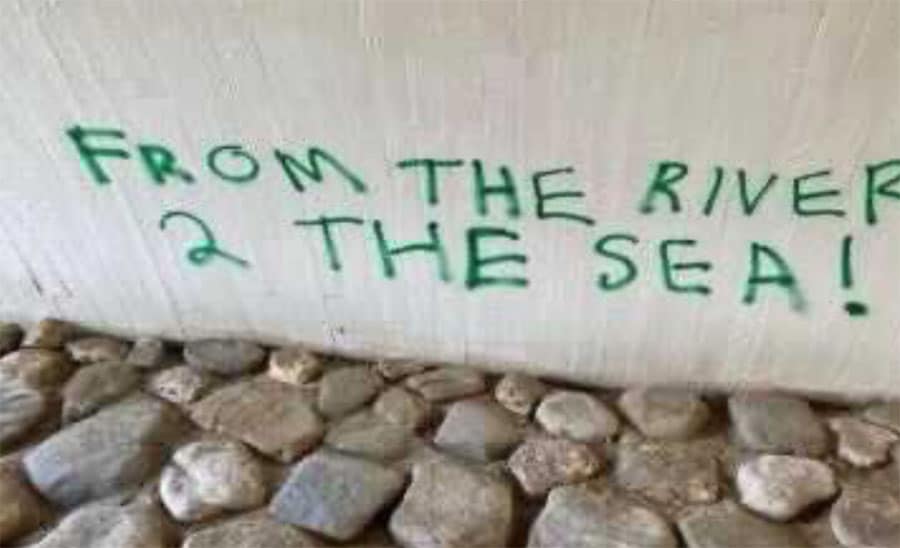
“From the River to the Sea” Graffiti Found at UMass Amherst

Graffiti stating “From the River to the Sea” and “Free Palestine” was found at the University of Massachusetts Amherst on April 19. The Stop Antisemitism.org watchdog tweeted a video of the graffiti, which was found in a tunnel on campus. Stop Antisemitism.org tweeted to University President Marty Meehan, “Please have this removed as dozens of your Jewish students have contacted us out of safety concerns!”

A university spokesperson told the Journal that the graffiti has been removed and the matter is being investigated.

“This anti-Israel graffiti incident at UMass is a blatant act of intimidation against Jewish students on campus,” Anti-Defamation League New England Regional Director Robert Trestan said in a statement to the Journal. “The message of ‘from the River to the Sea’ is divisive and an implicit negation of the Jewish state. We hope administrators will investigate this incident and ensure that the campus remains a safe and welcoming environment for all students.”

UMass Hillel said in a statement posted to Facebook that the “From the River to the Sea” graffiti was particularly unsettling to students because it is seen as “a call for an end of the State of Israel.” “While we support free speech, we condemn the use of inflammatory language and the defacement of public or private property,” the statement read. “And we continue to call for a constructive approach to the Israeli-Palestinian conflict through promotion of dialogue, working for peace, and affirmation of the humanity of both Israelis and Palestinians.”

Our statement regarding the recent graffiti at UMass:

Posted by UMass Hillel on Tuesday, April 20, 2021

“From the River to the Sea” Graffiti Found at UMass Amherst Read More »

Bipartisan Group of Senators Urge Biden to Nominate Anti-Semitism Envoy ASAP

A bipartisan group of senators on Monday urged U.S. President Joe Biden to quickly nominate a candidate to serve as the U.S. Special Envoy to Monitor and Combat Anti-Semitism and confront rising anti-Semitism worldwide.

The senators, who make up the Senate Bipartisan Task Force on Combating Anti-Semitism, sent Biden a signed letter explaining the urgent need for the nomination. The letter was organized by Sens. Jacky Rosen (D-Nev.) and James Lankford (R-Okla.).

“Tragically, 76 years after the end of the Holocaust, anti-Semitism remains a serious and growing danger for Jews in Europe, the Middle East, the United States and elsewhere in the world,” the letter stated. “According to a study by the Kantor Center for the Study of Contemporary European Jewry, violent anti-Semitic attacks worldwide rose 18 percent in 2019, including at least 53 synagogues and 28 community centers and schools that were targeted.”

Congress passed a bill at the end of last year that elevated the special envoy position to the rank of a presidentially appointed, Senate-confirmed ambassador who reports directly to the secretary of state. Former President Donald Trump signed the bill into law shortly before leaving office. It also requires the ambassador to be a person of “recognized distinction in the field of combating anti-Semitism,” the letter states.

There have been several candidates rumored to be up for nomination, including former ADL head Abe Foxman, Holocaust historian Deborah Lipstadt, former National Council of Jewish Women CEO Nancy Kaufman and National Coalition Supporting Eurasian Jewry CEO Mark Levin. Kaufman, who is backed by far-left anti-Israel groups such as IfNotNow, has raised concerns over her stance on the International Holocaust Remembrance Alliance working definition of anti-Semitism, which is opposes codifying it into law.

It remains unclear what President Biden’s timeline is for filling the position. The position under Trump was left vacant for the first two years of his administration and eventually filled by Elan Carr in February 2019.

“Swiftly nominating a qualified ambassador to monitor and combat anti-Semitism will help ensure that the United States remains a leader in combating anti-Semitism internationally and will equip the State Department with a designated senior diplomat to engage foreign governments to track and respond to this growing scourge,” the letter stated.

“We encourage you to move quickly on the nomination, and look forward to working with you.”

The letter was signed by 22 members of the task force.

Bipartisan Group of Senators Urge Biden to Nominate Anti-Semitism Envoy ASAP Read More »

Unscrolled, Acharei Mot-Kedoshim: Finding the God

During my weekly Torah study session with my mostly non-religious Jewish family, I often find myself in the position of apologist — making the case that what we are reading is not as strange, problematic or dull as it may seem, but rather is reasonable, spiritual and deeply relevant.

This is not always an easy case to make. By way of example, look no farther than last week’s parashah — Tazria-Metzora — which detailed the laws of menstrual impurity and contained long, prescriptive chapters for dealing with an individual stricken with skin disease.

Exasperated, my father announced: “I don’t know why we’re reading this. I don’t see how reading this will make me a better man.” He thought a minute and then added. “But I’ll wait until I read your column to pass judgement. You always manage to see the God in it.”

Indeed, I do. But not without effort and not without the abounding and unconditional love for Torah that I bring with me to my learning. With this as my starting point, I come to the text not as an unbiased reader but rather as a parent gazing at his child, enamored of the good and perhaps a little too ready to make excuses for the bad.

But what I am I to do with Parashat Acharei Mot-Kedoshim? Surely, when we read it together during this week’s Torah study, my family will look to me to fulfill my usual role of apologizer, contextualizer and justifier. But in the case of this particular parashah, when we come to the line “Do not lie with a male the lyings of woman; it is an abhorrence,” will I be up to the job?

When we come to the line “Do not lie with a male the lyings of woman; it is an abhorrence,” will I be up to the job?

Even as one who has dedicated his life to Judaism and Torah study, I still sometimes feel — on account of this verse — that I am a second-class citizen among the Jews. There are Jewish spaces in which I am not welcome. There are those who think it is absurd that a gay man would dare to become a rabbi. There are Jews for whom my life is seen not as an enactment of Torah but rather as an affront to Torah.

Beyond the personal pain that this verse has caused me, however, I must also acknowledge the countless souls, Jewish and gentile alike, that have been extinguished too soon because of this pasuk. They have been murdered. They have been tortured. They have been psychologically pushed past their limits. They have been forced to live out on the streets. They have been harassed, called perverts, forced into lives of silent sorrow.

In the light of this, it seems absurd to continue staring at these lines and looking for the “God in it,” as my father put it. But as difficult as it is, that is exactly what I do each year when this parashah comes along.

One cannot pour more wine into a glass than it will hold. The divine flow of revelation is boundless, but humans are limited in our capacity to see the world through God’s eyes. Our expressions of revelation — in our holiest texts — bear witness not only to the light of God but also to the darkness of our own narrow vision, our biases and our prejudices.

Thankfully for us, God gave us also the oral Torah — a whisper on the wind, brought to life whenever Jews convene over Torah to speak it into existence, to study it closely and to find God in it. This, I believe, is Judaism’s greatest asset: exegesis as a spiritual practice — interpretation as devotion.

Such a thing requires an act of faith — faith that even pasukim that seem hateful to us have their origins in love. They were written in the attempt to make the world a holy place, which is so clearly the underlying ethos of this week’s parashah.

With that belief as our starting point, our task becomes clear: to understand, to find the God, to guide the words back to their holy origins in love with a gentle and forgiving outreached hand.


Matthew Schultz is the author of the essay collection “What Came Before” (2020). He is a rabbinical student at Hebrew College in Newton, Massachusetts.

Unscrolled, Acharei Mot-Kedoshim: Finding the God Read More »

I’m Proud of You

Every child wants their parents to say, “I’m proud of you.” Even though my folks have been gone for decades, I would still love to hear my mom or dad say just once more, “I am proud of you, Mark.” Nothing wrong with that.

When your child tells you something good that is going on in their life, you can feel the beat that they take while they wait for the sign from you that you heard them. That you care. That what they said is important and meaningful. A book I read and loved is called “I’m Proud of You: My Friendship with Fred Rogers” by Tim Madigan. It’s about the relationship between the author and television host Mr. Rogers. Mr. Rogers would sign IPOY, or “I’m Proud of you,” in his letters to Tim, a phrase Tim never heard from his dad.

We can all do that for each other. There is a big difference between saying “good job” and “I’m proud of you.”

I have three boys, and I am proud of them all. Each one is unique, funny, interesting and, most importantly, a good person. A day does not go by that I am not thankful for them. I wish I gave my parents half the naches that they have given to me.

But the other day, I received a text from my favorite son that stopped me in my tracks (Just kidding — they are all my favorites!). It was from my oldest son, Jacob. He said, “On Shabbos, I am throwing a kiddush in honor of my wife’s birthday.” That is pretty darn cool on multiple levels. The little boy whose hand I used to hold while walking to shul, who I told not to step off the curb, who, when I had to punish him, just broke my heart. That boy is now married with a son and is making kiddush to honor his wife. A real mindblower.

But it gets better. Jacob then told me that because of COVID-19, the minyan is outdoors and mask-friendly. And here is the kicker. He wants the “old man” (or “pops”) to come. (Depending on how he feels, he calls me either “old man” or “pops.” When he first started calling me pops, I found it slightly annoying. Pops to me was Pa Kettle. But now, I love it. Like my wife’s cooking, it grew on me.) But no matter what Jacob called me, he wanted me to hang with him and his friends. I was honored.

That Shabbos morning at 8:55 a.m., I met Jacob and his friend Dan, and we sauntered over a few blocks to the minyan. It was in a backyard with no grass, just dirt, folding chairs and a few collapsible tables. There were about two dozen young men mostly in their late twenties and early thirties. I was easily the oldest by 34 1/8 years (but who is counting). Recently, when I go places, if I am the oldest, I feel weird. This time, though, I felt no such thing. I felt blessed and happy, and in the right place.

I felt blessed and happy, and in the right place.

This backyard dirt floor was holy ground and as holy as any great shul or cathedral. These young men, most of them already married with kids, were keeping Judaism and Shabbos alive and having a good time while doing it. This was truly the definition of a “Happy Minyan.”

After the davening ended, they put a few of the tables together for the kiddush food to sit on. And amazingly, these guys used tablecloths. It was beautiful. Sitting next to my son and looking at all that was going on, not only was I proud of him, but I was also proud of all these kids. I also thought of my wife and was proud of her for being an Eishet Chayil. That was a big part of getting Jacob to this point. And I thought of his wife, Anna, who helped make sure he continued this journey. And even though none of his grandparents are here to say IPOY, I could say it for them. Jacob — Grandma, Grandpa, Nana (or whatever your name for them) would be proud of you.

IPOY Jewish people who came before us, many of whom have died or suffered endlessly to keep Judaism alive and well for us. Keep it going, Jacob and friends. We need you. Judaism needs you. So, we can all be in the right place.


Mark Schiff is a comedian, actor and writer.

I’m Proud of You Read More »

Table for Five: Acharei-Kedoshim

One verse, five voices. Edited by Salvador Litvak, the Accidental Talmudist

And the Lord said to Moses: Speak to your brother Aaron, that he should not come at will into the Holy behind the dividing curtain, in front of the cover that is upon the ark, lest he die, for I appear in the cloud over the ark cover. Lev. 16:2

Rabbi Elchanan Shoff
Beis Knesses of Los Angeles

Do not just come sauntering into the Holy, behind the curtain. One may not be cavalier about how to serve God. When Aaron’s sons did so, barging into the Holiest of places in a moment of inspiration and passion driven by youthful idealism, they paid with their lives.

An unmistakable message of the Torah is that feelings and inspiration, important as they are, are just not enough. There is a way that things must be done. How many people have attempted to help others, and instead harmed them? It is truly one of the great historical truths that many sociopolitical systems caused terrible harm to the people who they purported to help! The good intentions of those people did not change a thing for the people that their misguided programs were harming.

We need to help the needy. We need to improve the world. But are we doing it correctly? The Torah tells us that this matters. There is a way to do what’s right, and to serve God. Failing to adhere to His instructions, no matter how well meaning that person may be, is a violation of the Torah, a betrayal of our commitment at Sinai of “naaseh vnishma – we will do, and then we will understand.” Every soul ever to be part of the Jewish people committed itself to be loyal to His word, and adjust our emotions and attitudes to the Truth, as defined by Hashem. Our credo, “Shema,” means “Listen.” The stakes are high!


Miriam Yerushalmi
CEO-SANE; Counselor; Author

Hashem has designed a process that will allow our mind, body, and soul to function in the greatest harmony. Aaron represents love and the loving service of tefilah, prayer. Our morning prayers prepare our bodies to become a pure vessel into which our soul can return anew each day. Our prayers also ignite the love of Hashem, which arouses our deepest passions. Prayer therefore should be followed immediately by Torah learning, so that intellect will temper these passions and guide them into proper channels, helping us avoid the pitfalls of negative pathways.

Kuntres HaMaayan explains that all disorders arise from having an abundance of holy energies (emotions) but no vessel to contain them. Essentially, without a strong enough vessel, these holy energies flood out indiscriminately, and their positive potential can manifest in a negative way. Hashem warns Aaron in this verse not to enter His sanctuary “at will,” indiscriminately. As the preceding verse relates, Aaron’s sons had such a fiery passion to reach spiritual heights that they tried to do so “at will”– their will, not Hashem’s. As a result, they were overwhelmed and totally consumed by the experience.

To bake a cake, you have to follow the recipe: specific ingredients in specific amounts, baked for a specific time at a specific temperature. Otherwise, it won’t succeed. Hashem is presenting us with the recipe for becoming our best selves. If we follow the Torah’s guidelines, in order and with attention to details, we can reach new heights, in total harmony.


Romain Hini-Szlos
Photographer, rhsgallery.com

After Aaron’s sons, Nadab and Abihu, die when bringing an extra offering to Hashem, He requisitions Moses to speak to Aaron. Moses explains that there is a specific time for the Cohanim to appear close to Him by making an offering.

Nadab and Abihu perish in what is mystically known as “Death by Divine Kiss.” But whereas Moses and Aaron later die when the Divine Kiss comes to them, Nadab and Abihu approach the Kiss themselves.

It can be deduced that Aaron’s sense of loss and grief over his sons’ demise might have left him so depressed that he contemplates leaving the physical world. But Hashem understands that unbearable pain of a parent who loses a child. Therefore, in instructing Aaron that he should not come “at will” himself, Hashem might also be entreating Aaron to not make a grievous decision in taking his own life after his sons’ death.

Hashem warns that he will appear as a “cloud” over the ark. This may also be interpreted as a metaphor for the dark cloud that would overwhelm Aaron’s legacy and his future generations if he were to take his own life.

Aaron’s essence was of such peace and compassion that Hashem felt compelled to make it perfectly clear, even painfully so, that Aaron should take extra precaution with his own life. Like an eternal father, Hashem must instruct with one hand and love with another.


David Sacks
instagram.com/davidsacksspiritualtools

Aaron wasn’t allowed to enter the Holy of Holies whenever he wanted to. Much of life is contained in this Divine directive. Because on a deep level this command is all about living with boundaries. The Ramban teaches that the Tabernacle experience closely paralleled the receiving of the Torah at Mount Sinai. When G-d gave us the Torah, He placed a boundary around the mountain and told us not to cross it. So, too a boundary separated us from the Holy of Holies.

Rav Aryeh Tzvi Frummer teaches that this was a test. Before G-d gave us the Torah, G-d wanted to know… Are we capable of living with boundaries? And not just physical boundaries. Can we live with the knowledge that there will be things in our lives that we’ll never fully understand? And even more importantly, can we do this while still maintaining faith in G-d and in His goodness?

It’s challenging. Not because we always need answers. Sometimes we just long for that closeness with Hashem. Hashem knows this, and during those times, He lifts up the boundaries and welcomes us in.

The Rambam teaches that if something in the Holy of Holies was broken even a simple craftsman has permission to enter anytime during the year in order to fix it. Every person has within them that sacred place which is their Holy of Holies. Hashem allows us in during those times when we need fixing the most. And in His goodness, He comforts us there.


Rabbi Rebecca Schatz,
Assistant Rabbi, Temple Beth Am

The moment a person dies, those mourning enter a state of limbo, “aninut”, “between” time. This category of “being” comes with Jewish laws that prescribe against most of our routine daily obligations, focusing us on preparation for burial and grieving a loss. A few Torah portions ago, Aaron’s children were unfairly destroyed based on their attempt at closeness to God. And here, Aaron is yet again put in-between the mundane and the holy just as in loss we are in-between during aninut, in between life and death. The images of the Tabernacle’s holy furnishings, curtains and cover, reinforce this in-betweenness of the high priest’s duties, privileges and limits.

Imagine a theatre performer, waiting behind the unopened curtain, ready to act, conjuring and controlling the emotions that will spew forth only after the curtain is lifted. Aaron sandwiched between a curtain and a cover. Aaron needs this boundary, this literal form of Kedusha or separation, distinguishing between everyday holiness and the holiest of holiness. He needs to be held in between.

The 16th Century Torah commentary Shney Luchot HaBrit equates this moment of “in-between,” or metaphorical aninut, to the laws of kosher eating that recognize holiness sandwiched between intentionality and excessiveness. The people need these laws to stand at a distance, to create mundane moments of kedusha and find that holiness between intentionality and excessive access. Aaron needs to stay backstage until his big number, behind the curtain. On Yom Kippur, Aaron can resume his loftiest role, until then, held back by the curtain, cradled between the world of self and an audience craving his and their redemption.

Table for Five: Acharei-Kedoshim Read More »