fbpx

March 30, 2021

Vaccine Sign-Ups: All The News That’s Fit To Print

A dozen pro-tips about the vaccines which are readily available here in LA County almost every day with appointments – please read this even if you’ve already “gotten your shot”, and pass this info around; you’d be surprised how many people don’t realize they are eligible each step of the way, or how easy appointments usually are to find if you look in the right places:

  1. Everyone over 50 is eligible here in California in just 2 days! You can already sign up on this website now: https://carbonhealth.com/covid-19-vaccines/los-angeles
  1. While I find that to be the easiest place to find appointments, the other two great hubs to sign up are:
    https://myturn.ca.gov/ and Kaiser. For Kaiser you can go online or just call this number 833-574-2273 And press 0 a few times until you push your way into talking to a human. And no you do not need to be a Kaiser member to sign up there!
  1. Everyone 16 and older will be eligible here in CA on April 15th. Pfizer is the only one for 16 and 17 year olds though; for Moderna or Johnson & Johnson you must be 18 or older.
  2. If you know anyone who is a gardener/housekeeper/maid, they are eligible NOW and may not have computer/internet access nor easy ways to get there. I encourage you to help them get appointments with your computers/smartphones, and then all they need are letters stating that they work in those jobs for 20 hours or more a week. And if you are already 2 weeks after your second dose (aka “fully vaccinated”), you can put on your mask and drive them.
  3. Immigration status is not relevant, and not asked of anyone. So please reassure anyone you tell who may be undocumented that they are completely safe, as it could be a very scary thing getting “into the system”, but all vaccine sites have reassured that this is not ever asked of anyone.
  4. Yes you can start getting some immunity after your first dose. Yes the numbers can even start to appear impressive. But many believe that the biggest benefit of immunity will come from the memory cells, and possibly also the lymph node response (that the mRNA vaccines create) – this mostly happens after the second dose. So don’t even think about skipping dose 2!

    Credit: Andriy Onufriyenko/Getty Images
  5. Many think they got COVID-19 and don’t need to get the vaccine. Also a silly thought. Natural immunity seems to last 3 to 5 months. And there are no neutralizing antibodies which are hugely important. Some vaccines are less effective than natural immunity. Not this time. These vaccines are awesome, and far more effective than natural immunity. We don’t know how long, but almost certainly longer and stronger from the vaccine than from the disease. So get the shots even if you’ve gotten COVID-19 in the past.
  6. The following might not matter. Most agencies think this guidance is unnecessary. But if you want to be totally safe/pragmatic, avoid any anti-inflammatories such as ibuprofen for 3-5 days after each dose. Why? Because you want inflammation – that’s how the vaccine works. So don’t inhibit that response. Even though honestly it’s a very small statistical difference. Same with alcohol, which is probably fine but I recommend playing it safe and avoiding it for 3-5 days. Tylenol is totally fine for any pain or fever after the dose.
  7. Side effects are normal and natural and expected. Less for the first dose, and whatever happens after dose 1 expect a stronger version for the second dose. Assume you will feel it the night of your dose, and the next day, and by the morning after that it will be 80-100% better in the vast majority of cases. In some other cases one or 2 extra days, but still safe.
  8. Yes, if you’ve already had COVID-19 and still have some antibodies, your first dose may have a stronger response, there’s nothing wrong with that.
  9. If you are pregnant ask your OB but the vast majority will tell you to get it, and that it may add the extra benefit of transferring some immunity to the baby.
  10. Data is looking great with all of the vaccines (including AstraZeneca which isn’t approved here yet and gets a lot of bad press overseas) at protection and lowering transmission. The world is becoming a safer place to live in on a daily basis, but please recognize that if you have access to the vaccine it is a luxury that many don’t have in different parts of the world. Please don’t look a gift horse in the mouth, even if you feel safe due to your health and age, or because you’ve had COVID-19 and “beat it” – enjoy the fruits of labor of the brilliant scientists from around the world, and be one less person who can spread this to others.

Boaz Hepner grew up in LA in Pico/Robertson and now lives here with his wife and daughter. Thus, the neighborhood is very important to him. He helped clean up the area by adding the dozens of trash cans that can still be seen from Roxbury to La Cienega. When he is not working as a Registered Nurse in Santa Monica, he can be found with his family enjoying his passions: his multitude of friends, movies, poker and traveling.

Vaccine Sign-Ups: All The News That’s Fit To Print Read More »

COVID-19 May Give Much-Needed Boost to Israel’s High-Tech Workforce

(The Media Line) Israel’s high-tech industry suffers from a perpetual workforce shortage, and the growth of large global companies locally has only intensified the problem. Now, however, COVID-19 and the uncertainty it created is pushing many Israelis working abroad to return home, and a joint project of a headhunting company and the Israel Innovation Authority is looking to assist returning professionals and facilitate long-term growth in the industry.

Almost 10% of Israeli workers are employed by the local high-tech industry, according to a 2019 report by the Israel Innovation Authority. The industry, world-renowned for its innovation, is central to the small country and its economy. Yet, it suffers from a chronic shortage of skilled workers. The same 2019 report stated that 18,500 technological positions are waiting to be filled.

The Israeli government “has been trying to cope with the challenge of training workers for the Israeli high-tech market for more than 15 years,” Yotam Tzuker, head of business development at CQ Global, an Israeli headhunting firm that works with the local tech industry, told The Media Line.

Danielle Tabin Rotem, who manages the Human Resources department for Redis Labs Israel, a tech company whose R&D center is located in the country, explained that the present situation is even more difficult for companies looking for employees. “In addition to the ever-present shortage, now, during the pandemic, the market has become very challenging,” she told The Media Line. “People are hesitant to leave their positions and look for opportunities in a period of uncertainty.”

Everyone’s looking for stable ground – and that ground is the State of Israel.

But now, a partial solution may come from a surprising source. The Israel Innovation Authority, together with CQ Global, has launched Back2Tech, a project intended to help Israelis working in tech abroad to return to Israel.

The Back2Tech project works closely with both the returnees and the companies to tailor-make a fit, encouraging Israelis to return and making the process as seamless as possible. Tzuker says that with the project now in the pilot phase, they are working with just a few dozen people, but they expect it to rise to hundreds of returning citizens further down the line.

Ofir Auslander, CQ Global’s spokesperson, told The Media Line that “an estimated 10,000 Israelis living abroad work in different positions” in the tech industry. And many are interested in returning, following a year of deep uncertainty.

“Hundreds, if not thousands, are going to return in the coming summer because of what happened with COVID-19 this year,” Tzuker said. “Everyone’s looking for stable ground – and that ground is the State of Israel.”

Tzuker also added that stability isn’t the only issue that COVID-19 raised to the surface. “People haven’t seen their families in a year and a half, two years, which isn’t easy,” he said. The forced separation, he explained, is pushing people to reconsider their residence abroad.

The Media Line spoke to an Israeli who specializes in business intelligence (BI) and works in the American high-tech industry. The professional, who plans to return to Israel permanently in August, told The Media Line that the forced separation caused by COVID-19 indeed influenced her family’s decision to return. “We are here visiting Israel after an absence of a year and three months,” she said, “and people couldn’t come and visit us. Our child was born four months ago, and no family member could come and see him.” Additionally, the strain of working from home without any help from their extended family also pushed them to prefer to be closer.

The pandemic also opened up the possibility of working from home, making the process easier. Ariel Lev, who works in Germany for a local tech company and plans to return to Israel, told The Media Line that COVID-19 “changed the way people work … many companies realized that it is possible to work from home.” This allows the process of returning to become significantly easier, as one can begin working for an Israeli company while still living elsewhere. However, Lev said that apart from this advantage, the pandemic and its troubles played no part in their family decision to return, which was motivated by their desire to give their children an education that has a more Israeli orientation.

On the one hand, COVID-19 is pushing a lot of people to return home, and on the other, the Israeli market has matured and is in dire need of quality workers that have worked for global companies.

Importantly, however, COVID-19 was only a catalyst that worked in tandem with a larger shift in the local tech industry to create this interest in returning to Israel. According to the 2019 Innovation Authority report, over the last decade the tech industry has shifted from growth based on new startups to growth based on “scaleups,” meaning that instead of the industry developing as result of new, small companies launching and selling to outside buyers, the focus of entrepreneurs is on expanding the companies, and growing them locally.

“The average Israeli entrepreneur isn’t looking at an exit, like five years ago, selling the company for a few hundreds of millions of dollars and moving on. Suddenly, there’s a challenge here to grow large companies like Wix, like Checkpoint, and to build global companies here, not small ones – startups – that sell to American or global multinational companies,” Tzuker explained.

Auslander said that, in the past, Israelis that had risen through the ranks of tech companies abroad would have had to “downgrade” in order to return to their homeland. But now, “all of a sudden, there are a lot of options here, the market is different.”

These large companies, whose headquarters are in Israel and who cater to the global market, have not only created opportunities, they have highlighted the need for skilled workers. “To grow large companies, global ones like Wix, we need potential workers that we don’t necessarily have in the Israeli market right now,” Tzuker said.

“There’s a very interesting opportunity at this point in time,” he said. “On the one hand, COVID-19 is pushing a lot of people to return home, and on the other, the Israeli market has matured and is in dire need of quality workers that have worked for global companies.”

The growth of these large companies is crucial for the country, as they widen the circle of those enjoying the fruits of Israel’s prospering tech industry. Many companies that have been sold as startups leave their R&D center in Israel, but these employ little other than programmers. The 2019 report says that such enterprises employ two programmers for every non-programmer. However, companies that have their headquarters in the country, Tzuker says, “need a finance department, need a marketing departing, need an administration.” All this means that more people get a piece of the high-tech pie.

COVID-19 May Give Much-Needed Boost to Israel’s High-Tech Workforce Read More »

Wheeling and Dealing Underway in Post-Election Israel

(The Media Line) One week after Election Day, Israel is no closer to a viable, stable government than it was last Tuesday, or last April, or the April before that, after initial negotiations among the various parties got underway.

While most Jewish Israeli families met over the weekend to celebrate the Passover holiday with hardly any restrictions due to the coronavirus, Jerusalem’s politicians their days working overtime in an attempt to finally pull the nation out of its ongoing political deadlock.

Yet, with the elections again producing no clear victor, and considering the various players’ growing list of terms, conditions and demands, it appears that a viable coalition is not in the offing.

The likeliest bet, yet again, is another go at the polls, which would be Israel’s fifth election in just over two years.

Yair Lapid, the clear leader of the center-left bloc of parties opposed to Prime Minister Binyamin Netanyahu’s continued reign, and the current head of the opposition, met on Sunday and Monday with his partners, the heads of the Labor, Meretz, and Blue and White parties.

Lapid, whose Yesh Atid party netted just over half the number of seats Netanyahu’s Likud landed on Tuesday, still hopes to become Israel’s next prime minister.

For that, however, he will need to secure the support of the two predominantly Arab parties, one of which has yet to declare its allegiance and has not ruled out joining a possible right-wing coalition led by Netanyahu.

Lapid met with the United Arab List leader, Mansour Abbas, on Sunday.

In order to clinch a 61-seat majority in Israel’s 120-member parliament, Lapid also will require yea votes from the right-wing New Hope party of Gideon Sa’ar, a former Netanyahu confidante and Likud minister who, while vowing to do anything to unseat the powerful premier, also has pledged not to be part of an Arab-supported government.

A different potential coalition that could spell the end of Netanyahu’s continuous 12-year reign, is one that consists of the parties headed by Lapid, Sa’ar and current Defense Minister Benny Gantz, but led by Naftali Bennett, another right-wing contender and former Netanyahu aide that during the elections promised to replace the prime minister’s “failed leadership.”

This, again, would demand at least passive cooperation by Arab lawmakers during the government’s swearing-in session, and for subsequent crucial votes such as the much-needed budget bill, a move Bennett, like Sa’ar, has ruled out in the past.

While Lapid has signaled his intention to establish a government and become prime minister at all costs, his right-wing partners Bennett and Sa’ar have drawn ever closer in recent days, hoping to force a more centered coalition on the left-wing candidate.

“We’ve called on Lapid, Bennett and Sa’ar to meet, the four of us, as soon as possible, to find a solution and end Netanyahu’s rule,” Gantz’s Blue and White said in a statement sent to The Media Line.

Not to be forgotten, of course, is Netanyahu himself.

Netanyahu’s only hope seems to be recruiting two defectors from Sa’ar’s New Hope party, which will enable him to introduce a 61-member coalition on the floor of the Knesset.

Yet unequivocal statements by potential candidates have made it clear that is not a likely outcome.

“The possibility of defection is mostly theoretical. We’ve seen in the past it’s a difficult and not very lucrative move to make,” Yohanan Plesner, president of the Israeli Democracy Institute, told The Media Line.

The alternative road map for a Netanyahu-led government relies, again, on a highly tricky combination of right-wing and Arab-led parties.

While Abbas has promised to lend his support to any bloc that will devote resources to Israel’s Arab community – which has been struggling for years with high crime and poverty rates – regardless of its right- or left-wing affiliation, it is the other side of the equation that is posing unsolvable terms.

Both Bennett, who will be essential in such a pairing, and other, more extreme right-wing lawmakers have repeatedly insisted they will not be part of any grouping that relies on the votes of the United Arab List or the Joint Arab List, the other parliamentary party with predominantly Arab representation.

Netanyahu himself, only days before the March 23 election, maintained he would not seek the United Arab List’s assistance, calling them his “rivals” and reminding anyone who would listen that they oppose Israel’s Zionist nature.

In the previous three election cycles, Netanyahu did not mince words condemning a possible left-wing alliance leaning on the votes of Arab lawmakers.

“It would be an immediate existential threat to the Jewish state,” the prime minister said when rumors of negotiations between Blue and White and the Joint Arab List broke last March.

Next Wednesday, two days after Netanyahu is due in a Jerusalem courtroom, Israel’s President Reuven Rivlin will, once again, nominate a prime ministerial candidate.

The president will hand the politician that he deems has the best chance to form a government in one month, with a possible two-week extension, to present his cabinet and rescue the beleaguered nation from its ongoing political nightmare.

But while Lapid, Netanyahu, Bennett and the rest tussle over the coveted prime minister’s office, the likeliest scenario, yet again, is another do-over: holding a fifth election in just over two years.

Wheeling and Dealing Underway in Post-Election Israel Read More »

Palestinian Accuses College Dems of Silencing Him for Supporting IHRA

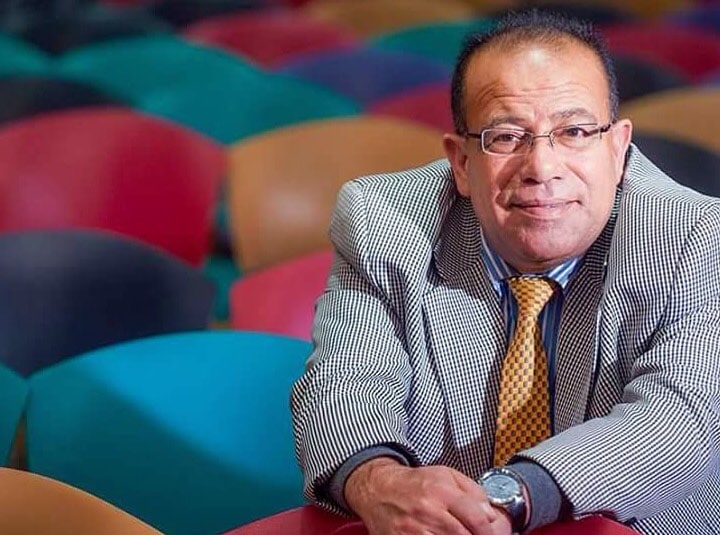
A Palestinian human rights activist accused the University of Minnesota (UMN) College Democrats of blocking him for expressing support for the International Holocaust Remembrance Alliance (IHRA) definition of anti-Semitism.

Bassem Eid, who is also a political analyst, wrote in a March 30 Times of Israel blog post that the UMN College Democrats had posted an Instagram statement against a campus-wide referendum adopting the IHRA definition, arguing that it silences Palestinians.


View this post on Instagram


A post shared by College Democrats at UMN (@demsmn)

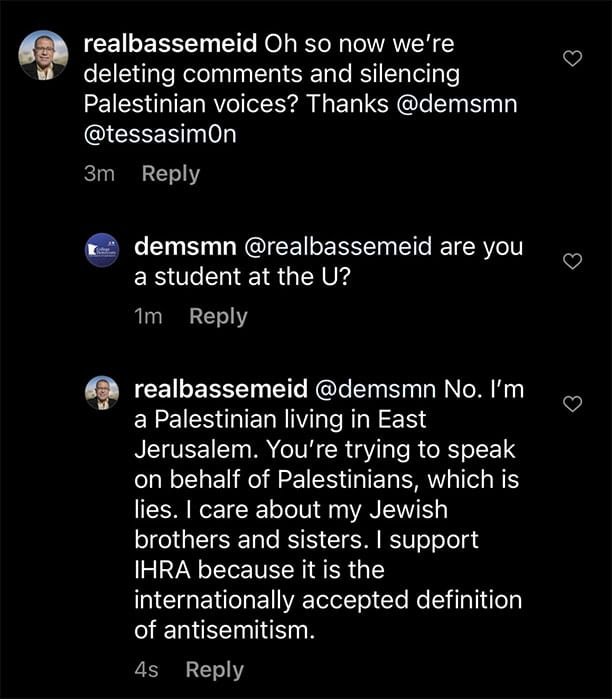
Eid claimed that he wrote a comment on the Instagram post stating that he’s “a Palestinian living in East Jerusalem. You’re trying to speak on behalf of Palestinians, which is lies. I care about my Jewish brothers and sisters. I support IHRA because it is the internationally accepted definition of antisemitism.” The College Democrat club proceeded to delete his comment and block him, Eid alleged.

“Does this sound like a group that cares about Palestinian voices?” Eid wrote. “The International Holocaust Remembrance Alliance definition of antisemitism does NOT silence Palestinians; only the UMN College Democrats do that.”

Eid proceeded to argue the UMN College Democrats are out of touch with the Democratic Party as a whole, noting that the Biden administration supports it, as did the Obama administration before him. He also argued that IHRA actually makes it easier to criticize the Israeli government because it provides “a clear distinction between what does and does not cross the line and constitute antisemitism.” Eid concluded his piece urging the UMN College Democrats to reevaluate their position on IHRA and called on the student body to vote in favor of the referendum.

Eid told the Journal that after the club deleted his initial comment, he posted the comment again and accused the club of silencing him on their Instagram post. “They deleted my first comment and then when they realized they couldn’t win the debate, they disabled commenting and blocked me.” He sent the Journal the following screenshots:

Screenshots courtesy Bassem Eid

Ultimately, the referendum did pass on March 29.


“We have always been grateful to Bassem Eid, a Palestinian, for speaking up about how the boycott movement against Israel harms Palestinians, and we are additionally grateful to him for standing up against those who would taint the IHRA definition of antisemitism,” StandWithUs co-founder and CEO Roz Rothstein said in a statement to the Journal. “Too often, anti-Semites want to retain the right to be antisemitic and are threatened by the passing of a definition that would serve to chill their words as being antisemitic.  We commend UMN students for recognizing the need to take a stand against antisemitism and for committing to educate themselves about the discrimination that Jewish people face.”

The Stop Antisemitism.org watchdog similarly tweeted, “When this Palestinian man stood up for Jews, anti-Israel extremists silenced him, claiming they know better.”

Kenneth L. Marcus, founder and chairman of the Louis D. Brandeis Center for Human Rights Under Law, said in a statement to the Journal, “There have been numerous reports of anti-Semitic vandalism and harassment deliberately intended to frighten, silence and intimidate UMN Jewish students, similar to what we have seen on too many other campuses. In the face of this social evil, we commend the student body for passing the International Holocaust Remembrance Alliance (IHRA) definition of anti-Semitism.  It is encouraging to see students having the courage to assume moral leadership and to show the way for administrations to follow.”

He added that it is “wrong” to state that IHRA will infringe upon free speech, arguing that “in reality, it is often the free speech of Jewish students that is curtailed by anti-Semitism that is left unaddressed by administrators, just as students with different identities have been silenced by other forms of bigotry. We urge more student bodies and university administrations to follow the leadership displayed by UMN students.”

The UMN College Democrats did not respond to the Journal’s request for comment.

Palestinian Accuses College Dems of Silencing Him for Supporting IHRA Read More »

Are Tamales Kosher for Passover?

I am currently in the process of converting from Catholicism to Judaism, and this is the first Passover where I am attempting to refrain from eating chametz — leavened bread and the five forbidden grains of wheat, rye, barley, oats and spelt. Strictly observant Jews will buy special other special food items for the week: vinegar, yogurt, ketchup, cake mix. But I’m going to start small and modest. If I can go a week without chametz, I’ll consider that a win.

I’m also Mexican American, and in an effort to impart my heritage onto my children, I cook a lot of traditional Mexican foods. This in and of itself is a fraught undertaking. I am half-Mexican, and a part of me always feels a little bit like a fraud, like someone putting on airs, like someone trying to prove a point. I make mole from scratch. I make chicken tamales using the recipe my aunt got from my abuelita before she passed. I cook elaborate dinners for friends with tamarind agua fresca and fresh cotija cheese that I drove across town to buy. Converting to Judaism feels a little like taking yet another step away from my Mexican-ness, leaving half of my blood thousands of miles away in Tamaulipas, especially as much of Mexican culture is deeply entwined with Catholicism. I worry, Can these two parts of me coexist?

I did a deep dive into my family’s ancestry a few years ago, as part of some research I was doing for my second novel. My Scandinavian mother’s side was a dead end, but my Mexican father’s side, to my great surprise, unspooled back for centuries across Mexico, Spain and beyond. I discovered that those Spanish and Mexican ancestors were actually Jews who’d fled Spain during the Inquisition, only to find themselves once again under the fire of the Catholic Church in Mexico. One ancestor was even written up by a parish priest for riding a horse while wearing silk and jewels, privileges apparently not accorded to those whose families had converted under fear of death.

It turns out that many Jews settled in what are now the Mexican states of Nuevo Leon, Coahuila and Tamaulipas. Unwanted in Spain, they traveled to these dangerous and remote areas, where their influence is still felt in a regional affinity for cabrito, or kid goat, and buñuelos, which began as a Sephardic treat for Hanukkah. When I told my elderly and devoutly Catholic aunt that our Spanish ancestors were persecuted Jews, she laughed a little — and then told me I must be mistaken.

I only decided to convert last fall, although I’ve been living as a common-law Jew for many years. My husband is Jewish and so are my children. I light the candles every Friday night. I fast on Yom Kippur. I know most of the words to Ma’oz Tzur. People have asked me why now, why Judaism? I give some vague answer about how I have spiritual questions and no answers, and how I’m hoping to gain answers, or at least learn the language to ask better questions. But the actual reason I’m converting is much more complicated and mysterious, even to me.

My decision to convert didn’t come all at once. I’ve had five years to absorb the realization about my ancestors, and over time it’s colored my understanding of my family and my heritage, and given a personal shine to the bitter legacies of anti-Semitism and the colonization of Latin America. Perhaps over these past five years my path to Judaism has been quietly growing in whispers and echoes, the ghosts of my predecessors murmuring blessings in Hebrew over me while I sleep. When I spoke to my rabbi last fall — when I was still just asking the question, What if I did this? — I asked him what would happen to my soul in the process.

Perhaps over these past five years my path to Judaism has been quietly growing in whispers and echoes.

“We would say that your soul has always been Jewish,” he said. “We believe that converts have always been Jewish, and that their souls are only now finding their way back.” It’s a beautiful thought, and given my family’s history, it’s one that I find compelling.

As I embark on my first Passover as someone on the cusp of conversion, someone whose soul is slowly finding its way back, I get to decide for myself what my new life as a Mexican-Jewish woman will look like. And I get to decide which laws of kashrut I will follow. I want to know: Are tamales kosher for Passover? What about hominy-laden pozole? And can you make charoset from tamarind paste? The Sephardic tradition says that I must abstain from leavened bread, but that I can eat rice, beans, corn and chickpeas. The Ashkenazic tradition… not so much. Are tamales kosher for Passover? Eh, as I understand, it depends on who you ask. For this year, my first time around, reaching my fingers towards the rest of my life where my Mexican and Jewish lives will lie side by side, I’ll say, Sure.


Elizabeth Gonzalez James’s debut novel, “Mona at Sea,” comes out June 30, 2021.

Are Tamales Kosher for Passover? Read More »

Student Warns of “Modern-Day Inquisition” Against Pro-Israel College Students

Cornell University student Isaac de Castro warned in a March 29 New York Daily News op-ed that there is a “modern-day inquisition” against pro-Israel students on college campuses.

De Castro, who runs the Instagram account “Jewish On Campus,” wrote that there has been a “precedent set” for students who openly support Israel or even proudly display their Jewish identity.

“At Columbia University, Jewish students were spat on and called murderers on their way to class, and professors have told their students anti-Semitism is no longer an issue,” De Castro wrote. “At Cornell, a student assembly member was threatened to be outed to his family if he did not vote for BDS (boycotting, divesting from, and sanctioning Israel). At USC, the student body vice president resigned from her position after being the victim of bullying and harassment for her identity as a Zionist. At Tufts, a student judiciary member was silenced when discussing an unquestionably anti-Semitic referendum because his Jewish identity allegedly made him biased.”

He added that when Jewish and pro-Israel students attempt to defend themselves, their “efforts are smeared as attempts at censorship, and infringements on academic freedom and freedom of speech. Faculty biases and student body bigotry are not addressed.”

De Castro proceeded to argue that if students don’t feel comfortable expressing their opinions on campus, then that actually undermines academic freedom. “The truth is that academic freedom is not for me. It is not for conservatives, it’s not even for liberals, and quite definitely not for Zionists. Academic freedom is the freedom to have the correct opinions. Right and wrong, good and bad, and no in-between — these have already been decided for us. Our job is to accept them without question. This ‘academic freedom’ is not freedom at all.”

The Cornell student analogized cancel culture on college campuses to “a modern-day inquisition,” comparing teachers to preachers, students to a mob, and Jewish students as “the archetypal heretics.” The inquisition goes beyond college campuses, de Castro argued, pointing to the Ethnic Studies Model Curriculum (ESMC) that the California State Board of Education unanimously passed on March 18. “The lesson plans aim to teach children a racial hierarchy, in which Jews are the only group described with the word ‘privilege.’ In previous edits, Jews were not even mentioned.”

De Castro concluded that the Jewish community now faces a choice to either force-feed “hostile ideologies” with Jewish and Zionist identity or “be key to a resistance. The singularity of our preemptive cultural suppression is also the gift of clarity in discerning the hypocrisy of these ideologies. Courage is needed, but the choice is a given.”

StandWithUs CEO and co-founder Roz Rothstein said in a statement to the Journal that de Castro’s op-ed was “important.” “Israel is part of Jewish identity and if Israel is made to be the villain through misinformation campaigns that leave context out of conversations, the ‘group think’ leaves no room for inconvenient information that creates cognitive dissonance for people who have accepted the popular sentiment,” Rothstein said. “While there will always be disagreements about the Palestinian-Israeli conflict, there should obviously be room for everyone to speak and share feelings openly.

“It is absolutely outrageous that bullying of students who support the ancestral homeland of the Jewish people has resulted in their feeling the need to hide their identities for fear of being punished. But that’s how it is right now, and that reality needs to be acknowledged and needs to change.”

Journalist Gary Weiss similarly tweeted that de Castro’s piece is “depressing but important.”

Student Warns of “Modern-Day Inquisition” Against Pro-Israel College Students Read More »

PM or Not, Netanyahu’s Agenda Will Continue

In the wake of last week’s election, the state of Israel now stands at a fateful crossroads. The nation’s leaders must choose between the options of a future with Bibi or, alternatively, a future without him. But either way, the agenda that Prime Minister Benjamin Netanyahu has shaped for Israel in the region and in the world will continue for the foreseeable future — with or without Netanyahu himself.

Regardless of which of the top contenders becomes prime minister when the current round of negotiations conclude, Israel will be led by a government increasingly committed to strengthening ties with the Gulf Arab countries but with diminishing interest in achieving peace with the Palestinians. Regardless of whether Netanyahu keeps his current position or is replaced by any of his most plausible successors, Israel will continue to warn the West of the dangers of placating Iran but will also attempt to push negotiations to include agreements on ballistic missiles and terrorist-sponsored activities. And regardless of whether a fifth round of elections becomes necessary, the broader right-leaning orthodoxy that Netanyahu has established on international relations and foreign policy will continue apace. As the pro-Bibi and anti-Bibi coalitions reinforce their battle lines, the most significant differentiator between the two groups is Bibi himself.

There are more pronounced differences on domestic matters, and of course Netanyahu’s own legal fate is directly related to the election’s ultimate outcome. But as it relates to the regional and trans-national issues that will shape Israel’s future, none of the leading contenders for PM are likely to greatly deviate from the current trajectory.

Netanyahu’s chief competitor, Yesh Atid’s Yair Lapid, uses somewhat different language than Netanyahu when he talks about Iran and the Palestinians, but even a Lapid government would not be much different on those fronts than current leadership. The most important differences between Lapid and Bibi are on domestic and religious matters, but Israel’s international agenda would continue mostly along current lines. (If anything, it’s a mark of how far right Israeli politics has shifted in the post-Labor era that Yesh Atid is sometimes described as “center-left.”)

Israel’s other prominent leaders — Naftali Bennett of Yamina, Gideon Sa’ar of the New Hope party, and Benny Gantz of Blue and White — all occupy various patches of conservative turf on the ideological landscape and all split from Netanyahu over personal, religious or domestic policy matters more so than over differences on international or security matters. If a situation emerged in which one of them was able to form a government, meaningful change from Netanyahu’s current course seems even less likely.

This campaign was waged almost exclusively over Netanyahu rather than the future he has framed for the country.

Every election in every country is a referendum on the incumbent. But usually the incumbent’s challengers or potential replacements bring with them some type of ideological shift along with a change of identity. But the unique nature of this campaign is that it was waged almost exclusively over Netanyahu himself rather than the future he has framed for the country. Even the debate over the government’s approach to the coronavirus pandemic seemed less about COVID-19 and more about Bibi. While traditional left-leaning Labor and Meretz have exhibited some signs of life, unless or until they manage to grow their ranks or decide to merge into one left-wing party, the nation’s policy debates will continue to reflect a decidedly Bibi-esque footprint.

We will spend the coming weeks watching the nation’s leaders scramble to develop a workable governing coalition. Given the outsized role that the Arab party Raam may play in the next round of negotiations, it’s currently hard to see the result being anything other than yet one more round of elections for a weary Israeli electorate. But no matter which individual ultimately becomes Israel’s next prime minister, it’s very safe to predict that Bibi-ism will ultimately emerge victorious. The only unknown factor at this point is the identity of the man who will carry Netanyahu’s policy prescriptions for the country into the future.


Dan Schnur teaches political communications at UC Berkeley, USC and Pepperdine. He hosts the weekly webinar “Politics in the Time of Coronavirus” for the Los Angeles World Affairs Council & Town Hall.

PM or Not, Netanyahu’s Agenda Will Continue Read More »