fbpx

March 29, 2021

Did Wildlife Really Reclaim Cities?

A new Israeli study assesses whether wildlife really “took over cities” during pandemic-related lockdown periods or if reports were simply exaggerated. 

Neta Nissim, ZAVIT* Science and Environment News Agency 

When the coronavirus pandemic first began and the streets became nearly devoid of people, the media often published stories about wild animals taking advantage of our absence and the resulting vacant space. Deer roamed the public gardens of Jerusalem, ibexes strolled on the promenade in Eilat, ducks enjoyed the streets of Paris, wild boards descended on Barcelona from the peaks surrounding the city, and wild turkeys flocked California. But do these claims of animals reclaiming the four corners of the Earth have a basis beyond the anecdotes written about in the press?

In a new study, conducted by doctoral student Reut Vardi, Dr. Oded Berger-Tal and Dr. Uri Roll of the Department of Desert Ecology at the Institute of Desert Research at Ben-Gurion University the researchers examined observations of wild mammals appearing in the urban environment recorded by private individuals near their place of residence.

The observations were recorded using the iNaturalist citizen science platform, one of the most popular nature apps in the world with over 3 million users around the world. Created as a joint initiative between the California Academy of Sciences and the National Geographic Organization, the app allows the general public to record and share animal observations. After their reliability and quality are tested by volunteer citizens, the information collected through the app is passed to a community of over one million scientists who use the data in their research and practical work for the natural environment.

Due to the larger number of observations from the United States and Canada, the researchers chose to focus their study on the common North American wildlife species reported there, which include the American black bear, bobcat, coyote, moose, and puma.

“There are animal species that we probably don’t see many reports of in the system, but captivating species like the ones we examined in the study, are more attractive and interesting to humans. Therefore, we expect them to be reported more in the app––large animals and predators,” says Vardi.

The researchers compared the app-reported locations of these mammals from March to July 2020 (the beginning months of the pandemic) to their locations during those same months from 2010 to 2019. They focused their searches on 40 selected urban districts, each of which documented at least 10 observations during those years. According to the researchers, the data included a total of 7,278 reports,1,957 of which were received in 2020.

To characterize a particular area as urban, the researchers used an international satellite system that measures the intensity and composition of artificial lighting in the night sky. “Cities are a major source of light pollution, so the more lit up we saw an area, the more urban we determined it to be,” Vardi explains.

The researchers also examined whether changes in human behavior during the lockdowns in those examined areas may have affected the amount of mammalian observations. They did so using the Google Mobility Index, which includes informative trends in movement from place to place (social distancing measures established during the coronavirus pandemic).

Changes in Human Behavior

Surprisingly, the study yielded unexpected results.

“In 2020, we saw that there were indeed more observations of the five mammalian species in urban areas compared to the previous decade, but we realized that there was a perceptual problem with the data,” Vardi says. “Because the reports were recorded during the coronavirus pandemic when people were more restricted to their immediate environment, most of the reports were also located in urban areas and closer to the residential environment.”

Although there have been more reports of sightings within cities, it is not the animals that have changed their behavior, but rather it is us paying closer attention to their nearby presence as a result of the majority of our time being spent at home.

As part of the study, the researchers examined whether the five targeted mammalian species had explored urban areas during the pandemic that they had not visited before.

“All of these species explored new areas in 2020, but apart from the puma, the animals were actually less observed in urban areas compared to previous years. That is to say they were actually ‘more urban’ in the past,” Vardi explains. Despite the increased reports of observations of species examined within the cities, it was found that these were not new areas, but areas that these species had already visited prior to the pandemic.

The only exception among the species tested was the aforementioned puma, which did visit more cities during the pandemic. “In terms of entering cities boundaries, the puma can be compared to coyotes in North America or the jackals in Ramat Gan, for example,” Vardi explains. “Pumas are naturally a more apprehensive species, and although they entered cities before the pandemic began, they did avoid the human environment. In their case, it seems as though the decline in human activity during the coronavirus crisis allowed them to explore additional living areas within the cities.”

Recognizing Nature Outside our Homes

As cities expand to adjust to the rising human population, multiple species of animals are choosing to take advantage of what cities have to offer them. In the city, animals have better access to food, many options for shelter, and a lower chance of being preyed upon by other animals. Of course, this does not necessarily apply to all wildlife.

In many cases, the vast majority of animal species are fatally affected by the expansion of cities, fragmenting their habitats where they gradually shrink and eventually disappear. “The entry of new species into cities is an ongoing process,” she says. “Some species can more easily adapt, making it less difficult for them to take advantage of the opportunities in the cities.” This developing phenomenon has been referred to as synurbization.

The new study demonstrates the potential and importance of citizen science, in which ordinary citizens volunteer to assist in scientific research. Today, there are many examples of research projects in which citizen science plays a significant role, such as the Israeli “Jellyfish Inc.” application––or Meduzot Ba’Am–– which centralizes reports on jellyfish sightings and creates a map of jellyfish distribution along the Mediterranean shores of Israel.

“Beyond this, we see this study as an opportunity to draw the public’s attention to animals, especially to urban nature,” says Vardi. “In its own way, the coronavirus has reminded the public that there is nature outside their homes, and that it can be observed and preserved. During and following lockdown periods, we have come to better understand just how important nature is––not only to animals, but to us humans,” Vardi concludes.

ZAVIT – Science and Environment News Agency 

Did Wildlife Really Reclaim Cities? Read More »

Passover 2021: The Jewish Season of Hope Arrives

When the Haggadah tells us: “You have redeemed us from Egypt, You have freed us from the house of bondage, You have fed us in famine and nourished us in plenty; You have saved us from the sword and delivered us from pestilence, and raised us from evil and lasting maladies,” in 2021 we sit up and take notice.

Because it’s been one long year.

Strapping on your mask for the millionth time and keeping your social distance, haven’t you thought dayenu—enough already?

As Jews around the globe prepare to celebrate the holiday of our people’s freedom from Egyptian slavery, we’re not quite as free as we had hoped we’d be by now.

So along comes the seder to remind us that, if there’s one thing Jews down through the ages have known it’s how to find hope in even the most dire of circumstances.

The seder, which kicks off the eight days of Passover (seven in Israel) beginning on Saturday night, March 27, has invited Jews down the ages to relive our people’s dramatic and most defining moment: No less than the Master of the Universe rescuing the Israelites from their 210 years of back-breaking and soul-killing slavery at the hands of the cruelest of Egyptian pharaohs and his whip-cracking taskmasters.

Oppressed as they were, how could our ancestors dare to hope they would ever be free? But hope they did, a skill much in demand today.

So here are eight arguments for hope from the Haggadah (and the Torah)—one to savor each day of the holiday:

Day 1: “Mah Nishtanah?” Why is this night different from all other nights?

“Remaining in our homes and separated from our families, this year we understand better what it means to be slaves—to be in the narrow and constrained place that was Egypt,” says Rabbi Zev Leff of Moshav Matityahu, who also teaches elsewhere in Israel. “But on Pesach night, we can break free and, like a car battery, charge up our soul for another year. We know that, just like God took us out of Egypt when things looked hopeless, we need to feel hope now. And tell the story in a way each child can understand that they are a link in an unbroken chain all the way back to what happened to us 3,000 ago, that they can be proud of being the next link in that chain.”

Day 2: “Now we are slaves. Next year, may we be free … ”

“I was 24 when I experienced my first [Passover] seder,” says Natan Sharansky, who, as a refusenik, spent nine years in Soviet prisons before immigrating to Israel, where he served in a variety of governmental roles, and afterwards, as chairman of the Jewish Agency of Israel. “I was the youngest at that seder and nobody even knew enough to read the Haggadah, but when it came to it the part of ‘this year we are slaves and next year we will be free’—to hear it, we knew we had the same struggle and that became exactly our motto. In all my years in prison, I used three pieces of bread. I knew it wasn’t matzah, but it was enough. Until today, we see the same miracle as then. In our generation, 2 million Jews went out to freedom from the Soviet Union. Coming back to our roots and our history.”

Natan Sharansky speaks during a Limud event ahead of the Jewish mourning day of Tisha B’Av at the Israeli president’s residence in Jerusalem on July 31, 2017. Photo by Hadas Parush/Flash90.

Day 3: “This is the bread of affliction that our fathers ate in the land of Egypt.”

“It’s not ‘this is like the bread of affliction,’ but ‘this is the bread of affliction that our ancestors made as they were fleeing from Egypt; it’s the real thing,” says Rabbi Leora Kaye, who directs programming for the Union of Reform Judaism. “Matzah is plain and genuine, and it’s also fragile. Seeing in the matzah our most genuine self deepens our humility and our empathy for the fragility of ourselves and others, especially this year, empathy for everyone who is struggling. But even though matzah is fragile, it’s also sustenance, so by the end of the day, we need to be careful not to break each other’s spirits, but to sustain each other in loving ways.”

Day 4: “As it is said, you shall tell your child on that day, it is because of this that the Lord did for me when I left Egypt.”

“The purpose of the seder is not to tell the story of Egypt. We all know that story. It’s to ‘pass over’ the deeper narrative underneath the story to our children. The narrative is what’s really going on,” says Charlie Harary, a New York motivational speaker on Torah and personal growth, as well as a radio and TV host, attorney and entrepreneur. “Why is it the child who recites ‘The Four Questions’? To engage them, yes, but really to remind us that our children are waiting for us to connect them, to give our people’s narrative to them. And even more so this year, we have to remember we cried out to God and God saved us not because we deserved it, but because He’s our father and He loves us. This reminds us to keep our heads high and be hopeful because we’re walking with our father, and when you walk with the father, miracles can and often do happen. Our whole history is proof of that.”

Moses parting the Red Sea. Credit: Mashosh/Shutterstock.

Day 5: “Today you are leaving in the month of springtime.” — Exodus 13/4

“Why is it so important that Passover is in the spring that Jewish calendar even adds an extra month each year to keep it there?” asks Rabbi Yitzchak Breitowitz, senior lecturer at Ohr Somayach who also teaches elsewhere around Jerusalem. “Each spring, we’re given the gift of signs of new life bursting forth, which the fresh green vegetable—the karpas—is on the seder plate to remind us. And the seder of 2021 will be even more powerful; it’s as if we are entering spring after an entire year of winter, a time of so much narrowness, so much suffering. Now, as we begin to see the early signs of our liberation from the imprisonment of this long winter—a warming and return to life with the first spring blossoms—we as individuals also can have a sense that we, too, can go beyond our own Egypt, our own narrowness and personal boundaries towards liberation and a new freedom.”

A Passover table setting. Credit: New Africa/Shutterstock.

Day 6: “This year we are here; next year in the Land of Israel.”

“Why is this year of the pandemic different from all other years? Why are aliyah applications up more than double in just a year? Many people used to take it for granted that they could leave home and a few hours later be sitting on the beach in Tel Aviv, but this is the first time in 72 years the borders have been closed,” says Marc Rosenberg, vice president of Diaspora Partnerships for aliyah-assistance organization Nefesh B’Nefesh. Stuck at home for such a long time, people are starting to see Israel as a viable option, especially since they can work from home here, too. They say, ‘We’re looking at our lives and asking where we need to be.’ It’s like, ‘We dreamed about it for someday, but now we’re beginning to wake up and see the dream can be real and that someday can be now.’ ”

Day 7: “These are the Ten Plagues which the Holy One, blessed be He, brought upon the Egyptians, namely as follows: Blood. Frogs. Lice. Wild Beasts. Pestilence. Boils. Hail. Locusts. Darkness. The killing of the First-born.”

“We’re living now in a world where there is a plague, like the tenth one, where the angel of death goes door to door. Our challenge is asking why God is bringing this plague to us now,” says Lori Palatnik, founding director of Momentum and author of Remember My Soul: What to Do in Memory of a Loved One (K’Hal), among other titles. “The only thing we do know is, if when it’s over we go back to the way it was, then this was for nothing. God put the whole world into a ‘time-out,’ and God wants us to learn a lesson. So we have to grow and change from this, to be better people committed to making a better world.”

Day 8: “Dayenu, it would have been enough.”

“I celebrate every seder since 1946 as if I myself had come out of Mitzrayim (Egypt),” says Julius Mazurek, 89, of the Borough Park neighborhood of Brooklyn, N.Y. “I know that’s what we’re all supposed to feel like, but for me, it really happened. That seder night I was 15 and on a train back to Poland with my mother, two older sisters and my older brother. In Russia, we’d baked our matzah weeks in advance since we didn’t know when they would let us go. It was hard to hear the words of the Haggadah over the noise of the train, but once the Russian border guards let us out of the country (after they confiscated our papers and our photographs), we were all so happy. We knew we were on our way to freedom from a terrible life of hunger in Russia. But back in Poland we faced more anti-Semitism—‘What are you doing back here?’ they asked us—so we ended up in an American DP camp in Germany for more than three years because the U.S. authorities wouldn’t let us in, until [President Harry] Truman gave the OK. I’m the only one left of my family, and when I hear the song “Dayenu,” I have another perspective. It really is enough. Survivors don’t consider this pandemic the worst thing in the world; it’s is nothing compared to what we went through. Yes, last year we were locked up at home for a while, but food is always accessible and nobody is looking to kill us now, except maybe the virus.”

U.S. President Harry S. Truman, Israeli Ambassador to the United States Abba Eban and Israeli Prime Minister David Ben-Gurion in the White House on May 1, 1951. The Israeli leaders presented Truman with a menorah. Credit: Fritz Cohen via Wikimedia Commons.

Let all who are hungry come and eat …

In a year that’s forced countless Israelis and others in Jewish communities around the world into poverty, the hard times are exacerbated by the additional costs of Passover, creating a huge strain on thousands. Here is a sampling of organizations working to alleviate the problem by providing the requisites for the holiday.

  • Ohr Meir & Bracha: The Terror Victims Support Center is upping its food distribution in Israel from its weekly 400 families to a record 700 this coronavirus year. Victims of terror and their families receive everything from cases of chicken and wine to 20 pounds of potatoes to quantities of matzah, vegetables and fruits, and assorted basic ingredients, while others outside the delivery area are provided with food vouchers. To learn more and contribute to Ohr Meir & Bracha’s Passover fund, visit: terror-victims.org.il.
  • The JDC (Jewish Joint Distribution Committee), in addition to its year-round support providing food, medicine and heat to the world’s most vulnerable Jews, including the elderly and poor in such places as the Ukraine, Moldova, Belarus, Russia and Central Asia (some 80,000 poor, Jewish elderly in the former Soviet Union alone), is delivering tens of thousands of boxes of matzah and other Passover supplies so needy Jews can enjoy a taste of the holiday and keep them connected to the community, especially those isolated due to the pandemic. To contribute, visit JDC.org/Passover2021.
  • Yad Ezra V’Shulamit is delivering 50,000 food baskets filled with every sort of necessity for the seder and the rest of the holiday—from chicken to fresh veggies and fruits and of course the requisite matzah. The 50,000 baskets, earmarked for low-income families, widows and isolated seniors in 47 cities around Israel, is five times its weekly distribution. In addition, Yad Ezra is getting food vouchers into the hands of families whose parents are out of work this year. To find out more or donate, visit https://www.yadezra.net/give-passover.

Passover 2021: The Jewish Season of Hope Arrives Read More »

Passover Food in Mexico is a Mashup of Cultures

PACHUCA, Mexico (JTA) — Like other Jews around the world, Alegra Smeke turns to traditional foods during Passover. For her that means Syrian dishes with a side of salsa.

Smeke is a chef and former president of a Zionist women’s group who lives in Mexico, which has long been a hub of culinary fusion.

Immigrants, conquering forces and other cultural influxes have left their mark on the country’s diverse cuisine over hundreds of years and in return incorporated local flavors and ingredients into their own cooking. For one prominent example, see tacos al pastor, a national staple, which was created by Lebanese immigrants.

For the country’s Jews, the story is no different. As waves of Jewish immigrants came from different countries to Mexico during the early to mid-20th century, their recipes came with them — and were subsequently influenced by the local cuisine.

For example, a centerpiece of Smeke’s Seder meal is a dish she calls kewash en nogada, a matzah meat pie smothered in walnut sauce, or nogada. It’s a Mexican spin on mina de carne, a Sephardic recipe.

“Our family recipes were handed down for the past 100 years, straight from Syria. So we serve only traditional dishes, but we also have Mexican spices,” Smeke said.

Smeke’s family is not alone in preserving its heritage even after decades in Mexico. Mexico City alone has Jewish immigrants from Europe, Russia, Turkey and the Balkans, and Syria — including two separate groups, one descended from Damascus, the other from Aleppo. Smaller communities are scattered as well throughout the country in cities like Guadalajara, San Miguel de Allende, Tijuana and elsewhere, which include Anusi Jews who have returned to Judaism after tracing their Jewish heritage back to Spain, where they were expelled and persecuted centuries earlier.

“Jewish life in Mexico is like a time capsule,” said Enrique Chmelnik Lubinsky, general director of the Center for Jewish Documentation and Research in Mexico City. “Not only is in-marrying still very high, but also each group has preserved its unique culture.”

The Syrian Jewish community in particular — which is very tight-knit, exclusive and religiously strict — contributes to the uniqueness of Mexican Jewish cuisine.

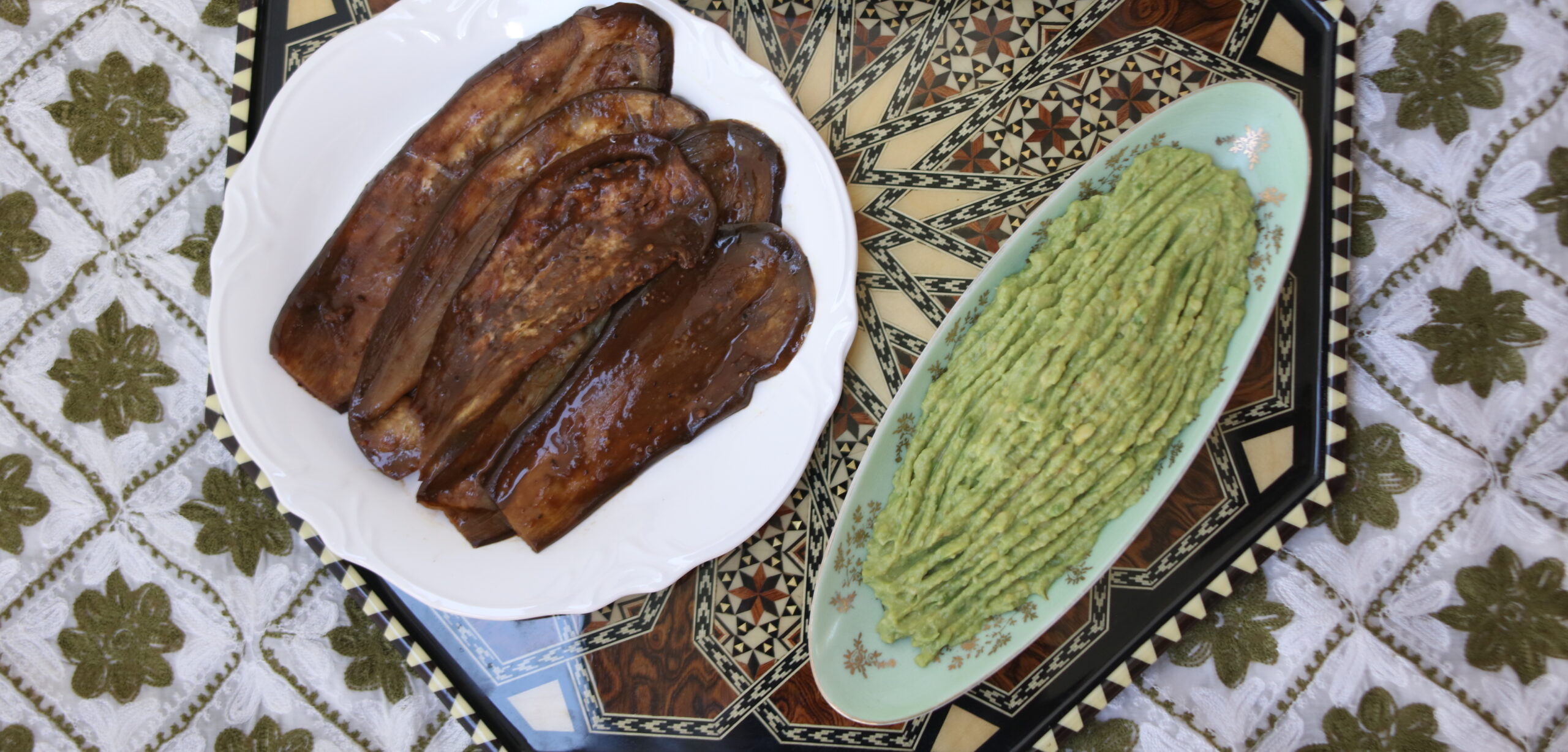
Some guacamole and eggplants in a balsamic sauce on Alegra Smeke’s table. (Elvira Smeke)

According to Paulette Kersenovich Schuster, a Mexican-born Israeli academic who studies Mexican Jewry, Syrian Jewish Mexican food is “very feminine-oriented, as it’s done mostly by women intergenerationally.” Like traditional Mexican Christmas tamale-making, Syrian Jewish “female relatives gather at their grandmother or mother’s house and prepare Passover kibbeh for hours, substituting the traditional bulgur wheat with rice to ensure that it’s kosher.”

Schuster is Ashkenazi, and her favorite Passover dish is col rellena, or meat-stuffed cabbage, with tamarind sauce, chiles and pine nuts. Other favorites include her grandmother’s matzah stuffing, which is served on the side of chicken or quail, and gefilte fish a la Veracruzana — a Spanish-Mediterranean-inspired fish recipe that originated in the Veracruz region, with spicy red sauce, capers and salty olives. It has become an icon of Ashkenazi-Mexican fusion in recent years.

Jakeline Weintraub of the Mexico City-based kosher catering company SJ Banquetes explains that Jewish cuisine has adapted to modern Mexican life and is becoming more available throughout the country.

“Not only do we have access to more vegetables than we did in our countries of origin, but vegetarianism is more popular. Plus, dietary concerns, like being gluten- or dairy-free, have changed how people eat,” she said.

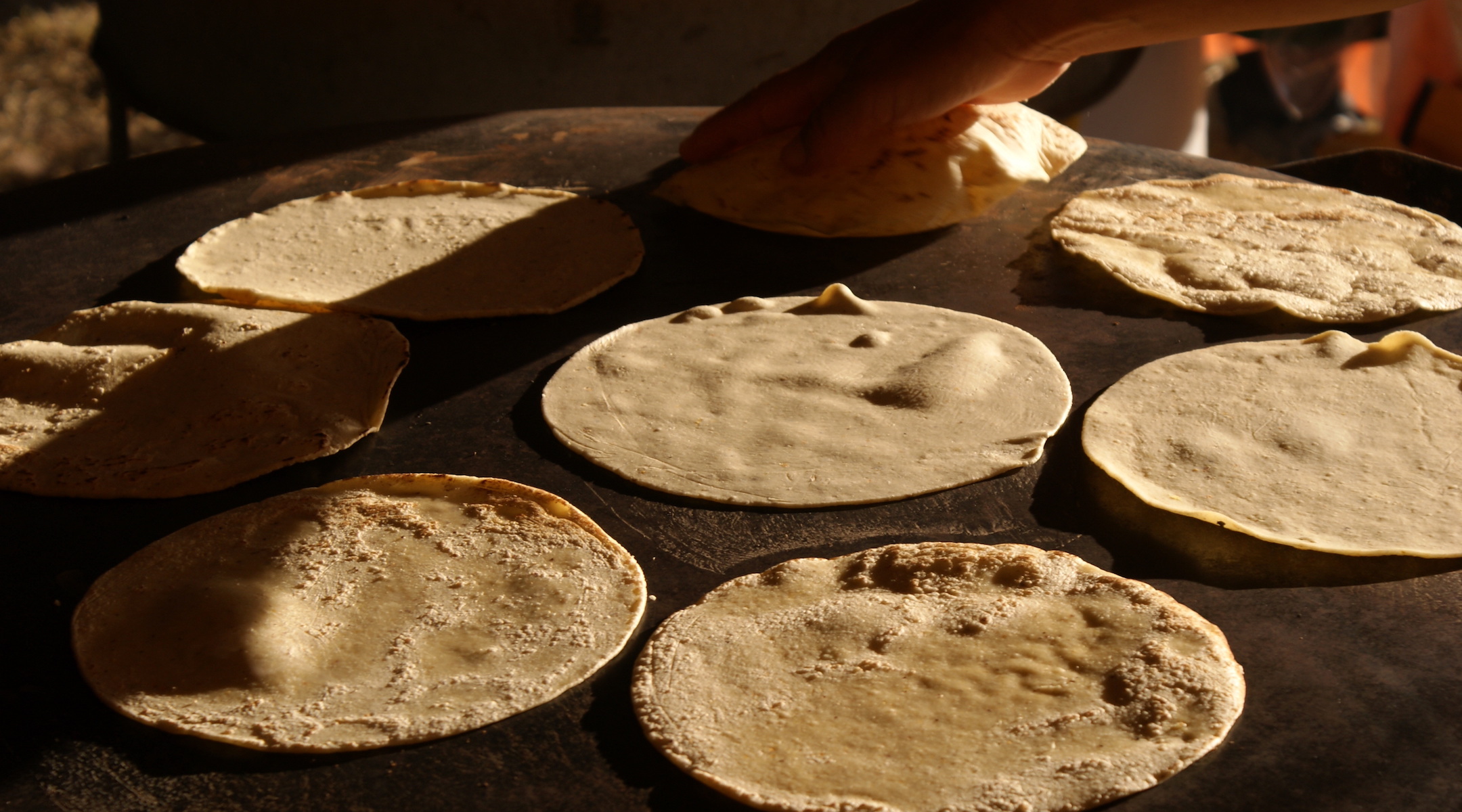
One common adaptation is matzah meal tortillas, which are eaten throughout Latin America. They can be homemade or purchased where kosher for Passover products are sold, but also in street tortillerias — little shops that sell only handmade tortillas — run by non-Jews in areas with even small Jewish populations.

Making tortillas by hand is a big part of Mexican food culture. Many makers have incorporated matzah into their tortilla recipes. (Alberto Rojas Serrano/Getty Images)

Each year many of the country’s Jewish communities sell packaged and fresh goods to their members at food bazaars — fundraisers that feel like small street fairs and last at least a week. The COVID crisis has put that tradition in jeopardy.

But stepping into the online space, a new company, Kosher Click, now offers a marketplace for 100 Mexican kosher vendors, including their own in-house brand. According to representative Salomón Hamui Abadí, some of the most commonly sought-after Passover dishes include mejshi, rice-stuffed zucchini in tamarind sauce; kibbeh, balls of meat mixed with toasted pine nuts and rice (adapted from bulgur wheat); barbacoa, a regional dish of lamb that is wrapped in agave cactus leaves and roasted in an earthen fire pit; and veal.

Chmelnik adds that cooking with serrano chile peppers and tamarind sauce are additional common garnishes. His personal favorites are spicy cholent and anything served with salsa or mole. The chunky salsa (pico de gallo) that’s commonly served in the U.S. with nachos or other chips is just one variety — Mexican salsas are far more substantial and diverse. Likewise, mole comes in a variety of flavors.

When it comes to dessert, Schuster explains that the Syrian community has different styles that are based on different cities of origin. The Shamis, Syrian Jews who originally hail from Damascus, use more preserved fruits, especially apricots, whereas the Halebis, of Aleppo, bake with almond paste. Marzipan, almond flour honey pound cake, and dates and pecans are also common Mexican Jewish desserts — but the more universally eaten chocolate-covered matzah and jelly fruit slices are also included.

A pot of Mexican barbacoa (fitopardo/Getty Images)

Kayla Siegel Fine, an American expat who retired in Mexico, encapsulated a typical Mexican Jewish Passover meal while shopping in Mexico City recently.

“I bought kosher for Passover tamales and salsa. There were mouth-watering Syrian pastries made of nuts, dried fruits and chocolate rather than the more typically Ashkenazi desserts made with matzah meal and potato flour,” she said.

“I also bought a kosher for Passover almond meal cake that was layered with buttercream and coated in marzipan, out of which a gorgeous rose was sculpted as an edible topper. The pistachio nuts layered with apricot and coated in chocolate were especially exquisite.”

Ultimately, the cuisine is characterized by a tasty mosaic of distinct ingredients and recipes, as opposed to being a blended monoculture of just one variety. But tradition stays at the core.

“The Syrian community has strong roots and our traditions have not changed, yet we have modernized several aspects of how we live,” Smeke said. “We are fortunate to have many families with grandparents or great-grandparents that are still alive who give us the richness of our culture.”

From a historical perspective, the community has forged a common bond and unique culture through its cuisine, Chmelnik said.

“In each Jewish house you find this influence, spicy Mexican flavors combined with Jewish food. We eat mole and all the sauces, chiles, with our traditional meals,” he said. “Yet Jews from Syria still eat kibbeh, while the Ashkenazis still have their gefilte fish, kugel and liver.”

Passover Food in Mexico is a Mashup of Cultures Read More »

Nominated as Book Critic! March 2021: Niver’s News

March News 2021 with Lisa Niver & We Said Go Travel:

Thank you to the National Arts and Entertainment Journalism awards! I am honored to be a finalist for the NAEJ awards in the category of Book Critic!

Thank you to Girls on The Air for including me in their International Women’s Day show. You can read the transcript and listen to the radio show here.

Thank you to Thrive Global for publishing my article, “Surviving COVID Like a Superhero.”

How can you decrease stress, sleep more and create more memories?

One of the best ways to feel more centered and calm is to try mindfulness meditation. During COVID, through the UCLA Senior Scholars Program, I took Professor Marvin Belzer’s amazing class on mindfulness meditation at the UCLA Mindful Awareness Research Center (MARC). MARC has an app called “UCLA Mindful,” which is free and has meditations by Diana Winston, the incredible director of MARC, which I highly recommend. MARC also offers reasonable evening and weekend retreats with renown teachers like Giselle Jones and Matthew Brensilver from SpiritRock.

I wanted to share my video, Hula Hooping Gangnam Style with Iwahig Dancing Inmates. YES I DID hula-hoop at a jail in the Philippines.

WHERE CAN YOU FIND MY TRAVEL VIDEOS?

Here is the link to my video channel on YouTube where I have over 1.3 million views on YouTube! (Exact count: 1,319,065 views) Thank you for your support! Are you one of my 3,050 subscribers? I hope you will join me and subscribe!

For more We Said Go Travel articles, TV segments, videos and social media: CLICK HERE

Find me on social media with over 150,000 followers. Please follow  on Twitter at @LisaNiver, Instagram @LisaNiver and on FacebookPinterestYouTube, and at LisaNiver.com.

My fortune cookies said:

“If given a penny for every kind act, you would be a millionaire.”

“You create enthusiasm around you.”

Stay safe and healthy! We will travel again! Lisa

Venice Beach March 23, 2021

Nominated as Book Critic! March 2021: Niver’s News Read More »

Understanding “Who” Is Behind Disinformation Is Key to Fighting It

Ever since the riots on the U.S. Capitol on January 6, policymakers and individuals alike have renewed their focus on technology and its role in promulgating disinformation. But much of the battle centers on “who is accountable” for the information published online. Is it the content’s creator? The person doing the posting? The platform? A community? A state actor?

That was just one of the topics tackled by 92Y during their “State of Democracy Summit” on March 25. The five-hour event consisted of nine panels that assessed the aftermath of the 2020 election and discussed the future of protecting democracy in America. The panels ranged from “Democracy on Film,” a discussion of the “Boys State” documentary, to “Local Democracy,” a conversation with Ithaca Mayor Svante Myrick.

But one panel, “Technology, Democracy, and Misinformation,” sought to answer how exactly America can “wrestle with the spread of dangerous misinformation.” The panel, which was moderated by Democratic strategist Emily Tisch Sussman, included Debora Plunkett, senior fellow at the Belfer Center and former director of the NSA’s Information Assurance Directorate; Jeff Kao, a data science journalist at ProPublica; and Jevin West, director of the Center for an Informed Public at the University of Washington.

Plunkett distinguished between the platform and content of technology. Platforms, she said, are “the tools and capabilities to be able to communicate largely on the internet,” such as Facebook, Twitter and Instagram. The past 10-15 years have witnessed an “exponential” rise of platforms. Content, by comparison, is the “information that rides on those platforms that serves all kinds of purposes.”

Plunkett said that younger people were the future of fighting disinformation, and that they need to build up a “healthy skepticism” early on.

The complication in fighting disinformation, Plunkett said, was the question of “who is accountable” for content, be it the poster, community or platform. Regulators are specifically challenged by the pace of technological changes, the borderless nature of the internet, and the notion that “internet is owned by no one.”

Although there are certainly positive uses for these platforms, Plunkett noted, the concern lies when these platforms are used for malicious purposes. As an example, she cited a recently released report from the Director of National Intelligence that detailed how Iran and China attempted to influence the 2020 election through online disinformation.

Kao elaborated on the foreign campaigns to spread disinformation. ProPublica tracked “10,000 suspected fake Twitter accounts” involved in a disinformation campaign traced to China. The Chinese government and their contractors used these fake accounts to praise China for its handling of the pandemic and tried to aid GOP goals.

Although Twitter regularly finds these fake accounts and posts the data for research, that “doesn’t really deter” these campaigns, Kao argued. Platforms try to deter disinformation by raising the cost of spreading it, but those disincentives don’t work as well on actors with “deep pockets.” “As social media economy has become more sophisticated… anyone with money and time can start up one of these campaigns,” he explained.

West explained that in addition to fake accounts, “blue check verified accounts” repeatedly violated site policies and amplified disinformation in 2020, especially when it came to information about COVID-19. West cautioned that often a piece of information is created in “good faith” but “nefarious” actors twist and frame that information into something more malicious. Addressing “home grown domestic problems” is as necessary as combatting foreign sources of disinformation, he emphasized.

Although many individuals are aware that disinformation exists, West noted, they are unaware of new disinformation tactics, such as deepfake videos. He expressed fear that “people will start not believing anything,” which is the “objective” of disinformation campaigns. Kao explained that this broad disbelief is called the “Liar’s Dividend,” in which true things are “dismissed as fake news,” too.

Kao explained that this broad disbelief is called the “Liar’s Dividend,” in which true things are “dismissed as fake news,” too.

All the panelists concluded that Americans can each take steps to fight disinformation. West suggested “digital civics” education to cultivate “habits of mind.” For example, when looking at information that seems “too good to be true,” ask who is saying it and what they have to gain by telling you. Kao raised a flag about extremely emotional content; if you get worked up while reading something, he explained, “step back” and investigate it.

Plunkett argued that younger people were the future of fighting disinformation, and that they need to build up a “healthy skepticism” early on, adding to the panel’s existing calls of researching and independently verifying information. “We are now expected to be our own editors,” West concluded.

The summit was produced in collaboration with the Knight Foundation, ProPublica and Craig Newmark Philanthropies. You can watch the full summit at their website (https://www.92y.org/state-of-democracy).


Ari Berman is Op-Ed Editor for the Journal.

Understanding “Who” Is Behind Disinformation Is Key to Fighting It Read More »

“Shiva Baby” Brims with Feverish Millennial Jewish Angst

A confession: When I first watched Emma Seligman’s debut feature, “Shiva Baby,” back in August 2020 during the virtual edition of L.A.’s OutFest, I was admittedly underwhelmed and a bit frustrated.

Perhaps my expectations were too high. The film’s bawdy premise — a bisexual, anxious Jewish college senior bumps into her high school ex-girlfriend and her sugar daddy at a shiva call — pandered right into my cinematic taste and my own identity as a bisexual, anxious Jew. Seligman’s inspired pairing of young, up-and-coming talent with well-established Jewish veteran actors also offered an exciting prospect for a rollicking Semitic time.

Ultimately, however, the execution left me a bit cold and fatigued. My dissatisfaction likely stemmed from the movie’s aggressive, vaguely misanthropic unpleasantness combined with my slightly misguided projection of my own experiences growing up in an Ashkenazi Jewish community. The latter, in particular, may have been a knee-jerk reaction that I believe many encounter when witnessing their backgrounds represented on the silver screen — a primal urge to judge the accuracy and authenticity of such depictions rather than critically engaging with the story itself. My initial thinking was that “Shiva Baby” would capture a contemporary microcosm of American Judaism in all of its cultural specificities and fraught generational divides. Instead, most of it seemed to coast on familiar, surface-level tropes and clever aesthetic gestures, arguably distracting from its themes of sex, work, sex work, family and postgrad dread.

It’s with great surprise and relief, then, that my feelings about “Shiva Baby” have shifted toward the positive upon second viewing. While my reservations around its thin, somewhat undercooked plotting remain, what really clicked for me this time was Seligman’s consistently amusing script, which draws prickly comedic and dramatic tension from its acidic humor and tantalizingly stressful setup.

At first glance, Seligman’s attempts to satirize Jewish motifs through a provocative lens can read as mean-spirited and unbecoming, but a lot of the discomforting jokes are necessary to illustrate the protagonist’s carnal guilt and economic uncertainty in a space where her sexuality and ambition are endlessly prodded. Any young Jewish person who’s been forced to attend a Jewish communal gathering, whether a funeral or a wedding, bar mitzvah or shiva, is acutely aware of having to answer interrogative questions about the status of one’s aspirations and relationships, a sentiment that “Shiva Baby” delineates in excruciating detail.

Although “Shiva Baby” heightens the absurdity of these hot topics within the Jewish community, they’re made accessible thanks to Seligman’s confident direction and the cast’s charismatic performances. Rachel Sennott, who plays the eponymous “shiva baby” Danielle, is striking in her first major lead role, aside from last year’s similarly themed “Tahara.” With an extensive background in performing stand-up, Sennott brings a layer of gumption and wit to her character’s neurosis around self-fulfillment, dialing into her nerves through barely contained winces, trigger-happy snark and impulsive decision-making. She also benefits from having played this role for Seligman’s short film of the same name and premise, which Seligman crafted in 2018 as a thesis on her experiences as a bisexual Jew who moonlighted as a sex worker while in college. This personal touch adds an admirable coat of honesty to Danielle’s antsy exterior, and by expanding her short into a feature, Seligman builds upon an already solid narrative foundation.

Squirms are almost immediately induced from the film’s very risqué opening passage, where Danielle engages in vigorous sex with her sugar daddy Max (Danny Deferrari, “Madoff”) at his vacant SoHo bachelor pad. Max is under the impression that he’s helping fund Danielle’s law school tuition. Little does he know that Danielle is an individualized study major, still undecided about her future and aimless in her career goals. And little does she know that Max is actually married to a successful shiksa entrepreneur named Kim (an immaculately icy Dianna Agron, “Glee”) and father to a noisy toddler.

Their mutual deceptions come to a collision when the two see each other at a shiva for Danielle’s distant relative, a coincidence rendered even more awkward by the appearance of Danielle’s bitter ex Maya (an exceptionally smarmy Molly Gordon, “Booksmart”). Top all the serendipity off with some nosy inquisitions from Danielle’s bumbling father (Fred Melamed, “A Serious Man”) and domineering mother (Polly Draper, “Thirtysomething”), and you’ve got a Molotov cocktail of second-hand embarrassment waiting to explode.

For a film as explicitly Jewish as this one, pointed quips about digestion problems, matchmaking and gossip-hungry moms are expected and delivered, but the true Jewishness of “Shiva Baby” lies within Danielle’s emotionally turbulent trajectory. A classic example of a schlimazel (a chronically unlucky person), Danielle ping-pongs around the house of mourning and builds a series of psychological mousetraps of her own doing. She tries wheedling her way out of uncomfortable conversations with her parents, lovers and a peripheral storm of prying guests. She eats bagels and lox to quell her worries, despite losing her appetite from her mother’s cutting comments about her weight. She takes a topless selfie in the bathroom to send to Max, only to leave her phone there after knocking on the door sends her in an erratic hurry (oddly, the mirrors are exposed in the film, even though they’re traditionally supposed to be covered during a mourning period, but that’s neither here nor there).

The true Jewishness of “Shiva Baby” lies within Danielle’s emotionally turbulent trajectory.

As the quietly intense mayhem escalates, Seligman amplifies Danielle’s regressive, infantilized behavior with enough suspense to keep the story chugging along at a brisk 77 minutes, juxtaposing busy, overlapping sound design with Ariel Marx’s menacing, string-heavy score and Maria Rusche’s claustrophobic, unsettling camerawork.

Although these elements strengthen the increasingly unfortunate set of circumstances, they occasionally seem like a crutch. For all of its formal flexing and conceptual attractiveness, “Shiva Baby” does feel somewhat indebted to more well-developed psychological thrillers like Trey Edward Schults’s “Krisha,” another brief, gnawing film that follows a woman beset with insecurity as she navigates an unwelcoming domestic environment. There are flickers, too, of the Safdie Brothers’ “Uncut Gems” and Darren Aronofsky’s “mother!”, particularly during one nightmarish stylized sequence where Danielle’s fears manifest and carry an almost hallucinatory quality. Influences aside, it would be unfair to compare the merit of creative visions between writer-directors at different stages in their careers.

But even then, “Shiva Baby” still falters when trying to justify its single-location setting. There is, for example, no clear reason for Danielle to stay at the shiva for as long as she does. One could surmise that it’s simply a guilt complex that confines her, a desperate need to prove that she can withstand whatever conflicts are thrown her way, or a sadistic gravitation toward chaos, but the absence of a concrete explanation for her perseverance doesn’t really make for the most compelling drama.

On top of that, the personal strains between Danielle and Maya aren’t quite as fleshed out as they should be. Though Sennott and Gordon share incredible chemistry and exchange some wicked verbal spars, the animosity and unresolved issues undermining their dynamic are vaguely defined, so much so that when a romantic twist between the two occurs late in the film, the scene feels abrupt and forced. Character continuity, or lack thereof, is a recurring weakness throughout “Shiva Baby” that sometimes makes it difficult to buy into the motivations that lead from one development to the next.

Imperfect as it may be, though, “Shiva Baby” is a competently made, frequently funny, and promising start for both Seligman and Sennott. While it certainly could have used a bit more narrative meat on its bones to further ground its material, “Shiva Baby” deftly confronts the grief of not having everything figured out when you feel like you’re supposed to, a theme that’s as indicative of millennial malaise as it is of Jewish guilt. The title’s astute play on words speaks to this juncture, with “shiva” exemplifying a constant reminder of our mortality and “baby” representing our inner child crying out for guidance, attention and love. Toward the end of the film, there’s a moment that synthesizes these two labels, when Max’s infant wails in the middle of Mourner’s Kaddish. The camera lingers on Danielle’s terrified visage, capturing a reaction of existential nausea that can only be summarized by two words: Oy vey.


Sam Rosenberg, a University of Michigan alumnus, is a screenwriter and freelance writer.

“Shiva Baby” Brims with Feverish Millennial Jewish Angst Read More »