Rabbi Ilay Ofran: The Torah – A Psychic Turn
Follow Shmuel Rosner on Twitter.
Rabbi Ilay Ofran: The Torah – A Psychic Turn Read More »
Follow Shmuel Rosner on Twitter.
Rabbi Ilay Ofran: The Torah – A Psychic Turn Read More »
(JTA) — This Passover, redemption feels so close — yet so far away. Nearly 50 million Americans have been fully vaccinated against COVID-19; at least 543,000 have died from the disease. Some of us are able to safely gather with others for the Seder this year; many of us are still separated from loved ones.
I was thinking about this tension recently as I read a new collection of Passover essays and advice by and for Jewish women, collected by Bari Mitzmann, a Las Vegas mother and Orthodox Jew with a large Instagram following.
The collection is called “HaKol B’Seder,” which can be translated from Hebrew to mean both “Everything in the Seder” and “Everything is Fine,” and this line by Alaya Hertzel, an influential Orthodox life and family coach in Los Angeles, stood out to me:
It’s time to stop telling people to put their pain away over the holidays and start inviting them to feel the pain brought about by the Holiday itself…
Pain demands to be felt and perhaps this is the year we finally free ourselves to feel it.
So often, I spend most of Passover focusing on ritual and planning, pushing any discomfort or lack of emotional connection out of mind. This year, I’m thinking about doing the opposite.
I asked several rabbis to reflect on a specific part of the Passover seder that feels different this year, after a full year of plague. In their own ways, all wrote about pain.
Mitzmann proposes that the seder is really a multi-sensory guided meditation. ”Done right,” she writes, “we are gifted with catharsis and achieve an emotional and philosophical understanding of God’s role in our lives.”
At the seder, I’ll channel these rabbis’ responses in the service of achieving greater feeling, connection and release.
What specific text or element of the Haggadah feels different after a year of pandemic?
“When we open the door for Elijah and recite ‘pour out your wrath,’ we think of God punishing those who have hurt or killed our people in ages past.
“During the pandemic we feared opening the door because the danger lurked without, and we didn’t want to give it a way in. We understand anew how being able to open your door is itself a kind of redemption. Welcoming the world into your home is a special sweetness that we have yearned for and missed.
“How blessed it will be when we can open our door for Elijah, and not be afraid.”
— Rabbi David Wolpe, Sinai Temple, Los Angeles
“This year’s seder, more than any in our lifetimes, will be in direct conversation with the previous year’s. We will be enjoying Pesach 2021 while thinking about Pesach 2020 (and while actively dreaming of Pesach 2022). No moment in the Haggadah better expresses the arduous journey from last Pesach, and the aspiration for a peaceful path to next Pesach, than one remarkable line in the Maggid’s concluding blessing:
Blessed are you, Hashem our God, Sovereign of the Universe … who has helped us make it to this night on which we eat Matzah and Maror … So may [You] help us make it to future holidays and festivals, may they come to us with peace.
“This blessing opens by thanking God for the distant past’s Exodus from Egypt (not exactly a shock!) and ends (again, no great surprise) with a lengthy prayer for the messianic redemption awaiting us in the eventual future.
“But for two short clauses the timeline suddenly shrinks, and the scale of Jewish history moves not in centuries or generations, but from one year to the next: We bless God for bringing us from last Pesach to today, and we pray to God to guide us from Pesach of this year to Pesach of next.
“Most years, I barely notice these words, because I take for granted that I ‘made it’ to Pesach. The Seder is for praising God for the miracles of leaving Egypt, not the wonders of making it to my cousins’ house. nd of all the bright hopes I have in mind for the future, doing a Seder once again, one year from now, isn’t very high on my list (especially while wrapping up Maggid!).
“But this coming Pesach, my feelings are different. I’m thinking of the many we lost to the pandemic and who will not make it to this year’s (or last year’s) seder. I’m thinking of all those who, due to heroic interventions by medical professionals, will arrive in peace to this upcoming holiday. I’m thinking of individuals in my community who finally received vaccines and now, after a year, will be able to celebrate with their families not just the Exodus from Egypt, but their long-awaited exit from isolation.
“Every seder marks an experience that began about 3,500 years ago; but this year’s Seder will also mark an experience that began about one year ago. While most of the Haggadah helps us dive into the former, it is the blessing at the end of Maggid that provides an opportunity to reflect on the latter.”
— Rabbi Ben Greenfield, The Greenpoint Shul, New York City
“‘Next year in Jerusalem.’
“By design, the Seder is unfinished. The conclusion, as it were, is an aspirational one. From our vantage point in the wilderness, we look forward to the Promised Land. From our vantage point at our own seder tables, we look ahead with our own hopes and visions, both personal and communal. ‘Where will we be,’ the seder asks, ‘a year from now?’ And, is that where we want to be?
“While our tradition, and general life experience, often reminds us that nothing is guaranteed, this line feels particularly difficult this year. A year ago, we were just at the beginning of this pandemic life, jokingly (or not) posting our Zoom seder pictures with our #nextyearinperson tags. Only, for many of us, this year is still not in person, and far beyond the usual unknowns — life looks so different than we could or would have imagined. I wonder if this year, the yearning hope of ‘next year in Jerusalem’ seems unattainable at best, mocking at worst. I know that it will just hit different this year.
“Throughout this pandemic year, my colleague Rabbi Yoshi Zweiback has turned our community to the words of the prophet Zechariah, who described the Israelites as ‘asirei tikvah,’ prisoners of hope. We carry hope with us in the narrow places, we hold on to hope in the overwhelming expanse of the wilderness. We cling to hope in our darkest moments; legend teaches that the melody we know for ‘Ani Ma’Amin’ was created by Reb Azriel David Fastag, who sang out the words on a train to Treblinka. The words, based on Maimonides’ Declaration of Faith, proclaim our enduring belief in the messianic era, the world as it should be, ‘af al pi she-yitmameah’ — even though it tarries.
“‘Return to your fortress, you prisoners of hope,’ Zechariah demands. Hope, then, creates the walls that surround us; it is our protective armor. And so, as in years and millennia past, I will close my seder with the words ‘next year in Jerusalem.’ Even if I might struggle to imagine, even if I cannot see — I will close with these words of hope that next year, I will be different. We will be different. And, offering those as words of prayer, the world will be different too.”
— Rabbi Sari Laufer, Stephen Wise Temple, Los Angeles
The World is in Pain this Passover. These Rabbis Help Us Embrace It. Read More »
The memory of the Lubavitcher Rebbe, whose birthday is today, is becoming increasingly shrouded in the mists of time. Who he was seems to be of interest to two groups: Chabad and those who monitor Chabad messianism. For the rest of the Jewish world, the Rebbe’s legacy, while important, is not a priority. And the non-Jewish world has not sufficiently heard of him. But that is a mistake, especially in our growing secular world.
It is generally agreed that religion plays a vital role in society by imparting values and calling on people to live for a cause higher than themselves. Without religion we would all be a little more selfish and much more materialistic. So, why do we live in such a secular age that in large parts of the globe, like Europe, religion has become irrelevant? And why is the once-indomitable religious right in America rapidly losing its political muscle?
Because religion has too often shown sharp teeth, has too frequently displayed an ugly face and has failed to produce people whose behavior is predictably better than the general population. This is not to say that there aren’t many religious people who are righteous, moral and good, but rather that there are many who are not.
The truth of any belief system is tested in its effectiveness. Communism looks better than democracy on paper, but in practice it produces poverty and tyranny. Whether it’s the Rabbinical saying that “action is what counts” or Jesus’s saying that “by their fruit you shall know them,” a religion is tested by its ability to inspire righteous action.
Few believers in the West would ever fly a plane into a building. But we would tell a gay man that he has no place in church or synagogue. We would spread malicious gossip about a friend, even though it is expressly condemned in the Bible. And we are often less than honest in our business dealings, even though the ancient Rabbis declared that the very first thing we are asked as our souls ascend to heaven after death is whether we were commercially honest.
Here is where the Lubavitcher Rebbe revolutionized all religious faith. For the first time in memory, a world religious figure gazed upon mankind and saw not a sea of sinners but an ocean of possibility. While the confessional of many our Christian brothers begins with “Forgive me father for I have sinned,” the Rebbe’s formula was “Join me my child in the performance of one good deed.”
For the first time in memory, a world religious figure gazed upon mankind and saw an ocean of possibility.
From his perch atop a broken neighborhood in Brooklyn, the Rebbe proclaimed the essence of faith as the call to perform a single mitzvah with its untold power of spreading love and light. Ronald Reagan called upon Mikhail Gorbachev to tear down the tyrannical wall that had been built over a generation. But the Rebbe called on religion to tear down the walls of condemnation and the towers of damnation that had been built over millennia.
The Rebbe replaced religious judgment with an impassioned humanity. His message became a mantra: give charity, pray daily, offer hospitality and love every stranger as oneself. He practiced what he preached.
A Catholic gay man I know once wrote the Rebbe a letter where he disagreed with the Bible’s views on homosexuality. Never expecting his letter to even reach the Rebbe, he was blown away when he received a five-page response in which he was treated as being infinitely beloved of G-d.
Whereas some religious leaders condemn abortions, the Rebbe sought to cultivate a love of children. Those of us who can still close our eyes and remember the enormous public gatherings where the Rebbe, a world-renowned scholar, would spend hours teaching children, or the warm smiles he would give our own children when, on Sundays, he would furnish thousands of kids with a dollar for charity, can only imagine the infinite anguish this great man felt when G-d withheld giving him offspring. But that seemed to only increase his empathy as he adopted the world’s children as his own.
When a man wrote to the Rebbe about an argument he had with his wife over home improvements, the Rebbe wrote back, “The true greatness of a man is to fulfill his mission in life by acting in a way that is favorable to the members of his family and the people that are around him.” Incredible. A world religious figure telling a man that he would find “true greatness” not by how piously he behaved in the synagogue but in how lovingly he treated his wife in the kitchen.
What is the Rebbe’s legacy? Simply this: He gave faith back its heart. In inventing global religious outreach, which has now been copied by nearly every other world religion, he forever shattered the religious inclination to judge, marginalize and send away.
Once, when I was sixteen, I was standing on Ben Yehudah Street in Jerusalem giving out Sabbath candles to non-religious women when an American mother in a tank-top ran from me as I approached her. I calmly told her that I could not recall giving her offense. She then related that she had just come from a religious neighborhood in Jerusalem where a man spat on her for showing cleavage. I responded that my Rebbe had taught me that in a place where there is darkness, it is best to light a candle. She took the Shabbos lights and went happily on her way.
Islam is a great world religion. What it most needs today is a Rebbe courageous enough to buck the trend of religious judgment, enjoining believers to inspire rather than destroy. The same is true of even Evangelical Christianity which, while producing adherents of unparalleled generosity and kindness, often sees its teachings spilling over into diatribes against the immorality of a godless culture. They too need a Rebbe to teach them to bless the daylight rather than curse the night.
Most of all, it is Jews who ought to rediscover the legacy of the Lubavitcher Rebbe. With the deep divide between religious and secular in Israel and the chasm that separates Orthodoxy from Reform in this country, we need to remember a leader who taught us that religion places as much faith in man as it does in G-d and that the principle means by which we come closer to G-d is by loving His children.
About once a month, I travel to the tomb of the Rebbe. I never tire of reading the awesome words of his headstone. “Here lies Ohr Olam — a light of the world.” My G-d. To be a mere mortal and to burn so brightly that one becomes a light of the world. If only, if only.
Rabbi Shmuley Boteach is the international best-selling author of 20 books, most recently “The Broken American Male and How to Fix Him.”
When a Tombstone Reads ‘Light of the World’ Read More »
Passover is three days away, and if you still don’t have seder plans, OneTable has you covered. Not many people realize the organization, which creates meaningful Shabbat dinner experiences for 20-and-30 somethings, also has resources for creating similar Passover seders.
Dani Kohanzadeh, OneTable field manager for Los Angeles, said one of the thrills of working with OneTable is helping individuals recognize hosting a seder is similar to hosting a Shabbat dinner.
“We believe that if you can host a seder, if you can figure out the intricacies of putting on this really special [and] organized gathering, then you can absolutely plan your own Shabbat dinner,” she said. “Our hope is that we can support the people who are trying out seder for the first time this year with a Shabbat dinner next week or later this year.”
Kohanzadeh said Passover seders are a huge moment for OneTable and are a major spring kick-off Jewish event that leads to more Shabbat dinners. There are more than 1,000 Passover events taking place this weekend across the country, 57 of which are happening in L.A. If hosting a seder virtually or safely in-person this year seems intimidating, the OneTable team is with you every step of the way.
Not only has OneTable partnered with haggadot.com to curate special Haggadot (prayer guides) for their users, it also partnered with Jewish Federation NuRoots initiative for fun and spiritual events. For the seder itself, OneTable has a series of Passover resources including guides to group, solo and Shabbat seders as well as recipes, playlists, DIY elements and inspiration boards.
Using OneTable’s resources, young adults can host or attend virtual, household-based or outdoor, socially-distanced Passover gatherings. Through its sister website Herefor, OneTable extends support to people of all ages interested in finding new ways of making the holidays feel holy this year. These platforms offer financial and creative support for Passover gatherings, a way to connect with others interested in hosting or attending the Passover meal and a place to reflect on the celebration.
Kohanzadeh said that last year, many had to learn how to celebrate major holidays alone. A year later, some still can’t reunite at the seder table, so the OneTable team is working to ensure that everyone from group pods to individuals has what they need to feel connected.
Al Rosenberg, chief strategy officer of OneTable, said the pandemic allowed the organization to reimagine how Jewish life can exist so everyone can create memories and maintain Jewish rituals in a time of isolation.
The pandemic allowed the organization to reimagine how Jewish life can exist so everyone can create memories and maintain Jewish rituals in a time of isolation.
In 2020, OneTable and Seder2020 (now Herefor) supported more than 38,000 virtual Passover participants, building on a long history of facilitating meaningful engagements. A recent OneTable study on how its young adult community is coping during COVID-19 showed that participants are relying on Shabbat more than ever. OneTable’s resource usage increased by 52 percent from 2019 to 2020 because users wanted to connect to their communities, rituals and Jewish identities.
“We learned a lot last year about the ways people can be creative and adapt ritual to make meaning in these times of distance,” Rosenberg said. “People may not gather together this year, but we can help create those personal connections and interactions that make Passover special, memorable and resonant today.”
Kohanzadeh said OneTable events allow young adults to feel like they have a connection to their Judaism and can take ownership in keeping Judaism alive.
“Our mission has always been about helping young adults build a practice that feels personally authentic and sustainable,” she said. “That’s so much more meaningful now as people are doing this on their own for the first time or feeling an increased need to try something out — in the spirit of Shabbat or Passover —that they haven’t in the past.”
OneTable Is Helping Young People Find Connection Through Passover Seders Read More »
We often forget that the season of Pesach is considered a Jewish New Year. As we should expect, Rosh Hashana gets a lot of attention. But Rosh Hashana invokes teshuvah, a time for introspection, forgiveness and actively trying to change a trait or repair a relationship.
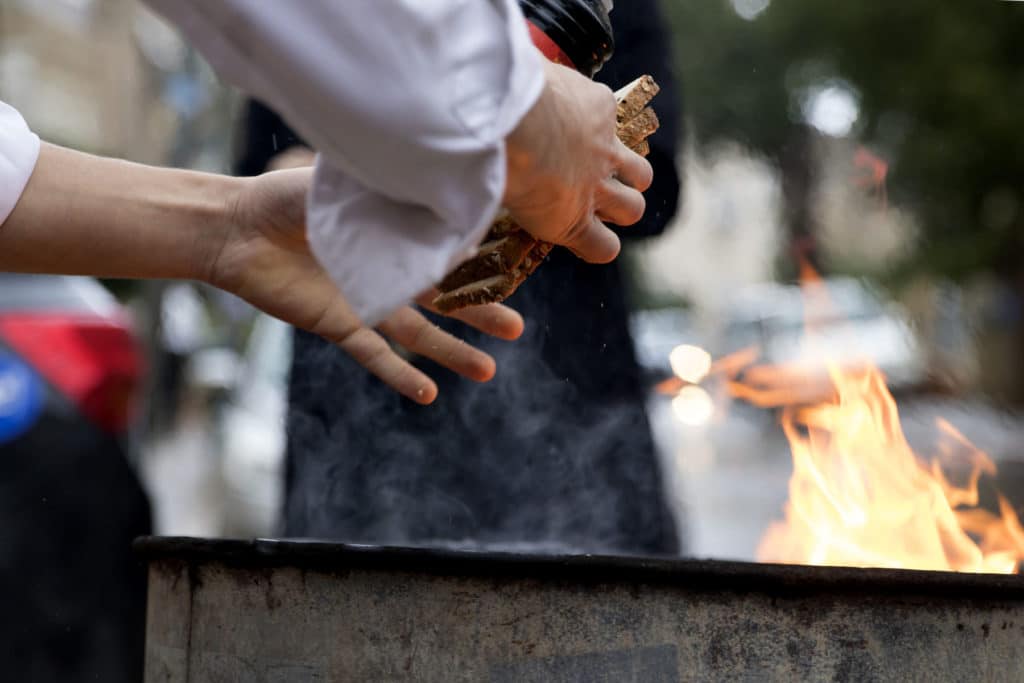
Passover brings a different kind of liberation. Last night, we searched through our homes for remaining pieces of chametz, leavened food. It’s the same food that today, we burn. Completely destroy. Only a few ashes left to remind us of its existence. Burning the chametz is an act that teaches there are some things in our lives that may never be forgotten, but should be consciously recognized, named and destroyed.
Oppression, racism, slavery. That’s the chametz recognized and named in the story of our people. The Pesach story is both collective and personal. We should each feel a deep desire to completely rid our souls of that which eats away at our essence. Rage, fear, questioning our purpose, shame, imposter syndrome, worthlessness and self-doubt. Lingering morsels of yeast that grow throughout the year. Hovering locusts that claim our character as it’s prize.
Biur chametz. The seder starts after we burn the chametz. After. We ritualize an extraction of that which plagues us. Naming our chametz and exclaiming, “I will not let this year hold me back from being me.”
Start this new year with a spring in your step. Let this Pesach be a collective and personal liberation. Set your soul free.
Shabbat Shalom and Chag Sameach
Rabbi Nicole Guzik is a rabbi at Sinai Temple. She can be reached at her Facebook page at Rabbi Nicole Guzik. For more writings, visit Rabbi Guzik’s blog section from Sinai Temple’s website.
One verse, five voices. Edited by Salvador Litvak, the Accidental Talmudist
These matters of the Paschal offering override Shabbos when Passover begins on Saturday night. -Pesachim 65b, B. Talmud
Rabbi Nathan Halevy
kahaljoseph.org
The laws of Pesach that fall after Shabbat are complex, as are the procedures of the Passover Sacrifice which only took place in the Temple. They performed certain parts of the sacrifice on Shabbat, whereas others were left till after Shabbat. The reasoning behind it all is quite complex.
The sacrifice, the sprinkling of the blood, the cleaning of the insides, and the burning of the fat, occurred on Shabbat. The roasting of the sacrifice would happen after Shabbat, as it is connected to human needs, and not Hashem’s. The cleaning of the insides had to occur close to the time of slaughter, in order for the innards of the animal not to become ruined. Although this is for our sake, it was allowed on Shabbat. Although halacha allows for the fat to burn all night, the Torah still says to burn it right away, related to treasuring of the mitzvot.
It is interesting that a Mishnah focused on what is permitted on Shabbat emphasizes cherishing mitzvot. Amidst the tremendous focus on details, we must constantly remember the love and passion we have for mitzvot. As Zohar states, “A Mitzvah performed without love and fear is like a bird without wings and unable to elevate.” Our Mishna demonstrates the care that must be put into important matters. We must think things through, and endeavor to make things happen at the right time. As Shlomo says “How good is a word in its proper time.”
Rabbi Cheryl Peretz
Associate Dean, Ziegler School of Rabbinic Studies at AJU
Abraham Joshua Heschel wrote: “The higher goal of spiritual living is not to amass a wealth of information, but to face sacred moments.”
Time is truly the essence and through time we achieve holiness and meaning. For Jews, Shabbat and holidays are each valued, but marked in different ways. So, what to do when two sanctified moments coincide, asking us to consider conflicting practices?
In the ancient world, Passover falling on a Saturday night meant the pascal lamb had to be prepared for sacrifice on the holiday eve. The Talmud audaciously states that this requirement superseded some Shabbat prohibitions and practices.
Animal sacrifice is no longer the central component of the Passover celebration, but Saturday night seder does still happen and will happen this very week. So, what do we do?
We search for and sell our hametz before Shabbat. Yet, our Shabbat observance still calls for bread for blessing. So, we use egg matzah or we reserve a contained amount of actual challah to be eaten before a specified time Shabbat morning. My personal favorite is the integration of the blessings for our Passover kiddush and Havdalah as we mark the end of Shabbat and the beginning of the holiday (the rabbis even offer a great acronym to remember the specific order.)
The goal is not to amass how-to instructions or to simply check off the to-do list. Rather, ancient sacrifice becomes a modern dance as we move between Shabbat and Pesach, creating meaning in each and strengthening both.
Nili Isenberg
Pressman Academy Judaics Faculty
Earlier this month my 7th grade students participated in a Moot Beit Din, debating issues in modern factory farming practices and possible tza’ar ba’alei chayim (causing pain to animals). The students explored our tradition’s ambiguous messages on this topic. On one hand, the Torah cares deeply about our animal friends. On the other hand, how do we explain the Temple service and its bloody rituals? Many have argued that the sacrificial service was a concession to the needs of ancient people that would not be reinstated in a future Temple, having been replaced by prayer.
But perhaps the Paschal offering has a different purpose. The discussion in the Talmud quotes Numbers 9:2, instructing Israel to “offer the Paschal lamb in its appointed time,” suggesting the possibility that this sacrifice overrides Shabbat because it is offered at a specific time: It is a reenactment of the dramatic story of our ancestors who killed the gods of their enemies in the middle of the night to profess their faith in deliverance from the one true God. This is experiential education of the highest order.
We can understand why Temple Mount activists have been profiled in the press in recent years for their excitement to slaughter sheep as a “general rehearsal” for the renewal of the Paschal sacrifice. However, over the years, we have in fact developed and refined an incredible intergenerational, multimedia, interactive ritual that fulfills our educational and experiential goals without killing a living being: It is the Passover seder.
Rabbi Michael Barclay
Spiritual leader, Temple Ner Simcha
In placing Passover observance over Shabbat observance, this law reflects the history of the Pesach being observed in the Torah prior to the commandment of Sabbath observance. But it is more than that: it is also the political foundation stone of this nation.
Passover celebrates freedom that is given to us by God. Shabbat is the personal expression of that liberty. This halacha reminds us that God gave us freedom, and only after recognizing that truth can we take advantage of this Divine gift through observing Shabbat.
The Declaration of Independence, and the country itself is based on this Talmudic understanding of these priorities. Jefferson beautifully expressed how it is God that endowed us with “inalienable rights,” including liberty, and that the purpose of government is to secure those rights with the consent of the governed. But like this Talmudic passage, our nation’s founders were clear. We must first recognize God’s hand in giving us freedom before acting upon that gift.
This passage is not just a reminder about necessary prioritizing for the religious purposes of Pesach and Shabbat. It is an important law for anyone who chooses to be politically active that they must always make sure that their activity is based in Divine principles. Otherwise their politics are not an expression of the freedom of Passover; but like Pharaoh, become an idol-worshipping of personal power.
May we all remember that freedom comes from God, and that all our actions need to be like Shabbat: an expression of God’s holy love in this physical world.
Salvador Litvak
Accidental Talmudist and Writer-Director of the Passover comedy When Do We Eat?
Before the Holy Temple in Jerusalem was destroyed, the centerpiece of the Passover seder was eating a piece of the Korban Pesach, the Paschal offering, a male lamb or a goat in its first year. It was slaughtered in the Temple precinct, then brought out to a seder site in Jerusalem where a group of people who had previously agreed to eat that particular animal would celebrate Passover together. Although slaughtering an animal is prohibited on Shabbos, that prohibition is set aside when Passover begins on Saturday night, as it does this year, because the Torah specifies that the Pesach must be brought in its “appointed time” and the time of its slaughter is always in the afternoon before Passover night.
During in the Second Temple period, it occurred that Passover had not begun on Saturday night for many years (possible then because the calendar was not fixed – new months began when the Sanhedrin received the testimony of witness regarding the new moon). The leaders were not sure whether the slaughter of the Pesach would override Shabbos or not. Enter the great sage, Hillel, who was then a young and recently arrived Babylonian Jew, who demonstrated that the slaughter does indeed override Shabbos, just as the slaughter of the daily sacrifice overrides Shabbos. They appointed him Nasi, head of the Sanhedrin, and he rebuked them for allowing the Torah scholarship to have fallen so low. Immediately, a question was brought which he himself could not answer: if the knife for slaughtering the lamb was not brought to Jerusalem before Shabbos, could it be carried in on Shabbos? He realized his arrogance in rebuking his elders had caused him to forget the answer, but he told them to observe how the common people behaved, and the answer was soon revealed: the knife could be transported in an unusual manner (by having the lamb carry it in its wool) without desecrating Shabbos.
This incident surely contributed to the development of Hillel’s famously kind and patient personality.
Table for Five: Passover First Days Read More »
The coach of a Massachusetts high school football team was fired on March 24 after the team used anti-Semitic slurs to call plays during a March 12 football game. The terms Duxbury High School reportedly used included “Auschwitz,” “rabbi” and “dreidel.”
John Antonucci, Duxbury’s superintendent, said in a statement that the school has “has severed ties with Dave Maimaron as Head Football Coach.” The game scheduled for March 26 has also been indefinitely postponed.
Robert Trestan, director of Anti-Defamation League New England, said in a statement to the Journal, “We welcome Duxbury Public Schools’ independent investigation into the deeply troubling allegations of antisemitism at the Duxbury Football program. Accountability and transparency are critical as the community moves forward. We look forward to learning of the ensuing facts and information in this case. ADL is ready to partner with Duxbury officials as they begin a new chapter in their school community.”
Liora Rez, director of the Stop Antisemitism.org watchdog, also said in a statement to the Journal, “We are happy to see Duxbury administration ultimately fire Coach Dave Maimaron for his antisemitic lexicon. Sanitizing the Holocaust and its atrocities must never be tolerated in American schools.”
StandWithUs CEO and co-founder Roz Rothstein tweeted that “the story makes me sick to my stomach, and makes it clear that Holocaust education goes hand in hand with being proactive about the fight against rising antisemitism.”
This story makes me sick to my stomach, and makes it clear that Holocaust education goes hand in hand with being proactive about the fight against rising antisemitism. What we know about Duxbury football team’s Holocaust-related play calls @standwithus https://t.co/o0DWBiw4dd
— Roz Rothstein (@RozRothstein) March 24, 2021
Massachusetts State Senator Barry Feingold, a Democrat, sent a letter to the Duxbury football team on March 24 inviting them to meet with him. Feingold explained that he used to play football and that he had never heard “Auschwitz” used as a play-calling term before.
“Football has played an incredible role in my life and helped me become who I am today. I want that same continued opportunity for you as well,” Feingold wrote. “I’m not looking to villainize you; instead, I think this moment could be an important learning experience.”
Prior to his firing, Maimaron had issued an apology stating that the terms used were “careless, unnecessary and most importantly hurtful on its face.” Maimaron had been the coach of the team since 2005 and has led them to five High School Super Bowls.
Duxbury High School Football Coach Fired After Team Used Anti-Semitic Slurs Read More »
The Religious Zionism party did surprisingly well in Tuesday’s national election, garnering a projected six or seven seats according to the exit polls.
Incumbent Israeli Prime Minister Binyamin Netanyahu will likely need the support of every Knesset member he can get if he is to assemble a 61-seat governing majority, including those of Religious Zionism.
The Religious Zionism electoral list consists of Knesset candidates from three parties running together in a “technical bloc” in an effort to pass the 3.25% electoral threshold for entrance to the legislature: the National Union-Tkuma faction (itself a merger of two parties), led by Bezalel Smotrich; Otzma Yehudit (“Jewish Power”), chaired by Itamar Ben-Gvir; and Noam, led by Avi Maoz. The latter two parties especially are considered extreme by many and are likely to soon split from Religious Zionism.
In addition, Netanyahu, to persuade Smotrich to run together with Otzma Yehudit and Noam and thus increase his chances of putting together a governing coalition, reserved a safe slot on the Likud candidates list for a member of Religious Zionism, guaranteeing it an additional seat in the Knesset.
Smotrich was arrested in 2005 during demonstrations against the disengagement plan to withdraw from the settlements in the Gaza Strip and was held in jail for three weeks but not charged. In 2006, he helped to organize the “Beast Parade” featuring barnyard animals as part of protests against the annual Jerusalem Gay Pride Parade. He has called himself a “proud homophobe.”
Noam’s raison d’être is to oppose LGBTQ rights.
Ben-Gvir was convicted in 2007 of supporting a terrorist organization and inciting racism for displaying posters proclaiming: “Rabbi [Meir] Kahane was right: The Arab MKs are a fifth column” and “Expel the Arab enemy.”
David Rosenstark, a high-tech worker from the Jerusalem suburb of Beit Shemesh and a Religious Zionism voter, says it is incorrect to characterize Religious Zionism as extremist.
“I believe that the Knesset is a place where voices should be allowed to be heard fairly even when they are not part of the consensus. People shouldn’t be forced to silence themselves or be pushed out,” Rosenstark told The Media Line. “Unless they’ve done something that entails them going to jail, everyone, whether they’re Arab or Jew, should be allowed in the [legislature].
“I’m voting for them mostly because I believe that in Israel, each sector has very few possibilities to protect its interests unless it has sectorial representation,” he said. “For good or for bad, that’s just the way things seem to work in Israel, and therefore it’s important that we have a party that represents the sector I belong to.
“I also believe this party stands for certain principles that are important to me: to protect the rights of people whose rights have been violated in various ways, whether it’s settlers losing their homes or not being treated properly,” Rosenstark said.
Still, he does not agree with all of the positions of the three parties that ran together in Tuesday’s election.
“The main party I associate with in this bloc to get into the Knesset is the party that used to be called the National Union. I believe that it was a tactical mistake not to stay with [Naftali] Bennett [and his Yamina party], and that would have been preferable to me,” Rosenstark said.
“I regard Noam as a necessary evil, as part of the politics of groups getting together. I don’t really support Noam. … As a religious Jew, I feel that it’s a complicated topic that’s not being handled correctly by Noam, but I can deal with the fact that they’re in my party, just as in any party there are people who have various views that are different,” he added.
“Politics is all about compromise, and [Otzma Yehudit leader] Ben-Gvir has his good and bad sides. … He has done a lot of good things on the other topics that are important to me, like when the human rights of right-wing youth have been tremendously violated and he’s there for them” as a defense attorney, Rosenstark continued.
When asked about Smotrich’s actions at the Jerusalem Gay Pride Parade, Rosenstark responded: “That was a long time ago and I can tell you [actor and comedian] Nadav Abuksis, who is homosexual himself [and who identifies as a right-winger], gets along well with Smotrich. … I think Smotrich regrets doing things in a crazy way, like referring to ‘the beasts.’ I don’t think he would say that today; people are entitled to grow up and mature.
“I’m not going to speak to what Smotrich did years ago, but what he said over the past few years while an MK is 100% representative of how I feel the situation with homosexuality has gone in Israel, where people are not entitled to other opinions or to state that they may not necessarily agree with everything,” he added.
“I think the violence, especially verbal violence, is more from the other side that doesn’t allow for other opinions,” Rosenstark said.
Dr. Gayil Talshir, of the Hebrew University of Jerusalem’s Political Science Department, disagrees, to say the least, about Religious Zionism.
“They are very extreme on three fronts: one is being homophobic, and they are very extreme religiously and nationalistically, so they want a Jewish religious state and not a democratic Israeli state with equality for the Arab citizens,” she told The Media Line.
Talshir added, however, that this does not mean that Israeli society is moving in this ideological direction.
“The vast majority of the Israeli population cannot stand these three extreme agendas and it’s just this unique situation that brought us to this moment,” she said.
Talshir said Netanyahu was driven to negotiate with parties out of the mainstream because the moderate and centrist parties will not join a coalition with him due to his legal woes, as the prime minister faces charges of bribery and corruption.
This has caused Netanyahu to act differently than he did in September 2019, when he first made an agreement with an extremist party, Talshir said.
“This is a pattern Netanyahu has invented and already used to get the more extreme right-wingers” into the Knesset, she said. “The Jewish Power party campaigned on its own, so around 20,000 votes were lost because they did not accept the offer that Netanyahu extended to them, which he wants to avoid this time.”
She noted that Netanyahu placed a candidate from Religious Zionism’s Jewish Home Party predecessor high on the Likud candidates list two election cycles ago, giving him a ticket to the Knesset. He had made an offer to the party, which it turned down, to run as a technical bloc with Otzma Yehudit. Neither party received enough votes to pass the electoral threshold.
This year, Netanyahu actively campaigned for Religious Zionism, a first for him, drawing criticism from some right-wing politicians.
The prime minister also bolstered the Islamist Ra’am party, which broke from the Joint List, in an effort to increase his chances of assembling a majority. But according to the exit polls, Ra’am will not enter the next Knesset.
“Netanyahu legitimized the Islamist party and now, for the first time in almost a decade,” it ran independently, and this was also because of the prime minister, Talshir said.
“You have to look at Netanyahu’s electoral difficulties and not necessarily deduce from them that the Israeli public is becoming more extreme,” she added.
There are international precedents, for example in France and Germany, for extremist parties to become “tamer,” Talshir said.
“You have, on the one hand, the way democracy tries to protect itself from extremists, nationalists, fundamentalists, and on the other hand, if they abide by the rules, they tend to become more moderate in one sense,” she said.
While Talshir is optimistic about the incorporation of these radical parties into the political system down the road, she says their participation now tarnishes Israel’s form of government.
“I think it is a sad day for Israeli democracy that such an extremist party is competing and probably passing the threshold, and I hope that it won’t be a feature of Israeli politics in the future but rather something that occurred because of the unique position of our prime minister who is undergoing a criminal trial,” she said.
Rabbi Susan Silverman, a candidate for the left-wing Meretz party, also hopes that mainstream parties’ interaction with extremism will be limited.
“Netanyahu is willing to make an agreement with anyone to keep him in power and out of jail, and if he is willing to make an agreement with fascists, with religious oppressors, with people who are out to minimize the humanity of other people, then that says everything about him and we should beware,” she said.
“Is that who we want to be? What are we willing to risk in terms of our emotions regarding security, which are not necessarily related to the reality of security, [for security] to be better? What are we willing to risk in terms of our emotions to be better? Who are we as a country and what is our purpose here on earth?” she asked.
Many Israelis agree with Rosenstark, as surveys ahead of the election had Religious Zionism receiving the same number of Knesset seats as Meretz, which is difficult for the rabbi to take in.
“For some reason in Israel, like in a lot of countries, we have associated cruelty and the oppression of the other as something that makes us safe, when actually the opposite is true,” she said.
“And not only is the opposite true, but we are obligated to behave toward human beings, whether it is our LGBTQ communities, the Arabs among us, or the Jews we disagree with in terms of their religious and cultural practices, to treat people with kavod [respect] and create a society of righteousness and justice and peace, and sometimes those are the things that take the most courage,” Silverman said.
“We clearly have not made our case well enough. I think a lot of us on the Left think it is self-evident that we were strangers in a strange land for most of our history…, that we were the minorities who were marginalized and hurt and so we [as Israelis] are not going to do that and will live our prophetic values at a very high level,” she told The Media Line. “But it’s not self-evident and we need to be better about making the case.”
Still, Silverman rejects the notion that Religious Zionism represents the Jewish sector in Israel.
“It doesn’t take a lot of courage to make sure that we are not mixing milk and meat, it doesn’t take any courage to observe Shabbat. What takes courage is to do what God told us more than … anything else, which is to treat people with justice and compassion and make ourselves feel vulnerable in doing so,” she said.
Talshir, however, is wary of likening the two political parties.
“I don’t think you can compare Religious Zionism to Meretz, because the [three right-wing] parties would not have passed [the electoral threshold] if they ran separately,” she said, explaining that instead, Meretz’s projected placement was more of a reflection of the increased threshold to get into parliament, which was raised from 2% in 2014.
“It became much harder because you need to have four mandates [to enter the Knesset], which means around 120,000 votes to pass the threshold, so this is why you see Meretz is struggling,” Talshir said.
In the event, both Religious Zionism and Meretz did better than expected in the initial exit polls, with each projected to have six or seven seats in the Knesset.

Israel’s Religious Zionism Party Exceeds Electoral Expectations Read More »
And so, we wait. We wait for the fourth time before we know if we are doomed to have a fifth election in three years. Prime Minister Benjamin Netanyahu, who seemed like a winner just yesterday, is experienced enough to know that winners are declared only when the last votes are counted. That means Friday. About 10 of the Knesset’s 120 seats are still waiting to be counted. This will take time and could change everything.
Why everything? Because as of now, the bloc that would support a Netanyahu coalition has 59 seats, and the bloc that would support his removal has 61 seats. After the missing votes are counted, we may have a symbolic 60-60 result. In many ways, a 60-60 result is what we deserve. A clear tie. A clear signal that we — Israeli voters — have failed again.
In many ways, a 60-60 result is what we deserve. A clear tie. A clear signal that we — Israeli voters — have failed again.
Our Talmudic sages called this inability to decide a Teiku. In the Middle Ages, the sages claimed that Teiku is an acronym for “Elijah, who will resolve unresolved matters” (in Hebrew it works). So we have to wait for an Elijah, or vote again, or count on one of our leaders to perform a political miracle. A 61-seat majority, such as the one the opposition has, is not a recipe for a stable coalition. A 59-seat minority, such as the one Netanyahu has, is even less of a recipe.
What are the options? One is for a very hawkish coalition to rely on the Islamist party Raam to form a coalition. Ideologically, that would be quite a feat, and many members of this imaginary coalition already vowed not to accept any such deal. Another option is for Netanyahu to find a few MKs who — for proper reward — agree to switch sides. Again, a difficult proposition. Another option is for Netanyahu’s opponents to form a coalition that stretches from the ultra-rightist Saar to the anti-Zionist Balad. That’s another unlikely feat, even when the glue of such a bloc is as strong as the temptation to unseat Netanyahu.
All this has to wait for Friday, for the final results. They could have meaning even if they just change the preponderance of power from 59-61 to 60-60; for example, by eliminating the option of a 61-seat anti-Netanyahu bloc move to take over the speaker’s seat and pass a law that prevents Netanyahu, who is in the middle of a trial, from running in the fifth election. No wonder Netanyahu instructed all Likud MK’s to cease from giving interviews. He does not want his party to commit to any specific position post-election (pre-election commitments are known not to be worth much). He wants all options open.
In Saar and Elkin, both of whom served Netanyahu as political operators, the PM finally found his match.
He wants them open, among other things, because of the rivals he is facing. The attempt of right-wing politicians to challenge Netanyahu did not produce much electoral success: The party of former Likud members Saar and Elkin will have five or six seats in the Knesset. But the game isn’t over yet. And in Saar and Elkin, both of whom served Netanyahu as political operators, the PM finally found his match. He knows that they know about politics almost as much as he does. He knows that they are aware of all his strengths and weaknesses. And they are nearly as charismatic as he is in campaigning. But Election Day is over, and now we brace ourselves for weeks of tricks and plots, back room deals and clandestine negotiations.
If this wasn’t depressing, it’d be fascinating to watch.
Israel Elections Update: The Waiting Game Read More »
Alexi McCammond has an impressive resume for a 27-year-old: A former political reporter for Axios, MSNBC and NBC, she covered the 2018 elections as well as the 2020 Biden presidential campaign. In 2019, the National Association of Black Journalists named her the emerging journalist of the year. This month, McCammond was set to start a new job as editor-in-chief of Teen Vogue. And then the skeletons in her social media closet emerged.
A decade ago, when McCammond was a teenager, she had posted “racist and homophobic tweets,” according to a statement by Teen Vogue staff. Those tweets included mentions of “swollen, asian eyes,” a “stupid asian T.A.” and “an old Asian woman.” She had also used slurs against gay people. McCammond apologized for the tweets in 2019 and removed them, but once her incoming position at Teen Vogue was announced, screenshots of those deleted tweets recirculated on social media. A 2011 Halloween photo of McCammond, in which she was dressed as a Native American, also resurfaced.
I hate what McCammond said about other people, but it’s times like these that I’m infinitely grateful that my refugee parents seldom invested in Halloween costumes when I was a kid (I grew up in the nineties, and people still dressed up for Halloween in Native American headdresses, Mexican sombreros and Japanese kimonos).
In fact, I’m eternally grateful that social media didn’t exist when I was in high school (1997-2001) because, by sheer virtue of having been a teenager, I seldom had anything mature or empathetic to say. I mostly spent my days studying for tests and trying to memorize lyrics from rap songs. Like many teenagers, I wasn’t exactly wise, and if I’d had access to public platforms like Twitter, I would have shot myself in the foot more than Elmer Fudd hunting in the dark.
For the record, McCammond’s comments were unequivocally wrong and, in her own words, quite “idiotic.” But whereas Condé Nast (Teen Vogue’s publisher) saw it fit to fire McCammond, I mostly saw offensive tweets from… a teenager.
I know it’s not a good excuse. But in McCammond’s case, we’re retroactively going after a then-seventeen-year-old. And I’m not sure I’ve ever met a teenager who didn’t accidentally (or purposefully) say something offensive or stupid — and often, at that.
Does this mean we let teens off the hook? Absolutely not, especially if their offensive language leads to bullying. But there should be gradients of punishment and accountability.
And now, I can’t help but ask: Will this argument get me in trouble? I’m deeply afraid of what I just wrote. Will friends who always thought I was a good person accuse me of defending a racist?
I believe in putting bullies in their place, but this agonizing fear makes me wonder whether we are all being held hostage by a few who threaten, on some level, to end our lives. We need to find a way to balance holding people accountable while also being liberated from paralyzing fear over saying the wrong thing.
I do hold by one standard, though: I’ll never fully believe in the validity of cancel culture if Alexi McCammond, Roseanne Barr and J.K. Rowling are cancelled, but Nation of Islam leader Louis Farrakhan, a proud anti-Semite and homophobe, continues to have 350,000 followers, a seat next to presidents and a net worth of $5 million.
In 2000, Farrakhan even admitted regret that his writings may have led to the murder of Malcolm X, who was killed in 1965 by three men with ties to the Nation of Islam. Two months before Malcolm X was killed, Farrakhan wrote, “such a man is worthy of death.”
Here’s the amazing part: After Farrakhan’s acknowledgement, Attallah Shabazz, the oldest daughter of Malcolm X, issued a statement thanking Farrakhan and saying, “I wish him peace.” Isn’t that incredible? We fire a once-ignorant teenager like Alexi McCammond, but Louis Farrakhan doesn’t even get cancelled for incitement to murder.
I recognize that the racism in McCammond’s tweets is especially relevant and dangerous today, as our nation is undergoing a terrible uptick in hate crimes against Asian Americans and continued struggles for the LGBTQ community. But I wish we could use McCammond’s mistakes as a teenager to teach a new generation of kids what not to do. It would be even better if McCammond could be part of that national dialogue. Her first order of business at Teen Vogue could have included giving more platforms to writers of Asian descent.
“You’ve seen some offensive, idiotic tweets from when I was a teenager that perpetuated harmful and racist stereotypes about Asian Americans,” she tweeted on March 10. “I apologized for them years ago, but I want to be clear today: I apologize deeply to all of you for the pain this has caused. There’s no excuse for language like that.”
It’s easy to believe a person whose views you loathe should be cancelled until you stumble, too. Christine Davitt, senior social media manager at Teen Vogue, was among the staff who voiced concern about McCammond. And then, tweets from 2009 resurfaced in which Davitt used the N-word. As the biblical adage says, Let she who is without sin issue the first cancellation.
It’s easy to believe a person whose views you loathe should be cancelled until you stumble, too.
Should McCammond have been denied her incoming position? I don’t think so. I really don’t like what she said, but she apologized even before the screenshots resurfaced. I don’t know why McCammond was let go, but Davitt still has her job. Did Davitt apologize more profusely? What does a cancelled woman have to do to crawl out of the hole we’ve dug for her?
I believe that McCammond will find another media position. But her past will continue to haunt her, and she now can count herself among the growing number of penitent souls whom I call “the unforgiven.”
There’s something terrifying about a lack of forgiveness. Like many people this past year, I had moments when I didn’t know whether I would live or die during this pandemic. But today, I no longer fear death; what I really fear is being cancelled.
Once you die, your hard work, career and countless Happy Hours with friends at the bar cease to exist. But when you’re cancelled in life, it’s a whole different story.
Unless your concept of the afterlife is torment, fire and pitchforks, there’s something to be said for the anticipated solace of wherever you end up after you die. I imagine the afterlife as a place where the soul is shown a mirror that reflects its high and low moments in life, and that soul will work for as long as it takes to make things right. Yes, in the afterlife, people who made racist comments as teenagers will have to make things right somehow. But I can’t help but wonder what sort of punishment awaits those who actually ruin other people’s lives over an offensive comment made decades ago.
I know this sounds morbid — maybe even crazy — but the afterlife sounds like a much more peaceful and compassionate place than the physical world. Given the terrifying disposability of those who’ve been cancelled in the past few years, I know this to be true: God is more forgiving than people. And that’s why I no longer fear death but life. God gives you a second chance; people cancel.
And if they don’t cancel you, they leave you in a career and social purgatory — a world where you’re never sure whether you’ll get another job or another friend, despite apologizing and self-nullifying to the point of metaphoric flagellation. At least in hell, you know where you stand.
At some point, if I haven’t done so already, I’ll probably say something offensive (and it’ll probably be about fellow Iranians). But every day, I’m learning. And every day, I’m trying. Without sarcasm or bitterness, if I make a terrible mistake, I preemptively ask for another chance to make things right. Please, don’t cancel me.
If I can still enjoy Nick Cannon as the host of “The Masked Singer” after his shockingly anti-Semitic comments last summer, maybe others can be forgiven, too. As Cannon said last week on ABC’s “Soul of a Nation”: “It’s not about cancel culture, it’s about counsel culture.” Cannon, who has even met with Jewish leaders such as Rabbi Abraham Cooper, associate dean of the Simon Wiesenthal Center, is trying to right his wrong.
And if God can understand and forgive, then surely we can, too. Life is for the living, but the cancelled are the walking dead. There’s already enough unknown about the afterlife. Let’s not use the blessing of life to create hell on earth.
Tabby Refael is a Los Angeles-based writer, speaker and activist. Follow her on Twitter @RefaelTabby
Will We Have to Cancel All Teenagers? Read More »