Ben Freed is a 5th (and final)-year rabbinical student at the Jewish Theological Seminary in New York City. Before rabbinical school he lived and worked in Ann Arbor, Michigan as a journalist, Uber driver, yoga instructor and Bar Mitzvah DJ while dabbling in tap dance and Jewish community organizing. As a Gladstein Fellow, Ben currently lives in Riverdale, New York and interns at the Conservative Synagogue Adath Israel of Riverdale. He is also the student rabbi of Congregation Agudath Achim in Little Rock, Arkansas.
In parshat Trumah the people of Israel are called upon to contribute to the building of the temple – gold, silver, copper, dyed wool, animal skins, and more. On Mount Sinai, Moses is given detailed instructions on how to construct this Temple. In the Sanctuary’s inner chamber, was the ark, containing the tablets with the Ten Commandments. In the outer chamber stood the seven-branched menorah. Outside the sanctuary stood the copper-plated altar.
Jews are called the People of the Book, an epithet which reveals much about our perception of God as an author. Indeed, we apply ourselves diligently to the study of God’s written works — the sacred histories, law codes and poems — but in Parashat Terumah, we are reminded that God is also a practitioner of the plastic arts. God is a designer and an architect — a shaper of material who is shaped by material.
“Let them make Me a sanctuary that I may dwell among them.” So speaks God to Moses before delivering elaborately detailed instructions for the construction of the Tabernacle, the portable sanctuary that will accompany the Israelites throughout their sojourn in the wilderness.
For those who seek a philosophically perfect God, this parashah presents a challenge. God, incorporeal, should require no home upon the earth. Such a structure would be an affront to God’s omnipresence — to the idea that God is spread thinly and evenly throughout the universe.
So how are we to understand God’s insistence on a sanctuary? Does it mean that the Infinite One is finite in spacetime? Does it mean that the Creator can be housed by the Created? Does it mean that God is smaller than a breadbox?
Maimonides, steeped in the philosophical framework of Aristotle, would abide by no such notions, and explicated that the commandment to make God a sanctuary was one of purely practical import, addressing the need for a designated space for the offering of sacrifices and the like.
Rashi, meanwhile, taught that the construction of the Tabernacle was only commanded because of the Israelites’ addiction to idolatrous practices. Drawn to idols of gold and silver, God tossed the Israelites a shiny sanctuary to satisfy their cravings. The Tabernacle was thus a transitional item designed to ease the Israelites’ psychic growing pains as their consciousness evolved.
But perhaps God had another angle in commanding the Tabernacle. And perhaps a Maimonidean concept of God is unhelpful when trying to unpack the mystery of this sacred structure. After all, a philosophically perfect God lacks the biblical God’s dynamism, personhood and capacity for intimate contact with human beings. And besides, we know from experience that God is indeed in some places more than others.
Sometimes these places are vast and open — a stretch of plain under a wild sky. Other times they are intimate and portioned off — a forest glen or a quiet room. Often, they are natural places, though they might just as well be sanctuaries, like synagogues or cathedrals. Sometimes the holiness of these places seems attributable to their very hiddenness, to the fact that we alone have stumbled upon them. Other times their holiness seems attributable to the communal and historical bonds that are knotted up within them.
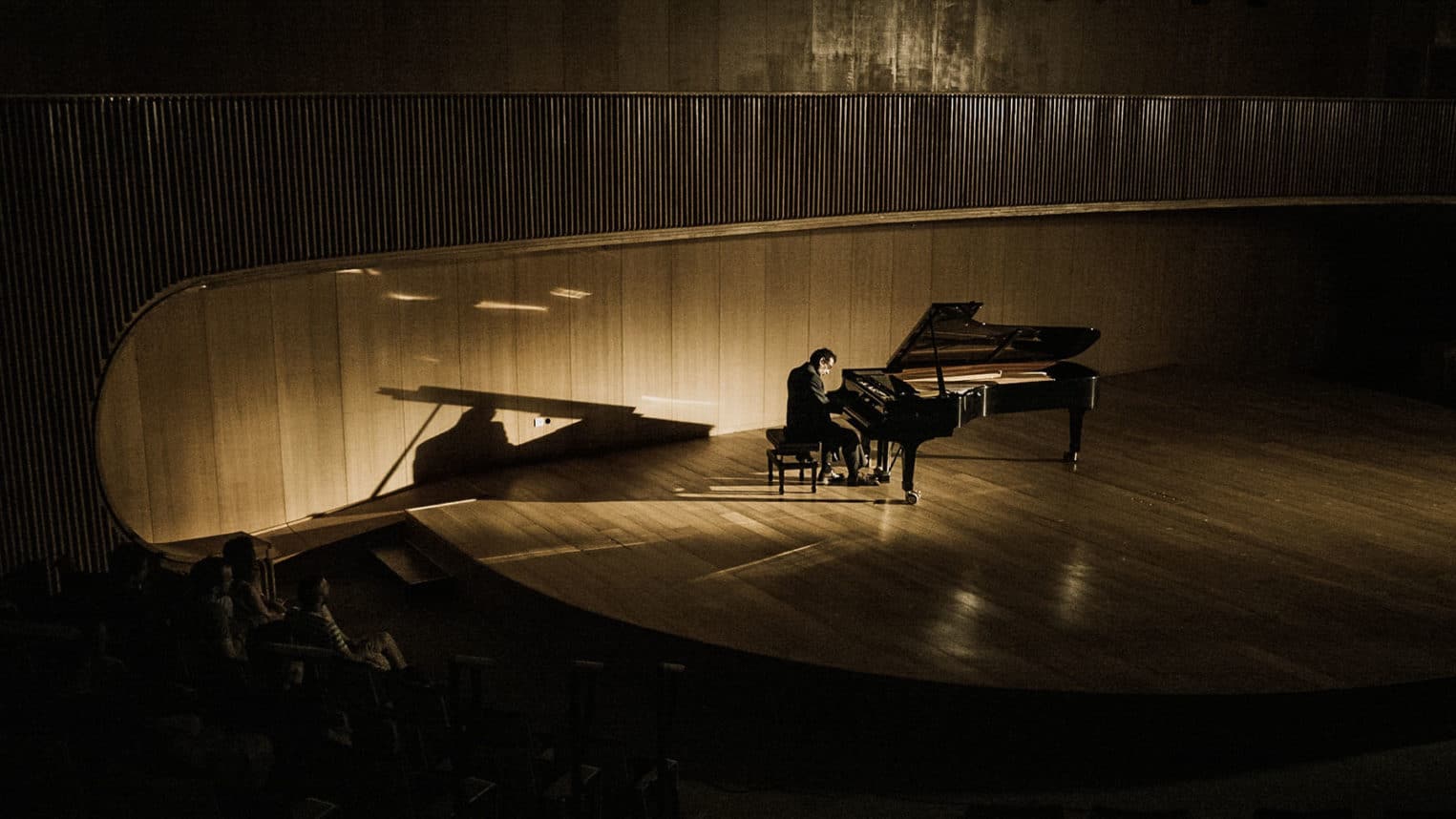
In the same way that the hollow of a drum or the chamber of an acoustic guitar gives shape to the instrument’s sound, the internal architecture of these sacred places determines the way we will experience God within them.
the internal architecture of these sacred places determines the way we will experience God within them.
For this reason, the God of Parashat Terumah seems to be deeply concerned with details of acoustics. In the innermost chamber of the sanctuary, God commands the creation of two golden Cherubim above the ark of the covenant. From between these Cherubim, God will speak to Moses. “Their wings will be spread upward,” God commands. “The Cherubim will shelter the cover of the Ark with their wings.”
We can picture the curvature of those golden wings, forming a miniature bandshell in which the Holy Voice can reverberate. Surrounding this central concavity, the sanctuary spreads outward in concentric layers of enclosure, culminating in the curtains of twisted linen which circumscribe the outer courtyard.
In creating an acoustic chamber for the music of revelation, God is relieved of the need to shout from the mountaintop. He can now speak from within the very midst of the people.
Built in the Sinai wilderness, the Tabernacle will impose a sacred geometry on the undifferentiated and shapeless desert landscape. It will also give shape to the undifferentiated omnipresence of God, providing Him a vessel in which to become a living presence known intimately by His people.
Matthew Schultz is the author of the essay collection “What Came Before” (2020). He is a rabbinical student at Hebrew College in Newton, Massachusetts.
Definition of a Greek Tragedy: “A play in which the protagonist, usually a person of importance and outstanding personal qualities, falls to disaster through the combination of a personal failing and circumstances with which he or she cannot deal.” — Collins English Dictionary.
Viewing the finely executed Israeli film “God of the Piano,” written and directed by Itay Tal, through the lens of a veteran parent disability advocate seems like a non-starter.
For one thing, there’s the establishing overhead shot of a pregnant woman’s fingers playing classical music during a concert, and then we see her amniotic fluids drip out onto her nice shoes under the piano, making it clear that mastering — no, conquering — the 88-keys is the sole religion of Anat Tal and her extended musical family. There is no place for anyone who is not a virtuoso, let alone someone who is “defective.”
Parados (entrance of the Greek chorus)
Anat’s father, Arieh Marom, is piano composer and instructor with exacting standards that are impossible for Anat to obtain. She transfers her driving ambition into her newborn baby boy. Meanwhile, her husband is distant and seems to be having an affair, absent at the time of the birth. Can her son’s dazzling pianism provide the path to her father’s love? And why are these Israelis so uncharacteristically tight-lipped? The film itself has the texture of a ballet, with muted colors framing the music and movements and very few spoken words.
Episode (Main action)
Anat’s baby boy is a healthy newborn with all ten fingers and toes, but routine testing shows a potential hearing issue. He might even be deaf. Spoiler alert: Out of desperation to raise a musical prodigy, Anat switches her baby for another in the hospital nursery.
On the drive home from the hospital, Anat’s husband asks her if she’s told anyone about the baby’s possible deafness. No, of course not. He signs them up to learn sign language at the “Silent Speaking” institute, which they never attend because at his one-month checkup, Idan’s hearing is better than normal. What a relief!
The next time we see Idan, he is around 7 or 8, and already playing Bach’s Prelude beautifully, getting ready for his first concert. Then, the action shifts to Idan’s 12th year, when he is getting ready to apply for the most prestigious music conservatory in Israel, a place where budding pianists from abroad compete to attend. Tiger Mom Anat will do anything to get Idan into the conservatory, including having an affair with the number one pianist in Israel so he will mentor Idan.
Of course, there are twists in the journey to musical greatness, as Idan starts to rebel — he wants to be a typical video-playing teen and go on a class overnight trip. Destiny, like water, seems to be slipping away from Anat no matter how hard she grasps it.
Stasimon (Greek Chorus comments on the episode)
When Anat’s baby appears to be deaf, I internally cheered — maybe this would turn out to be a heartwarming movie about the acceptance of a deaf child? How wonderful it would be to show Israel’s musical elite embracing human diversity? Perhaps the baby grows up to be a musical genius despite his deafness, like Beethoven, sensing the minutest of vibrations?
Alas, this film is a bloodless tragedy, not an inspirational feel-good film. It was gut wrenching for me to watch Anat swap her beautiful newborn baby for one who responded to sound, rejecting her own flesh and blood for what she thought would be a “normal” baby.
And Anat ultimately suffers for her deception. Throughout the 12 years depicted in the movie, Anat receives periodic fundraising phone calls from the Silent Speaking charity (kudos to them for long-term donor engagement!), which trigger her back to that first unforgivable sin at the hospital. Anat eventually visits the Silent Speaking campus and meets with the Developmental Director, who drops her from the fundraising list, but not before seeing Anat’s address and noting that they are neighbors.
Anat keeps coming back to the Silent Speaking campus, seeking out a 12-year old who looks more like her than her “own” Idan. By the end, her husband and son don’t want to speak to her, and her dreams of creating a master pianist turn to dust. The curtain falls and we are left devastated, hoping that other future families in a similar situation will be able to accept, maybe even embrace the many plot turns that happen in all of our lives.
None of us, even the most talented and exceptional, can escape or outrun random happenstance, illness and, inevitably, death. Perhaps the real tragedy here is that although Anat is ready to do everything for her chosen son, in the end she has nothing.
“God of the Piano” is directed and written by Itay Tal and stars Naama Preis, Andy Levi, Ze’ev Shimshoni, Ron Bitterman and Shimon Mimran. Run time is 1 hour 20 minutes.
Michelle K Wolf is a parent disability advocate and the Founding Executive Director of JLA Trust & Services https://jlatrust.org/.
Coronavirus is a new pandemic, but anti-Israel bias and anti-Semitism represent an age-old illness with modern mutations. One of those mutations is when anti-Semitism is disguised as anti-Zionism, and it was on full display in Orange County this month.
On February 9, the student government at University of California, Irvine (UCI) passed a resolution to divest from companies that work with Israel. The text of the measure claimed that it was in “no way related to Judaism.” Yet the primary goal of the Boycott, Divestment and Sanctions (BDS) movement on campus is to intimidate Jewish students from taking pride in their religious identity and from being deeply connected to Israel.
At UCI, California State University, Fullerton (CSUF) and Chapman University — the three Orange County campuses where I serve as a Jewish Agency Israel Fellow — the environment for Jewish and pro-Israel students can be challenging but is generally positive. Although anti-Israel incidents occur each year, our campuses are places where Jewish students feel comfortable and can speak their mind. Since the pandemic began, there has been a dearth of all forms of activism on campus and with that, a decline in anti-Israel activity, notwithstanding the recent passage of the pro-BDS resolution at UCI.
Photo by Allyunion/Wikimedia Commons
That said, more than a decade later, the UCI school administration and the broader Orange County Jewish community still remember the high-profile incident in February 2010, when anti-Israel students disrupted a speech on campus by then Israeli Ambassador to the United States Michael Oren. What happened that day shook me to the core, much like last week’s jarring BDS resolution. Once I found out that I would serve as a Shlicha (Israeli emissary) on the UCI campus, I felt a profound sense of responsibility to create a safe haven for Jewish students to come together, share ideas and be proud of their identity.
Fortunately, despite the new resolution at UCI, BDS isn’t particularly active on our Orange County campuses. One indicator of this increasingly tolerant environment came last year, when the UCI student government voted to repeal a separate resolution (originally passed in 2012) that had also called for the school to divest from firms that conduct business in Israel. At the time, I took pride in the fact that the student who wrote the text of the resolution to repeal the 2012 measure is an active member of Hillel and attends our Israel education events on a weekly basis.
Even though the student government has now passed a new divestment resolution, the UCI administration’s response marked another positive development. The administration issued an unambiguous statement that the new BDS measure “has no impact on UCI’s operations, does not reflect the university’s views, and is not aligned with the investment policies of the University of California.” We appreciate the administration’s efforts, as described in its statement, to oppose boycotts of Israel and create “specific initiatives to address anti-Semitism and anti-Semitic forms of anti-Zionism.”
The UCI administration’s response to BDS marked another positive development.

Yet I see “victory” not only when it comes to countering anti-Israel sentiment, but also when I see students actively and passionately engage in learning about Israel. Hillel staffers work to forge personal connections with Israel by running a weekly virtual discussion on current events and making ourselves constantly available for one-on-one conversations with students.
I continue to take pride in how the Jewish and pro-Israel students on our campuses refuse to be ashamed of their identity. The new BDS resolution will not intimidate us. We will not be ashamed of our connections to the one and only Jewish state.
Maya Vorobyov is the Jewish Agency Israel Fellow at the Hillel Foundation of Orange County.