fbpx

February 10, 2021

UIUC Student’s Israeli Flag Egged

An Israeli flag draped over a University of Illinois Urbana-Champaign (UIUC) student’s balcony was egged on February 8.

WCIA reported that the student, Jeremy Zelner, heard something hit one of his apartment windows at 1:00 A.M., and he found that 10-20 eggs had been thrown at the flag.

“This was a hateful and Anti-Semitic act aimed at Jews,” he wrote in a Facebook post. “This is disgusting and unacceptable. There is no room for hate crimes in the United States against anyone, regardless of skin color, opinions, religion etc.”

At around 1 AM om February 8th, 2021 in Champaign, Illinois, eggs were thrown at our apartment complex at our Israeli…

Posted by Jeremy Zelner on Monday, February 8, 2021


Zelner also told WCIA that he hopes the incident garners a lot of attention and that the flag will stay on the balcony. “We’re very in tune with the conflict, we understand what’s going on. We are people that are very welcoming to the conversation about it. And so, you know, I am very proud of being a Jewish person. I’m very proud of my friends who are Jewish as well. And we have conversations, we talk about it. And, you know, it’s important to have those conversations.”

Erez Cohen, executive director of UIUC Hillel, told WCIA that the incident was “clearly targeting someone for their national origin or for their ancestral identity… it’s a form of discrimination that we should not have on our campus or in our town. There is no room for hateful vandalism anywhere, especially in a town that really tries to be as diverse and as welcoming as possible.”

Jewish groups condemned the egging.

“StandWithUs strongly condemns this hateful attack against Jewish students based on their identity and connection to Israel,” StandWithUs CEO and co-founder Roz Rothstein said in a statement. “No student should feel that they need to hide their Israeli flag due to fear of discrimination. We call on UIUC’s administration to take all necessary steps to respond to this act of hate and prevent similar discrimination going forward. We are proud of Jewish and pro-Israel students who are standing up for their community in the face of this unacceptable incident.”

Liora Rez, director of the Stop Antisemitism.org watchdog, also said in a statement to the Journal, “We are horrified to see yet another antisemitic incident occurs at UIUC. What will it take for the school administration to step up and do something significant to finally stop the ongoing antisemitism happening on their campus?”

Jack Saltzberg, president and founder of The Israel Group, similarly said in a statement to the Journal, “I’m sorry to burst the bubble of those who think there’s a separation between Israel and Jews. There isn’t. An attack on an Israeli flag is an attack on all Jews. It’s only camouflaged better than most hate crimes are.”

A university spokesperson told the Journal that the vice chancellor of Diversity, Equity and Inclusion will be issuing a statement addressing the matter.

In November, the Department of Education’s Office of Civil Rights announced that they would be investigating a complaint that the university hasn’t properly handled anti-Semitic incidents on campus. Prior to that, the university had issued a statement acknowledging that “for many Jewish students, Zionism is an integral part of their identity;” the university also announced that they will be establishing an Advisory Council on Jewish and Campus Life, implementing educational programming on anti-Semitism and re-evaluating their procedures for handling instances of anti-Semitism and other forms of discrimination on campus as part of their efforts to combat anti-Semitism on campus.

UPDATE: Sean C. Garrick, vice chancellor for diversity, equity & inclusion, wrote in an email to the campus community, “We cannot allow disrespectful and hostile acts such as this to happen without comment and condemnation. Anonymous, targeted vandalism of expressions of personal and national identity create a climate of fear and distrust, threatening a sense of inclusion and safety that is foundational to our campus community. It is our responsibility to speak together to say loudly and clearly that this behavior is antithetical to the values of our university, and that anti-Semitism in any form will not be tolerated.”

UIUC Student’s Israeli Flag Egged Read More »

The Historical Problem with Poland

The International Holocaust Remembrance Alliance (IHRA) launched a new website last month titled “Protect the Facts” for the purpose of addressing Holocaust “distortion.”

“Distortion” is not quite the same thing as “denial.” The claim that the Holocaust is a fabrication is a wicked lie that is relatively straightforward to counter. Not quite so easy to deal with are the “distortions”—revisionist accounts of the Holocaust that don’t question the basic event, but do question key aspects, for example, by minimizing the number of victims slaughtered by the Nazis, or by posthumously honoring Nazi criminals and their local collaborators as national heroes.

No. 1 on a list of 10 characteristics of Holocaust distortion assembled by the IHRA emphasizes that minimizing the role of “collaborators and allies of Nazi Germany” is very much included. The trend of doing precisely that has swept Eastern Europe for more than a decade, resulting in government-led protestations from the Baltic states to Poland and Hungary that it was “the Germans”—and only the Germans—who were responsible for rounding up and murdering their Jewish “fellow citizens.”

Holocaust distortion is nothing new, however. Indeed, the trauma of the Shoah was still registering among the survivors when the Soviet Union, under the direct instructions of Joseph Stalin, decided to expunge any specifically Jewish element from the official narrative of the “Great Patriotic War.” During the nearly 50 years of Communist Party rule that followed, the very word “Holocaust” was absent from Soviet historiography, dismissed as a “Zionist” construct that placed a “chauvinistic” stress on the particular sufferings of Jews at the hands of the Nazis.

In tandem with the insistence that Jews were no more persecuted by the occupiers than any other nationality, the Soviets came up with another insidious myth: that “Zionists” had actively collaborated with the Nazi oppression of the Jews to the point that they were equally culpable for the massacres that followed. This line was eagerly swallowed up the Arab world, and then by large sections of the western left, as part of the ideological offensive against Israel and Zionism during the Cold War. And, of course, it is still in circulation today, alongside more recent variations on the same theme—that Israel treats the Palestinians like the Nazis treated the Jews, that Israel manipulates the Holocaust to milk European governments for reparations payments, and so on and so forth.

History is always rich with ironic episodes, and the spectacle of fiercely anti-Communist nationalist politicians playing the same deceitful games with Holocaust memory as the Stalinist bureaucracies they overthrew 30 years ago is certainly one of those.

Again and again, Poland and its nationalist government have been at the heart of this increasingly painful turn of events. And Poland is an especially interesting case of Holocaust distortion because the government has generated a series of harmful revisions about the Holocaust that rest upon two indisputable facts.

Poland is an especially interesting case of Holocaust distortion because the government has generated a series of harmful revisions about the Holocaust that rest upon two indisputable facts.

Fact one: Poland was under the direct control of Third Reich after the German invasion of 1939; the Nazis did not install, and were not assisted by, a local puppet regime, as was true for France, Croatia, Romania and other occupied nations. Fact two: Poland experienced a distinctly brutal fate under the Nazis, reduced to a slave status that took the lives of nearly 2 million non-Jewish Polish civilians.

These two sobering facts have been stretched and twisted by the government and its supporters to determine that Poland underwent the very same Holocaust that was inflicted upon the Jews. And since 2018, any historian who asserts “publicly” that “the Polish Nation or the Republic of Poland is responsible or co-responsible for Nazi crimes committed by the Third Reich” can become the subject of a civil lawsuit.

Currently, two distinguished historians, professors Barbara Engelking and Jan Grabowski, are on trial for their 2018 jointly authored study “Night Without End,” which examines the fate of Jews who escaped into the Polish countryside during the occupation, many of whom were delivered into German hands by Polish collaborators. The trial of the two scholars has been decried by Holocaust experts around the world, including Israel’s national memorial, Yad Vashem, which denounced the legal proceedings as “a serious attack on free and open research.”

In an even more sinister development, on Wednesday of last week, the editor of the website Jewish.pl—an indispensable source of news and features about Jewish life in Poland—was called in for questioning by police in her home town to answer for an article she wrote last year about the Holocaust.

An anonymous complaint to the public prosecutor against the journalist, Katarzyna Markusz, accused her of violating Article 133 of the Polish constitution in her piece. That article states: “Whoever publicly insults the Nation or the Republic of Poland shall be subject to the penalty of deprivation of liberty for up to 3 years.”

At issue was a passage in Markusz’s article that poignantly asked: “Will we live to see the day when the Polish authorities also admit that hostility toward Jews was widespread among Poles, and that Polish complicity in the Holocaust is a historical fact?”

During her questioning by police, Markusz was asked by one officer whether it had been her intention to “offend” the Polish nation (“Of course, not,” was her answer). The fact that police officers in a European Union member state are even asking questions like these speaks to the climate of illiberalism that prevails in Poland more broadly. What it suggests is that, if anything, the mood is hardening, and that more libel trials pushing the message of Polish absolute innocence during the Holocaust can be expected.

We may be coming to a point where further discussion and debate with the Polish authorities becomes fruitless, and that will pose an uncomfortable challenge to the custodians of Holocaust memory. Poland was the epicenter of the Holocaust, and it’s impossible to imagine the process of memorialization without it—the land where the Germans sited mass extermination camps like Auschwitz and Treblinka, and where Jewish resistance fighters, in 1943, staged a historic armed uprising in the Warsaw Ghetto. But if its present government continues to force its dangerous and historically flawed interpretations of the Holocaust upon the rest of the world, then we are entitled to ask whether this same government can continue to be a partner in the ongoing duty of commemoration.


Ben Cohen is a New York City-based journalist and author who writes a weekly column on Jewish and international affairs for JNS.

The Historical Problem with Poland Read More »

Giraffes and Liars

In all the world the tallest of all creatures
is the giraffe, which is as tall
as tales told by liars, or by teachers
to hide their ignorance from all.

Their height will often reach to twenty feet,
their necks erect, by them held high,
but it’s unlikely that you’ll ever meet
a specimen that tells a lie.

Giraffes are therefore creatures you can trust,
unlike those for whom if you stretch
your credence like their necks, you’ll bite the dust,
and eat your words, truth-wrecking wretch.

Although I’ve heard giraffes are kosher I
oppose a shochet’s right to slaughter
them as much as telling any lie,
which don’t forget, you never oughtta.

The only mammal that’s already born
With horns: our graceful, gauche giraffe.
The lie that Jews are born that way they scorn,
Responding, “Please! Don’t make me laugh!”

Gershon Hepner
2/10/2021


Gershon Hepner is a poet who has written over 25,000 poems on subjects ranging from music to literature, politics to Torah. He grew up in England and moved to Los Angeles in 1976.  Using his varied interests and experiences, he has authored dozens of papers in medical and academic journals, and authored “Legal Friction: Law, Narrative, and Identity Politics in Biblical Israel.” He can be reached at gershonhepner@gmail.com.

Giraffes and Liars Read More »

Our Morals Should Compel Us to Take the COVID-19 Vaccine

(JTA) — A poll released last week by Monmouth University showed that 24% of Americans likely will never get the COVID-19 vaccine if they can avoid it. One hopes that as people have more information and know others who have been vaccinated without ill effects, they will change their minds.

Education and encouragement are the most reliable tools we have in our increasingly libertarian democracy — our government will barely ask us to wear masks, let alone require us to subject ourselves to a jab in the arm. In the absence of a government mandate, we would do well to consider our moral obligations.

The Torah insists that we take an active role in the rescue of those in danger. “Lo taamod al dam re’ekhah” (Leviticus 19:16) — Do not stand by the blood of your fellow — means that should a passerby spot someone in trouble, they are obligated to try and help them. Passivity in the face of danger is not an option. Intervening will always entail some degree of risk, but that doesn’t lessen the obligation to act.

Many countries in Europe and Latin America insist on a similar duty to rescue. In Quebec’s Charter of Human Rights and Freedoms, the obligation is explicit: “Every human being whose life is in peril has a right to assistance. Every person must come to the aid of anyone whose life is in peril, either personally or calling for aid, by giving him the necessary and immediate physical assistance …”

In the United States, however, there generally is no such duty. Even if a state has a Good Samaritan law, the edict typically serves as an incentive rather than an obligation. By protecting a bystander who intervenes from potential legal action, the law encourages intervention in cases where a person’s life may be in danger. But the failure to intervene is by no means criminal.

We Americans have been conditioned to think of our own liberties and well-being. We have a patient’s bill of rights at the doctor’s office and a passenger’s bill of rights in the car that takes us there. Ours is a world of entitlement rather than a world of duty. The notion of an obligation to proactively come to the aid of our fellow citizens sounds like a foreign concept.

Whether and to what extent individuals might refuse treatments that preserve or protect their own wellness might be open to some debate. And while the law might not require intervention, there is simply no moral justification for neglecting the affirmative obligation each of us has to proactively help others when they face mortal danger.

The threat of coronavirus is real, it’s imminent and millions of people are now standing directly in harm’s way. When lives are on the line, the Torah’s ethics do not countenance nonfeasance. Refusing to receive the vaccine is tantamount to standing idly by while another person is being assaulted. If achieving herd immunity will save lives – and there is no doubt that it will – then each of us has a responsibility to help our nation achieve that goal. To shirk that responsibility is to fall woefully short of what the Torah expects of us.

Refusing to receive the vaccine is tantamount to standing idly by while another person is being assaulted.

But what of the unknowns? What of the risks? None of us can lay claim to prophecy. But we can lay claim to scientific data. Among the vaccines now being distributed in the United States, tens of millions of doses have been administered. The number of adverse reactions is so infinitesimally small that speaking of risk with respect to the vaccine is a misnomer. On questions of science, we rely on our medical experts — and those experts have spoken with one voice.

Our state won’t compel us to get the vaccine. But our conscience should. Living in a civilized society isn’t a free lunch. Every once in a while it comes with a moral obligation. We walk around with the expectation that were we in trouble, someone would come to our aid. With trouble looming for others, let’s hold up our end of the bargain and come to theirs.


Rabbi Yosie Levine holds a doctorate in Early Modern Jewish History from Yeshiva University and is the seventh rabbi of The Jewish Center on Manhattan’s Upper West Side.

Our Morals Should Compel Us to Take the COVID-19 Vaccine Read More »

Steven Spielberg Named 2021 Genesis Prize Laureate

The Jewish people have spoken this year and have deemed Steven Spielberg — known for his iconic films including “Schindler’s List,” “Jurassic Park” and “Jaws” — as the recipient of the 2021 Genesis Prize.

Announced on February 10, the Genesis Prize Foundation (GPF) recognized the filmmaker’s commitment to Jewish values, extraordinary contribution to cinema, dedication to preserving the memory of the Holocaust and preventing future genocides.

The annual $1 million Genesis Prize, dubbed the “Jewish Nobel” by TIME magazine, honors extraordinary individuals for their outstanding professional achievement, contribution to humanity and commitment to Jewish values.

For the first time in its history, voices of the global Jewish community played a major role in Laureate selection. Two hundred thousand Jews on six continents cast their votes for the 2021 Laureate; millions more engaged on social media. Although the Prize Committee made the final decision, the overwhelming majority of votes going to Spielberg helped make him the ninth Genesis Prize honoree.

Two hundred thousand Jews on six continents cast their votes for the 2021 Laureate.

“The Genesis Prize celebrates Steven Spielberg’s unique talent, his commitment to making the world a better place and his unparalleled contribution to teaching the post-war generations about the horrors of the Holocaust,” Stan Polovets, co-founder and chairman of GPF, said. “We are delighted to welcome Steven Spielberg to the distinguished family of Genesis Prize honorees, which includes such luminaries as Justice Ruth Bader Ginsburg, Natan Sharansky and Michael Bloomberg.”

This is the latest in a series of prominent awards awarded to Spielberg. He was the recipient of the Presidential Medal of Freedom, the highest civilian award of the United States; Legion d’Honneur, the highest order of the French Republic and Germany’s Federal Cross of Merit. In 2001, Queen Elizabeth II appointed Spielberg as an honorary Knight Commander of the Order of the British Empire. In 2013, he received Israel’s Presidential Medal of Distinction from Shimon Peres for his work to preserve the memory of the Holocaust.


Spielberg’s films have grossed $10 billion worldwide, making him the highest-grossing director and producer. He’s a three-time Oscar winner, three-time BAFTA winner, six-time Golden Globes winner and four-time Emmy winner.

“Spielberg is a great Jewish visionary and storyteller,” said human rights activist Natan Sharansky, who was awarded the Genesis Prize in 2020. “Key Jewish themes are often woven into his narratives: importance of identity and belonging, maintaining humanity in a ruthless world, caring for the other and honoring the moral obligation to do the right thing. His talent makes them universal: told by Spielberg, these stories come alive in people’s hearts across the globe.”

In addition to his cinematic success, Spielberg’s philanthropic efforts have impacted communities locally, nationally and globally. In 1994, following the success of “Schindlers List,” he founded the USC Shoah Foundation with a $10 million grant to make audio-visual interviews with survivors and witnesses of the Holocaust. To date, the Foundation has conducted 55,000 interviews in 32 languages with survivors from 56 countries. The Foundation is also working to preserve the memory of other genocides in Cambodia, Armenia and Rwanda. The foundation is financed with proceeds from “Schindler’s List.”

Also in 1994, Spielberg founded the Righteous Persons Foundation to recover and preserve Jewish stories from the past and build a contemporary Jewish community. The Foundation provides extensive philanthropic support to a wide range of Jewish organizations such as Moishe House, Jews of Color Initiative and the Anti-Defamation League.

He also co-founded Starlight Children’s Foundation to help improve the quality of life for children with life-threatening conditions; donated $30 million to the Motion Picture and Television Fund to provide healthcare and assistance to older people who worked in film and television and supported the American Heart Association, the Children’s Diabetes Foundation, Planned Parenthood of Los Angeles, Teddy Bear Cancer Foundation and the UCLA Foundation towards medical research. He has financed construction of a 13,000 sq. ft microbiology lab at the Cedars-Sinai Medical Center in Los Angeles and pediatric programs at the hospital. Most recently, he has donated $500,000 to the gun control initiative March for our Lives and $500,000 to support COVID-19 relief in the Los Angeles area.

Isaac Herzog, chairman of the Jewish Agency for Israel and chairman of the Genesis Prize selection committee said that Spielberg is an example of great Jewish talent, worthy of this award.  “[His] extraordinary work in film and philanthropy is infused with the values of his people — a quest for justice, compassion, humanism, and a heartfelt desire to make the world a better place,” Herzog said.

Steven Spielberg Named 2021 Genesis Prize Laureate Read More »

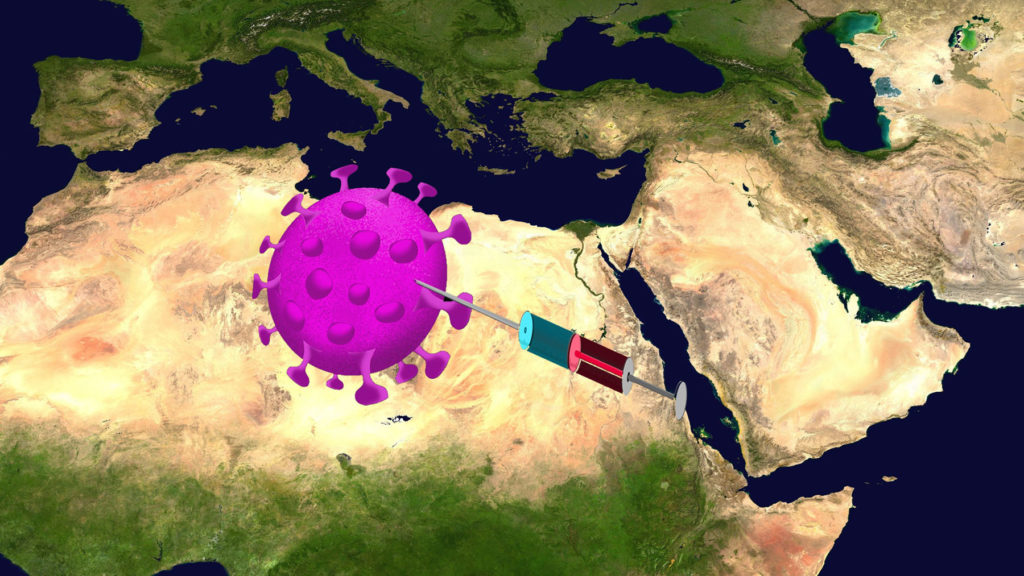
It’s West Versus East in the Battle to Inoculate the Mideast

(The Media Line) — The next frontier in the East-West rivalry lies in vaccines against the coronavirus, particularly in the Middle East, where Moscow and Beijing are striving to expand their influence since the United States has scaled back its involvement in recent years.

Foreign policy objectives are being injected into the vaccine distribution process by both the providers and the recipients of the vaccine doses. In some countries in the region, deciding which vaccine to use is only the beginning of the politics involved in getting shots into people’s arms.

With not nearly enough vaccines available, global health organizations have raised the alarm about the ability of poorer countries to obtain the treatment.

Yemen and Syria, for example, will have the cost of the preparations entirely paid by COVAX, or COVID-19 Vaccines Global Access, a program set up to improve vaccine equity that was created last year by Gavi, the Vaccine Alliance (formerly known as the Global Alliance for Vaccines and Immunization); the Coalition for Epidemic Preparedness Innovations; and the World Health Organization (WHO), in collaboration with international agencies such as UNICEF.

Gavi announced its plan late last week to distribute more than 330 million doses to developing nations in the first half of 2021: 240 million doses of the British and Swedish Oxford-AstraZeneca vaccine, produced by the Serum Institute of India, and 96 million doses of the same preparation manufactured in-house, under a prior contract between Gavi and AstraZeneca.

COVAX also projects having 1.2 million doses in the first quarter of 2021 of the American-manufactured Pfizer-BioNTech vaccine, the only COVID-19 vaccine already approved by the WHO for emergency use.

“The process of delivering nearly 150 million doses of the Pfizer and AstraZeneca vaccines in the first quarter 2021 could begin as early as February, pending favorable regulatory outcomes and the readiness of health systems and national regulatory systems in individual participating economies,” a Gavi spokesperson told The Media Line.

The Oxford-AstraZeneca vaccine is still going through the approval process, as are manufacturing licensees SK Bioscience of South Korea and the Serum Institute of India.

Yemen is planning to receive 2,316,000 doses from SK Bioscience in the first half of 2021.

Abdulghani al-Iryani, a senior researcher at the Sana’a Center for Strategic Studies, said that since COVAX is paying for the vaccine, Yemen will take whatever it can get.

“Yemen’s drug board usually takes whatever certification comes from abroad, so approval is a nonissue. It has nothing to do with scientific investigation; it’s a bureaucratic review of the paperwork that is submitted by the manufacturer,” he told The Media Line. “If the WHO says the vaccine is good, the Yemeni government will take it.”

Afghanistan and Syria, countries for which COVAX is completing funding the vaccine, are slated to receive a projected 3,024,000 doses and 1,020,000 doses, respectively, of the SK Bioscience vaccine in the first half of this year.

Iraq and Iran are expected to receive the AstraZeneca vaccine manufactured by the Indian company. Baghdad is set to receive 2,018,400 doses in the first half of the year, while Tehran is scheduled for 4,216,800 doses.

While the above vaccines were all developed in Western countries, China and Russia are hard at work promoting their own vaccines, Sinopharm and Sputnik V, respectively.

Whether it’s technology, weapons or vaccines, it’s the same common denominator of goods Russia can supply. It’s important for their general image and relationship with those other countries.

According to Galia Lavi, a research fellow at the Israel-China program at the Institute for National Security Studies (INSS) in Tel Aviv, China has sold and donated vaccines to MENA countries. Egypt has launched its vaccine drive using the Sinopharm vaccine, with United Arab Emirates, Bahrain, Iraq, Jordan and Turkey greenlighting the inoculation for use.

Lavi believes that through the vaccines, Beijing is reaching for its long-term goal of increased influence in the region.

“They want to improve their image that took a hit because of the COVID-19 outbreak and their late response, and strengthen their connections with the countries of this area,” she told The Media Line. “In the future, China hopes those countries will remember who helped them and support China on issues that are important to Beijing.”

Zvi Magen, a senior fellow at INSS and a former Israeli ambassador to Moscow, describes Russia’s Sputnik V vaccine as one of it “toys for foreign policy,” used to garner favor overseas.

“Whether it’s technology, weapons or vaccines, it’s the same common denominator of goods Russia can supply,” he told The Media Line. “It’s important for their general image and relationship with those other countries.”

Like the Chinese vaccine, the Russian preparation is generally not being used in the West, highlighting the importance of MENA as a market.

“No one in the West will use it, but it could be useful in places like Iran or somewhere in Africa or the Middle East, like Syria,” Magen said.

“The rest of the world is very suspicious of Russian technologies,” he added.

Iran has approved Sputnik V for use in the Islamic Republic. This comes against the backdrop of Supreme Leader Ali Khamenei prohibiting the use of US and UK vaccines due to the sanctions imposed on the country.

“Let me be clear: A few hours after Khamenei made that decision, Iran’s Red Crescent Society declared that it stopped receiving 150,000 vaccine doses from a US philanthropist,” Arash Azizi, a researcher at New York University and author of “The Shadow Commander: Soleimani, the U.S. and Iran’s Global Ambitions,” told The Media Line.

“The international sanctions are a problem, but Khamenei’s self-declared policy of not accepting the main vaccines of the world has come at the price of Iranian lives and is one more sign that Iranians can fear their government does not care for their lives,” he added.

Iran started dealing with the coronavirus in February 2020, whereas the rest of the world started tackling it in March. The country has been hit hard by the pandemic.

Azizi said that there needs to be a nonpartisan body to determine the safety of the vaccines, based solely on objective scientific proof.

The NYU researcher suspects that Iran may be using the Russian vaccine either because Moscow offered it a good deal or asked it to do so as a favor to the Kremlin.

Tehran’s close bond with Moscow is part of the East-West divide, manifesting itself inside Iran.

“An important segment of the Iranian leadership has prioritized a view to the East in terms of foreign policy and wanting Iran to have a closer relationship with Russia and China,” Azizi said. “Traditionally, Iran’s economy and scientific community has been much more West-oriented.”

“Of course, prior to the 1979 revolution Iran had a lot of links to the West, and this hasn’t fundamentally changed,” he continued. “When you go to Iranian universities today, they mostly read European or American books. In fact, the Iranian Cabinet today has more US-educated cabinet ministers than most places.”

Azizi says that the East-oriented sector of society has been influenced by the close collaboration of Iran and Russia in the Syrian civil war, as the Assad regime was the main Middle Eastern power to invite Moscow to intervene on its soil.

“What this shows is that there is a desire on the part of elements in both the Iranian and the Russian leaderships to position the regimes closer together in some sort of an anti-Western axis, but these relationships are also always full of contradictions,” he said.

The author noted, for example, how Russia also has close ties to Israel and has looked the other way when Jerusalem attacked Iranian targets in Syria.

The international sanctions are a problem, but Khamenei’s self-declared policy of not accepting the main vaccines of the world has come at the price of Iranian lives and is one more sign that Iranians can fear their government does not care for their lives

Tehran is not as close to the other Eastern power, China. Beijing has made pledges to invest in Iran but has not come through with much of what it has promised.

“China has one of the world’s biggest economies. Iran is a very troubled economy under all sorts of international sanctions; this is in no way an equal relationship,” Azizi said. “Iran is more of a sideshow for China.”

This is, in part, due to Beijing’s dependence on the US economy.

“China will never prioritize its relationship with Iran over its relationship with the United States, which is much more important to it,” Azizi said.

Iraq has approved the Chinese vaccine for use, as well as Pfizer’s and Oxford-AstraZeneca’s.

A., an Iraqi political analyst who asked that his name be withheld, said the country is not picky about who makes its vaccine.

“Pfizer has already been used and tested and the Iraqi government has opened channels with all the other vaccine options. Whoever is willing to deliver is the one we will pick,” he told The Media Line.

Iraq is also caught up in the East-West divide, with protesters in 2019 demonstrating against Iranian influence over their government. There is, of course, American influence in Baghdad as a result of the 2003 invasion.

“Russia, China, Iran is one group versus the US and the West,” A. said. “One of the main issues in Iraq is there is no Iraqi identity. It’s like the country either becomes too Iranian and you join with China and Russia because Tehran partners with them on the economy and everything else, or you become too American. I don’t think either option is good,” the analyst said.

Politics surrounding the coronavirus vaccine in Iraq is based on connections, and there is concern about malfeasance.

“I think there will be a lot of corruption involved with the vaccine; that’s where there will be black markets and a few private clinics will have it,” A. said. “It will be based on who you know and who can get you it first.

“That is what’s happening with COVID testing. You’ve got to know somebody to do the test. And there were a few private clinics, although the government said there were no private clinics to do this, which did this and made a lot of money,” he said.

A.  said the same is true of Iraqi Kurdistan, which has its own government.

“Whenever you would go to Erbil, they would do the test and then they would tell you that they will call in two days. No one has been called. It’s basically a money-making endeavor, because Kurdistan is struggling with [paying civil servants’] salaries and everything else,” he said.

In addition, Iraq’s Ministry of Health has received criticism for paying for hotel rooms for people to quarantine in without any transparency over the cost.

“A crisis is the best time for corruption,” A. said.

The analyst also is concerned that Iraq does not have the infrastructure to keep the vaccines stored at a cool temperature on a mass scale.

“Iraq is definitely not ready for the logistics required for a vaccine campaign. How can you trust the government and the health care sector to come up with a plan to vaccinate people, keep the inoculation at the right temperature and determine who is most deserving of the shot?” he asked.

It’s West Versus East in the Battle to Inoculate the Mideast Read More »

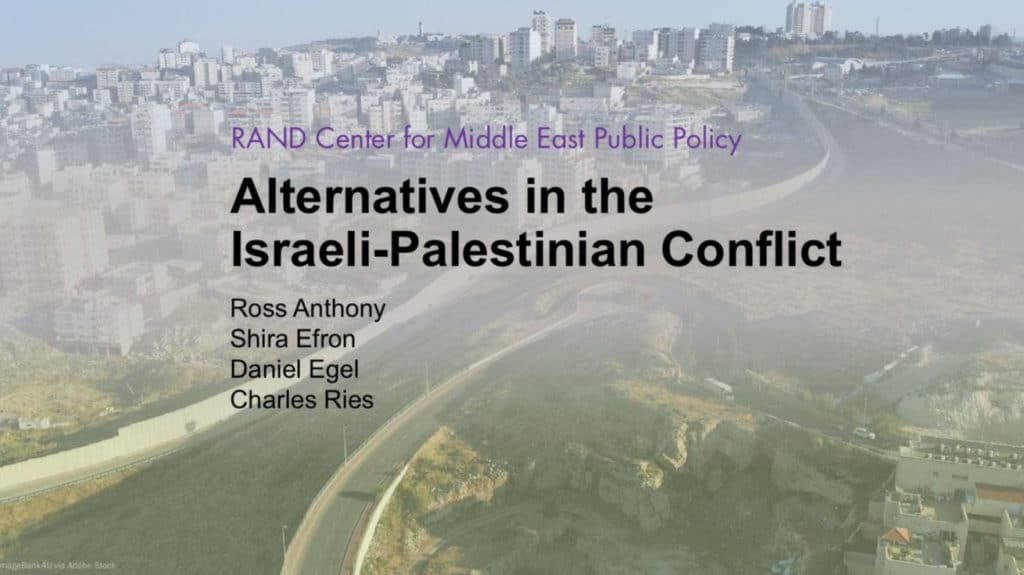
RAND Israeli-Palestinian Study Sees Cool Response to Conflict Alternatives

(The Media Line) — The RAND Center for Middle East Public Policy conducted a two-year study that saw thirty-three focus groups comprised of the core players in the Israeli-Palestinian conflict react to five different courses of action to solve the seemingly endless crisis.

Reacting to an apparent loss of momentum in the so-called two-state solution as the lynchpin of the peace process, RAND researchers sought responses from groups of Israeli Jews, Israeli Arabs, West Bank Palestinians and Gazan Palestinians to a series of options that, in addition to two states, also included the status quo, confederation, annexation and a one-state solution.

The data for the study was compiled in July 2018 and May 2019 before two seminal events in the region: the coronavirus pandemic and the Abraham Accords. It was, however, adjusted in February 2020 in response to the Trump peace initiative.

In the first interview upon release of the report, The Media Line’s Felice Friedson reviewed the results with C. Ross Anthony, director of the RAND Israeli-Palestinian Initiative and co-author of the study.

TML: The RAND Center for Mideast Public Policy conducted a study over a period of two years, examining alternatives to the two-state state Palestinian solution. C. Ross Anthony is director of the RAND Israeli-Palestinian initiative and co-author of the study. Thank you for joining us!

Anthony: It’s a pleasure to be here!

TML: You conducted focus groups, comprised of a cross-section of the Middle East’s cast of characters – Israeli Jews, Israeli Arabs, Palestinians from the West Bank and from the Gaza Strip, and ultimately asked them to choose between the status quo and several other options commonly talked about. Not surprising to any Mideast watcher, none of the options seem viable, but in broad terms, what insights were you able to glean from the exercise?

Anthony: The results are very interesting and perhaps what’s interesting – you have to read the whole report to get this – is the words that people spoke and the feelings that they had. And these were, we were talking to ordinary people and not just the policymakers, but we found out that a number of broad solutions that were coordinated, and that is, as you said, [that] none of the alternatives in and of themselves that people find acceptable, but when you ask the Israelis, they preferred the status quo, but [only] slightly better than the two-state solution. And the reason that they preferred the status quo, was because they didn’t, they saw risks in the other solutions and the two-state solution that they thought was not really feasible at the present time for a number of reasons. The Palestinians don’t like the status quo and they want change, almost any change, but what they really found most compelling is the two-state solution where it’s the most accessible, but only if it changed certain characteristics.

They wanted to have control over the borders. They wanted also to have an army and do things and things that generally are not acceptable to Israelis. The second thing that we found also, or the third thing I guess, is that most people did not really understand the alternatives that there are out there. In addition to the two-state solution, there was an annexation, there’s a confederation option, and a democratic one-state solution that we asked them about. And when we provided them with education on all of these various options, which we discussed in detail before, we asked people to rank them beforehand and afterwards and, in general, what was very interesting is people indicated that they really did not understand the various alternatives that were there, and many people felt that they made a much-better-informed decision after having the discussion, and also in some cases changed their opinion. So, what that has said to us is that going forward, it’s going to be important for there to be some kind of education campaign so that people are better informed and can make better-informed decisions.

We also found that interestingly enough, on the Palestinian side, that security was extremely important to them and [for] this kind of security, we need personal security. I mean, it’s not surprising that security was also important to the Israelis. So, what we believe is that international guarantees that emphasize both security and economic incentives are going to be important in helping to find a solution to the issues. And overall, the strongest issue that most people brought forward with the desire for separation, which is again, not overly surprising, but the vehemence in which it was held was surprising.

And it says to us that a much more holistic approach is necessary to solve this problem than people have taken in the past. Economics are important, but ranked lower down when you looked at the rank preference of people than a lot of other issues, so things that take into consideration the entire spectrum of issues, including the political solutions, are going to be key to finding any kind of resolution. Overall, we’d hope in our study that we would be able to find areas of commonality between the parties that they would form the basis, perhaps for dialogue. Sadly, we really did not find that. The data did not show us any of those commonalities that we hoped to see.

TML: And that is sad indeed. I think you can sum it up by those few words. The expression “two-state solution” is more than an option. It becomes a political mantra. And, as you said, it might not mean the same thing to different people. Did your study support two-state as the best choice among weak options?

Anthony: No, we didn’t. We did not try to support anything. We were asked to lay out the five options as impartially as we could. Of course, each one of these options have various characteristics. And in the study, you’ll see that we clearly presented those different characteristics of the various options, so they even had a full understanding. Even in a two-state solution, obviously, there was a discussion about all kinds of, what they call the core status-agreement issues. And the same thing is true, for instance, annexation, in the discussions that they have on the West Bank, the Jordan Valley, the settlements, so there are a lot of variants within that. We do have a very lengthy appendix that goes through the specifics of all of these different options. But when we presented them to the people, we tried to summarize them and we were clear as to what we’re talking about. We sought not to put forward a preference on our part. We were more interested in hearing what other people had to say, but we did not express any preference from our perspective.

TML: Ross, you have had many focus groups. Can you just explain how that went down?

Anthony: Yeah, we did 33. We actually originally did it in two phases. In the first phase, we wanted to see whether this provided us with good information, and in the second phase we were kind of surprised in some senses that we were able to get the focus group in Gaza and so in the second phase, we also wanted to increase the sample size, both of the Gazans and of the Israeli Arabs, so that we had a full set of opinions from all of those different groups.

Basically, we hired a firm to help us, but we put these focus groups together with an idea, trying to find a broad spectrum of the population, both among Israelis and Palestinians, and we think that we achieved that. Certainly, 33 focus groups took a lot of time and effort. There’s a tremendous amount of very interesting information and quotes in the report. And – we’re all of 273 people – we recognize that’s not a huge sample as you’ve seen in polling. But we believe that it gave us a really good idea of what the average Palestinians and Israelis thought across the spectrum.

TML: Separation is a much more complex idea than it would appear to be at first glance. The recent situation where Israel was scolded in the media and even by members of the US Congress to provide COVID vaccines to the Palestinian Authority, even though the Oslo Accords relegates such health care responsibilities to the PA, which was making its own provisions for obtaining the vaccines as an example. So, how do you separate the players? How separate do they really want to be?  

Anthony: Well, I think what people are talking about in general, when they’re talking about separation is, is political separation. In this case, the Palestinians, they obviously would like settlers to move and things that have been discussed. Interestingly, and this was not part of the work in this study, but RAND many years ago, after the swine flu, did some joint exercise between Israelis and Palestinians to try to look at how they dealt with the contracting of infectious diseases, and that was actually quite interesting. And actually, it included, as I recall, also people from Lebanon. Certainly, when you talk about the confederation, and we talked about that issue for instance, the way it is positive, that there would be two independent states who would control most of the issues that were relevant to them. But there might be, there will be, certain areas in which they commonly might mutually agree on to cooperate.

And those usually are thought to be things like the environmental issues and also health care. The COVID does not recognize borders and it’s going to pass back and forth. So, I recognize that the issue of COVID in the distribution has become an important one in the lack of a vaccine on the Palestinian side, compared to the Israeli side. It’s striking. My understanding is that the Israelis also recently started to share some vaccines with the Palestinians. So, we did not study that in this study, but it’s an important area where people could cooperate in the best interest of both parties.

TML: Water, gas, health, employment, this is something where we see areas of cooperation on a daily basis. So, how is it even feasible to separate? You’re an economist. So, how do you really see this?

Anthony: This was not in the study, but you know, there are certain areas where in other interviews we’ve done in the past where you can’t separate. The quality of the air between [them] is shared. The water, the aquifers are shared. So, there are some areas, even if you had two independent states, where the parties would need to get together and collaborate on what was in the best interests of both.

TML: Has the Abraham Accords impacted your study at all? Do you see any change in opinion?

TML: Ross, President Trump’s approach was to take a totally different approach with the Abraham Accords. Do you think that attitude could work in the Israel-Palestine relationship?

Anthony: The Abraham Accords?

TML: The concept of a different approach. The status quo has not worked.

Anthony: Well, the status quo clearly is not working for the Palestinians. If we go back through the research here, we find that the status quo is working for Israelis. They find it, and you see that in the quotes and the other references, they find it workable. It’s worked for some time. The Israelis are doing well economically, and they see risks in the other alternatives. So, in fact, they are satisfied with the status quo. The Palestinians are very unsatisfied with the status quo.

TML: That is correct, but you’re looking as a policy institute. And in terms of this study of how you’re able to change the whole picture and bring two sides together towards an agreement, so you need both sides partaking in that theory.

Anthony: The final outcome, including both parts of the report, indicate the thing that I had talked about earlier that we certainly need education and understanding on both sides; different factors could be a resolution. And also, it emphasizes the need for leadership. Not only leadership among the Palestinians and the Israelis, as well as national leadership in the United States. Right now we haven’t seen the kinds of strong leadership on really any sides to be able to promote the kind of change and the difficult decisions that will be necessary for the two parties to come together.

TML: I’m glad you brought that up, because Israel and the Palestinians are both nearing elections. Can this change the outcome of your five options?

Anthony: Well, again, we didn’t look at that, but the leadership is important in terms of the two parties being able to talk to each other and reach some kind of agreement or understanding. So yes, I think the elections are important and how they turn out, of course, is the purview of the different parties involved.

TML: I’m speaking with Ross Anthony, who is the director of the RAND Israeli-Palestinian initiative and co-author of a new study that has just come out with regards to 33 focus groups. One of the study’s options was a confederation of the State of Israel, the West Bank, and the Gaza Strip.

Anthony: Correct!

TML: How will that look?

Anthony: The configuration could be made up of two states or it could be three, but it’s easier to talk about two –  a Palestinian state and an Israeli state – and what that would imply is two independent states, much like, in some senses, the two-state solution. They are independent, except in areas where they mutually agree to cooperate. And, in that situation, involve some kind of federal entity that would help spark coordination and discussion and policy on those areas.

Commonly, the areas mentioned that the parties might agree upon would be the environment, sanitation, health care, and also external security. So, these are areas that are commonly mentioned, but the parties themselves would get together and mutually agree on what they could work together on. A model of that is the European Union, which is in some sense that kind of confederation.

TML: If interest in the scenarios you’ve suggested is so low, the end result doesn’t seem so promising. What one factor would turn it all around?

Anthony: The report emphasizes the need for education and understanding among the two parties, but the policy recommendation which is in the report is that the security and economic guarantees are going to be probably required from the outside, from the international community, to help precipitate movement in the right direction. So, we didn’t go into a lot of the details as to how to resolve the various conflict ideas. There’s a lot of other literature out there on that, but those are two areas that we did suggest.

TML: In looking back over these last two years of trying to move the bar, I’ve heard you say over and over again education, education, education. Do you feel that’s the only thing left at the moment that’s going to change the status quo?

Anthony: No, I think there are other areas that we mentioned. We mentioned leadership and then interviews that we did in addition to the focus groups. People emphasized to us that leadership was important and they also emphasized that leaders could help change the opinions of everyday people if in fact they wanted to do so. So, there are other areas that could be looked at, but the ones that we looked at in the report were confined to the status group recommendations that they made.

TML: C. Ross Anthony, Director of the Rand Israeli-Palestinian Initiative, and co-author of this new study. Thank you so much for joining me here at The Media Line!

Anthony: I appreciate the opportunity to speak to you about the upcoming study.

The full report is available here.

RAND Israeli-Palestinian Study Sees Cool Response to Conflict Alternatives Read More »

Israel and the Academy Awards — One Miss and One Hit

Israel missed one crack at an Oscar but won another, as the Academy of Motion Picture Arts and Sciences announced the qualifying nomineers in the first elimination round on Tuesday  (Feb. 9).

A total of 93 countries, from Albania to Vietnam, entered their respective top movies in what used to be called the best foreign language film category but has now been changed to a less chauvinistic designation as best international feature.

Films from 15 countries made the first cut, but Israel’s entry, “Asia”, was not among them.

On the brighter side, a group of inventive Israelis from Tel Aviv University and the startup Amimom industry in Ra’anana were selected for the Academy Award in the Scientific and Engineering category. The group developed a wireless video technology now used throughout the global film industry.

This Oscar may be not as glamorous as one bestowed on a movie queen but will arguably have a longer lasting impact on film studios throughout the world.

The movie title “Asia” has nothing to do with the continent. Rather it is the given name of the Russian-born mother (actress Alena Yiv), who emigrates to Israel with her 17-year old daughter Vika, who suffers from an apparently incurable degenerative motor disease.

Vika is played by Shira Haas (familiar to fans of the Netflix series “Unorthodox”) who clings to life (“I don’t want to die a virgin”) and hangs out with pot-smoking skater punks – more akin to juvenile delinquents in American movies than our image of clean-cut Israelis toiling away on a kibbutz).

Shira Haas and Alena Yiv in “Asia.” Credit: Ruthy Pribar

The film is saved by the empathy between mother and daughter, lovingly portrayed by the two actresses.

In a phone interview, director Ruthy Prieber noted that in the film, “I try to look at the beauty in their lives and not the ugliness… to look at what cards we are dealt with and how to make the best of it.”

“Asia was slated for its American premiere at the Film Forum in New York City but the pandemic has put a hopefully temporary halt to the film’s distribution to the country’s shuttered movie houses.

Neil Friedman, president of Menemsha Films, the American distributor for “Asia,” hopes that in the meanwhile the film can be viewed via television, Jewish film festivals and other venues.

By tradition, this annual column on the Academy Awards focuses on films submitted by other countries, this year from 93 nations, ranging from Albania to Vietnam. The rationale underlying this personal choice is that the big name categories -– best film, best actor, best director etc. – are already covered to a fare-thee-well by the general media.

The other rationale is that the choice by other countries on what films to submit reflect to some extent the current crises and historical memories of the participating countries.

For instance, year after year, different countries will submit films dealing with some aspect of the Holocaust, contradicting the assumption that some 76 years after the fall of the Third Reich the general public was tired of the subject.

year after year, different countries will submit films dealing with some aspect of the Holocaust, contradicting the assumption that some 76 years after the fall of the Third Reich the general public was tired of the subject.

The following entries did not make the list of 15 surviving nominees, but the assumption is that they will be available via TV, Jewish film festivals and other venues.

The following countries, in alphabetical order, have submitted films whose content should be of special interest to Jewish viewers.

Armenia entered the film “Songs of Solomon” which, however is not about the wise and wealthy biblical king of a unified Israel (and whose reported 700 wives of royal descent and 300 concubines would have required too large a cast.) Rather, the title character is Armenian Archbishop Solomon (1881-1915).

Belarus’ entry, “Persian Lessons” was unfortunately eliminated by the Academy, because too much of its creative talent was not from Belarus, but one would hope that it will be shown at other venues.

“Persian Lessons” Courtesy of Berlin Film Festival

Reminiscent of Roberto Benigni’s “Life Is Beautiful,” the Belarus entry raises the question whether a film about the Holocaust can dare to include some humor and absudities.

In this case, a Belgian Jew is sent to a concentration camp but hopes to survive by claiming to be a non-Jewish Iranian. Unfortunately, a Nazi officer at the camp plans to open a restaurant in Teheran after the war and sets up a schedule of lessons with the pseudo-Iranian, who is forced to invent a fake language. According to the film’s introduction, the plotline is based on an actual Worrld War II occurrence.

The German entry is “And Tomorrow the Entire World.” With a woman director , Julia von Heinz, and a female heroine, the film tells the story of a young girl from an upper class family who joins an antifa (anti-fascist) group to oppose a rising neo-Nazi movement.

Jordan’s entry “200 Meters” is the only entry dealing directly with Middle East tensions. The movie focuses on a Palestinian husband and wife, who live in two villages 200 meters apart, but are separated by the Israeli-built wall.

By contrast, the Palestinian entry “Gaza, Mon Amour” (“Gaza, My Love”) – despite the title and its creators, doesn’t touch at all on the enclave’s border clashes with Israeli troops.

Rather the plot concerns a 60-year old Gaza fisherman, secretely in love with a woman who works in a market stall. His life changes drastically when he finds a ancient phallic statue of Apollo in his fishing net.

Bearing most directly on the Holocaust is the Slovakian film “The Auschwitz Report,” a Slovak/Czech/German co-production. Based on actual happenings, the film’s focus is on two young Slovak Jews, who with the help of other inmates escape in Apil 1944. Their goal is to inform the outside world of the horrors of Auschwitz but to their dismay their eyewitness accounts are too harrowing to be acceped by those who have not experienced them first hand.

The Academy Awards were originally scheduled for February 28 but have now been postponed to April 25. The format is still under discussion but will depend on the status of the pandemic and other factors. ”We find ourselves in unchartered territory,” noted Kary Burke, president of ABC entertainment, whose network will televise the event.

One possibility is to emulate the recent Emmy Awards, in which the hosts and award presenters were on stage, but the nominees spoke from their homes or other remote locations.

Israel and the Academy Awards — One Miss and One Hit Read More »

Local Rabbis Release Community Guidelines for Purim in New Letter

Last Purim, the world was going into lockdown. In Los Angeles and other Jewish communities around the globe, some shuls canceled Purim celebrations while others stayed open. Later on, we discovered that many holiday parties became superspreader events, leading to people contract COVID-19 and even pass away from the illness.

“Last Purim we were still so clueless about COVID, that although we told people they had the option not to attend Purim services, we did not cancel our Purim carnival kids program on Purim night after Megillah,” said Senior Rabbi of Beverly Hills Synagogue Pini Dunner. “It was only a few days later, when the first stories of serious illness and even deaths began to surface in New York and New Jersey, that we decided to shut our doors and close the shul indefinitely. Even then, we imagined it would only be for a few weeks or perhaps a couple of months. We would never have believed that a year later, 450,000 people would be dead from COVID, and that we would still not be ready to open our doors.”

This year, ahead of Purim, local rabbis in Pico-Robertson have released guidelines on how the community can avoid spreading COVID-19 and safely celebrate the holiday. Rabbi Dunner, Rabbi Jason Weiner of Cedars-Sinai Medical Center and Knesset Israel Synagogue of Beverlywood, Rabbi Elazar Muskin of Young Israel of Century City, Rabbi Kalman Topp of Beth Jacob Congregation and Rabbi Yosef Kanefsky of B’nai David-Judea Congregation signed the letter.

“It is crucial to continue taking precautions so that we can avoid sickness and death in the community,” said Dunner. “Until the vaccinations are given out to a majority of our community and numbers overall are down, it is imperative that we do everything in our power to prevent any danger to our members and those they may come into contact with.”

The letter states that people should hear the Megillah in person with a minyan on both Purim night and day. But if they can’t leave their home due to COVID-19 concerns, they should read the Megillah from a Kosher Megillah, or follow the Megillah via a Zoom transmission. “In such a circumstance it is preferable to follow the reading with a Kosher Megillah and to recite the Megillah along with the Ba’al Kriah word for word,” it says. “If this is not possible, then you can simply listen to the reading via Zoom.”

The letter stresses that the ruling to hear the Megillah via Zoom is only for this year because of COVID-19, as it is not ideal.

It also states that it’s best to avoid social gatherings and being in close proximity to anyone outside of the immediate family when delivering Mishaloach Manot or having a Purim Seudah. Since many people are worried about getting food from outside their home, the letter says, “it is worth considering reducing the amount of Misholach Manot one distributes. Additionally, consider supporting your shul Mishloach Manot programs.”

“These guidelines offer direction in how to celebrate Purim in the halakhically correct fashion, even with COVID being the reality,” said Muskin. “It is certainly our prayer and hope that with the vaccines we will be able to celebrate Purim the way we did before COVID ever was part of our lives.”

“These guidelines offer direction in how to celebrate Purim in the halakhically correct fashion…”

Weiner agreed. “The main health concerns are the pandemic, particularly its rapid spread recently in our community and the variants of the virus… I am very hopeful that by next Purim things will be back to normal.”

The full letter is below.

Purim 5781 (2021)
Halakhic Guidelines
Covid-19 Considerations

With Purim just a few weeks away and the realization that COVID-19 has created unique circumstances, it is the purpose of this document to outline the special features that pertain uniquely to this year’s Purim holiday. We present this Halakhic guidance, which has been reviewed and approved by Rabbi Hershel Schachter, Rosh Kollel of Yeshiva University and a world respected Posek, as our united community policy.

Kriyat Parashat Zachor:

The practice to hear Parashat Zachor (which are the last three Pesukim in Parashat Ki Teitzei in Chumash Devarim) traditionally takes place on the Shabbat preceding Purim. If you are able to attend a Minyan and hear the Torah reading at that time, you should do so. If you are not able to attend a Minyan due to COVID-19 considerations:

a) If you have access to a Sefer Torah you should read Zachor from the Torah, but without Brakhot.

b) If you don’t have access to a Sefer Torah, you should read Zachor from a Chumash. In this case, during the coming summer, when Parashat

Ki-Teitzei is read (Shabbat August 21), you should have in mind that you are fulfilling the mitzvah of Zachor with that Torah reading.

Megillah on Purim Night and Day:

If you are able to hear the Megillah in person with a Minyan on both Purim night and day, you should absolutely do so. If due to COVID-19 concerns you are not able to leave your home to attend a Minyan and you are not able to read the Megillah on your own from a Kosher Megillah, then you should follow the Megillah via the Zoom transmission that will be arranged by your community Shul. In such a circumstance it is preferable to follow the reading with a Kosher Megillah and to recite the Megillah along with the Ba’al Kriah word for word. If this is not possible, then you can simply listen to the reading via Zoom.

A general note: If one is reading the Megillah without a Minyan, the concluding blessing of “Harav Et Reveynu” should not be said.

We would like to emphasize that under normal circumstances, hearing the Megillah via Zoom is not ideal and our Psak is only for this year due to the extenuating considerations that Covid-19 has created.

Purim Seudah, Mishloach Manot and Matanot L’Evyonim:

This year Purim falls … on Thursday night and Friday, creating a challenge of when to have the Purim Seudah (as one cannot fulfill the Mitzvah on Thursday night). One should have a Purim Seudah either for breakfast or lunch on Friday. The meal should be a festive one, similar to a regular year, preferably featuring meat and wine.

The Mitzvot of Mishloach Manot and Matanot L’Evyonim can only be fulfilled on Purim day. We would like to remind you that social distancing rules still apply, and we therefore urge you to avoid social gatherings or close proximity to those outside your immediate family when delivering Mishloach Manot or having your Purim Seudah.

Mishloach Manot only requires that you send two food items to one person. This year, because many people are concerned about receiving food from outside their home, it is worth considering reducing the amount of Misholach Manot one distributes. Additionally, consider supporting your shul Mishloach Manot programs.

Matanot L’evyonim requires that we give money to at least two people so they can celebrate Purim. By appointing your rabbi to distribute the money on Purim, you can accomplish this Mitzvah. You can give the money to your rabbi for Matanot L’evyonim even before Purim.

Wishing everyone a safe and wonderful Purim Sameach,

Rabbi Pini Dunner
Rabbi Yosef Kanefsky
Rabbi Elazar Muskin
Rabbi Kalman Topp
Rabbi Jason Weiner


Kylie Ora Lobell is a writer for the Jewish Journal of Los Angeles, The Forward, Tablet Magazine, Aish, and Chabad.org and the author of the first children’s book for the children of Jewish converts, “Jewish Just Like You.”

Local Rabbis Release Community Guidelines for Purim in New Letter Read More »

Not “Music” to My Ears

On February 3, Australian pop star Sia finally apologized for her controversial choice to cast a neurotypical actor as a nonverbal Autistic girl in her directorial debut film, “Music” (out February 10).

The movie follows drug dealer Zu (Kate Hudson), who receives the news that she is to become the sole guardian of her Autistic half-sister Music (Maddie Ziegler). Through her experience of caring for Music, who is non-verbal and has sensory processing difficulties, Zu becomes motivated to get her life back on track by getting sober and opening herself up emotionally to those around her.

For the Autism community, the synopsis landed with a thud, and I’m not surprised. Casting neurotypical Ziegler in an Autistic role, as well as depicting the use of restraints to calm her down, is problematic. And indeed, when the backlash first began, Sia doubled down and defended her choices, at times even lashing out at her critics.

Sia’s since seen the light and come clean. Before deleting her Twitter account, Sia tweeted a mea culpa to her six million followers. “I listened to the wrong people and that is my responsibility, my research was clearly not thorough enough, not wide enough,” she wrote. “Music in no way condones or recommends the use of restraints on Autistic people.” She added that a warning would now be added to the beginning of the film.

A 2019 report by GLAAD concluded that 95% of characters with disabilities are played by able-bodied actors. These include Abed (Danny Pudi) from “Community,” Sam Gardner (Keir Gilchrist) from “Atypical,” Dr. Shaun Murphy (Freddie Highmore) from “The Good Doctor,” Isadora Smackle (Cecilia Balagot) from “Girl Meets World,” and Sugar Motta (Vanessa Lengies) from “Glee.” How many Autistic characters can you name that have been portrayed by actors on the spectrum? I’m guessing not nearly that many.

I can get on board with neurotypical or able-bodied actors playing Autistic or disabled characters, however out-of-vogue that idea is becoming. Leonardo DiCaprio, for example, was phenomenal in “What’s Eating Gilbert Grape,” and Daniel Day-Lewis brought enormous depth to his Oscar-winning depiction of Christy Brown, the Irish artist and writer with cerebral palsy, in “My Left Foot.” These are seasoned actors known for the intense, lengthy preparations they undergo for roles.

My main issue with the movie stems less from the casting and more from the lame plot device of using Autistic characters to improve the circumstances or outlook of neurotypical people around them.

Like “Rain Man,” “Music” follows a struggling neurotypical person who meets a long lost relative on the spectrum and then uses the experience of being close to them as a path to self-discovery. In Sia’s film, Music’s mere presence is what pushes Zu to stop doing drugs and leads her to deliver maudlin lines like, “I’m going to help her, just like she helps me.” Music also serves as an unofficial shadchan by facilitating a meet-cute between Zu and her neighbor and friend, Ebo (Leslie Odom Jr.).

Once again, rather than depicting Autistic people as fully-fledged humans who can think and act on their own terms, Hollywood instead opts for “inspiration porn” by making the Autistic character a means to a neurotypical person’s happy end. (And this isn’t a Hollywood-specific phenomenon, either: I see a subtle form of it in my own community.)

But Autism shouldn’t — and doesn’t — exist to make you feel better about yourself. And the experience of parenting or otherwise caring for a person with Autism is in some ways unique, but in other ways, it’s just parenting, which is to say, sometimes beautiful, sometimes maddening and sometimes humdrum. My son is neither a savant nor a savior. He’s a regular teenager, and he certainly doesn’t exist to help me learn things about myself: he’s here to live his own life.

In the end, the abled gaze is reductive and ends up flattening and simplifying Autistic stories for the sake of feel-good endings, producing what is yet another example in a long tradition of exploitation and fetishization.

The abled gaze is reductive and ends up flattening and simplifying Autistic stories for the sake of feel-good endings.

What we really need are complex, diverse Autistic characters that represent Autistic people authentically. Practically, this might mean making greater efforts to cast Autistic or otherwise neuro-diverse people; it could also mean hiring them as script consultants, writers, producers or otherwise making sure they’re involved in production so they can have a direct say in how their stories are told.

There are wonderful organizations out there that do advocacy and research around disability representation in media, including the Ruderman Family Foundation. Producers and directors who are working on projects that include Autistic characters should also look to the research these organizations conduct to help inform and enrich their work.

Still, as a rabbi and Autism Daddy, I believe in forgiveness. I chose to believe the movie was made with the best intentions, however naive.

I would recommend if Sia truly wants to be an ally to the Autistic community, she should continue to listen to the feedback from Autistic people and communities about representation, something that should have happened before production began.

In other words: Sia, consider this an open invite for a post-pandemic Shabbat dinner at the Weinsteins’.

February marks Jewish Disability Awareness and Inclusion Month.


Rabbi Simcha Weinstein is a best-selling author who chairs the Religious Affairs Committee at Pratt Institute. He is the founder of the Jewish Autism Network (www.JewishAutismNetwork.com) and resides in Brooklyn.

Not “Music” to My Ears Read More »