fbpx

January 14, 2021

Thou Shalt Get Vaccinated


This is the way I’m telling everybody to be vaccinated,
learning from the Torah that we must do this to stay alive.

The Torah tells us that we will not suffer from the plague that God inflicted
on the Egyptians if we follow His wise rules, since He himself will heal
all our diseases, but it never quite explicitly predicted
the covid-19 epidemic: it did not choose to reveal

the vital fact that we should take steps to help God’s task by preventing
the plagues like this one, caused by the dread coronavirus, an important task
regarding which performance sadly not all people are consenting,
not social distancing as they ought, nor wearing – as is most important – any mask;

piling the responsibility for healing on our God who promised He would do
this if all men follow all His rules. Wake up! Not all men do, yet prevention
of the disease is the best rule we should religiously stick to,
with the vaccination, deus ex machina, preventive medicine for menschen.

The rule? It states “You should live by them” Leviticus eighteen, verse five.
Live, not die, as I’ve the Hebrew in the first verse Anglo-Saxonated.


Exod. 18:5 states:

ה  וּשְׁמַרְתֶּם אֶת-חֻקֹּתַי וְאֶת-מִשְׁפָּטַי, אֲשֶׁר יַעֲשֶׂה אֹתָם הָאָדָם וָחַי בָּהֶם:  אֲנִי ה.   5 Ye shall therefore keep My statutes, and Mine ordinances, which if a man do, he shall live by them: I am the LORD

Gershon Hepner 1/13/21


Gershon Hepner is a poet who has written over 25,000 poems on subjects ranging from music to literature, politics to Torah. He grew up in England and moved to Los Angeles in 1976.  Using his varied interests and experiences, he has authored dozens of papers in medical and academic journals, and authored “Legal Friction: Law, Narrative, and Identity Politics in Biblical Israel.” He can be reached at gershonhepner@gmail.com.

Thou Shalt Get Vaccinated Read More »

Ksenia Svetlova

Ksenia Svetlova: On high heels in the Middle East

Shmuel Rosner and Ksenia Svetlova discuss her book – On high heels in the Middle East, her unique experiences as a journalist and a former Knesset member, and her views on the future of the middle east.
Ksenia Svetlova is a seasoned expert and analyst on Middle Eastern issues, with unique academic and practical experience. She had covered the Middle East extensively and visited many countries in the region, including Lebanon, Syria and Libya, interviewed Palestinian leaders Yasser Arafat and Sheikh Ahmed Yassin, and many high-profile politicians in Lebanon, Syria, Egypt and Jordan. She speaks English, Hebrew, Russian and Arabic.
Svetlova served as a member in a committee for foreign affairs and defense during her term as Parliament member. Currently she is serving as a senior analyst at the IPS (Institute for Strategy and Policy) at the Interdisciplinary Center at Herzliya. She is also leading the department for research of ties between Israel and the Middle East at “Mitvim” think-tank for regional foreign policy.

Follow Shmuel Rosner on Twitter.

Ksenia Svetlova: On high heels in the Middle East Read More »

Closed Lips – A poem for Torah Portion Vaera

But Moses said before the Lord,
“Behold, I am of closed lips; so
how will Pharaoh hearken to me?”
Exodus 6:30

Closed lips –
Is it a medical condition?
Does the speaker not know
how to, simply, open his lips?
How is he saying, what he’s saying
if his lips are closed?
Is complaining exempt
from the condition of closed lips?
Or is it the cure?
Is this how ventriloquism
got invented?
Have my lips ever been closed
when they should have been open?
I know the reverse is true.
What is it I should have said
and what is the difference it
would have made?
Should more people be
opening their lips to
make a difference?
I’d like to contribute to the list
of people whose lips
should remain closed.
I’d like to know when I
should be on that list.
Maybe it’s a confidence thing?
Maybe we’re scared the
things that will come out
will get us cancelled.
Maybe we’re afraid
if we make a space
a fly will go in.
Maybe we just need
a set of helper lips.
We can’t always do it alone.
Moses, with his closed lips,
with his brother’s voice
with Divine assistance
managed to get it all done.


God Wrestler: a poem for every Torah Portion by Rick LupertLos Angeles poet Rick Lupert created the Poetry Super Highway (an online publication and resource for poets), and hosted the Cobalt Cafe weekly poetry reading for almost 21 years. He’s authored 25 collections of poetry, including “God Wrestler: A Poem for Every Torah Portion“, “I’m a Jew, Are You” (Jewish themed poems) and “Feeding Holy Cats” (Poetry written while a staff member on the first Birthright Israel trip), and most recently “The Tokyo-Van Nuys Express” (Poems written in Japan – Ain’t Got No Press, August 2020) and edited the anthologies “Ekphrastia Gone Wild”, “A Poet’s Haggadah”, and “The Night Goes on All Night.” He writes the daily web comic “Cat and Banana” with fellow Los Angeles poet Brendan Constantine. He’s widely published and reads his poetry wherever they let him.

Closed Lips – A poem for Torah Portion Vaera Read More »

Government Announces United Women’s Economic Development Network

The Media Line — The US State Department’s Office of Global Women’s Issues and the US International Development Finance Corporation are hosting the virtual launch of the United Women’s Economic Development Network on January 14.

Special Envoy for Economic Normalization Aryeh Lightstone is the conceptualizer of the latest American government initiative falling under the auspices of the Abraham Accords, the series of normalization agreements between Israel and Arab nations announced in August and including the United Arab Emirates, Bahrain, Sudan; and outside the borders of the Accords, Morocco.

Explaining the genesis of the new effort, Lightstone told The Media Line that, “It was at the Abraham Accords Business Summit that I was sitting across the table from a very dynamic female entrepreneur who turned to me and said, ‘First of all, women[-run] businesses in this region are booming. We are on the ascendency. Secondarily, it is different to be a woman entrepreneur and leader in this part of the world than in other parts of the world. It would be beneficial if we created a network to support each other.’”

Since the signing of the Abraham Accords in September, signatory nations have worked to establish a warm, inclusive peace and to develop cross-country economic partnerships. In pursuit of these goals, the advancement of women’s economic empowerment has come to occupy a role of central importance, according to a spokesperson at the US Embassy in Jerusalem.

Asked about the timing of the launch coming at the end of the administration’s term in office, Lightstone recounted the series of events leading to the actualization of the initiative. He told The Media Line that he received immediate green lights from both the White House and State Department despite its coming after the election and the transition effectively being underway.

Women business leaders and entrepreneurs from the United States, Bahrain, Morocco, Israel, the United Arab Emirates, Sudan, Uzbekistan and Kosovo will convene for the virtual launch.

Special Envoy for Economic Normalization Aryeh Lightstone and Ambassador-at-Large Kelley Currie will be keynote speakers at the launch of the Network.

The spokesperson added that “the involvement of the Secretary’s Global Women’s Initiatives Office of the State Department ensures longevity to the network and complements existing S/GWI programs promoting women entrepreneurs. Ambassador Currie is expected to mention other S/GWI programs in her remarks.”

Government Announces United Women’s Economic Development Network Read More »

As Regional Alliances Shift, Israel Must Tread Lightly

When it comes to tensions between the United Arab Emirates and Egypt, which of these two allies should Israel support? There’s tremendous importance and great benefit to Israel’s recent normalization of ties with the Arab world, but it also raises several previously unknown dilemmas.

Now that the Arab world is no longer against Israel in principle, we need to learn to navigate the tensions among Israel’s various Arab allies.

Shakespeare’s famous line, “Misery acquaints a man with strange bedfellows,” has been adapted to describe strange partnerships in the political arena, as “politics makes strange bedfellows.”

This is how Israel and Egypt came to collaborate in the 1960s, when they found a common enemy, the radicals who tried to drag Egyptian President Gamal Abdel Nasser into a confrontation with Israel over Jordanian waters.

Israel’s number one ally in the region is Egypt and its president, Abdel Fattah el-Sisi. The 1979 Egypt-Israel peace treaty shifted the balance of power in the region to Israel’s benefit. El-Sisi saved Egypt, the Middle East and Israel from the threat of the Muslim Brotherhood, which was dragging the region into radicalism, war and bloodshed.

Last year’s most important alliance was that of Israel with the UAE. It signaled that the normalization of ties with Saudi Arabia is possible, and promises economic and security collaboration, as well as cooperation in the fight against radicals in the region.

The UAE elite is presenting for the first time the format of complete legitimization of the Jewish state. Egypt might be more significant, but the UAE brings added value to the region and to Washington.

Egypt, the UAE and Israel belong to the same regional camp.

All three are aware of Iran’s regional hegemony aspirations, fight the Muslim Brotherhood, fear Turkish President Recep Tayyip Erdoğan’s attempt to impose his rule in the eastern Mediterranean basin, oppose the Libyan government—which supports the Turkish dictator—and support Lebanese rebel General Khalifa Haftar.

Israel, Egypt and the UAE all rely on the United States, but there are substantial differences between the three.

While Egypt is mainly concerned with the Muslim Brotherhood, and Turkish and Libyan threats to its western border, the UAE and Saudi Arabia worry about Iran and its proxies.

While Egypt sees Ethiopian activity on the Nile as an existential threat, the UAE is examining the southern arena in the Red Sea, in the broader context of dealing with the Houthis there and in Yemen.

In all these matters there’s tension and competition: the UAE, often with Saudi backing, is much less rigid when it comes to the Qatari supporters of the Muslim Brotherhood and the government of Libyan President Fayez al-Sarraj.

The depth of the ties between Israel and the United States is also a cause for concern in Cairo. Egypt praised the Abraham Accords, but Emirati Sheikh Mohammed bin Zayed and the United States did not need El-Sisi to establish this normalization; the bilateral ties bypass Cairo.

The incoming administration of U.S. President-elect Joe Biden is expected to pressure el-Sisi on human-rights violations, and Egypt’s previous status as Israel’s sole ally in the area will no longer protect it.

It is unlikely that Egypt will lose its status as the largest and most unified Arab state, but it is gravely dependant on economic aid, unlike its competitors in the Persian Gulf.

This dependence is always mentioned when discussing Egypt’s importance in the region. But this importance is fading away right in front of Egypt’s eyes.

Israel has to acknowledge these sensitivities and navigate the tensions carefully. It is important to use new opportunities, but we can’t abandon valuable allies in the process.

This article first appeared in Israel Hayom.

As Regional Alliances Shift, Israel Must Tread Lightly Read More »

Palestinian Women Say Planned Increase in Legislative Council Representation Not Enough

The Media Line — Palestinian Authority President Mahmoud Abbas issued a decree this week, amending the Palestinian election law.

The amendments include an increase in women’s representation in the Palestinian Legislative Council (PLC), in addition to holding three elections in succession, beginning with the legislative council vote.

The PLC election is to be followed by votes for president and then for the PLO’s National Council.

The amendment comes against the backdrop of the current national consensus, in particular between Fatah and Hamas, to hold elections after years of delay.

Additionally, it accords with the decisions of the Palestine Liberation Organization on raising the quota for women’s representation in the PLC, the unicameral legislature of the Palestinian Authority, whose activity has been suspended since 2007.

Hisham Kuhail, executive director of the Palestinian Central Elections Committee (CEC), told The Media Line that the increase in women’s representation is new, and was not included in the discussions among the factions in Gaza last November, who met to define the terms for holding the three elections according to the president’s vision that they not be simultaneous, as was set in the original law.

Women’s organizations lobbied for an increased female presence in the PLC, “and they have a document from the PLO to increase their representation by 30%,” he said.

Kuhail explained that, previously under the quota, 20% of the 132 PLC members were women, and the amendment has raised that proportion to 26%. “The new amendment didn’t stipulate percentages, but rather changed the place of women on the parties’ electoral lists. Meaning a woman among the first three candidates, and a woman among every four names that follow,” he said.

The amendment includes abolishing the requirement for candidates to adhere to the policies of the PLO, Kuhail added.

Hamas and Islamic Jihad are not members of the PLO.

Sabah Salameh, coordinator of the Al Muntada Forum to Combat Violence Against Women, told The Media Line that the increase in women’s representation is actually a “catastrophe,” because the Palestinian feminist movement and civil society for years have demanded that the quota for women be raised to 30%.

“We have a decision by the Central Council of the PLO that women’s representation will be 30%, in addition to agreements and understandings with all of the PLO factions that it should be 30%. So, there’s a big problem here,” Salameh said.

“We reject this stalling tactic and this policy of evasion,” Salameh said.

“In some Arab countries, such as Bahrain, there’s no quota system and women compete with men on an equal basis. I hope and aspire to reach this point.”

Haifa al-Agha, a former PA minister for women’s affairs who is based in Gaza, told The Media Line the increased quota, from 20% to 26%, is a step in the right direction, even though it does not fully meet the aspirations and needs of Palestinian women.

“Previously, we fought to have it be 30%, or to split the council in half, like our sisters in Tunisia, and why not? Women can now compete with men in terms of education, and females now occupy sensitive positions,” Agha said.

The amendment is not bad, but not what women have been working for over the years, she said. “We hope that the proportion goes up to at least 30%, and in the future to 50%,” she added.

Agha said she hopes that society will be able to move beyond its traditional and stereotypically negative view of women.

“In some Arab countries, such as Bahrain, there’s no quota system and women compete with men on an equal basis,” she said. “I hope and aspire to reach this point,” she said of Palestinian women’s representation.

The Central Elections Committee is set to meet no later than January 20 so the president can issue decrees setting the dates for the three votes, to be followed by consultation among all factions about the electoral process.

The last presidential election, which Abbas won, was held in January 2005. The last PLC election, which Hamas won, was held in January 2006. Palestinian National Council elections have never been held and most members were appointed by the PLO’s Executive Committee.

Palestinian Women Say Planned Increase in Legislative Council Representation Not Enough Read More »

Mayim Bialik to Guest Host ‘Jeopardy!’

Answer: Star of “The Big Bang Theory” and “Call Me Kat,” she has a PhD in neuroscience. Question: Who is Mayim Bialik? The actress has been tapped to guest host the popular game show “Jeopardy!,” a role Ken Jennings has been temporarily filling in the wake of host Alex Trebek’s death from cancer in November.

Bialik joins a group of guest hosts that includes journalist Katie Couric, “60 Minutes” correspondent Bill Whitaker, and Green Bay Packers quarterback Aaron Rodgers, who earned $50,000 for a cancer charity on “Celebrity Jeopardy!” in 2015. Donations will be made to charities of each host’s choice, equal to the winnings the contestants accumulate that week.

‘“Jeopardy!’ has been a part of the cultural milieu for practically my entire life,” Bialik told the Journal. “As someone who embraces my inner–and outer–nerd, being able to be a part of this iconic show is absolutely beyond anything I ever imagined. I am flattered, honored, humbled, and beyond excited!” she said. “I can’t imagine saying no to hosting permanently if I was asked, so I consider this guest thing my audition and I will do my best to make everyone want me forever!”

No airdate has been announced, but Bialik is scheduled to tape her episodes this spring.

Mayim Bialik to Guest Host ‘Jeopardy!’ Read More »

A Moment in Time: Bringing Goodness into the World

Dear all,
I’ve been working with an incredible young person in our congregation whose Bat Mitzvah is this coming Shabbat. Her name is Maya (no relation to my Maya), and she truly embraces light on so many levels.
A couple of days ago, Maya gifted our family these adorable bunnies that she made by hand, one for each of my twins. (Maya made baby blankets for each as well). As soon as my little Maya and Eli saw the bunnies, their faces lit up with delight.
These acts of kindness make such a difference. With all that is happening globally and nationally, for a moment in time, everything was perfect because one young person did a thoughtful act that brought goodness into the world.
With love and shalom,
Rabbi Zach Shapiro

A Moment in Time: Bringing Goodness into the World Read More »

Marc Lessman on Creating Jewish Virtual Detective Show ‘Oy, Gevalt!’

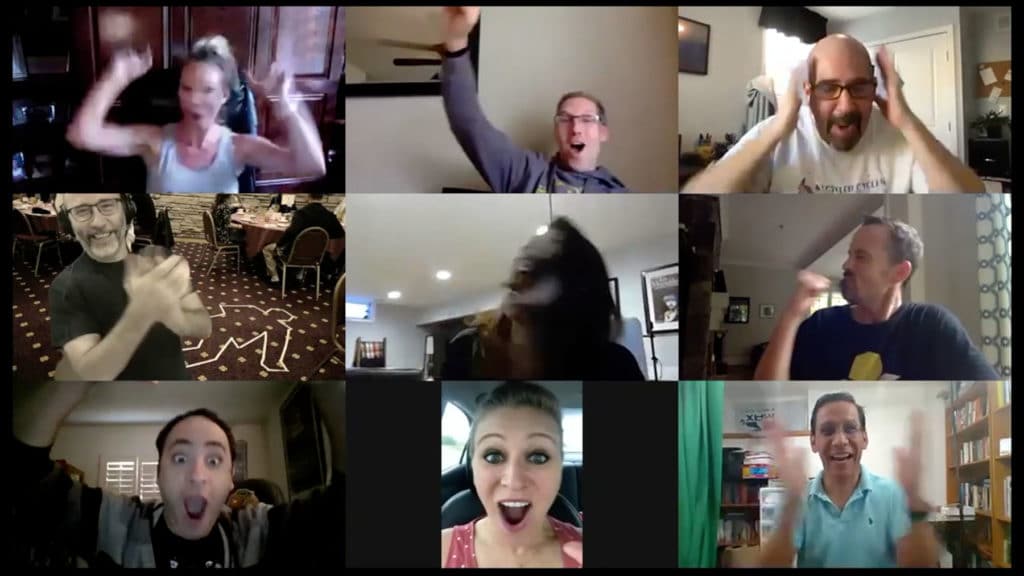
Brothers Marc and Benjamin Goldenblatt are detectives working on an undercover mission when Benjamin is kidnapped by the Mafia. It’s now up to a team of trained Zoom-savvy detectives to find the nice Jewish detective before it’s too late. Sort of.

In reality, Ben and Marc Goldenblatt are not in danger, rather characters in a Jewish escape room script written by Marc Lessman, co-executive producer of The Dinner Detective in Los Angeles. Since 2005, Lessman has been producing live murder mystery shows in more than 75 locations around the country. When the pandemic hit, he and his colleagues turned to virtual escape rooms, scavenger hunts and other scripted detective shows so people could find joy and escapism during the pandemic.

He also created “Oy, Gevalt!” a new Jewish-themed detective escape room experience —starring the Goldenblatt Brothers— where Jewish and non-Jewish attendees use Jewish clues to solve the mystery.

The Journal spoke with Lessman, who is quarantining in Los Angeles, about the show, how Dinner Detective pivoted from live shows to virtual experiences and what it means to bring joy to families during COVID-19. This interview has been edited for clarity.

JJ: You have multiple locations, including in L.A. How did the pandemic change your live show format?

Marc Lessman: We have shows in downtown Burbank, Thousand Oaks, Anaheim, and we have a show in Long Beach that is aboard the Queen Mary, which is this amazing historic docked ship. We do two to three shows there every week, and it’s probably our biggest seller in the country because it’s a really cool experience. We haven’t been able to start up shows since last March, but we were doing hundreds and hundreds of shows every month, and everything came to a screeching halt last March.

JJ: You then thought ‘let’s turn it virtual.’ Were you experienced with virtual experiences?

ML: I had never done any kind of virtual show at all. It was very new to us. We just started brainstorming. Scott [O’Brien, Dinner Detective owner and co-executive producer] and I just started brainstorming.

When we first started we formed this [virtual] escape room. Scott wrote the first script for a detective themed escape room and sent it to all of us and said, “What do you guys think about this?” It grew from there. Now we’re doing virtual escape rooms and we have all these different themed escape rooms, and we have two different virtual murder mystery shows, and we have a virtual scavenger hunt which is really fun. That one you can play with up to 200, 300 people.

JJ: How does it work if you can’t all be in the same room?

ML: We have hidden clues all over the internet… [on websites and through emails.] Everything is done in a way where you can play these games at home sitting at your computer. [For the] scavenger hunt, that was really fun to put together because we were trying to think of fun things to do while you’re at home. You have to take a picture of a self-made crime scene in your house and get creative, like use toilet paper for police tape and reenact a scene from your favorite detective movie, make a video and send it in. All of these games have live moderators as well. It’s very new to us, so we’re still changing things as we go along.

JJ: Murder mysteries are a very specific genre, and now you’re mixing in Jewish heritage. How did ‘Oy Gevalt!’ come to be?

ML: I am the lone Jewish person in the company. When we started coming up with the ideas for different themed escape rooms, we created an escape room for Halloween [and] Christmas. I was thinking it would be really cool to have one that’s Jewish themed and has all Jewish clues. I wanted it to be more open so that it could be played at all times of the year. I tried to add as many different clues about all Jewish holidays, Hebrew references and there’s a lot of Yiddish references in it that I took from my grandparents teaching me.

I wanted to have it be something that was a little bit more educational, so I tried to find some details and facts about Jewish history or Jewish events that a lot of people don’t know already.

JJ: So similar to other detective storylines, the Jewish clues indicate different parts of Goldenblatt’s life that help users rescue him?

ML: Yeah, exactly. It still has a detective theme. I tried to make it not so hard that you have to have an extensive knowledge of Jewish history to play this game or to win the game. That’s another thing: you can use anything at your disposal while you’re playing the game. You can look things up on the internet if you’re not sure what it is. That’s another way we found to make things a little more difficult because we tell people if you don’t know the answer to something, you can go ahead and use Google, and that’s helped us out.

JJ: What do you hope virtual Dinner Detective gives people during this time?

ML: One thing I really enjoy about [virtual Dinner Detective] is that we are connecting people. A family in California bought this game to play with their cousins in New York, so they all got onto the same Zoom call. I didn’t even want to start the game. I held off for 15 minutes because they were all catching up and having fun and talking to each other over Zoom. I think that’s one of the best things about this game is watching people enjoy it with other loved ones of theirs and playing it together. You find out certain things about your family and friends that you didn’t know before when you play this game, and that’s another fun thing.

JJ: This pandemic has impacted everybody in so many different ways. As a business owner, what has this experience taught you? 

ML: I was really scared when this happened because obviously, I work for a company that does live shows, and I was very scared that I was going to be out of a job. I didn’t know what was going to happen. So it’s taught me a lot about being creative, and [pivoting] to make things happen. Sometimes you’ve got to take life into your own hands and really search within yourself to find an answer that is going to help you out and help you survive. I’m very thankful that I work for a company that was able to let me go forward with creating a Jewish game and really giving me the freedom to dive into creating something like this and providing it for other Jewish people around the world.

Each game costs $20 per screen. Prices for private shows vary. To learn more about Dinner Detective or “Oy Gevalt!” visit the website.

Marc Lessman on Creating Jewish Virtual Detective Show ‘Oy, Gevalt!’ Read More »

Montreal Synagogue Vandalized With Swastika Graffiti

A major synagogue in Montreal was vandalized with swastika graffiti on January 13.

The synagogue, Congregation Shaar Hashomayim, had multiple swastikas spray-painted on its front doors; a 28-year-old man was arrested in connection to the matter. The suspect is also alleged to have brought a cannister of gasoline to the synagogue; a security guard caught the man before he could use it.

Canadian Prime Minister Justin Trudeau condemned the graffiti as “despicable” and “vile” in a tweet. “We must always denounce antisemitic hate, no matter when or where it arises,” he wrote.


B’nai Brith Canada CEO Michael Mostyn called the vandalism “another jarring reminder of the constant need for vigilance in protecting our Jewish communal institutions.”

Friends of the Simon Wiesenthal Center President and CEO Michael Levitt similarly said in a statement, “As the presence of online antisemitism and extremism increases, we continue to see that turning into real-life hate and violence. We are calling on community members to remain vigilant and government and law enforcement to take the necessary action to protect the Jewish community from such attacks.”

Rabbi Reuben Poupko, co-chair of the Centre for Israel and Jewish Affairs-Quebec (CIJA-Qc), also said in a statement that the vandalism “targets the entire [Jewish] community and all those who embrace civility and tolerance.”

“Coming in the wake other violent antisemitic attacks, it is yet another reminder of the dangerous role social media continues to play in the spreading of hate and the provocation of violence,” he added. “The Jewish community calls on government and social media to redouble their efforts to monitor and halt this propagation of antisemitism and bigotry. We are grateful to the synagogue security and the police for their rapid response.”


Jewish groups in the United States expressed their solidarity with the Canadian Jewish community.

“This deeply disturbing act of Jew-hatred must be condemned by all,” the American Jewish Committee tweeted.

The Simon Wiesenthal Center similarly tweeted, “Anti-Semitic attacks continue against Jews and our institutions around the world. This time in Montreal. Relieved that this time the perpetrator was caught.”

Montreal Synagogue Vandalized With Swastika Graffiti Read More »