fbpx

December 20, 2020

What to Know Before Giving A Genetic Test As a Holiday Gift

For the person who has everything, a DNA testing kit is a popular gift choice for the holiday season. These Direct-to-Consumer (DTC) tests, which people can order on sites such as ancestry.com or 23andme.com, provide the novelty of discovering where your ancestors come from. You can even dig up some long-lost relatives, whether or not they really want to be found.

Some of these DTC tests also can provide information about whether you are a carrier of certain genetic conditions. In other words, are you a carrier for a condition that could be passed down to your children or that could even affect your own health? This crucial information goes beyond the fun aspect of DNA tests into more serious territory. But if this is the type of information you are looking for, you should be aware of the limitations of DTC testing.

DTC tests are not all inclusive. In other words, they do not test for everything and it is possible that someone is a carrier of a condition that’s not included in the DTC test. In addition, the technology used in DTC testing differs from the technology used in clinical genetic testing that a genetic counselor or healthcare provider orders. Therefore, it is possible that the DTC technology misses something or provides an inaccurate result.  .

In fact, DTC testing companies specifically state that their test is not to be used for making medical decisions. Decisions regarding your health should only be made based on a clinical test ordered by a healthcare provider such as a genetic counselor.

Genetic carrier screening is a clinical test that is different from DTC ancestry tests.

  • Carrier screening ordered by a healthcare provider provides a comprehensive DNA analysis that looks at many genes that are known to be associated with specific genetic diseases.
  • This type of testing cannot be ordered without a healthcare provider.
  • Generally, the diseases tested for are recessive conditions, meaning a carrier of the disease does not show any symptoms. If both you and your partner are carriers for the same genetic disorder, there is a 1 in 4 (25%) chance with each pregnancy that the child could be affected with the disease. Therefore, carrier screening usually doesn’t give you information about your own health, but about reproductive risks, or risk that may exist when you decide to have children.

There are specific panels of genes for specific ethnicities. For example, there is a Sephardic Panel and an Ashkenazi panel, which look for genes of different diseases that are common in each community. However most of the time comprehensive pan-ethnic tests are ordered regardless of ancestry. For example, the genetic testing company JScreen offers a carrier test for more than 200 genetic conditions that occur in people of all different ancestries.

Another point to consider with DTC testing is that you do not have the support and guidance of a healthcare provider to help you understand your results. It’s up to you to interpret the findings. That can be daunting — and dangerous — when genetic condition are involved. However, meeting with a genetic counselor prior to proceeding with testing and after you have your results can help make sense of the information and create a plan for you and your family going forward integrating the genetic information. ,

Genetic tests certainly make great gifts. Just be sure you get the right one when it comes to health decisions.

For more information on genetic carrier screening, visit genetestnow.com, where you can get a $36 discount on a genetic test from JScreen if you’re planning on giving the gift of carrier screening this holiday season.

GeneTestNow.com is a nonprofit initiative of the Doris Factor Endowment Fund of the Jewish Community Foundation of Los Angeles.

What to Know Before Giving A Genetic Test As a Holiday Gift Read More »

Women Creating Change Benefit Promotes Middle Eastern Entertainers

“Stand Up 4 Her: Inspiration 2020,” Women Creating Change’s second annual fundraising gala, went virtual this year, presenting a program of music, poetry, short films and stand-up comedy from talented Middle Eastern and North African women via YouTube.

Hosted by comedians ​Mona Shaikh ​and​ ​Batia Parnass​, with a musical performance by singer/guitarist Ninet Tayeb, the Dec. 19 fundraiser represented voices from Egypt, Israel, Iran, Palestine, Pakistan, Lebanon, Morocco, Syria and Turkey, bridging cultural divides and celebrating diversity through art.

Performers included comics Shaikh, Noam Shuster Eliasi, Sarah Fatemi, Maya Simchi and Atheer Yacoub; singers Zein Khleif, Meital Venus, and Inbal-Rotem Sagiv; filmmakers Shir Cohen, Natasha Kermani and Yasmine Asha; and poets Dania Boustany, Shelly Skandran, Sanam, Erfani and WCC Founder and Executive Producer​ Lee Broda, who recited several of her poems during the event.

​“Women Creating Change was founded by female filmmakers and artists from across the greater Middle East and North Africa (MENA), who seek to inspire change and bridge cultural divides,” Broda said. “I am thrilled for the opportunity to celebrate our talented international community, and spotlight new artists and filmmakers.”

​“Women Creating Change was founded by female filmmakers and artists from across the greater Middle East and North Africa (MENA), who seek to inspire change and bridge cultural divides,” — Lee Broda

Founded in 2017 a by a group of Israeli and Arab female filmmakers, WCC is multicultural, multifaith organization dedicated to diversity, equality, fighting stereotypes and supporting women in entertainment, giving a voice to artists outside the mainstream media through workshops, showcases, networking and other initiatives.

During the pandemic, the WWC community has stayed connected via virtual coffee meetings, masterclasses, workshops, networking, and unifying opportunities which resulted in five collaborative film projects between female MENA filmmakers and actresses. Panels and masterclasses featured Israeli, Palestinian, Iranian, and many more nationalities from the Middle East.

To learn more or to donate, visit www.womencreatingchange.com.

Women Creating Change Benefit Promotes Middle Eastern Entertainers Read More »

Between Peak Fear and Peak Hope: Where We Are Now

We are entering a bizarre moment, caught between two extremes. On Friday, our country hit a record single-day caseload of over 251,000 coronavirus cases; while on the same day, a second vaccine was authorized for emergency use.

We’re fearful, yet hopeful.

Fear has been our dominant emotion since the virus started spreading in early March. Three months ago, though, we saw a ray of hope, as new cases were trending downward and death reports were flat. But now, according to a New York Times database, “There are nearly six times as many cases being reported each day, and three times as many deaths.”

Fear, then hope, then peak fear, then peak hope. That is our 2020 pandemic journey. We are navigating today between the fear of record deaths and the promise of a vaccine that will protect us from a nightmare virus.

It’s hard to imagine a bigger test of our collective resilience.

One of the least talked-about aspects of this resilience is dealing with those close to us. Consider this paradox: The people we feel closest to can be our biggest health threat. We spend years building trust with dear friends and close family members. We become accustomed to feeling safe in their company. Suddenly, you see your child or grandchild lighting a Hanukkah candle, and you wonder: Shouldn’t she be wearing a mask while singing the blessings? Am I too close to her? Has she seen anyone recently? Should I ask her to be tested? Am I in danger here?

Consider this paradox: The people we feel closest to can be our biggest health threat.

Because the virus is so lethal and contagious, we can’t help but have those thoughts. But those are disturbingly foreign thoughts. The whole beauty of families and friends is that they represent the opposite of danger. When we’re with them, we don’t need to watch our backs. We can let our guards down.

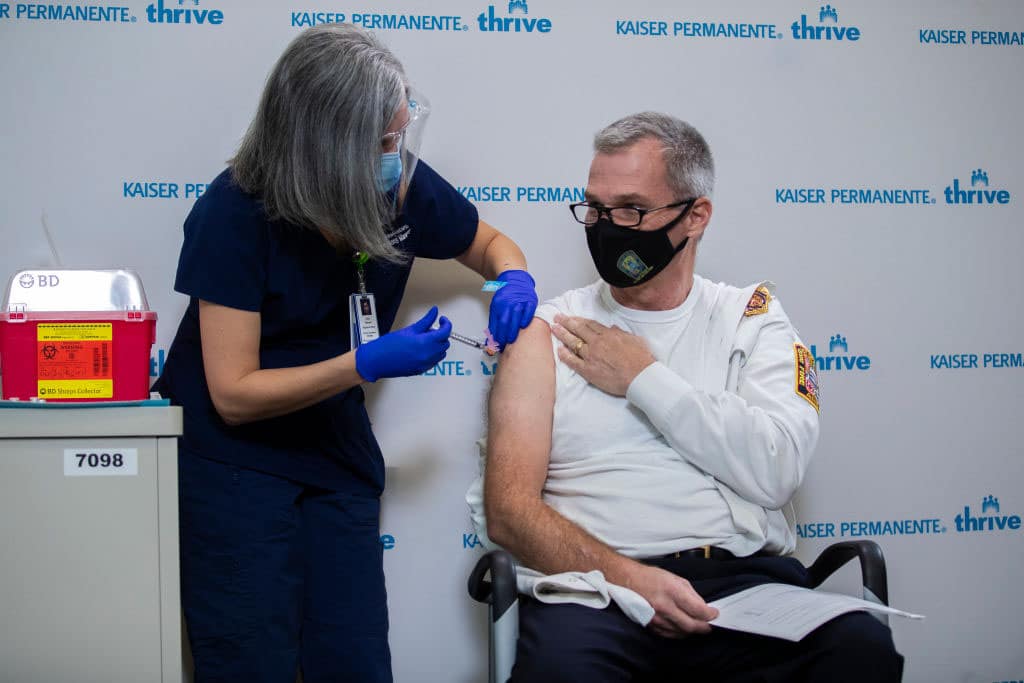
In the midst of this dark winter, of course, the last thing we ought to do is let our guards down. We’ve come too far to mess things up now. Yet we can see a hopeful light that flickers in the distance. That light is a needle carrying a vaccine, a shot in the arm after a horrible year. There’s no guarantee the vaccine will work equally for everyone or that it’ll be free of side effects. And the mass rollout is likely to be difficult and messy.

But the very notion of a vaccine has always held a special place in humanitarian lore. Vaccines of all kinds have saved millions of lives. Because we’ve been so physically isolated this year, the COVID-19 vaccine offers hope that we will regain our physical proximity, that people will feel free to commune in groups, that grandparents will be able to hug their grandkids again.

Perhaps the simple hug has been the biggest human deprivation of 2020. How poignant that in pandemic times, we couldn’t even think as far as a hug. We’ve been so careful to stay distanced from one another, the hug became just another luxury that hardly came up for discussion. We got used to not having it, to settling for “virtual” alternatives.

Perhaps the simple hug has been the biggest human deprivation of 2020.

Now we must double down on our distancing before we can think of physically embracing our friends and families again. The miracle of the vaccine was announced at Hanukkah, but the liberation of the human hug may not come until Passover, or even later.

We’ll have to scale the peak of fear before we can savor the peak of hope.

Between Peak Fear and Peak Hope: Where We Are Now Read More »

Jeremy England

Jeremy England: Every Life Is on Fire

Shmuel Rosner and Jeremy England discuss England’s latest book: Every Life Is on Fire: How Thermodynamics Explains the Origins of Living Things.
Jeremy England is an American physicist who uses statistical physics arguments to explain the spontaneous emergence of life, and consequently, the modern synthesis of evolution.

Follow Shmuel Rosner on Twitter.

Jeremy England: Every Life Is on Fire Read More »