fbpx

December 18, 2020

French Jewish Family Attacked While Singing Hanukkah Songs

A Jewish family in Aubervilliers, France was attacked on December 17 while they were singing Hanukkah songs inside their car.

The Algemeiner reported that four people shouted “F— the Jews!” at the family and then proceeded to shake “the car violently while smashing glass bottles against the body of the vehicle.” The Algemeiner also cited a tweet from French Interior Gerald Darmanin stating that the four people involved in the assault were arrested shortly thereafter.

“They should be punished commensurate with the gravity of these facts,” he wrote.

Liora Rez, director of the Stop Antisemitism.org watchdog, said in a statement to the Journal, “Imagine hating Jews so much that you’re triggered by Hanukkah music and physically attack a family. We’re nauseated at how barbaric some people are and hope all four men are prosecuted to the fullest extent of the French law.”

In January, the French Interior Ministry released statistics showing that anti-Semitic incidents had increased by 27% from 2018 to 2019.

French Jewish Family Attacked While Singing Hanukkah Songs Read More »

‘Shtisel’ Secrets: Revelations from the Season 3 Virtual Sneak Preview

“Shtisel,” the Israeli series about an Ultra-Orthodox family in Jerusalem’s Haredi community, has been a worldwide hit since it premiered its first season on Netflix in 2018, five years after its debut in Israel.  Its insular world may be foreign to most, but its themes of love and faith, jealousy, loyalty, social pressures, and generational conflicts are universal.

Ahead of the pandemic-delayed third season’s launch on the streaming service in spring 2021, Temple Emanu-El’s Streicker Center celebrated the last night of Hanukkah with an exclusive advance screening of episode one, preceded by a live, virtual Q&A with series stars Michael Aloni (Akiva), Shira Haas (Ruchami), Neta Riskin (Giti), Doval’e Glickman (Shulem) and writer Ori Elon.

Set four years after the events of Season 2, the premiere was full of surprising developments and one very big shocker that we won’t reveal here. But the cast’s insights during the Q&A were both entertaining and revelatory.

Artist Akiva Shtisel married Libbi and had a daughter in the time jump since the second season. “Will this relationship continue? We’ll see that and his life as an artist and his loving and complex relationship he has with his father,” Aloni said, noting that he had tears in his eyes when he read the script. “I can’t tell if it was from joy or sorrow or a mixture of both.”

Ruchami only has a few brief scenes in the premiere, but Haas promises a lot more to come. “I see how mature she’s become since the first season, understanding who her family is and her responsibility, and in the second season becoming this person she is. In the third season it’s a whole new level, being a woman, being a wife and dealing with hard stuff. It’s about her relationship with Hanina and the heartbreaking challenges they’re going through.”

She was on the set of “Unorthodox” when she learned there would be a third season. “It feels so natural to go back to this character,” she said. “It’s been eight years from the first season and five and a half since the second. ‘Shtisel’ is home and it was so natural [to be back].”

Riskin was somewhat apprehensive before shooting commenced. “I was a bit afraid because I hadn’t been Giti for five years, but it was actually very easy because it’s getting into a person that you already know. You know the inner soul of this person. It’s like an old friend. So it was easier than I thought.” Glickman concurred: “It’s easier to come back to something you know.”

He and his fellow actors recalled their initial auditions for “Shtisel.” “I never wanted a role so much as this one. When I read it I was astonished. I never read such a script,” Glickman said. “I did two auditions. The first one I wasn’t ready. I didn’t know it well. I waited for months for the second.”

“My audition was with Dov,” Aloni said. “They wanted me for this role, but they weren’t sure that I was able to play a Haredi Jew. So they had the makeup artist glue payes and beards on me and they realized if I grew a beard I’d be fine. The show was very dear to me from the very beginning.”

Riskin “didn’t know too much about the character because I was given two scenes. But I had an intuition about this character. She’s very assertive in a very quiet way, she gets what she wants and nobody notices that she took it. She sneaks in, takes something and goes,” she said. “She has everything on her shoulders. She’s a powerhouse.”

Neta Riskin as Giti (Credit: Vered Adir)

Having come from a non-religious background, Riskin researched for the role by spending time with Haredi families, “[who] taught me a lot about their daily life. ‘Shtisel’ is not about religion, it’s about certain people living in a certain way,” she said. “I had coach who told me, ‘It’s not about what you believe it’s about how you behave.’ Once you get the rules of the game, it becomes a lot easier.”

When the discussion turned to the show’s impact on the Haredi community, the world’s perception of it, and the differences that set the community apart, Aloni opined that “‘Shtisel’ has built sort of a bridge connecting both sides of the equation. In the end we are all human beings. We are driving for something we have the same wills and dreams, and we’re all flawed in different ways,” he said. “That’s what makes us humans, and you see that in the show.”

For Glickman, “‘Shtisel’ isn’t about religious people. It’s about relationships between people that have desire, love, jealousy, but the religion makes the drama deeper and the conflict stronger [because] they have to stand before God each day.”

“‘Shtisel’ isn’t about religious people. It’s about relationships between people that have desire, love, jealousy, but the religion makes the drama deeper and the conflict stronger [because] they have to stand before God each day”—Doval’e Glickman 

The in-demand actors were also asked about the projects they’re working on apart from “Shtisel.” Aloni, also known for “Our Boys” and “When Heroes Fly” and who hosts the Israeli version of “The Voice,” has been shooting “The Beauty Queen of Jerusalem,” a tri-generational saga in which he plays the patriarch of a Sephardi family in a story that chronicles the history of the family and Israel.

Glickman has completed work in Prague on “Oslo,” about the Israeli-Palestinian Peace Accords and Riskin declined to provide details about the project she’ll begin in February. Also an accent coach, she prepared Natalie Portman for her Hebrew-speaking role in 2015’s “A Tale of Love and Darkness.”

Michael Aloni and Doval’e Glickman (Credit: Ohad Romano)

Haas, whose Ophir Award-winning drama “Asia” will be Israel’s entry for an Oscar nomination in the international feature category, was similarly circumspect. “I can’t tell you about my next project but I’m very excited about it,” she said.

Writer Elon wasn’t concerned about the cast’s other commitments, and said that he’s written Season 5 and planning Season 6. “We could go on forever, but nothing comes easily,” he said. Glickman offered help on that score, proposing his idea for a future season in which Shulem wakes up to find Akiva missing and he goes searching for him all over the world.

When “Shtisel” does eventually end, Haas hopes that Ruchami will get a satisfying close to her story. “I think she’s an amazing character and I’ve learned a lot from her. She has so much empathy within her and is so stubborn and knows what she wants and still takes care of everyone she loves, so I feel that she deserves a happy ending,” she said.

Aloni envisioned the series’ very last scene. “For me, whenever it ends, it should be Akiva and Shulem at the dining table. That’s where it started and that’s where it should end.”

“Shtisel” will premiere on Netflix in spring 2021.

‘Shtisel’ Secrets: Revelations from the Season 3 Virtual Sneak Preview Read More »

david suissa podcast curious times

Pandemic Times Episode 113: Can we still laugh when the stakes are so high?

New David Suissa Podcast Every Tuesday and Friday.

Reflections on the value of humor and levity.

How do we manage our lives during the coronavirus crisis? How do we keep our sanity? How do we use this quarantine to bring out the best in ourselves? Tune in and share your stories with podcast@jewishjournal.com.

Listen on Apple Podcasts

Listen on Spotify

Listen on Stitcher

Follow David Suissa on FacebookTwitter and Instagram

Pandemic Times Episode 113: Can we still laugh when the stakes are so high? Read More »

Axios Criticized for Calling Leila Khaled a “Palestinian Activist”

The news outlet Axios has faced some criticism for referring to Popular Front for the Liberation of Palestine (PFLP) terrorist Leila Khaled as a “Palestinian activist” in a recent article.

The article, titled “Zoom faces its content moderation moment,” discusses the video conferencing platform’s efforts in developing guidelines for how to handle content on its platform. The Axios article references how in September, Zoom deplatformed a San Francisco State University (SFSU) event featuring Khaled.

“Zoom decided not to host a San Francisco State University event featuring Palestinian activist Leila Khaled, who had taken part in two plane hijackings,” the section reads.

Shelby Talcott, reporter for the conservative website Daily Caller, first noted the description of Khaled, tweeting, “Ah, yes. The ‘Palestinian activist’ who hijacked a plane with hand grenades and a pistol for the designated terrorist organization PFLP… And then had multiple cosmetic surgeries so she could do it again.” She noted in a subsequent tweet that the Axios article doesn’t mention the PFLP at all.

https://twitter.com/ShelbyTalcott/status/1339617689967456257?s=20

https://twitter.com/ShelbyTalcott/status/1339619490603147266?s=20

The American Jewish Committee similarly tweeted, “There is a word for someone who has ‘taken part’ in two plane hijackings. That word is not ‘activist.’ Leila Khaled is a terrorist, a member of the PFLP, designated as a terrorist group by both the U.S. and the [European Union]. Fix this.”


The Stop Antisemitism.org watchdog also tweeted, “Leila Khaled hijacked TWO airplanes. A flight attendant was shot on one of them. She is a convicted terrorist not an activist.”


Axios and Ashley Gold, the reporter who wrote the article, did not respond to the Journal’s requests for comment.

In September, Zoom announced that they deplatformed the Khaled event because Khaled’s involvement with the PFLP violated Zoom’s terms of service. Khaled had been scheduled to appear on a panel with Rula Abu Dahou, acting director of the Institute for Women’s Studies at Birzeit University in the West Bank, South African politician Ronnie Kasrils, former Black Liberation Army member Sekou Odinga and Jewish Voice for Peace member Laura Whitehorn. SFSU professors Rabab Abdulhadi and Tomomi Kinukawa had been set to co-moderate the panel and the event.

Khaled, now 76, was among the terrorists who hijacked commercial airliners in 1969 and 1970. Her attempt to detonate grenades on the 1970 flight were thwarted and no one was injured or killed in either incident.

Axios Criticized for Calling Leila Khaled a “Palestinian Activist” Read More »

I’m a Black Jewish Communal Leader. I Know We Can Make Our Communities Welcoming.

The racial justice protests that swept across the country this past summer has prompted the American Jewish community to reckon with the racial disparities that exist inside and outside of our communities.

My own life has been a masterclass in understanding these tensions. When I was two, I was adopted. Two years later, my adoptive parents divorced. I lived with my mom, who did not have a college education, and we struggled with poverty. We lived in Orange County, an interconnected mesh of largely white wealthy suburbs, so I saw what life could be even if we couldn’t afford it. I saw what nice houses looked like even during times that we didn’t have a home.

When I was in middle school, my adoptive mother unearthed a genealogical bombshell: my birth mother was Jewish. My adoptive mother, by comparison, was a worship leader in our church, and I mostly grew up within the Christian community. In fact, the first time that I consciously met another Jew was in sixth grade.

This discovery dramatically altered the course of my life. I began to engage deeply in our Jewish community. I learned more about the faith of my ancestors and reconciled my Christian upbringing with my newfound connection to my birth mother’s Jewish heritage. In high school, I led Kabbalat Shabbat services for my Jewish day school on Fridays and sang on the worship team for my church on Sundays as a featured singer during services.

Although Jews of Color like me represent approximately 15% of the American Jewish community, we are egregiously underrepresented as constituents and as leaders in mainstream Jewish organizations. This disparity is especially true for Black Jews. Events from this past year have forced the American Jewish community to recognize the difficulty of living as a Black person in our country and how it is necessary to be an active ally — including to the Jews of Color within our community.

Jews of Color are egregiously underrepresented as constituents and as leaders in mainstream Jewish organizations.

While we must change internally, we also have a responsibility to advocate for our people, starting with educating our peers about Judaism and Israel. In college, I began to see how anti-Zionism breeds bigotry and stifles free speech on campuses. I was in a unique position because most Jews involved in pro-Israel advocacy had very different childhoods than I did. I explained why Zionism is so important for Jews to my non-Jewish classmates.

After college, I decided to work in Jewish communal life. Today, I am one of a few Jews of Color who are leaders at a Jewish organization not specifically devoted to Jews of Color. I am deeply proud of the work I do as Associate Director of Alums for Campus Fairness, which serves as America’s unified alumni voice on issues of anti-Semitism and bigotry on campus. Alums for Campus Fairness takes alumni off the sidelines and mobilizes them to speak out at their alma maters. As the Associate Director, I have the privilege of engaging directly with alumni and building chapter networks from the ground up. My experience as a Jew of Color growing up in Ashkenormative spaces helps our chapters be more purposeful and effective in engaging a wide array of Jewish alumni and supporting their development as leaders in this space.

The struggles I have faced in my life — as a Black child who faced poverty, as an adoptee who learned of his Jewish identity later in life and as an empowered advocate for my communities — are what have made me the man I am today. Genesis 32:25-29 tells the story of Jacob wrestling with an angel all night and at the end, being renamed “Israel” (he who wrestles with God). In his commentary on Genesis 32:25, the medieval Italian Rabbi Obadja Sforno says that Jacob receives this name because a period of ups and downs — like Jacob’s struggle with Esau — occurs before we can emerge triumphant. Certainly, much of our history as Jews — as the nation of Israel — has been rife with trials and tribulations.

Most communal Jewish leaders lack a personal stake in stopping the racism that is the daily reality for many Jews of Color. We must wrestle with challenging conversations: How can we welcome Jews of Color? How can we more effectively dedicate our organizations to the anti-racism movement? How can we say “Black Lives Matter” when the previous BLM platform espoused the bigotry of anti-Zionism? What does this mean about the future of our communities?

Like Jacob, I have always embraced struggle because you learn more by facing adversity head-on. Challenges teach you about yourself, your community and your ability to persevere. The struggles I faced growing up led me to never see any challenge as insurmountable. I believe there is a solution to everything. Finding the solution to a problem is the hardest part, but applying it requires courage and willpower.

Meeting these challenges will not be easy. It means devoting resources to recruiting and retaining Jews of Color at the grassroots and leadership levels. It means many Jews must wrestle with preconceptions about the Black community. It means taking a second look at how we end bigotry in our daily lives. It means respectfully and genuinely engaging in difficult conversations.

But we are the nation of Israel, of he who wrestles with God. When the Jewish American community embraces these struggles, we will be stronger and more vibrant than ever before.


Joel Bond is the associate director of Alums for Campus Fairness, America’s unified alumni voice on issues of antisemitism, demonization of Israel and bigotry.

I’m a Black Jewish Communal Leader. I Know We Can Make Our Communities Welcoming. Read More »

A Moment in Time: Recognizing God’s Voice

Dear all,

I take the babies on a walk 4-5 times a week through the hills. (Yes, I am always wearing a mask). It isn’t easy. As they get bigger, I get stronger. But then they get bigger again!

I try to complete the 3.5 loop within a certain time frame. But earlier this week, I faced a challenge.

10 minutes into the walk, a car slowed down, and the driver asked for directions. It was a little complicated, but I was able to (hopefully) help him out.

A while later, my phone rang. It was a close friend who was returning a call as I needed advice regarding parenting.

After that, I bumped into a neighbor whose husband had recently died. It was hard not to give her a hug given the pandemic.

I then decided to cut the walk short, as it was already getting dark. At first I was a little annoyed. You see, I didn’t reach my intended exercise goal.

But then I realized that I experienced something far more significant. You see, these three interactions were (perhaps) God’s outreach to me.

God was the stranger who needed direction.
God was the friend who offered advice.
God was the neighbor who was in grief.

And I had the opportunity, for three moments in time – to recognize God’s voice.

How will God call out to you this week? And how will you respond?

With love and Shalom,

Rabbi Zach Shapiro

A Moment in Time: Recognizing God’s Voice Read More »

Sorry Mindy Kaling, We Don’t Light The Menorah For “Dramatic Effect”

On the fifth night of Hanukkah, Mindy Kaling gave to us… a fully lit and fully tone-deaf menorah. Oy vey. 

As a Jewish woman, I’ve become accustomed to a general lack of understanding of the many customs, traditions and holidays that I hold dear, save for Hanukkah because of how it falls close to Christmas.

On her Instagram on December 14, Kaling shared a photo of herself smiling with a lit menorah and the caption: “Happy Hanukkah night 5! *All candles lit for dramatic effect*.” Even if her intentions were in the right place, the execution was all wrong. Five nights. Five candles and the shamash. Not eight, as Kaling’s post suggests.


View this post on Instagram


A post shared by Mindy Kaling (@mindykaling)

B.J. Novak, Kaling’s former costar and longtime friend, is Jewish and has been long-rumored to be the donor father of the Kaling’s two children. Many Instagram commenters seemed to be more concerned that her Hanukkah wishes could be a sign that the two were celebrating the holiday together. Even if that was the case, wouldn’t a lifelong Jew like Novak know that Kaling’s post would be viewed as a major faux pas? And if he wasn’t there to celebrate with her, why have a menorah in the first place?

As someone who has been in an interfaith relationship for the past several years, I can say that my partner has been nothing but open and understanding about Judaism. But I can’t imagine ever being okay with him or any non-Jews that I know sharing a photo with a menorah “for dramatic effect.”

In the ruthless space that is the internet, public figures have seen how cautious they must be when sharing anything online so it does not lead to a #CancelMindyKaling hashtag trending on Twitter. But after some digging, I was dismayed — though unsurprised — to see that the outrage over Kaling’s offense was limited to the comments section of her Instagram post.

Many Jewish and non-Jewish commenters shared in my frustration that something so symbolic and meaningful would be used for “dramatic effect.” Nonetheless, there are more than 125,000 likers who apparently disagree with seeing any wrongdoing.

In no universe is lighting the menorah early the same as putting up your Christmas lights early, and while we may not know what her true intentions were behind this picture, let’s hope that she’ll learn never to use something like an improperly lit menorah as a photo op again.

Next time, a simple “Happy Hanukkah” post or tweet will suffice, no dramatic effects necessary.

Sorry Mindy Kaling, We Don’t Light The Menorah For “Dramatic Effect” Read More »

Milken Foundation Gifts UCLA with Center for Music of American Jewish Experience

UCLA announced on Dec. 3 the opening of its first permanent academic home for the study of American Jewish music. Housed in the UCLA Herb Alpert School of Music, the new Lowell Milken Center for Music of American Jewish Experience will foster artistic creativity, scholarship, performance, and other cultural expression, all through a Jewish musical lens.

“The Lowell Milken Center for Music of American Jewish Experience will unite the academic and the artistic, showcasing the artists, scholars and educators who reveal to us the authentic voice of our shared humanity,” Eileen Strempel, dean of the school of music said in a statement to the Journal. “We are incredibly grateful to Lowell Milken for his generous gift to endow this center, which builds on our latest learnings, establishes a standard of excellence and an enduring infrastructure at UCLA for [the] music of American Jewish experience, and gives us the ability to plan more ambitious initiatives for years to come.”

The new center, which was a $6.75 million gift from the Lowell Milken Family Foundation, is an extension of the Milken Archive of Jewish Music, which was founded by Milken in 1990. Its mission was to record, preserve and disseminate music inspired by more than 350 years of Jewish life in the United States.

The Lowell Milken Center also builds on the Lowell Milken Fund for American Jewish Music at UCLA. Established in 2017, the fund has produced a diverse calendar of concerts, lectures and projects, ranging from klezmer workshops to large choral and orchestral performances to artist residencies and commissions of new music. In the first three years of programming, the Lowell Milken Fund partnered with more than 12 different Jewish organizations to deliver both academic events and public performances which highlighted the broad range found in American Jewish music, and featured artists from UCLA, Los Angeles and across the world.

“Shaped by Jews from every corner of the globe, who absorbed their host cultures while retaining their Jewish heritage, the archive is as diverse and beautiful as America itself,” Milken, a UCLA alum, renowned businessman and philanthropist, said in a statement to the Journal. “Our vision was to create a living archive making education central to our mission. The partnership with the UCLA Herb Alpert School of Music positions the new center as a global leader in the field of music of American Jewish experience.”

“Shaped by Jews from every corner of the globe, who absorbed their host cultures while retaining their Jewish heritage, the archive is as diverse and beautiful as America itself.” — Lowell Milken

In March, the Lowell Milken Fund produced the UCLA American Jewish Music Festival, which culminated in the “Titans of Jewish Music” concert in Royce Hall with performances by various UCLA ensembles. The Center’s inaugural program, “American Culture and the Jewish Experience in Music,” featured the world premiere of the oratorio “David’s Quilt,” along with programs in conjunction with the UCLA Alan D. Leve Center for Jewish Studies. This co-presented event was part of a three-day conference covering major intersections between Jewish and American life. The conference featured lectures on heritage, innovation, key facets of the Jewish-American musical experience and Hollywood pioneers.

Performance of “David’s Quilt”

Mark Kligman, UCLA’s Mickey Katz Professor of Jewish Music, and director of the new center, told the Journal many in L.A. and around the world still don’t realize the rich pool of diverse Jewish music that’s out there. He’s excited to incorporate Ladino, Sephardic, Ashkenazi and Persian Jewish music, among others into concerts, workshops and UCLA’s musical curriculum.  This way, students and community members can expand their grasp on what Jewish storytelling looks like through music.

“I feel Jewish music is both historically driven and… cultural,” Kligman said. “To tell those stories are very important…Our endgame of our center is to help people experience Jewish music on many levels. This ‘Ashkenormative’ fashion, is something that we’re very conscious [of] and aim to really widen people’s knowledge and exposure to Jewish music.”

The Lowell Milken Center is currently producing videos on subjects including the story of “David’s Quilt,” a concert work by 15 composers of different backgrounds and styles, and insights on the scope of music showcased in the UCLA American Jewish Music Festival. The series of videos will be available for viewing on the center’s website. They hope once the pandemic passes, the center can hold an official concert to celebrate its opening.

Kligman, who also worked at Hebrew Union College for 20 years, added that while UCLA teaches a wide variety of musical genres from The Beatles to Ludwig van Beethoven and the history of Hip Hop, the history of Jewish music often is only taught at Jewish seminaries. With the opening of the Center, musicians and performers will learn the complexities and history behind Jewish music.

“What doesn’t exist [until now] is in secular academic culture where Jewish music can flourish as an academic field of study, and a focus for performances, and the creation on new music,” Kligman said. “This gives me the opportunity to work strategically within the school of music to have Jewish music represented in many different ways because it has such a deep historical context.”

Known for his philanthropy in education, music and design, Milken has long supported UCLA. He previously established the Lowell Milken Institute for Business Law and Policy at UCLA School of Law and the Lowell Milken Family Centennial Scholars Endowed Scholarship Fund for student-athletes. Kligman said the Lowell Milken Center for Music of American Jewish Experience will expand UCLA’s already established music programs into the community, and enhance the field of American Jewish music on an international scale.

“This is the beauty of a large university like UCLA and the generosity of donors like Lowell Milken, who really have a passion,” Kligman said. “Jewish music in the United States is not just New York. For decades, various composers and performers in L.A. have been trendsetting and we need to tell all those stories…We want students and members of the community to learn about the diversity and range of Jewish music and meet the artists who are making the music.”

Milken Foundation Gifts UCLA with Center for Music of American Jewish Experience Read More »

FDR, the Nazis, and the Jews of Morocco: a Troubling Episode

The normalization of relations between Israel and Morocco and the  U.S. recognition of Moroccan sovereignty over the disputed Western Sahara have stirred interest in the history of Morocco’s Jews, including during the Holocaust years.

Unfortunately, some pundits, in their enthusiasm over these developments, have misleadingly portrayed the Allied liberation of North Africa in 1942 as the simultaneous liberation of the region’s Jews from their Nazi and Vichyite persecutors. That narrative papers over the harsh reality of what happened after the Allies’ victory. The full story of how President Franklin D. Roosevelt treated the Jews in Morocco and elsewhere in North Africa is a deeply troubling chapter in his administration’s history.

On November 8, 1942, American and British forces launched “Operation Torch,” the invasion of German-occupied Algeria and Morocco. In just eight days, the Allies defeated the Nazis and their Vichy French partners in the region. American Jews expected that the liberation of North Africa would also mean liberation for the 330,000 Jews there.

In 1870, the French colonial authorities in Algeria had issued the Cremieux Decree, which granted equal rights to that country’s Jews after centuries of mistreatment by Arab rulers  (although it did not affect the Jews in neighboring Morocco). When the Vichyites took over North Africa in 1940, they abolished Cremieux and subjected all of the region’s Jews to a range of abuses, including restrictions on admission of Jews to many schools and professions, seizures of Jewish property and occasional pogroms by local Muslims that were tolerated by the government.

In 1941–1942, American Jewish newspapers carried disturbing reports that the Vichyites had built “huge concentration camps” in Morocco and Algeria to house thousands of Jewish slave laborers. The prisoners endured backbreaking work, random beatings by the guards, extreme overcrowding, poor sanitation, near-starvation and little or no medical care. According to one report, 150 Jews scheduled to be taken to the camps were so fearful of the conditions there that they resisted arrest and were executed en masse.

With the Allied victory, North African Jews — and their American coreligionists —expected the prisoners to be released and the Cremieux Decree reinstated for Jews living throughout the region. The American Jewish Congress optimistically predicted that the repeal of the Vichy-era anti-Jewish laws would follow the Allied occupation of North Africa “as the day follows the night.”

But President Roosevelt had other plans.

Meet the New Boss, Same as the Old Boss

At the beginning of “Operation Torch,” the Allies captured Admiral François Darlan, a senior Vichyite leader. FDR decided to leave Darlan in charge of the Allied-occupied North African territories in exchange for Darlan ordering his forces in Algiers to cease fire.

Many prominent liberals in the United States were appalled by this decision. “[It] sticks in the craw of majorities of the British and French, and of democrats everywhere, [that] we are employing a French Quisling as our deputy in the government of the first territory to be reoccupied,” an editorial in The New Republic protested.

The war was supposed to bring enlightened democracy to areas that had been under the boot of fascism — not keep the old tyrants in power.

The war was supposed to bring democracy — not keep the old tyrants in power.

Not only was Darlan still in power, but he also retained nearly all of the original senior officials of the local Vichy regime. Darlan did dismiss one Vichyite of note, Yves Chatel, the governor of Algeria — but promptly replaced him with Maurice Peyrouton, the very Vichy official who had signed the anti-Jewish laws of 1940. Together, Darlin and Peyrouton deep-sixed the Cremieux Decree and kept thousands of Jews in the slave labor camps.

Rumblings of concern began to surface in the American press. A December 17 editorial in the New York Timesexpressed doubt that Darlan really intended to bring about “the abrogation of anti-Jewish laws [and] release of prisoners and internees.” The editors of The New Republic asked on December 28, “Who controls French Africa, Darlan or the [Allies]? And if the latter, isn’t it high time we cleaned up the remnants of fascism that obviously still exist there?” An investigative report in the New York City newspaper PM on January 1 asserted that the Darlan regime was actively discriminating against Jews, and “thousands” remained “in concentration camps.”

President Roosevelt publicly claimed that he had already “asked for the abrogation of all laws and decrees inspired by Nazi governments or Nazi ideologists.” But he hadn’t. When reporters questioned him at a January 1, 1943 press conference, FDR replied, “I think most of the political prisoners are — have been released.” But they hadn’t.

No Rights for Jews

The official transcript of FDR’s meeting with Major-General Charles Nogues, a leader of the post-Vichy regime, in Casablanca on January 17, 1943, provides some insight into the president’s thinking.

Nogues asked President Roosevelt about demands by North African Jews for voting rights. According to the stenographer, Roosevelt replied, “The answer to that was very simple, namely, that there just weren’t going to be any elections, so the Jews need not worry about the privilege of voting.”

The transcript continues, “The President stated that he felt the whole Jewish problem should be studied very carefully and that progress should be definitely planned. In other words, the number of Jews should be definitely limited to the percentage that the Jewish population in North Africa bears to the whole of the North African population.”

FDR explained that he wanted to make sure the Jews would not “overcrowd the professions.” He pointed to what he called “the specific and understandable complaints which the Germans bore towards the Jews in Germany, namely, that while they represented a small part of the population, over fifty percent of the lawyers, doctors, school teachers, college professors, etc. in Germany were Jews.”

In reality, Jews comprised about 16% of the lawyers, 11% of the doctors, 3% of the college professors and less than 1% of the schoolteachers in Germany.

It’s striking that the president of the United States was so quick to believe the wildly exaggerated numbers — and to conclude that German hatred of Jews therefore was justified.

American Jews Speak Out

As the weeks turned into months and as the fascists remained in power in North Africa, public criticism of the Roosevelt administration intensified.

Near-daily reports by I. F. Stone in PM featured headlines such as “U.S. Policy in North Africa: Why State Dept. Holds Up Repeal of Nuremberg Laws,” and “Hull Admits Anti-Fascist Prisoners Still Being Held in North Africa.”

Reports in the New York Times and the Jewish Telegraphic Agency’s Daily News Bulletin began citing, by name, the camps where North African Jews and political refugees were being enslaved — including one that was just five miles from where “American troops, dedicated to end government by concentration camp, live.”

American Jewish leaders were strongly supportive of President Roosevelt — and some 90% of Jews voted for him repeatedly — but his perpetuation of the persecution of North African Jews was just too much. On February 14, 1943, the American Jewish Congress and World Jewish Congress took the unprecedented step of publicly denouncing the president’s North Africa policy.

In a joint public statement, the two groups charged that “the anti-Jewish legacy of the Nazis remains intact in North Africa.” Despite three months having passed since the Allied liberation, only a few “grudging concessions have been made” to aid the Jews, while no changes “of an important character have been made in the[ir] political and economic situation.”

The statement reminded the president that he had pledged “action to insure that the four freedoms shall without further delay be declared as valid for all the peoples in North Africa, which means the total abrogation of all anti-Semitic laws and decrees and … the release of those of whatever race or nationality who are being detained because of their support of democracy and opposition to Nazi ideology.”

The remarkable statement from those two mainstream Jewish organizations was only slightly milder than the charge by Benzion Netanyahu, executive director of the militant U.S. Revisionist Zionists (and father of the current prime minister of Israel), that “the spirit of the Swastika hovers over the Stars and Stripes” in the administration of North Africa.

Rabbi Stephen S. Wise, the founder and longtime leader of the American Jewish Congress, then led a delegation to Washington to personally make their case directly to U.S. officials, and Wise’s co-chair, Dr. Nahum Goldmann, organized a group of prominent French exiles in the United States to present the State Department with a petition of their own. The Union of American Hebrew Congregations (Reform) also called on the administration to intervene against the Vichyites.

These protests induced a number of other prominent individuals to speak up, among them Supreme Court Justice Felix Frankfurter, the exiled French Jewish leader Baron Edouard de Rothschild and leaders of the American Jewish Joint Distribution Committee.

Agonizing Delays

In March 1943 — more than four months after the Allies liberated Morocco and the rest of North Africa — the Roosevelt administration finally instructed the local authorities to repeal the anti-Jewish measures.

The implementation process, however, was agonizingly slow. In April, the forced labor camps in North Africa were officially shut down — yet, in reality, some of them continued operating well into the summer.

The Jewish quotas in schools and professions were only gradually phased out. It was not until October 20, 1943, that the Cremieux Decree was at last reinstated.

After ten long months of presidential stalling and stonewalling, this disturbing chapter in American foreign policy finally came to a close.

The increased public interest in the history of North African Jewry is a welcome byproduct of Israeli-Moroccan normalization. But discussions of that history should include its less pleasant side; that part, too, has important lessons to offer.


Dr. Medoff is director of The David S. Wyman Institute for Holocaust Studies, in Washington, D.C., and author of more than 20 books about the Holocaust and Jewish history. This essay is based in part on the research for his most recent book, “The Jews Should Keep Quiet: Franklin D. Roosevelt, Rabbi Stephen S. Wise, and the Holocaust.”

FDR, the Nazis, and the Jews of Morocco: a Troubling Episode Read More »

Dismantling Anti-Semitism or Dismissing It? A JVP Panel

On the sixth night of Hanukkah, the anti-Zionist group Jewish Voice for Peace (JVP) hosted an online discussion called “Dismantling Antisemitism, Winning Justice.”

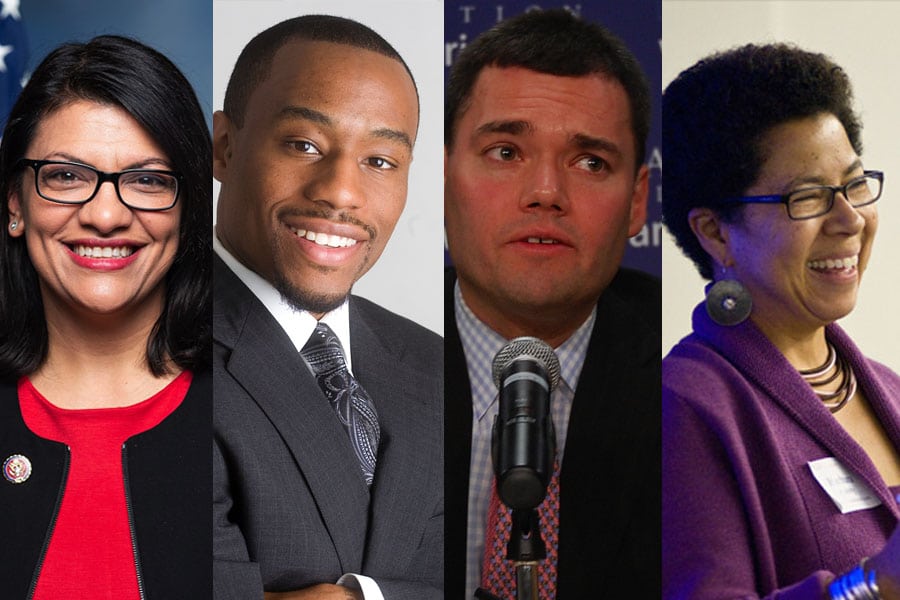
The panel members had all been heavily criticized beforehand, with reactions ranging from skepticism to outrage. Only one panelist was Jewish, but all were noted opponents of Israel. The host, JVP, had recently come under fire for a now-deleted tweet proclaiming “L’chaim Intifada” and comparing it to resistance against Nazis. Two panelists had been accused of anti-Semitism in the past: U.S. Representative Rashida Tlaib (D-Mich.) and Temple University professor Dr. Marc Lamont Hill (who prerecorded his responses). They were joined by writer and professor of history and political science Peter Beinart — editor-at-large at Jewish Currents — and history professor and activist Dr. Barbara Ransby. While lacking expertise in anti-Semitism, Hill, Tlaib and Ransby are known for their work on racism.

The event began with panelists sharing personal recollections of how they discovered anti-Semitism. These were heartfelt and diverse stories. “The fight against anti-Semitism is as urgent as any other struggle here in the U.S. and around the world,” Hill said.

The panel was moderated by JVP’s Rabbi Alissa Wise, who explained her anti-Zionism in the context of anti-Semitism. Wise spoke of the Holocaust and how, from her education, “When we needed allies, they failed us. So I was taught that when, inevitably, Jews are at risk of genocide again, we would need somewhere to go, and that’s why there must be Israel.” Wise disagreed, arguing, “I want so much for the Jewish community to release, even trust fall, into that feeling of safety and solidarity.”

The panel never strayed into the anti-Semitism denial that critics had predicted. There was very little on the specifics of anti-Semitism today. More attention was given to denunciations of Israel and to the commonalities of anti-Semitism and other forms of racism.

When the panelists did address anti-Semitism, they argued it was about President Donald Trump and white supremacists. Ransby said, “It’s very important that we name the thing [true examples of anti-Semitism]. So we don’t get distracted.” Ransby ran off a list of white supremacist attacks and crimes against Jews in recent years.

But despite the panel’s focus on anti-Semitism, Ransby failed to mention Hamas’ calls for Jewish genocide when she spoke of her visit to the Palestinian territories and their litany of injustices at the hand of Israel. The wave of attacks terrorizing Jews in New York one year ago, which were not white supremacist, were also ignored. Tlaib described the trauma of her young son thinking he might have to hide his Muslim identity due to racism, but she didn’t address that almost half of young European Jews are afraid to identify as Jewish in public due in large part to violence from Muslim extremists.

Ransby said, “Those of us who advocate for BDS are not the enemy,” but the panelists did not address the anti-Semitism incontrovertibly within the BDS movement nor the abuse of British Jews over the last two years. As a result, the anti-Semitism discussed by the panel appeared to be a much more isolated problem.

The anti-Semitism discussed by the panel appeared to be a much more isolated problem.

Dr. Hill spoke about how he challenged Ice Cube’s anti-Semitic conspiracy theories on Twitter. “When I saw Ice Cube tweet a cartoon, for me, it was an urgent matter that I must speak out against.” Hill took abuse from Ice Cube’s online supporters, who accused him of selling out Blacks to the Jews. Hill stood by his comments, but that episode did not lead him to share his firsthand experience of anti-Semitism outside of white supremacists.

When the panelists turned to Israel, Hill spoke of self-determination as a right of all people, including Jews. This statement was at odds with his demand for a Palestine “from the river to the sea” at the UN. And in her introductory remarks to the panel, JVP’s Academic Program Manager Tallie Ben Daniel alleged that the widely used International Holocaust Remembrance Alliance definition of anti-Semitism was created as a weapon against Palestinians. She said, “This definition was developed specifically to be so broad, it is basically meaningless, and therefore anything can be deemed anti-Semitic… the true targets of the campaign are Palestinians, and the second target is the solidarity we engage in.”

Towards the end of the program, Beinart said that “while the primary anti-Semitic threat is white nationalists, it’s on the left as well…. [we must] show a great concern to make sure that progressive movements are never tainted by anti-Semitism.” He added that “Zionist Jews should not be excluded from progressive spaces.” The panelists did not elaborate beyond that statement.

In his closing remarks, Beinart preemptively pushed against critics, stating, “Listen to the folks on the panel and what they said — do they sound like people who hate Jews to you?” “If you have not found that,” he continued, “then let this be the beginning of the process of listening.” Tlaib echoed Beinart, stating, “I don’t hate you [Jews]. I absolutely love you.”

But those who disagreed with Beinart’s conception of “hate” as the measure of anti-Semitism thought differently of the event. Ben Freeman, a globally recognized educator on anti-Semitism, did not mince words. “The JVP panel … was a joke. Not only does JVP itself incite anti-Semitism through its obsessive anti-Zionism, but the choice of participants was laughable. First of all, it was made up of a majority of non-Jewish people, with one token anti-Zionist Jew,” he said to Jewish Journal. “Secondly, these specific people include Rashida Tlaib and Marc Lamont Hill, two well-known anti-Semites. The fact that they had the audacity to sit on this panel shows just how far they are willing to go to troll the Jewish people.”


David Sachs is an author and political commentator. He has been a communications specialist on campaigns for four Canadian cabinet ministers.

Dismantling Anti-Semitism or Dismissing It? A JVP Panel Read More »