fbpx

December 9, 2020

Supreme Court to Determine If Jews Can Recover Art Allegedly Stolen By Nazis

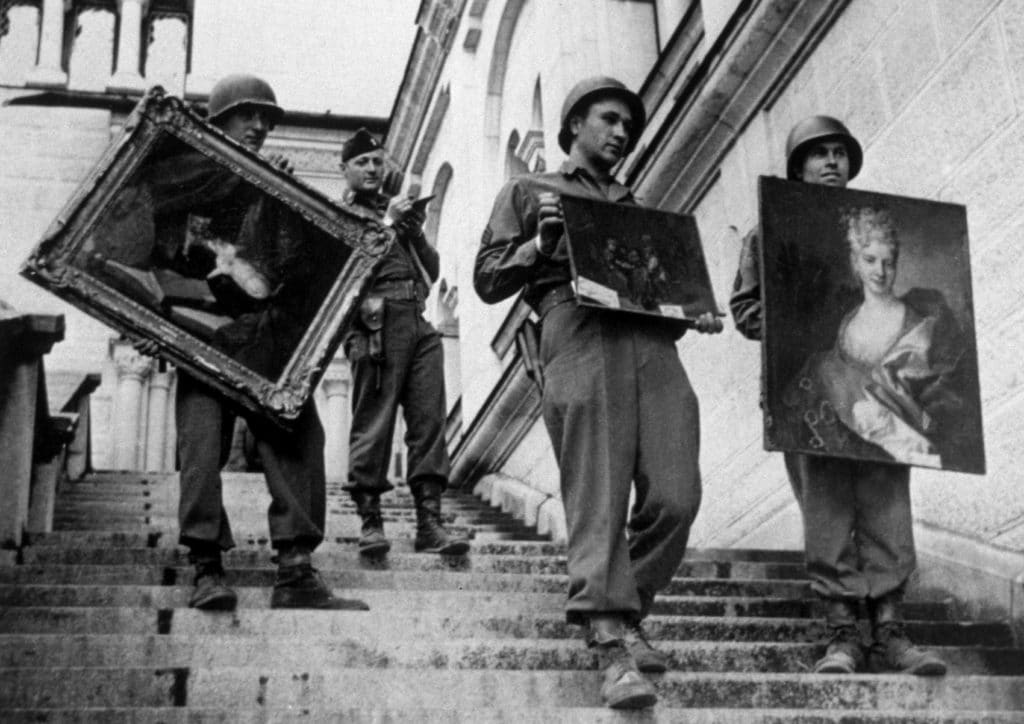
A Supreme Court case that began on December 7 will determine if American Jews are able to recover art that was part of an alleged forced sale to the Nazis.

The case, Federal Republic of Germany v. Philipp, centers around the Guelph Treasure, which is a collection of Medieval-era Christian art, The Los Angeles Times reported. A group of Jewish art dealers purchased the art collection in 1929 but were allegedly forced by the Nazis to sell the art in 1935 to the Prussian State Museum for about a third of its value. Most of the art collection currently resides in Germany.

The plaintiffs, which includes the grandson of Saemy Rosenberg — the man who sold the art — as well as two other heirs to the art collection, argue in their lawsuit that Germany is required under international law to return the art to them because the forced sale amounted to a genocide since, at that time, Jews in Nazi Germany were being persecuted and couldn’t properly negotiate the sale. Germany has argued that the sale was legitimate and that the lower value of the 1935 sale was the result of the Great Depression. 

Nicholas O’Donnell, one of the lawyers representing the plaintiffs, told the Journal that an appraisal of the art on behalf of his clients suggest otherwise and that the Nazis were open about obtaining the art for less than it was worth.

The Trump administration has sided with the German government on the matter. O’Donnell said that the administration’s brief to the court implies that international law only applies to property seized from aliens. 

“Even if you applied that rule, we win, because, as a matter of undisputed historical fact, Nazis treated Jews under the law as aliens,” he said. “They declared them from Day One as non-Germans.” O’Donnell added: “It is outrageous that the United States has done this and it will be to the enduring shame of everyone involved.”

The defendants assert that the art sale wasn’t a forced sale, citing the Germany Advisory Commission’s ruling on the matter.

Jed Lieber, a Los Angeles-based musician who is Rosenberg’s grandson, told the Journal that he has been trying for decades to get his grandfather’s art back as a means of preserving his family’s history. Rosenberg and his family had fled Nazi Germany after the 1935 sale to Amsterdam and then to London before settling in New York City.

Jed Lieber, a Los Angeles-based musician who is Rosenberg’s grandson, told the Journal that he is been trying for decades to get his grandfather’s art back as a means of preserving his family’s history.

“The Supreme Court hearing was very emotional for me,” Lieber said, calling the fact that he has reached this point in his decades-long quest to retrieve the art “a huge accomplishment.”

“But in coming away from that I had huge disappointment that the United States, who is proud of what they call the Greatest Generation… are now defending Germany’s position in this case,” Lieber said. “My disappointment is not something I can verbalize at this time.”

Jewish Telegraphic Agency (JTA) reported that the December 7 hearing, which was oral arguments, featured the United States arguing that the Foreign Sovereign Immunities Act prevents disputes with foreign governments from being litigated in the U.S. and that the case should be heard in front of a German government court instead. The plaintiffs have argued that the law in question has an exception for “property taken in violation of international law,” according to JTA. Chief Justice John Roberts as well as Justices Neil Gorsuch and Elena Kagan all questioned the Trump administration’s argument during the hearing. 

Associate Dean and Director of Social Global Action Agenda at the Simon Wiesenthal Center Rabbi Abraham Cooper said in a statement to the Journal, “Everything about this case is deeply disturbing. The arrogance of German government who have the audacity to depict the Nazi expropriation of Jewish held art treasure as a legitimate ‘sale.’ The outrage that US government would depict this as a normal ‘domestic matter’ when brutal history of Third Reich proved the opposite. And the collusion of museums and art collectors on both sides of the Atlantic to overwhelmingly remain silent in cases involving art impacting by Nazi anti-Jewish policies. We can only hope that US Supreme Court will set this case and history right.”

The German embassy in Washington, D.C. told the Journal that they could not comment on the case since it “is still ongoing.”

A previous form of the article described the sale as a “forced sale.” It has been changed to “alleged” because the matter is currently under dispute.

Supreme Court to Determine If Jews Can Recover Art Allegedly Stolen By Nazis Read More »

‘Love, Lights, Hanukkah!’: Mia Kirshner Stars in Hallmark’s Nod to the Festival of Lights

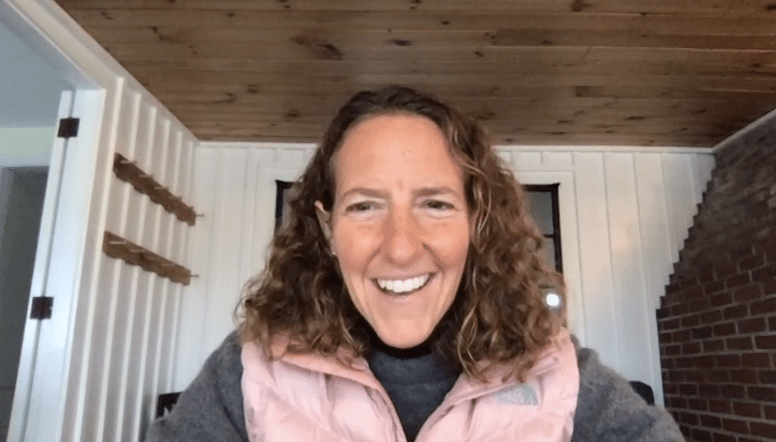
Among the 40 new holiday movies that will premiere on Hallmark Channel this season, there’s just one that highlights Jewish tradition. Premiering Dec. 12, “Love, Lights, Hanukkah!” stars Mia Kirshner as a chef and restaurateur who was adopted as a baby and discovers via an ancestry search that she’s Jewish. In short order, she meets her new family, the Bermans—half siblings Scott and Becky and her husband and daughters, and the mother (Marilu Henner) who gave her up for adoption. Over the next eight days, she learns about Hanukkah—and begins a romance with a menschy food critic (played by Kirshner’s fellow MOT Ben Savage).

“I feel very lucky to have gotten to do this film. I’m very proud of my Jewish culture and heritage and it’s really a pleasure for me to share that with a larger audience,” Kirshner told the Journal on a call from her native Toronto. “My other reason for doing it is we’re living in challenging times. I wanted to do something that would make people feel good about their lives and themselves– Nothing too complicated or heavy.”

“I feel very lucky to have gotten to do this film. I’m very proud of my Jewish culture and heritage and it’s really a pleasure for me to share that with a larger audience”
—Mia Kirshner

Known best for her roles in “24,” “The Vampire Diaries,” “Star Trek: Discovery,” and “The L Word,” in which she played Jewish writer Jenny Schecter, Kirshner was additionally drawn to the festive, meal-centric milieu on the seasonally-decorated set. “I love food,” she said.

Shooting in Canada under strict COVID-19 protocols meant quarantining beforehand, social distancing and masks for everyone. “We wore reflective masks between takes but it was a challenge for the cinematographer to light us because of the glare. The hair and makeup people were constantly shuttling back and forth with our masks and sanitizer. It’s a lot, but we were glad to be working,” Kirshner said. “I appreciated the camaraderie and how we took care of each other and be safe for one another. It created a really strong bond on the set.”

She and Advah Soudak, who plays her half-sister and has an Israeli mother, entertained each other by speaking Hebrew together and shared Hanukkah memories and experiences.

“Growing up, we had the menorah and latkes, of course,” Kirshner said. “My mom had a grater that her mother gave her as part of her trousseau. It lost its grip over time, peeling hundreds of potatoes. My mom made the crustiest, fluffiest latkes and served them with sour cream, applesauce and donuts, and we’d sing songs. It wasn’t about the gifts. It was about honoring tradition, culture and heritage, our Eastern European roots.”

Kirshner’s mother was born in Sofia, Bulgaria and raised in Jaffa, Israel, where she spent summers growing up. Her father’s parents were Polish Holocaust survivors, “and what they went through and lost affected our outlook on the world and the way we were raised,” she said. Immigrating to Canada, her grandfather, a tailor, began anew. But he didn’t escape anti-Semitism. “He was shot and robbed outside his store and people just walked by as he shouted in Yiddish for help.”

Kirshner’s father, Sheldon, was born in a DP camp in Germany and became one of the foremost Holocaust experts in the world and worked for three decades as a journalist for the Canadian Jewish News. His family’s experiences “solidified my cultural relationship to Judaism, because of what they went through, what they lost, and the traditions they weren’t allowed to practice. I feel it’s very important to honor them now,” she said, by becoming self-made, self-reliant, and never giving up.

Determined to become an actor from the time she was six, she pursued her passion with resolve, getting her first big break in the movie “Exotica.” Although she didn’t love the loneliness and time away from loved ones that the job requires, Kirshner has never stopped working. “Acting has always been a wonderful outlet for me but I’ve always had other things in my life because it’s not enough to sustain me,” she said. She has found that sustenance in human rights and advocacy.

In 2008, she published “I Live Here,” an anthology of stories and illustrations about women and children refugees from renowned writers and artists. Her current project is WeAreRosa.com, a Canadian platform to help those who’ve encountered sexual harassment in the workplace with the resources and the legal information they need. “I saw this happening in my own industry and decided to do something about it,” Kirshner said. “I devoted the last few years of my life to putting this together. My goal is to help as many people as possible.”

As for future roles, Kirshner wouldn’t mind doing something else in the feel-good, comedy-drama vein of “Love, Lights, Hanukkah!” “I’ve never played a character or been in a piece that doesn’t have something awful happening or characters going through these Herculean struggles of life and death. I gravitate towards drama naturally, but it was a relief to do something a little lighter where I didn’t have to be in a constant state of pain,” she said. “There’s nothing more interesting than telling stories about complex people and complicated things and that’s what I’m here to do as an actor. If the story and character are right, I’m open to it.”

Hanukkah will be different this year due to the pandemic, and she worries about people who are alone and separated from loved ones. “In these times, we have to make sure we have community and are surrounded by love. There are a lot of social programs and resources out there and I hope people who are struggling reach out and make a call,” she said.

Her partner is not Jewish, so as in the movie, she will be honoring both their heritages by having a menorah and a Christmas tree at home. She plans to make latkes from the old family recipes her parents have recorded and preserved in a binder. She hopes that “Love, Lights, Hanukkah!” will bring some joy into what has been a difficult year. “It’s warm, it’s about family, and it’s bound to make you smile and feel a little bit better about the world, at least momentarily,” she said. “It’s a great break.”

“Love, Lights, Hanukkah!” premieres Dec. 12 at 8 p.m. on Hallmark Channel.

‘Love, Lights, Hanukkah!’: Mia Kirshner Stars in Hallmark’s Nod to the Festival of Lights Read More »

JVP Criticized for Tweeting “L’Chaim Intifada” Poster

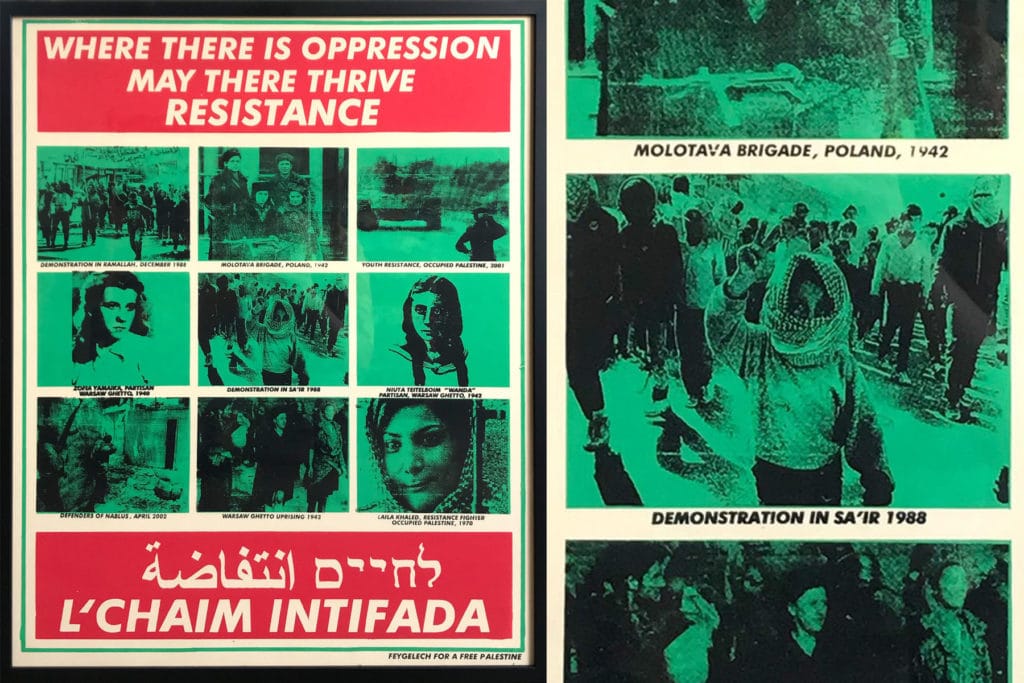
Jewish Voice for Peace (JVP), an organization that supports Boycott, Divestment and Sanctions (BDS), has come under fire for a since-deleted tweet that appears to glorify the First Intifada.

The December 8 tweet featured a poster from a JVP member stating “where there is oppression, may there thrive resistance” and “L’Chaim Intifada.” JVP described the First Intifada in the tweet as “a series of mass protests against Israeli settler-colonialism and occupation.”

Various pro-Israel users on Twitter condemned JVP’s tweet.

“277 Israelis, mostly civilians, were murdered during the First Intifada,” Avi Mayer, director of global communications for the American Jewish Committee, tweeted. “What do you call a group that celebrates the deaths of Jews?”

He added in a subsequent tweet that the poster in the JVP tweet “equates Palestinian rioters with partisans during World War II, suggesting that Israel is akin to Nazi Germany. As a reminder, this is defined as a form of antisemitism by the [International] Holocaust Remembrance Alliance.”


The Israel Advocacy Movement, a pro-Israel group in Britain, similarly tweeted: “This utterly repulsive antisemitic tweet from JVP will shock you. In it they compare the al-Aqsa Martyrs Brigade terror group and [Leila] Khaled (a terrorist who hijacked a plane) to Jews who resisted the Nazi genocide. This is disgusting, even by their standard.”

International human rights lawyer Arsen Ostrovsky also tweeted, “[The] 1st Intifada was a brutal and violent Palestinian uprising. But trust [JVP] to stand up and glorify the terrorists.”


JVP did not respond to the Journal’s request for comment.

According to Jewish Virtual Library, the First Intifada in 1987 was sparked by rumors that Israelis killed four Palestinians in a refugee camp in the Gaza Strip and that Israeli soldiers poisoned a Gaza water reservoir. The Palestine Liberation Organization (PLO) “played a lead role in orchestrating the insurrection,” according to Jewish Virtual Library, and Palestinian death squads killed around 1,000 Palestinians for “collaborating with Israel” from 1987-1993. This was known as the intrafada.

JVP Criticized for Tweeting “L’Chaim Intifada” Poster Read More »

Israelis Pour Into UAE for Business and Pleasure

The Media Line — From high-tech entrepreneurs seeking sales to tourists who want to experience the formerly forbidden, Israelis have been flooding into the United Arab Emirates to take advantage of new business and leisure opportunities.

Israeli-Emirati activity this week surged to one of its highest points since the August 13 announcement of the Abraham Accords that officially established relations between the two countries. Hundreds of Israelis came for GITEX Technology Week, the annual computer and electronics show and conference in Dubai. Others arrived to celebrate the Jewish holiday of Hanukkah, which starts Thursday at sundown, or to get away from Israel’s partial lockdown to prevent the spread of the coronavirus. Still others were there for cultural gatherings or academic training.

With so many tourists coming since flights began last month, the government-owned airline Flydubai is adding a third daily Tel Aviv-Dubai flight starting on December 10. The airline is the first from the UAE to offer direct flights between Israel’s Ben Gurion Airport and Dubai International. Up to 15,000 Israelis are expected to travel this month to Dubai, the UAE’s second-largest city, which has an easy e-visa process for passengers from the Jewish state. There is no quarantine for visitors.

Ofer Ronen, vice president of business development for Corsight, a facial-recognition business that is part of the Cortica autonomous artificial intelligence (AI) company, said he has been in talks with UAE police forces. He has been demonstrating Corsight’s complex facial-recognition system, which works from multiple angles, even through a mask. Corsight’s sister company, Fintica, which provides data analysis and analytics, was one of the first Israeli businesses to conclude a deal with the UAE after the signing of the Abraham Accords in September.

Ronen, who was at GITEX, told The Media Line: “There is a lot of interest in AI. The UAE is one of the only countries with a national program for AI, so there’s a really genuine approach to take this country forward and make it like a global case study into a smart city, from police to security.”

Tal Bar Or, chief executive officer of Octopus artificial intelligence, is also in talks with UAE government entities about the company’s control-and-command platform that unites facial-recognition, video-management and other systems. The platform is being used in 28 countries including Singapore, the United States and Thailand.

There has been great interest in the platform in the Gulf region, he told The Media Line.

“First, we have to be here and understand the business culture before we start to sell,” Bar Or said. “We have unique tech offerings, but we need to bring value. The UAE especially is a very mature and sophisticated market, and they’re really looking for high-end solutions here.”

“we have to be here and understand the business culture before we start to sell.”
— Tal Bar Or

Academic collaboration is also blossoming, although sometimes via Zoom. Nir Tsuk is a professor of innovation at New York University’s Tel Aviv campus. He came to Dubai this week to offer innovation training for the Dubai chapter of the Young Presidents Organization, a non-profit group that connects business leaders. This is the start of a knowledge exchange that could also bridge cultural gaps with the UAE, where citizens of nearly 200 countries co-exist peacefully, he said.

“What we’re trying to do with these kinds of events is expose what’s happening in other parts of the world because innovation is a mindset, a new language, much like we went through when we became computer literate,” he explained.

“What is acceptable in one country isn’t in another, for example in Japan, where the Japanese are taught tenets such as harmony and obedience. Their manifestation of innovation will look very different to the more risk-taking Israeli population. It’ll be very interesting to learn from here now, and take that out to other places, too,” he added.

Dr. Majid Al Sarrah, an Emirati public-policy specialist, joined students and professors from the University of Haifa this week for The Researchers Night webinar that brought academics together from around the world. He is one of many UAE-based Emirati and foreign academics looking forward to working with Israelis, he told The Media Line.

“The idea was for us to meet young people,” he said, allowing many students the chance to interact with people from the Gulf for the very first time. The group discussed the innovative history of the UAE, its rise from desert coastal town to modern-day metropolis, among other topics. “We touched on how UAE and Israeli history is so similar. It’s really important to focus on these similarities and to show the students how much commonality there is from an academic point of view.”

The roughly 9.5 million residents of the UAE include 2.6 million Indians, the largest non-Emirati group. Many of the world’s richest Indians call the UAE their second home, if not their first.

Merzi Sodawaterwala, chairperson of the International Federation of Indo-Israel Chambers of Commerce, has been preparing to open the international headquarters in the UAE.

“The idea is now to take this strong community of diaspora Indians to Israeli companies,” he told The Media Line. The UAE is situated between India and Israel, making it a meeting point for businesses on both sides.

“We’ll be facilitating business and investment opportunities in areas such as scientific research, IT, agricultural and food security, health care and med tech and sustainabilty; industries where there is a synergy among the three countries,” Sodawaterwala said.

Israelis Pour Into UAE for Business and Pleasure Read More »

Israel’s Political Swing: Netanyahu is Suddenly Vulnerable

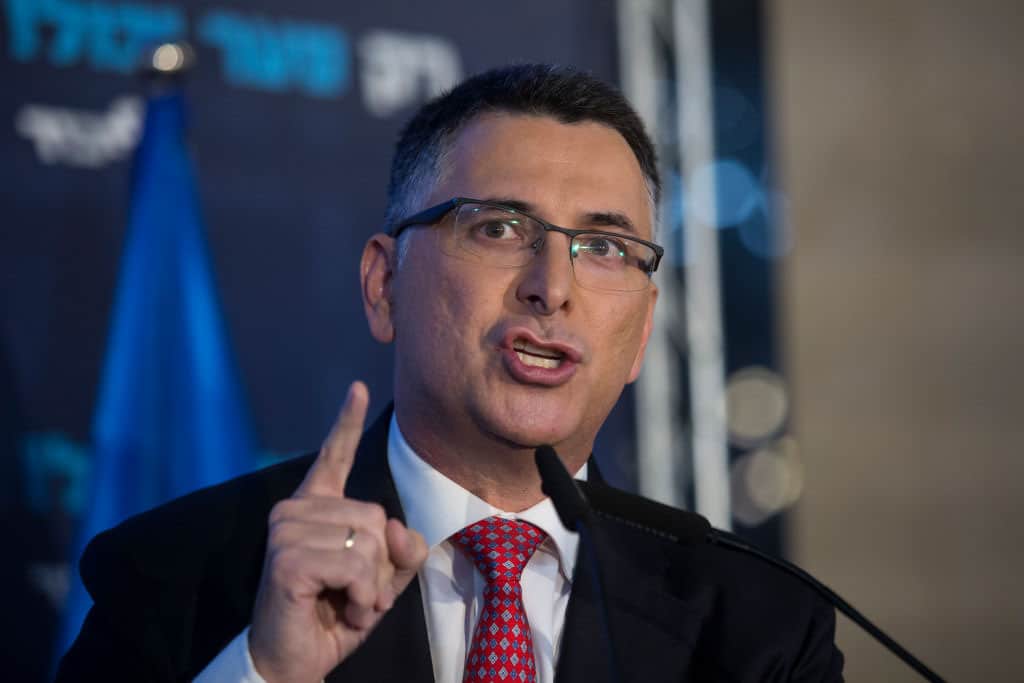
In 24 hours, Israel’s political map completely changed. All because of a decision by a senior Likud politician to leave his old party and form a new right-wing party, one without Prime Minister Benjamin Netanyahu and without the baggage (and advantage) or religiosity that puts a ceiling above the head of the Yamina party. This new party, according to early polls and sober analysis, could be the undoing of Netanyahu.

The name of the politician is Gideon Saar. He is an experienced political operator, a well-liked communicator, a man who thinks about the issues of the day with proper seriousness. He can be a magnate for the following voters: right-wingers who no longer care for the cult of Bibi; centrists who look for a viable political option that could make a change; even some center-left voters who see the ousting of Netanyahu as the first priority and anything else as second. All these supporters translate to seats. How many? Maybe close to 20. Maybe, in an ideal scenario, close to the number of seats that Likud will get.

Saar can alter the political map because of his flexibility if he will be tasked one day with forming a coalition. There is no reason Yamina would not join his coalition (he is right-wing enough for anyone). There is no reason the ultra-Orthodox will be against him (he is known to have had close relations with them). There is no reason center-left parties like Blue and White and Yesh Atid would not join him (he speaks the language of secular Tel Avivians).

Saar can alter the political map because of his flexibility if he will be tasked one day with forming a coalition.

Saar breaks the old formula of “right means Bibi and all the rest is left.” Breaking this formula is essential because most Israelis are right or center-right, and the ceiling for a center or left party is limited. Blue and White could not convince Yamina to join. But Saar has such an option. Yesh Atid could not convince United Torah Judaism to join their coalition. Saar could and would. Finally, Netanyahu has to face a rival that says what many Israelis agree with — Netanyahu’s policies are fine, but we reject his character.

From an ideological perspective, Saar is not going to be a sea change from Netanyahu. He supports annexation in the West Bank, he wants to put restrictions on the Supreme Court’s ability to intervene in political affairs, he was tough on keeping the Golan Heights and supportive of the Nationality Basic Law. Under different circumstances, Saar would be a nightmare for a true leftist agenda. Under the current circumstances, however, he could become the savior of center-left voters.

The only question is timing. Specifically, whether Netanyahu and his rival Benny Gantz — who also just lost his ability to be the main alternative to Netanyahu — will decide that their shared interest in avoiding an election is suddenly more important than their mutual dislike.

Israel’s Political Swing: Netanyahu is Suddenly Vulnerable Read More »

Rosner’s Torah Talk: Vayeshev with Michelle Goldhaber

Michelle Goldhaber of Hebrew College is our guest this week. Our parsha is Vayeshev. In this week’s Torah portion (Genesis 37:1-40:23) we read the first part of the story of Joseph and his brothers. It begins with Joseph’s dreams and continues to tell us about how he was sold into slavery by his brothers, about the affair with Potiphar’s wife, and about the beginnings of his career as an interpreter of dreams. Our discussion focuses on Joseph’s journey.

A note to viewers: We will have a special Torah Talk edition for Hanukkah, coming up on Sunday.

Previous Torah Talks on Vayeshev

Rabbi Michael Pincus

Rabbi Joe Blair

Rabbi Harold Robinson

Rabbi Reuven Leigh

Rabbi Debra Landsberg

Rabbi Martin Cohen

Rabbi Olivier Benhaim


Rosner’s Torah Talk: Vayeshev with Michelle Goldhaber Read More »

Table for Five: Hanukkah Edition

Edited by Salvador Litvak, the Accidental Talmudist

A miracle occurred and they lit [the menorah from the single, undefiled cruse of oil] for eight days. The next year the Sages instituted those days and made them holidays with recitation of hallel and special thanksgiving in prayer and blessings. -Shabbos 21b, B. Talmud


Ari Segal  
Head of School, Shalhevet High School

This has been a dark (secular) year, one of serious strife and challenge. I’ve always looked forward to Chanukah as a literal light in the darkness, but this year, I needed a spiritual angle assuring me of an end to these dark times.

I found it in an observation of Rabbi David Fohrman’s, who points out two unrelated Talmudic texts with notable parallels in their wording. One is the pasuk above. The other, in Tractate Avodah Zarah 8a, seems to have nothing to do with Chanukah at all.

This Gemara tells us that Adam HaRishon believed that the shortening days of the first solstice signaled the death of the world, a consequence of eating from the Tree of Knowledge. Terrified, Adam fasted and prayed for eight days, hoping to save the world.

When the days lengthened again, Adam celebrated this natural miracle for an additional eight days. The next year, the Gemara says, “He instituted both these and these days as holidays.” Those words are the exact same formula as our Gemara — the only other place where the same phrase appears.

This can’t be a coincidence. In each instance, both Adam and the Jewish people celebrate the miracle of the light — physical and spiritual — which returned just when it seemed to be gone forever.

These Gemaras promise the same for us. Our current darkness is painful, but it is also natural and finite. The world will cycle back into light. It’s going to be okay.


Rabbi Ilana Grinblat
VP of Community Engagement, Board of Rabbis of Southern California

One day’s oil lasted for eight days…

As Election Day stretched into multiple days of waiting for results, Trevor Noah described the delay as “like a Hanukkah miracle no one wanted.” Indeed, things lasting longer than expected doesn’t feel particularly miraculous nowadays. Surely, the pandemic is continuing much longer than we hoped. This terrifying period of societal and political uncertainty stretches out indefinitely as a Groundhog Day on repeat.

So, what does the miracle of Hanukkah mean this year?

Perhaps, this year, the miracle of Hanukkah is that we haven’t run out of strength. How many times this year have we felt that we were out of steam and couldn’t go on? How many times have we felt that we are at the end of our rope? Patience has been even more hard to come by than toilet paper! But somehow, we get up each morning and keep going.

If someone told you a year ago that you would accomplish and endure everything you have this year, would you have believed them? As Rabbi Jack Riemer wrote, one lesson of this pandemic is “that you are smarter and that you are more innovative than you thought you were.”

As Rabbi Jonathan Sacks, of blessed memory, wrote, the lesson of Hanukkah is captured in the phrase, “Od Lo Avda tikvateinu,” our hope is not extinguished. This Hanukkah, may we realize that we are actually more capable and have more stamina and faith than we think. That’s the Hanukkah miracle everyone wants.


Yehudit Garmaise
Journalist

After lighting our menorahs, Rabbi Yosef Yitzchak Schneersohn reminded us to linger awhile, gaze at the candles, and allow their messages to engrave themselves on our hearts.

“We must listen carefully to what the candles’ lights are saying,” the 6th Lubavitcher Rebbe said. One thing the candles can teach us is the Baal Shem Tov expectations that we strive to be “warm Jews” -the highest compliment.

Like candles, we should always ask ourselves whether we are emitting warmth, respect, and positivity to our loved ones, our friends, and the members of our community.

The candles’ light is bright and cheerful, but, we might notice, also small and quiet: not getting too much in other people’s space. Candlelight does not overwhelm, but substantially enhances every environment. The environment the candles create affirms our aspirations to create cozy, comforting, and safe homes that are full of love, Yiddishkeit, encouragement, affirmation, and good humor.

The candles also can remind us to daven, learn Torah, and perform mitzvahs with concentration, enthusiasm, and joy.

When we gaze at the candles, we can also consider what is it that makes them burn. For the Maccabees, the candles’ fuel was the pure oil that reflected their neshamas, as they stayed true to Hashem.

Finally, some say that the powerful flickering flames from which we cannot avert our gaze suggest the Next World: where Hashem stores the holy and beautiful light that He created on the first day of Creation, but then put away for the future.


Rabbi Nathan Halevy
Kahal Joseph Congregation

The name ‘Chanukah’ comes from ‘The Chinuch’ (reinauguration) of the temple after it had been defiled by the Greeks. It was a perilous period of our history. Israel had been spiritually oppressed by Antiochus and the Greeks.

Many Jews, seeking security, began assimilating into Greek culture. The Chanukah miracles were a tremendous spark of hope for Israel. Hashem brought salvation in the darkest of times. This experience reinforced the spirit of Israel, showing them that there is always hope, no matter how dire the circumstances. Israel reached a new level of spiritual service in a most challenging time.

The nation demonstrated tremendous self-sacrifice in so many ways, rising to the task of standing up to a mighty adversary. This service elicited a spiritual response from Hashem bringing about their salvation. This strengthened the bond of Hashem and Israel for eternity.

The sages foresaw the influence Chanukah had on the future of our nation. It became embedded into the story of Israel. As stated regarding all special holidays, “Vehayamim Haelu nizkarim venaasim-these days are remembered and celebrated.” By our celebration of holidays, their spiritual influences and energies are drawn down in a renewed and stronger measure. Our world contains light and darkness. At times the darkness seems so strong that there is no light that can illuminate it. Chanukah reminds us that no matter how strong the darkness may appear to be, we are always connected to Hashem, the most powerful light in existence who is the source of all.


Rabbi Rebecca Schatz 
Assistant Rabbi, Temple Beth Am

Why the next year? If in that moment the miracle was known to us, why wait a year to declare the days celebrated and distinct or holy? When we experience a miracle, do we know that it is happening in the moment or do we need perspective away from the event to celebrate the greatness?

In Berakhot 54a, our rabbis describe various expressions of gratitude and blessing regarding wondrous events. Our sages say “on a miracle performed on behalf of many people, everyone is obligated to say a blessing; a miracle performed for an individual, only the individual says a blessing.” The Chanukah miracle, though encountered by relatively few, benefitted the many. We’ve grown to value bringing light to darkness, and the distinction of each. The original Chanukah miracle was for its own sake. The repeating, resounding miracle, declared the following year, is each generation’s annual rededication.

Our Sages knew that in order to institute these days as the holiday of Chanukah, each person needed to experience light growing in their home, recite a story of triumph and miracle, and recognize how important it is to their own story. May we continue to share our light into the world and experience moments of joy and strength, in the darkness of our lives, as miracles waiting to be blessed. Next year we will recognize that something this year was a miracle!

Table for Five: Hanukkah Edition Read More »

Rabbi Abraham Isaac Kook and Tikkun Olam

This is the second piece in a series sponsored by Tevel b’Tzedek that examines the concept of Tikkun Olam through conversations with some of the Jewish world’s best minds. The full videotaped conversation with Yehuda Mirsky, professor of Jewish Thought at Brandeis University and author of the acclaimed “Rav Kook: Mystic in a Time of Revolution,” can be seen here.

Rabbi Abraham Isaac Kook (1865-1935) is one of the most fascinating — and most important — Jewish figures of the twentieth century. A Talmudic genius and kabbalist, who even his rabbinic opponents  recognized as a uniquely gifted master of Torah, Rav Kook was a mystical visionary whose perspective was cosmic in scope and also a person deeply engaged in the world. Kook was the spiritual father of Religious Zionism and creator of the modern Chief Rabbinate, who answered complicated Halachic questions and helped impoverished and desperate people on a daily basis. Trained at the famed Volozhin Yeshiva, Rav Kook became a Zionist because, according to Professor Mirsky, he thought Judaism “Was in need of a good revolution.”

What was Rav Kook’s attitude towards social justice? According to Professor Mirsky, “A major part of Rav Kook’s attraction to Zionism was based on his perception of the Zionist movement as a movement for social justice that could transform the world for the better. He saw the idealism of the secular revolutionaries of the Jewish world of the turn of the century as a kind of a vibration of God’s presence in the world. For Rav Kook, social justice and spirituality were profoundly intertwined. You can’t call somebody secular, Rav Kook asserted, if they are involved in social justice. For him the stirring within oneself to make the world better, kinder, more just, fairer and more beautiful is an echo of G-d’s stirring in the world — the way G-d speaks through us.”

Rav Kook was perhaps the first Jewish thinker who used the phrase “Tikkun Olam” in the way it is meant now — “the fixing of the world” through social and political changes that create more equality and justice for the impoverished and oppressed. According to Rabbi Yitzchak Luria, the foundational Kabbalist of fifteenth-century Sfat, Tikkun — the fixing of the shattered cosmos — was to be accomplished mainly by performing the commandments with focused inner intention. Rabbi Moshe Chaim Luzzato, Professor Mirsky explains, introduced a new idea — that Tikkun could be accomplished through historical processes. Rav Kook adopted and adapted Luzzato’s notion of Tikkun to the specifics of his own historical period: Tikkun was happening through the idealistic young men and women who were building a new, just society in the Land of Israel.

Rav Kook was perhaps the first Jewish thinker who used the phrase “Tikkun Olam” in the way it is meant now.

Professor Mirsky points out that Rav Kook was not involved in party politics. But the one party he did feel close to and tried to help was Hapoel Hamizrachi, the Religious Zionist Workers Party. Hapoel Hamizrachi was composed of both fiery young revolutionaries who grew up within Polish Hasidism (with its Kotz-inspired emphasis on existential authenticity) and of German Jewish humanists ( students of Rabbi Samson Raphael Hirsch). The party’s leader, Samuel Chaim Landau, spoke about “the sacred rebellion” against bourgeois Judaism and wished to create a socialist society, which he felt was closest to the will of God as expressed in the Torah. Rav Kook was the party’s patron, supporting them as much as he could and sometimes aiding them with a choice halachic decision — his affirmation, for example, of the right of workers to strike from a halachic point of view.

Professor Mirsky points out that Rav Kook was a complex, multi-faceted thinker. On the one hand, as a panentheistic mystic who believed that everything that existed was united in God and that God transcended everything that existed, Rav Kook was perhaps the most far-reaching universalist in the history of Jewish thought. At the same time, Rav Kook was far from our modern conception of progressive. He was against giving women the right to vote when the issue came up in the 1920s. Despite his universalism, he had a shockingly essentialist view of Jewish peoplehood. He was a nationalist, although he believed that nationalists should be open to hearing critiques from secular humanists and the religiously oriented.

Rav Kook, Professor Mirsky says, had “a richly dynamic and tensile understanding of what it is to be a human being in motion in the world. Living a Godly life meant being in the world, being alive to this time and this place — and this is a man who wore tefillin all day.” Rav Kook “had his third eye open to eternity all the time. At the same time, he paid copious attention to the details of the world.” Mirsky conveys what he witnessed in Rav Kook’s archives: on the same days as Kook was writing these incredibly dramatic poetic, mystical explorations, “he is also writing dozens and dozens of Halachic responsa, is signing off on charitable foundations, and giving money to the poor from his own pocket — he lived in poverty most of his life.”

To learn more about Rav Kook’s remarkable legacy watch the full conversation here.


Rabbi Micha Odenheimer is a writer and journalist and the founder of Tevel b’Tzedek, an Israeli organization working to address extreme poverty in the Global South. 

Rabbi Abraham Isaac Kook and Tikkun Olam Read More »

We Must Keep Hanukkah Disability-Inclusive During COVID-19

There’s an old joke that every Jewish holiday can be summed up with a single statement: “They tried to kill us, we survived, let’s eat!” The particulars behind the punchline are that we have survived a lot of hatred and many — but not all — of our holidays include communal meals and celebrations that allow us to revitalize our connections to our shared culture, customs, history and each other.

But after months of keeping us socially distanced, the coronavirus pandemic has derailed our longstanding tradition of togetherness, chipping away at the very foundation of Jewish communal life. The latest holiday under attack? Hanukkah — the great unifier that draws Jews to radiant traditions of connecting, giving and spreading light.

No mass gatherings to publicize the miracles of the season. No singing and dancing hand-in-hand. No making crafts, playing dreidel, or preparing heavily fried foods with good friends and perfect strangers. And, most importantly, no disability-inclusive activities.

As an advocate for disability inclusion, I have witnessed the pandemic add numerous barriers to participation for our brothers and sisters with disabilities. Although most of us can find alternative ways to learn, pray, collaborate and socialize from a distance, individuals with disabilities don’t have nearly as much flexibility and are being sidelined from communal activities. Memories of Hanukkahs past make this drastic step backward clearer than ever.

Yes, the Jewish community has harnessed technology to ensure that people of all abilities can log on to virtual community events. But deep down, we know that nothing holds a candle to tangible opportunities for encountering disability, raising awareness and promoting acceptance. If we are serious about securing our Jewish future and building truly inclusive communities, we must safeguard Hanukkah at all costs.

That’s why my organization, Ability Diversity Inclusion (ADI, formerly ALEH Jerusalem and ALEH Negev-Nahalat Eran) — Israel’s most comprehensive provider of residential and rehabilitative care for individuals with severe disabilities — is working hard to save Hanukkah for our residents and reverse this dangerous trend.

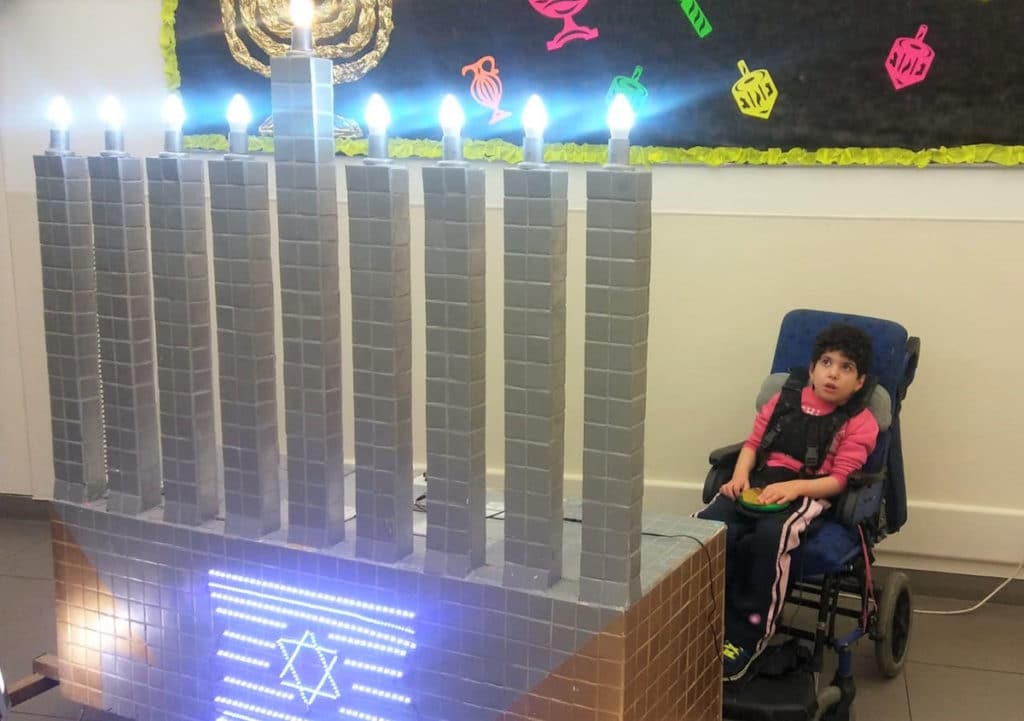
For years, hundreds of people worldwide visited the ADI centers during the month of Kislev to shower the residents with gifts and attention, sing and dance to Hanukkah songs, help create seasonal crafts and participate in Hanukkah lighting ceremonies aided by adaptive technology. But with travel discouraged and extreme sterilization protocols in effect at the ADI centers to shield the immunocompromised residents, throngs of visitors are no longer an option.

So, ADI got creative to spread the light of inclusion. When it became clear that the masses wouldn’t be able to visit ADI and partake in inclusive experiences, it only made sense to bring opportunities for disability education and inclusion to them.

ADI got creative to spread the light of inclusion.

Since the beginning of November, ADI has taught children of all ages at schools, community centers and synagogues across North America and the United Kingdom about the care, rehabilitation and advancement of children with severe disabilities. These children have also created beautiful ‘Sensory Hanukkah Cards’ — which include 3D elements that are fun for the residents to look at and touch — to brighten the holiday for the ADI residents. These cards will be delivered just before Hanukkah to show the ADI residents how much they are loved and to symbolize just how easy and beautiful inclusion can be. This project is proof that heightened awareness and real change are achievable, even during a pandemic.

On Hanukkah, the primary objective is pirsumei nisah, publicizing the miracles of the season by retelling the story and spreading our light outward. For generations, we fulfilled this directive by organizing large public events and ensuring that a parade of Hanukkah candles burned along every residential street. But with everyone tethered to their homes, we have no choice but to fulfill our obligations with the occupants of our own households, to go through the motions and hope for the best in the months ahead.

Unfortunately, it feels like we have begun to do the same with our communal responsibilities and inclusive efforts. We find ourselves numb, complacent and treading water. If we don’t take action to prioritize inclusion and meaningful connections during quarantine, we may be faced with irreparable damage to our Jewish communal fabric.

And although Zoom and other tools could be used to promote inclusion and stimulate Jewish connection, they will only truly assist us in these efforts if we aren’t just phoning it in. After all, inclusion is a choice we have to make and act upon — for each holiday and every other day of the year.


Elie Klein is the North American Director of Development for ADI (formerly ALEH Jerusalem and ALEH Negev-Nahalat Eran), Israel’s most comprehensive provider of residential and rehabilitative care for individuals with severe disabilities and an international advocate for disability inclusion, equity and access.

We Must Keep Hanukkah Disability-Inclusive During COVID-19 Read More »

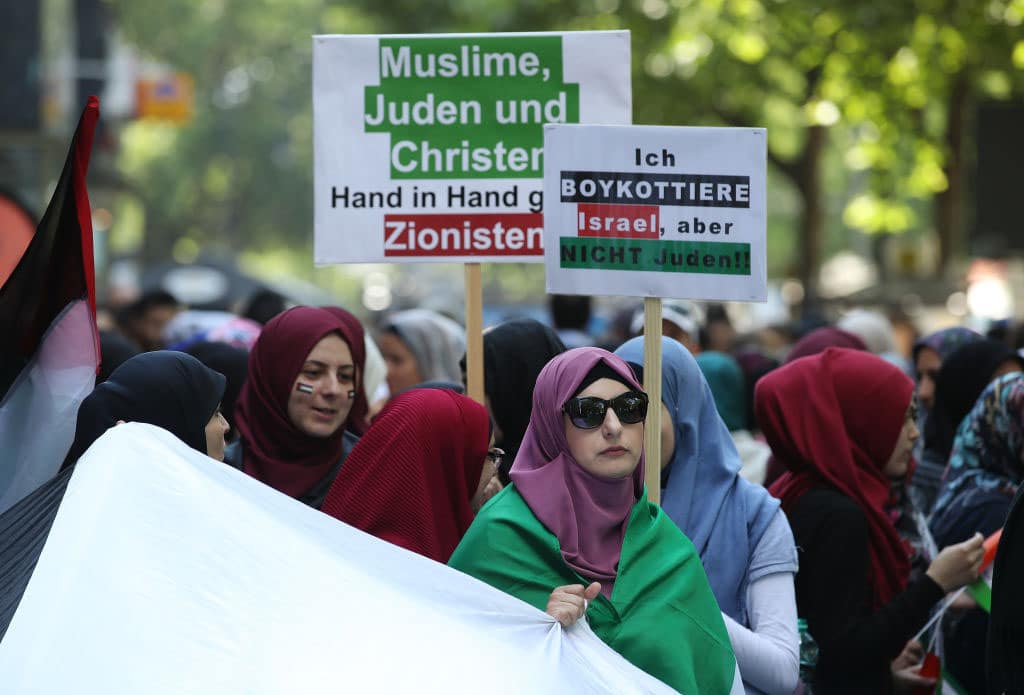
Time Magazine Tries to BS Americans About BDS

On December 4, 2020, Time Magazine published an article titled “Here’s What You Need to Know About BDS” (the Boycott, Divestment and Sanctions campaign against Israel). This title would lead most readers to conclude the magazine was simply publishing an educational or (or at a minimum) a balanced piece on this controversial campaign.

Instead, Time whitewashed the campaign, legitimizing anti-Zionism and ignoring how harmful BDS is to the people it purportedly seeks to help — the Palestinians.

First, the article flat-out lies about the “goals” of BDS. It claims BDS aims “to push Israel to recognize the rights of Palestinian citizens currently living in Israel; allow Palestinian refugees, who were driven out of the country as early as 1948 when Israel was created, to return to their homes; and withdraw from all land that it seized after the 1967 Arab-Israeli war.”

Setting aside how misleading this description is (in particular with what caused the Jewish and Arab refugees from the Arab-Israeli conflict), this description ignores that BDS’s actual goal is to destroy Israel. BDS co-founder Omar Barghouti has repeatedly stated that BDS’s goal is to eliminate Israel. For example, in a 2009 interview with Electronic Intifada, Barghouti said, “You cannot reconcile the right of return for refugees with a two state solution…a return for refugees would end Israel’s existence as a Jewish state.” And BDS activist and Cal-State professor As’ad Abukhali wrote in a 2012 Al-Akhbar article that “The real aim of BDS is to bring down the state of Israel….That should be stated as an unambiguous goal.” Pro-BDS activist and author John Spritzler also wrote in a piece in New Democracy World, “I think the BDS movement will gain strength from the forthrightly explaining why Israel [the one Jewish state in the entire world] has no right to exist.”

This piece’s author, Sanya Mansoor, introduces yet another misleading claim when she writes that “BDS was formally launched in 2005.” Although this is technically true, Mansoor brushes past the fact that BDS is a continuation of the Arab League’s boycott of Israel, which was actually initiated in 1945 to boycott the entire Jewish community in British-controlled Palestine. The Arab League boycott of the Jewish community itself was a continuation of the Nazi boycott of Jewish businesses, which was itself a continuation of the boycott against Jews initiated in 1882 by the first International Anti-Jewish Congress in Dresden. Anti-Semitic boycotts are nothing new. The only thing that changes is the rationalizations and justifications for boycotting Jews. The hate underlying these boycotts remains the same.

Mansoor then deplorably claims BDS “was born out of the lack of alternative ways to express Palestinian grievances” because “[e]very other form of Palestinian resistance has been criminalized and made unavailable.”

Given that the Palestinian leadership has turned down every partition and peace plan since 1937 because it also required saying “yes” to an independent Jewish state, one can reasonably conclude that the principle “Palestinian grievance” is the existence of one Jewish state.

But the worst part of Mansoor’s euphemism of “Palestinian grievances” is not how it masks the anti-Semitic rejectionism of the Jewish people’s right to self-determination — it is how it glosses over the horror of the other alternative ways to express those “grievances,” and why they have been “criminalized.”

Long before the Jews began to seek self-determination in their indigenous homeland, Arab and Islamic Supremacists in the Middle East from the seventh to the nineteenth century regularly mass-murdered Jews in pogroms for the “crime” of being Jewish. Once Zionism developed by the end of the nineteenth century as a political ideology to match the Jewish people’s millennia longing for a return to sovereignty in Zion (the land of Israel), and as Jews began to move in larger numbers to Ottoman and British-controlled Palestine, the local Arabs often found similar ways to “express their grievances.”

As early as 1919, there were regular pogroms in the Levant to try and murder Jews. From Nebi Musa to Jerusalem to Hebron, between 1919 and 1939, over 730 Jews were murdered in these pogroms, which were mainly organized by Haj Emin al-Husseini, the man considered the Godfather of Palestinian Arab nationalism. Husseini also was an infamous Nazi collaborator who helped the Nazis find and murder Jews in the Balkans after the British deported him from Palestine.

After Israel declared its independence in May 1948, the “other forms” of “Palestinian resistance” that have “been criminalized” have been terrorism. Since 1948, over 4,000 Israelis have been murdered in various Palestinian terrorist attacks. After the Palestinian leadership rejected an offer at Camp David in 2000 to have the first-ever independent Arab state in over 90% of Judea and Samaria and all of Gaza, they launched the Second Intifada, during which over 1,100 Jews were murdered, and over 8,000 were badly wounded from bombs exploding in school buses, restaurants, supermarkets, discos and even at Passover holiday dinners.

In 2008, the Palestinian leadership rejected yet another offer to have the first-ever independent Arab state west of the Jordan River (this time in 94% of Judea and Samaria and all of Gaza). This rejection was followed by more “expression of Palestinian grievances,” such as the massacre of the entire Fogel family — including a three-month-old baby — in Itamar in 2011 or the massacre of four rabbis praying in a synagogue in Har Nof in 2014. Since 2008, this “criminalized” expression of “Palestinian grievances” has murdered over 200 Israelis.

The Time Magazine article then proceeds to mislead and outright lie about Jewish support for anti-Israel boycotts and BDS. Mansoor argues that BDS — the campaign to uniquely and only target the one Jewish state in the world for a boycott — is not considered anti-Semitic by many Jews:

“Jews and Jewish groups are not united on the issue about whether BDS is anti-semitic. While many conservative Jewish groups criticize BDS for unfairly singling out Israel and worry that [its] ultimate aim is to delegitimize any notion of a Jewish state, dozens of progressive Jewish groups have taken issue with the characterization of BDS as anti-Semitic, fearing that doing so overshadows “legitimate critiques of Israeli policies.”

But the “dozens of progressive Jewish groups” is actually a list of fringe far-left groups such as Jewish Voice for Peace (JVP), which quite unlike the overwhelming majority of Jews and all mainstream Jewish organizations, believes being against Israel’s existence (i.e. being “anti-Zionist”) and pro-BDS, is somehow not anti-Semitic.

But Mansoor citing JVP for the proposition that many Jews are “not united” about whether BDS is anti-Semitic is akin to citing to Candace Owens and Diamond and Silk (or the 13% of African Americans who voted for Trump) for the proposition that the African American community is “not united” over Biden.

Mansoor’s nod to JVP’s assertion that recognizing BDS as anti-Semitic “overshadows legitimate critiques of Israel” is also a classic red-herring. Almost no one claims that “legitimate criticism of Israel” is anti-Semitic. After all, most Israelis regularly, openly and often vociferously criticize their government. Unlike its neighbors, Israel is an open democracy with a free and often highly aggressive press. Criticism of the government and government policies is a national pastime in Israel.

What makes BDS anti-Semitic is not “legitimate criticism of Israel.” It is Natan Sharansky’s famous “3 D’s (Demonization, Delegitimization and Double Standards).

It is the violent demonization of Israel as an evil equivalent to Nazi Germany and apartheid South Africa. It is the delegitimization of Israel as the only nation-state of the Jewish people, while no one seeks to delegitimize the existence of 56 Muslim countries, dozens of countries that identify as Christian countries, as well as numerous countries that formally identify as the nation-states of other historically oppressed peoples (such as Armenia, Poland or Latvia).

What also makes BDS anti-Semitic is its double standards — focusing unique opprobrium only on the Jewish state and calling to boycott only the one Jewish state — literally, the only state in the region where Arabs citizens have freedom of speech, religion, assembly and have served as Supreme Court justices, high ranking military, police officers, legislators and even as the CEO of the country’s largest bank. BDSers do not seek to boycott the worst human rights abusers in the world, including China, which is literally imprisoning people for being Muslim, or even Mauritania or Qatar, countries that are still engaging in slavery.

And if this dissembling about whether “Jews and Jewish groups are not united” on BDS’s anti-Semitism is not enough, Mansoor outright lies when she claims: “Almost one quarter of American Jews under 40 support the boycott of products made in Israel, according to a National Jewish Survey of 8000 Jewish voters in the 2020 election from J Street, a ‘pro-Israel, pro-peace’ group that identifies as progressive—they oppose Israeli occupation but are also against the global BDS movement.”

This figure stands in sharp contrast to almost all other studies about the attitudes of American Jews towards Israel and the 136 American Jewish organizations that all signed a letter condemning BDS. As it happens, the J Street survey referenced did pose a misleading question about BDS (describing it as only seeking to pressure Israel “to withdraw from the West Bank and end its control of Palestinian territories”); even with that misleading question, nowhere does the J Street survey contain any evidence of, or even make reference to, a claim that 25% of any group of Jewish voters support boycotting Israel. What it does provide — notwithstanding the misleading question about BDS’s goal — is that 89% of surveyed American Jews oppose a “campaign that calls on people to boycott products that are made in Israel.”

But perhaps the biggest sin in the article is what it omits: that BDS hurts the Palestinians. BDS, for example, forced SodaStream to move one of its plants out of Judea and Samaria, thereby costing the local Palestinians 500 jobs.

Perhaps the biggest sin in the article is what it omits: that BDS hurts the Palestinians.

In addition to actually causing Israeli companies to divest from operations that would employ Palestinians, BDS is harmful to the Palestinians because it prevents peace. BDS, just like the Palestinian leadership (since at least 1937), has an all-or-nothing approach to the Arab-Israeli conflict. It does not offer or encourage any compromise. It just seeks Israel’s complete capitulation to its own destruction, which will never happen.

As a result, BDS is only a recipe for continuing the conflict. Now, that may bode well for the Palestinian Arab leadership in Hamas and the Palestinian Authority, who have made (stolen) billions of dollars as a result of the conflict, but it does nothing to help the average Palestinian living under either the PA or Hamas kleptocracies.

The Arab-Israeli conflict took on its current dimensions based on the Palestinian leadership repeatedly saying no to any compromise. That resounding and repeated “no” was based in large part on the belief that the Arab League, with its promised annihilation of Israel, would make such compromise unnecessary. BDS continues to hold out this false hope for the Palestinians and their corrupt leaders, and just as it did in 1948, it will only cause more suffering.

Ultimately, despite BDS being plainly anti-Semitic and seeking Israel’s destruction, the campaign’s biggest sin is that it works to perpetuate the conflict and discourages compromise by the Palestinians and their leaders.

On its website, Time Magazine claims that it is “one of the most authoritative and informative guide[s] to what is happening in current affairs, politics, business, health, science and entertainment.” Although this article’s title presents it to be “informative,” its anti-Israel bias is far from it. It not only misleads, it outright misrepresents. If Time Magazine wants to be even a semblance of how it describes itself, then it must do better, much better.

Time Magazine Tries to BS Americans About BDS Read More »