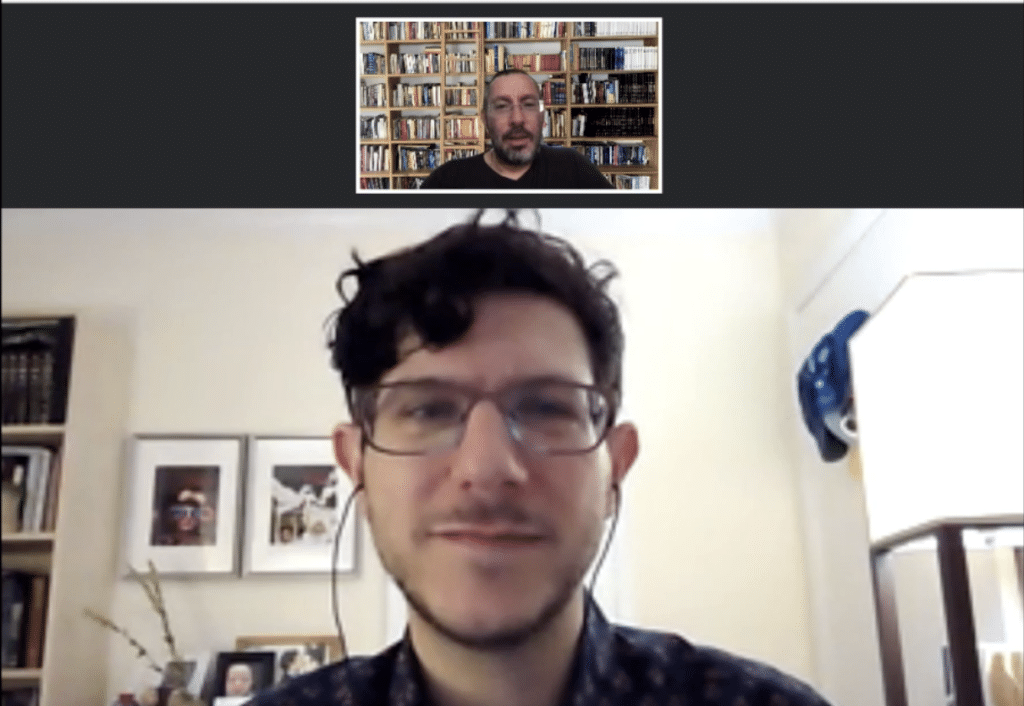
Our guest this week is David Shmidt Chapman, a rabbinic student at JTS.
Our parish is Chayei, Sarah. Sarah dies at age 127 and is buried in the Machpelah Cave, which Abraham purchases from Ephron the Hittite. Abraham’s servant is sent to Charan, to find a wife for Isaac. Rebecca, the daughter of Abraham’s nephew Bethuel, is the chosen wife.
What do we know about Sarah? Does Abraham love her? Is Isaac and Rebecca the perfect match?
and she will say, ‘Drink, and I will also water your camels
I didn’t have much growing up
but I have everything now and
I’m glad to give the excess away
I didn’t have much growing up –
No vehicle, or lunch money
No annual family vacation
No reason to go on an airplane
No family, really. If I dropped a dime
on the cafeteria floor and it rolled away
I felt that loss. I would show up to the well
with no cup. I never had a cup.
But I have everything now –
Two vehicles under the roof
I know the seats inside airplanes
like I know the back of my cat’s paw
Family in more states than I have the
time to calculate. If I drop a dime
I put it inside the Tzedakah box and
there are plenty more dimes where
that one came from. I show up to the well
prepared. I’ve got a cup with my name on it.
I’m glad to give the excess away –
I once donated an old car to the radio
I’m happy to pay for your dinner
Your concert tickets, your mail-order nuts
If you let me in, I’ll put your name on
the family tree. Whenever they say can you help fund, I’m already mailing
them dimes before they finish their sentence.
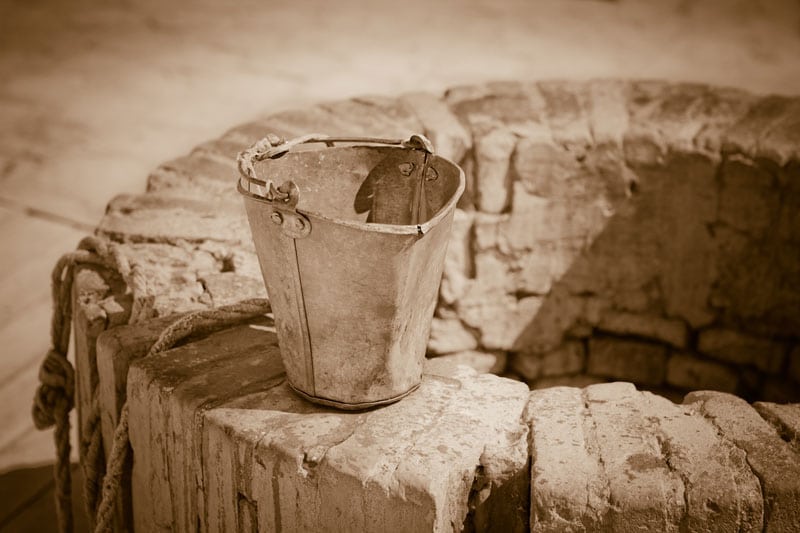
I’m permanently perched at the well
with a water bucket. You’ll be sated before
you even know you are thirsty.
“Fiddler on the Roof,” about life in a Jewish shtetl in Czarist Russia adapted from Sholem Aleichem’s short stories, is still a hot property, having launched revivals, a movie version, and countless amateur productions since it opened on Broadway in 1964, winning nine Tony Awards. It’s the subject of the documentary “Fiddler: Miracle of Miracles,” which will have its television premiere Nov. 13 on PBS’ “Great Performances.”
It tells the story of the show’s creation, its legacy, influences, and impact, and includes footage of international “Fiddler” productions and choreographer Jerome Robbins at work; interviews with lyricist Sheldon Harnick, producer Hal Prince, actor Austin Pendleton, Chaim Topol, who starred in the film version; and appearances by such notables as Itzhak Perlman, Fran Lebowitz and Lin-Manuel Miranda, a “Fiddler” fan who staged a “To Life” production number at his wedding.
“You may love ‘Fiddler on the Roof’ because it’s a fun musical, but the reason it has lasted so long and will continue to last is because it’s deceptively sophisticated and meaningful,” said Valerie Thomas, who co-wrote and produced the film with director Max Lewkowicz. “It’s more relevant than ever. It’s about what it’s like to be thrown out of your home and off your land, and remaining somewhat strong in the face of that, keeping your family together and your religion intact. It really moves you, and anything that can move you can translate from one culture to the next and can last. It doesn’t matter who you are; you will relate to it.”
It’s not even December and it’s beginning to look a lot like Christmas. Everywhere you go. It’s hard to compete with a holiday that takes over shopping centers, radio stations and coffee cups. Jews are lucky if there is a dedicated nook for Hanukkah goodies.
Jewish rabbi and entrepreneur Yael Buechler knows this struggle, and has made a career designing and selling cute and trendy apparel for those yearning for some Jewish holiday spirit.
Established in 2012, Buechler’s business, Midrash Manicures, sells thousands of nail decals, scrunchies, leggings and sweaters every year for every Torah parsha and holiday in the Jewish calendar. She even sold Band Aids with Yiddish phrases for a limited time.
For 20 years, Buechler has been notorious for painting Jewish nail art depicting biblical and holiday themes for friends and students. A rabbi at The Leffell School (formerly Solomon Schechter School of Westchester) in New York, she created a Midrash Manicures class where students decorated their nails according to the weekly Torah parsha. Her Jewish-themed products have also gained attention from Jon Stewart, Barry Manilow and the late Supreme Court Justice Ruth Bader Ginsburg.
Her goal is for Jewish women to proudly wear their Judaism year round especially during holidays. The pandemic this year changed everything, including the way Jews gather. Buechler teamed up with New Yorker cartoonist Hillary Fitzgerald to create holiday-themed cards for Rosh Hashanah and Hanukkah as a way for people to connect when meeting in person isn’t an option. She also created a new COVID-19-friendly Hanukkah fanny pack so people don’t have to leave their sanitary essentials behind.
The Journal spoke with Buechler on the phone to discuss Hanukkah, the pandemic and how to redefine one’s Jewish identity while wearing a bagel scrunchie. The interview has been edited for clarity.
Jewish Journal:Right now, all I see online are manicure kits and sticker manicures. You’ve been doing this for years already.
Rabbi Yael Buechler: Exactly. I’ve been doing nail art since before it was cool. It sort of fell on me, actually. I was doing it for myself for many years for the Torah portion and then for Jewish holidays and other themes on my own, and friends would ask if I could do their nails, but eventually I started almost ten years ago, actually. It just took off. People were asking. “Where can I buy these?” I said, “They’re painted on my nails.”
There was definitely a demand out there for some sort of a product. I had gone to rabbinical school. I didn’t go to business school, so this was certainly interesting, being a Jewish entrepreneur and learning about all the effort that goes into creating an amazing product.
JJ:When did it click with you that you could go beyond the manicures, like fun, creative, fashionable Jewish apparel, not just hokey ugly menorah sweaters?
RYB: I think it dawned on me because it was something I wanted for myself. Again, I’m always thinking about how I can find ways to be able to demonstrate my own excitement about Judaism and model that for people across the world. I’m a rabbi, and so I have a lot of students. I was always thinking how can I demonstrate to them how Judaism is not just about something we study in the Torah and the Talmud, but it’s actually something we can wear.
The Torah literally says “Let it be a sign upon your hand.” We have other foundational understanding that Judaism is something that can be worn, and it feels to me that it’s not just about learning, but it’s about making your own meaning of Judaism and that can be through outer expression. That can be through something you wear. That can be through something you listen to music-wise. There are so many ways to celebrate our own Judaism.
JJ: We’re still trying to break out of this idea that rabbis and Judaism are only for men, and women are just on the sidelines. I think there’s something so amazing seeing female rabbinical leadership giving something to women for them to own their creative Judaism.
RYB: When we typically think of Jewish garb, I might head toward a blue and white tallit or other typical things like tefillin, and yet there’s so much out there even outside the official ritual world. Why not be able to wear your own argyle dreidel dress? There are so many other ways to celebrate Judaism aside from what we would do in a synagogue setting.
When I found a lot of the Judaica out there, they were very traditional prints. Midrash Manicures prints are much more vibrant, a breath of fresh air to modern design. If you have argyle print and a dreidel that the argyle’s in, that’s cool. It’s not your bubbe’s Judaica. It’s been particularly meaningful this year for the millennials. This is something that works for them and fits into their own Jewish identity because often we’re not, as a generation, always super excited to affiliate or connect with traditional institutions. So, we find other ways to embrace our own Judaism, and this is one way in which people can do that.
JJ: Especially now in a pandemic where we can’t rely on our institutions and our traditional forms of spiritual gathering in order to be Jewish. Do you feel this is another way to be spiritually connected to your religion without having to jeopardize your health?
RYB:Yes. This is a way to also be connected to the Jewish community and to your community in general. I remember that every Rosh Hashanah we’d get tons of cards. I remember getting my hands sore from hole-punching and hanging them in our sukkah. We only got a few cards this year. Cards are sort of not in. I attempted at Rosh Hashanah [to design cards.] I work with this amazing cartoonist, Hillary Fitzgerald Campbell. I followed her on Instagram, and she’s great. We just clicked. She’s not Jewish—she has a lot of Jewish friends—but we were able to vision with each other and figure out what it is that would work for the cards.
Hanukkah 2020 card. Illustrated by Hillary Fitzgerald Campbell
I think part of it is how do we create something that enables people to smile but that isn’t taken the wrong way. She’s great, and we created a design for Rosh Hashanah, and I didn’t really know what would happen next. I was hoping it would make Rosh Hashanah cards cool again, and I really think it did based on how many we sold. There were a lot. I think that was really powerful and cool to see that we could make a difference. Sometimes we need to go to an old-school model, literally reaching out with a note and saying, “We’re here for you. We’re thinking of you,” and saying, “Hanukkah sameach,” “Happy Hanukkah.” The winter holidays will be much tougher for everyone.
JJ:Everybody’s saying that, and you’re here with happy, fun, lighthearted but also very functional products. Why do you think the fanny pack is making its comeback and why was that something that you really wanted to personalize with a Hanukkah theme?
RYB: First of all, fanny packs are amazing and it’s a bummer that they haven’t come back sooner because no one makes pockets for women, so that’s been great. I also tend to typically wear dresses, so I think having a fanny pack is super helpful. I would say I think part of it was thinking about what during a pandemic would be most helpful in order to create something that is meaningful and helpful at the same time.
For me, I celebrate Hanukkah in July. That’s sort of like Christmas in July. I think about all the things I want to design for Hanukkah every summer, and the fanny pack seemed like such an obvious choice given that everything we were doing involved Purell and gloves and not always holding your phone. I wear a fanny pack every day right now and people are welcome to wear them however long they want, but it’s really helpful to have that right now.
I do follow fashion trends and season trends. I would like to say I had a seasonal scrunchie before [it was cool.] I think I’m paying attention to what it is that people want to wear, and why not find opportunities to make those items celebrate Judaism?
JJ:On your website, you encourage creative religious expression. I love that you’re putting it out there. Did this experience of Midrash Manicures help re-identify any parts of your Jewish journey?
RYB: I grew up as the daughter of a rabbi in an observant home, with most of my life within the Jewish community itself in different varieties. I always felt like I didn’t have female role models in my life in terms of Jewish leaders, and I think it was important for me to be able to say, “I want to be a rabbi and I want to be a future role model to someone like me,” and create my own way of celebrating my Judaism through my nails after studying the Torah portion.
I think what Midrash Manicures has shown me is that there’s a lot of people that are very willing and excited to engage in creative expression for their Judaism, but my hope is that it would spark other ideas for other women and other Jews to find ways to celebrate their Judaism and to express their Judaism in new ways.
JJ: What pattern has been on your list to try?
RYB: The fanny pack [Hanukkah design] is a pattern that I had done on leggings, which I absolutely love, so that is another way. I wanted to do a fanny pack, so for me it was a transfer of the pattern. The argyle dreidel pattern, I worked so long to make that happen. I think that was my goal in Jewish patterns. I’d love to see that on other products, too, but it was a very long process, a dream of a pattern, and it fit. I knew I could visualize it and then finally see it on the dress, it was just so cool.
JJ:Is Hanukah your busiest time of year?
RYB: I assumed it would maybe be Hanukkah, but actually some years it’s been Passover; the Ten Plagues decal just took off. I think for families, they’re often buying things to have at their Seder, and it just worked, so that’s been a really busy time of the year. Also, there are other holidays that don’t have as much of, I guess you’d say, a reason to go out and get things, so I have High Holiday nail decals, and for many people, that’s their way of getting ready for Rosh Hashanah, by putting an apple, honey, and other symbols on their fingers.
I love being able to think about new ideas all the time, even just the idea of making a scrunchie. That just had not been done in the Jewish community before and now there are many. We one with bagels on them, and we have one for Hanukkah and things like that. We even have one with pomegranate seeds for Rosh Hashanah. Then I sent a sample to RBG. She wrote back saying she’s wearing it around. That was probably the highlight.
JJ:RBG had your merch?
RYB: Yep. Now I have the letter hanging in my office. It’s my biggest accomplishment.
JJ:What was your reaction to her passing?
All I could say is that a light just burned out, and we have an opportunity and an obligation to do everything we can to honor her memory right now. There were over 220,000 people that weren’t able to vote because they’re not living. In her memory, how do we honor their legacy? How do we represent what they might have wanted? Those are big questions for me, and I think that Judaism does teach us about our role in terms of obligations for our own communities and for the world.
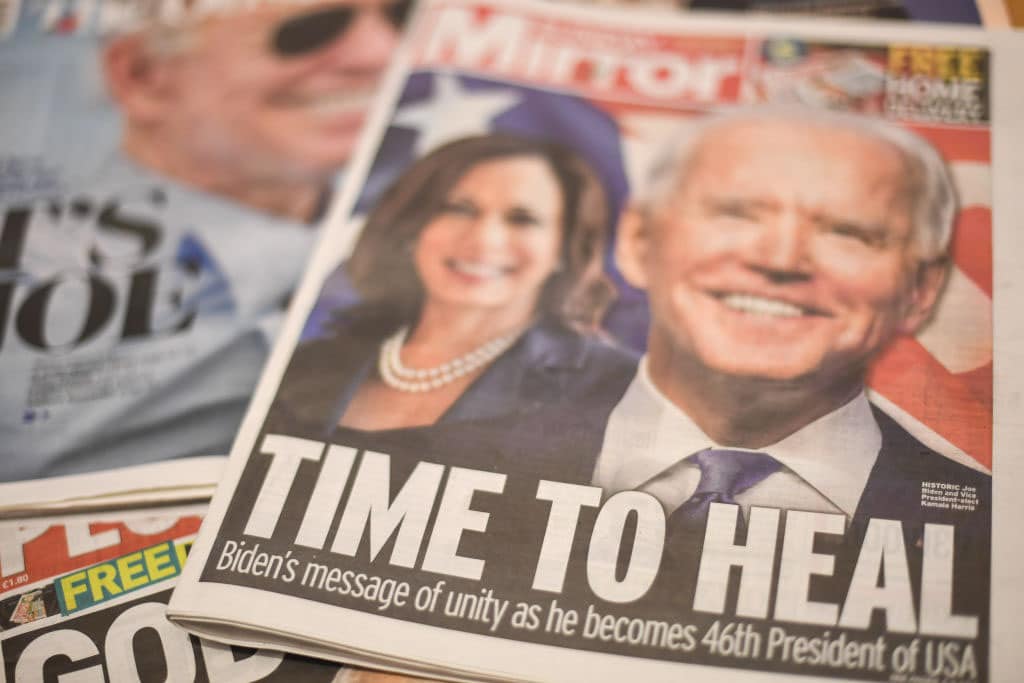
JJ: With Biden now our president elect, does this change the feelings you have going into the holiday season?
RYB: I think that now that the election season is behind us, we can all breathe a sigh of relief and begin to think about Hanukkah. Hanukkah this year will certainly look and feel different but I’m excited for the creative possibilities of Hanukkah celebrations on Zoom, Facebook and Instagram.
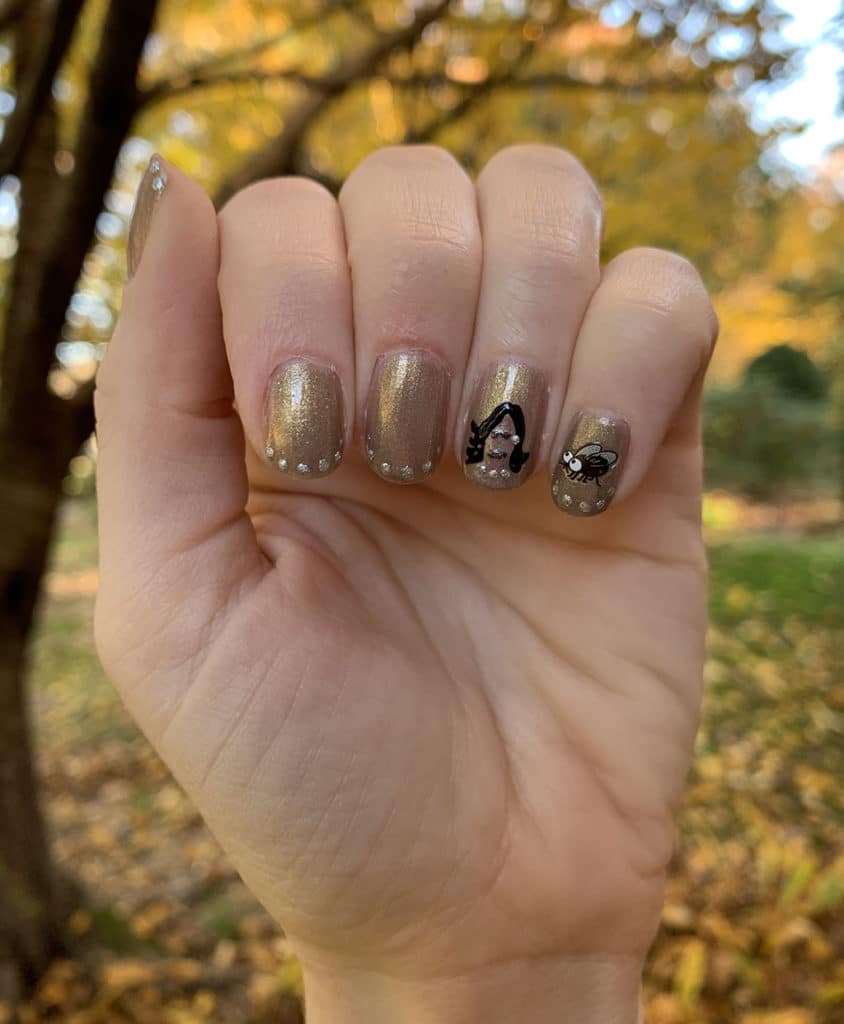
My hope is that our new shamash, President-elect Biden, will bring much-needed healing to our nation. I was excited to have the chance to paint my nails in honor of Vice President-elect Harris. The process of choosing a design to paint was a bit cathartic. I went with a pearl themed french manicure and couldn’t resist throwing in a gnat (from my Ten Plagues Nail Decals set) as an ode to the fly that joined us at a recent debate.
JJ: You said Judaism isn’t just kept within, it literally takes over your body and is acted on through your voice, through your hands, through every part of you. That’s what you try to do with your products. What does it meant to you that you can pass around your products like they’re extensions of the Jewish culture and traditions?
RYB: Many of us were new immigrants to America in the early 20th century. We spent a lot of time trying to fit in with the Joneses, right? But I think now is an opportunity for us—and throw in American consumers—you can wear a real American style by wearing our Jewish holidays. I think there’s a huge piece to that that now is our opportunity to both be American and be Jewish. I think we’re constantly figuring out what that means, but I think the Midrash Manicures has certainly played a role in that.
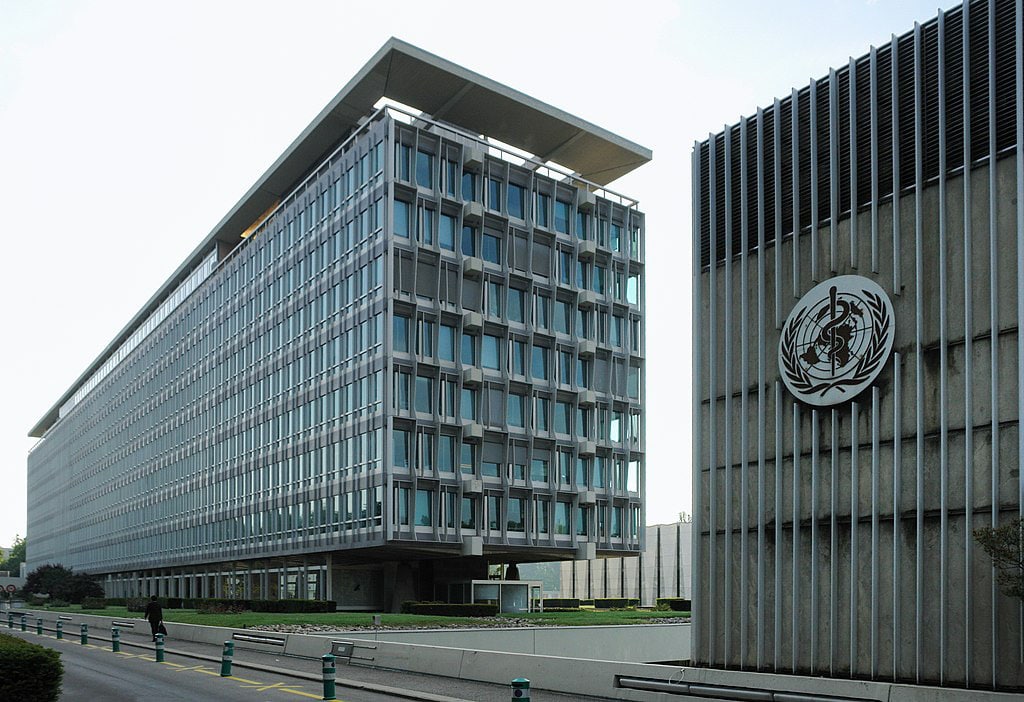
The World Health Organization (WHO) held a session on November 12 accusing Israel of violating Palestinian health rights during the COVID-19 pandemic.
UN Watch reported that for four hours, Israel was “condemned in speeches by some 30 delegations, including Iran, Syria, North Korea, Cuba, Malaysia, Lebanon and Venezuela, for allegedly violating the health rights of Palestinians and Syrians in the Golan Heights.” For instance, the Iranian delegation alleged that Israel’s “chronic occupation has profound implications for the health of Palestinians. More than 12 years of inhuman blockade has had a profound effect on the health sector, worsening an already dire situation.”
🇮🇷 Islamic Republic of Iran at special debate against Israel @WHO assembly: "Chronic occupation has profound implications for the health of Palestinians. More than 12 years of inhuman blockade has had a profound effect on the health sector, worsening an already dire situation." pic.twitter.com/A1Jd9dgkBD
UN Watch Executive Director Hillel Neuer said in a statement, “Out of 23 items on the current world health assembly’s Agenda, only one, Item 17 targeting Israel, focused on a specific country. There was no agenda item or resolution on any other country, conflict, civil war or political impasse—not on Syria, where hospitals and other medical infrastructure are repeatedly and deliberately bombed by Syrian and Russian forces; not on war-torn Yemen, where 14 million are in dire need of health assistance; and not on Venezuela, where the health system is in a state of collapse and 7 million people are in need of humanitarian assistance.”
Neuer added that the Israelis have been coordinating with the Palestinians to provide training, assistance and medical equipment to help combat the COVID-19 pandemic. Additionally, Israel has treated “tens of thousands of Palestinians” at Israeli hospitals, per Neuer.
“Even the UN’s own Middle East peace envoy hailed Israel’s ‘excellent’ coordination and cooperation with Palestinians amid the coronavirus pandemic,” Neuer said.
The WHO also voted to approve a resolution (78 yeas, 14 nays, and 32 abstentions) to adopt a November 5 report from the UN Health General, which blames Palestinian health problems on Israel’s “chronic occupation” of the West Bank. The report also accuses Israel of engaging in “discriminatory planning policies and practices towards Palestinians” Area C of the West Bank, which is under the Israeli military’s jurisdiction; it additionally blames Israel for violence on the border of the Gaza Strip during the “March of Return” riots. UN Watch noted that the report doesn’t acknowledge “the role of Hamas and other terrorist groups in orchestrating violence and encouraging demonstrators to approach the hostile area of the Gaza-Israel border.”
Under the resolution, the WHO director-general will be required to issue another report in 2021 about Palestinian health in the West Bank.
“Amid a global pandemic, the minority of [European Union] member states and other democracies who voted for the resolution should be ashamed, including France, Spain, Belgium, Switzerland, Ireland, Poland, Portugal, Japan, India, New Zealand, Luxembourg and Monaco,” Neuer said. “These countries have now encouraged the continued hijacking of the world’s health priorities, and the diversion of precious time, money, and resources to fight global disease, in order to wage a political prosecution of Israel.”
Among those that voted against the resolution included the United States, Britain and Australia.
Pro-Israel Twitter users also criticized the WHO.
“There is a global pandemic. Over a million have died, 10s of millions infected, the world in lockdown, economies in serious trouble,” British researcher David Collier tweeted. “The World Health Organisation met today and used the opportunity to..[.] You’ve guessed it – bash Israel. Each of those involved should be fired.”
There is a global pandemic. Over a million have died, 10s of millions infected, the world in lockdown, economies in serious trouble..
The World Health Organisation met today and used the opportunity to..
Noah Pollak, executive director of the newly formed foreign policy organization Democracy Alliance Institute, similarly tweeted, “World Health Organization, in the midst of a global pandemic it helped cause, just held a four-hour session condemning Israel [with] speeches by Syria, Cuba, Turkey, & Qatar. [President Donald] Trump left this corrupt org; [President-Elect Joe] Biden will re-join, naturally.”
World Health Organization, in the midst of a global pandemic it helped cause, just held a four-hour session condemning Israel w/ speeches by Syria, Cuba, Turkey, & Qatar. Trump left this corrupt org; Biden will re-join, naturally. https://t.co/ILb2MF3mWZ
In July, the Trump administration announced that the United States will be withdrawing from the WHO in a year. The State Department said in a September statement that U.S. aid to global health and humanitarian initiatives is conditioned on “the reasonable expectation that it serve an effective purpose and reach those in need. Unfortunately, the World Health Organization has failed badly by those measures, not only in its response to COVID-19, but to other health crises in recent decades. In addition, WHO has declined to adopt urgently needed reforms, starting with demonstrating its independence from the Chinese Communist Party.” Biden has said that he will reverse the Trump administration’s decision to withdraw from the WHO on his first day in office, arguing that “Americans are safer when America is engaged in strengthening global health” and that rejoining the WHO is necessary to “restore our leadership on the world stage.”
The Media Line — The US election is over, and Israelis and Palestinians are on tenterhooks, waiting to find out the incoming president’s policies and whom he will appoint to carry them out.
Outgoing President Donald Trump implemented a radical shift from past administrations’ policy on the Israeli-Palestinian conflict. He recognized Jerusalem as the capital of Israel in December 2017 and relocated the US Embassy to the city in May 2018, leading the Palestinians to sever ties with his administration.
Dan Gillerman, former Israeli ambassador to the UN, told The Media Line the Biden presidency will not disavow all the decisions taken by Trump, but it will reconnect with the Palestinians.
“What will be the distinction from the Trump Administration is that they will attack the Palestinian issue in a much thorough and more effective way. They will not allow the Palestinians to be left behind.”
“While the Trump Administration sort of bypassed the Palestinians and to a great extent maybe even isolated them, I think the Biden Administration will bring them back to the fold, to the negotiating table, and try to solve the Palestinian-Israeli issue, with the involvement of the moderate Arab states,” he says.
“What will be the distinction from the Trump Administration is that they will attack the Palestinian issue in a much thorough and more effective way. They will not allow the Palestinians to be left behind,” Gillerman says.
Palestinians had been hoping for a Biden win, as they believe Trump’s policies were biased against them.
“Biden’s policy will be characterized by balance to some extent, moderation, bypassing the so-called deal of the century, bypassing imposing solutions, trying to bring the Palestinians back to the table, and encouraging negotiations on the basis of international law and legitimacy.”
Ahmed Rafiq Awad, president of the Jerusalem Center for Future Studies at Al-Quds University, told The Media Line the Democrat’s win brings renewed hope for Palestinians.
“Biden’s policy will be characterized by balance to some extent, moderation, bypassing the so-called deal of the century, bypassing imposing solutions, trying to bring the Palestinians back to the table, and encouraging negotiations on the basis of international law and legitimacy,” he says.
“Every new president who comes will be more supportive of Israel and have greater disregard for Palestinian rights than his predecessors.”
Abdul Sattar Kassem, a former political science professor at An-Najah University in the West Bank, told The Media Line it does not matter who occupies the White House. “Our experiences with successive US administrations are quite clear. Every new president who comes will be more supportive of Israel and have greater disregard for Palestinian rights than his predecessors.”
The Palestinians also accuse the current White House team on the Middle East of not having the experience needed to deal with the Israeli-Palestinian conflict.
The president’s son-in-law Jared Kushner, who had no previous diplomatic experience, leads the White House Middle East peace process team.
“Trump and his team have absolutely adopted the Israeli vision,” says Awad, who argues that the Biden Administration will include officials who respect international law and signed agreements, “in contrast” to the outgoing administration.
“Biden is an old-style politician and comes from a traditional political school, and he has a long history in politics. This will be reflected in his appointments, as he will employ those with experience and will not rely on personalities who act according to their ideologies and personal whims,” he says.
Gillerman says the president-elect, in an attempt to revive the stalled peace talks, may turn to veteran diplomats, and that he will recruit ones with extensive experience of the conflict who worked for previous administrations.
“The big question is will President Biden pick someone who has been involved with the Israeli-Palestinian issue for a long time, someone like Martin Indyk or Dennis Ross? Or will he pick someone who is more internationalist?”
But regardless of whom the president-elect chooses as his secretary of state or for his Middle East team, Gillerman says they will carry out his agenda.
“I think whoever is the next secretary of state will defer to the president’s agenda on international relations and policy, and that includes the Middle East and the Palestinian-Israeli issue.”
Susan Rice is a very deserving and worthy and able candidate, and did a very good job as national security adviser and as ambassador to the UN. I consider Rice a hawk if you compare her with [John] Kerry, the former secretary of state. But names do not matter because in the end, it is the president’s agenda that determines the policy
One frontrunner for the top US diplomatic job is Susan Rice, who had been under consideration to be Biden’s vice-presidential running mate. Gillerman says she has the credentials to succeed.
“Susan Rice is a very deserving and worthy and able candidate, and did a very good job as national security adviser and as ambassador to the UN,” he says. “I consider Rice a hawk if you compare her with [John] Kerry, the former secretary of state. But names do not matter because in the end, it is the president’s agenda that determines the policy.”
According to insiders, former US ambassador to Israel Dan Shapiro may be Biden’s choice for his envoy to the Middle East.
“He may also join the national security team. These are very experienced people who know the issue, and I think it would be very wise of the [incoming] president to bring them back,” Gillerman continues.
Says Kassem, “We do not expect Biden and his new secretary of state, whoever he is, to reverse any of Trump’s decisions on the issue, such as returning the US Embassy to Tel Aviv from Jerusalem.
“We do not expect him to stand against the settlements. Even though he talks about a two-state solution, there is no longer a possibility for a two-state solution,” Kassem says.
My friends on the left and right can’t understand why I’m always looking at both sides of an issue. Trump haters can’t stand that I’m not pushing only for their side, and Trump lovers can’t stand that I’m not pushing only for theirs. Each side believes it owns 100 percent of the truth.
Is President Trump delusional to challenge the election results? If his side believes fraud was committed, is he properly exercising his rights or is he violating the long tradition of the prompt concession speech? Are his legal challenges spreading mistrust in a vital American institution or is a legal process necessary to prove integrity of the process itself?
These are questions for another time. Right now, I’m more interested in things like hypocrisy, defined in the dictionary as “the practice of claiming to have moral standards or beliefs to which one’s own behavior does not conform.”
So, when I see the mainstream media’s all-out assault on Trump’s refusal to concede, I can’t help but wonder: Would they be reacting the same way if the shoe were on the other foot? If Biden was refusing to concede, would they mock him for being a fool and accuse him of undermining our democracy?
Would they categorically dismiss Biden’s contention that there are enough examples of irregularities to merit a legal challenge?
Would they run with the “Trump is our President-elect” story as they are running with the “Biden is our President-elect” story?
Which side am I on? Ultimately, on the side of treating everyone the same, whether we love them or hate them.
Let’s remember that it was a member of Democratic royalty, Hillary Clinton, who said a few months ago, as reported in Politico:
“Joe Biden should not concede under any circumstances because I think this is going to drag out, and eventually I do believe he will win if we don’t give an inch and if we are as focused and relentless as the other side is.”
Would the media and Democratic establishment beat up a “focused” and “relentless” Joe Biden who fought for every vote and refused to “give an inch” as they are doing now with Trump?
I don’t know. You tell me.
Finally, does anyone remember this exchange in the first debate between Biden and Chris Wallace: “Final question for you…will you pledge not to declare victory until the election is independently certified?”
Biden’s answer: “Yes.” Is the election independently certified? Well, not exactly: The Electoral College is expected to formalize Biden as president-elect on December 14, unless Trump prevails in court.
Personally, I lean in the direction of Karl Rove’s op-ed in yesterday’s Wall Street Journal, in which he wrote that Trump was “100% within his rights” to challenge the fairness of the election, but that “once his days in court are over,” the president “should do his part to unite the country by leading a peaceful transition and letting grievances go.”
I do wish that by now we would have had final closure on this election, but we don’t. Which side am I on? Ultimately, on the side of treating everyone the same, whether we love them or hate them.
According to an exit poll conducted by J Street, 78% of American Jews voted for Joe Biden, the Democratic candidate, while 21% voted for Donald Trump, the Republican candidate. No surprise there — Jews have historically voted Democrat.
Now, consider the findings of another survey, released by the American Jewish Committee on October 26, the second anniversary of the killings at Tree of Life Synagogue in Pittsburgh. As part of its State of Antisemitism report, AJC had some surprising data about how American Jews feel about political parties. According to the AJC survey, 37% of American Jews think the Democratic Party holds some anti-Semitic views, while 69% believe the Republican Party holds such views.
I’m not surprised that the perception of anti-Semitism within the Republican Party is so high, given the growing alliances between some Republicans and white nationalists in recent years. Witness, for instance, the recent election of Marjorie Taylor Greene in Georgia and Lauren Boebert in Colorado to Congress, both of whom are candidates who support QAnon, the far-right group purveying anti-Semitic conspiracy theories.
But what are the reasons that over a third of American Jews believe there is anti-Semitism in the Democratic Party? I believe it is indicative of a common misconception about the nature of anti-Semitism, especially as it relates to Israel, that leads some to believe that the anti-Semitism on both sides of the political spectrum is equally dangerous and that that each type should be treated equally.
Look at the Jewish Journal, for instance. An informal tabulation of the Journal’s coverage of anti-Semitism shows that since 2017, there were 144 stories about left-wing anti-Semitism and 176 about right-wing anti-Semitism. Or consider the New York Times writer, Bret Stephens who, in a column commemorating the slaughter of Jews by a white supremacist in Pittsburgh, devoted more than twice as much space to anti-Semitism on the left than the right.
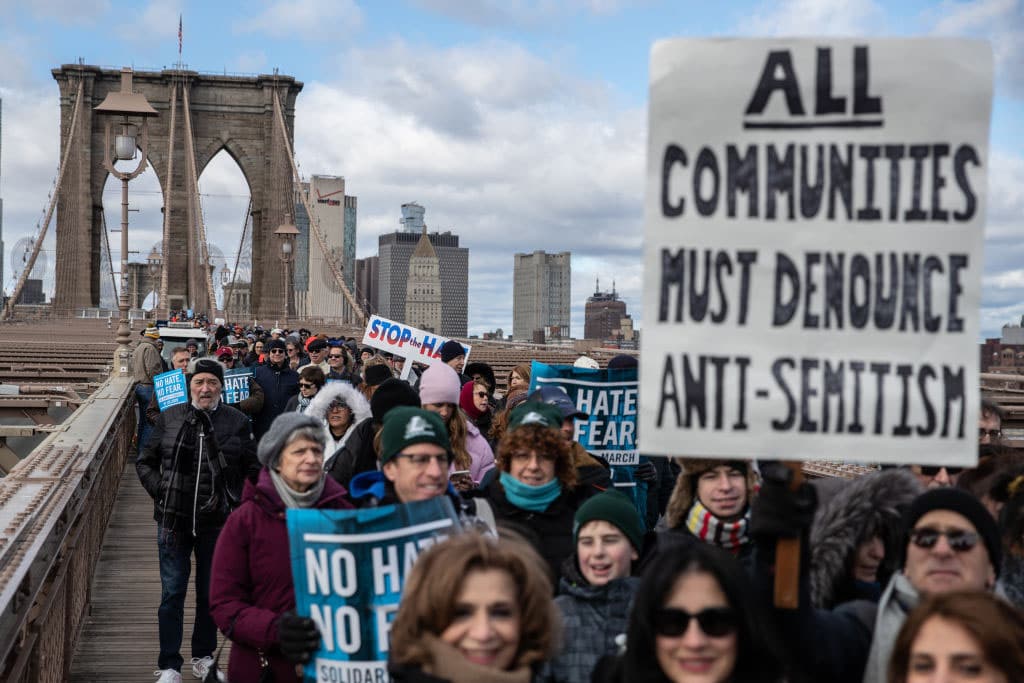
To be clear, there is anti-Semitism on both ends of the political spectrum. But they are different in kind and in quantity.
There is anti-Semitism on both ends of the political spectrum. But they are different in kind and in quantity.
Anti-Semitic remarks from the right appear in different forms. When white supremacists attack Zionism, they condemn “Zionist control” of the U.S. government and the American financial system and, as the ADL puts it, the way that “American Jews are manipulating U.S. immigration policy in order to undermine the U.S.’s white majority.” And President Trump, for instance, was accused of invoking the anti-Semitic trope of “dual loyalty” in his 2020 Rosh Hashana call with American Jewish leaders when he said, “We really appreciate you… We love your country also.” Evangelical pastor John Hagee demonstrates another example of right-wing anti-Semitism in his attitude toward Israel; he once said that Hitler and the Nazis were sent by God to chase Jews back to the land of Israel.
As for anti-Semitism on the left, many of us remember how the Soviet Union drew upon classic Russian anti-Semitism (as expressed in “The Protocols of the Elders of Zion”) as a way of cozying up to Arab nations. Anti-Semitism also finds its way into contemporary progressive movements, such as the British Labour Party when Jeremy Corbyn was its leader. We also see anti-Semitic tropes in statements by leaders such as Zahra Billoo, who was booted off the board of the Women’s March after she defended Hamas for firing rockets into Israel. Or the anti-Semitic meme that Rodney Muhammad, president of the Philadelphia NAACP, shared on Facebook (Mohammad was forced out a month after).
But there are times when it’s tempting to think that criticism of Israel on the left is anti-Semitic, but it really isn’t. Even when criticism and condemnation of Israel are harsh, it tends to be based on politics, not religion. And it’s essential to respond to it that way.
Let’s take the example of how double standards relate to anti-Semitism. The “Working Definition” of anti-Semitism, adopted by the International Holocaust Remembrance Association (IHRA), states that it is anti-Semitic to apply “double standards by requiring of Israel a behavior not expected or demanded of any other democratic nation.”
But is it necessarily anti-Semitic when held to a different standard and treated differently than others?
Clearly, there are numerous reasons for focusing more on Israel than other countries. Some people focus on Israel’s human rights record because of the level of aid Israel receives from the United States. Others may pay more attention to Israel because the Palestinians are more effective at PR than the Uighurs oppressed by the Chinese.
In both these cases, the focus on Israel is political. It is not automatically indicative of anti-Semitism or a biased double standard.
What would make a double standard about Israel anti-Semitic? When Israel is treated differently because it is a Jewish state, that’s anti-Semitism. For example, it would be anti-Semitic to say that Israel doesn’t have the right to exist because Jews don’t have the right to self-determination — but other people do.
Writing in the National Post, Stephens repeats another misconception about anti-Semitism. “Anti-Zionism is anti-Semitism,” he says.
I am a proud Zionist. But I know people who oppose Zionism, and they are far from being anti-Semites. Their opposition does not necessarily reflect a specific anti-Jewish stance, they are not advocating the end of Israel, and their positions do not necessarily lead to anti-Semitic behavior. For example, some people oppose Zionism because, on principle, they are against ethnonationalism, including Zionism and Palestinian nationalism.
I know others, mostly Palestinians, whose personal or national experience was adversely affected by Zionism and the creation of the State of Israel. The Palestinian Knesset Member Jamal Zahalka, for example, once introduced a bill to turn Israel from a Jewish state into a “state for all its citizens.” Does that make him an anti-Semite? I don’t think so. Neither was Saeb Erakat, the Palestinian peace negotiator who passed away from COVID-19 on November 10. He once asked me: “Why should I be a Zionist? Israel took my family’s land. But does that mean I oppose the existence of the state of Israel? Of course not!”
And let’s not forget Jewish anti-Zionists, who hold ethical and religious convictions that oppose a Jewish state (a Jewish state shall only come about after the Messiah arrives, or that statism is not compatible with Judaism).
None of these motivations or attitudes towards Israel or Zionism necessarily constitute anti-Semitic behavior. What turns opposition to Zionism into anti-Semitism is the use of anti-Semitic tropes, accusations, or threats. What also makes anti-Zionism anti-Semitic is the negation of the right of Jews to identify themselves as Jews and thereby fulfill their rights to self-determination in Israel.
Why is it important to distinguish between right-wing and left-wing anti-Semitism? What does this have to do with our daily realities, like tensions on college campuses? How does it help us respond to a friend or colleague whose condemnation of Israel feels anti-Semitic to us?
These distinctions are important because the more we understand the sources of anti-Semitism, the better we’ll understand how to combat anti-Semitism in each of its forms. Ultimately, that’s our shared goal: to defeat anti-Semitism wherever we find it. I hope to explore strategies for doing that in future columns.
Jonathan Jacoby is the Nexus Task Force Director at the Knight Program of the USC Annenberg School, exploring issues related to anti-Semitism and Israel.
WASHINGTON DC (Israel Policy Forum) — President-elect Joe Biden is going to be inaugurated on January 20, irrespective of how much chaos and uncertainty marks the coming weeks, and governments around the world are scrambling to adjust to what will undoubtedly be a reset for American foreign policy. Israelis and Palestinians are no different, and Jerusalem and Ramallah are strategizing as to how they can start things off with the Biden administration in a positive way.
It is no secret that the Israeli government spent the past four years exulting over its policy victories under the Trump presidency. Now that a new sheriff is coming to town, there will be twin impulses in Israel that result from a sense of urgency over the impending last days of the Trump administration. One impulse will be to batten down the hatches in anticipation of a massive policy shift and a return to public battles over Israeli policy in the West Bank. A second impulse that follows from the first will be to lock in gains and expand upon them before President Trump leaves office.
Both of these will be a mistake should Israel act on them. For starters, while Biden differs very publicly from Trump on a number of key issues in the Israeli-Palestinian sphere, he has publicly supported some of the Trump-era initiatives that have made Israel the happiest, most saliently recognition of Jerusalem as Israel’s capital and the relocation of the embassy to reflect that and the normalization deals between Israel and Arab states. On issues where he clearly departs from Trump, with West Bank annexation topping the list, he reflects nearly universal and mainstream Democratic policy. Biden is a known quantity to Israel and to Prime Minister Netanyahu, and there are unlikely to be any surprises on the horizon. Biden and his foreign policy advisers have spoken about Israel as a critical ally and their desire to keep disagreements largely private, and are as committed to Israel’s security as anyone on either side of the aisle. The best way to precipitate a public blow-up is for the Israeli government to act as if they are anticipating a public blow-up.
Biden is a known quantity to Israel and to Prime Minister Netanyahu, and there are unlikely to be any surprises on the horizon.
This does not mean that disagreements will not exist, because they will. Trump policy regarding the West Bank, from embrace of annexation to an assumption that all settlements are not only de facto legal but are to be encouraged, is going to be set aside. Biden policy toward the Palestinians is going to be where the real break with the Trump administration will be most easily seen, and not only will that lead to philosophical disagreements between the U.S. and Israel but it may lead to tangible ones as well, since moves like reopening the Consulate-General in Jerusalem will require Israeli consent.
But the likely focus of a Biden administration in the Middle East at the outset is not going to be the Israeli-Palestinian conflict. It is going to be on another issue in which Israel has a stake, which is figuring out if and how the U.S. reenters the JCPOA or negotiates a new deal with Iran to address its nuclear program. The scars from the last fight over the Iran deal are still visible, and Biden is not going to want a pitched battle with Israel or other regional allies who opposed the JCPOA and will be extremely wary of a new effort to engage with Iran. This means that Biden is not going to want to open up multiple fronts with Israel that distract from the main priority, which in turn points to trying to tamp down public disagreements on the Israeli-Palestinian conflict.
This is why, for Israel, trying to extract as much as possible from the Trump administration on its way out would be a mistake. It is one thing if there is disagreement between Biden and Netanyahu on general Israeli settlement activity. It is quite another if on his first day in office, Biden is facing West Bank annexation that has already been enacted, or Israeli construction in the most sensitive possible areas such as Givat HaMatos, or a rash of demolitions of entire West Bank villages. These are all things that the Trump administration has either encouraged or to which it has turned a blind eye, and they are things that a Biden administration will be hard pressed to ignore. Not only would it strain the relationship with a new president, it would make it less likely for Israel to be included in a more robust way in any deliberation process surrounding a reconstructed Iran deal. The Israeli government has no need to go into anything resembling crisis mode with a Biden administration, but that also means not laying the groundwork for a crisis.
The Palestinians have a mirror image dynamic. Whereas Israelis may be tempted to think without cause that there are rough seas ahead, Palestinians may be tempted to think that they have nothing but smooth sailing. The Biden campaign endorsed restoring diplomatic relations with the Palestinians and resuming funding to the West Bank and Gaza, which will include humanitarian assistance and USAID infrastructure projects and likely also some level of American funding for UNRWA. The Trump administration moved the pendulum as far as it could possibly go in one direction with the Palestinians and held it there, and the logical assumption is that with a new Democratic president, it is now due to swing back.
While there is little question that the Palestinians will benefit in the immediate term from a Biden presidency, the pendulum is not going to swing as far in their direction as it did for Israel under Trump. The Trump administration has been an extreme outlier in terms of its policies, and extreme and outlier are not words that make sense when discussing Biden. The Biden administration is going to look to restore a sense of balance, and that means that the Palestinians will also have to get their house in order in a way that they were able to elide while facing the Trump administration’s all-out assault.
While there is little question that the Palestinians will benefit in the immediate term from a Biden presidency, the pendulum is not going to swing as far in their direction as it did for Israel under Trump.
The U.S., the European Union, and the United Nations have all been frustrated with downgraded Palestinian security coordination with Israel. They have all implored the Palestinian Authority to accept the tax revenues that Israel collects on its behalf and that the PA has refused to accept due to the threat of annexation even though that immediate threat seems to have dissipated. They have all urged the Palestinian leadership to address the martyr and prisoner payments system, with its escalating payments for severity of the crime and time in Israeli prison and which has led to sanctions such as the Taylor Force Act and the Knesset law offsetting tax transfers by the amount of the martyr and prisoner payments. These are all going to be bones of contention with the Biden administration irrespective of Biden’s desire to roll back some of the more punitive measures taken by Trump.
The best thing the Palestinians can do for themselves is to make it easier for the Biden administration to help them by addressing some of these concerns. It is incongruous to bemoan the cuts to funding and UNRWA’s dire financial situation while continuing to reject clearance revenues from Israel, a policy that President Abbas should reverse before Biden takes office. It is also critical for the Palestinians to take the prisoner payments concern more seriously given how large it looms in Congress, in Israel, and in the American Jewish community. If the Palestinians start off a Biden presidency with a list of requests without being prepared to give something in return, it will make it politically more difficult to restore some balance to U.S. policy and will erode any goodwill that exists.
A Biden presidency is inevitably going to unfold differently in many ways than either Israelis or Palestinians expect as events drive policy positions and policy responses. The Israeli and Palestinian governments can get off to a positive start by assessing what the new administration’s priorities are likely to be and what steps they should avoid in order not to thwart those priorities.
Michael Koplow is Israel Policy Forum’s policy director, based in Washington, DC. To contact Michael, please email him at mkoplow@ipforum.org.
Recently, I received an email from a fellow Occidental College student advertising the possibility of a Youth (DSA) chapter coming to campus.
Occidental College has a reputation for being a very left-leaning campus, an environment that I quite enjoy most of the time. However, Occidental also has a history of Anti-Zionist activism. This anti-Zionism manifests in everything from Israeli Apartheid Week to a talk given by Steven Salaita — a known anti-Semite — just a few years ago.
The petition to bring the DSA to campus is yet another example of the many times that Occidental has encouraged Anti-Zionist ideology, but I am especially concerned it has already received 74 signatures — four percent of the student body.
There are certainly many ways we can engage critically with the DSA’s politics — college campuses are just one venue — but we must be clear-minded about the organization when we do so. To be clear, I do not take issue with the concept of Democratic Socialism. Rather, it is some anti-Semitic parts of the organization’s platform with which I have tensions. If you are a student attending college in Los Angeles, you can and should join any association with which you identify. However, before deciding whether or not to join DSA, there are a few things you should keep in mind:
In 2015, DSA carried the motion to endorse the Boycott, Divestment, and Sanctions (BDS) campaign against Israel. BDS is a blatantly anti-Semitic organization; one of its founders, Omar Barghouti, claims the Jews are not a people and denies the equal moral claim of both Jews and Palestinians to the land of Israel.
In August of 2020, DSA released their application for political endorsement. In this application, DSA asked New York City Council candidates if they would support BDS and if they would pledge not to visit Israel if elected to City Council. The candidates’ answers to these questions would determine if the New York City DSA would endorse them.
There are multiple issues with the questionnaire. First, promoting the Boycott, Divestment, and Sanctions Campaign against Israel, but no other country, is a blatant double-standard against the only Jewish state. Countries such as Turkey, China, Iran, and Russia all have lengthy records of human rights abuses, yet the questionnaire mentions none of them.
According to the International Holocaust Remembrance Association (IHRA) Working Definition of Antisemitism, denying the Jewish people their right to self-determination and applying double standards (by expecting from it a behavior not demanded of any other nation) is anti-Semitic. Twenty-seven countries around the world agree with the IHRA and have formally adopted this definition.
The questionnaire ignores the fact that singling out Israel, and only Israel, is an attempt to smear and delegitimize the Jewish state. This all-or-nothing mindset, common in social justice frameworks, pushes supporters of Israel completely out of progressive spaces, thus alienating the vast majority of the world’s Jews.
The questionnaire ignores the fact that singling out Israel, and only Israel, is an attempt to smear and delegitimize the Jewish state.
The second issue with the questionnaire is the DSA’s request that Jewish City Council candidates not visit a land that has religious, cultural, and historical significance to them. This request is flagrantly anti-Semitic, as it only requests this of Israel and not of other countries. Asking this question not only encourages non-Jewish candidates to adopt problematic Antisemitic attitudes for the sake of gaining an endorsement, it also serves as a litmus test for Jewish candidates.
Based on this “test,” Jewish candidates who agree not to travel to Israel become “progressive,” and those who refuse are not. In implementing this test, DSA promotes the “Good Jew/Bad Jew” trope, which defines a “Good Jew” as one who assimilates, rejects Israel, and excuses Antisemitism when they see it. A “Bad Jew” is someone who does not forgo parts of their identity, stands up for Israel, and does not excuse anti-Semitism when they see it. The “Good Jew/Bad Jew” trope has been exploited by non-Jews in an attempt to point fingers at the “Good Jews” and subsequently justify their own anti-Semitism.
DSA’s intended purpose of asking public officials not to visit Israel is to silence Israeli and Jewish voices, but it also silences vital Palestinian voices in the process. For many candidates, trips to Israel — such as the state-sponsored trips led by the Jewish Community Relations Council (JCRC) — are the only opportunities to meet Israelis and Palestinians and hear their stories. These state-sponsored trips bring New York public officials to Israel to meet with leaders of all religions, nationalities, and creeds. Alexandra Ruiz, the founder of Immigrant Advancement Matters, recalls meeting with Dr. Khalil Shikaki at the Palestinian Center for Policy and Survey Research, and U.S. Representative-elect Ritchie Torres remembers visiting Israelis and Palestinians, Arabs and Jews on the JCRC trip. Trips to Israel and support for Palestinian people are not mutually exclusive. Arguing otherwise is nothing more than an anti-Semitic attempt to wrongly painting Jews and Zionists as bigots.
It is important to recognize the emerging and rapidly growing anti-Semitism in the Democratic Socialists of America, and it is even more important to be critical of the organizations we support as a result. Organizations like DSA, which are celebrated for their commitment to social justice, often have anti-Semitic tropes woven into the fabric of their platforms. In a time as volatile and polarized as now, just days after an election, we must be vigilant in our self-education and stand up against all forms of bigotry and prejudice. This means understanding how anti-Semitism presents itself in communities even as progressive as Occidental College. If you are a student considering joining DSA, you have every right to do so. However, eventually, you may have to decide: are you willing to work with your Jewish peers to fight anti-Semitism, or will you choose to tolerate it?
Alissa Bernstein is a senior at Occidental College and a Foreign Policy Intern at the American Jewish Committee in Washington, D.C.

 Los Angeles poet Rick Lupert created the