fbpx

November 6, 2020

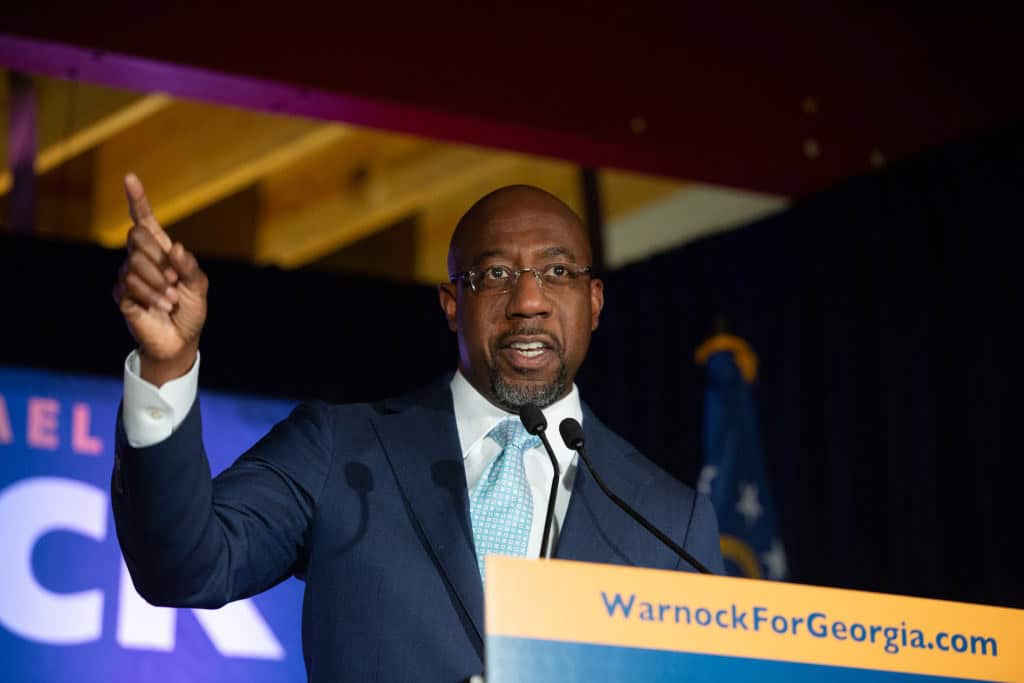
Senate Candidate Warnock Signed Letter Accusing Israel of Apartheid

In 2019, Georgia Democratic Senate candidate Reverend Raphael Warnock signed a letter comparing Israel to apartheid South Africa, Jewish Insider reported.

The letter, which was written by a group of various African American church leaders including Warnock, expressed the leaders’ observations about the Israel-Palestinian conflict after a trip to Israel and the Palestinian territories. The leaders had visited both Israeli and Palestinian communities and decried “the heavy militarization of the West Bank, reminiscent of the military occupation of Namibia by apartheid South Africa.” They also compared the Israeli security barriers in the West Bank to the Berlin Wall and alleged that there are “laws of segregation that allow one thing for the Jewish people and another for the Palestinians.” The letter does call for a two-state solution in which both Israel and the Palestinians are “safe and secure,” as well as for elections in the Palestinian territories.

The Institute for Black Israel criticized Warnock for signing the letter, tweeting: “When you sign a lengthy document on Israel-Palestine that never once mentions Palestinian leaders’ systematic oppression of their own people, you’ve been deceived.”


The conservative website Washington Free Beacon noted that Tamara Cofman Wittes, a senior fellow for the Brookings Institute, argued in a Facebook comment that “the letter did not explicitly compare Israel to apartheid [South] Africa.”

Warnock is also listed as a delegation member on a Progressive National Baptist resolution that called on the United States to cease all military aid to Israel and urged Israel to stop building “illegal Israeli settlements, checkpoints and apartheid roads in the occupied Palestinian territories,” Fox News reported.

Terrence Clark, spokesperson for the Warnock campaign, told Jewish Insider, “Reverend Warnock has deep respect for the invaluable relationship the United States has with Israel and how Georgia continues to benefit from that friendship. The reservations he has expressed about settlement activity do not change his strong support for Israel and belief in its security — which is exactly why he opposes ending direct military aid to such a strong ally.” According to the Jewish Democratic Council of America, which has endorsed Warnock, he is opposed to the Boycott, Divestment and Sanctions (BDS) movement.

Stephen Lawson, communications director for incumbent Senator Kelly Loeffler’s (R-Ga.) campaign, told Fox News that “Warnock has a history of anti-Israel positions, from embracing anti-Zionist Black Lives Matter and defending anti-Semitic comments made by Rev. Jeremiah Wright, to calling Israel an ‘oppressive regime’ for fighting back against terrorism.” Lawson also argued that Loeffler’s staunch support for Israel is “unwavering.”

Jewish News Syndicate (JNS) reported that Warnock had previously defended Wright in 2008, saying “that we celebrate the truth-telling tradition of the black church, which when preachers tell the truth, very often it makes people uncomfortable.” Warnock defended Wright again in March. JNS also highlighted how Wright said shortly after Barack Obama was elected that “them Jews” were preventing Obama from stating “anti-Israel” remarks.

Clark told Fox News in October that Warnock “doesn’t agree with all of the positions other pastors support and has said such throughout this campaign. Rev. Warnock loves this country, and he supports honoring the dignity of all people, but also finding common ground to reform our broken systems.”

Loeffler and Warnock are set to face off in a runoff election for the Georgia Senate seat on January 5, as mandated by Georgia law should no candidate receive a majority of the vote. Warnock received 32.9% of the vote on November 3, whereas Loeffler received 26% of the vote. Representative Doug Collins (R-Ga.), who also ran in the race, received 20% of the vote.

UPDATE: Warnock wrote an op-ed for the JDCA’s website on November 10 stating, “Claims that I believe Israel is an apartheid state are patently false — I do not believe that.” He added that he’s opposed to the BDS movement its “anti-Semitic underpinnings, including its supporters’ refusal to acknowledge Israel’s right to exist” and pledged “to ensure Iran does not obtain a nuclear weapon.”
Warnock also decried the Israeli government’s “continued settlement expansion” as an impediment to a two-state solution. He concluded the op-ed by quoting Martin Luther King, Jr. and Dietrich Bonhoffer to demonstrate the need to fight against anti-Semitism and other forms of bigotry.
“Without reservation, you can count on me to stand with the Jewish community and Israel in the U.S. Senate,” Warnock wrote.

Senate Candidate Warnock Signed Letter Accusing Israel of Apartheid Read More »

Can What Separate Us Unite Us?

The 2016 election results shocked the nation and caused a national collective trauma, which has been exacerbated this year by COVID-19, protests against racism, and a tightly contested election. Collective trauma is insidious. Its impact affects all aspects of society.

Collective trauma is, by definition, marked by intense polarization, which causes a profound demonization of the other, making discourse about important political issues seem futile. Collective trauma manifests in labeling, blaming and shaming the “other,” harassment, and even violence against opponents. This leads to the inability to listen to the other. Our breakdown of civility has reached even the halls of Congress.

As a result of this collective trauma,  many have cut ties with their loved ones in the name of political differences. Social media, touted to be a unifier, has instead facilitated anonymous incivility, boorishness, and vitriolic hatred, compromising a basic unity Americans previously felt. Collective trauma leads to mistrust, which fuels conspiracy theories. Fake news proliferates, tainting reasonable discourse. If allowed to continue unabated, it will  destroy the very fabric of a free, democratic country.

Just witness the vitriol as Americans waited, with bated breath, for the election results. Half of the country is deemed irremediable and malevolent, the other half treacherous, and most institutions diminished.

The voice of collective trauma is amplified by the media, which has become so polarized it creates opposing and mutually negating narratives. Those stories are completely mistrusted by one side and blindly believed by the other.  The polarized media fosters the belief that the nation is doomed if the other wins, provoking a decision to break all the rules because the ends justify the means. Collective trauma undermines the hope for common ground.

Deeply emotional social issues, such as the composition of the Supreme Court, abortion, gun control, gay and transgender rights, racism, freedom of religion, and freedom of speech have become incendiary political bombs that ignite collective fear instead of needed dialogue and compromise.

To successfully address these issues and quell partisanship, we must acknowledge that we are trapped in collective trauma and commit to release it. We can recognize that we are traumatized if we scorn and hate our opponents. We are traumatized if we obsess over extremists and label them as dangerous enemies, if we can’t see good in the other, if we lose our compassion, and if we believe they deserve to be punished and hurt.

We must acknowledge that we are trapped in collective trauma and commit to release it.

We can recognize where we are through this description: Do you believe “the other” is ignorant, crude and uncaring, rigid, immoral, hawkish, bigoted, radical, extreme, dangerous, and malevolent? That “the other” is hypocritical, dangerous, self-righteous, and unpatriotic? Regardless of your political orientation, it is easy to fall prey to this partisanship.

What can reunify us right now, immediately?

A landslide by either party would have validated the winning party’s belief in the truth of their narrative. However, what currently appears to be a narrow victory shows us that neither side holds a mandate and demonstrates the need for acknowledging the other. This is the opportunity to reunify the country and return to bipartisanship and balance. Unity will be based on moderation and collaboration through a democratic political process.

It is possible to unite these two legitimate narratives once we take away the traumatic layers. When we work on our stressed nervous system and help release our layers of activation, we will regain our balance. With a balanced nervous system, we lose the excess energy held in our body and the polarization it provokes.

COVID-19 spurred a tremendous response from the mental health field. Thousands of therapists delivered the tools that can help us through this unusual crisis. We have many options for discharging the stress and trauma from our bodies.

A self-regulated nervous system will naturally move us towards more moderate stances and reasonable discourse. We can engage in dialogue to manage differences, as we have done for so many centuries. We can  create worthy goals of compassionate care for the downtrodden and mobilize an economy that can serve as a locomotive for the rest of the world. We will recover our reputation as one of the healthiest democracies in the world and the envy of nations. Americans have recovered from serious obstacles before, and we can do it again.

By addressing collective trauma and reaching unity, we can overcome the obstacles facing us. There is a keen awareness now that we need to end the pandemic, curb Iran’s nuclear and hegemonic ambitions, confront China’s economic and military growing power, end jihadism, repair the world economy, address climate change, and reckon with the impact of racism.

Let’s use this post-election period to do our individual part to confront our trauma and rein in our polarization.


Gina Ross, MFCT, is Founder/President of the International Trauma-Healing Institute in the US (ITI-US) and its Israeli branch (ITI-Israel) and author of  “Beyond the Trauma Vortex into the Healing Vortex.” Look at her institute’s EmotionAid for free, easy-to-learn stress release tools that can be used on the spot, anywhere, anytime.

Can What Separate Us Unite Us? Read More »

No One Can Pack a Suitcase Faster Than This Refugee

“Are you OK?” a friend asked me during a phone call on election day.

“I feel anxious and helpless…even a little sick to my stomach,” I said, as I contemplated the sight of hundreds of boarded-up businesses I’d seen in our neighborhood in the hours leading up to the November 3 election. I was stressed and worried over civil unrest and possible violence in the streets, especially since my husband and I have two small children, ages three and four.

You feel helpless?” my friend responded. “I have to say, I’m a little surprised.”

“Why would I be an exception?” I asked.

“Because I thought you, of all people, would know more than most of us how to get your things together and leave quickly if you needed to,” she said.

She was right. Who would have thought that having been a refugee in this country would potentially leave you in a better position to protect yourself and your family than hundreds of millions of other Americans?

I immediately embraced the truth — something I’d pushed to the recesses of my mind for over three decades: My full name may be unpronounceable; I may not have my birth certificate (we left it behind in the old country); many Americans may not even be able to point to my birth country (Iran) on a map. But when it comes to political instability and street violence, no one knows how to stuff a suitcase and make a run for it better than me.

No one, that is, except other refugees and immigrants.

It’s a dubious honor. It means we don’t get too attached to material possessions, whether nice silverware or entire homes; it means that when we can afford it, we try to buy clothes we love, but we’re careful not to love them too much. They could always end up on someone else’s back.

It also means many of us aren’t motivated toward civic action, especially if we escaped a tyrannical country. We know we’re now in a democracy, but sometimes, we wonder, what’s the point of even getting involved if policies have already been decided long before we voted? We’re wrong in this regard, but this is how many of us think nevertheless. Worse, we wonder if, like in the old country, anyone is keeping an eye out and remembering for whom we voted. That truly terrifies us.

“I don’t like Biden,” a relative hesitantly revealed to me days before the election. “Will anyone find out if I voted for Trump?” He actually believed the government would keep track of his voting record and weaponize it against him and his family. You can take the refugee out of the fearsome state, but you can’t take the fear out of the refugee.

You can take the refugee out of the fearsome state, but you can’t take the fear out of the refugee.

The way my friend on the phone seemingly swooned over my survival instinct and institutional memory of how and when to make a run for it — you would have thought she was admiring a character trait or weight loss success on my part. It was almost as if she was saying, “I wish I knew how to do that.”

But the only reason I know anything is because I watched my mother and father strategically (and quickly) pack suitcases for themselves and their two young daughters. What stayed? What got left behind? The process felt like a Yom Kippur poem for our possessions: Which will perish by fire and which by water? Which, like our houseplants, by neglect and which, like our heirlooms, by necessity?

We packed what we could, though some of our choices seemed dubious, especially our pointy kabob skewers, which we stuffed under some clothes and medicine. I guess my father thought the kabob skewer could be weaponized, if needed.

And there was the metaphoric packing that we endured in our worried minds and broken hearts. We couldn’t take anyone else with us, including beloved family members, but in carefully storing our moments and painful longing for one another, we didn’t leave a single memory behind. That kind of packing was much harder for all of us.

We joined tens of thousands of Jewish refugees from Iran and the former Soviet Union and were temporarily resettled in Italy in the late 1980s. As we waited and prayed for our American paperwork to be finalized, my mother and father did an audit of the suitcases. We didn’t know when we’d get the green light to come to the United States. Despite the fact that we stayed in Italy for over eight months, we prepared ourselves the possibility that we’d have to pack our bags within hours if good news arrived from the American Consulate.

In Italy, we reviewed all of the possessions we’d taken with us out of Iran. What would we retain? What would perish? We lightened our load even more, but for some reason, the kabob skewers made it past the chopping block. We still have them after 31 years in the United States.

I don’t know why I’d never thought about it before: I’ve got this. I know what I’ll take and what I’ll leave behind, right down to the toys and books that belong to our two small children.

But there’s a slight problem. In our deeply loyal but possibly short-sighted, unconditional love for this country, my family and I (especially me, as I basked in the security of marriage and motherhood this past decade) completely overlooked one thing — a whole slew of expired passports.


Tabby Refael is a Los Angeles-based writer, speaker and activist.

No One Can Pack a Suitcase Faster Than This Refugee Read More »

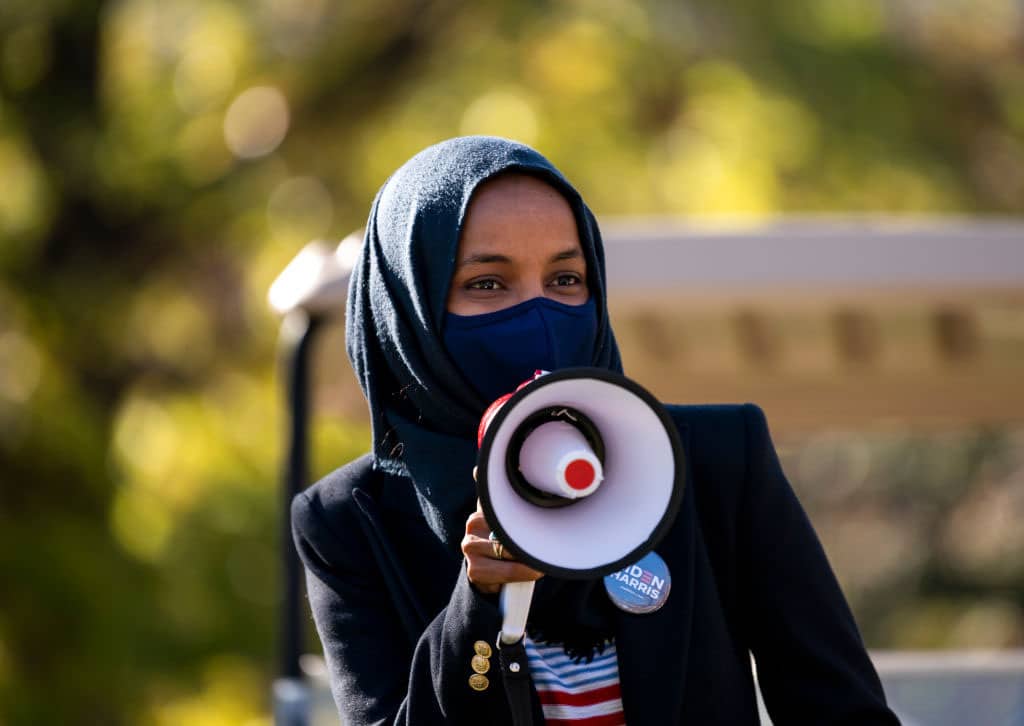
Rep. Ilhan Omar Accuses Israel of ‘Ethnic Cleansing’

Representative Ilhan Omar (D-Minn.) accused Israel of “ethnic cleansing” in a November 5 tweet, after the Israeli army demolished several Palestinian Bedouin homes in a West Bank village.

Omar tweeted, “This a grave crime—in direct violation of international law. If they used any US equipment it also violates US law. An entire community is now homeless and will likely experience lifelong trauma.

“The United States of America should not be bankrolling ethnic cleansing. Anywhere.”


Pro-Israel Twitter accounts criticized Omar’s use of the term “ethnic cleansing.”

“No, it’s not ethnic cleansing,” international human rights lawyer Arsen Ostrovsky tweeted. “And you most certainly don’t know anything about international law or the situation on the ground, you unhinged Antisemite.”


Students Supporting Israel also tweeted, “Sounds like a talking point from [your] radical friends. What else do you know about these homes ? Were [they built] with permits? [W]ere they build in an area that is approved for housing ? [U]sing the word ‘ethnic cleansing’ wont make your case right.”

Writer Claire Voltaire tweeted, “Armenia genocide acknowledgment- silence. Armenia Azerbaijan conflict- silence. Illegal tents in a firing zone legally taken down- ethnic cleansing!”

According to The Times of Israel, around 73 Palestinian Bedouin homes were demolished on November 3, including those of 41 children, in Khirbet Humsa. Israel had declared the area to be a live-fire military training zone in 1972; the Israeli High Court determined in 2019 that the Palestinian Bedouins didn’t have a claim to the land.

“These are intruders who use these areas for grazing,” the court ruled.

Both the United Nations and the European Union have denounced the Israeli military’s actions; the U.N. called the move a violation of international law.

“The extensive destruction of property and the forcible transfer of protected people in an occupied territory are grave breaches of the Fourth Geneva Convention,” United Nations Development Programme Administrator for the Programme of Assistance to the Palestinian People Yvonne Helle said in a statement.

Rep. Ilhan Omar Accuses Israel of ‘Ethnic Cleansing’ Read More »

Will a New President Help Us Mend Our Relationships?

Regardless of which side of the political fence you’re on, we can all agree that politics has damaged relationships.

Everyone’s got a story. Earlier this week, Reuters ran a story titled, “’You are no longer my mother’: A divided America will struggle to heal after Trump era.”

The story led with lifelong Democrat Mayra Gomez, who told her 21-year-old son five months ago that she would vote for Donald Trump. According to Gomez, he then responded: “You are no longer my mother, because you are voting for Trump.”

She thinks “their last conversation was so bitter that she is not sure they can reconcile, even if Trump loses his re-election bid.”

That is an extreme case that dramatizes an all too common aspect of modern life– allowing the news to poison relationships.

When I am in complete disagreement with a friend over a political issue, I ask myself: How much is this relationship worth to me?

When I am in complete disagreement with a friend over a political issue, I ask myself: How much is this relationship worth to me?

Ten times out of ten, I will conclude that the relationship is worth more than our disagreement. Indeed, if I allowed our disagreement to damage the friendship, what would that say about the friendship? I’d be, in effect, spitting on it: “I know we’ve been close for so long, but hey, your political views are just too much for me. Sorry.”

Such reactions are so dangerous because they turn us into heartless robots at the mercy of exterior factors. If there’s one thing we’ve relearned during this pandemic year, it is the value of essential things. What is more essential to human beings than having deep and meaningful relationships? How could something as cold as politics trump that?

For most people, the obvious solution is to hang out only with like-minded people, staying away from anyone who doesn’t share their worldviews. That’s fine as far as it goes, but if it means staying away from (former) friends or never engaging with those with different viewpoints, what kind of communities would that create? Smug bubbles of like-minded folks?

If we don’t have the courage to engage politely with those with whom we disagree and if we don’t have the curiosity to listen to other worldviews, how does that make us better human beings? How does that repair the world?

If we don’t have the courage to engage politely with those with whom we disagree… how does that make us better human beings? How does that repair the world?

With a new president likely to enter the White House in January, it will be fascinating to see whether our divisions will mend or deepen. Will the winning side double down on its smugness? Will the losing side double down on its anger? Will the anticipated chaos make both sides dig in?

How will Mayra Gomez’s son react if the man he hates loses and his man Joe Biden wins? By getting what he wants, will that make him more forgiving or will it remind him of how “wrong” his mother was?

The next few weeks and months will test the humanity of both winners and losers. We can only hope and pray that humanity will win out.

Shabbat shalom.

Will a New President Help Us Mend Our Relationships? Read More »

COVID-19 Is Ushering In The Future of Jewish Education

For years to come, 2020 will be remembered as a time that changed everything. These months in quarantine have changed the way we interact with others, engage in our professions and relate to our family, friends and community. Nothing has gone untouched by the new reality.

The Jewish community, and Jewish education specifically, is not, and will not, be immune from the changes taking place. In fact, many of the changes are happening so quickly that most of us in the field have been too busy to take the time necessary to evaluate the changes and their long-term effects on the way we perceive education, how we educate, where we educate and, most importantly, why we educate.

In many of our Jewish schools, we’ve transitioned to either remote (Zoom) teaching or small, insulated pods with very little diversification or collaboration. We’ve moved away from extracurricular programs that promote social and emotional growth, connection and cultural awareness to remote or socially-distanced events that lack the same levels of connectivity and bonding opportunities. These are just a few of the changes we are seeing in the field of education.

These sweeping changes are forcing education to move into a realm that most educators have resisted for over 20 years. Personally, I have been pushing for a move to a more student-focused direction for over ten years, and I believe that we can offer our students so much more by shifting to online and blended learning, not just remote learning. I also firmly believe that we can offer our students so much more by giving them more ownership of their learning and learning outcomes. Here are some of the things we’ve already learned from the shift to online learning:

Moving a traditional classroom onto a remote (Zoom) platform does not work. Although this was a good, quick fix for the shutdown, Zoom and similar platforms are not appropriate for long-term online learning. Students, for the most part, are disengaged while attending remote classes: Most students struggle with maintaining their attention and are not actively engaged throughout the class. Although the use of cameras and microphones have been hotly debated because of issues with equity and self-esteem, a study conducted through the Department of Education in​ April 2020, found that approximately 40% of students turn on their cameras and only five percent actively use their microphones. In some cases, students have become so tech savvy that they create a short video of themselves seemingly engaged and loop it so that it looks like they are fully participating even when they’ve stepped away from their computers.

Honestly, the issue with remote education is the use of cameras and microphones. Teachers may not actually know what to do differently to engage their students or ensure they are following the lesson. They are using the same in-person classroom management techniques in a remote environment instead of adapting their teaching styles to the remote environment. They don’t know how to use exit tickets, choice boards, Google Forms, chat boards, or flipped classes to even begin to assess how much their students are learning. Of course, there are outliers who are adept at using the technology, while others resist it.

In the past, a gentle touch to a shoulder or pointing to the place in the text or simply asking a question was enough to re-engage a student. In our new reality, none of these tricks exist and teachers don’t know what to do. Nor should they. This is a brand new way of teaching that requires a whole new set of pedagogical skills. And the bigger, unspoken problem is that school administrators didn’t know how to provide the training (or retraining) that teachers, students and parents so desperately needed.

In the past, a gentle touch to a shoulder or pointing to the place in the text or simply asking a question was enough to re-engage a student.

The solution is simple but very difficult to implement. First, every school needs to create policies to boost family engagement. These policies need to be implemented across the entire system, integrated in all programs, and sustained, with resources and infrastructure available for all participants. Parents should be provided with opportunities to participate in decisions that focus on student learning, beyond participation in pre-planned events. These family engagement policies must become part of our school evaluation process, putting the focus on student achievement and the shared responsibility of all stakeholders. These policies allow teachers to stop blaming students for not being engaged and parents to stop blaming teachers for not engaging their students. Instead, each teacher partner evaluates what they could be doing differently to support their students’ growth and progress. When we stop blaming others and reflect on what we could be doing differently to support our students, they get the best support possible.

There’s just one problem. Every stakeholder in education — administrators, teachers, community leaders, parents and students — assumes that educators possess the requisite skills, knowledge, confidence and belief systems to successfully implement and sustain these policies. But we don’t. These capacities, like everything else, need to be taught, modeled, refined and evaluated on an ongoing basis. We all need some training. Without this training, our partnership efforts can fall flat and default to one-way communication.

These capacities can be taught, but they cannot be applied across the community. Each school needs to take the time to really, deeply reflect on their community and evaluate what their students need and build the training that makes the most sense for their stakeholders — especially their students. It also requires that each school evaluate the capacities of their teachers to fully embrace a partnership with their students’ parents. Building these capacities requires an understanding between schools and parents that they have equal responsibility in the success of their students. Paying (and collecting tuition) is not enough to ensure our students’ growth — especially now. We all need to take responsibility for what is happening, and not happening, in our classrooms and our homes, for the sake of our children and the future of our Jewish community. It is time for parents and community leaders to become active partners in the education experience and not merely consumers of whatever the school offers.

For parents, this partnership will require them to show more flexibility with administrators and teachers. It requires experiments in pedagogy, in using technologies and techniques (exit tickets, choice boards, Google Forms for assessments, chat boards, flipped classes, alternative class schedules) while we move away from didactic instruction, where the teacher lectures and the students just listen. It requires acknowledging that we are learning all the time and that mistakes are going to be made. But these mistakes are part of the learning process and will lead to a better learning environment for our children. It also means that administrators and teachers need to be transparent about their experiments, the data they’ve collected, the results the data yields, and where the learning will go. Most importantly, parents and students need to work together to bridge whatever gaps may exist while pedagogies are being tried and refined for the long-term sake of our students, our schools, and our Jewish community.

We may be stuck with COVID-19 for a while. Let’s use the time in quarantine to emerge with a stronger Jewish education system.


Rebecca Coen is a long-time educational leader, coach and consultant dedicated to advancing the field of education through reflective thinking and strategic planning.


COVID-19 Is Ushering In The Future of Jewish Education Read More »

Save the Tomato: Israeli Scientists Fight Devastating Plant Disease

THE MEDIA LINE — Israeli researchers from leading agricultural institutes have found a new way to combat a viral disease that has devastated tomato crops around the globe.

First observed in southern Israel in 2014, tomato brown rugose fruit virus, also known as TBRFV or ToBRFV, has caused untold damage to tomato plants in recent years and has been detected in Europe, North America and throughout the Middle East.

(Click here to see a video report.)

While it does not affect human health, TBRFV causes plants to grow tall and spindly, and to produce yields of roughly 30% less than before contamination. The virus also has other symptoms, including yellowing leaves, yellow spots on infected fruit or brown wrinkled patches on fruit surfaces.

Similarly to HIV in humans, TBRFV weakens the immune system of tomato plants, making them particularly susceptible to various pathogens such as fusarium solani, a group of fungi that wreak havoc on crops.

In fact, in 2015 nearly 50% of tomato crops in southern Israel were wiped out as a result of the fungi attacking plants already weakened by TBRFV.

Dr. Yuval Kaye is director of vegetable research at the Ramat Negev Desert Agro-Research Center. Together with a team of scientists from other research centers around the country, he managed to find a rootstock – the base root portion of a grafted tomato plant – that can resist the fungi.

Fusarium solani fungi cause the roots of tomato plants to rot, thereby killing the plant. (Yuval Kaye)

“[Thanks to] the experiments that we did in the past two to three years, we found rootstocks that were more resistant or less affected by the fungi,” Kaye told The Media Line.

Thanks to the experiments that we did in the past two to three years, we found rootstocks that were more resistant or less affected by the fungi

Tomato grafting is a horticulture technique in which a scion – the top portion of plant that produces fruit – is grafted onto a rootstock that has been selected for its ability to resist certain pathogens in the soil.

This photo shows where the scion of a tomato plant was grafted onto fungi-resistant rootstock. Photo taken November 2. (Raymond Crystal/The Media Line)

According to Kaye, while the research on fungi-resistant rootstocks has not yet been released to the general public, Israeli farmers have already been made aware of the scientific findings.

“We’re writing our reports and we’ve passed it to the farmers, [who are] already using this knowledge to grow their tomatoes in a better way,” he said.

Kaye spoke to The Media Line ahead of the world’s largest annual conference on desertification, led by the Jacob Blaustein Institutes for Desert Research (BIDR) at Ben-Gurion University of the Negev.

Titled “Feeding the Drylands: Challenges in a Changing Environment,” the virtual event will take place November 16-18 and include presentations from more than 100 researchers, government officials and activists.

Kaye and colleagues from other research centers around Israel hope to present their findings on TBRFV and fusarium solani in a scientific journal in the coming weeks. Nevertheless, he stresses that the fungi-resistant rootstocks are already available in most places around the world.

“I’m not doing this project alone,” he said. “It’s the whole [research and development] station here in Ramat Negev, researchers from the Arava, Volcani Center and many other people that are helping us. It’s a big initiative.”

“I’m not doing this project alone,” he said. “It’s the whole research and development station here in Ramat Negev, researchers from the Arava, Volcani Center and many other people that are helping us. It’s a big initiative.”

This development is music to the ears of Eran Guy, an Israeli farmer from the Western Negev town of Kmehin who grows tomatoes and pumpkins, among other crops. His 2015 tomato crop was devastated by the combination of TBRFV and fusarium solani.

“In the beginning, the virus was a total shock. [Then] our yield dropped drastically year after year,” Guy told The Media Line.

“In the beginning, the virus was a total shock. Then our yield dropped drastically year after year.”

“This virus causes the plants to become very weak, which leads to other issues,” he continued. “Our crops were attacked by blights we had no idea existed. There were periods where suddenly the entire crop would be destroyed and simply collapse.”

A close up of cherry tomatoes on Eran Guy’s farm. Photo taken November 2. (Raymond Crystal/The Media Line)

Once inside a greenhouse, TBRFV spreads like wildfire and can contaminate all nearby plants within weeks. According to scientists, it spreads mainly via bees that collect pollen from infected plants and transmit the virus when they visit the flowers of healthy plants. The disease is especially virulent in warmer climates.

For this reason, Kaye says that researchers are now focusing their efforts on finding new ways to treat the virus itself, rather than just the fungi, in order to restore tomatoes to their former delicious glory.

“When we find the solution to the virus, the yield will go up by at least 30%,” he stressed.

“When we find the solution to the virus, the yield will go up by at least 30%.”

In the meantime, with the help of Kaye’s research, Israeli farmers have gone from losing half of their crops in 2015 to just 10% last year.

“We’ve reached a breakthrough and we now understand which rootstock to use and how to properly take care of the plants,” Guy explained. “This morning, I walked around and couldn’t find the fungus on any of my plants.”

Save the Tomato: Israeli Scientists Fight Devastating Plant Disease Read More »

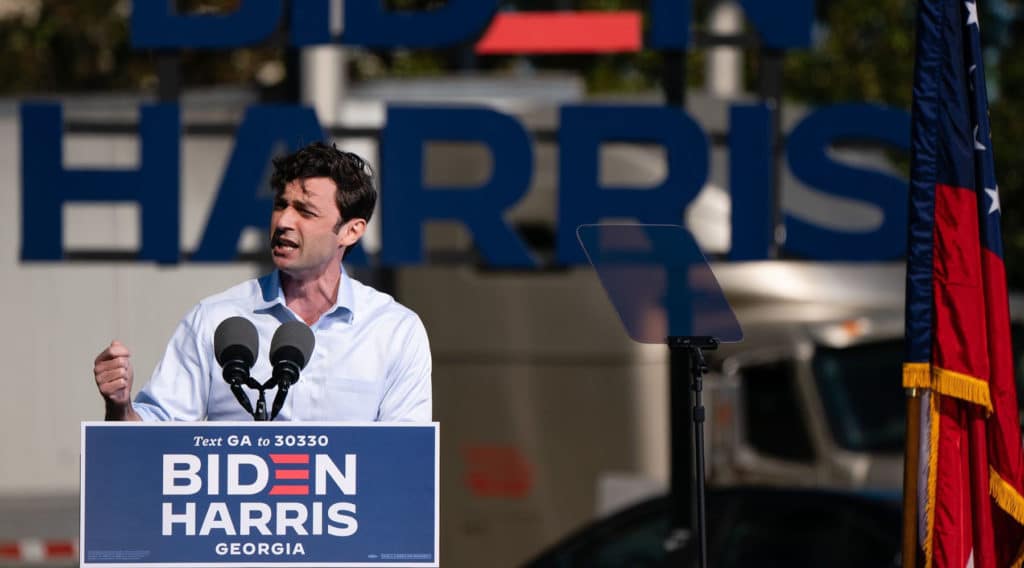
In Georgia, Jon Ossoff’s Senate Bid Goes to a January Runoff Election

(JTA) — Jon Ossoff, the Jewish Georgia Democrat running for the US Senate, gets another chance to unseat Republican incumbent Sen. David Perdue in a runoff.

Neither nominee in Tuesday’s election met the 50% threshold that under Georgia law would have won him the election outright. The runoff election will take place on Jan. 5. The most recent count has Perdue at 49.8% and Ossoff at 47.8%. A Libertarian candidate in the race held the rest of the votes.

The race until now was marred by accusations of bigotry against Perdue’s campaign, including an ad that digitally manipulated Ossoff’s nose to make it look longer. Ossoff raised the ad, which Perdue had taken down, in a contentious debate.

Also headed for a Georgia runoff is a separate special election for the Senate, pitting incumbent Sen. Kelly Loeffler, a Republican business owner whom Georgia’s governor named to the seat earlier this year after a longtime senator retired because of illness, against Raphael Warnock, a Black Atlanta pastor. Warnock is the spiritual leader of the Ebenezer Baptist Church, which Marin Luther King Jr. helped helm until his 1968 assassination.

Georgia’s Democrats are energized by the surprise win in their state of Democratic presidential nominee Joe Biden, who appears likely to win the presidency. Wins by Ossoff and Warnock, coupled with a decision in favor of the Biden-Kamala Harris ticket, would hand the Senate to Democratic control, and both races are set to attract a lot of attention and a lot of money.

In Georgia, Jon Ossoff’s Senate Bid Goes to a January Runoff Election Read More »

Jewish Trump Voters: More About Israel Than About Religion

Counting and debating the Jewish vote in the American presidential election is a somewhat silly — yet persistent — exercise in which I participated more than once or twice (I even wrote a short book about it). Does it really matter whether the exact share of Jews who voted for Trump is 20% or 30%? Is it surprising that a J-Street poll says 20 and a Republican Jewish Coalition (RJC) poll says 30?

In Florida, close to half of all Jews voted for Trump, according to the exit polls. Jews comprised 5% of the total vote cast in the state, which means that 20% more Jews for Trump in 2020 could mean about 1% of the total. That’s not insignificant in a close race. It is still not the reason Trump ended up triumphant in Florida. In other states with large Jewish communities, such as New York, the significance of the vote share is even lower.

Different polls of Jews have different methodologies and definitions of Jewishness, which can easily explain certain gaps between them. Just the other day, I wrote about the fascinating alliance between Orthodox Jews and the Trump movement. What the numbers in all of the new polls show could lead to another important and surprising conclusion: the gap between Democratic-leaning Jews and Republican-leaning Jews is, in many cases, about Israel. And that’s a serious gap that seems to deepen with time. As Jonathan Tobin wrote a few days ago: “People can agree to disagree about policy choices. However, the gap between thinking someone is akin to Joseph Goebbels (as Biden termed him in an interview) and believing Trump to be a righteous gentile is a clash of worldviews, not a polite disagreement.”

Take, for example, question eight in the RJC survey: “which issue would you say most impacted who you decided to vote for?” Twenty-three percent of Jewish Trump voters said Israel was the issue that “most impacted” their vote. Point eight percent of Biden Jewish voters said the same. Is this just a coincidence, based on the fact that Orthodox voters (who tilted heavily towards Trump) are more inclined to consider Israel an important matter? Not really. Look at this graph. It tells you that Israel matters more than the religious stream. In fact, Conservative and Reform Jews who voted for Trump prioritize Israel in a share similar to the Orthodox.

And here is a similar finding from the J Street poll. The question is: “Below is a list of issues facing our country today. Please mark which TWO of these issues were the most important for you in deciding your vote in the Presidential election between Joe Biden and Donald Trump.” In total, 5% of Jews marked Israel as one of the top two issues. Of those voting for Biden, it was 1%. Of those voting for Trump, it was 97%. Of non-Orthodox Jews who voted for Trump, it was 95%. Almost as high as for Orthodox Trump voters.

Of course, there is a huge gap between Orthodox and non-Orthodox Jews over matters related to Israel. Here is one example from the J Street survey: support for a J Street-designed final status agreement between Israel and the Palestinians.

The authors of the J Street poll presented a final status formula for the “conflict” and asked Jews whether they’d support such a solution. It includes a demilitarized Palestinian state in the West Bank and Gaza, internationally recognized borders based on the 1967 line with land swaps, and more. All in all, 75% of U.S. Jews would support such a convenient agreement (which Israelis and Palestinians tend to reject). In the graph below, you can see that Trump voters tend to oppose the proposal and Orthodox voters even more so.

But notice the last column of the graph. There is a clear similarity between those who said Israel is a key factor in their vote and those who voted for Trump. In both cases, the share of support for a final status agreement is about half and half. Among non-Orthodox Jews who prioritize Israel, 40% oppose the final status proposal — making it seem that prioritization of Israel means more than denomination, not just when it comes to voting but also when it comes to political views of Israel-related matters.

Jewish Trump Voters: More About Israel Than About Religion Read More »

University Synagogue, Wilshire Boulevard Temple Announce a Merger

The University Synagogue Board of Trustees and the Wilshire Boulevard Temple (WBT) Board of Trustees have made the decision to merge the Los Angeles congregations into one in a preliminary agreement announced November 6.

This expansion plan will create a future Reform Jewish synagogue at the current University Synagogue location in Brentwood, which will take on the new name the Wilshire Boulevard Temple University Campus. The Erika J. Glazer Family Campus and Irmas Campus will still remain in use.

Both congregations share a long, proud history and a deep commitment to Reform Judaism and Tikkun Olam. Between the two congregations, they serve more than 2700 family units.

According to spokespeople at WBT and University Synagogue, both synagogues communicated the news of this preliminary agreement to their respective communities on the evening of November 5.

Following the merger, and once donations are secured, the University Campus will “undergo significant renovation to enable members of both synagogues to worship and celebrate together for generations to come,” a statement sent to the Journal said.

Spokespeople also told the Journal that “all University Synagogue staff and clergy contracts will be honored and virtually all staff will be integrated into Wilshire Boulevard Temple’s administrative structure.”

WBT Rabbi Steve Leder told the Journal that over the past several months he has been impressed and grateful for the University Synagogue’s leadership. He also said he feels optimistic about the possibilities.

“Between our two communities which will become one community, we will have the physical space and spiritual wherewithal to create a vibrant center for Jewish life from the 405 to the ocean,” Leder told the Journal via email. “I am particularly keen on filling the early childhood center and religious school to capacity so that over the coming years we have hundreds more families with young children learning to love the Torah and their synagogue.”

“Between our two communities which will become one community, we will have the physical space and spiritual wherewithal to create a vibrant center for Jewish life from the 405 to the ocean.” — Rabbi Steve Leder

Leder noted that WBT currently has to turn Early Childhood Center families away from the West Side Irmas Campus due to licensing limits. “Now,” he added “we will be able to keep many more of those families engaged in Jewish life. Through this merger, everyone wins.”

Discussions about the merger began in April, when the University Synagogue Board of Trustees appointed multiple committees to explore options with three goals in mind: preserving the traditional values and practices of the University Synagogue community, retaining employment for staff and clergy, and restoring vibrancy to the community. They added that after months of exploration, it was determined that a merger with Wilshire Boulevard Temple provided a “historic opportunity to promote Reform Judaism on the Westside of Los Angeles while maintaining the familiar Sunset Boulevard building that holds so many memories for congregants.”

Synagogue communication spokespeople added “while the coronavirus pandemic is not responsible for University Synagogue’s current situation, it has magnified problems and accelerated the need for action.”

The combined congregation will serve the growing Reform movement on the West Side and will provide resources for worship and celebrations, as well as expanding preschool, religious school, youth events, and adult programs.

Leder added that the Irmas Campus is “inadequate for our needs,” with limited space for classrooms or adult programs and parking. He noted that the University Campus allows for both congregations to grow while building on its sanctuary and small chapel. “We will use every inch of the University Campus to engage more people and bring more Jewish content and community to all,” he said.

University Synagogue Co-Presidents Fern Topas Salka and Jennifer Haarmann told the Journal in a statement, “This is an exciting new chapter in the history of our congregation that will allow us to remain in our building, make long overdue renovations, benefit from Wilshire Boulevard Temple’s extensive resources and continue to worship and celebrate together as a synagogue family for generations to come.”

The merger is scheduled for the first quarter of 2021. They are waiting for pending approval by a University Synagogue congregational vote, which is set to take place in coming weeks, in addition to California Attorney General approval.

University Synagogue, Wilshire Boulevard Temple Announce a Merger Read More »