fbpx

October 23, 2020

Jewish Organization Sharsheret Helps Women with Breast and Ovarian Cancer During Pandemic

October is National Breast Cancer Awareness Month and despite the COVID-19 pandemic, it’s still important for women to maintain their annual OB-GYN appointments and mammograms. To help answer the myriad questions, should you be diagnosed with breast or ovarian cancer, the Jewish nonprofit Sharsheret is on hand to help.

Sharsheret (chain in Hebrew), has been providing breast and ovarian cancer support and resources for women and families since 2001. And now, during the pandemic, the organization has been more vigilant in ensuring patients feel comfortable and able to make important decisions about their health.

CEO Elana Silber told the Journal that Sharsheret offers a link for women during this challenging time in their lives, allowing them to share their experiences and lean on each other for support.

Silber, who has an MBA in health care, became involved with Sharsheret in 2002 after seeing founder Rochelle Shoretz, speak at her local synagogue in New Jersey.

Shoretz founded Sharsheret after being diagnosed with breast cancer at the age of 28. While her local Jewish community provided support, all Shoretz wanted was another Jewish mom to talk to about all her concerns, including what to tell her two young children. After finding another mother going through the same struggles, she set out to find more, including Silber and current national advisory board member Courtney Mizel.

“Rochelle said, ‘I can’t do this alone will you help?’” Silber said. “We were getting a thousand calls. I stayed on as a volunteer, then became program coordinator. In 2015, Rochelle was living with metastatic breast cancer and passed away. Ever since then, I took on the CEO position. Her legacy [was her] two [little] boys who are now adults — and Sharsheret. I never left. I am compelled to stay because of the mission and the tribute to the founder, and the incredible people we are working with.”

Sharsheret continues to provide educational and emotional support and social work resources for breast and ovarian cancer to more than 65,000 Jewish women, families, healthcare professionals and students. Thousands of women participate in its national peer support network and thousands more have participated in its education and outreach programs.

Sharsheret continues to provide educational and emotional support and social work resources for breast and ovarian cancer to more than 65,000 Jewish women, families, healthcare professionals and students.

Mizel was introduced to Sharsheret in 2009 after she was diagnosed with breast cancer. She had also recently undergone a double mastectomy. Mizel, who was mom to two young children (3 and 4 at the time) and was in the process of a divorce, was overwhelmed. Then she received a Busy Box—a Sharsheret service that customizes a box of age-appropriate activities and books for children whose mothers are undergoing cancer treatment.

“That box gave me something to do when I was unable to get out of bed… to really engage with my kids,” Mizel said. “These amazing books served as resources to be able to talk to my kids about breast cancer as well as follow up information about every part of life.”

Due to the pandemic, Sharsheret events have been put on hold, but Silber and Mizel said their virtual presence is more active than ever.

On their website you can find virtual Busy Box activities including webinars featuring medical professionals, social workers, in-house genetic counselors and members of the Sharsheret team to speak with. They also offer other virtual resources so women feel connected as well as  24/7 live chat. Regardless the time zone, support is always offered.

“Women were concerned about what they could do for treatment,” Silber said. “If they postponed [due to the pandemic] would their outcomes be worse? We immediately got oncologists to go on one of our webinars—we had about 800 people who registered for the first one — and they could ask their questions. Now we are at the point where medical centers are taking every precaution into consideration. We are sending the message with the medical community: do not delay your appointment.”

Silber added Sharsheret has provided a list of questions to ask doctors before confirming appointments. She noted they are receiving more calls from women during chemotherapy treatment so they don’t feel alone. “We spoke to [women] on the phone [during treatment], giving them encouragement, meditation, something to listen to, because anyone who brings them has to wait outside,” she said.

Mizel said another of Sharsheret’s key components  is their attention to resources for the families and caregivers. “They recognize the importance of being there for the families [even if they can’t physically be with them]. We encourage self-care for the caregiver and identify ways [they] can be better for the woman in their lives touched with cancer.”

Today, Mizel and her daughters devote their time and energy to making Sharsheret stronger. Mizel is part of Sharsheret’s California Community Advisory Committee, and was previously its Chair.

Sharsheret has peer supporters all over the country, Israel, Canada and the United Kingdom. In California alone the organization has peer supporters in more than 60 cities and has partnered with 13 local organizations including UCLA Health, Cedars-Sinai Medical Center, UCLA Santa Monica Breast Center and Pancreatic Cancer Action Network.

The organization also received awards for its research. In 2005 they were named a recipient of the New York State Innovation in Breast Cancer Early Detection and Research Award, and in 2012 they were selected as a member of the LIVESTRONG Young Adult Alliance. In addition, in 2011 Sharsheret received a seat on the Federal Advisory Committee on Breast Cancer in Young Women under the auspices of the Federal Centers for Disease Control and Prevention (CDC).

Silber said one in 40 Ashkenazi Jews carries the BRCA gene mutation that increases the risk for breast cancer and ovarian cancer. This makes Jewish families significantly more susceptible to hereditary breast cancer and ovarian cancer. According to their website, “Sephardic Jews may also be genetically predisposed to hereditary breast and ovarian cancer, but their risk to carry a BRCA mutation has not been identified to be as high as the risk for Ashkenazi Jews.” In addition, 2.5 million women live with breast cancer with more than 250,000 women age 40 and under living with breast cancer in the United States.

one in 40 Ashkenazi Jews carries the BRCA gene mutation that increases the risk for breast cancer and ovarian cancer. This makes Jewish families significantly more susceptible to hereditary breast cancer and ovarian cancer.

“More people are getting tested [for BRCA 1 and 2 genes], but what you do with that test, information and when you do it for your children is something that is really challenging,” Mizel said. “Being able to have that discussion with someone at Sharsheret, who can support you through all those things [is] really important.”

Silber said it’s essential for women to get tested early because both breast and ovarian cancer can be cured if they are diagnosed early. Sharsheret helps all Jewish and non-Jewish women figure out what team of doctors they will need as well as providing referrals for doctors in the patient’s area.

Mizel said while breast cancer education has improved over the last 10 years, Sharsheret continues to debunk misconceptions about breast and ovarian cancer.

“[People] don’t know that that the BRCA gene can be passed down through the father” Mizel said. “For me and my conversations, that is the number one thing that comes up.”

“The second thing people are thinking is that if they test BRCA negative it’s the end of the story,” Silber added. “It’s not. We still encourage you to call your doctor and call Sharsheret because there are still things you need to do. We aren’t doing it to scare you. There’s too much information out there. You need to have someone who can channel that and quiet it down a little bit. Sharsheret, with your medical team, is a recipe for success.”

For more information on Sharsheret or how to get involved, or donate, visit their website.

Jewish Organization Sharsheret Helps Women with Breast and Ovarian Cancer During Pandemic Read More »

Seth Rogen, Jonah Hill, Judd Apatow to Host ‘Superbad’ Reunion and Watch Party as Democrat Fundraiser

The cast “Superbad” will reunite virtually on Oct. 27 for a livestream of the movie, with actors Seth Rogen, Jonah Hill, Michael Cera, Christopher Mintz-Plasse, Bill Hader, Martha MacIssac, director Greg Mottola, and producer Judd Apatow providing jokes and commentary to raise funds for the Democratic Party of Wisconsin.

“We are thrilled to have the cast of Superbad join us in the fight to defeat our super awful president,” said Democratic Party of Wisconsin Chair Ben Wikler. “With the help of our talented guests, we know that we can win this election for Wisconsin and for the country. Laugh with us as we raise the funds and mobilize the volunteers. We need to finish this race strong.”

A donation of any amount will give you access to the event. Sign up here.

Seth Rogen, Jonah Hill, Judd Apatow to Host ‘Superbad’ Reunion and Watch Party as Democrat Fundraiser Read More »

U.S. and Bahrain Agree to MOU Saying Anti-Zionism is Anti-Semitism

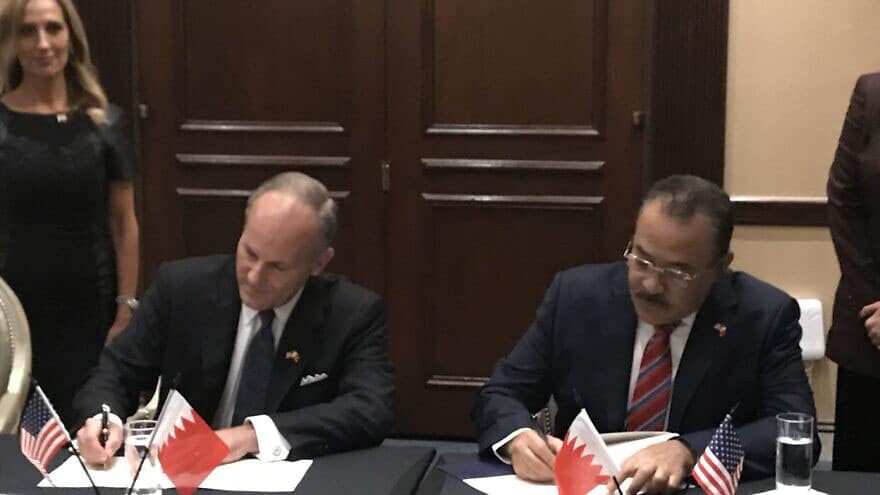
On October 23, the United States and Bahrain signed a memorandum of understanding (MOU) that included a statement about anti-Zionism being anti-Semitism.

The MOU stated that both the U.S. and Bahrain will work to combat anti-Semitism in the Middle East and will use the International Holocaust Remembrance Alliance definition of anti-Semitism, which refers the demonization and delegitimization of Israel as anti-Semitic.

The MOU also stated that the two countries will fight “all forms of anti-Semitism, including anti-Zionism and the delegitimization of the State of Israel.”

Special Envoy to Monitor and Combat Anti-Semitism Elan Carr, who was one of the signatories of the MOU, tweeted thanks to Bahrain King Hamad bin Issa Al-Khalifa as well as President Donald Trump and Secretary of State Mike Pompeo “for leading us to a new Middle East!”

Jewish groups praised the MOU.

“We thank U.S. Envoy Elan Carr (@USEAntiSemitism) for his leadership in the fight against global anti-Semitism,” the American Jewish Committee tweeted.

“Amazing achievement!” the Simon Wiesenthal Center tweeted. “SWC proud to partner with #Bahrain and State Department as we pursue true peace among all nations.”

The MOU with Bahrain comes the same day as Israel and Sudan agreed to normalize ties with each other. As part of the agreement, Sudan designated Hezbollah as a terror organization.

U.S. and Bahrain Agree to MOU Saying Anti-Zionism is Anti-Semitism Read More »

Israeli Arabs Remain Divided Over Normalization Deals with Gulf States

The Joint Arab List was alone in voting against the normalization deal with the United Arab Emirates in the Knesset, upsetting many Israeli Arabs that welcomed a move that is likely to become a key economic, education and tourism opportunity for the community.

The vote last week in the Knesset was 80 in favor and 13 against the agreement.

Shaheen Sarsur, who has been involved in Arab politics for more than 12 years and served as a parliamentary consultant for three previous Knesset members—the most recent being Talab Abu Arar of the United Arab List (Ra’am)—said the move by the Joint List was “not wise since it always presents itself as supporting peace so this seems like a double standard.”

“Peace is good, even if it does not deal directly with the Palestinians,” he said, adding that he doubts the Arab public supports the decisions by the Joint List to vote against the normalization agreement.

“Many Israeli Arabs will travel to the UAE and Bahrain, just like they travel to Turkey, and so if the Joint List members are against peace, then they shouldn’t later take advantage of it and travel to these countries like we know will occur,” said Sarsur.

Ghada Zoabi, founder and CEO of the Israeli-Arab news portal Bokra.net and a board member in the UAE-Israel Business Council, told JNS that the council started a few months ago, and that many Israeli Arabs support the normalization agreement and see opportunities for travel, business, education and more.

“The peace deal will positively affect the entire region, and Israeli Arabs that have family members there will more easily connect with them and study there just as some study now in Jordan,” said Zoabi.

The agreement acts “as a bridge for Israeli Arabs,” she added.

An estimated 1.9 million (20 percent) of Israel’s population is Arab, and prior to the latest deals, the only Arab countries open to them were Egypt, a popular tourist destination, and Jordan, where many attend college. Arab Israelis also travel to Saudi Arabia for the Haj pilgrimage, commuting through Jordan or another country since there are no direct flights from Israel.

Regarding opposition by Israeli-Arab parties in the Joint List, Zoabi said political leaders have their own personal interests and desire to make headlines.

“Most Israeli Arabs want a peace agreement between Israel and the Palestinians,” she said. “Forming other peace agreements with Arab states can’t hurt, and Arabs see the new opportunities created by this agreement.”

“The Joint List is acting like the Palestinian Authority in rejecting the deal, when, in fact, it will help Arabs in Israel and the Palestinian territories,” she continued, adding that in the case of the Joint List, they should not have come out publicly against the deal.

“Many Israeli-Arab businessmen were upset with the position because it only hurts their desire for business ties with Gulf states,” asserted Zoabi.

In fact, Zoabi claimed that many Israeli Arabs supported them in the last elections because they wanted to oust the right-wing government led by Prime Minister Benjamin Netanyahu, not because they necessarily support the entire Joint List agenda.

Zoabi revealed that some Arab Knesset members quietly support the UAE and Bahrain agreements, but were forced to vote against them and follow the Joint List leadership.

‘People-to-people relations is key to peace’

The UAE-Israel Business Council states on its website that it aims “to build mutually beneficial relationships between Emiratis and Israelis that advance business ties, investment and understanding.”

Zoabi said the council seeks to facilitate and connect between business entities in both countries, as well as in Israel based on cooperation between Jews and Israeli Arabs.

She pointed out other key figures on the council, such as Jerusalem Deputy Mayor Fleur Hassan-Nahoum and founding member Asher Fredman.

A founding member of the UAE-Israel Business Council and the Israeli-Emirati Forum, Fredman was on his way to the UAE on Tuesday evening and told JNS that “building people-to-people relations is the key to peace.”

Fredman, who also is a research fellow at the Kohelet Policy Forum, added that “the reception from the other side has been so warm and with such interest, respect and desire to build relations in various fields.”

Israeli Arabs Remain Divided Over Normalization Deals with Gulf States Read More »

Voting is Holy: A Reflection and a Prayer

A Reflection:

Life’s paradox and promise:

continuity across time,

minute modifications day by day,

as living things reinvent themselves

in a flow

that shifts caterpillars into butterflies

tadpoles into leaping frogs. …


… and monarchies into democracies.


We come together to reinvent ourselves

through debate, deliberation,

a welter of personalities and issues,

of interests and of values.


The promise of elections is precious yet fragile:

The capacity to shape our future

to redefine ourselves and expand our capacity

as a people,

this is the miracle of the vote.


But only if we show up.

Only if we rise on the shoulders

of the suffragettes who marched for this right,

of African Americans who were beaten and burned,

of immigrants who lined up for hours to leave their mark.


We owe it to those who came before us,

and to our children’s children.


Casting a vote is a sacred deed:

an expression of faith in tomorrow,

in our neighbors’ humanity,

God’s image in us all.


A Prayer Before Voting:  

Holy One of Blessing, grant us the perspective to cast our ballots wisely.

  • Expand our vision to meet the needs of all, rather than to shore up our own self interest.
  • Grant us wisdom to steward the planet, the land, and life, rather than to perpetuate the short-term plunder that recklessly endangers humanity and Creation.
  • Fortify your teaching that all people reflect the Divine image, and that we are commanded to maintain one law for ourselves and for each other.

May this vote implement democracy’s invitation to equality under law, with opportunity for all to thrive. May our vote advance Your vision of beloved community, flowing with your gifts of justice, compassion, and peace. May it be Your will, and let us say, Amen.


Rabbi Dr Bradley Shavit Artson (www.bradartson.com) holds the Abner and Roslyn Goldstine Dean’s Chair of the Ziegler School of Rabbinic Studies and is Vice President of American Jewish University in Los Angeles. A member of the Philosophy Department, he is particularly interested in theology, ethics, and the integration of science and religion. He is also dean of the Zacharias Frankel College in Potsdam, Germany, ordaining Conservative rabbis for Europe.

Voting is Holy: A Reflection and a Prayer Read More »

Yitzhak Rabin Miniseries ‘The Leader’ in the Works

Former Israeli Prime Minister Yitzhak Rabin, who was assassinated in 1995, will be the subject of a six-part miniseries called “The Leader” from L.A.-based Israeli filmmaker Ariel Vroman (“The Iceman”). It’s based on the book “The Rabin Memoirs” by Rabin and Dov Goldstein and additional archival interviews and footage, courtesy of The Rabin Center and the Rabin family.

Written and directed by Vromen, the in-depth portrait will trace Rabin’s life and journey from soldier to statesman, with each episode focusing on a key moment in his career and the decisions and heightened drama behind it.

“It is an amazing story about a guy that was born in Israel who through his lifetime sacrificed everything he had and went on an amazing journey,” Vromen, who once lived on the same street as Rabin, told Deadline.

Rabin’s grandson Jonathan Benartzi approached Vromen about the project on behalf of his family. “For the first time in 25 years, our family has allowed access to private materials and family collections so that we’ll finally be able to dispel the myths and present an authentic, in-depth picture of this very exceptional man,” he said.

“I’m very honored and grateful to have the opportunity to tell the untold story of a man I’ve admired all my life,” Vromen added. “I want to thank the Rabin family for trusting in me to shed new light on the life and times of a truly legendary leader.”

No casting has yet been announced.

Yitzhak Rabin Miniseries ‘The Leader’ in the Works Read More »

Report: Anti-Semitic Hate Crimes Rose 18% in LA County

The Los Angeles County Commission on Human Rights released a report on October 23 detailing how anti-Semitic hate crimes increased by 18% in Los Angeles County from 2018 to 2019.

According to the report, the number of anti-Semitic hate crimes in the county in 2019 was 93; in 2018, that number was 79. The report noted that the 93 instances is the largest number of anti-Semitic hate crimes that the county has recorded since 2009.

“This increase was mirrored by a national 2019 Audit of Anti-Semitic Incidents issued by the Anti-Defamation League (ADL),” the report stated. “The study found that the number of anti-Semitic incidents in 2019 (both hate crimes and non-criminal hate incidents) increased 12% percent compared to the previous year. That included a 56% increase in the number of assaults and 5 fatalities, including a white supremacist shooting at a Chabad center in Poway, California that took the life of a 60 year-old woman and wounded two others.”

Additionally, white supremacist-induced hate crimes increased 38% in the county, from 84 instances in 2018 to 116 instances in 2019. Fifty-one percent of the victims of white supremacist hate crimes were Jews, 28% were Blacks, and 6% were Latino.

Additionally, white supremacist-induced hate crimes increased 38% in the county.

Some of the anti-Semitic hate crimes that occurred in LA county in 2019 included an assailant shouting, “F— Jews!” as he robbed an individual in April 2019 and the welcome sign of a Northridge synagogue being vandalized with graffiti stating, “6 million was not enough” in September 2019, according to the ADL.

Los Angeles Jewish groups called the report “troubling.”

“Of particular concern was that religious-based hate crimes increased by 11 percent, with those targeting the Jewish community increasing 18 percent,” ADL Los Angeles Regional Director Jeffrey Abrams said in a statement. “These crimes are always the majority of religious-based hate crimes and this year, at 89 percent, was no exception.”

American Jewish Committee Los Angeles Regional Director Richard S. Hirschhaut similarly said in a statement, “The LA County Hate Crime Report is a troubling barometer of the climate of intolerance in our community and society. That the number of bias-motivated incidents remained constant in 2019 reveals a coarseness and incivility in our culture, too often fueled by divisive rhetoric, in which bigots and extremists believe they can act with impunity. Behind every incident of hate lies an individual or institution that represents a larger and often vulnerable community. And while this report only covers 2019, we already know the corrosive effects of the bigotry that has spiked during the COVID-19 pandemic.

“It is incumbent upon the apparatus of civil society — law enforcement, public officials, and community leaders alike — to redouble our efforts to address this scourge, especially during this period of national introspection about the kind of society we hope to become.”

Report: Anti-Semitic Hate Crimes Rose 18% in LA County Read More »

In a Striking Move, State Department Plans to Label 3 Large Human Rights Groups as Anti-Semitic

WASHINGTON (JTA) — In an unusual move, the State Department is planning to formally identify three large international human rights organizations as anti-Semitic, citing disputed aspects of the groups’ agendas.

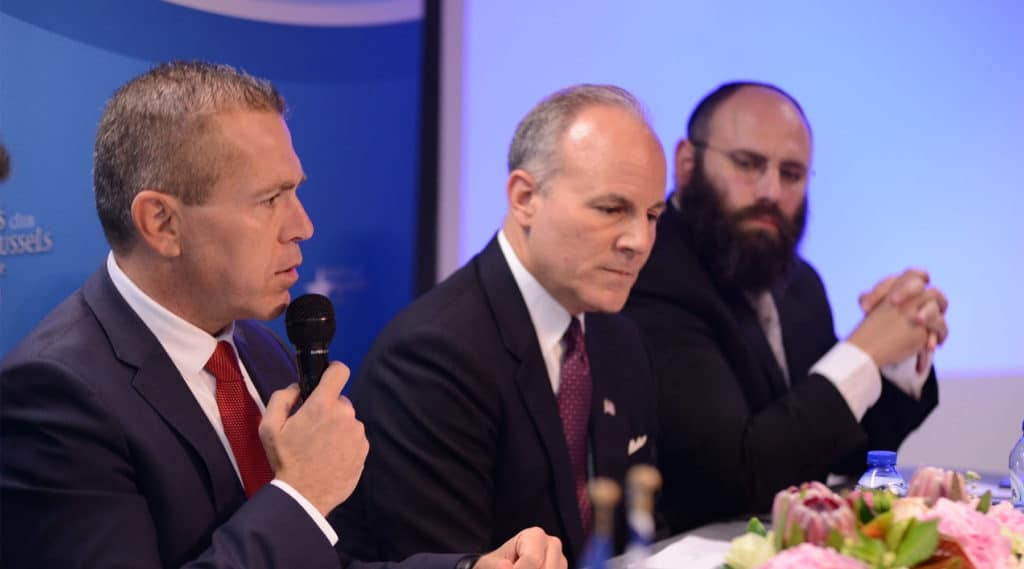
Elan Carr, the department’s anti-Semitism monitor, is planning to release a statement calling on governments not to support Human Rights Watch, Amnesty International and Oxfam, congressional sources told the Jewish Telegraphic Agency.

The planned statement was first reported by Politico on Wednesday, just as as the State Department began a two-day conference on anti-Semitism that featured Secretary of State Mike Pompeo, Israeli Prime Minister Benjamin Netanyahu and a range of other officials and analysts. The conference, which focused on online hate, emphasized anti-Semitism from the left and Islamic terrorists, including anti-Israel activism. Some panelists did discuss far-right anti-Semitism as well.

Politico reported that the statement will cite analysis by some pro-Israel groups concluding that the human rights groups back the boycott, divestment and sanctions movement targeting Israel.

The groups say they do not support or oppose BDS, but they are sharply critical of Israel’s settlements in the West Bank. According to Politico, the West Bank issue would also feature in the State Department statement.

“The criteria they seem to be using are preposterous and we hope they will come to their senses and withdraw it,” Eric Goldstein, the deputy director for Human Rights Watch’s Middle East and North Africa region, told JTA. “Calling them anti-Semitic would invite repressive regimes around the world to dismiss human rights organizations on this basis and that would actually be counterproductive to the cause of human rights.”

Goldstein said Israel’s settlements were a natural target for criticism by human rights groups. He affirmed that his group backed a U.N. registry of companies that do business with settlements, an initiative aimed at allowing consumers to decide whether they want to buy settlement-made products.

“We have a responsibility to not associate with human rights abuses inherent in settlements,” Goldstein said.

The three groups in question rate governments on an array of human rights issues, among them speech freedoms and the treatment of captives, minorities and political dissenters. Their assessments are based on first-hand investigations and reports from people on the ground.

It’s not clear what the effect of the designation, which is unprecedented, would be. The groups do not receive U.S. funding.

Rabbi Jill Jacobs, who heads T’ruah, a liberal rabbinic human rights group, said diminishing the influence of human rights watchdogs was counterproductive.

“They hold Israel to human rights standards, as well as Hamas and the Palestinian Authority,” she said in an interview. “They report on abuses in ways that Palestinians living in those places cannot.”

The Anti-Defamation League also criticized the planned statement as a move that “would politicize the fight against antisemitism.”

“We strongly believe that these organizations are crucial to ensuring robust civil society and democratic protections worldwide,” the ADL said, adding that has had “significant disagreement” with the three groups on Israel policy. It added that calling the groups anti-Semitic “is neither accurate nor helpful to the fight against antisemitism.”

Rep. Andy Levin, the Jewish Democrat from Michigan, appealed on Twitter to the State Department not to release the statement as described in Politico.

The groups “do essential, often dangerous work to protect human rights,” he said. “I know because I worked for one of them. Criticizing Israel’s policies is not anti-Semitism. I know because I do so out of love for a country I want to thrive.”

Levin, a human and labor rights advocate before his 2018 election, once worked for Human Rights Watch.

The State Department anti-Semitism conference on Wednesday, in the vein of previous discussions of anti-Semitism by the administration, focused on anti-Semitism from the left and from militant Islamist groups. True to its theme, many speakers talked about the proliferation of hate online and how to combat it.

No sessions focused primarily on white supremacist groups, which the Department of Homeland Security recently called the “most persistent and lethal” terror threat in the country and which have organized online in recent years. Rep. David Cicilline, a Jewish Democrat from Rhode Island, last week urged Pompeo to include sessions in the conference focused on far-right anti-Semitic groups that back Trump.

Notably, the ADL, the most prominent Jewish organization combating anti-Semitism, was not included among the speakers. Another anti-Semitism watchdog that has been less critical of Trump, the Simon Wiesenthal Center, was included, as were other pro-Israel organizations.

But officials, including Netanyahu and others, did mention neo-Nazis among the dangerous groups facing the Jewish people. Some criticized anti-Semitic invective directed at the billionaire progressive philanthropist George Soros, though at least one speaker, Deputy Attorney General Jeffrey Rosen, pushed back on the notion that criticism of Soros is anti-Semitic.

“Contemporary anti-Semitism feeds off its more traditional precursors, often focusing on the state of Israel, which for the modern anti-Semite is the manifestation of the collective Jew,” Netanyahu said. “Today people with opposing political agendas can nevertheless find themselves united in hatred for Israel and the Jewish people. The neo-Nazi, the ultra-left revolutionary, the Islamist militant might agree about nothing else, but they all do share a common hatred towards us and that hate is awash across the internet.”

In a Striking Move, State Department Plans to Label 3 Large Human Rights Groups as Anti-Semitic Read More »

A Moment in Time: The Ten Qualities I Expect in my President

Dear all,
Earlier this week, Ron and I sat down to cast our votes in the upcoming election. While we poured over the many propositions and judicial seats, it only took a moment in time to fill out our choice for President. Why? It comes down to the ten qualities I expect in my President:
  1. Character
  2. Integrity
  3. Humility
  4. Accountability
  5. Love for Israel
  6. Ability to unite
  7. Exemplar of decent behavior
  8. Ability to be guided by principles
  9. Insight to appoint wise justices to the Supreme Court
  10. Understanding that our country is strongest when those with the weakest voice also have a place at the table
No one person will have all ten. But I still expect the person who leads our country to strive for these.
I think of the words of George Washington Carver, “How far you go in life depends on your being tender with the young, compassionate with the aged, sympathetic with the striving, and tolerant of the weak and the strong. Because someday in life you will have been all of these.”
With love and shalom,
Rabbi Zach Shapiro

A Moment in Time: The Ten Qualities I Expect in my President Read More »

Amid Middle East Peace Deals, Israel and the US Reassert Commitment to Israel’s ‘Qualitative Military Edge’

(JTA) — The United States’ commitment to Israel’s “qualitative military edge” — or having the strongest armed forces in the Middle East — is longstanding and baked into the countries’ relationship, and into US law.

But the Pentagon’s proposed sale of advanced combat aircraft to the United Arab Emirates has stirred concerns among supporters of Israel that that commitment could be at risk.

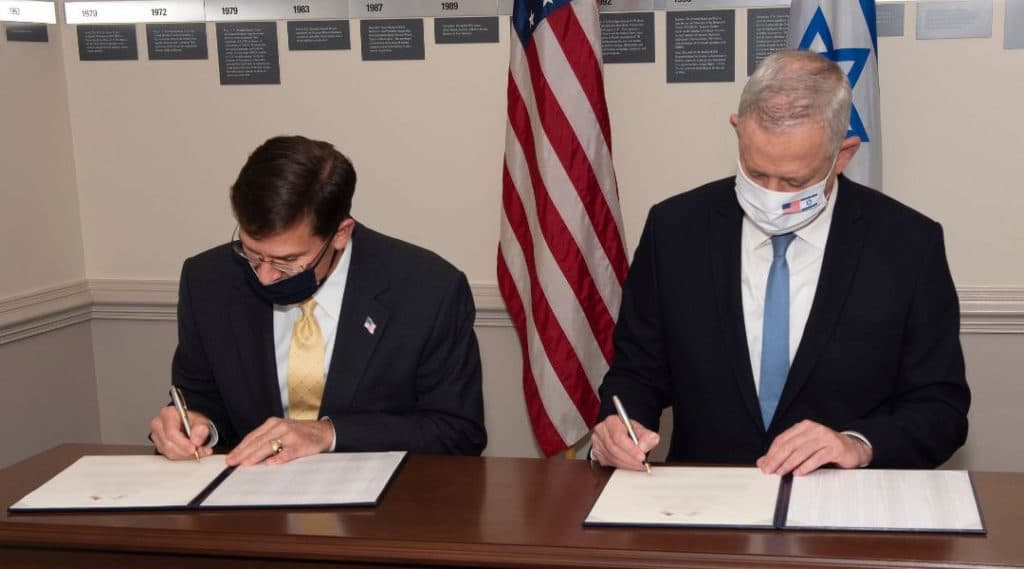
So it was significant that Israeli Defense Minister Benny Gantz and Mike Esper, the US secretary of defense, on Thursday reasserted the United States’ commitment to maintaining Israel’s edge in a declaration signed jointly Thursday in Washington, D.C.

Gantz and Esper posed for photos after signing the declaration, and in his remarks, Gantz alluded to the underlying reason for the appearance: Israel is opposed to the sale of F-35 stealth fighters to the United Arab Emirates, even though the Trump administration brokered a normalization deal last month between the two countries.

Israeli leaders are seeking affirmations that if the sale goes through, there will be guarantees that the aircraft do not challenge Israel’s regional preeminence. The Trump administration says the UAE needs the planes to deter the enemy the Emirates shares with Israel: Iran.

“Over the last few weeks, you and I led, together with other people, very good and very important discussions that reassure the bipartisan commitment to Israel’s QME,” Gantz said. “I want to thank you and your people, and the American administration, for supporting it. Now that we are entering an era of positive normalization processes in the Middle East, which actually can face an aggressive Iran across the region, this ability of continued cooperation is so very important.”

Democrats in Congress have introduced legislation that would allow Israel a say on the U.S. sale of military hardware to the Middle East.

Consolidation of the normalization deals between Israel and the UAE and Israel and Bahrain, called the Abraham Accords, are continuing apace. Vast majorities of lawmakers in both chambers of Congress have agreed to cosponsor non-binding resolutions praising the deals. The American Israel Public Affairs Committee lobbied for the resolutions.

Direct flights from Israel to both countries have commenced, and there was a direct flight this week from Israel to Sudan, which President Donald Trump has said may be the next country to normalize relations with Israel. The United Arab Emirates and Israel have agreed to allow citizens to fly between their countries without prior visas.

The United Arab Emirates, the United States and Israel jointly announced a plan called the Abraham Fund that would raise $3 billion from the private sector for investment in the Middle East.

On Monday, delegations of top officials from Israel and the United States met in Bahrain to sign joint Israel-Bahrain agreements on economic and trade cooperation, air services, agriculture, telecommunications and postal services, visas, financial services. Bahrain was set Thursday to sign a memorandum of understanding with the United States on combating anti-Semitism.

Amid Middle East Peace Deals, Israel and the US Reassert Commitment to Israel’s ‘Qualitative Military Edge’ Read More »