fbpx

October 16, 2020

david suissa podcast curious times

Pandemic Times Episode 96: Let There Be Darkness and Light

New David Suissa Podcast Every Tuesday and Friday.

Reflections on the first Torah portion of the year, and the pandemic dance between darkness and light.

How do we manage our lives during the coronavirus crisis? How do we keep our sanity? How do we use this quarantine to bring out the best in ourselves? Tune in and share your stories with podcast@jewishjournal.com.

Pandemic Times Episode 96: Let There Be Darkness and Light Read More »

The Highs and Lows of Pandemic Era

Let’s admit it. The coronavirus pandemic can drive us crazy. It makes us see things we never thought we’d see. We are living in surreal times, which can bring out the ugliest or the most beautiful scenes.

I saw both examples this week in news items from Israel.

The first was a violent confrontation at a wedding reception. Apparently, the party was attended by several dozen guests in violation of coronavirus regulations. When the police came to break up the gathering, violence and chaos erupted. There’s a video of the incident that is making the rounds, but I suggest you do not watch it.

People are screaming. A man is lying on the ground with a bloody face. Officers trying to enforce the rules look befuddled but also forceful. Guests are fighting back. They look befuddled and forceful, too.  It’s ugliness all around.

I totally understand that if we want to eradicate this lethal virus, we all must respect the rules. It’s possible that the police went too far. I’m sure there will be an investigation. And if the hosts of the reception violated the rules, they deserved consequences. I get all that.

My point here is more philosophical: This horrible scene would never have happened without the coronavirus. The law enforcement officers who were assigned to break up that wedding celebration surely have attended weddings where they danced in joy. Now they had to break one up. Who would want that job?

The pandemic era is forcing us to see things we never thought we’d see, and to make choices we never thought we’d have to make.

This pandemic era is exposing us to clashing extremities.

But if the pandemic triggers ugly scenes, it can also trigger beautiful ones. On the same day that I read about the wedding fracas, I read about people reaching out to alleviate loneliness among the elderly.

According to a report in JPost, “Approximately 200 employees of Tel Aviv-Yafo Municipality have begun to make phone calls to elderly citizens. The callers check on the elderly person’s well-being and identify any needs resulting from the current lockdown.”

The report continues: “Any details recorded are then transferred to social workers employed by the municipality’s social services department. Workers from all municipal departments are participating in the effort. They have conducted more than 37,000 phone calls to date and receive responses from senior residents, who have often found themselves isolated from family members.”

What I found remarkable about the two stories is that they both originated from the government—in one, law enforcement officers were forced to do ugly work, and in the other, municipality workers were motivated to do beautiful work. It’s tempting to focus on one narrative or the other– either all bad or all good, either all ugly or all beautiful. But we lose something when do that; for one thing, an appreciation for the complexity of humanity and the humbling uncertainty of our times.

This pandemic era is exposing us to clashing extremities. In our own state of dizziness, we must navigate somewhere in the middle, trying as best we can to keep our balance and our sanity.

Shabbat shalom.


The Highs and Lows of Pandemic Era Read More »

Israel and Azerbaijan: Setting the Facts Straight

For several weeks, I have been seeing articles published by the Armenian lobby that make a great attempt to diminish the deep and lasting friendship shared by Israel and Azerbaijan, and to sway readers to believe that Azerbaijan is not a beacon of tolerance, and that the current aggressions by Armenia are anything other than criminal. 

Yet as a lifelong Jewish citizen of Azerbaijan, I know from first hand experience, that the country of my birth and where I have proudly raised two generations of Azerbaijani Jews, is in fact a land built on the pillars of tolerance, acceptance and multicultural harmony for which it has become so famously known. 

Azerbaijan is not a new friend to Israel, or to the Jewish people. Our ties run centuries deep. My hometown of Red Village is the largest all-Jewish town outside of Israel and the U.S. and the last surviving shtetl in Europe. It was enacted centuries ago, when the Jews in surrounding regions faced invasive, antisemetic threats, and the leaders of Azerbaijan dedicated a safe haven to assure our protection. And today, 30,000 Jews representing Ashkenazi, Georgian and our unique Mountain Jewish community, live peacefully in Azerbaijan.

In my capacity as head of the Baku Mountain Jewish Community, I have witnessed first hand the degree of investment and appreciation our government and our national culture has put into celebrating diversity, and honoring our unique traditions as Jews. 

You see this in our beautiful synagogues, built and rebuilt by Azerbaijan’s Government and gifted to our community. You see this in our sprawling orthodox Jewish day school, where some hundreds of students attend. You also see this in our impressive mosques and churches; Orthodox, Catholic, Baptist, and most prominently: Armenian. In Azerbaijan, Armenian residents live in equal peace and prosperity, just like any other citizen, residing in Baku and other major cities. Sadly, this safety and respect afforded to every Armenian residing in Azerbaijan is not even close to be reciprocated in Armenia. There are no Azerbaijanis left in Armenia, after they were all expelled in 1988-1991.

One of Azerbaijan’s most celebrated and dedicated war heroes is a Mountain Jew named Albert Agarunov. He was awarded the country’s highest honor, the title of National Hero, and has had a large avenue in Baku named after him, where the Azerbaijani Government unveiled his statue last year. Albert volunteered to fight with his countrymen, against Armenian invasion, and was known for his tremendous skills and courage, and that he lived and died a life inseparable from his faith – one of courage, justice and compassion. 

The anti-Azerbaijani narrative of the Armenian lobby misses some key factors that help define reality. A major issue is that Armenia has a serious problem with antisemitism, and was actually ranked by the Anti-Defamation League the second most antisemitic nation in Europe and one of the top 3 antisemetic nations in the world outside the Middle East and North Africa. Antisemitism in Armenia is a very old problem, although it has been especially pronounced in the last century, such as when the Armenian Legion of Nazi Wehrmacht helped Nazis. The most revered Armenian national hero, Garegin Nzhdeh, for whom a grand statue was officially raised in 2016 in Armenia’s capital city of Yerevan, was the leader of this Legion and a Nazi collaborator. 

In Azerbaijan, a majority-Muslim nation, we erect a statue to a Jewish National Hero, and in Armenia they erect a statue to a Nazi collaborator!

These are difficult yet significant factors that carry tremendous consequence in determining the viability of relationships. That Armenia spends every penny it has on invading and vilifying Azerbaijan, rather than investing in the incredible opportunities countries like Israel and Azerbaijan focus on, only deepens the divide. 

In Azerbaijan, we are proud of what the UAE and Bahrain have done with Israel, and we applaud this progress with fervor. But it doesn’t make our friendship with Israel irrelevant, quite the contrary, we serve as the exemplar for Muslim nations around the world, especially as they relate to Israel, our key partner in trade, technology, education, international security and diplomacy. Azerbaijan and Israel’s friendship has been deeply ingrained for decades, and will only continue to expand as both nations share the drive and passion for innovation, progress and most importantly peace, values and dreams that are more powerful than any manipulation or attempt to diminish what is inarguably true.

Israel and Azerbaijan: Setting the Facts Straight Read More »

The Bagel Report

Bagels for Bartlet (for America)

With ultra-Orthodox protests against mask-wearing in New York, and election anxiety nationwide, Erin “Snuffy” Ben-Moche and Esther “Gal Gadot” Kustanowitz have a lot on their plate. Finally, Erin (and HBOMax subscribers) received the restaged, “Hartsfield’s Landing” episode of the “West Wing.” The Josiah Bartlet megafan shares her reactions and Esther Debbie Downers it with a dose of realism. Eventually, the Bagels discuss Israeli TV shows like “Tehran” on AppleTV+ and the forthcoming “Valley of Tears” on HBO;the prospect of Wonder-Woman-and-Representative-of-Israel-in-Hollywood Gal Gadot as Cleopatra launches a representation conversation; and why “Shtisel” gets all the love and “Fauda” gets criticised. Plus, our question of the week: “Are you a TV binger, or a series savorer?”. Grab a bag of Twizzlers (or Red Vines, if you must) as the co-hosts revisit the value of weekly episode releases over streaming a series in one sitting.
Helpful Links:
Follow ErinEsther and The Bagel Report on Twitter! 

Bagels for Bartlet (for America) Read More »

A Moment in Time: Eye See!

Dear all,
I saw a reflection of myself in my daughter the other day. It made me think deeply about what it must be like to see the world through the eyes of a baby. There is so much, so much we take for granted on a daily basis, and we often lose sight of the miracles that are occurring at each and every moment in time.
We have a sacred opportunity each day to not just look at the world, but to see it.
What will I see today?
A cloud formation?
A dog wagging its tail?
The note on the homeless person’s sign?
The smile of a neighbor?
The ballot I need to fill out?
The perspective of someone that I don’t usually see eye to eye with?
See it. Absorb it. And make a difference!
With love and shalom,
Rabbi Zach Shapiro

A Moment in Time: Eye See! Read More »

Israel Must Aim for Net-Zero Emissions

One of Israel’s primary goals should be to quit fossil fuels and create an economy with zero emissions by 2050. That is the dominant global trend, and if we do not change our course, we may pay a severe economic price.

Gideon Bachar, ZAVIT* Science and Environment News Agency

Climate and economy are two seemingly separate issues that, in reality, are closely intertwined and, today, have become almost inseparable. The destructive impact of the fossil fuel-powered economy on the global climate, biodiversity, and the natural environment is glaring and demonstrable. Now, the pressure on the Israeli economy to change for the sake of the climate and the environment is growing.

For example, the Convention of Biological Diversity (in which President Reuven Rivlin represented Israel) marks a shift in consciousness among many countries worldwide. This shift was also reflected in a statement by some 80 countries to Reverse Biodiversity Loss – Israel was also among those countries. The voices calling for change are getting louder.

A key step on the path to change is to reach a balance between the rate of greenhouse gas emissions and the rate of their removal from the atmosphere. The Paris Agreement, which Israel has ratified, stipulates that humanity must avoid crossing a 2 degrees Celsius warming threshold, and if possible, not even cross 1.5 degrees.

Crossing these science-based thresholds will cause massive, irreversible, lasting, and powerful changes to the global climate system. It’s important to emphasize that we are very close to crossing the limit of1.5 degrees Celsius. The global temperature has already risen by one degree and possibly even by 1.2 degrees over the last few years.

Towards carbon neutrality

Like every other country in the world, Israel must contribute to the global effort to reduce greenhouse gas emissions and reach a state of net-zero carbon by 2050. However, in Israel, things are happening slowly. Too slow. In government ministries, we talk at best about a “low-carbon economy” – that is, an economy that will reduce its greenhouse gas emissions. This is very different from the global trend towards a “net-zero emissions economy” – an economy that has dramatically reduced its greenhouse gas emissions and aims to remove the excess carbon dioxide from the air, for example, by planting trees and ecological restoration.

Either way, Israel is still light years away from even reaching a low-carbon economy, mainly because of its continued dependence on natural gas. This might impact not only the climate but also the local economy, as the world is steadily and rapidly moving away from fossil fuels (coal, oil, and gas) and towards renewable energies. There is a genuine risk; some may even say certainty that infrastructure and projects based on fossil fuels will turn into white elephants within a few years.

In addition, insisting on holding on to conventional means of energy production and developing projects based on fossil fuels could steer The State of Israel into a very unpleasant economic and political situation in the future: In the face of the climate crisis, the nations of the world will have no choice but to change direction in order to save themselves. The pressure to reduce greenhouse gas emissions will increase immensely and be reflected in political pressures and excruciating foreign trade policies. Polite diplomatic requests to align with the global effort to save the planet will turn into massive political pressure. This will be accompanied by strict economic measures like imposing a carbon tax on products and goods for major export markets in the world.

As a result, for example, the European Union, Israel’s largest and most important trading partner, is already openly declaring its intention to adopt an assertive foreign policy in this area. More countries in the world are expected to join this trend and impose severe economic sanctions on those who do not meet the stringent standards to protect the Earth’s climate. Today, there is a growing list of many dozens of countries that have declared their intention to reach carbon neutrality in the future. Among them are economic giants like Germany, France, Britain, and countries from Latin America and Asia. China has also recently announced a similar target by 2060. This is a historic announcement since China is not only a gigantic economy but also the largest producer of greenhouse gases in the world today.

It is important to understand, this is not a passing fad, but a significant development in international relations, joined by big countries and cities, and large corporations like Nestle, Qantas ) Australia’s biggest airline), and IKEA. The latter pledged to reach net-zero emissions in 2030. Even oil companies like energy-giant TOTAL jumped on the bandwagon. All of these important players in the global economic arena understand that the era of fossil fuels is over and that it is only a matter of a short time until the process is complete.

This development is also evidenced by the meteoric rise in the shares of renewable energy companies and the dramatic decline in the value of shares of obsolete energy companies. The market has already set sail for a new era. Will Israeli decision-makers decide to follow?

About 53 percent of the global economy is currently on track to implement net-zero emissions targets by 2050. Some countries have set an even more ambitious timetable: Bhutan and Suriname have already met the target, Norway will follow in 2030, and Sweden in 2045. It is essential that Israel also recognizes this global trend and prepares for it by making strategic decisions to move towards a zero-emission economy by 2050 and, if possible, even before that. Only this action will prevent significant economic shocks, considerable damage to the economy, and political pressures in the future. Israel must not miss the bus.

The author of this article is the Special Envoy on Climate and Sustainability at the Israel Ministry of Foreign Affairs

ZAVIT* Science and Environment News Agency

Israel Must Aim for Net-Zero Emissions Read More »

Jewish Women’s Theatre Celebrates its Bat Mitzvah with New Virtual Show ‘I Am a Jew’

In celebration of its thirteenth year, Jewish Women’s Theatre/The Braid launches a new salon performance titled “I Am a Jew” on October 18, taking place virtually via Zoom at 11 a.m. PT. The event also celebrates the JWT’s transformation from a local theatre to a national and international voice for Jewish culture. JWT performs in communities across America and recently toured the American South, bringing Jewish culture to cities that lack opportunities to experience Jewish theater. Many works from the company’s archive are now available on the streaming platform ChaiFlicks.

The bat mitzvah will also include a blessing from Rabbi Zoe Klein, plus music, montages, and more.  “I will never forget how two friends and I gathered around my kitchen table in 2008 to discuss the radical idea of creating a theatre to showcase the ideas, themes, and stories of contemporary Jewish women,” Ronda Spinak, JWT’s founding artistic director, said in a statement. “We had no space and no money but were fueled by a bold and worthy mission. We wanted to give voice to today’s creative, talented, and just plain incredible Jewish women, who are often under- or misrepresented by media stereotypes. So we pioneered a new art form at the intersection of theatre and storytelling to do just that.”

We wanted to give voice to today’s creative, talented, and just plain incredible Jewish women, who are often under- or misrepresented by media stereotypes. So we pioneered a new art form at the intersection of theatre and storytelling to do just that.” — Ronda Spinak

To date, JWT has created 60 original shows and presented 675 diverse stories to more than 105,000 delighted patrons.  In partnership with more than 100 interdenominational organizations, it has showcased 345 writers, aged 13 to 98, and graduated 33 emerging artists who participated in a fellowship program designed to foster the next generation of Jewish theatre and arts professionals.  JWT also co-produced Monica Piper’s “Not That Jewish,” which played off-Broadway for 200-plus performances.

In “I Am a Jew,” the Zoom audience will meet an African-American Jew who wonders whether her hair extensions must be removed before she is allowed in the mikvah, even after she has completed six years of study to prepare her for conversion.  A rabbi will tell the story of her difficulty offering spiritual guidance to a congregation who desperately needs it during the coronavirus crisis, as she wishes that rabbinical school had included a pandemic class.

The recent recurrence of anti-Semitism is a theme in three unforgettable stories. One tells how a hotel guest, relaxing in a hot tub, meets an ex-convict who sports a swastika tattoo covering his entire chest.  When the man offers to raise money to get it removed, he gets a shocking response.  The granddaughter of a Holocaust survivor relates how glad she is that her grandma is no longer here to see how her synagogue has been destroyed in a recent anti-Semitic attack. And an African-American Jew realizes that the prejudice he has experienced during his life hasn’t been from white supremacists, but from other Jews who felt he did not belong in “their box.” The show also includes a lighthearted story of religious “conversion” stemming from Costco whitefish salad and other Jewish delicacies.

“This event promises to be a very special one. There will be something for everyone – memories, laughter, and maybe some sentimental tears of joy,” said bat mitzvah co-host Gail Israel.  “Looking back to see how JWT has grown is really exciting, but it’s even more exciting to look forward to new stories, new ideas, and a whole new generation of Jewish theater professionals being nurtured by JWT.”

Tickets to the bat mitzvah celebration are just $36 and can be purchased at www.jewishwomenstheatre.org

Jewish Women’s Theatre Celebrates its Bat Mitzvah with New Virtual Show ‘I Am a Jew’ Read More »

Larry David Gets Married, Celebrates 20 Years of ‘Curb’

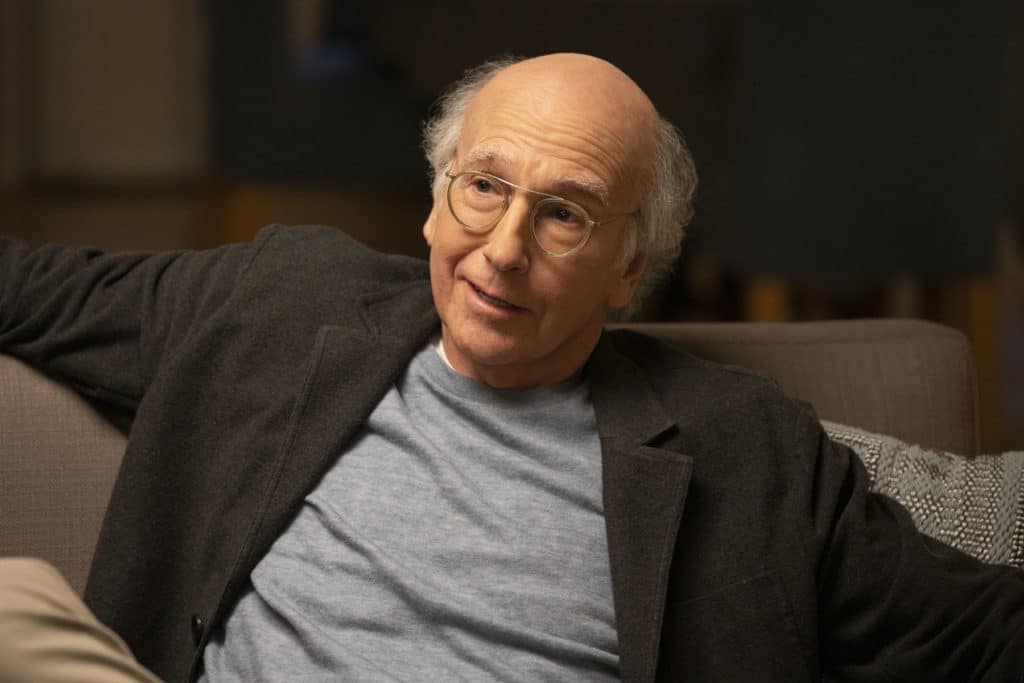
Larry David has two things to celebrate this October: the 20th anniversary of “Curb Your Enthusiasm’s” 2000 premiere and his recent wedding, to TV producer Ashley Underwood on Oct. 7.

“Curb,” in which David plays a fictionalized version of himself in improvised scenarios, has racked up two Emmys and a Golden Globe in its ten seasons on HBO. Now all 100 episodes of the show are streaming on HBO Max.

“I’m a lucky man,” David said in a statement. “Not just to be able to do ‘Curb’ for twenty years, but also for my flawless complexion.”

David, 73, and Underwood, 42 met at Sacha Cohen’s birthday party in 2017. Both Cohen and his wife Isla Fisher have appeared on Curb,” in Season 5 and Season 10 respectively. David has two daughters with his first wife, environmental activist Laurie David.

Larry David Gets Married, Celebrates 20 Years of ‘Curb’ Read More »

Table for Five: Bereshit

One verse, five voices. Edited by Salvador Litvak, the Accidental Talmudist

When God began to create heaven and earth — the earth being astonishingly empty, with darkness over the surface of the deep and the spirit of God hovering over the water — God said, “Let there be light”; and there was light. God saw that the light was good, and God separated between the light and the darkness. God called to the light, “Day,” and to the darkness He called, “Night.” And there was evening and there was morning. One day.- Genesis 1:1-5

Rabbi Pinchas Winston
Thirtysix.org

Man’s knowledge is vast, but God’s knowledge is infinite, making Torah infinitely deep. The first word of the Torah makes this point when understood through the prism of PARDES, a Hebrew word that alludes to four levels of Torah learning: peshat, remez, derash  and sod — simple, hint, exegetical and secret. 

Simple refers to the most obvious explanation of a verse or idea, hint to allusions, exegetical to discussions like those in the Talmud or midrash, and sod to kabbalah. For example, the first word of the verse, Bereshit, means simply “in the beginning.” Or at least it would if a different form of the word were used: Berishonah. Such a misspelling would be a mistake in a person’s book, but in God’s book, it hints to a deeper meaning (as Rashi explained). 

Exegetically, Bereshit can be read “Bara-shit,” or “He created six.” This indicates that at the first moment of Creation, God made everything that would emerge throughout the next six days, indeed, the next 6 millennia of history! 

Kabbalistically, “Bara-shit” also means “He created six,” but the six refers to the sefirot or Godly attributes of chesed (lovingkindness, gevurah (judgment), tiferet (beauty), netzach (eternity), hod (splendor) and yesod (foundation), which are the cosmic DNA, if you will, of our 6,000 years of history. The Tikunei Zohar has 70 interpretations of the word Bereshit. Needless to say, Torah learning is endless and it just gets better with time. Considering that Torah was God’s blueprint for Creation, learning it provides incredible insight into our world and the people in it.

Rabbi Shlomo Seidenfeld
JMI/Aish, scholar-in-residence 

“Astonishingly empty.” What a visceral description! The question is, what made our world feel so utterly empty “in the beginning”? 

A number of years ago, I came across a quote attributed to Albert Einstein that alleged if honeybees disappeared from the planet, all organic life would disappear within four years. I remember being blown away by the realization that the whole ecosystem was dependent on the presence of an insect. Then I discovered that Einstein probably never said it. 

The authenticity of the quote notwithstanding, my realization and thesis still remained. Remove an earthworm, a bee or any other seemingly peripheral life form, and the planet is significantly impacted. With that reality still in play, my mind then pivoted to a disturbing thought. What creature, I thought, was that statement not true of? What creature’s disappearance might actually benefit the planet? You know where I’m going. Humans! You remove mankind from the planet, the oceans would be cleaner, the skies clearer, there would be no violence (except competition among animals for food and mates). Earth would be a paradise. Are you kidding me? Aren’t humans supposed to be the most enlightened life form? 

So here’s the truth. An idyllic world and a bio-programmed life, one without choices, without light and darkness, without mistakes and triumphs, would be purposeless. Such a life wouldn’t be paradise, it would be irrelevant. We are here to rise, fall, rinse and repeat. Without that dance, the air would be clearer but life would be astonishingly empty. Shanah tovah!
Dedicated in loving memory to Rabbi Shaaya Seidenfeld

Rabbi Ilana Grinblat
Vice president of community engagement, Board of Rabbis of Southern California

Each year, my mother-in-law cooks an elaborate Thanksgiving feast. Some years ago, she was away for the holiday. We weren’t sure what to do because we didn’t know how to make any Thanksgiving dishes. We asked for her recipes and hosted Thanksgiving. The next year, I was glad she was back but grateful to have learned how to cook the meal in her absence. 

These verses begin a story of tsimtsum — God contracting to make room for creation. According to Rashi, the first day is called “day one” because God was alone. God created the angels on the second day. 

In this pandemic, we, too, are experiencing tsimtsum — our lives contracting into smaller spaces. Our usual ways of celebrating are unavailable. From this painful process, new creations emerge. 

On Rosh Hashanah, the Jewish Federation of Greater Los Angeles and IKAR created the Shofar Wave, during which 50 synagogues sent shofar blowers to more than 65 locations across Los Angeles  County. Hearing the shofar blasts move through the neighborhoods block by block was incredibly moving. 

Likewise, on Simchat Torah, B’nai David-Judea Congregation organized communitywide “Apart-But-Together” neighborhood singing, on balconies or in backyards with participants social distancing and wearing masks. I am heartened by how the community is coming together across denominations to celebrate in new ways. 

Next year, hopefully this excruciating pandemic will be over and our sanctuaries reopened. In the meantime, we are learning new techniques to take our faith into our hands. We may even find a few angels along the way.

Erica Rothblum
Head of School, Pressman Academy

If the Torah is a Book of Law, why not start with the first commandment? Why do we begin with the story of creation? 

Seen simply, the Torah is a book of laws by which we should live — a nuts-and-bolts set of instructions. But by beginning with the story of creation, we get a reminder of how to live. 

Rashi wrote that the story of creation is not told in chronological order. Although we want to understand each moment of creation, we also need to accept the mystery that surrounds creation — and with that mystery comes a sense of wonder. As Albert Einstein said, “There are only two ways to live your life. One is as though nothing is a miracle. The other is as though everything is a miracle.” 

By beginning with the story of creation, we are taught that it’s not enough to follow the other mitzvot — we should do so with wonder. It’s not enough to go through the rote actions of our day — we should observe the world around us with awe. Experiencing wonder in our everyday lives enables us to feel connected and a sense of belonging. When we experience wonder, we feel humility and gratitude, and we can see beyond ourselves. 

Our Torah then, is not simply an instruction manual for the commandments we are to follow, but its very beginning is a reminder of the mindset with which we should approach those commandments.

Justin Levi
President, The Community Shul

A careful analysis of the first passage of the Torah reveals something interesting. God’s first act is to “Let there be light” — a rather obvious allusion to the Big Bang. But after that, the order of creation gets muddled. God separates the light and darkness into “Day” and “Night.” But day and night, as we know them on Earth, do not occur until billions of years later. In fact, later in the passage, we are told that the land and seas are created before the sun and stars. 

With this rather strange chronology, God is telling us something crucial — the Torah is not a history book. Rather, the Torah is a guidebook based on God’s teachings. 

According to the Torah account, the sun and stars are not created until the fourth day. This was to deliberately communicate to the idol worshippers of the time that the sun is not god, nor is it the center of the universe. God is the ultimate power in the world. We are enjoined to follow Him, and not any false idols. 

This wisdom is critical as we navigate our new reality. Never before have we felt such a collective lack of control over our world. Our false idols — money, fame, success — are powerless. But if we follow God’s path of morality and adhere to his commandments — rules that demand treating others with respect, dignity and kindness — we will make it through this difficult period. And we will be better for it.


Table for Five: Bereshit Read More »