Chabad and Yeshiva University are offering a Torah class high school students can take for college credit.
Beginning in November, high school students in grades 10-12 will have the opportunity to earn two private college credits in the course being offered by CTeen U, a joint initiative of Yeshiva University and Chabad Teen Network (CTeen).
“I know how busy teens are preparing for college—this is an opportunity for them to advance their resume and college career while studying the Torah’s timeless wisdom,” Bais Bezalel Rabbi Moshe Levin, who will be leading the class along with other teachers, said. “The teens will be encouraged to ask questions and make their knowledge personal.”
The course — which CTeen U describes as a “Jewish philosophy overview presented by local instructors with an online review on the Yeshiva University Portal” — is open to Jewish high school students from all backgrounds across Los Angeles. No previous Judaic knowledge is required.
Classes will be held once a week over 14 weeks. The curriculum will examine God’s existence, faith, divine providence, purpose, relationships and other topics.
Students will meet in-person in a small group setting at the Bais Bezalel Chabad on Pico Boulevard, or virtually over Zoom.
Students will meet in-person in a small group setting at the Bais Bezalel Chabad on Pico Boulevard, or virtually over Zoom.
The registration deadline for the class is October 22.
Credits earned in the class are transferable to a number of colleges, including Brandeis University, Harvard University, and California Institute of the Arts. (For a complete list of colleges that will accept these credits, visit cteenu.com/faqs.)
The cost of the course is $999, although, according to CTeen U, the value of the course —which will count toward “elective credits” in an undergraduate program—is worth $2,000. Scholarships are available.
CTeen U is one of many programs of CTeen, which has over 600 chapters in 37 countries and six continents and describes itself as “the fastest growing network of Jewish teens.”
Based in New York City, Yeshiva University is an institution of higher education with undergraduate programs in both Jewish and secular studies.
For additional information about the course, visit cteenu.com.
Neuroscientist and “The Big Bang Theory” actress Mayim Bialik is launching a new podcast encouraging fans to witness her “breakdown.” Slated for a fall release, “Bialik’s Breakdown” takes a holistic approach in discussing mental health. During a live taping of Tablet Magazine’s “Unorthodox” podcast on Oct. 12, Bialik said she will begin to record episodes in a few weeks.
“I’m starting a podcast because during quarantine I think many of us realized that anyone who had issues, they got worse, and all the people who didn’t think they had issues, now they know that they have them, too,” she said. “I wanted to be able to say, ‘I’m Mayim Bialik and welcome to my breakdown.’”
Using her degree in neuroscience and with the help of experts and her friends, each episode will feature different mental health diagnoses and challenges rather than, “here’s what you got, and here are the pills to take,” Bialik said. She added she also will examine daily actions and mentalities that can negatively impact a person’s mind and body.
Using her degree in neuroscience and with the help of experts and her friends, each episode will feature different mental health diagnoses and challenges.
Bialik has been vocal about her personal life over the years, whether offering advice on parenting, science and going vegan, to discussing Israel and her Jewish journey. She also has been transparent about her own mental health and well-being.
“I try and present my authentic self so that what I’m presenting matches what [my kids] pick up on,” she said, describing her nervous feelings about going back to work during COVID-19 and then describing it to her kids. “They pick up on things even when you think you’re hiding it. So, don’t try and hide it.”
Click here to sign up for updates when the podcast goes live.
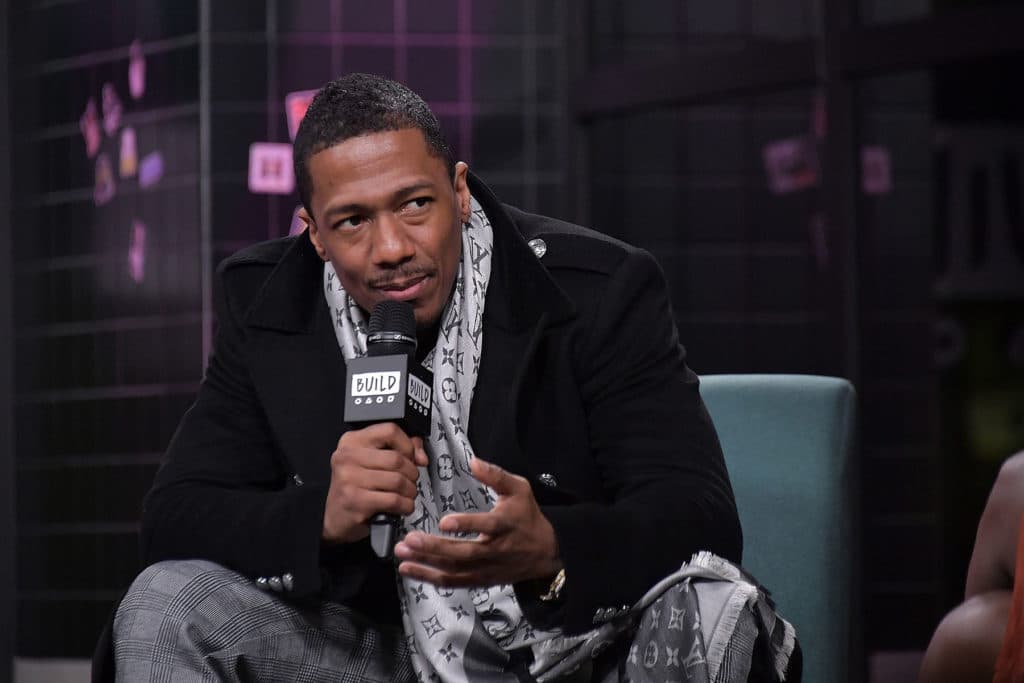
Actor Nick Cannon has come under fire for having white supremacist Richard Spencer on his October 12 podcast.
Mediaite reported that Cannon had Spencer on his podcast “Cannon’s Class,” where Cannon said that he didn’t understand why there is a holiday for Christopher Columbus. Spencer defended Columbus as “amazing.”
Cannon retorted, “He came and started f—ing with people. People were enjoying themselves and he brought famine, disease and just raped and pillaged everything.”
Spencer told Cannon that “at some level, you have to own the blood and guts,” pointing to the Haitian Revolution; Cannon defended the Haitian Revolution as people fighting back against being enslaved.
Cannon then asked Spencer why people like him “want to protect the statues of losers.” Spencer replied that it’s because they were “great,” prompting Cannon to call them “great losers.”
Cannon was criticized for giving Spencer a platform.
“Nick Cannon: I’m sorry, I’m not antisemitic I don’t hate Jews, really!” Stop Antisemitism.org tweeted. “Also Nick Cannon: let’s host Neo Nazi Richard Spencer and piss off some more Jews.”
Nick Cannon: I’m sorry, I’m not antisemitic I don’t hate Jews, really!
Also Nick Cannon: let’s host Neo Nazi Richard Spencer and piss off some more Jews https://t.co/dT7KwnDtRI
Journalist Yashar Ali responded to Cannon, calling Spencer “controversial” by tweeting, “He’s not a reality show star, he’s a white supremacist. My god.”
Daily Wire contributor Harry Khachatrian also tweeted, “So after losing his improv comedy show over anti Semitic comments, Nick Cannon is now hosting a self-avowed white supremacist to discuss Columbus Day on his talk show?”
According to the Anti-Defamation League (ADL), Spencer “has become more openly anti-Semitic in recent years,” pointing to how Spencer said in 2014 and 2016 that he doesn’t “consider Jews to be European (i.e. white in alt right nomenclature)” and that he believes in establishing a white ethnostate. Spencer was also the keynote speaker at the 2017 Unite the Right protests in Charlottesville, Virginia. In 2016, Spencer shouted “Hail Trump!” at a Washington, D.C. event hosted by the National Policy Institute think tank, of which he is the president. At that event, audience members responded to Spencer with Nazi salutes, which Spencer did not condemn. Spencer has since endorsed Democratic presidential nominee Joe Biden for president, but Biden’s campaign immediately disavowed Spencer.
Cannon previously came under fire for saying in 2019 that people are “giving too much power to the ‘they’ — and then the ‘they’ turns into the Illuminati, the Zionists, the Rothschilds.” Cannon also praised Nation of Islam leader Louis Farrakhan as “uplifting” and said that Blacks were the real Hebrews. His remarks caused ViacomCBS to terminate its relationship with Cannon; Cannon had been hosting the show “Wild N’Out” on MTV and VH1.
The “Masked Singer” host has since apologized for his remarks and said in an August American Jewish Committee (AJC) webinar that he has attempted to atone for his comments through reading Jewish literature and meeting with members of the Jewish community. In July, Cannon had Simon Wiesenthal Center Associate Dean Rabbi Abraham Cooper on “Cannon’s Class” to discuss anti-Semitism and called Bari Weiss’ “How to Fight Anti-Semitism” book a “powerful read” later in the month.
However, during that AJC webinar, Cannon said that while he doesn’t stand for Farrakhan’s “hateful” comments, he has seen the Nation of Islam leader “transform the lives of incarcerated individuals.” Cannon added that “I can condemn the message but I can never condemn the messenger.”
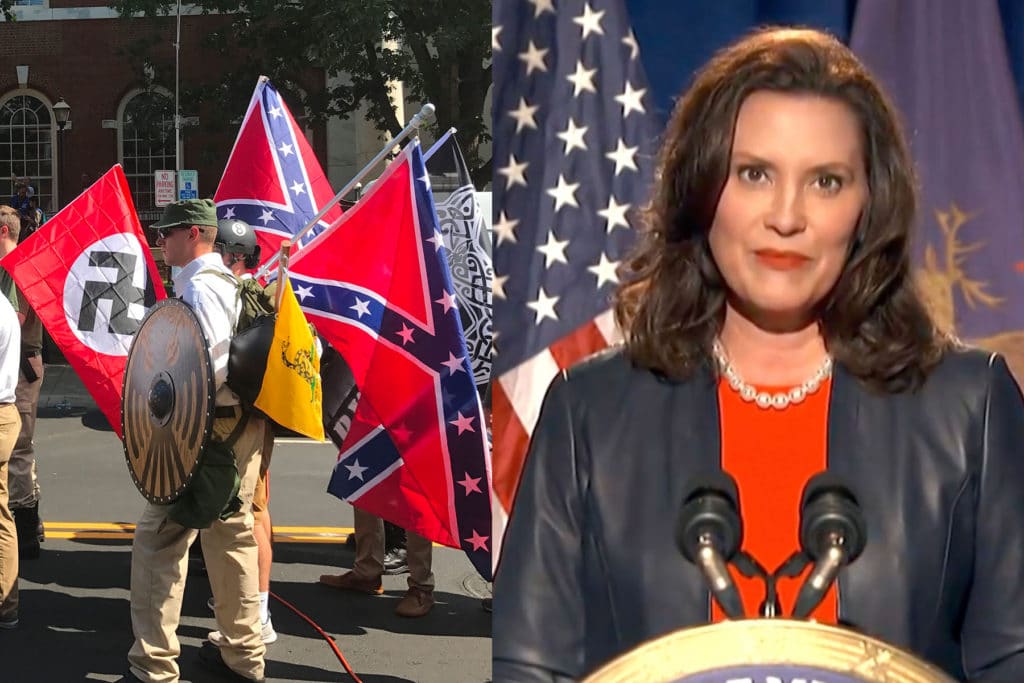
Hours before the Jewish Museum of Milwaukee hosted a virtual panel on Oct. 8 on the upcoming landmark federal Sines v. Kessler case against the neo-Nazis, white supremacists and hate groups connected with the August 2017 violence in Charlottesville, Va., federal authorities announced they had thwarted a white supremacist plot to kidnap Michigan Gov. Gretchen Whitmer.
The panelists — Amy Spitalnick, executive director of the civil rights nonprofit Integrity First for American (IFA), which is backing the lawsuit; Michael Bloch, attorney at Kaplan Hecker & Fink, which is trying the case and partnering with IFA on litigation; Reggie Jackson, co-founder and lead trainer at Nurturing Diversity Partners; and moderator Hannah Rosenthal, a former special envoy on monitoring and combating anti-Semitism at the U.S. State Department — noted that the incident merely underscores the need to recognize that what happened in Charlottesville was not an isolated incident.
“IFA’s role,” Spitalnick said, “is to make sure we understand how Charlottesville fits into the broader cycle of extremist violence that we’re seeing. It’s so important to understand that Charlottesville was not an isolated incident, but a flashpoint and a harbinger in the lives of white supremacist terror in recent years.”
Spitalnick then went on to speak about what she called “the deep, disturbing connections from the Charlottesville defendants in the case. We know that the [October 2018] Pittsburgh shooter communicated with some of the Charlottesville leaders before his attack; the [March 2019] Christchurch, New Zealand, shooter painted on his gun a white power symbol that was first popularized by one of our defendants. Christchurch inspired the [April 2019] Poway attack and the [August 2019] El Paso attack,” she said.
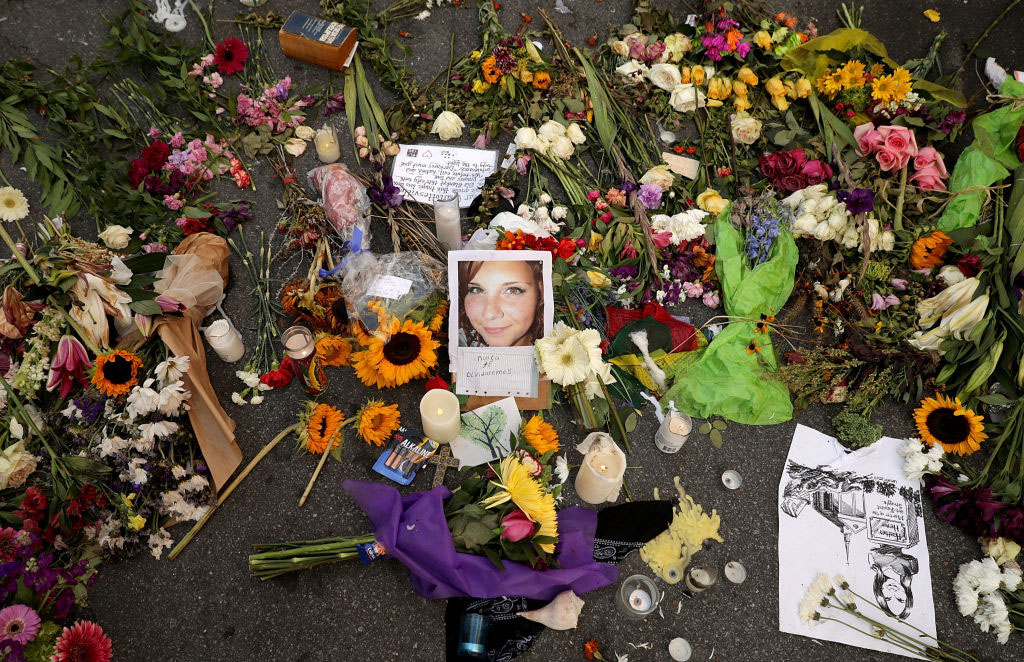
Flowers, candles and chalk-written messages surround a photograph of Heather Heyer on the spot where she was killed and 19 others injured when a car slamed into a crowd of people protesting against a white supremacist rally, August 16, 2017 in Charlottesville, Virginia. (Photo by Chip Somodevilla/Getty Images)
Taking on the case, Spitalnick said is a way to “effectively bankrupt and dismantle [these groups] in ways that no other legal effort has done.”
The panelists also cited other recent incidents including (but not limited to), President Donald Trump during the first presidential debate on Sept. 29 calling on the Proud Boys to “stand by” and Vice President Mike Pence and Democratic vice presidential nominee Sen. Kamala Harris (D-Calif.) bringing up the Charlottesville violence three times during their debate, as why now is the time to be having this discussion about white supremacy and far-right extremist hate groups.
Jackson said, “It’s amazing to me that people continue to delude themselves that [these groups] are fringe elements in our society. They are not fringe elements. They are actively recruiting young people on a consistent basis. We’d better wake up as a society and realize [we need to do] something specific — not just this lawsuit — but force our elected officials to do something about the rise in these hate groups and the violence they’ve been perpetrating.”
“We’d better wake up as a society and realize [we need to do] something specific — not just this lawsuit — but force our elected officials to do something about the rise in these hate groups and the violence they’ve been perpetrating.” — Reggie Jackson
Discussing the upcoming case, which originally was slated for trial on Oct. 26 but has been pushed back to April 2021 because of the COVID-19 pandemic, Bloch said, “The timing couldn’t be more important to have this discussion,” adding, “the most prominent attack that most people know about is the car attack when James Fields drove a Dodge Challenger through a crowd of peaceful protesters killing Heather Heyer and injuring scores of others.”
What the upcoming lawsuit uncovered, Bloch said, is that the entire weekend was “really a weekend of terror” that started on Friday night, Aug. 11, when white supremacists and Nazis marched through the University of Virginia (UVA) campus chanting, “Blood and soil” and “Jews will not replace us.”
Arriving at the statue of Thomas Jefferson, who founded the university, Bloch said, “There were about 20 peaceful counter-protesters — UVA students against white supremacy — who were then surrounded by 500 white supremacists who started attacking them; throwing their tiki torches at them; throwing lighter fluid; kicking and punching them.”
The following day, the same group marched through Charlottesville, reportedly committing similar attacks. That’s when Fields drove into the crowd, killing 32-year-old Heyer. (Fields, who was 20 when he committed the crime, was convicted of first-degree murder and eight counts of malicious wounding, and is serving a life sentence in the death of Heyer). Ten of those injured over that weekend are now Kaplan Hecker & Fink plaintiffs in the upcoming litigation.
Bloch said the key to the case — and why it is so important in today’s climate — is that what happened in Charlottesville was not some random march that somehow spun out of control, but that it was a meticulously planned and executed attack.
“It was revealed shortly after [the Aug. 12 weekend] that all of this was planned on a social media platform called Discord,” Bloch said, “which has invite-only servers. The organizers and defendants in our suit created their own server called Charlottesville 2.0 and they planned the rally in meticulous detail from about June [2017] onward.”
Those chats were leaked online and Bloch said they discussed every detail, “from uniforms they would wear, the formations they would march in, fighting tactics, about whether it was legal to run over protesters in Virginia. They researched self- defense laws in Virginia. They had medics on hand for the aftermath.”
The suit is being filed under a federal statute called the Ku Klux Klan Act of 1871, Bloch said, “passed by the Reconstructionist Congress to really give teeth to the 13th, 14th and 15th amendments — that abolished slavery, gave equal protections [to] and gave African Americans the right to vote. The statute gives the ability [to victims] to sue in federal court for conspiracy to commit racially motivated violence.”
It’s also why, Spitalnick said, IFA was created in 2017 because of “a vacuum in civil rights protection. We’ve seen in recent years how the Department of Justice (DOJ) civil rights investigations and prosecutions is down nearly two thirds from the end of the [Barack] Obama administration.”
So who exactly is IFA taking on? Among the nearly two dozen defendants are Richard Spencer, who Spitalnick noted is “the most famous neo-Nazi.” Also listed in the suit is Chris Cantwell, who on Sept. 28 was found guilty in a separate case of extortion in a rape threat case. Also listed as a defendant is Andrew Anglin, who last week posted on his website, the Daily Stormer, which Spitalnick said is “the most trafficked hate site in the world,” that Trump’s comments about the Proud Boys during the presidential debate were calls for a race war during the election. Other defendants are groups including the National Socialist Movement, Vanguard America and certain KKK-affiliated groups.
Bloch said the defendants are alleging they were exercising their First Amendment rights and filed a motion to dismiss the case on that basis but the motion was denied. “We have been very careful to make sure that we are asserting claims based exclusively on conduct primarily and speech that is not protected. Our focus is the violence and the plans to commit violence.”
Jackson spoke about how ongoing right-wing extremist violence “is as American as apple pie,” stating how the first iteration of the Ku Klux Klan was formed as America’s first organized terrorist group right after the Civil War ended and has never disappeared.
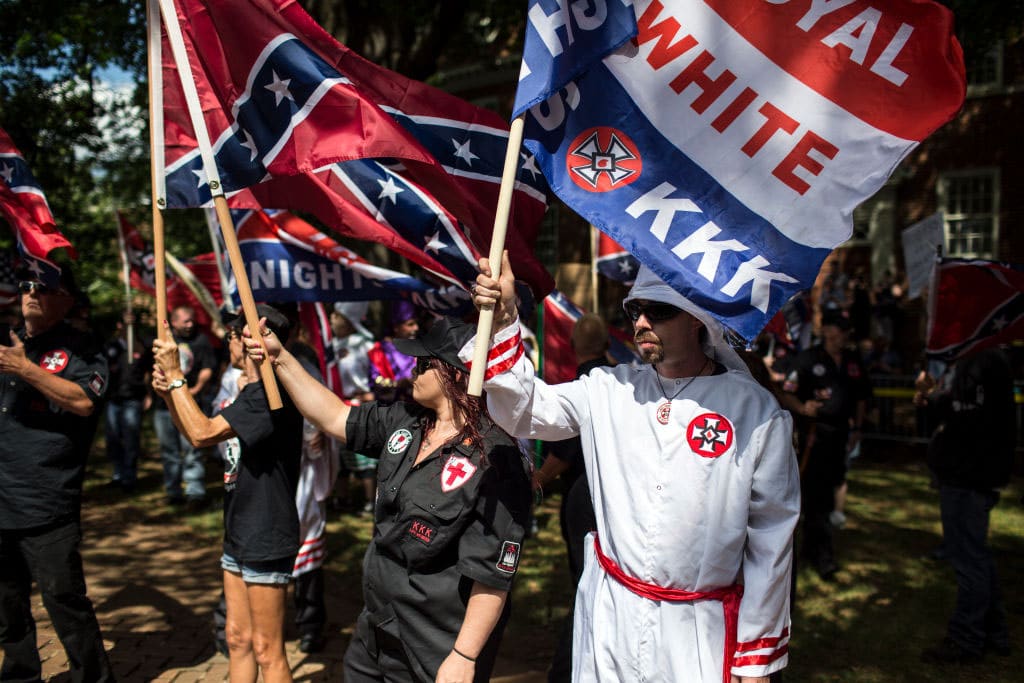
The Ku Klux Klan protests the planned removal of a statue of General Robert E. Lee on July 8, 2017 in Charlottesville, Virginia.(Photo by Chet Strange/Getty Images)
The issue, he said, “is not in the groups themselves but in the people who support them.” He added that when it came to Charlottesville, “this didn’t come out of the blue. They have been planning a race war — to disrupt democracy and create a nation that is only for the people they want. These things were happening 100 years ago.”
He also noted that in the KKK’s heyday in the 1920s, the government enacted immigration quotas on Southern and Eastern European countries, which affected Russian Jews attempting to escape pogroms and that those quotas were maintained through the 1960s.
“The Jewish community has had an exceptionally long history of fighting against these types of elements,” Jackson said. “There has never been a time in this country when the Jewish community hasn’t had to deal with these types of folks.” He also noted that Black people had been talking about these groups for “a long time but no one is listening. We are under siege.”
It’s why, he added, that the group that is suspected of attempting to kidnap Whitmer and the August shootings in Kenosha, Wis., “are all part and parcel of the current state of affairs in America …. We have seen a rise in hate groups since the election of [President] Barack Obama in 2008. They’ve taken advantage of social media to spread like wildfire and, tragically, we have a president that refused in 2017 to say that these were horrible people. Even during the [Sept. 29 presidential] debate, he refused to call out white supremacists.”
Spitalnick and Bloch spoke with the Journal in a joint phone call after the panel, when Spitalnick echoed Jackson’s words. “Without fail, we are living at a time where the urgency of this is so clear,” she said, citing an Oct. 6 Department of Homeland Security report that stated white supremacy is “the most persistent and lethal threat” in the U.S. The report comes on the heels of FBI Director Christopher Wray’s testimony to Congress last month that white supremacists make up the majority of domestic terror threats.
Bloch also noted that despite Trump’s declaration and a GOP narrative that antifa is the same as white supremacists, that is in fact a “false equivalency. You fairly regularly now — starting from Charlottesville — see violent plans and actions including terrorist-type actions by white supremacists that keeps cropping up in the news,” he said.
She added that the suspected attempted kidnapping of Whitmer “should just underscore to everyone in this country this is a dire threat; that these extremists are not going away without sustained, strategic action from our government; from private plaintiffs like ours; from social media companies and others.”
Protesters carrying Nerf guns gather near armed protesters at the Michigan Capitol Building on May 14, 2020 in Lansing, Michigan. Protesters were angry at Michigan Governor Gretchen Whitmer for the stay at home order currently being enforced in the state of Michigan during the ongoing global pandemic due to COVID-19. (Photo by Gregory Shamus/Getty Images)
She also noted that in the immediate aftermath of the arrests, many of those same extremist groups were circulating the charging document and commenting on social media. “It’s sadly in line with the sort of violent extremism we see from our defendants and their supporters in our case and across the board,” she said, “and informs the importance in keeping every one safe. This is not just s— posting. These are people who take their violence online and turn it into real-world action. We’ve seen it in Charlottesville and now in Michigan and in between.”
It’s also why, Spitalnick noted that security for the IFA team and the plaintiffs in the Charlottesville case is the biggest line item in IFA’s budget.
Regarding media reports calling the suspects in the attempted kidnapping of Whitmer a militia as opposed to domestic terrorists, Spitalnick said that Mary McCord, senior litigator at the Washington, D.C.-based Institute for Constitutional Advocacy and Protection (ICAP) and visiting professor at Georgetown Law school, is the “best legal expert in the country on the unconstitutionality of private militias, and there has been a total misrepresentation of what these [militias] are: unconstitutional armed gangs, and domestic terrorists in the case of Michigan.”
Bloch added that theoretically the word “terrorism” should not be a political term. “There is a legal definition for it,” he said. “ ‘The use of violence or intimidation for the purpose of intimidating a population.’ That’s something that theoretically could and should be applied objectively. When you drive a car through a crowd of peaceful counter-protesters that is part of the purpose of hurting or intimidating a population of racial minorities or their supporters, which is what James Fields did, that’s terrorism. The same thing can be said of trying kidnap a governor for political purposes.”
He added, “Right after Charlottesville, you saw people who immediately came out and said that’s terrorism. That’s what we said when a Muslim man drove a car through New York City (on Oct. 31, 2017, killing eight and injuring 11). There was no question among our political leaders that we were going to call that terrorism and treat it that way. But [the term] is used subjectively by this administration to shield white supremacists from the use of that label. That itself helps encourage, support and embolden white supremacists to keep doing what they’re doing.”
Bloch also said when it comes to DOJ priorities, at the same time the Whitmer attempted kidnapping story broke, the DOJ sued Yale University for discrimination against white people and Asian Americans. “When you have law enforcement saying white supremacy is the most lethal threat in America today, and [the Yale case] is where the DOJ is putting its resources, it tells you everything you need to know about what this government is focused on,” he said.
Spitalnick added that after Trump made his “stand down and stand by” comments at the Sept. 29 presidential debate, Anglin posted on the Daily Caller how the president’s comments “ ‘were a call for a race war and people should be prepared to violently fight for him.’ There are actively neo-Nazis, Proud Boys and others who have heard the president’s comments and more broadly are eager and ready — often fueled by his voter fraud disinformation — to defend his power.”
“There are actively neo-Nazis, Proud Boys and others who have heard the president’s comments and more broadly are eager and ready — often fueled by his voter fraud disinformation — to defend his power.” — Amy Spitalnick
It is important, she added, “to understand and not lose sight of or turn a blind eye to [these groups]. They do this to threaten us, as a means to scare people from exercising their rights — whether it be voting or supporting candidates, canvassing or phone banking. You can’t let them dissuade or scare you from exercising your rights. Our defendants are trying to get us to back down from this case. We won’t.”
Today, she added, the threat from these right-wing extremists is greater than ever. “What we’ve seen is how using more modern technologies has translated that ideology and hate into its modern form. In the past, they’d meet in white hoods in the woods somewhere and plan their violence, and they’d be relegated to specific geographic areas. Now you have extremists who can connect across the country and across state lines as we’ve seen in Charlottesville and the Michigan case. That provides a level of horrific expansiveness that makes the impact infinitely greater and terrifying.”
Every single expert, Spitalnick said, “is ringing the alarm bell that this is the grievous, most dire threat to our country right now. Even as the White House and the DOJ attempt to deflect and point fingers elsewhere, the experts are making clear the urgency of this threat. Don’t let it fall off the radar screen.”
To learn more about IFA and support the Charlottesville case, click here.
Rabbi Rachel Adler is a woman of many accomplishments. She is a celebrated and revered feminist theologian. She is the David Ellenson Professor of Modern Jewish Thought at Hebrew Union College Jewish Institute of Religion. She is the author of Engendering Judaism, the first book by a female theologian to win a National Jewish Book Award for Jewish Thought.
And, as it happens, Adler is also a cat-lover, a category that includes the poet T.S. Eliot, the owner of YouTube star cat Maru, my wife, and me—a fact that explains what inspired her latest book, “Tales of the Holy Mysticat: Jewish Wisdom Stories by a Feline Mystic” (Banot Press). The book is an utterly charming and deeply illuminating meditation on Jewish mysticism, as explained by Dagesh, Adler’s rescue cat.
Adler’s book originated with the tales that she invented to tell her friends about her “peculiar cat.” All true cat-lovers are prone to telling such stories. But Adler concluded that Dagesh ( “Holy Mysticat,” as she dubbed him), was more than a flesh-and-blood feline. Rather, he was “a holy teacher of sorts,” and understanding his ways “through the lens of Jewish texts and practice” was a path to higher wisdom.
“Truthfully, Dagesh was not the most engaging cat I had ever lived with,” she confesses. “He was imperious, obstinate and crabby, but he radiated a complex spiritual beauty that humbled me.”
Of course, it was Adler—not her cat—who consulted the texts, and it was Adler who wrote the book. Her stories started as “a surreal joke,” as she readily concedes, but they opened a pathway for Adler and for her readers.
For example, Adler explains that the ancient rabbis divided the night into “watches,” the last of which ends with the dawn. During the last watch, the Mysticat “performs his most mundane duty as a ferocious watchcat protecting his household from things that go bump in the night.” And he honors the exhortation of the Shulchan Arukh Orach Chayyim to “arise like a lion to do the will of our Creator.” Writes Adler, “The Holy Mysticat, being more closely related to the lion than I, finds it easy to obey this dictum.”
Adler employs both wit and wisdom in using the Mysticat to explore the inner meaning of Jewish wisdom. When she puts on tefillin for weekday morning prayers, for example, the leather straps remind the Mysticat of “the state of war between the snake and cat.” (For my cat, anything long and string-like will do the same.) “The long, sinuous black strap,” Adler explains, “perfectly symbolizes for the Mysticat the primeval serpent who is, according to the Talmudic sage (one of the amoraim) Resh Lakish, also the Satan or Accuser, the Angel of Death, and the yetzer ha-ra, the Impulse to Do Evil.”
Adler employs both wit and wisdom in using the Mysticat to explore the inner meaning of Jewish wisdom.
Throughout “Tales of the Holy Mysticat,” Adler uses the same bracing approach to Jewish learning with charm, humor, and knowledge. Dagesh prepares for Shabbat “by engaging in pre-rest rest,” she jokes. He is free to do so, she points out, “because, like [the] pious sages, he has a woman to take care of all his material needs.” The joke has a sharp edge: “The implications of this critique have never quite penetrated the Mysticat’s consciousness, but he wishes all who are preparing, in whatever humble manner, a blessed Shabbat.”
Lest the reader think that “Tales of the Holy Mysticat” is the equivalent of a children’s book for grown-ups, be assured that Adler seeks to explore every complexity of Jewish mysticism. We are told that the Mysticat, like some mystics, is an “acosmist,” which means that he believes that there is no cosmos apart from the Almighty. “Instead, as the first Lubavitscher Rebbe, the Baal Ha-Tanya, said, ‘Alz iz Gott’ (God is all that is).”
The implications of this acosmism are mind-blowing: “Our sense of being distinct, individual selves other than God is merely illusion,” Adler explains. “The entire Creation is part of God.” Adler herself dissents: “[A]cosmism seems to me to lack consistency… How else would we be able to have relationships with our Divine Other and with all the others around us?”
The Mysticat isn’t an entirely benign creature, either. One night, mistaking Adler for a demonic creature known as a mazik in the dark, he sunk his teeth into her foot. “I was as offended at being mistaken for a mazik as my sister once was when a complete stranger mistook her for the egregious Linda Tripp,” writes Adler. But the Mysticat makes amends with a face bump. “Now that Tisha b’Av is past, we had better all be setting our thoughts and actions toward teshuvah. I only hope I will do as well as he.”
Adler concludes her book with a passage that sent chills down my spine because it prefigures the actual fate of her beloved cat. “When I try to imagine the depths of the Mysticat’s prayer, I imagine it as more tactile and visual, less wordy, and more brilliant than mine,” she writes. “Perhaps he saw the light of the Garden of Eden, one of the metaphors for the perfect, untainted place to which we return when our lives are done. Perhaps, perhaps.”
The world, of course, is divided between cat people and dog people. (Only a few us are equally smitten by both species, and I am one of them.) But readers who are not comfortable with cats need not shun Adler’s enchanting book. Adler’s grandson, she reports, has a Mystidog. “[T]he Mysticat had to acknowledge that since he believes the entire creation is a part of God, dogs must be as much a part of God as anything else.”
Jonathan Kirsch, author and publishing attorney, is the book editor of the Jewish Journal.
The rabbi of a synagogue in a San Diego neighborhood was assaulted by a teenager on October 10.
ABC 10 reported that Rabbi Yonatan Halevy was walking with his father to Shiviti Congregation in University City, which is near UC San Diego, when a teenager rode his bike over to them. Halevy told KUSI News that the teen hit him in the head with his fist and shouted “n—–“ and “white power.”
“I was dressed in traditional Jewish Middle Eastern holiday garb, and I fell down to the floor and my hat fell down to the floor, and I’m just glad he hit me instead of hitting my father, who would have suffered much injuries than myself,” Halevy said.
The teen then began circling the synagogue on his bike, his friends on skateboards, and began taunting Halevy and other congregants.
Halevy told ABC 10 that the teen who assaulted him is part of a group of teenagers who have routinely caused trouble for the synagogue.
“Everyday they come by here, taunt us, throwing bottles at us, sitting on our roof blasting music, and then breaking a window to my van,” Halevy said. He also told KUSI that the teens have been stealing property from the synagogue as well.
Police are investigating the matter as a hate crime; Halevy said that the synagogue is beefing up its security in response to the incident.
“We are fearful,” he said.
Anti-Defamation League (ADL) San Diego tweeted, “ADL San Diego is aware of this incident, and are pleased to know that SDPD [San Diego Police Department] has made finding the suspects a high priority. No one should be the victim of such crimes because of their religious beliefs.”
ADL San Diego is aware of this incident, and are pleased to know that SDPD has made finding the suspects a high priority. No one should be the victim of such crimes because of their religious beliefs. #NoPlaceForHatehttps://t.co/E6G2tDJPgi
As a first-generation American, I was raised to believe any one person can make a difference. Like many children and grandchildren of Holocaust survivors, I was drawn to public service, inspired by a combination of patriotism and civic duty to address the most pressing challenges in society. I went to law school, had a fulfilling career in public law and, after 9/11, turned my focus to the non-profit sector.
For me, watching the events of 9/11 created a moment of hyper-focus on anti-US and anti-Zionist extremism. When the opportunity arose the following year, I joined the Anti-Defamation League (ADL) as the Los Angeles Regional Director. Thechallenges we faced were daunting. Besides extremist rhetoric against the United States and Israel, ADL focused on nationalism and Islamophobia, an emerging prevalence of cyberbullying, a struggle on college campuses to balance free speech with the desire for an open and welcoming environment, a growing wealth gap and, by 2008, an economic crisis. During it all, I helped ADL LA navigate its role fighting hate and building bridges to meet each challenge.
While there was no single moment of hyper-focus comparable to 9/11 for me, watching events unfold in the 2016 election and in the warm-up to the 2020 election created a shift in my focus to the increasing polarization of our communities, our methods of engaging, and our sources of information. According to a January 24, 2020, report by the Pew Research Center, “Republicans and Democrats place their trust in two nearly inverse news media environments.” The report concludes that “partisan polarization in the use and trust of media sources has widened in the past five years.” This polarization has hampered responsible and effective social interaction.
In 2020, polarization is only getting worse. The coronavirus pandemic is one new source of divisiveness. Our national reckoning with systemic racism and police abuse, triggered by the brutal killing of George Floyd and too many others, has also contributed to political discord. And, unquestionably, the presidential election has further exacerbated the divide, even among friends and family.
As I started to focus on the cause (and effect) of political polarization, it became clear to me that social action and civil discourse were catastrophically at risk.
As I started to focus on the cause (and effect) of political polarization, it became clear to me that social action and civil discourse were catastrophically at risk.
In August, after 18 years at ADL, I started a new role as president of Constitutional Rights Foundation (CRF). CRF is a non-partisan, non-profit organization whose mission since 1962 is to bring civics education to schools, especially in underserved areas. It does this through teacher training, civic action programs, law-related education, internships, and a host of other programs designed to create the next generation of informed and engaged citizens.
I knew that my experience at ADL would translate well. Both organizations change society through education and participation: ADL provides resources in anti-bias education and engages young people to stand up to hatred and anti-Semitism; CRF provides resources in civics education and engages young people to become active citizens.
Both organizations also hold a keen recognition that enduring change requires more than angry invective—it requires knowledge about government and civil discourse skills to effectively bring about change. According to the 2018 National Assessment of Educational Progress (NAEP) civics assessment, U.S. 8th graders scored, on average, just three points higher than they did in 1998, but still well below NAEP proficiency in knowledge of government and civil society. Yet, during the same two decades, we have seen a continued marginalization of civics education, once required for and foundational to public education.
Creating enduring change also requires giving a voice to the voiceless. There is no better way to mitigate the effects of out-of-control political polarization. At ADL, I learned that if we want to remove hate and anti-Semitism from society, we must teach students how to stand up for others and for themselves. I now bring to CRF the viewpoint that, if we want to remediate disenfranchisement and injustice, we must teach students about how government works, how to collaborate, and how to participate and advocate for issues that matter to them.
My job may have changed, but my calling to public service has not. Societal ills may have shifted, but the most effective antidote has not. I still believe one person can make a difference. I am still drawn to the work of giving people the tools to make their own difference.
The through-line is empowerment.
Amanda Susskind assumed the role of president of Constitutional Rights Foundation in August, after 18 years as ADL’s Los Angeles Regional Director.
Long ago—far too long than I am willing to admit—when I was a young rabbi teaching Bar Mitzvah boys, the mother of one of my star students informed me that the Bar Mitzvah dinner for her son was not going to be a kosher affair.
She explained that the dinner simply had to take place at a five-star hotel, and none of the fancy London hotels had in-house kosher catering. It was clear that she did not want to deal with kosher caterers—there were a number of them who had concessions at a range of West End hotels. As a result of this aversion, she was willing to abandon having kosher food for her son’s Jewish coming-of-age celebration.
Serendipitously, I had just become involved with introducing in-house kosher catering at the newly reopened Langham Hilton Hotel, a luxury venue very close to London’s iconic Regents Park. I suggested to the mother that at the very least, we should make an effort for the Bar Mitzvah function to be kosher, and assured her that I would arrange for a bells-and-whistles food tasting with Langham’s head chef and banqueting manager. Reluctantly, she agreed.
A week later, we sat around a table at the Langham’s Palm Court. Quite randomly, my student’s mother had decided to bring her elderly father to the tasting. He was a very dignified looking man, well dressed and courteous, and he spoke with just a hint of a German accent.
Curious to find out more, I struck up a conversation with him. He told me he was born into a very religious family but had abandoned his Orthodox roots in his youth, and he later became very successful in business. Despite his personal journey, he was delighted that his grandson was going to have a proper Bar Mitzvah and that the celebratory dinner would be kosher. Just to make sure it would indeed be kosher, he had decided to attend the Langham tasting to see to it that his daughter didn’t change her mind.
After preliminary introductions, the head chef summarily snapped his fingers, and out of nowhere, six immaculate waiters appeared in full white-jacketed splendor, simultaneously serving us with a range of starters for us to choose from.
To me, it seemed like a dazzling display, but the Bar Mitzvah boy’s grandfather looked at the various choices and grimaced. “Is that it?”
The head chef blanched and then went red in the face. He looked ready to explode. The banqueting manager — a charming man with a great Orthodox pedigree of his own — smiled warmly at the grandfather.
“Why, is there something wrong?”
The grandfather shook his head and sighed. He put a hand on the banqueting manager’s arm. “My dear man,” he said, “I want to teach you an important lesson about choice and choices, and hopefully, you will remember this lesson for the rest of your life.”
And although I’m not sure the banqueting manager remembers what the old man told us, I certainly do, and it continues to resonate with me to this day.
“Take a look at these starters you brought in for us to try today,” he began, “smoked salmon parcels with salmon mousse filling, poached salmon salad, and salmon en croûte.”
He turned to me. “Do you notice,” he said, “that they all share something in common? Yes, that’s right — they are all salmon. The hotel kitchen clearly wants to sell us salmon today, so that whatever choice we make, we still end up with the same result. Obviously, that’s what is good for them, but actually, if you think about it, there is no choice in it for us.”
He turned back to the banqueting manager. “How about you offer us trout, or halibut, or dover sole, or seabass?” he asked. “Surely, with a world-class chef, such as the one joining us here, you can come up with a real and meaningful range of choices for us to choose from — especially if you know that we are kosher clients willing to go the extra mile?”
By now, both the chef and banqueting manager were beaming from ear to ear, as the wisdom of the old man sank in. Sure, salmon is in plentiful supply and very popular, but they needed to expand their horizons beyond the obvious and include the obscure, so that when a potential client made a choice — even if it turned out to be salmon — the client would be fully satisfied that their pick was meaningful and significant.
One of the great mysteries of Jewish tradition is what might have happened had Adam and Eve not eaten from the “tree of knowledge of good and evil” (Gen. 3). It almost appears as if evil came into existence only as a result of this terrible primordial blunder by the ancestors of humanity.
But there is no real mystery here, and the change resulting from that sin was actually one of complexity rather than any material difference. The Garden of Eden would not have been perfect had there not been a choice to opt out of that idealized world — a choice that was concentrated in one very specific option, namely, eating from the forbidden tree. And this choice was real, for as we see from the narrative in Genesis, it had real consequences.
Meaning in life results from meaningful choices. It is only the fact that we can make a wrong choice that gives value to making the right ones. If life was utterly uniform and two-dimensional, not only would it be boring (even if it was an utter paradise), it would also be devoid of any meaning.
It is only the fact that we can make a wrong choice that gives value to making the right choices.
As it turned out, oversimplifying choice proved overwhelming for Adam and Eve, which is why we were ultimately given a proliferation of mitzvot, as exemplified in the statement of Rabb Hananiah ben Akashia (Makkot 3:16): “God wanted to give Israel superlative merit, so He gave them a vast Torah and many commandments.”
In other words, the more opportunities we have to get things wrong — and the more real choices we have — the greater opportunity we have to get things right and give meaning to our lives.
The Bar Mitzvah dinner for my star student took place at the Langham Hilton after all, and we started the sumptuous five-course feast with poached salmon salad. As we ate it, I looked across at the boy’s grandfather, and he looked at me. He winked, and I smiled. We both knew that this starter was so important. It represented choice, and as long as there are choices, everything we do has an impact — even something as simple as eating poached salmon salad.
Rabbi Pini Dunner is the senior spiritual leader at Beverly Hills Synagogue, a member of the Young Israel family of synagogues. For details of the time and login for the International Succah Hop, email Carly Einfeld: carly@yinbh.org.
In those old prison movies, there’s always a scene where guards strap a convicted murderer into the electric chair and he screams, “I’m telling you — I didn’t do it!” Standing next to him is a priest (never a rabbi, unless it’s the convicted spies Julius and Ethel Rosenberg, then it’s Rabbi Irving Koslowe). Then there’s a shot of a wall clock ticking. Next, a shot of a silent phone. The convicted murderer asks if the governor has called to stay the execution. That’s an important phone call.
Nowadays, many people act as if every tweet and text is of a similar magnitude. In old horror movies, normal-looking people walked around like zombies being controlled by outside forces. Like a woodworm beetle, the mobile phone has bored a hole into our brains. We now await moment-to-moment commands from the digital galaxy. Our prayer is that one day our tweets go viral.
Once in a while, I’ll ask rude people to put away their phones despite warnings from my family that one day I’ll be shot. I was once at a doctor’s office waiting to get an important blood test result. I was nervous. Across from me was this chatterbox gabbing away at the same volume Pavarotti used when trying to reach the rafters at Lincoln Center. I politely asked her to please take the call outside and then pointed to a “No Cellphone Calls Permitted” sign. She gave me a look of hatred and continued her call. I asked her again. She then said into her phone, “Some man is being very, very rude to me.”
Even at funerals, shivah houses and weddings, it’s not uncommon to hear phones ring and to see people hunched over them talking.
Have you ever taken a phone away from your child? They go berserk. Once, when I left my phone at home, I immediately felt like I’d left the house without pants. I know that feeling, because I once did leave without my pants. I was at a Passover program with my family. I went out to get them some drinks. Standing by the elevator, I looked in a mirror and saw that I had nothing on but my boxers. Fifteen years later, my family still mocks me.
Have you ever taken a phone away from your child? They go berserk.
What I’m most concerned about is the new generation of babies. When I was a kid and went out with my parents, they would talk to me, point things out, scream at me and of course, threaten me. But at least they were paying attention to me. Seemingly that’s happening less and less. I don’t know about their home life, but in public, fewer adults seem to be paying attention to their little ones. Many times, I’ll see people talking or texting while pushing strollers across almost freeway-busy streets while the lonesome kid is told to be quiet.
On Shabbat, what’s better than talking with your child while walking to shul? But I’ll see parents who are running late rushing the kids to walk faster while they have their faces buried in their siddur. All they’ve done is replace the phone with the siddur. Instead of talking to the kids, they are talking to God. Again, the kids are asked to be quiet.
“Shema beni mussar avicha v’al titosh Torat imecha” means “Hear my child the discipline of your father and do not forsake the teaching of your mother.” What’s more important to you: Praying for your children or answering their question, “Are there bugs on clouds?” Talk to them now or they might not want to talk to you later. Remember, they won’t be young forever.
Granted, paying attention isn’t easy. Multitasking has cut all of our attention spans. Paying attention takes practice. It means getting out of yourself and really finding out about someone else. And there is a price for that. That’s why they call it “paying attention.” You are paying for it with your attention. Like they say in the Army, “Ten-hut!”
Since my recent breakup, I know I’m not ready to date, but one biting text made me feel like I should avoid all men.
Here’s what happened.
Friday afternoon, a recently-separated friend of mine texted pictures of his Shabbat dinner in progress. I responded with glowing praise. I suggested next week we cook together and invite friends.
“Maybe. Let me think about it. OK?”
He then texted a photo of his final Shabbat feast, with a “Ta-dah! Shabbat Shalom.”
I enthusiastically replied, “Yummy! Excited to cook with you next week!”
He quickly pushed back, “I haven’t accepted your gracious invitation yet!”
Oh damn, I cringed. I hastily typed, “I’m sorry, you don’t have to accept.”
What I didn’t share was his response sent me straight to a pity party. My critical self-talk started hard and fast. “Stop being so pushy. Listen to his hesitation.”
And when I did, his reply punched me in the gut: “I know. Just let me marinate on the idea for a bit. And whatever you do, word to the wise — don’t ever try to bulldoze me on anything. It doesn’t work on me. Compassion and guilt work much better on me than force. I was brought up with way too much street in me to relent in the face of force from anyone.”
T R I G G E R ! I triggered him, but damn did he trigger me.
Tears of shame rushed down my face into the Challah dough I was braiding.
“Buuullll – dooozerrr” became my nickname ten years ago, when I founded the San Diego Chapter of the Israel advocacy organization, StandWithUs. My colleagues gave me that nickname because I was able to make anything happen, with little consideration for others. My Israeli colleagues understood me, but my American colleagues thought I was worse than an Israeli.
This man’s text painfully reminded me of my bulldozer nature. His reaction was a mirror to reflect on how my forceful approach can be too much.
But after I cursed and cried, I was grateful he chose to be real and raw. He didn’t attack me; he shared how my behavior made him feel.
Some of the greatest catalysts to transformative change come from painful exchanges. This one hurt, so I knew there was a lesson in it.
Some of the greatest catalysts to transformative change come from painful exchanges.
I wondered, why is our best character trait also our worst? Why are the yetzer hara, our evil inclination, and our yetzer hatov, our inclination to do good, so deeply intertwined?
My blessing and my curse are that I’m a “force of nature.”
I’m grateful for my gift, but I need to modulate it to not overpower others.
What if I could be like the wind — sometimes a gentle breeze and sometimes a roaring hurricane? Or the ocean, with high and low tides with the power to carve into the rock as well as reveal treasures in the sand?
In order to master my power, I need to set an intention of how to use it. My goal is to exude a strong, yet calm energy that inspires others to find their flow.
Over the last decade professionally, I have begun to do this work. I’ve consciously strived to be more intuitive, listen more, move with, and not push people.
Obviously, in my personal relationships, I’m still evolving. But I’m working on it.
For my 50th birthday gift to myself, I found a therapist. I’m committed to release past traumas and explore if fear causes me to be controlling.
As for my friend? Well, after Shabbat, he brought me leftovers and asked me to lunch. I said yes. I felt he had something to say. He did: He apologized if his response was hurtful. I had triggered him.
He said it’s too painful to celebrate Shabbat at another’s home. After a divorce, the pain of losing “home” is most poignant during Shabbat.
I understand. I’ve been there. I remember that sometimes it was easier to be alone and sad at my table than be at someone else’s joyful one.
No one could force him to feel safe. He wasn’t ready. I chose not to see that.
My lesson is not to avoid all men but to permanently park my bulldozer and be mindful of how I engage with everyone. To nurture relationships, I need to dance, not dominate, flow, not force, and most of all, be present and not pushy.
Audrey Jacobs is a financial adviser and has three sons.