fbpx

October 6, 2020

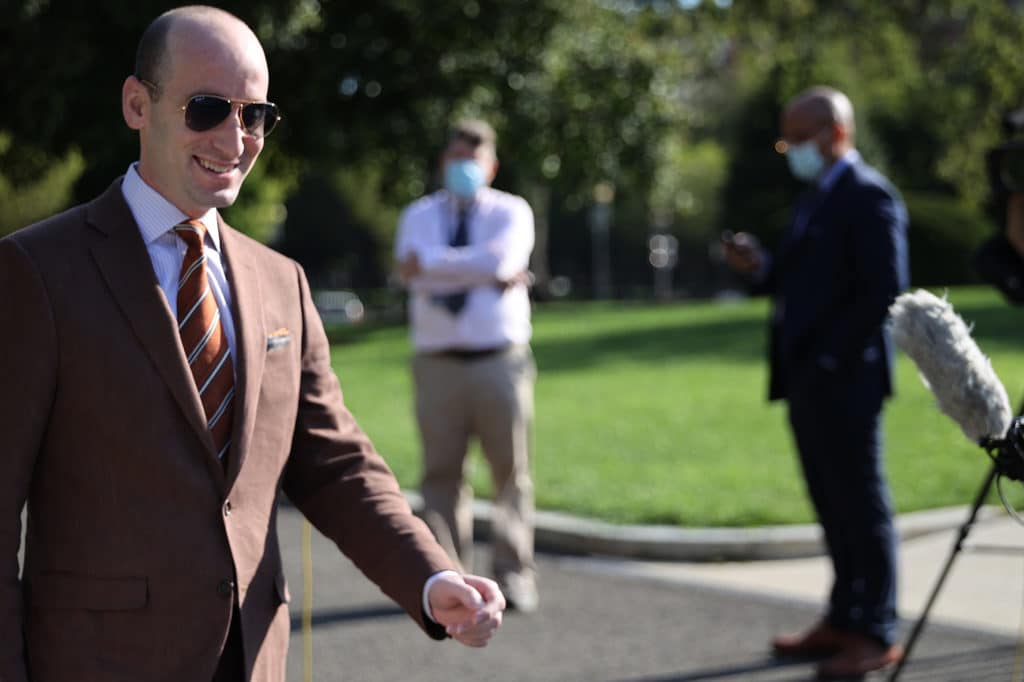
Stephen Miller, Top Trump Aide, Tests Positive for Coronavirus

WASHINTON (JTA) — Stephen Miller, one of the top advisers to President Donald Trump, has tested positive for the coronavirus as the pandemic proliferates among Trump’s circle.

“Over the last five days I have been working remotely and self-isolating, testing negative every day through yesterday,” Miller said Tuesday in a statement. “Today, I tested positive for COVID-19 and am in quarantine.”

Miller is the latest of around 20 people close to Trump, including Trump himself, who has since last week tested positive for the virus. Trump spent close to 72 hours in hospital over the weekend for treatment.

Miller, who is Jewish, has shaped Trump’s restrictive immigration policies. His wife, Katie Miller, tested positive in May. According to media reports, she tested negative on Tuesday.

Stephen Miller, Top Trump Aide, Tests Positive for Coronavirus Read More »

Holiness by Proxy

This Yom Kippur, I mourned for myself.

I mourned a part of me who, before this pandemic, felt much more connected to God. Being able to attend synagogue during High Holy Days services was a big part of that connection.

There’s something comforting about being in shul, especially during the High Holy Days. It’s one of the few places where the energies of the individual and the greater community flow through one another; where, if you listen closely on Yom Kippur, you can hear the gentle cries of a woman who is striking her chest during the Vidui (confession) prayer while others have moved on and are singing psalms with jubilation.

More than anything, this year, I longed to hear the blast of the shofar. It’s a wake-up call that always penetrates my stubborn soul — a soul that longs to connect with its maker. I haven’t felt this disconnected since I was 16 and visited the Kotel for the first time. An angst-ridden teenager without an appreciation for the beauty of Jewish history, I pressed my face to the stones and thought, that’s it?

The holiday season is almost over, and I feel only one thing: malaise. But six months into this pandemic, I’ve finally found a helpful motto for matters ranging from grocery items to meaningful experiences: I’ll take what I can get.

I’ll take the package of one-ply toilet paper because it’s the last one in the store. I’ll take hand sanitizer that’s been marked up 300%. I’ll take any semblance of prayer, whether or not I’m standing in a synagogue pew.

In the days leading up to Rosh Hashanah, I stumbled upon a way to nourish my soul — on a street corner in West Hollywood. Walking my 4- and 2-year-old sons  to school, I heard the faint sounds of Hebrew prayers. It was middle school children chanting morning prayers on the playground. I was so moved that I almost cried. Strangely enough, the cracking, high-pitched voices emanating from a bunch of pre-teens was one of the most beautiful sounds I’ve ever heard.

I walked my kids to the gate and headed back to my car, stopping again outside the playground, which was surrounded by a tarp-covered fence. I couldn’t see anyone, but I heard a rabbi approach the microphone and sing “Avinu Malkeinu” as the kids continued to pray.

I pressed my face and hands to the fence, closed my eyes and breathed in the energy of young Jews in prayer. I forgot about the heatwave and the fact that I was eavesdropping on children. Perhaps some of the kids prayed absentmindedly, taking such meaningful moments for granted, but there was only one term for what I experienced: soul on the street.

The cracking, high-pitched voices emanating from a bunch of pre-teens was one of the most beautiful sounds I’ve ever heard.

And then, I heard the glorious sound of the shofar. It was just one blast, but that was enough. I was so thirsty for that sound I almost collapsed in a heap of longing. 

I stayed there a few minutes longer until a security guard approached. Like the parents driving by, he had a look of curiosity on his face.

The Jewish soul, however disconnected from God, still longs for return. Spontaneity and flexibility are integral to taking what you can get during this challenging time. A patient security guard also helps.

Next year, I pray I’ll stand in a synagogue pew during the High Holy Days, but I’ll always remember this as the year I found holiness by proxy.


Tabby Refael is a Los Angeles-based writer, speaker and activist.

Holiness by Proxy Read More »

NY Governor Imposes New Rules on Houses of Worship, Schools and Essential Businesses

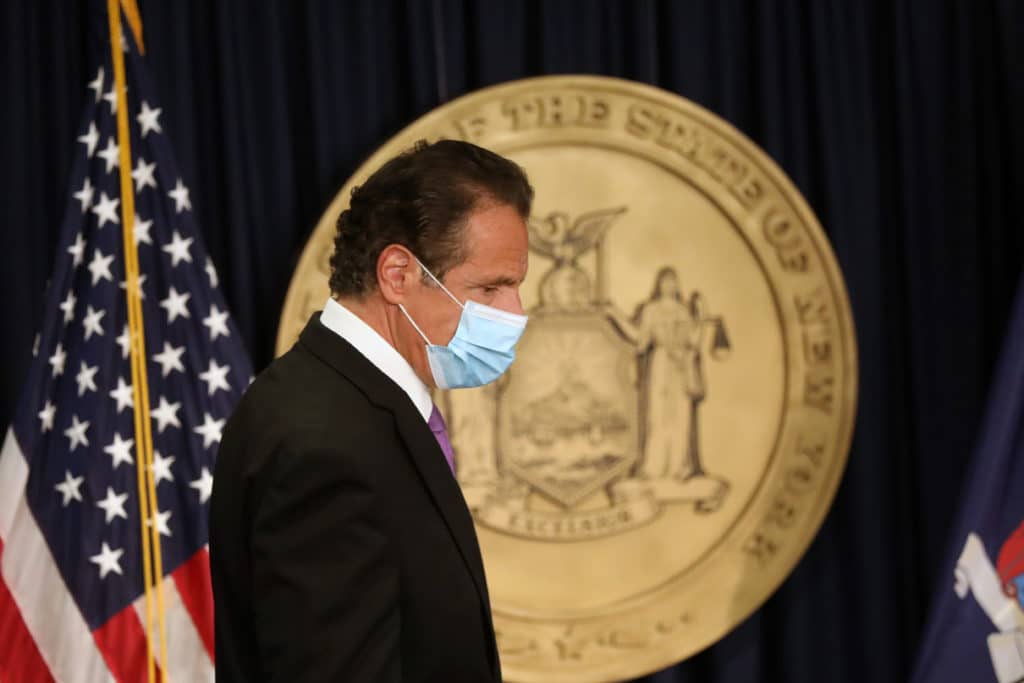
(JTA) – It won’t just be schools that close in areas of New York City with many COVID-19 cases. New York Gov. Andrew Cuomo has announced new restrictions on houses of worship, with services in some parts of the state capped at just 10 people.

The new restrictions will go into effect by Friday, as Jewish communities begin celebrations of Shemini Atzeret and Simchat Torah, the last of the fall holidays, which are generally celebrated with large gatherings and dancing.

The decision marks the first time in-person religious services, central to Orthodox Jewish communities, will be restricted since the spring. It constitutes a major blow to the communities at the end of the High Holiday season.

The rules will be applied to targeted geographic areas depending on the severity of COVID upticks, with less strict restrictions applied to the areas immediately surrounding them.

Cuomo had said Monday that he would speak to leaders of the Orthodox Jewish community about ensuring safety precautions are followed at synagogues, where, in some New York City neighborhoods, attendees say mask-wearing has remained lax even as more masks are worn on the streets. But by Tuesday, he moved forward with stricter guidelines that rolled back some of New York’s reopening phases.

The governor’s new rules designate different parts of the state as red, orange and yellow zones with red zones representing the areas with the most severe outbreaks.

In the red zones, houses of worship will be limited to 25% capacity, with services of no more than 10 people. In orange zones, 33% capacity and no more than 25 people will be the limit. Only in yellow zones will houses of worship be permitted to fill up to 50% capacity. The previous rules had allowed for services of up to 33% capacity for indoor services and no more than 50 people outdoors.

“This is about mass gatherings and one of the prime places of mass gatherings are houses of worship,” Cuomo said, showing a picture of an Orthodox Jewish prayer service. “That is the truth.”

The new restrictions also require all schools that are open for in-person learning in the yellow zones to mandate weekly testing of students and teachers. Schools in red and orange zones will have to close.

The new rules come amid a week of confusing messaging from Cuomo and New York City Mayor Bill de Blasio over how to address the rising cases in New York City. After de Blasio announced Sunday that he would move to close public and private schools in nine New York City Zip codes with COVID upticks beginning Wednesday, pending the governor’s approval, Cuomo announced Monday that he would close those schools on Tuesday, pre-empting the governor’s plan.

While de Blasio wanted to close nonessential businesses in those Zip codes as well, Cuomo did not give his approval to that plan on Monday. But by Tuesday afternoon, he said he would close nonessential businesses in certain areas experiencing upticks.

He also said he would close schools in Rockland and Orange Counties, two counties in upstate New York that are also home to large Orthodox Jewish communities and which have seen major increases in COVID test positivity rates in recent weeks.

Though Cuomo acknowledged the similarities between the situations in Rockland and Orange Counties to that in New York City on Monday, he did not close the schools in those areas when he closed the schools in New York City, nor did he explain the decision. Orange County’s health commissioner ordered schools in Kiryas Joel, a Hasidic enclave with the highest positivity rate in the county, to close Monday.

Most Orthodox Jewish schools are closed this week anyway for the holiday of Sukkot.

NY Governor Imposes New Rules on Houses of Worship, Schools and Essential Businesses Read More »

Black Musical Clergy and Jewish Cantors Come Together for ‘Voices for Change’

The death of George Floyd while in police custody on May 25 and the protests that followed were a national reckoning. Alisa Pomerantz-Boro, the immediate past president of the Cantors Assembly, the largest organization of cantors in the world, knew she wanted to use her voice for change. “That’s what cantors do,” she told the Journal. 

The chazan (she prefers that title because the Hebrew word chazan means visionary, as opposed to cantor, which means singer), said her congregation, Beth-El in southern New Jersey, has a good percentage of Black members, some of whom have belonged to the congregation for generations. 

Pomerantz-Boro said she also works with Jews by Choice, and a story one of them told her soon after Floyd’s death left her disgusted and aghast. She recounted that the person in question was a Black man who had recently converted. “He was so excited [but] as he put on his tallis, he overheard someone behind him say, ‘There goes the neighborhood.’ ” That was the moment, Pomerantz-Boro said, she knew she had to do something, noting that “music speaks louder than words.” 

To that end, she decided to bring together cantors and members of the Black musical clergy. “Any time we can show the world Blacks and Jews working together, a la Martin Luther King Jr. and Rabbi Abraham Joshua Heschel in the civil rights movement, is a good thing,” Pomerantz-Boro said. When she presented her idea to the Cantors Assembly board (of which she is a member), it was met with unanimous support.

Pomerantz-Boro said she knew the song she wanted them to sing: Richard Smallwood’s “Total Praise.” The song is a familiar one in Black churches, and the lyrics are based on Psalm 121 and can be connected to the coronavirus pandemic: “Lord, I will lift mine eyes to the hills / Knowing my health is coming from You / Knowing my health comes from God.”

When Pomerantz-Boro approached Smallwood, she said the composer was “delighted and gracious [and] taken by the idea of having cantors and Black ministers singing together, to show that equality is important to all of us and if we partner together, we can promote change and understanding and love in our world, which is so broken.” 

To help recruit and organize the 100 clergy persons, Pomerantz-Boro turned to a friend, Rabbi Jeffrey Myers of the Tree of Life synagogue in Pittsburgh, where 11 people were killed by a gunman in October 2018. Myers then reached out to Pastor Eric Manning of the Mother Emanuel AME Church in Charleston, S.C., where nine congregants were shot and killed in June 2015. Manning was one of the first people to reach out to Myers after the shooting at his synagogue.

The group also includes two cantors from the Los Angeles area, Judy Dubin Aranoff of Adat Ari El and Yonah Kliger of Temple Judea. 

Kliger told the Journal via email that he was “proud and honored that my professional organization had decided to make its collective voice heard [and show] solidarity and support and continue to build bridges.” He added that he always has been drawn to the song “Total Praise” for its powerful melody and harmonies, and while he misses the experience of leading and feeling the emotional connection of a live congregation, after nearly seven months of Shabbat services on Zoom and having recently prerecorded all of their High Holy Days services this past summer, “I am no longer a stranger to singing straight into a camera with no reaction or response from the congregation.” 

“Any time we can show the world Blacks and Jews working together, a la Martin Luther King Jr. and Rabbi Abraham Joshua Heschel in the civil rights movement, is a good thing.” — Alisa Pomerantz-Boro

Aranoff also told the Journal she had become used to singing into her computer after leading services remotely since the start of the quarantine. “This is now, sadly, the new ‘normal,’ ” she said via email. Making the video, she added, shows that “camaraderie and the attitude of cooperation that can be fostered in this restrictive environment in which we currently live, by coming together on a project of deep emotional connection for all of us. Real changes will only come with continued contact and cooperation and interaction between our communities, which I hope will be inspired by a project such as this.”

After recruiting the performers, Pomerantz-Boro said she had to come up with a visual idea that conveyed the message of equality while working within the constrictions of COVID-19 social distancing. That turned out to be each of the performers “floating in our own little worlds” that look like three-dimensional Zoom screens. As the song progresses, they grow closer. By the end of the video, they are singing side by side. 

To create the desired effect, the singers each recorded themselves, conducted by Smallwood. Bracketing the music is a dialogue between Myers and Manning, who reminds listeners that although we live in a time when “people are focusing on our differences … we realize that it’s equally, if not more, important to focus on the things that unite us.”  

Myers and Manning looked to the formation of the NAACP in 1909 for inspiration, Manning said, noting, “It wasn’t just People of Color coming together, it was also in conjunction with a lot of our Jewish brothers and sisters.” 

The video also serves as a fundraiser for the Afro-American Music Institute (AAMI) and its scholarship program. 

Pomerantz-Boro said of the project, “One person can have a dream and find the right people to help make that dream reality. … I know that my one voice can be heard in my community, but to be heard around the country, we need to have voices from across the country.”

The “Voices for Change” video can be viewed here.

Black Musical Clergy and Jewish Cantors Come Together for ‘Voices for Change’ Read More »

Palestinian Would-Be Suicide Bomber Said She Felt ‘Like a Bride on Her Wedding Day’

A Palestinian woman whose suicide bombing attempt was thwarted in 2002 said in a September Israeli television interview that she had felt “like a bride on her wedding day.”

Palestinian Media Watch reported on Oct. 5 that Shifa Al-Qudsi was describing the thwarted suicide bombing attempt, in which she was going to put 33 pounds of explosives underneath her dress while pretending to be a pregnant woman and then detonate the explosives at a Netanya supermarket. Israeli intelligence agents were able to arrest her before she was able to carry out the bombing.

Al-Qudsi told the Israeli television station that she wasn’t even “a bit” afraid about the bombing and nothing was going through her head.

“You just think … like a bride on her ‎wedding day, who is preparing to go to her groom,” she said. “That’s the only thing that ‎went through my head. I’m preparing to go to my groom. Can you imagine?”‎

Al-Qudsi served six years in an Israeli prison for the attempted suicide bombing. She claimed she was seeking revenge for her brother, who was imprisoned earlier in 2002 for wearing a suicide bomber belt. Since she was released in 2008, Al-Qudsi has been a member of Combatants for Peace Now, a nongovernmental organization that claims to be working for peace for both Israelis and Palestinians.

In 2016, Al-Qudsi was barred from entering Israel to attend a screening of the “Disturbing the Peace” documentary that she was featured in.

Palestinian Would-Be Suicide Bomber Said She Felt ‘Like a Bride on Her Wedding Day’ Read More »

A Reminder to American Jews: Civilization Is Fragile

The question I receive more than any other from non-Jews is: Why are so many Jews on the left?

The same question could be asked of Christians and other non-Jews. Why have so many mainstream Protestants and Catholics (up to and including the pope) embraced the left? Why have nearly all Black people, the majority of Latinos and Asian Americans — the most successful ethnic group in America — embraced the left? And, outside of the United States, why have most Germans, French, Canadians, Australians and others in the West embraced the left?

Nevertheless, it is valid to ask it about Jews because, if any group should be wary of dismantling a society, it is the Jews. The moment civilization begins to disintegrate, the Jews are the first victims — never the only, but always the first. That’s why Jews have so often been likened to the proverbial canary in the coal mine. 

That’s why decent non-Jews who don’t fight anti-Semitism don’t understand that anti-Semitism represents a mortal threat to them. Tens of millions of non-Jews were killed because decent non-Jews ignored Hitler early on, dismissing him and Nazism as a Jewish problem.

It is often asked how the most culturally advanced country in Europe could produce Nazism and the Holocaust. Or, as it is often put, “How did the country that gave us Bach, Beethoven, Heine and Schiller give us Auschwitz?”

One answer is that advanced culture and advanced morality are not the same. The Nazis loved classical music. The other, more important answer is that civilization is fragile because civilization consists of human beings, and human nature is profoundly flawed. Exceptional evil is as common as exceptional good. It takes a great deal of time and effort to make a decent society. But it takes little time and effort to destroy a society.

That most American Jews do not appreciate how extraordinarily decent America is — compared with other countries — proves the lack of relationship between education and wisdom and between intelligence and wisdom.

Civilization is fragile because civilization consists of human beings, and human nature is profoundly flawed.

The left in America is what it has been everywhere: a destructive force — in music, art, universities, high schools, elementary schools, economies, comedy, journalism, sports and, now, the sciences. In addition, everywhere the left gains power, it suppresses personal freedom, beginning with the most important freedom — freedom of speech. Every violent demonstration (also known as riots) over the past six months has been from the left.

Why, then, does this not frighten American Jews? Do they not know the more power the left has, the less freedom they and all other Americans will have? Do they not know how much Black Lives Matter, antifa and the rest of the left loathe Israel? Or do they not care? Increasingly, many American Jews do not care, especially young Jews, who have been raised by left-wing teachers and left-wing media. How do they not recoil when statues of George Washington and Abraham Lincoln are violently removed?

Do American Jews not know that the unique esteem in which they (and Israel since 1948) have been held in American society has been due to the Judeo-Christian roots of America’s values and its Judeo-Christian identity? Do they not know that in a post-Christian America, they will be just another minority and that, as the left gains influence, non-left Jews (specifically religious and pro-Israel Jews) will be singled out for opprobrium? Look at how Jewish students who publicly identify as Jews, let alone as pro-Israel Jews, are treated on many American campuses.

Conservatives know the answer to the question, “How did the country that gave the world Beethoven give the world Nazism?”

The answer: Civilization is fragile.

That was true in Germany, and it is true in America.


Dennis Prager is a nationally syndicated radio talk show host, president of PragerU and author of “The Rational Bible.” Copyright 2020 creators.com. Reprinted with permission.

A Reminder to American Jews: Civilization Is Fragile Read More »

‘The Home Edit’ Helped Me Create a Personal Edit for 5781

Despite my appreciation for the ideal of a tidy home, I never fell under the spell of the decluttering guru and cultural phenomenon Marie Kondo. At least 11 million people who bought her book disagreed with me and sparked joy by parting with extraneous belongings. Luckily (or unluckily) for me, my heart still rejoices when I peruse saved letters from former students or decades-old challah covers with the painted toddler handprints of my now college-age children.

However, six months into the pandemic, my shelves and kitchen cabinets have experienced a fair amount of weight gain: clothes, sports equipment, books, dog toys and “junk.” It was time for the house to slim down.

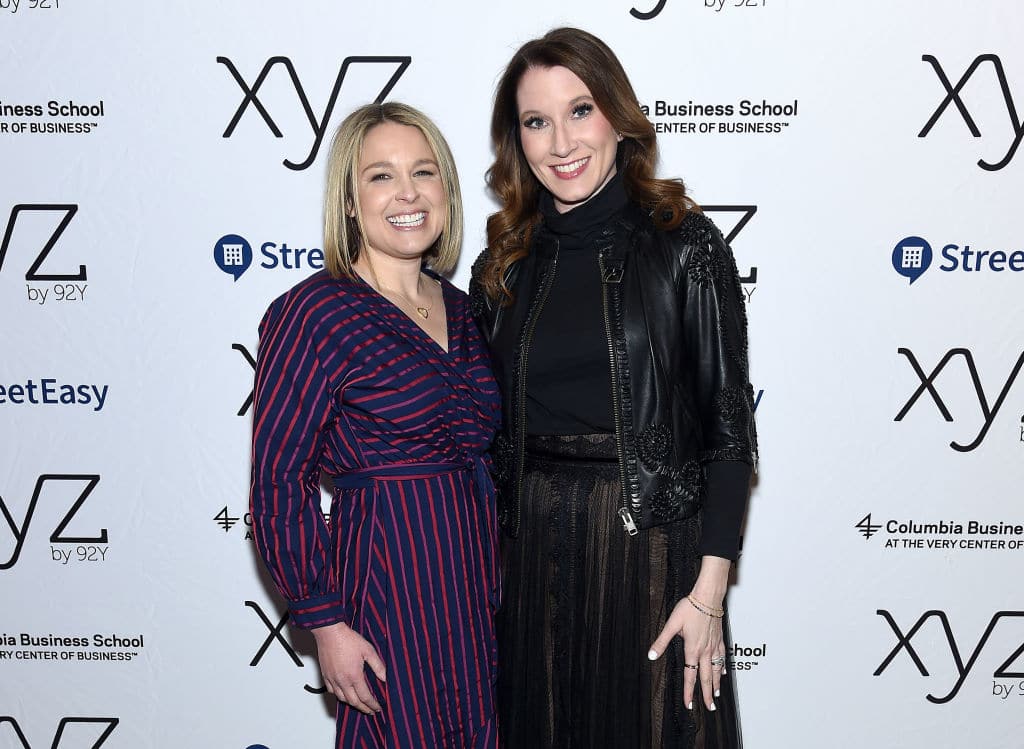
Eager to learn from others, I watched “Get Organized with The Home Edit” on Netflix. Organizers Clea Shearer and Joanna Teplin run their own business, and the series features them making clutter vanish for both celebrities and ordinary folks. The episodes follow the team as they transform closets and garages into attractive and workable spaces by putting the saying, “A place for everything, and everything in its place” into action. 

I almost turned off the program when they began categorizing books according to the color of their covers. Yet the unbridled enthusiasm these professionals exude reminds me of my own joyful reaction to hoped-for positive pregnancy tests years ago. These people really love their work.

https://www.instagram.com/p/CFspUzdBvwx/?utm_source=ig_web_copy_link

As a rabbi, I appreciated that the first season of “The Home Edit” dropped about a week before Rosh Hashanah. While Passover is the springtime holiday most closely associated with home cleaning and organizing (the word seder literally translates as “order”), I found the timing to be just right. Shearer and Teplin encourage their clients to articulate practical goals, purge unnecessary detritus, take stock of familiar spaces with fresh eyes and, above all, not jam all their accessories into a junk drawer. 

These lessons apply to straightening up a physical space as well as a human soul.

Television loves a great makeover show. Who doesn’t feel a twinge of satisfaction when a shabby and messy room is transformed into a sparkling oasis by a fairy godmother’s magic wand (or, in this case, plastic bins)? With external and physical changes, the subjects of these makeovers might now experience newly acquired confidence, calm and fulfillment — or so the television producers would like us to believe.

As a rabbi, I appreciated that the first season of “The Home Edit” dropped about a week before Rosh Hashanah. While Passover is the springtime holiday most closely associated with home cleaning and organizing (the word seder literally translates as “order”), I found the timing to be just right.

Rosh Hashanah pops up at the start of the seventh Hebrew month and offers us the opportunity to make over our spiritual selves in the midst of our own messes and busy lives. Rather than edit our living spaces, we seek to revise our inner lives. We don’t have a team of professional organizers carting in elegant boxes and fancy labels with bespoke blue calligraphy to convert our closets into inner sanctums of tranquility. But we do have thousands of years of tradition, prayers and music reminding us that improvement is not only possible but also necessary for our survival.

Following Shearer and Teplin’s template for change, at the start of the Jewish New Year, we first come up with some goals: to become more patient with our children and partner? To learn a new skill? To take more time to listen to others and less time to talk? Then, we categorize, contain and make tough choices. What behaviors should we hold on to for 5781 and which ones need to be put to rest, or at least out of sight and into storage? 

May we fill the spaces in our hearts and between us and others with peace, happiness, blessing and compassion. That’s a home improvement that can start now or at any time. No plastic products required.


Rabbi Sharon G. Forman is the author of “The Baseball Haggadah: A Festival of Freedom and Springtime in 15 Innings” as well as numerous essays about Judaism, education and parenting. She lives in Westchester County, N.Y., with her husband and three children.

‘The Home Edit’ Helped Me Create a Personal Edit for 5781 Read More »

david suissa podcast curious times

Pandemic Times Episode 93: What Happens To Us When Too Much Is Happening?

New David Suissa Podcast Every Tuesday and Friday.

As crises converge and climax, how do we keep our balance and sanity?

How do we manage our lives during the coronavirus crisis? How do we keep our sanity? How do we use this quarantine to bring out the best in ourselves? Tune in and share your stories with podcast@jewishjournal.com.

Pandemic Times Episode 93: What Happens To Us When Too Much Is Happening? Read More »

Schools in Kiryas Joel, Upstate NY Hasidic Enclave, to Be Shuttered Amid 27.6% COVID Positivity Rate

(JTA) – The county health commissioner in upstate New York’s Orange County issued an order Monday closing schools serving students from Kiryas Joel, a community made up of mostly Satmar Hasidic Jews.

The village has the highest COVID positivity rate of any town or village in the county, according to the commissioner’s order, with 27.6% of COVID tests confirming a positive result in a three-day average. Schools for whom a majority of students come from Kiryas Joel and Palm Tree, a town that overlaps with Kiryas Joel and which is also largely Hasidic, will be closed for at least two weeks or until the village and town’s seven-day rolling average positivity rate drop below 9%.

The community has been experiencing a major outbreak of COVID-19 for weeks, with a local branch of Hatzalah, the Jewish ambulance corps, issuing a warning and Rabbi Aaron Teitelbaum, the leader of the local Hasidic community, choosing to stay in the village for the Jewish holidays instead of traveling as he normally does.

The school closure order comes as hundreds of schools are being closed in nine New York City Zip codes with large Orthodox Jewish populations due to an uptick in COVID cases in those areas.

As in the Orthodox communities in New York City, several Orthodox communities in upstate New York have been experiencing new upticks of COVID-19 cases. In Orange County, the COVID test positivity rate was 7.4% on Oct. 4, the most recent date for which data is available. In Rockland County, also home to a number of large Orthodox communities, the positivity rate was 9% for Oct. 4.

New York Gov. Andrew Cuomo addressed the increasing positivity rates in several parts of the state with large Orthodox communities in a press conference Monday where he announced the New York City closures, which accelerated by one day a closure timeline set by the city’s mayor. Although he noted that positivity rates were similarly high in counties in upstate New York as well as in parts of New York City, Cuomo declined to close the schools in the upstate counties. He did not explain his decision.

Schools in Kiryas Joel, Upstate NY Hasidic Enclave, to Be Shuttered Amid 27.6% COVID Positivity Rate Read More »

Columbia’s BDS Motion Misses the Point About Dialogue

Last week, students at Columbia University passed a resolution calling for boycotting and divesting from Israel. Their motion, sponsored by the Boycott, Divestment and Sanctions movement (BDS), asserts that any commercial or intellectual connections to Israel “fall under the UN International Convention’ for both the suppression and punishment of the ‘Crime of Apartheid.’”

For me, this news is personal. I received my BA and PhD in English from Columbia, the latter during the 1980s, when the powerful cocktail of French deconstruction and American neo-Marxism first united literary theory and political activism. The most visible version of this hybrid was Professor Edward Said, an outspoken supporter of the Palestinian Liberation Organization (PLO) and the person with whom I studied the novels of Thomas Mann, Joseph Conrad and Marcel Proust. Some members of my graduate student cohort are today practitioners of that 80s cultural worldview. Others lament how that perspective, now an orthodoxy, increasingly encroaches on their teaching and academic writing.

It is no wonder, then, that the BDS resolution passed at Columbia, where activists were supported by some professors, who took advantage of credulous students in their attempt to celebrate ideology over nuance.

Paradoxically, in the English Department at Bar Ilan University in Israel where I teach, we have a greater chance of creating genuine dialogue between different groups of Israelis —Muslims, Jews and Christians. And that takes place in a country where ideologies can be dangerously out of control.

Through the shared experience of listening, over time, to books, students eventually start to listen to each other.

Here’s the truth about Israel: Attempting to create a democracy forged in the cauldron of Zionism makes, at best, an unstable alloy. Israeli democracy may involve unresolvable contradictions, but in a region where liberal educational and political traditions are imports, we are trying. Israelis, like Americans, fail to recognize diversity and acknowledge structural inequalities in our society. Nor are we always proud of the leaders who speak in our name.

But unlike some students at Columbia, I don’t call my centrist relatives in America and ask them to renounce their country because of President Donald Trump’s cruel, autocratic and increasingly persecutory regime. Nor would I boycott their professors or students. Yet Columbia students are informed to pass judgment on their Israeli cohorts because, as many BDS supporters believe, there is no Israel.

The BDS movement works hard to influence university students and the professors in the Humanities who support their cause. An increasingly prevalent story told among humanities professors is what they would call a ‘meta-narrative,’ in which Israel stands for all of the evils of the West — religious, political and economic. Consider the most recent and most outrageous example: A professor at San Francisco State University hosted an event with Leila Khaled, a member of the People’s Front for the Liberation of Palestine and the first woman to hijack an airplane. Israelis should not waste time apologizing to spectators in the United States who use Israel to express their fundamentalist politics.

Although many of my American colleagues plan their pedagogy around the demands of identity politics, my Israeli Arab and Jewish students do not. We succeed in creating dialogue because we don’t think it’s easy — that, for example, the conviction that diversity is good will magically transform discord into community. Last year, for example, it was only after a full semester and a visit to the gallery in the Israel Museum in Jerusalem (which housed the ruins of a 6th century mosque, synagogue and church) did first-year students begin to open up to each other. Understanding shared history, traditions and responsibility— despite our differences — allows for the beginnings of dialogue. It takes time and great effort to teach students to listen and understand that they can learn from a tradition not their own, without giving up their identity.

How do we achieve this nuance at Bar Ilan? First, we find ways for literary works to speak to our students, and we emphasize that you don’t have to take off your hijab because you love Shakespeare; stop wearing ritual fringes because you really like the Christian poet John Milton; or, for that matter, renounce your feminism because you like Ernest Hemingway. Through the shared experience of listening over time to books, students eventually start to listen to each other. We do not, as has become normal in most humanities classrooms, stand above literary texts — at least not right away — and point out ways in which they fail according to our contemporary standards. We listen and learn.

But listening is not enough. You have to become accustomed, as one student wrote after our museum visit, to tell your story with kindness. This means not negating the experience of others and leaving a space for them to tell their stories. Only in this way can other stories exist. We know our conversations about “Pride and Prejudice” will not bring down Prime Minister Benjamin Netanyahu’s government or end the Occupation. But we will not stop working, through reading, to build a community based on tolerance and eventually, hopefully, respect.

My students and colleagues do not have time for the sloganeering and empty abstractions of students and professors in America. With violence in our midst, we Israelis feel the urgency to learn from each other. So, let Columbia students do their virtue-signaling about apartheid.  Here in Israel, we have work to do.

William Kolbrener writes about English literature, Jewish philosophy and contemporary anti-Semitism.  His 2016 book, “The Last Rabbi: Joseph Soloveitchik and Talmudic Tradition” was published by Indiana UP. His newest book, “Literature and the Sacred: God and Reading in the Time of COVID-19,” is forthcoming.

Columbia’s BDS Motion Misses the Point About Dialogue Read More »