Facebook and YouTube shut down the online San Francisco State University (SFSU) event featuring Popular Front for the Liberation of Palestine (PFLP) member Leila Khaled.
SFSU professor Rabab Abdulhadi, who was set to co-moderate the event, announced Sept. 23 on her Facebook page that Facebook had taken took down the event page as well as the link to the webinar. Abdulhadi later announced that “YouTube shut us down. If SFSU Administration has stood by us and if SFSU President did not join the Zionist chorus, we would not be here today.”
YouTube streamed the event for about 23 minutes before it went dark, the Jewish News of Northern California (J) reported. The stream ended when a clip of Khaled was played in which she defended her prior involvement in airplane hijackings in 1969 and ’70, saying “People have the right to fight those who occupy their land by any means possible, including weapons.” The page for the YouTube stream now states that the video was removed because it violated YouTube’s terms of service, according to the J.
Facebook and YouTube’s actions came after Zoom announced on Sept. 22 that it would not host the Khaled event on its platform, citing Khaled’s membership with “a U.S. designated foreign terrorist organization.”
SFSU President Lynn Mahoney wrote in a Sept. 23 email to the campus community that the university didn’t agree with Zoom’s decision, according to The Forward.
“The University does not believe that the class panel discussion violates Zoom’s terms of service or the law,” she wrote. “The University has also shared with Zoom the assurances received from the faculty members that: Ms. Khaled is not speaking as a member, representative, spokesperson, or surrogate for the Popular Front for the Liberation of Palestine; and Ms. Khaled is not receiving compensation from the University of any kind for her participation in this event. Speaking through their legal counsel, the faculty members have also assured the University that they have no intention of violating the law.”
She went on to state, “We cannot embrace the silencing of controversial views, even if they are hurtful to others,” Mahoney wrote. “We must commit to (free) speech and to the right to dissent, including condemning ideologies of hatred and violence against unarmed civilians.”
Abdulhadi blamed Mahoney, saying that the university of responded with “radio silence” when she reached out to campus officials for alternative platforms to hold the webinar.
“The question is why are Palestinian narratives exceptionalized and why SFSU president siding with Zionist defamation, silencing and bullying?” she wrote.
Joe Catron, the U.S. coordinator of the Samidoun Palestinian Solidarity Network, tweeted that the webinar will be recorded and distributed “one way or another.”
To be clear, @AmedStudies’ event, “Whose Narratives? Gender, Justice and Resistance: A Conversation with Leila Khaled,” is still taking place and being recorded, and the video will absolutely be distributed widely, one way or another. https://t.co/FECQ3uXmVY
Khaled had been slated to speak as part of SFSU’s Arab and Muslim Ethnicities Diaspora (AMED) Studies department’s Zoom webinar. Other panelists included Rula Abu Dahou, acting director of the Institute for Women’s Studies at Birzeit University in the West Bank; South African politician Ronnie Kasrils; former Black Liberation Army member Sekou Odinga; and Jewish Voice for Peace member Laura Whitehorn. Abdulhadi and Tomomi Kinukawa, who is also an SFSU professor, had been slated to co-moderate the panel and the event.
The American Jewish Committee tweeted, “Thank you to @Facebook and @Google for joining @Zoom_us in recognizing this event for what it is: incitement to violence. Still waiting for @SFSU to come to the same realization.”
Thank you to @Facebook and @Google for joining @Zoom_us in recognizing this event for what it is: incitement to violence. Still waiting for @SFSU to come to the same realization. https://t.co/JUpsMNYopP
StandWithUs CEO and co-founder Roz Rothstein similarly tweeted, “BRAVO YOUTUBE, FACEBOOK and ZOOM for cutting off the ability of this absurd and dangerous propaganda program with convicted Palestinian terrorist hijacker Leila Khaled, to be shown on your platforms. SHAME ON @SFSU.”
BRAVO YOUTUBE, FACEBOOK and ZOOM for cutting off the ability of this absurd and dangerous propaganda program with convicted Palestinian terrorist hijacker Leila Khaled, to be shown on your platforms. SHAME ON @SFSU@StandWithUshttps://t.co/kzRUCQjmx9
United States Ambassador to the United Nations Kelly Craft told the news outlet Al Arabiya that another Arab nation is going to sign a peace agreement with Israel in the “next day or two.”
Her comment to Al Arabiya reads in full: “Our plan is to bring more countries, which we will have more being announced very soon …. One [country will sign] in the next day or two. I know others are going to be following.” Craft also expressed hope that Saudi Arabia eventually will normalize ties with Israel and added that it’s important to ensure that the Iranian government doesn’t “exploit the goodwill of Bahrain, the United Arab Emirates (UAE), or Israel. We want to bring everyone on board in hopes that this will allow the Iranian citizens to see that people really want peace in the Middle East, and they are part of this peace.”
Craft’s comments come after Palestinian Authority (PA) Social Affairs Minister Ahmed Majdalani told the Israeli public broadcasting radio outlet Kan that Comoros, Djibouti, Mauritania, Oman and Sudan have been in negotiations to normalize ties with Israel. President Donald Trump said after the Sept. 15 signing of the diplomatic agreements between Israel and Bahrain and Israel and the UAE that seven to nine countries could soon follow with agreements, including Saudi Arabia.
However, the Saudis have publicly stated that the Gulf Arab nation won’t normalize ties with Israel until a two-state solution is reached with the Palestinians.
PA Foreign Minister Riyad al-Maliki told the Arab League on Sept. 22 that the PA won’t be chairing the Arab League because “there is no honor in seeing Arabs rush towards normalization during its presidency.” The Palestinians view the agreements with Israel as a betrayal because a unified Arab bloc was seen as a bargaining chip in talks to establish a Palestinian state.
Whatever else may transpire during the craziness of 2020, Jewish Angelenos can be secure in the knowledge that any in-home gatherings they hold during the holidays will not be interrupted by raids by Los Angeles County Sheriff’s deputies and subsequent hefty fines in the name of preventing the spread of COVID-19.
Could such a scenario have been possible? Perhaps not, but a local rabbi was concerned enough to enlist a well-known legal organization dedicated to religious freedom with an eye toward clarifying the county’s intent and quashing any proposed threat.
Earlier in September, the county had implemented a coronavirus health order that specifically called out having dinner with extended family and friends “to honor the high holidays (Rosh Hashanah and Yom Kippur).” As the holidays approached, the county changed the language of the order to reference “religious or cultural holidays” instead of calling out the Jewish observances specifically.
But members of the Jewish community still interpreted the order as specifically targeting their holiday observances. Agudath Israel California CEO Rabbi Yisrael Gelb hired the Texas-based First Liberty Institute to file a formal objection and urge the county to lift the order. The petition was filed on Sept. 16.
The petition stated, in part, “The burden of this policy is particularly heavy on members of the Orthodox Jewish tradition. … In accordance with millennia-old tradition, Rabbi Gelb intends to gather with another family to observe the High Holy Days safely in the host family’s home. Los Angeles County now has the opportunity to demonstrate whether it intends to follow through on its threat to criminalize the observance of the High Holy Days at a family’s dinner table or whether its profoundly disrespectful language was a mere empty threat. The county must immediately remove all language from county policy threatening to police small, religious gatherings at family homes.”
According to First Liberty Senior Partner Stephanie Taub, violations of these types of orders historically have warranted fines of up to $1,000. Even in the wake of COVID-19, however, L.A. County has not been enforcing bans of small gatherings. Taub told the Journal she did not expect there to be a crackdown on holiday assembling either.
“That’s what makes this even more egregious,” Taub said. “Even though they’re not enforcing it, they still list it as an example of prohibited conduct. So along with gathering with friends at the beach, they list meeting with your extended family to celebrate the most holy days of the Jewish calendar.
“They haven’t enforced this when they have had mass protests of 100,000 people marching through Hollywood,” she added. “It just shows a disrespect that they would single out these Jewish holidays as they did in this policy.”
Asked for its response to the First Liberty petition, L.A. County released a statement emphasizing its commitment to “protecting the health and safety of its residents through an unprecedented crisis.
“We recognize that religious services are central to many of our residents’ lives, especially in these trying times,” the statement continued, “and religious services have been allowed to be held online and outdoors with physical distancing and the use of face coverings, and they may continue to be held with those public health safeguards in place.”
In a subsequent email to First Liberty, the county’s legal counsel, Mary Wickham, addressed Taub’s concern that small, in-home holiday gatherings might result in raids, fines or other strict measures of enforcement.
“You … have asked whether Los Angeles County will ‘dispatch Los Angeles County Sheriff’s deputies to the homes of Jewish families gathered for religious meals during the High Holidays inside someone’s homes,’ ” Wickham wrote. “The answer to that question is no.”
“Our client and the Jewish residents of Los Angeles County can breathe a little easier,” Taub said. “Our Jewish neighbors are strong and resilient and simply want to share a table with their local families during the High Holidays in peace.”
BERLIN (JTA) — The protective locked door had kept out the shooter.
One year ago, that was the bright spot in the aftermath of the attempted synagogue shooting on Yom Kippur in Halle, a sleepy city of 240,000 located about 100 miles southwest of Berlin.
It was the most frightening terrorist attack targeting Jews on German soil in recent memory, and many saw it as symbolic of rising anti-Semitism and right-wing extremism across the country. But there was also a somewhat encouraging result: The synagogue’s security system had done its job.
The attacker, a neo-Nazi sympathizer named Stephan Balliet, tried to enter the building, but the main door had withstood his guns and homemade explosives. He instead shot and killed a passerby before firing into a nearby Turkish kebab shop, killing a customer. No one inside the synagogue was physically injured — some even kept the Yom Kippur service going through all the turmoil unfolding outside.
However, in the months that followed, a fuller and more disturbing narrative about the attack surfaced.
Local police admitted that they had no idea about the Yom Kippur holiday, which brought a larger than normal number of Jews together. About 20 young Jews had also traveled down from Berlin to observe the holiday in Halle on a trip organized by the Base Berlin/Hillel Deutschland, a pluralistic Jewish home in the city that hosts events and learning sessions.
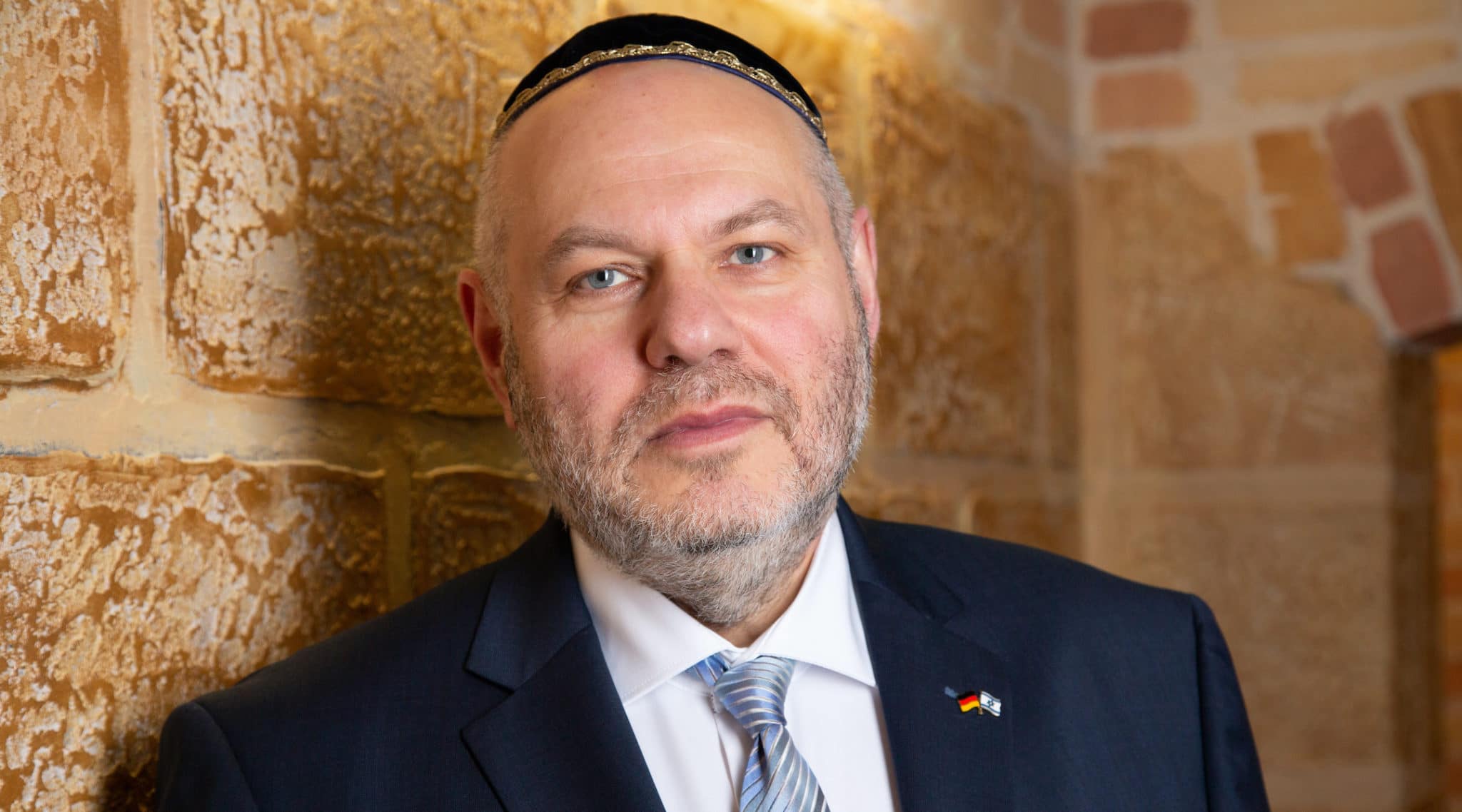
According to Max Privorozki, the chairman of the Jewish Community of Halle organization, it took the police 10 minutes to arrive at the synagogue after he called to report the attack. He has become the public spokesman for Halle Jews, a community made up mostly of Russian immigrants who are wary of speaking to the media and Holocaust survivors.
“In my opinion, they were too slow,” Privorozki said of the police. “I think when there’s a report coming from a synagogue of an attack, then they need to be there immediately with all their power.”
Police captured the gunman after a 50-mile chase.
When Christina Feist, one of the visitors from Berlin, arrived in front of the Halle synagogue, she said she immediately noticed a lack of security compared to other Jewish institutions in Europe. The 30-year-old Vienna native had come to Berlin for a doctoral program that required her to split time between the German capital and Paris.
“Wherever shul is is where the police are,” she said. “I was pleasantly surprised in my naive conception that hey, maybe Halle is the place where you do not need police to be in front of shul because there is no anti-Semitism.”
Inside, Feist asked the synagogue’s cantor about the situation. She recalls the cantor telling her that the synagogue had made requests for security but nothing had happened to that point.
The police have claimed that the congregation did not request any security for Yom Kippur. Privorozki has disputed that charge, claiming that the State Association of Jewish Communities in Saxony-Anhalt sends the city an updated Jewish calendar every year along with an explanation of the most important holidays.
Christina Feist was surprised by the lack of security presence at the Halle synagogue before the attack. (Ina Breust)
A cultural chasm
In general, survivors have also complained of a general lack of compassion they say police showed them, allegedly treating them as suspects instead of victims. For example, the police are alleged to have made it difficult for the survivors to retrieve their kosher food after the attack to break the Yom Kippur fast. Later at the hospital, the survivors continued their service, only to allegedly be interrupted by police.
“In the middle of the prayer, the police came and said they had to debrief us immediately,” recounted Rabbi Jeremy Borovitz, one of the Base Hillel trip’s organizers. “I resisted and said that they would have to wait 20 minutes until we finish before we can talk. They were angry and frustrated, saying that the debrief was more important than our prayer. The only reason they didn’t manage to break up the prayer was that one of the hospital’s managing directors told them to stop intervening and let us finish.”
Privorozki argues that the causes of this schism between local Jews and police “lies much deeper” than the police response to the attack. He says there is a broader lack of education concerning Jewish culture in Germany, and a stark divide between Jews and non-Jewish Germans throughout the country.
“What the police don’t know isn’t their fault, Privorozki said, “but rather the fault of whoever is responsible for giving them all the information they need to do their job well.”
It’s something that Jewish institutions are working to address. The Central Council of Jews in Germany, the country’s umbrella Jewish organization, launched a program earlier this year called “Meet a Jew,” designed to increase contact between Jews and non-Jews.
Max Privorozki is the spokesman for Halle’s Jewish community. (Courtesy of Ella Privorozki)
“We realized a lot of people in Germany don’t know Jewish people in person,” project coordinator Mascha Schmerling said. “The knowledge that they have about Jews comes from history books, from school, or it’s connected to the Shoah or current anti-Semitism or sometimes through the policies of Israel.”
Hetty Berg, the new director of the Jewish Museum of Berlin, has also told the Jewish Telegraphic Agency that she would like the museum to do more to connect with local non-Jewish communities.
But the claims of cultural insensitivity have persisted throughout the trial of the shooter, which is taking place in Magdeburg, a city between Halle and Berlin. Survivors of the attack have been making the trip from both cities to give their testimony in support of the 43 co-plaintiffs.
Trauma in public
Last year’s Yom Kippur was supposed to be a unique experience shared by different communities. Privorozki said that he and the rest of the mostly older Halle community — about 530 members, compared to 740 in 2005 — were excited to hear about the bus of young visitors.
“The idea was to support the local community and bring new energy into shul,” Feist said. “They welcomed us and it was really nice.”
After the attack, locals were reserved in sharing their experiences. Some of the visitors, however, have spoken and written about their experiences openly.
And Privorozki has been public about his grievances with the press, saying the experience has been “ganz negative” or “completely negative,” with few exceptions.
“I can understand that there was an attack, it’s a rare event, it’s out of the ordinary,” he said. “But it seems, regardless of the country, the media didn’t understand that we were in a very challenging situation.”
Above all, Privorozki is tired of answering what he calls “the most unpleasant question,” the question he’s asked the most by the media — to recount his experience on the day of the attack.
“You need to understand, I don’t want to relive that day,” he said. “I’d really like to never speak about it because when I speak about it, the events are once again woken up in my head. I’ve experienced something in my life that I’ve never experienced before and hope to never experience again.”
That said, Privorozki has resigned himself to the fact that it’s his obligation to tell the story on behalf of a community that for personal reasons has refused to speak to the press.
“I’m the chairman of the community and have certain obligations regardless of whether or not I like it,” he said.
Following the attack, Feist felt herself tensing up whenever she visited Berlin. In the months after, she felt panicked and triggered in crowded spaces or whenever she heard a loud bang. She signed up for boxing lessons to deal with the trauma, but it became clear quickly that she needed therapy as well.
Mollie Sharfman, another visitor from Berlin, walked out after the morning Yom Kippur service for a quick break, expecting she’d be right back, and missed the attack. Still, she is acutely aware of the fact that had she left a few minutes later, she could have encountered the gunman in the street. She displayed similar traumatized symptoms and began therapy, too.
“The most helpful therapy was EMDR Trauma Therapy [Eye Movement Desensitization and Reprocessing],” Sharfman said. “It helped me see past the current situation and see a bright future again.”
Mollie Sharfman, standing outside of the Halle synagogue, had left the building early before the attacker showed up. (Amie Leibowitz)
Moving on, this year and beyond
Due to the ongoing pandemic, Privorozki explained that this year’s services will not take place in the synagogue but in a larger rented hall so that more members can attend while adhering to social distancing guidelines.
Base Berlin, the organizers of the bus trip to Halle last year, will mark the anniversary with a Festival of Resilience in Berlin, in a beer garden and park, where the community will reflect on the healing process throughout the year since the attack. It will also “underline the importance of developing and expanding support based on education and culture,” according to an online description.
For Privorozki, the most important thing to reflect on is the fact that two people lost their lives. It’s impossible for him to put that aside, but as things stand, he’s actually optimistic about the future of Jewish life in Germany.
“The reaction from regular people in and outside of the city leaves me more optimistic than before the attack,” he said.
Privorozki expected to hear from presidents and politicians, but he never expected such an outpouring of support from the non-Jewish community. He referred to the 400 children from schools in Halle who visited the synagogue to show their support and to the 2,000 people who made a chain next to the synagogue two days after the attack, on Shabbat, “to show that they are with us.”
“Our synagogue was attacked twice,” he said. “Once on Nov. 9, 1938 — Kristallnacht — and last year on Yom Kippur. The difference is the reaction from people. Back then, people either welcomed it or took part in it. Now people are on our side.”
Feist spends most of her time now in Paris and only returns to Germany to witness the testimony at the trial in Magdeburg. She has testified herself and said it was an important step in the process of coping with her trauma. But she has plans to observe Yom Kippur again with the community in Halle.
“It was the first thing I decided last year after Yom Kippur,” she said. “I took a good year to figure out if I really want to do this and I stand by it.”
Feist said she will return to Halle to stand with the community, but she also views it as an opportunity “to go full circle” with her experience, to help herself heal.
“There’s no place on Earth, no building, nothing that’s a piece of me except for that shul,” she said. “I am fiercely protective over it and the entire community. I really want to be there.”
Less than a week ago, for the first time in my life, I blew the shofar on Rosh Hashanah. I have a short, black shofar that’s relatively easy to blow. I bought it on Sept. 17, the day before the holiday began, at a small Chabad shop not far from where I live.
Because I have some experience playing trumpet, clarinet, flute and other brass and wind instruments, I figured that the challenge would be manageable. Indeed, it was. On Sept. 20, we climbed onto the roof, recited the blessings, and let the whole neighborhood know that a new year was upon us.
In a year like no other, it was a Rosh Hashanah like no other. On the eve of the holiday, Israel was placed on lockdown, at least officially. Having failed to contain the spread of the coronavirus, the government imposed restrictions on movement, congregation and activity. Some of these rules were meant to make the synagogues less dangerous to our collective health. It was ordered that only small groups could pray together, preferably outside, or in “capsules” separated by partitions.
I decided not to trust the rules, the government or the synagogue. The road to hell is paved with good intentions. And in Israel’s case, the road to confusion and insubordination is paved with the same bricks. I knew from experience that in many synagogues the rules aren’t taken seriously. And when they are, they aren’t strictly practiced. And when they are, they are insufficient. People get infected at the synagogue. So the choice was simple: Visit a synagogue at your own peril or avoid it and set up your own holiday show.
Such dilemmas are becoming everyday life in Israel. Workplaces are open (except for those, like stores or restaurants, that must engage with the public), but schools are closed. Some people must find a way to go to work without having any arrangements for the kids — unless they leave the kids with a relative who’s not sheltering with them. But that violates the edicts. Or take them to work. Also a violation. Or send them to a friend’s house. Also a violation. So parents end up breaking the rules by skipping work or by having contact with a relative who’s not sheltering with them. Some have lost their jobs.
In a year like no other, it was a Rosh Hashanah like no other.
Had Israelis been certain that the lockdown would stem the spread of the virus, they might be somewhat understanding, somewhat cooperative. But government officials continue to say it’s not enough. They say the policy issued by the government won’t work. What this means is that Israelis are going to pay a heavy price — claustrophobia, economic hardship, job loss, loneliness — without any benefits. When the High Holy Days are over, the government is going to tell Israelis that they need to continue the lockdown, or implement stricter rules, or whatever. In the meantime, hospitals are becoming crowded and the death toll rises daily.
Israel is spiraling and there’s no pilot. Or maybe our problem is too many pilots are pulling us in different directions. Or maybe it’s Israelis — the passengers — who make it impossible for the pilot to take back control.
That’s probably it. The pilot lost control and, with it, the passengers’ trust. When Rosh Hashanah ended, thousands protested shoulder-to-shoulder in Jerusalem. Thousands more drove their cars from city to city and lied to officers who questioned them at roadblocks about where they were going or where they’d been. Thousands more said goodbye to their families, having spent the holiday together, against the rules.
In short, when the pilot is finally trying to control the plane, Israelis won’t let him. The pilot says, “Lockdown” — and we say, “Been there, done that”; “won’t work”; “can’t stand it”; “don’t believe you”; “what about prayers”; “what about protest”; “what about shopping”; “what about schools”? The pilot says, “Trust me.” We burst into bitter laughter. The pilot says, “There’s a pandemic.” We say, “Where? We can’t see anything because of our masks.” The pilot asks, “Are you finally wearing masks?” We laugh again.
If you haven’t been humbled by 2020, then you’re not telling the truth.
How can anyone not be humbled by 2020?
Our lives, our societies, our everyday habits and our economy all have been turned upside down by the pandemic. Even our buildings have been humbled. Thousands of synagogues across the country were empty on Rosh Hashanah. How is that not humbling?
Many of us have responded to this year of calamity by looking for any silver lining that would strengthen us— by finding things to still be grateful for; by reminding ourselves of the resiliency of our tradition; by focusing on doing good deeds, and so on.
But as we approach Yom Kippur, I’d like to suggest another kind of silver lining, one that won’t necessarily make us stronger. It is, however, the most crucial ingredient for a meaningful Yom Kippur and the dominant emotion of 2020: humility.
What do we need most to look honestly at ourselves and own up to our sins? Humility.
What do we need most to recognize that there is a Divine presence in the world that transcends time and space? Humility.
What do we need most to admit to our spouse, our child, our parent, our friend, our sibling, our neighbor that we were wrong? Yes, humility.
In other words, without humility, it’s hard to even begin to do the real work of Yom Kippur.
I can’t say I have ever approached the High Holy Days with the humility I feel this year. But I take no credit. This humility was showered on me by a perfect storm of crises none of us could ever have predicted. It’s built-in humility.
If we don’t take advantage of this built-in humility during Yom Kippur, it will all go to waste. If we continue to look only for things that strengthen us, we will squander the power of feeling vulnerable.
Yom Kippur counts on us to feel vulnerable. It is through feeling vulnerable that we open the hidden vessels of growth and healing.
Yom Kippur counts on us to feel vulnerable. It is through feeling vulnerable that we open the hidden vessels of growth and healing.
That look of confidence that helps us win at the game of life? It’s useless on the Day of Judgement. There’s no need to act strong on Yom Kippur, or look like we’ve got our acts together. We don’t. None of us have our act together during this pandemic year. Let’s admit it. Let’s face it. Yom Kippur is the perfect time to do that.
To make this the most meaningful Yom Kippur of our lives, we need to be inspired by vulnerability.
(JTA) — President Donald Trump said Jews “stick together” and are “only in it for themselves” following conversations with Jewish lawmakers, The Washington Post quoted senior White House officials as saying.
The quotes are in a lengthy article quoting anonymous current and former officials describing how Trump treated race in private conversations. The Post did not add further context to those two partial quotes except to say that by “sticking together,” Trump appeared to mean that the loyalty of Jews to one another exceeds all others.
Many of the quoted broadsides echo remarks Trump has said in public, perhaps in slightly less blunt terms. In the run-up to the 2016 election, he told Republican Jewish donors, “You’re not going to support me because I don’t want your money. You want to control your politicians.”
The story posted Wednesday adds detail to the protests among his staff sparked by his equivocations following the neo-Nazi march in 2017 in Charlottesville, Virginia, that turned deadly.
Trump on the day of the protest, in which a white supremacist killed one protester and injured 20 others, said there was violence from “many sides,” although the violence overwhelmingly came from the side of the white supremacists.
When Gary Cohn, then the White House economic adviser, confronted Trump about the remarks and threatened to resign, Trump denied saying “many sides.”
“Not only did you say it, you continued to double down on it,” Cohn, who is Jewish, reportedly told Trump. “And if you want, I’ll get the transcripts.”
Trump relented and two days after the march unequivocally condemned neo-Nazis and white supremacists — although he subsequently equivocated again, describing “fine people” on both sides of the events.
A White House spokeswoman disputed the characterizations to the Post.
“Donald Trump’s record as a private citizen and as president has been one of fighting for inclusion and advocating for the equal treatment of all,” she said.
I cooked meals for my family for Rosh Hashanah. I reviewed the service I planned to lead that night, from my home. I knew this holiday would be weird – no big, in-person family meals or services, only Zoom. But if ever I needed a new beginning, it was now. I wanted to put 5780 into the trash bin and start over in joy.
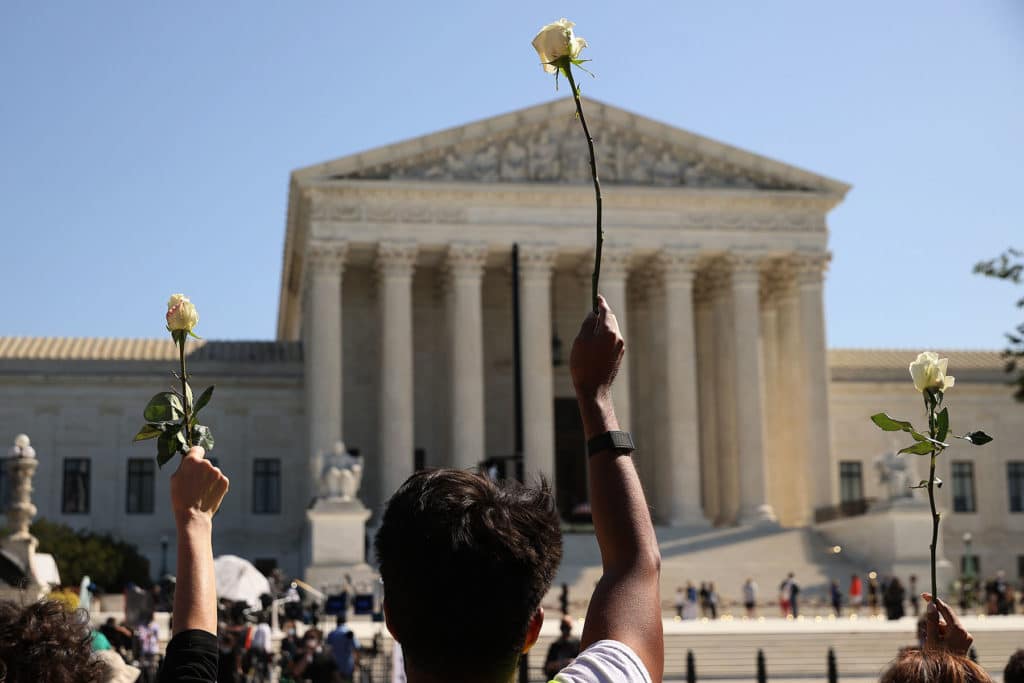
Then I heard the news that Justice Ruth Bader Ginsburg died. My eyes filled up with tears and my spirits fell. How could I lead festive services in just a few minutes when my heart was filled with sorrow? How could I find the words to pay tribute to her life with so little time to reflect? How could we start the New Year like this? With the pandemic, the killings of Breonna Taylor and George Floyd, the shooting of Jacob Blake, the fires, and now this loss too. It was all too much.
Somehow, as the service began, seeing familiar faces of congregants on the screen lifted me up a little bit from the abyss. To pay tribute to RBG, I needed to look no further than the song which we had intended to begin the service. Pitchu Li, “Open for me the gates of justice, I will enter them and thank God.” (Psalm 118:19). That’s what RBG did. She opened the gates of justice wider for women and for everyone in this country.
That’s what RBG did. She opened the gates of justice wider for women and for everyone in this country.
The words she embodied were also found in the first sentence of the Torah reading of the last week of her life, read on Shabbat before Rosh Hashanah. With these words Moses summoned the whole people to ratify the covenant.
You stand this day, all of you, before Adonai your God, your tribal heads, your elders, and your officials, all the men of Israel, your children, your wives, even the stranger within your camp, from the woodchopper to the water drawer – to enter into the covenant of Adonai, your God.
Moses made sure to specify that everyone was to be included in the community.
Ruth Bader Ginsburg conveyed the same idea in her speech at her nomination hearing for the Supreme Court in 1993. She said:
One of the world’s greatest jurists, Judge Learned Hand said that, “the spirit of liberty that imbues our Constitution must lie first and foremost in the hearts of the men and women who compose this great nation… a community where the least shall be heard and considered side by side with the greatest.” I will keep that wisdom in the front of my mind as long as I am capable of judicial service.
Ginsburg’s decisions showed that she fulfilled this promise.
I take comfort in the idea that I spent Rosh Hashanah in a way Justice Ginsburg would have liked. After leading virtual services on Erev Rosh Hashanah, for the rest of the holiday, I watched the virtual services led by Rabbi Naomi Levy of Nashuva and Rabbi Sharon Brous of Ikar, both of whom paid tribute to Justice Ginsburg. Both these women rabbis had the courage to create their own congregations from scratch which have grown into large, thriving communities. Both are true prophets in the spirit of Justice Ginsburg.
On Rosh Hashanah day, my stepmother, Melissa recounted the time she met Justice Ginsburg during Ginsburg’s confirmation process in the Senate. “Jewish Women everywhere are proud of your accomplishment,” Melissa told Ginsburg.
“My grandchildren call me Bubby,” Ginsburg replied.
How fitting now that Melissa retells this story as a Jewish grandmother to our children (who call her Safta).
We then Zoomed dinner with our children’s other Safta and Sabbah and family. Over the rest of the holiday, I read the biography that my mother, Linda Bayer of blessed memory (who my children called Bubby) wrote about Justice Ginsburg. On the inside cover of the book, my mother wrote me an inscription which read:
May you continue to break down the barriers of discrimination and ignorance that hurt us all.
In this New Year, in memory of Justice Ginsburg, may we all resolve to do just that!
Rabbi Ilana Grinblat is the vice president of community engagement for the Board of Rabbis.
In tribute to the remarkable life and accomplishments of Supreme Court Justice Ruth Bader Ginsburg, who died on Sept. 18, PBS NewsHour will present the special “RBG: Her Legacy & The Court’s Future” on Sept. 24 at 8 p.m.
Hosted by Judy Woodruff, the special will feature conversations and interviews with people who knew and worked with Ginsburg, including Justice Stephen Breyer, Judge M. Margaret McKeown, former Court of Appeals clerk Lisa Blatt, and Christopher Scalia, son of the late Justice Antonin Scalia. The program also will address the battle to replace Ginsburg and how that will affect the future of the Supreme Court.
Meanwhile, two excellent films about Ginsberg — the 2018 documentary “RBG” andthe 2018 biopic “On the Basis of “Sex” starring Felicity Jones — will be re-released in 1000 theaters on Sept. 25. And on Sept. 24 at 5 p.m. (PDT), The Los Angeles Jewish Film Festival and the Journal will host a free webinar Q&A with “RBG” documentary co-director Julie Cohen.
“Ruth Bader Ginsburg gave us hope, a public figure who stood for integrity and justice – a responsibility she did not wear lightly,” Jones said. “She will be missed not only as a beacon of light in these difficult times but for her razor-sharp wit and extraordinary humanity. She taught us all so much. I will miss her deeply.”
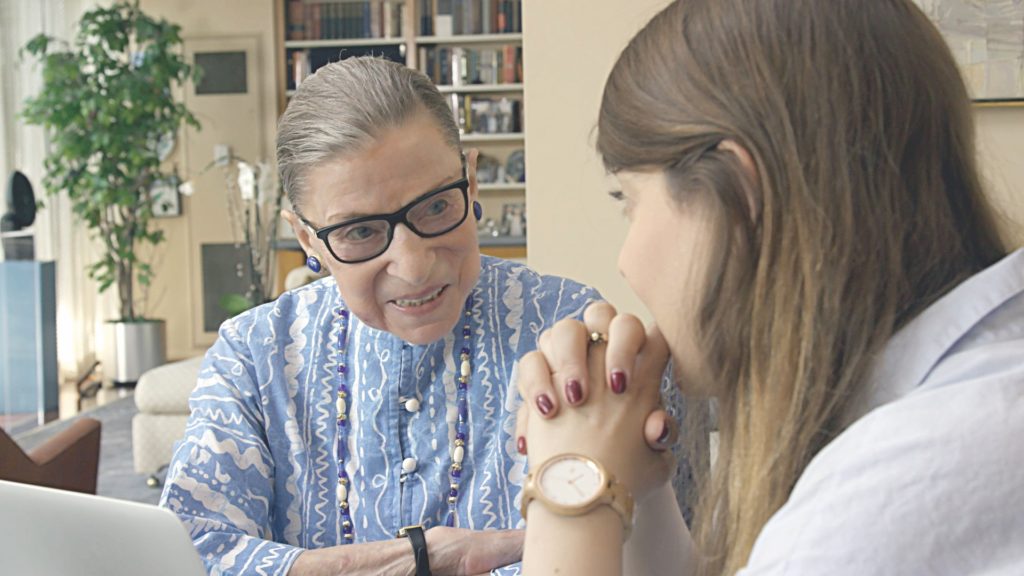
“RBG” filmmakers Betsy West and Julie Cohen said, “From her Supreme Court chambers to her exercise room, what a privilege and a joy it was for us to train our cameras on RBG, and capture the story of this feisty, determined, brilliant woman who used her talents to make our world a better place.”
Focus Features and Magnolia Pictures will donate the net proceeds from the showings to the American Civil Liberties Union Foundation in support of their Women’s Rights Project, which was co-founded by Ginsburg in 1972. Theater chain AMC is selling tickets to the films for $5 each.
In addition, “On the Basis of Sex” is available On Demand to Showtime subscribers. “RBG” is streaming on Hulu, Kanopy and Hoopla and is available to rent and buy on Amazon.
Click here to register for the Los Angeles Jewish Film Festival webinar with Julie Cohen.
Jewish groups praised Zoom for deplatforming an upcoming San Francisco State University (SFSU) webinar featuring Popular Front for the Liberation of Palestine (PFLP) member Leila Khaled.
The Lawfare Project announced in a Sept. 22 press release a spokesperson told the legal group, “Zoom is committed to supporting the open exchange of ideas and conversations, subject to certain limitations contained in our Terms of Service, including those related to user compliance with applicable U.S. export control, sanctions, and anti-terrorism laws. In light of the speaker’s reported affiliation or membership in a U.S. designated foreign terrorist organization, and SFSU’s inability to confirm otherwise, we determined the meeting is in violation of Zoom’s Terms of Service and told SFSU they may not use Zoom for this particular event.”
A spokesperson for Zoom confirmed to the Journal that Zoom told SFSU the university can’t use the platform for the Khaled event.
Jewish groups praised Zoom’s decision.
“Bravo to @zoom_us, that indispensable app, for refusing to be used as a platform for the antisemitic terrorist Leila Khaled,” the American Jewish Committee tweeted. “If only @SFSU had the same moral compass.”
Bravo to @zoom_us, that indispensable app, for refusing to be used as a platform for the antisemitic terrorist Leila Khaled.
StandWithUs CEO and co-founder Roz Rothstein similarly said in a statement to the Journal, “We commend Zoom for setting a powerful precedent by refusing to allow the normalization of terrorism on its platform. It is now clearer than ever that SFSU must take action against this outrageous event and the dangerous environment it creates for Jewish and Israeli students.
“Bigger picture, this event is being hosted by a program in SFSU’s College of Ethnic Studies, as the CSU system is deciding how to implement an ethnic studies graduation requirement for all students. CSU must act now to prevent the exploitation of this requirement to promote hate and bias for generations to come.”
San Francisco Hillel executive director Rachel Nilson Ralston also said in a statement to the Journal, “We are relieved that Zoom, who provides such a vital tool to our students, is equally concerned with their technology serving as a platform to amplify hate and violence. SF Hillel and partners will move forward with our vigil tomorrow evening as planned to affirm our values and vision for our campus.”
Stop Antisemitism.org also tweeted, “Thank you @LawfareProject and @GoldsteinBrooke for your continued effort on stopping Jew hatred!”
On Sept. 14, The Lawfare Project had sent a letter to Zoom arguing that the video conference platform could be in violation of federal law if it allowed the SFSU webinar to go on as planned, given that the State Department has designated the PFLP as a terror group. The letter argued that Zoom providing a platform for Khaled to speak essentially amounted to providing a “service to a member of a foreign terrorist organization.”
Khaled had been set to speak as part of SFSU’s Arab and Muslim Ethnicities Diaspora (AMED) Studies department’s Zoom webinar. Other panelists included were Rula Abu Dahou, acting director of the Institute for Women’s Studies at Birzeit University in the West Bank; South African politician Ronnie Kasrils; former Black Liberation Army member Sekou Odinga; and Jewish Voice for Peace member Laura Whitehorn. SFSU professors Rabab Abdulhadi and Tomomi Kinukawa had been set to co-moderate the panel and the event.
AMED Studies at SFSU wrote on their Facebook page, “Zoom has threatened to cancel this webinar and silence Palestinian narratives. We expect SFSU/CSU to uphold our freedom of speech and academic freedom by providing an alternative venue to this open classroom. We will see you tomorrow at 12:30 pm (PST) at the Zoom webinar.” SFSU is part of the Cal State University (CSU) system.
The Twitter account BDS Report tweeted, “When you hijack two planes in an act of terrorism and threaten to take the lives of everyone onboard, you forfeit your right to free speech. Terrorism is not academic freedom.”
When you hijack two planes in an act of terrorism and threaten to take the lives of everyone onboard, you forfeit your right to free speech. Terrorism is not academic freedom https://t.co/l1Gezuk7LC
Khaled, now 76, was among the terrorists who hijacked commercial jetliners in 1969 and ’70. Her attempt to detonate grenades on the 1970 flight were thwarted and no one was injured or killed in either incident.
During the day on Sept. 22, several Jewish groups — including The Lawfare Project, Club Z and Yad Yamin — sponsored a protest in front Zoom’s headquarters in San Jose, Calif.
“THIS is what Jewish solidarity looks like,” Lawfare Project executive director Brooke Goldstein tweeted. “And THIS is what gets results. We canceled a terrorist Jew hater from Zoom #EndJewHatred.”
THIS is what Jewish solidarity looks like. And THIS is what gets results. We canceled a terrorist Jew hater from Zoom #EndJewHatredpic.twitter.com/CXZKCsY4yE