fbpx

September 22, 2020

Where Are the Protests for France’s Jews?

Justice of every variety—racial, social, economic, environmental—has been on many people’s minds. This has been especially true for progressives—for whom Black Lives Matter (BLM) was so urgent a cause, even a pandemic could not compel them to shelter at home.

Throughout the summer of 2020, protests, many without masks, took place in cities across America. Most were peaceful; some were violent and accompanied by looting. All seemed focused on the disparate treatment that many felt African Americans experience when they come in contact with law enforcement—whether in the form of chokings, shootings, or unjustified harassment. “No Justice, No Peace,” became the favorite rallying cry. But the coronavirus was a secondary consideration. And the volume of protestors—both in their presence and the noise they created—was dense enough that social distancing protocols were pointless. Fevers ran high, fires raged, and the heat, this time, was on the police itself.

Jews, of course, participated in these marches and the conversation about racial justice. That is no surprise. As far back as the creation of the NAACP and its Legal Defense Fund, Jews have championed the cause of racial equality. Jewish liberals have consistently shown themselves to be equal opportunity social activists, signing petitions, assembling in front of city halls, and marching alongside their brothers with raised fists. But the Jewish community’s track record of marching on behalf of fellow Jews who may be in similar, if not worse, peril . . . not so much.

Newly arrived immigrants from France study Hebrew at Ulpan on March 12, 2015 in Netanya, Israel. The recent wave of anti-Semetism that has swept over France and the string of terror attacks in Paris are expected to lead to a record-breaking number of French jews that will emigrate to Israel. (Photo by Lior Mizrahi/Getty Images)

American Jews have long resisted making a fuss when it came to rescuing their own people. The Holocaust is perhaps the most extreme example. Many Jewish leaders didn’t dare demand that President Franklin Roosevelt dedicate a part of the war effort to rescuing European Jewry. Even today, far too many Holocaust survivors face privations without proper support from Jewish communal organizations.

Sure, there is the occasional act of solidarity, such as the Celebrate Israel Day Parade in New York City. But that annual event probably draws an entirely different gathering of Jews from those who marched behind the Black Lives Matter banner. After all, many leaders of BLM have repeatedly invoked anti-Zionist rhetoric. Having full knowledge of this conflict, some of the Jews marching for George Floyd may have decided that the righteousness of BLM’s cause is more important than defending the safety and very existence of a Jewish homeland.

Of course, there are those who reject the organization behind the slogan “Black Lives Matter” precisely because of the anti-Zionist pronouncements of the movement’s leaders. For these people, their participation in the protests is qualified. But that’s the problem when a large mass of people gather for a united cause: a solitary statement is made, and all who are present are making it. There is no way to be exempt from the whole.

Yes, a segment of American Jewry participated in the crusade to free Soviet Jewry throughout the 1960s and 1970s. But there, too, I wonder how much overlap there was with Jews who linked arms and marched for racial justice in Selma and Montgomery, Alabama. Put simply: when it comes to putting their feet to social activism, Jews accumulate far fewer blisters marching on behalf of Jews.

When it comes to putting their feet to social activism, Jews accumulate far fewer blisters marching on behalf of Jews.

So if there is any remaining legroom and capacity to take on an additional cause, Jews should consider whether they can be of some assistance to strangers who just happen to be Jewish. French Jewry, for example, could surely benefit from some Franco-American Jewish love. France, which is home to the largest community of Jews in Europe, has witnessed roughly 15 years of virulent, often murderous, anti-Semitic misery. Most American Jews probably don’t know; even less might care: rabbis, for instance, are not pounding their pulpits on behalf of French Jews in the same way they sermonize about racial injustice. And the Jewish media, generally, has not made the story a front-page headline.

Justice in America may be flawed when it comes to arresting African Americans. But in France, which has failed to protect Jews, justice appears to be nonexistent. Take the case of Sarah Halimi, a French Jew who, in April 2017, was beaten to death and then thrown from her balcony window by an assailant (who shouted “Allahu Akbar” during the attack). In December 2019, a judge ruled that even though the assailant had a clear anti-Semitic motive for his actions, he was not criminally responsible because he perpetrated the act while under the influence of marijuana. Less than two weeks ago, a paltry 50 people protested the appeals court’s decision, a stark contrast from when the decision was first announced—thousands had expressed their outrage. Clearly, this issue does not have the same legs as the BLM crusade. Jewish lives in France haven’t mattered for years, which accounts for why tens of thousands have decamped for Israel during this recent rise in anti-Semitic violence.

The list of crimes against French Jewry, committed mainly by Muslims, is long. Twelve Jews have been murdered in France from six separate incidents since 2003. Scores have been beaten. In 2006, for example, Ilan Halimi was kidnapped by a self-described “Gang of Barbarians” and tortured for three weeks. He was discovered naked and torched. In March 2012, a gunman murdered a teacher and three students at a Jewish day school in Toulouse. Four Jews lost their lives in the terrorist attack at the kosher market in January 2015. A young man had his finger sawed off in 2017. And in March 2018, an elderly Jewish woman, Mireille Knoll, was stabbed eleven times in her apartment and burned to death. Her killers, who acknowledged that she was targeted for being Jewish, are still awaiting trial.

Mourners stand next to the graves of four Jews killed in an Islamist attack on a kosher supermarket in Paris on January 13, 2015 in Jerusalem, Israel. Thousands of people attended funeral ceremony of Yoav Hattab, Yohan Cohen, Philippe Braham and Francois-Michel Saada, who died when a gunmen opened fire during a terror attack in a kosher supermarket in Paris. (Photo by Lior Mizrahi/Getty Images)

Certainly, anti-Semitic violence is not confined to Europe. The murder of 11 Jews at the Tree of Life Synagogue in Pittsburg in October 2018, the shootings at the Poway Synagogue in April 2019, and the attacks against Hasidic Jews in Brooklyn, Monsey, and Jersey City in December 2019, were tragic and disturbing. But the vulnerability of Jews to such anti-Semitic violence has never been a global priority. That is because Jews are now perceived as members of the ruling class, undeserving of the paternalistic, anti-colonialist outrage routinely generated on behalf of people of color. And with Israel as a convenient piñata for anti-Semites, the persecution of the Jewish people garners even less sympathy.

Inclusiveness within the wide net of vulnerable minorities never seems to include Jews. Yet, the unwillingness of the Jewish community to galvanize support for each other is a separate matter. Why is it that Sarah Halimi’s murder does not muster the same indignation as that of George Floyd? And, more gravely, what does it say when Jews can’t muster the same compassion and sense of urgency for their own people?

Of course, it is commendable, and not surprising, that Jews can be counted on to support progressive causes. After all, many Jews express their Judaism not through Torah study but social activism. Tikkun olam has become a catchphrase that, for many, absolves the turpitude of eating shellfish so long as Jews perform good deeds. But there is no requirement that social activism extend only to the doors of strangers.

The entire world seems to be on fire. The bucket brigade, however, doesn’t move only in one direction. To those who were previously unaware of the horrific anti-Semitism in France but have been beating their breasts alongside BLM protestors: it’s time to consider saving a little passion for the plight of your own.


Thane Rosenbaum is a novelist, essayist, law professor and Distinguished University Professor at Touro College, where he directs the Forum on Life, Culture & Society. He is the legal analyst for CBS News Radio. His most recent book is titled “Saving Free Speech … From Itself.”

Where Are the Protests for France’s Jews? Read More »

Two Men Sentenced to Life in Prison in Bulgarian Bus Bombing That Killed 5 Israelis

A Bulgarian court sentenced two men with alleged ties to Hezbollah to life in prison over their involvement in a 2012 bus bombing that killed five Israelis.

The bombing occurred in July of that year; a suicide bomber, identified as Mohammed Hassan El-Husseini, blew up a bus outside of Bulgaria’s Burgas Airport. Five Israelis, including a pregnant woman, were killed in the bombing, as was the Bulgarian bus driver. More than 34 people were injured in the bombing.

The German news outlet Deutsche Welle (DW) reported that the two men, identified as Meliad Farah and El Hajj Hassan, were tried and sentenced in absentia. Prosecutors alleged that the two men transported the bomb to El-Husseini and helped with logistical matters.

Israel and Bulgaria have accused Hezbollah of being behind the attack; the Iranian Shiite proxy has denied involvement.

It is not known where Farah and Hassan are at this time.

Anti-Defamation League CEO Jonathan Greenblatt tweeted, “Two Hezbollah-linked men who perpetrated the fatal attack on Israeli tourists in Bulgaria sentenced — in absentia — to life in jail. Yet another reminder of the ever-present threat posed by Hezbollah & why it must be fully designated as a terrorist group.”


The European Union currently designates only Hezbollah’s military wing as a terror organization; the United States has been among those arguing that Hezbollah’s political wing should be designated as a terror group as well.

Two Men Sentenced to Life in Prison in Bulgarian Bus Bombing That Killed 5 Israelis Read More »

A Lesson From Ginsburg, Mandela and Scalia

Because it’s unlikely that the United States will elect a Jewish president in the foreseeable future, the passing of Ruth Bader Ginsburg on Sept. 18 will mark the most impactful death of an American political figure to this community that many of us will experience in our lifetimes. Because of an unusual combination of demography, ideology and cultural iconography, Ginsburg had taken on, in the minds of her admirers, a status well beyond those of most Supreme Court justices and most elected officials. The result has been an outpouring of grief among most American Jews.

That doesn’t mean to suggest that every Jewish American supports the aggressive liberal agenda for which Ginsburg fought throughout her career. A sizable minority of Jewish voters will cast a ballot for Donald Trump this fall, and most of them are rooting heavily for Trump’s nominee to the high court to be quickly confirmed. But it should be possible to disagree with Ginsburg’s judicial philosophy while still admiring her accomplishments, and shivah should be a time to share fond memories rather than revisit old disagreements.

The stakes involved in selecting her successor are colossal. In a less polarized and less angry political climate, it would have been considerate to Ginsburg’s loved ones and respectful to her memory if political combatants allowed a decent amount of time for mourning before moving into a high-stakes bloodletting over the court’s future. But in a bitterly divided country, only weeks from a bruising election, that is simply not conceivable.

And so, the battle has been joined. The debate will infiltrate almost every corner and crevice of the nation’s politics, governance and culture, and will dominate the remainder of the presidential campaign and beyond. No matter which man wins the election, and which woman is sworn in to fill Ginsburg’s seat, this fight will scar our nation even more deeply than the past several years of partisan warfare.

The stakes involved in selecting her successor are colossal.

When the dust settles, almost exactly half the country’s population will be dreadfully disappointed, not just at the final outcome but with a process they will believe has swindled them out of what they know they deserved. Almost exactly half of our fellow Americans will believe that their country has been stolen out from under them, and will immediately began plotting resistance and revenge. The only questions are whether that aggrieved faction will occupy the political right or left, and whether the equally angry victors will be progressive or conservative. Either way, the chasm that separates Americans will grow wider and the acrimony and anger will worsen.

At that point, we will have two choices. Either our society can continue to turn on itself, with ever-increasing consequences as a downward cycle of fear, rancor and retaliation accelerates. Alternatively, whichever side prevails could decide that absolute subjugation and humiliation of the defeated is unlikely to lead to any productive accomplishments and forward progress, let alone any actual healing.

When Nelson Mandela was sworn in as South Africa’s first Black president, many of his allies were eager to seek retribution against the leaders of the apartheid state they replaced. Mandela instead called for conciliation, and argued to his colleagues that their country could not reunite if their primary goal was to subjugate those they had defeated. “If you want to make peace with your enemy, you have to work with your enemy,” Mandela said. “Then he becomes your partner.”

Such magnanimity seems unlikely in these troubled times. But it will be necessary.

In the weeks ahead, I will do my best to provide analysis on how this critically important nomination might play out. But for today at least, let us think about our obligation after the battle is done. During their time together on the bench, Ginsburg and her conservative compatriot Antonin Scalia forged a close friendship across deep ideological divisions. Now that both are gone, perhaps this is one lesson that those on both sides can take from our respective heroes.


Dan Schnur teaches political communications at UC Berkeley, USC and Pepperdine. He hosts the weekly webinar “Politics in the Time of Coronavirus” for the Los Angeles World Affairs Council & Town Hall (lawac.org).

A Lesson From Ginsburg, Mandela and Scalia Read More »

House Passes Bill That Requires Federal Government to Act Against Domestic Terrorism

(JTA) — The federal government would be required to take steps to prevent domestic terrorism under a bill passed by the U.S. House of Representatives.

The Domestic Terrorism Prevention Act of 2020, which passed Monday by voice vote, would authorize dedicated domestic terrorism offices in the departments of Homeland Security and Justice, as well as the FBI, to analyze and monitor domestic terrorist activity.

Rep. Brad Schneider, D-Ill., sponsored the legislation, which had 179 co-sponsors.

Sen. Dick Durbin, also an Illinois Democrat, has sponsored a similar measure in the Senate.

“Racially/ethnically motivated violent extremists were the primary source of ideologically motivated lethal incidents and violence in 2018 and 2019. From the Tree of Life synagogue to a Walmart in El Paso, Texas, we have all tragically seen the deadly effect,” Schneider said Monday from the House floor. “According to the Southern Poverty Law Center, the number of white nationalist groups rose by 55% since 2017. And last November, the FBI reported violent hate crimes reached a 16-year high in 2018. That number went up in 2019.

“Groups like the Boogaloos, Rise Above Movement and White Nationalist militias across the country are organizing. And so must we.”

House Passes Bill That Requires Federal Government to Act Against Domestic Terrorism Read More »

Ilhan Omar Says It’s Important to Understand How People Experience Anti-Semitism

(JTA) — Many people have gaps in their understanding of what anti-Semitism is and how it works, according to Rep. Ilhan Omar, who has been accused of fomenting anti-Semitism.

Omar, D-Minn.,  offered her perspective on the anti-Semitism experience in an interview published Sunday in The New York Times Magazine.

“In the process of writing a few of the op-eds I’ve written on the rise of anti-Semitism in comparison to the rise of Islamophobia, it has been interesting to see the ways in which so many people create a lens through which they see it,” she said. “It is important, when you are not of that community, to understand the different ways that bigotry shows up.”

Omar apologized last year for a tweet in which she said “It’s all about the Benjamins baby,” referring to the Israel lobby’s influence on lawmakers. Critics from both parties condemned the tweets as echoing anti-Semitic stereotypes about Jews, money and power.

In July, the first-term congresswoman came under fire for a campaign mailer that named three donors, all Jewish, to her Democratic primary opponent.

She told The Times Magazine that “there are a lot of preconceived notions about what thoughts and ideologies I have that have no basis in reality” based on her religion, skin color or gender.

“There’s no one else that exists in a space where they have to deal with the hate of anti-Muslim, anti-immigrant, anti-Blackness, but also with sexism,” said Omar, an immigrant from Somalia.

Ilhan Omar Says It’s Important to Understand How People Experience Anti-Semitism Read More »

Community Voices on the Legacy of Justice Ruth Bader Ginsburg

Ruth Bader Ginsburg’s death on erev Rosh Hashanah hit the Jewish community hard. The Journal reached out to local Jewish community leaders to ask them how Ginsburg inspired or impacted them.

Yet You Persisted
Daughter of East Midwood Jewish Center, you dissented long before others were willing. Harvard Law School’s dean asked why you were taking the place of a man. Justice Frankfurter turned you down as an intern. Yet you persisted. Even as a professor, you were paid less than your male colleagues. Yet you persisted. You defended widowers denied pensions, fighting for gender equality before the law. Your elevation to the Supreme Court elevated us all. With the passage of time, you became the living symbol of the dignity of all people. You used the power of your pen and office to force the law to conform. You persisted. Through it all, you lived life well. You cultivated a loving marriage, raised kind and smart children, supported a diverse circle of friends. You lived the Torah’s demand to love your neighbor as yourself, that there must be one law for the citizen and the stranger, that the land must be allowed to rest, that we are commanded to pursue justice. We will honor you. We will walk your path. Your memory is a blessing.
— Rabbi Bradley Shavit Artson, Abner and Roslyn Goldstine Dean’s Chair of the Ziegler School of Rabbinic Studies and vice president of American Jewish University

Justice and Equality
There have been 114 justices on the Supreme Court since 1789. But only one of them became a veritable rock star. How remarkable that it was the millennial generation that elevated this tiny octogenarian Jewish mother and bubbe into the iconic Notorious RBG. She may have been the second woman on the Supreme Court, but she was the first feminist. At her core, she was committed to elevating the powerless, to empowering the vulnerable, and to bringing justice and equality based on the simple concept of fairness; and she often cited her Jewish heritage as a source for her commitment to and pursuit of justice. Her rise in popularity coincided with her stinging dissents in which she displayed her courage and conscience as she spoke truth to power. It fills me with hope for the future that our younger generation recognized her for the hero that she was. May her memory be a blessing.
— Janice Kamenir-Reznik, co-founder, Jewish World Watch and Jews United for Democracy and Justice; chair, Beit T’Shuvah

Strength Embodied
She was a living symbol of resistance, a hero of human rights, the very embodiment of strength in a tiny frame. Despite well-publicized battles with cancer and her advanced age, she somehow seemed superhuman. And, so, when I learned of her death, it was hard to fully comprehend. How could RBG die? The truth is, the ideals that Justice Ginsburg fought for are bigger than any one life, no matter how extraordinary. We were truly privileged to share the world with her for a time. Now it is up to us to carry on her dissent against the status quo. Madam Justice, we are ready.

— Rabbi Adam Greenwald, vice president for Jewish Engagement, American Jewish University and director, Maas Center for Jewish Journeys and the Miller Introduction to Judaism Program

We Cannot Surrender to Fear
As the newly freed Israelites were escaping from Egypt, trapped on the shores of the Sea of Reeds, one person, Nachshon, had the courage to step into the water first. The waters did not part at first, but Nachshon kept going, risked drowning, and inspired the others. Ruth Bader Ginsburg was a modern Nachshon. At her first appearance before the Supreme Court, she famously quoted Sarah Grimke: “All I ask of our brethren is that they take their feet off our necks.” It was chilling to think about those words just a few short months after a knee on the neck of George Floyd again demonstrated the deadly weight of racism and state violence. Her absence leaves the Supreme Court poised to put a knee on the neck of Native American rights, voting rights, reproductive rights, LGBTQ rights, affirmative action, access to health care, clean air, clean water, the separation of church and state (which has been vital in protecting the rights of those from minority religions, like Jews) and much more. I won’t lie — when I think of all of that I feel afraid. But I’m certain of this: We can’t surrender to fear. We must all find within the Nachshon-like courage of Ruth Bader Ginsburg.
— Eric Greene, writer, civil rights activist, board member of Jewish Multiracial Network 

The Thurgood Marshall of Disability Rights
The disability rights community lost a champion in RBG. The NAACP and others have noted that President Bill Clinton, when nominating Justice Ginsburg to the Supreme Court, referred to her as the Thurgood Marshall of women’s rights. Often hailed as the legal linchpin of independent living for people with disabilities, her powerful decision [in 1999’s Olmstead v. L.C.] mandated that people with disabilities should live in the least restrictive environment possible. The centerpiece of the opinion is Justice Ginsburg’s recognition of the value and humanity of people with disabilities, and the danger of shutting us away. Justice Ginsburg was known to emphasize the importance of the Jewish exhortation “U’vacharta b’chaim (Choose life).” Her jurisprudence gave that choice to thousands of Americans with disabilities.
— Matan Koch, director of RespectAbility California and Jewish Leadership

A Giant of Her Generation
Every night, my 3-month-old goes to sleep with a stuffed likeness of Justice Ruth Bader Ginsburg in his crib. The proliferation of RBG swag may seem kitschy, but her status as a pop culture icon reflects a deeper yearning in our society: We are hungry for righteous role models. The non-superhuman among us find strength and refuge in the massive shadow cast by an 85-pound octogenarian. She was a seeker of justice with a steadfast moral compass and an unflinching fight balanced only by a patient integrity that enabled her to navigate a world that was decades behind her. She had faith that the world would catch up. I want that faith. And I want to teach that faith to my son.
— Rabbi Sarah Bassin,  associate rabbi, Temple Emanuel of Beverly Hills

Cancer Took Her Life But Never Defined Her
Our late founder, Rochelle Shoretz, clerked for Justice Ginsburg in 1998, and the women shared a strong bond of friendship and respect. Justice Ginsburg served on Sharsheret’s Honorary Advisory Board, and in her 2015 eulogy for Rochelle, she shared: “Rochelle redoubled her efforts to uplift others battling cancer. Rochelle will be missed by legions whose lives she touched. We have a store of memories of her bright spirit. May those memories encourage us to follow in her way — to love life, and whatever the obstacles, to exert our best efforts to advance worthy causes outside ourselves.” Ironically, these words best capture how Justice Ginsburg inspired Sharsheret’s community. Though cancer took her life, it never defined her. Her dedication to the pursuit of justice and devoted commitment to women and humanity inspire our work.
— Jenna Fields, California regional director, Sharsheret 

Optimism and Fearlessness
I found out that RBG had passed away just as we started our Rosh Hashanah family Zoom call. It felt almost like taking a punch to the stomach right at our moment of joy with the new year beginning. While of course her entire life had been dedicated to the pursuit of justice, I found her fearlessness over the past four years to be truly awe-inspiring. With everything against her — failing health, a conservative majority on the bench, ugly public discourse — she did not slow down, she did not lose her spirit. In this perilous moment in history, I find comfort in her words from about a year ago: “The progress I have seen in my lifetime makes me optimistic for the future.” My hope is that we can carry on with her optimism and fearlessness.
— Todd Shotz, executive director and founder, Hebrew Helpers; board co-chair, JQ International

A Rare Combination of Civility and Intellect
I wish our public servants would better emulate her rare combination of civility and impassioned intellect. Most famously, this feat of character appeared in her storied friendship with her colleague and ideological rival, fellow Justice Antonin Scalia. Observers often noted her ferocity, particularly on women’s and voters’ rights — all the more potent for the mildness of her presence and the moderation of her language. At the end of her life, she emerged as a contemporary hero, embodying an Americanized version of Shammai’s admonition (Avot 1:14-15): “Stick to your guns; walk the walk; and greet everyone with a friendly disposition.”
— Joshua Holo, dean of the Hebrew Untion College-Jewish Institute of Religion Jack H. Skirball Campus in Los Angeles and associate professor of Jewish history

A Resilient, Defiant Trailblazer
After I emerged from my yontif break from technology, I read some of the articles on RBG, including those by people who were professionally closest to her, and was struck by what a woman of few words she was socially. (I want to learn from her in this regard, for sure.) I was reminded how much of her strength as a woman was because of her resilience, her defiance and her trailblazing in a field of misogynistic men of the legal world who did not even believe she had a right to be a lawyer. She fought for the rights of women to be seen, to be treated fairly and to use their sensibility to change the world. RBG was a classy feminist of the most esteemable order. Thank you, RBG.
— Mayim Bialik, actress and neuroscientist

Witness to the Greatness of America’s Promise
Hearing about the passing of Justice Ginsburg felt like losing a hero, a Jewish biblical matriarch and a grandmother all at once. As soon as my daughters were old enough, my wife and I read them books on “Ruth” and took them to the exhibition about her life at the Skirball Center. “Ruth” instantly became their hero, too. Justice Ginsburg drew strength from her Jewish values and often spoke about her family story. My favorite quote of hers was: “What’s the difference between a bookkeeper in the garment district and a Supreme Court justice? One generation.” Her life bore witness to the greatness of America’s promise and her life’s work made sure that promise was extended to more and more Americans. And like a good grandmother, she even gave us all some good marital advice: “In every good marriage, it helps to be a little deaf.” Baruch Dayan Emet. Blessed be the true Judge.
— Sam Yebri, 30 Years After president and co-founder 

She Sought Justice for All
Ruth Bader Ginsburg proved through her own incredible life story that nothing stands in the way of those who are determined to succeed, even if they are from a disadvantaged background, or, as was the case during her formative adult years, a disadvantaged gender. In 1996, she wrote that she was “proud of being a Jew,” adding that “the demand for justice runs through the entirety of the Jewish tradition.” RBG has inspired generations. She had such a great relationship with her legal nemesis on the Supreme Court, the late Justice Antonin Scalia. Her greatest quality was that she was a true mensch.
— Rabbi Pini Dunner, Beverly Hills Synagogue

A Loss That Sparks a Great Awakening
Jewish tradition teaches that when a righteous person, dies, an opening is created for a moral and spiritual awakening among the community of mourners, and even in the natural world. We pray that Justice Ginsburg’s death, especially in this time of unimaginable loss, especially with the devastating implications it will likely have for our nation, will in fact spark that great awakening. We hold now many layers of grief — first and foremost for the death of an exceptionally brilliant, fierce and courageous Jewish woman, a jurist, a mother and grandmother, a role model to millions, whose steadfast commitment to justice, equality and basic fairness made this country and world a better place. And we hold anticipatory grief, as we project the ramifications of her death and the brazen political maneuverings that will likely ensue in her absence. We must remember: even as we say Mourner’s Kaddish for our beloved Justice Ginsburg, we must not yet say Mourner’s Kaddish for our nation — for this fight is not yet over. And Justice Ginsburg, of all people, would fervently decry the passive acceptance of predetermined outcomes. We grieve, and then we pick up the baton and carry on.
— Rabbi Sharon Brous, senior rabbi, IKAR

A Shofar Call to Confront Ageism
I am especially grateful for the ways Ruth Bader Ginsburg was a shofar — an instrument that calls out for change. She [also] challenged the way we think about growing older. A common stereotype of older adults is that they disengage from life, become physically frail and withdraw from many of those activities that had brought purpose to their lives. Not Justice Ginsburg. Think of her now famous “Ruth Bader Ginsburg Workout” that encouraged so many of us older adults. She kept working at a job she loved, demonstrating that older adults ought to be able to find meaning whether they continue to work, explore encore careers or discover volunteer opportunities through which they can make a difference. She was a role model for getting good at getting older and a shofar call to confront  ageism.
— Rabbi Laura Geller, rabbi emerita, Temple Emanuel of Beverly Hills; co-author, “Getting Good at Getting Older”

A Trailblazing Advocate
I am the first female executive director of the Jewish Free Loan Association in its 116-year history because of people like Justice Ruth Bader Ginsburg, who spent her life tirelessly fighting to ensure equality for all. Today, millions of women like me benefit from her trailblazing work for fair employment practices. We must learn from the strength of her convictions and continue to work toward creating equality for all, while modeling her dignity and credibility. RBG’s legacy can serve as a guide for everyone and inspire each one of us in our quest to make the world a little more just. May her memory be for a blessing.
— Rachel Grose, executive director, Jewish Free Loan Association

Restore for Us Our Judges of Old
Forty-three years ago on my bar mitzvah, I read the Torah portion Shoftim (Judges), whose opening verse reads, “You shall appoint judges and officials.” The third verse contains three of the Torah’s most famous words: “Tzedek, Tzedek Tirdof — Justice, justice, you shall pursue.” RBG spent a lifetime following the Torah’s vision of pursuing justice and creating a just society. Those famous words were framed on the wall of her Supreme Court chambers, and they were etched deeply in her heart. As I mourn her loss, I connect to these words even more, as I do to the words recited thrice daily: “Restore for us our judges of old.”
— Rabbi Daniel Bouskila, Sephardic Educational Center and Westwood Village Synagogue

She Paved the Way
With dignity, courage and moral vision, Ruth Bader Ginsburg brought to life the vision of the biblical prophet Micah to do justly, to love mercy and to walk humbly with God. She devoted her life, inspired by her Jewish values, to seeing well before others and in her own words that the “We” in our Constitution included all people. I am inspired to remember and act by her notion of “the dissenter’s hope,” asking questions, even when the answer is no, for “they are writing not for today, but for tomorrow.” May we be ever blessed by her legacy.
— Rabbi Cheryl Peretz, associate dean of the Ziegler School of Rabbinic Studies, American Jewish University

Fighting for Dignity
Justice Ruth Bader Ginsburg once taught that tears in the fabric of our community can be viewed as opportunities for repair. Whether she was championing and defining women’s equality in the workplace or bonding with her fellow justices across party lines, she modeled an authentic commitment to bettering our present and challenging us to be more connected. As she traversed her own uphill battle, she fought for the dignity and rights of others — a feat that took immense empathy, courage and sacrifice. And as the first female Jewish justice, she proudly grounded herself in the biblical mitzvah of “Justice, justice, you shall pursue” (displayed in her chambers). As a professional woman in America, I know I am blessed to have had her, and women like her, fighting for me before I was even born. Right now, we feel the tears in our community acutely. So, too, we need to seek out the opportunities for repair. In this way — and many more — may her memory be for a blessing.
— Rabbanit Alissa Thomas-Newborn, B’nai David-Judea Congregation

RBG Changed Our World
Last year, when I was hosting a salon about democracy and social justice work, my friend Jenny (who is related to RBG) gave me an RBG action figure. Since then, it’s been sitting proudly on my mantel, as a background for every social justice event I do. It’s made me feel that a little tiny bit of RBG is with me, and that tiny bit represents hope, hard work and the truth that a smart Jewish woman can achieve things that many of us haven’t even dreamed of. My daughters can’t imagine a time when women were treated the way that RBG was in her early years. Demoted when pregnant? Really? RBG was a force that changed our world to a point where we can’t imagine that the “old way” ever existed. So, we fight, we work hard and we continue — as hard as it is — to have hope. Just like Ruth Bader Ginsburg.
—Lisa Greer, philanthropist and author

Equality, Humility and Fortitude
Three years ago, one of my daughters declared that she wanted to become a Supreme Court justice because of Justice Ginsburg. My other two daughters proudly wear their “I dissent” RBG shirts regularly. RBG embodied the Jewish notion of machloket, of healthy and passionate debate. Her friendship with Justice Scalia reminded us of the fierce, but respectful, relationships modeled by rabbis in the Talmud. She fought for the Jewish notion of b’tzelem Elohim, that all people, regardless of gender or sexual orientation, deserve equal and fair treatment. She taught us the value of anavah, of humility, and she showed us that one’s stature is not based on one’s height, but rather on one’s social and intellectual fortitude. RBG cared deeply about language, using her own words to remind us that just as God created the world through words, so too do our words have the power to change the world.
— Rabbi Joel Nickerson, Wilshire Boulevard Temple

Paving the Way
I try to teach my students that when we extend equal access to opportunity, everyone benefits. Ruth Bader Ginsburg’s trailblazing work for the ACLU’s Women’s Rights Project in the 1970s changed the paradigm of how women were treated under law. But her most brilliant tactic was her ability to convince men that extending rights to women would improve their lot, as well. The American dream of equal justice and opportunity is still a work in progress. But by using our voices to dissent and our power as citizens to ensure our country delivers on the Constitution’s promise and the ideals of democracy for all people, we can build on RBG’s legacy.
— Leora Smith, humanities teacher, Milken Community Schools 

Heaven’s Decree Won
So many of us prayed for Justice Ginsburg’s health — in shul, at home, on social media. She was our great scholar, teacher and leader, so we stood outside praying for her well-being, while inside, her body suffered. And she stayed with us, working until the very last possible moment to do what was right. But like it always does, heaven’s decree won, and now our great elder has become a great ancestor. May we have the strength and compassion to let her go — because her persistent, insistent work now continues with us.
— Rabbi Kerry Chaplin, spiritual counselor, Beit T’Shuvah

Her Wisdom Becomes Our Obligation
In the Book of Deuteronomy, the famous line tzedek tzedek tirdof (justice must surely be pursued) is interpreted by the rabbis that one must be just in order to pursue justice. Justice Ginsburg lived out this mantra every day of her life, fighting for women’s rights and all people’s rights for equality and prosperity. Rav Avraham Isaac Kook once wrote, “[T]he death of tzaddikim inspires us to imitate their personal conduct.” That was Justice Ginsburg’s highest aspiration. For most of her life, she was uneasy with the mantle of “icon.” Rather, she wanted all of us, in our everyday lives, to live righteously. With her passing, this wisdom becomes an obligation — to, as Isaiah wrote, “Learn to do right, seek justice. Defend the oppressed. Take up the cause of the fatherless; plead the case of the widow.” (Isaiah 1:17). May her memory be a blessing.
— Rabbi Noah Farkas, Valley Beth Shalom 

An Eishet Chayil
She was a true Eishet Chayil — a courageous woman of integrity and values. She believed in all the positive potential that our great country has to offer and remained optimistic. That is what I will focus on at this time, not giving up hope of working together to help people build better lives for themselves and feel that they can make an important contribution to life in the U.S. She will be remembered for her wisdom and insights, trailblazing role as a woman and, certainly, her achievement in reaching the highest court in the land. She’ll also be remembered for her connection to the Jewish people and being rooted in Jewish values of caring, compassion and concern for others.
— Rabbi Michele Paskow, spiritual leader, Congregation B’nai Emet 

Motivated by Jewish Values
Justice Ginsburg believed her Jewish heritage demanded that she work for the equal treatment of all people. She courageously stood up to what she considered to be the wrongs of the world. As a justice, she not only voted her conscience, but shared in eloquent fashion why a minority opinion should matter. Justice Ginsburg’s friendship with Justice Scalia modeled the rabbinic dictum “Who is wise? The one who can learn from everyone.” In all these ways, she followed in the shoes of Louis Brandeis, the first Jewish Supreme Court justice, who is quoted as saying, “To be better Americans, we must become better Jews.”
— Rabbi Stewart Vogel, Temple Aliyah; president, Rabbinical Assembly 

A Role Model for All People
When I arrived as a student at Loyola Law School in 1983, 50% of my classmates were women. When I was hired at my first law firm, where a woman was the managing partner, I was not the only Jewish woman hired that year and every new associate received the same pay. In my work, my marriage, my parenting — equality and shared responsibilities have been a given. For much of that, I have Justice Ruth Bader Ginsburg to thank for planting those seeds and modeling that life. Justice Ginsburg began and continued to fight to gain and maintain those rights to her dying day, literally. She is a role model for all people who believe in justice and equity, especially, but not exclusively, on issues of gender. That she became known recently as the Notorious RBG — this quiet, petite, elderly Jewish woman — is a testament to the power of her mind, her perseverance, her passion and her heart. It’s on us to pick up her mantle and fight like hell to preserve her legacy, for the good of our country and for the good of all people.
— Tzivia Schwartz Getzug, community activist

Community Voices on the Legacy of Justice Ruth Bader Ginsburg Read More »

What Ginsburg Meant to a Jewish UCLA Law Professor

In the wake of Supreme Court Justice Ruth Bader Ginsburg’s death, social media has reminded us of how enigmatic she was. We don’t even bat an eye when we speak of the justice who became a pop culture icon and earned the fabulous nickname the Notorious RBG. However, she was part of a not particularly glamorous profession for those who work in it every day. 

A Jewish professor of constitutional law, evidence, law of the border and other legal courses at the UCLA School of Law, Peter Reich told the Journal that Ginsburg “was someone who was a model for many generations of law students and lawyers — in terms of someone who combined her scholarly precision with activism for social justice.”

Reacting to her death, Reich said, “It’s a huge loss. She was a person who spent every day of her working life as though it was her last. I feel as though we’ll be missing a voice on the court; not only a voice of reason but a voice for various causes.”

 “I don’t think that law exists simply to serve the powerful. I think it exists to spread the notion of justice to all people in all situations. That is something [Ginsburg] definitely believed and she connected with Judaism.” — Peter Reich

One of the classes Reich teaches is U.S. Constitutional Law for Foreign Lawyers. One of Ginsburg’s cases he teaches is what Reich said is probably her most famous: the 1996 equality case U.S. v. Virginia  that struck down the Virginia Military Institute’s ban on admitting women, in which she authored the majority opinion. 

“[Ginsburg] clearly set up a standard for defining when sex discrimination takes place under the 14th Amendment equal protection clause,” Reich said. “This case, in a way, was sort of an accumulation of the work that she had done as an advocate for women’s rights and earlier cases when she was a lawyer. Equal protection under the law doesn’t just apply to racial minorities; it also applies to women.” 

Reich plans to discuss Ginsburg’s passing with his students. “The way I look at [her death] is when someone in the ranks of fighting for justice falls, it’s like someone who is carrying the flag falls and someone has to rush in and pick up the flag and fill that position,” he said, adding, “that is a duty that not just lawyers have but citizens have in terms of achieving a broader notion of justice in society. I don’t think that law exists simply to serve the powerful. I think it exists to spread the notion of justice to all people in all situations. That is something she definitely believed and she connected with Judaism”  

That sentiment resonates with Reich, as does Ginsburg’s famous quote that she had said before but also used to close her talk in 2001 during an address at the National Council of Jewish Women titled “Three Brave Jewish Women,” focusing on Emma Lazarus, Anne Frank and Henrietta Szold (founder of Hadassah). The quote was: “I am a judge born, raised and proud of being a Jew. The demand for justice runs through the entirety of the Jewish tradition. I hope that all the years I have the good fortune to serve on the bench of the Supreme Court of the United States, I will have the strength and courage to remain steadfast in the service of that demand.”

As a member of IKAR, Reich has been involved in a slew of social justice projects with the community going back over a decade and professionally has represented pro bono plaintiffs in land rights and water rights cases in the Southwest, particularly involving the cross-border access to water between the United States and Mexico. Ginsburg, he said, “has been an inspiration in all of these things.” 

However, he doesn’t believe all of Ginsburg’s decisions were uniformly progressive. “I would call her a structuralist with progressive inclinations, by which I mean she looked to recurring patterns and themes in the Constitution like access to justice, the federal-state relationship and equality. She was a careful writer and didn’t overextend herself.”

What Ginsburg Meant to a Jewish UCLA Law Professor Read More »

Actress Tovah Feldshuh on Playing RBG and Meeting the Justice in Her Chambers

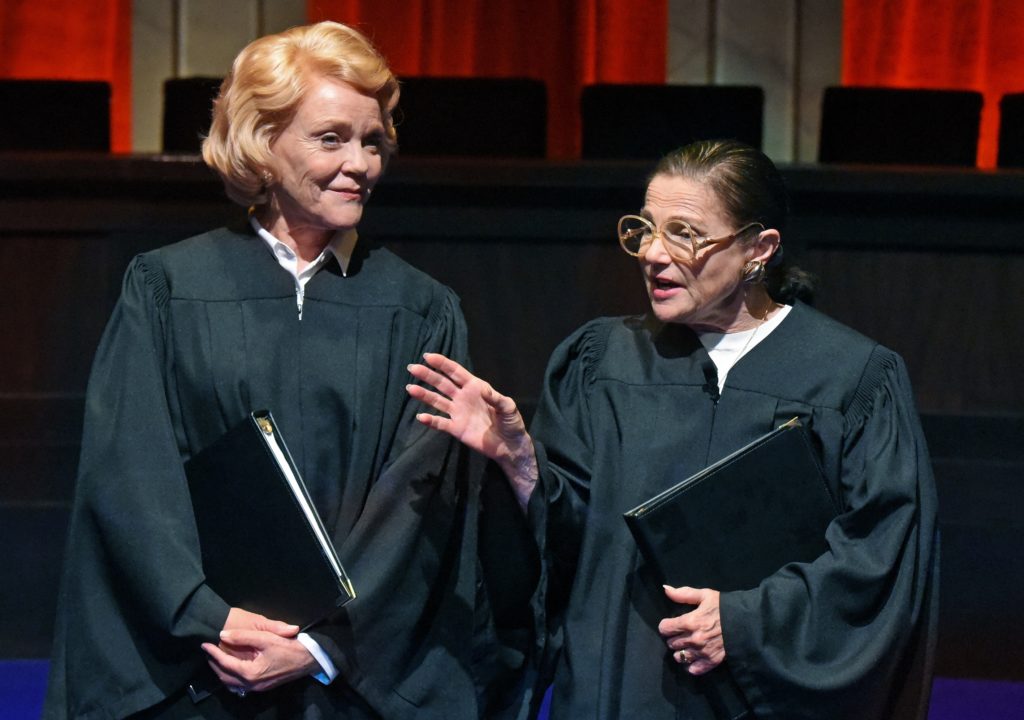
On Sept. 18, hours after Justice Ruth Bader Ginsburg died, a memory popped up on my Facebook page. It was a photograph I had taken of actress Tovah Feldshuh in the lobby of the Wallis Annenberg Performing Arts Center in Beverly Hills. The photo was taken after I interviewed Feldshuh on opening night of the West Coast premiere of the play “Sisters in Law” by Jonathan Shapiro — on Sept. 18, 2019.

In it, Feldshuh plays the Notorious RBG opposite Stephanie Faracy’s Justice Sandra Day O’Connor. During that interview, Feldshuh told me she was excited because she was going to meet RBG in her chambers the following month. One year later, Feldshuh agreed to speak about that meeting.

“Like the country, I was shattered [by Ginsburg’s death],” Feldshuh said in a phone interview from the Hamptons on Long Island, N.Y. “Obviously, I’m sharing what we all feel — that we’ve lost a humble woman with a great sense of profound justice and liberty for all.” 

During that 2019 interview at the Wallis, Feldshuh said, “How do we honor a woman who is soft-spoken, shy, modest and just decent and moral?” It’s something Feldshuh was deeply concerned about, especially “because I’m about as shy as a tank coming toward you.” 

It was that tank-like mindset that prompted Feldshuh to reach out to Ginsburg after she landed the role in “Sisters in Law.”

“I wrote her a very professional loving letter,” Feldshuh said. “I wrote, ‘I know how extraordinarily occupied you are with the great matters of the United States of America and making sure there is justice for all. I, however, have been given this extraordinary opportunity where I will be playing you. I will be your messenger out in the theatrical universe. Is there any way you would meet with me? I just need to be in the room with you, to have a cellular interchange, to take you in.”

Ginsburg did indeed respond. “I got an email back via her aide,” Feldshuh recalled. It said, “ ‘Dear Ms. Feldshuh, I received your lovely letter. Please be in my chambers on Oct. 23 at 4:30 sharp.’ I just couldn’t believe it.” 

It would be the first of at least four occasions that Feldshuh spent time with Ginsburg. During that first meeting, Feldshuh got to spend an hour alone with the justice. “Her two aides escorted me into this gorgeous mahogany-paneled room,” Feldshuh recalled, “with all the pictures of her family. And it made me think of on my Steinway, and in my living room on my hearth, there are all the pictures of my family. I don’t claim to be anywhere near as extraordinary as Ruth Bader Ginsburg but there are certain values that people can share and certain values that people share as Jews that was clear about her office and was clear about my life. It was as if we had come from the same pod, just a generation apart.”

“I said, ‘Please forgive me. I’m so very moved to meet you, having spent so much time on you and watching you from afar and with all the research I’ve been doing. Seeing you in the flesh is like moving from a book of illustrations to the real deal.’ ” — Tovah Feldshuh

Feldshuh, 66, also recalled when she finally met Ginsburg she teared up. “I said, ‘Please forgive me. I’m so very moved to meet you, having spent so much time on you and watching you from afar and with all the research I’ve been doing. Seeing you in the flesh is like moving from a book of illustrations to the real deal.’ ”

Knowing of the justice’s love of opera, Feldshuh went to the Metropolitan Opera shop and bought Ginsburg a jacket from ‘Der Rosenkavalier,’ and gave it to her at that meeting. “She was thrilled with it,” Feldshuh said, “and told me she was going to wear it to the opening of the Washington Opera [season], which she did.” 

So, what did the two women talk about during that hour in chambers?  

“We talked about opera and we talked about gender equality,” Feldshuh said. “We talked about how early in her life she had a purpose, and her very intimate relationship with her mother and the loss of her mother (Ginsburg’s mother died of cancer the day before Ginsburg’s high school graduation), and [probably] carrying on her mother’s torch.”

And although Feldshuh signed a nondisclosure agreement before that meeting, now that the justice is dead, Feldshuh said she can talk about “generalities” they discussed, which included “sharing with me some of the intimate details of her life — the type of perfume she liked, the shampoo she used, the brands of lipstick she liked [which] were whatever her roommate from Cornell [University] had sent her last.”  

Feldshuh said Ginsburg also spoke about the fact that she didn’t have pierced ears, that she hadn’t cooked since 1980 — that her late husband, Marty Ginsburg, was her chef par excellence, and that marrying him was the luckiest moment of her life. “I also learned she loved mangos, Granny Smith apples, bananas, raspberries and strawberries, and that she didn’t eat ice cream because she didn’t want to digest fat.”

Feldshuh came to that meeting with books for Ginsburg to sign, which she did. She showed the justice photographs of her grandson Raphael. Later, Ginsburg sent Raphael a T-shirt that said “Grand Clerk of Justice Ruth Bader Ginsburg.”

What stood out most to Feldshuh about Ginsburg was “that as humble and as quiet as she appeared, she was intellectually fierce and not intellectually shy. Ruth was a tiny woman but as they say in [Shakespeare’s] ‘A Midsummer Night’s Dream,’ ‘though she be but little, she was fierce.’ She was this voracious learner, a voracious reader. She entered the minds of other people the way normal people enter the hearts of other people.”

On a personal level, Feldshuh said Ginsburg “gave me tremendous help in my characterization of her in “Sisters in Law,” which was supposed to come to New York but then COVID happened and that was the end of that for now.”

However, she has managed to play Ginsburg again in her one-woman show “Aging Is Optional,” which played in New York in January and February before COVID-19 shut down that, too. In that show, she said, “With a wink in my eye, I did a rap as RBG, which is one of the great moments of that concert.” 

And, in true Feldshuh style, she broke into the rap down the phone, complete with beatboxing:

I’m always optimistic, I never get rattled
Each day’s an opportunity to win another battle
Don’t worry about my health, I’m performing at my peak
You’ll find me on the bench, doing pushups next week
According to Twitter I’m  notorious
I’ve gone viral, ain’t it glorious
I’ve much in common with B.I.G.
We’re homies from Brooklyn, Yo, Jay-Z!

“I did what I could to support a great American soul — a great patriot,” Feldshuh said. “I loved her very much and I will  miss her. Considering all the cancer she had, she lived brilliantly and was alert. She never had dementia. She lived until she died; until she fell off that cliff. She didn’t diminish except in the last weeks.” 

Despite the great loss of Ginsburg and the turmoil now swirling around her potential replacement, Feldshuh said, “I believe in Anne Frank. The world will right itself and this person in the White House will be out and we will get well again.” 

Actress Tovah Feldshuh on Playing RBG and Meeting the Justice in Her Chambers Read More »

David Pomeranz on His Jewish Roots, Having An Unorthodox Successful Career and Writing For Broadway

A multi-platinum, award-winning recording artist, songwriter and performer, the music of David Pomeranz has been recorded and/or performed by the likes of Queen’s Freddie Mercury, Bette Midler, Barry Manilow, Missy Elliott, John Denver, Mel Brooks, Cliff Richard, Clay Aiken, Donna Summer and Bon Jovi’s Richie Sambora. In turn, Pomeranz’s recording and songwriting projects have earned him a total of 22 platinum and 18 gold albums, selling over 40 million records internationally.

As a performer, David Pomeranz earned his record deal as a teenager via Decca Records, first releasing “New Blues” in 1971. In turn, his touring credits include the likes of The Carpenters, George Benson, Steve Martin, Steely Dan, Three Dog Night, Air Supply, Laura Nyro, Randy Newman, Phoebe Snow, Badfinger, Rod Stewart and The Doors. Pomeranz’s popularity as a performer would earn him fans at major studios and agencies, leading him to write music featured in key television projects (e.g. “Homeward Bound”), major films (e.g. “Big”) and theatrical productions (Broadway’s “Scandalous”). This would lead Pomeranz to superstardom in some parts of the world, including unprecedented success in the Philippines that brought him 2 keys to the City of Manila; he is the only international artist to receive a star on the city’s “Eastwood Walk Of Fame.”

Current COVID-19 pandemic-related restrictions aside, David Pomeranz continues to keep busy as a recording artist, live performer and composer. I had the opposite to speak with him about this, his Jewish roots, how performing at a Long Island synagogue as a child inspired his path as a professional musician, future career plans and all. Our full chat, as recorded in two parts via Zoom on Sept. 21 is embedded below for your viewing/listening pleasure.


More on David Pomeranz can be found here, here and here.

David Pomeranz on His Jewish Roots, Having An Unorthodox Successful Career and Writing For Broadway Read More »

The CEO Creating ‘Joy Ventures’ in the Well-Being Space

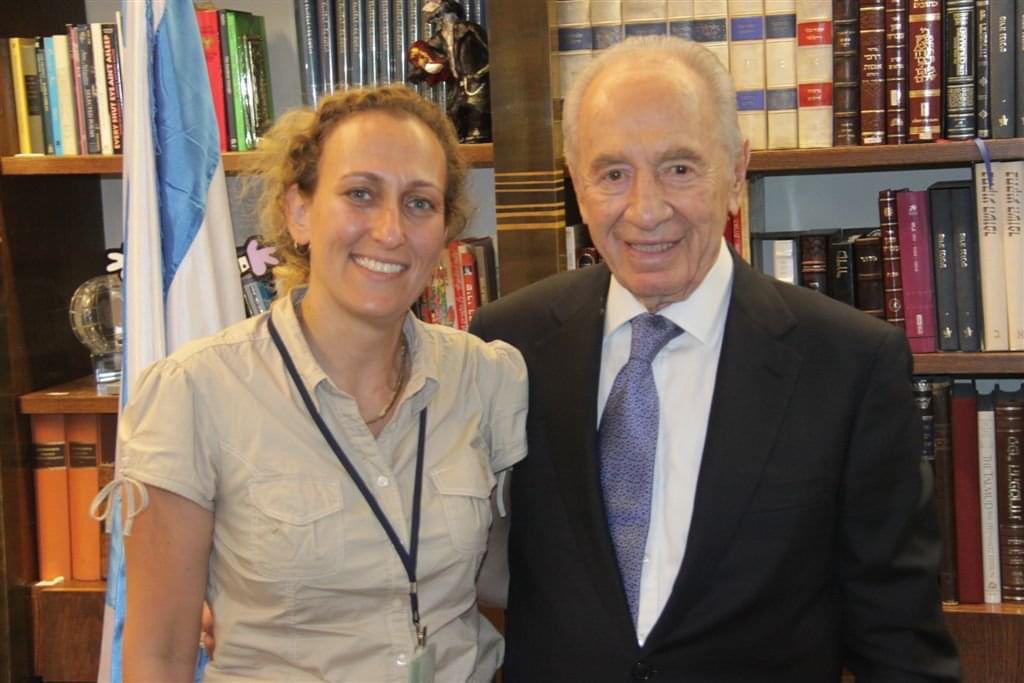
With a neuroscientist mother and tech entrepreneur father, Miri Polachek grew up in a home where Nobel laureates were the ultimate celebrities. Years later, when Polachek found herself in the late President Shimon Peres’ Jerusalem residence, she asked him if he would pose with her for a picture alongside his Nobel Peace Prize medal.

Peres was the visionary who inspired the now-defunct Israel Brain Technologies, the nonprofit that worked to establish Israel as a hub for brain-related innovations. Polachek was the founding director.

Polachek spent the first half of her career working in finance for large corporations in the United States. After moving to Israel, she switched to the entrepreneurial domain. She said the entrepreneurial mindset captures her imagination and inspires her, adding that it is the lifeblood of the startup ecosystem.

Today, Polachek is the CEO of Joy Ventures, a company that supports, funds and builds science-backed consumer products in the well-being space, or in her words, “that help people manage their daily lives more joyfully.

“It’s a different kind of space to operate in,” Polachek said. “You really need to take a fresh look all the time at consumer trends, at what people’s pains are and understand the different demographics.”

Emotional well-being has become de rigueur in tech, with apps like Calm and Headspace flooding the booming mindfulness market. The advent of COVID-19 has taken a heavy toll on people’s mental health, and the companies that Joy Ventures supports aim to help people get through this period of heightened stress.

“You really need to take a fresh look all the time at consumer trends, at what people’s pains are and understand the different demographics.”

Empathic Technologies’ so-called “Doppel” is worn on the wrist and creates a silent vibration that mimics a heartbeat to either reduce stress or increase alertness. Sanga’s unique meditation program features human coaches to help people achieve a stable meditation practice. The Vi Trainer app is a conversational fitness coach that uses GPS and phone movements to monitor progress.

The challenge, Polachek said, is creating a product that is fun, appealing and marketable, while using technology that can have a meaningful impact on how people feel. One product Polachek said has achieved this balance is Reflect, which currently is in a pilot program in the U.S. A portable, interactive “soft and fuzzy” globe created by a textile designer turned tech entrepreneur, Reflect uses biofeedback to monitor and improve its user’s mood.

One of the perks of working in the consumer space, Polachek said, is that she and her staff get to be the guinea pigs. On several occasions, she’s even brought the products home for her three teenagers to try.

“It brings awareness to them of how important it is to be aware of our emotions, to manage them and to develop resilience to stress and uncertainty — skills that are not always taught at home and school,” she said. Polachek added that her children love to cuddle and take a moment to relax with the Reflect ball.

“It’s actually so natural when you talk to kids about it,” she said, “that it’s sort of an aha moment, that there should be more products they can use to help them develop those skills.”

The CEO Creating ‘Joy Ventures’ in the Well-Being Space Read More »