fbpx

September 18, 2020

God Is in Our Resiliency

Where was God when … ? We ask this question through the most difficult times in our history. Rabbi Neil Gillman (z”l) of the Jewish Theological Seminary of America, would ask this question of us as students on our first day of rabbinical school. Where is God in a cancer ward of a hospital? Where was God during the Holocaust? And in 2001, he added another question: “Where was God on 9/11?”

Each one of us has a unique perspective of that tragic day. I was a sophomore at Columbia University, a pre-med student studying biology, when murmurings spread through the classroom that there had been a plane crash just miles away. Minutes later, the towers came down, and our world changed forever. Just days before Rosh Hashanah, we again asked, “Where was God?”

Three days later, I took a bus to my home in Syracuse, N.Y., while all airports remained closed. The bus exited the Lincoln Tunnel, and I turned around to witness a plume of smoke billowing overhead, representing so many lives lost.

This summer, I read the book “On My Watch,” a memoir of Virginia Buckingham, head of Boston’s Logan Airport on Sept. 11, 2001, where two of the four hijacked planes originated. Buckingham addressed our Sinai Temple community last week, discussing her experiences of faith, blame, forgiveness and resilience during 9/11. She was blamed for one of the worst days in U.S. history. Although eventually cleared of any wrongdoing, her life changed as she struggled to live with the blame others thrust upon her.

Hours after the planes hit, Buckingham’s mother called her to say, “God does not do anything without a reason.” Buckingham replied, “God would never let this happen. I refuse to believe in that kind of God. How could God stand by and let hijackers murder thousands of people?”

In an instant, her staunch faith was shattered. After many therapy sessions, her therapist told her the way she would get back to herself is through God. “Go home and write God a letter.” It was not until Buckingham entered a synagogue for a bar mitzvah more than a decade later, when the rabbi spoke about Sodom and Gomorrah, did she think about God again. That morning, the rabbi taught, “Perhaps Abraham was trying to teach God. Abraham challenged God. Perhaps we learn from God, but God learns from us.” It was then that she understood. Maybe, on 9/11, just as we were crying, so, too, was God. God was learning from us.

Resilience is not simply moving on with strength. Rather, resilience is moving forward while carrying the broken parts and the joyful parts of our lives in the same basket.

Over the years, Buckingham understood that scapegoating and blaming others are convenient ways to avoid the truth. Blame leads to more tragedy; resilience leads to peace. Yet, resilience is not the common societal adage, “What doesn’t kill you makes you stronger.” Resilience is not simply moving on with strength. Rather, resilience is moving forward while carrying the broken parts and the joyful parts of our lives in the same basket. We may be broken, unrecognizable to what and who we were before, but we still are capable of living a life of joy.

We live in unprecedented times. It’s hard to see a way out. We’ll never forget this period of our lives. We’ll live with it, but we once again will find joy with our brokenness. We will find that God was crying with us, and that God was learning from us.

Each day as Buckingham would head to work, she would utter this prayer: 

“Dear God, help me to remember that nothing is going to happen to me today that you and I cannot handle.” A prayer of resilience, a prayer of strength, a prayer that we can make it through this together.

May the call of the shofar this Rosh Hashanah enable us to be resilient. The sound of the tekiah is the same but we have changed. We may look different, we may feel different, but our souls remain pure, ready for us to cleanse in the days ahead. A soul that gives us the answer to that question: “Where is God?”

God is in me … and God is in you.


Rabbi Erez Sherman is a rabbi at Sinai Temple.

God Is in Our Resiliency Read More »

French Prosecutor to Investigate Rapper Over Alleged Anti-Semitic Lyrics

A French rapper is being investigated over anti-Semitic lyrics in his songs.

The Algemeiner reported that the rapper, Freeze Corleone, released an album on Sept. 11 titled “LMF [The Phantom Menace].” Some of the songs on the album feature lyrics in French that include “Everyday day (nothing to f—) of the Shoah,” “I arrive determined like Adolf [Hitler] in the 1930s,” “Like Swiss bankers, everything for the family so that my children live like Jewish pensioner,” and “every day I f— Israel like I live in Gaza.” Nine lyrics from the album in total had been reported to the Paris public prosecutor’s office, the Associated Press reported.

The album has sold more than 15,000 copies and received more than 5 millions hits on Spotify, according to The Algemeiner.

Paris prosecutor Remy Heitz told Agence France-Presse (AFP) that Corleone, born Issa Lorenzo Diakhaté and who lives in Senegal, is being investigated for “inciting racial hatred” in the album.

French Interior Minister Gerald Darmanin said in a statement that Corleone’s lyrics were “unspeakable,” and urged Facebook and Twitter to not “spread this rubbish.” Additionally, the International League against Racism and Anti-Semitism (LICRA) tweeted that “all partner actors to take responsibility” in promoting Corleone’s album.

Algemeiner Editor-In-Chief Dovid Efune similarly tweeted to Spotify, “Dear @Spotify, As French Jews bring in Rosh Hashana, the #3 album on the country’s music charts includes the lyrics ‘F**k the Shoah (Holocaust)!’ and ‘I arrive determined like Adolf.’ It’s attracted 5.2 million listeners on your platform. What say you?”

Universal Music France announced on Sept. 18 that the record company is dropping Corleone because the album featured “unacceptable racist statements.” Corleone tweeted in response to the move, “Finally free. Thank you to everyone for their support. God will be victorious, we will never give up on this marathon.”

French Prosecutor to Investigate Rapper Over Alleged Anti-Semitic Lyrics Read More »

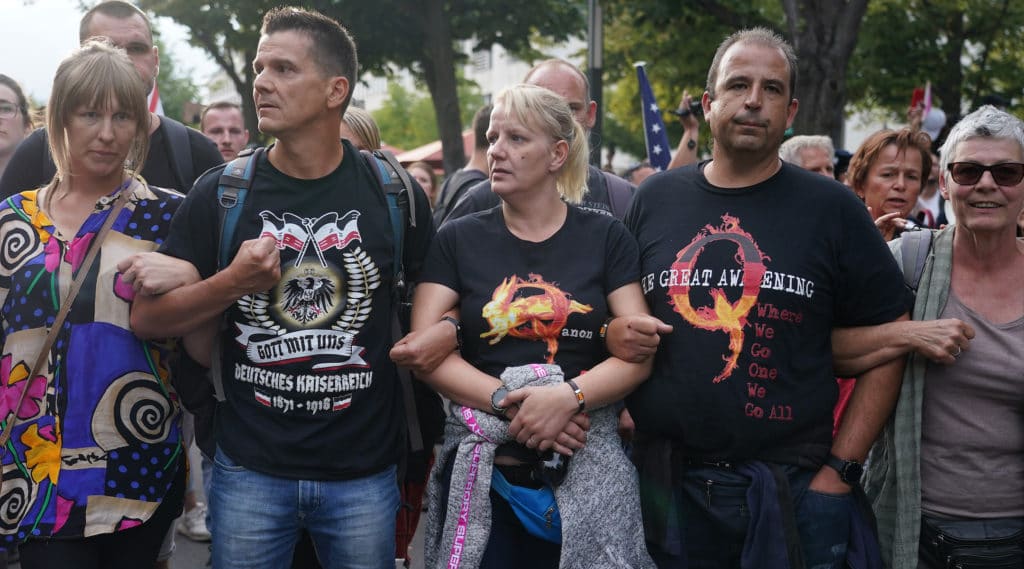
QAnon Is an Old Form of Anti-Semitism in a New Package, Experts Say

(JTA) — Scott Wiener, a California state senator, has been barraged with anti-Semitic attacks online, including one falsely accusing him of promoting “Jewish pedophilia.”

A Republican congressional candidate, Marjorie Taylor Greene, appeared to accuse George Soros and the Rothschild family of being involved in a cabal of Democratic pedophiles. On Twitter, she has repeatedly called Soros, a Jewish billionaire, of being an “enemy of the people.”

On Sept. 11, a Facebook group’s post claimed that an Israeli company knew about the 2001 terrorists attacks in advance.

These smears have at least one thing in common: They come from followers of QAnon, the vast — and patently false — theory that Democrats across the country are running a secret cabal to abduct and abuse children, harvest their blood and defeat Donald Trump.

But are those anti-Semitic beliefs baked into QAnon? Or do some of the posters happen to be anti-Semites while believing in QAnon?

The answer, according to those who study extremism and have been watching the meteoric ascent of QAnon, is the former: QAnon is inherently anti-Semitic — and only growing more so. Researchers are still gathering data, but are seeing the trend pop up globally. The New York Times reported that there are 200,000 QAnon social media accounts on Germany’s far right, and that the conspiracy was part of what inspired a faction of German extremists to storm its parliament in August.

“In terms of qualitative intelligence, there’s no doubt that it’s becoming more anti-Semitic,” said Joel Finkelstein, the director of the Network Contagion Research Institute, which studies hate and incitement on social media, and is gathering data on anti-Semitism in QAnon. “There’s just no doubt about that.”

The QAnon theory has become increasingly popular and visible in recent months, in the United States and abroad. According to NBC, its Facebook groups boasted millions of members in early August. Republican candidates for Congress have supported it, and people wearing or carrying Q slogans have shown up to mainstream political rallies. Even as some Republican leaders have condemned the theory, Trump has declined to disavow it.

The theory is expansive and elastic, stretching to include many different tropes in the service of its sweeping scope. That can make its core anti-Semitism hard to detect or track.

But the claim that rich Jews, including the Rothschild banking family, secretly control the world has long been a recurring feature. And other elements that don’t explicitly mention Jews also have anti-Semitic resonance, like the blood libel, an age-old anti-Semitic canard claiming that Jews kill Christian children to harvest their blood for ritual purposes.

“This whole blood libel is very prominent there, the idea of kidnapping children for blood,” said Magda Teter, a Jewish studies professor and author of “Blood Libel: On the Trail of an Antisemitic Myth.” “People are going to start googling ‘killing children for blood.’ That will lead them to anti-Semitism even if they may not be initially inclined.”

In recent weeks, QAnon has begun to attract heightened scrutiny, many others have pressed that case. One was the founder of the group Genocide Watch, former George Mason University professor of genocide studies Gregory Stanton, who published a piece earlier this month titled “QAnon is a Nazi cult, rebranded.”

QAnon is the latest version of “the conspiracy ‘revealed’ in the most influential anti-Jewish pamphlet of all time. It was called Protocols of the Elders of Zion,” Stanton wrote in his essay. He also said QAnon is a revamped take on the blood libel, which was spread in modern times through the “Protocols.”

In fact, according to Eric Feinberg, vice president of content moderation at the Coalition for a Safer Web, which aims to combat extremism online, references to the Elders of Zion and to a “Zionist-occupied government” are common on QAnon forums. He said QAnon adherents are latching on to widespread Jewish support for Democrats, especially as the election approaches.

“In terms of Elders of Zion, calling out Hollywood, which tends to be Jewish, calling out specific Jewish congresspeople as pedophiles,” said Feinberg, describing anti-Semitic ideas found in QAnon. “Also, it tends to be that Jewish people align more with Democrats. They use that against us to basically say that Jews are pedophiles.”

Some of QAnon’s supporters are surely aware that they are targeting Jews. But the ideas of harvesting children’s blood and controlling the world through a secret cabal are anti-Semitic even if the growing numbers of QAnon adherents don’t realize it, or don’t directly refer to Jews, Teter said. These ideas are so old and established, she said, that they function as codes for anti-Semitism and obviate the need to mention Jews directly.

“Some of them are using anti-Semitic tropes even though they may not be directly talking about Jews,” she said. “There are a number of elements that they promote that are definitely coming from the vocabulary and from the cauldron, reservoir of anti-Semitic ideas even though they may not be saying directly that Jews are doing it.”

Teter added that these ideas will act as dog whistles for neo-Nazis and other anti-Semites, such that they have the effect of propagating anti-Semitism regardless of their original intent.

“If they are going to mention the whole package of conspiracy, of blood, of media, of money, even without mentioning Jews, you can definitely get that kind of implicit anti-Semitic message about controlling the media, government and whatnot,” she said. “You don’t have to be explicit and then those who know, know.”

The way that QAnon ideas tend to propagate means that large numbers of people are encountering and absorbing anti-Semitic tropes all the time. Feinberg said his research has found that QAnon content across social media platforms is increasingly coming from Telegram, a messaging app that also has open groups where users can see and share public content. That makes the content more easily shareable to mainstream social media platforms than, say, an entry on the extremist message board 8kun, and also gives rise to “a boomerang or circular ecosystem” whereby QAnon ideas move rapidly across platforms with little evidence of their origins.

The fact that certain messages on Telegram are encrypted, and that the company is based outside of the United States and therefore not fully subject to U.S. oversight, also make the messages harder to track, Feinberg said.

“The Rothschilds, all of that Elders of Zion stuff, you can actually search that on Telegram and pick that up,” he said. “They’re using it in this regard especially because Jews tend to be Democrats and they say most of the media is controlled or owned by Jewish people. So they use that against us because they believe Trump is the savior.”

QAnon Is an Old Form of Anti-Semitism in a New Package, Experts Say Read More »

Table for Five: Rosh Hashanah

One verse, five voices. Edited by Salvador Litvak, the Accidental Talmudist

There are four days in the year that serve as the New Year, and each has a different purpose …. The first day of Tishrei is the New Year for counting years.
Rosh Hashanah 2a, B. Talmud 

Rivkah Slonim
Education director, Rohr Chabad Center, Binghamton University, New York

Rosh Hashanah is the day that makes every other day matter; even the other three “New Years.” Rosh Hashanah, the Chassidic masters teach, is about reinstating God’s Kingship over us. This is affected through making our will subservient to His, thus evoking His desire to reign over us. And specifically, that it be with taanug, pleasure, as a result of how deeply we matter to God. This spiritual service is referred to as Binyan HaMalchut, building the Monarchy. 

Conventionally, we think of Rosh Hashanah as being all about us —  our health, our happiness and our prosperity in the coming year. But really, it’s about God; His becoming King over us again and being enthusiastic about the prospect. That is the question of Yom Hadin, the Day of Judgment: Do we have a real relationship with God? This explains why Rosh Hashanah comes before Yom Kippur; it would makes more sense to first work on atonement and then come before God to ask for our needs. But if we don’t have a relationship, then nothing else matters. Asking for forgiveness has to wait until we actually solidify our relationship. 

An ohr chodosh, a new light, energizes the world each Rosh Hashanah. This novel, vivifying energy must come down into this world. The question is: Will we have a share in drawing down this effluence? Will we allow it to illuminate our lives? Will we use it to evoke God’s continued joy in His reign? God is hoping for a yes.

Miriam Yerushalmi
CEO SANE, counselor and author

Rosh Hashanah is the only holiday that begins on the first of the month, when the moon is hidden. The Alter Rebbe explained that this alludes to the concealment of Divine chochmah, the wisdom with which the world was established. When the moon is hidden, at the end and beginning of each year, this wisdom also is hidden and withdrawn to its source, to be Divinely reawakened and re-energized. 

The intensity of the light that is elicited into the world below has the potential every year to be greater than that of the preceding years; the level of intensity is determined by the strength with which we call it forth. On Rosh Hashanah, we affect this light through blowing the shofar and praying. This cycle of renewal is based, kabbalistically, on the slumber into which God put Adam on the first Rosh Hashanah, during which the mochin — the supernal intellectual attributes — were withdrawn, just as the human intellect is withdrawn during sleep. 

Similarly, as our intellect and strength are revived by our daily prayers, the supernal wisdom also is affected. The blast of the shofar awakens us to pray with more intensity. May we be mindful, as we hear the shofar blast, that our intense prayers can draw this wisdom down to us as the year begins. But we do not have to wait for Rosh Hashanah to access and accrue this intellectual wherewithal. We count the years on the first of Tishrei, but our prayers count every day.

Rebecca Klempner
Author and editor

When we capitalize the first letters in the words Rosh Hashanah, we’re referring to the first of the Hebrew month of Tishrei. How did Tishrei come to be elevated above the other “rosh hashanahs” in the Mishnah? The Ramban suggested that the extra honor accorded to Tishrei connects to Shabbat. Just as we labor for six days and then rest and enjoy the fruits of our efforts on Shabbat, farmers work in their fields for six months starting in Nissan, and then during Tishrei, rest and enjoy the fruits of their labors. 

Additionally, the Ramban suggested that Tishrei is the vessel which receives redemption, which he conceived as a process that begins at Passover and continues through the end of Elul. 

How do we maximize these energies? Let’s create space for rest during Tishrei. Make time over the High Holy Days and Sukkot to just be. Take pleasure in the results of our hard work. Count blessings; remember that food, clothing and shelter come from God, who graces human efforts with success. 

The pandemic has left us feeling confined. Nothing has fulfilled our expectations. Feeling gratitude for what God has sent our way this past year may be beyond some of us. If so, to acknowledge that God controls events — and that we can’t — will help us crown God as our King, the central task of Rosh Hashanah. 

Letting go of how we think things “should” be has another effect: It frees us to explore new possibilities. May we all find respite and redemption in 5781.

Rabbi Chaim Singer-Frankes
Interfaith chaplain, Kaiser Panorama City

Each “New Year” in the Jewish calendar signifies a sacred interval. All are auspicious means for humbly and dutifully regulating our relationships: with the land, with one another, with governance and with the Holy One. Accordingly, each “Rosh Hashanah” festival possesses both mundane and Divine significance. By judiciously observing this consecrated pattern, the community universally accepts the essential starting and ending points: the year of a King’s reign, crediting the plantings and yields of each harvest, and counting toward our Jubilee. God offers guidelines to avoid confusion in the reckoning of obligations, be they interpersonal or societal. It is a marvelous system of ordained pauses that have the power to supersede the hectic and harried patterns of a year. 

Seen as emblems, all new years are intentionally strict, possessing epic overtones. For example, Rabbi Adin Steinsaltz (z”l) clarified that we are entirely forbidden to work our fields when the month of Tishrei begins. In this way, we erase any doubt as to which year the sowings of a field belong, because for religious tithes and orlah (questionable fruit), there can be no wavering as to the year of a reaping’s provenance. From a spiritual perspective, “The Avodat Yisrael” references the Midrash Rabba on Exodus; the Holy One is known as “Rosh” (meaning “first”) as is written in Isaiah 44:6 “I am the first, and I am the last, and beside Me there is no other God.” In summation, all the Rosh Hashanahs beautifully reorient us to faithfully verified priorities.

Rabbi Nolan Lebovitz
Adat Shalom

The first day of Tishrei, or Rosh Hashanah, has evolved into more than just a day when we count years. We count our personal blessings as we gather with loved ones (whether in person or on Zoom). We count on the familiar spirit and melodies of the services. We affiliate with Jewish institutions so that our support can be counted. Standing together with loved ones on this day matters. It counts. We count. 

In terms of actually counting, the number 5781 holds less significance to me than the number 5. Five is for my wife, three kids and me being together. This is my fifth Rosh Hashanah as the rabbi at Adat Shalom. This is my 11th Rosh Hashanah as a father praying on behalf of my children. Or say, the number 15, as my wife and I just celebrated 15 years of marriage, saying L’David together every evening for weeks. We’ll all remember 5780 and 5781 for its adversity. However, we should remember that the quantity of years is not what the holidays are about. This New Year is about looking inside, and standing together in relationship with God and, most importantly, standing together in relationship with one another. 

More than ever, Rosh Hashanah is about examining the quality of our lives. Don’t waste time on things that don’t matter. Count the most important relationships in your life. Then go strengthen them. Let’s not count our years. Let’s make our years count.

Table for Five: Rosh Hashanah Read More »

A 6 A.M. Wake-Up Call

Our family is in possession of an abundance of shofarot. Many, many shofars. During quarantine, our children took up chess, learned to swim and, now, blow shofar.

But unlike the other somewhat delightful skills, the practice of blowing shofar is not pretty. It’s loud, sometimes sounding like a bird squawking in your ear. At other times, it  sounds like the sputtering of a car running on empty. Not melodic — headache-inducing.

One morning, with the sun barely peeking through the fold of darkness and dawn, I heard my conspiring children. “You blow it.” “You try it.” And before our new neighbors would have a legitimate excuse to ask us to move away, I intervened, “Nobody is ready to hear that! Nobody wants to hear the shofar right now!” Three sheepish kids put down their rams’ horns and walked away.

We’re usually so excited to hear the call of the shofar, a highlight of Rosh Hashanah. And yet, I wonder how many calls we’re just not ready to hear. How many alarms, cries, inner and outer voices we’ve pushed away, refusing to heed. What truth is too painful to admit? Whose complaint needs more attention than we’re willing to address? Which blasts prompt us to cover our ears instead of revealing our hearts?

We can hear someone our entire lives and yet never understand them. But perhaps it’s the makeup of the shofar’s different sounds that cause us to lift our eyes and pay attention. A long blow, medium blasts, broken cries — how can someone possibly turn away? Why are we willing to hear the shrillness of this instrument but refuse to hear the voices of those we love the most?

It is possible that the blowing of the shofar is less about what we actually hear and more about the cries we can’t bother to acknowledge? Less about the alarm in the moment and more about the voices we emotionally can’t bear?

Could it even be our own raw, vulnerable voice that we’re afraid to hear

As much as my kids want to practice, blowing the shofar at 6 a.m. is probably one many of us would gladly wish away. But the question is worth asking: Which shofar are we silencing, over and over again?

May we recognize that which we refuse to hear.

Shanah tovah and Shabbat shalom.

A 6 A.M. Wake-Up Call Read More »

david suissa podcast curious times

Pandemic Times Episode 88: Words of Light for Rosh Hashanah

New David Suissa Podcast Every Monday and Friday.

Excerpts of inspiring messages from community leaders.

How do we manage our lives during the coronavirus crisis? How do we keep our sanity? How do we use this quarantine to bring out the best in ourselves? Tune in and share your stories with podcast@jewishjournal.com.

Pandemic Times Episode 88: Words of Light for Rosh Hashanah Read More »

‘The Get’ to Tell Story of Notorious Chasidic Rabbi

With the success of “Shtisel” and “Unorthodox” arousing interest in the ultra-Orthodox world, a just-announced project will tell the true story of Rabbi Mendel Epstein, who helped Charedi women whose husbands refused to grant them divorces by employing such drastic means as beatings and torture by cattle prod. “The Get,” based on a GQ article called “The Orthodox Hit Squad” by Matt Shaer, is being adapted for a feature film by writer Taffy Brodesser-Akner for the production company Sister.

“When it comes to a figure like Epstein, where should we draw the line between criminal and hero? And who, exactly, gets to make the distinction – the secular criminal justice system or the families that count themselves in Epstein’s debt?” Shaer, who will be one of the producers, said in a statement. “I’m thrilled Taffy is going to be the one wrestling with these questions. In addition to being a sharp, sensitive writer, Epstein’s background is a background she understands. She has a personal connection to the material, and the wit to bring it to life.”

“The subject matter is incredibly close to my heart. My family is ultra-Orthodox, and I’ve seen women close to me whose lives and plans have been derailed by the arcane and dangerous law that men possess the singular power to end a marriage, a state of affairs that tests some of their most abusive tendencies,” Brodesser-Akner, the author of “Fleishman is in Trouble,” added. “But I couldn’t begrudge Matt the story—his is the rare one story on this subject that actually gets the world of it right, and treats the Jewish community with respect, despite its flaws.”

She’s now adapting that novel for ABC Studios and will publish her second, “Long Island Compromise,” next year.

‘The Get’ to Tell Story of Notorious Chasidic Rabbi Read More »

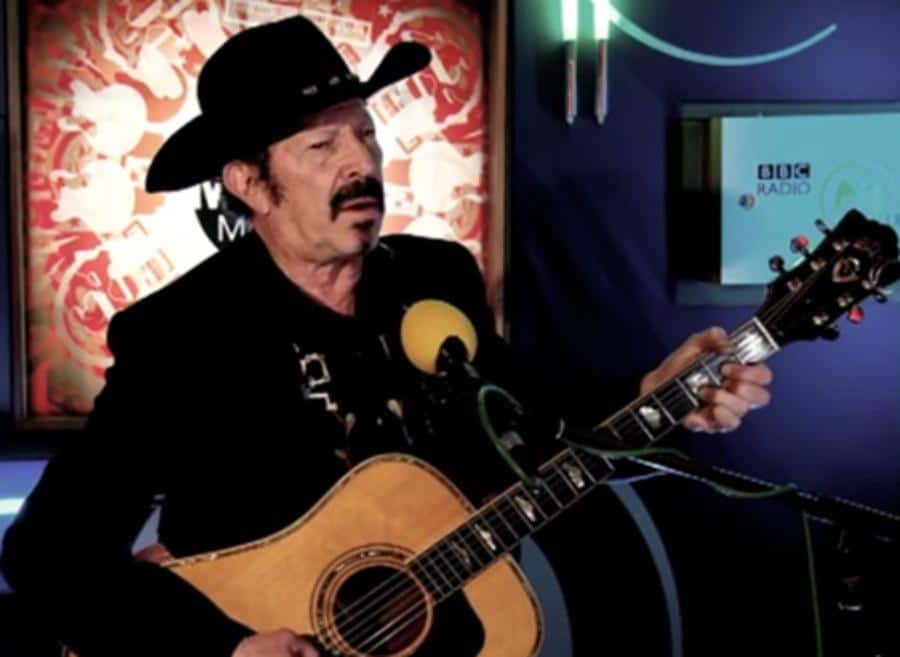
Kinky Friedman on Working With Sister Marcie on The Echo Hill Ranch Gold Star Camp

As said by Rolling Stone in 2018 about Kinky Friedman: “At 73, the Texas oddball has landed on a newfound sincerity. Friedman has arrived at a more empathic narrative voice, spinning old yarns in new ways.”

Last year, legendary singer/songwriter Kinky Friedman released “Resurrection” via Echo Hill Records. Produced by superstar producer, multi-instrumentalist, and three-time Grammy Award winner Larry Campbell, Kinky Friedman’s latest studio effort featured contributions from 3-time Grammy-winning engineer Justin Guip, co-writer Doc Elliot, and long-time pal Willie Nelson. In support of “Resurrection,” Friedman immediately kept busy with the “Merry Kinkster Tour,” and I had the pleasure of interviewing him in-person for the Jewish Journal during a New York City stop in late 2019.

However, there is a lot more to Kinky Friedman – who NPR called “the most outrageous Jewish cowboy in Texas” back in 2015 – than his 50-ish years in music. Sure, he was first full-blooded Jew to take the stage at Nashville’s Grand Ole Opry and has had his sounds covered by the likes of Dwight Yoakam, Tom Waits, Kelly Willis, Lyle Lovett and the aforementioned Willie Nelson. But philanthropy has also been a big part of the Kinky Friedman equation.

Friedman’s parents “Uncle Tom” and “Aunt Min” Friedman ran the 266-acre Echo Hill Ranch for 50 years, and their children operated it for another 10, before the echoes of happy campers’ laughter faded in 2013. But Kinky and his sister Marcie Friedman wanted to hear that laughter again, particularly from kids who could really use a chance to build happy, positive memories through nature hikes, horseback riding, canoeing and campfire singalongs; many of its campers are kids who were traumatized from the loss of an active-duty military or first-responder family member. So the Friedmans have resurrected the Texas Hill Country camp as the Echo Hill Ranch Gold Star Camp, where children of Gold Star families can experience the healing power of summer-camp fun, free of charge.

In turn, the Friedman siblings have established the nonprofit Echo Hill Ranch Foundation and are raising funds to cover all costs, including travel; donations may be made online via echohill.org. The foundation has partnered with several military nonprofits serving those families to identify “campership” candidates. Each of its 3 10-day sessions slated for 2021 will include 50 to 60 campers ages 8 through 12, while the third session is for children of deceased first-responders.

On Sep. 9, I had the pleasure of speaking with Kinky Friedman for a second time, as embedded below. We talked about the Echo Hill Ranch Gold Star Camp, his 2019 album “Resurrection,” his Jewish roots, his friend Willie Nelson and plenty more.


More on Kinky Friedman can be found here and here.

Kinky Friedman on Working With Sister Marcie on The Echo Hill Ranch Gold Star Camp Read More »

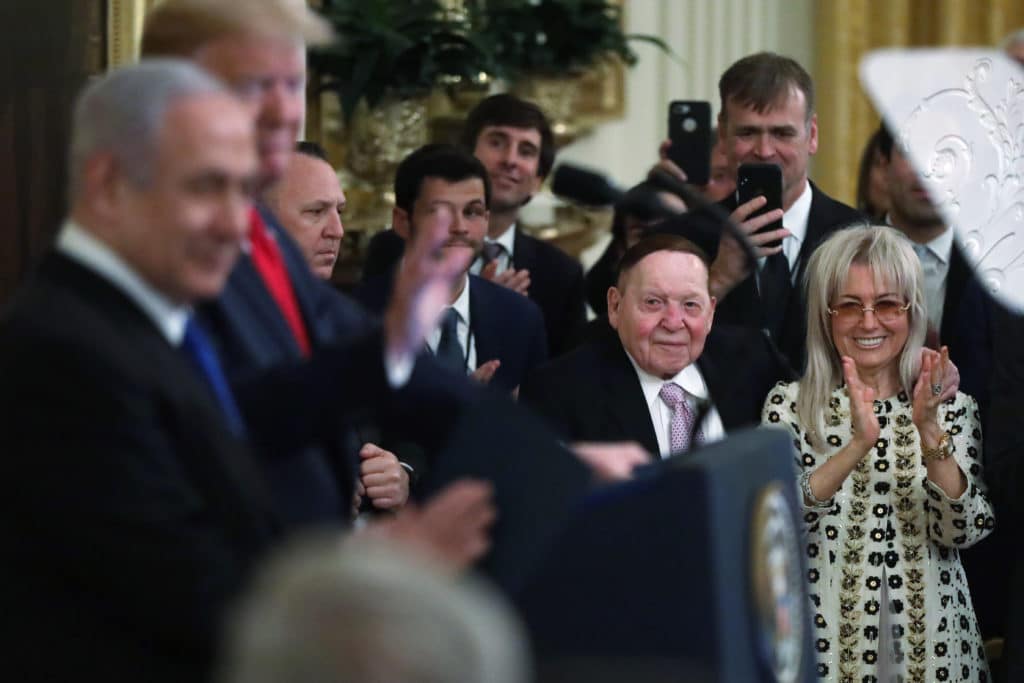
Adelsons Pledge up to $50 Million in Final Trump Campaign Push, According to Report

(JTA) — Sheldon Adelson and his wife Miriam, the pro-Israel philanthropists and major Republican givers, will spend up to $50 million in a final weeks campaign push for President Donald Trump, CNBC reported.

The casino magnate and his physician spouse are consulting with Republican officials close to Trump about where to spend the money, the report said.

Trump is trailing his rival, Joe Biden, in fundraising and a Biden ally, former New York mayor and media mogul Mike Bloomberg, has pledged $100 million in the critical swing state of Florida.

The report of Adelson’s pledge comes after reports that Trump berated Sheldon Adelson for not stepping up and helping him in the final part of the campaign. Trump has shifted Israel policy to the right-wing postures favored by the Adelsons and has awarded Miriam Adelson the Presidential Medal of Freedom for her medical philanthropy.

The Trump campaign has meantime accelerated its Jewish outreach, this week launching Jewish Voices for Trump as its official campaign Jewish outreach body. Its board includes the Adelsons; conservative radio host Mark Levin’s wife, Julie Strauss Levin; investment executive Wayne Berman; and Boris Epshteyn, a top adviser to the campaign.

The Biden campaign has had a Jewish outreach operation for months. This week, Epshteyn challenged the Biden campaign’s Jewish outreach director, Aaron Keyak, to a debate.

Both campaigns and their allies are focused on getting out the Jewish vote, particularly in Florida, in what is expected to be a tight race.

The Trump campaign launched an ad this week celebrating the normalization agreements signed this week between Israel and two Arab states, the United Arab Emirates and Bahrain. Trump brokered the deal, and the ad includes Israeli Prime Minister Benjamin Netanyahu saying at the White House lawn ceremony, “I am grateful to you, President Trump, for your decisive leadership.”

Trump also mentioned the deal in the Rosh Hashanah greetings statement he issued Friday.

“This year’s High Holy Days come with a sense of optimism for the people of Israel, as my Administration continues to make great strides in securing a more stable, prosperous, and peaceful Middle East region,” the statement said.

Adelsons Pledge up to $50 Million in Final Trump Campaign Push, According to Report Read More »

Poem: The Five Things You Must Know About Rosh Hashanah

1

This is only one of four Jewish New Years.
We also have one for trees
one for redemption from slavery
and one for cattle.
So don’t worry if you sleep through this one
Another one is bound to come along
sooner or later.
We Jews are always making backup plans.

2

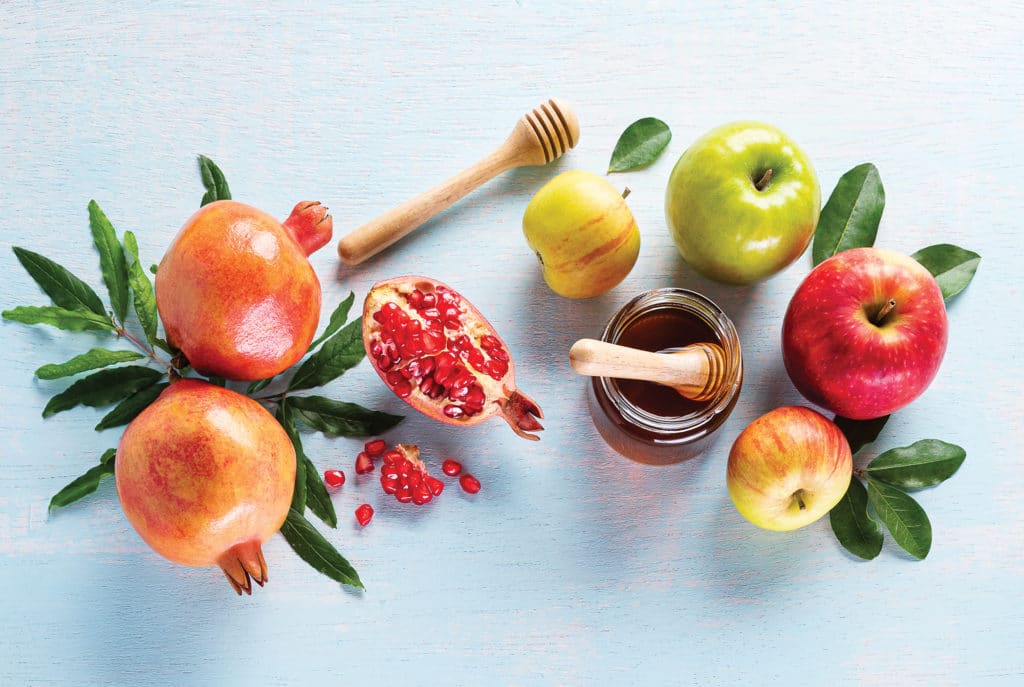
Apples can be red or green
Apples are sweet
If it weren’t for apples, gravity would be a mystery
We’d still be stuck inside a garden somewhere
wondering what to call the animals.
We owe apples everything, dip one in honey
so you can feel that gratitude on your tongue.

3

Let’s move on to pomegranates.
Also red. If it’s not red yet, be patient.
Have you ever cracked open a pomegranate?
You’re going to want to lay down some plastic.
It gets messy. You’ll find seeds inside.
One for every rule you forget to follow.
You’ve still got time. Yom Kippur is right around the corner.
Put a pomegranate side in your mouth
and say you’re sorry. Do this 613 times.
Now you’re getting it.

4

Do you hear that sound?
It’s not a foghorn, it’s not a train whistle
It’s not a sign that dinner is on the way.
It’s a shofar. It comes from a ram.
Don’t let his sacrifice be in vein.
You’re going to hear this a lot over the next 10 days.
Let it be a call to action.
Don’t forget what we said about the pomegranate seeds.
Now’s your chance.

5

Kiss and hug everyone you know
(or do that as soon as social distancing allows).
It’s the birthday of the world.
This is your cake.
Shanah tovah!


Rick Lupert, a poet, songleader and graphic designer, is the author of
25 books including “God Wrestler: A Poem for Every Torah Portion.”

Poem: The Five Things You Must Know About Rosh Hashanah Read More »