fbpx

September 8, 2020

MESA Defends Canceling Supporters of Israel at USC

The Middle East Studies Association (MESA), the largest academic organization for the field, has a long and ignominious record of defending apologists for Palestinian terrorism and BDS advocates, even as it opposes efforts to stem the rising tide of anti-Semitism on U.S. college campuses. To use a currently fashionable word, it evinces systemic anti-Israel bias. Even in light of this intolerant record, however, its latest effort to whitewash anti-Semitism at the University of Southern California stands out for its cynicism and deceitfulness.

A recent letter from MESA’s Committee on Academic Freedom purports to defend freedom of speech from Zionists’ efforts to censor criticism of Israel on campus. In fact, it endorses the “right” of anti-Semitic bullies to drive Jewish students who support Israel from campus leadership. Under the pretense of defending freedom of speech, it seeks to cancel Zionists for their beliefs. In the end, by omitting key facts and attributing demonstrably false motives to others, it succeeds only in embarrassing its authors and further degrading their organization.

Under the pretense of defending freedom of speech, it seeks to cancel Zionists for their beliefs. In the end, by omitting key facts and attributing demonstrably false motives to others, it succeeds only in embarrassing its authors and further degrading their organization.

Signed by MESA president Dina Rizk Khoury of George Washington University and academic freedom committee chair Zachary Lockman of New York University, the letter attacks USC president Carol Folt’s Aug. 6 “Message to the USC Community.” The catalyst for Folt’s action was the Aug. 5 resignation of USC student government vice president Rose Ritch, a rising senior who was subjected to what she and Folt characterize as anti-Semitic smears on her character triggered by her pro-Zionist beliefs.

Folt’s opening sentences state this clearly: “As you may know, our Vice President of Undergraduate Student Government, Rose Ritch, resigned yesterday from her position in student government. In her heartbreaking resignation letter, Rose described the intense pressure and toxic conditions that led to her decision—specifically the anti-Semitic attacks on her character and the online harassment she endured because of her Jewish and Zionist identities.”

Ritch’s resignation letter details her experience: “Because I also openly identify as a Zionist, a supporter of Israel’s right to exist as a Jewish state, I have been accused by a group of students of being unsuitable as a student leader. I have been told that my support for Israel has made me complicit in racism, and that, by association, I am racist.” Over the summer, “Students launched an aggressive social-media campaign to ‘impeach [my] Zionist a**.’ ” Resignation, she wrote, “is the only sustainable choice I can make to protect my physical safety on campus and my mental health.”

An op-ed Ritch wrote for Newsweek further elucidates: “Let’s be clear: This is anti-Semitism. …  Nearly 96 percent of American Jews support Israel as the Jewish state, inherently connected to our religious history and communal peoplehood. An attack on my Zionist identity is an attack on my Jewish identity. The suggestion that my support for a Jewish homeland would make me unfit for office, or would justify my impeachment, plays into the oldest and most wretched stereotypes of Jews: accusations of dual loyalty and holding all Jews responsible for the actions of the Israeli government.”

Readers of Khoury and Lockman’s letter will learn none of this. Blatantly distorting the record, they mention neither Ritch, nor the vicious anti-Semitism to which she was exposed that led Folt to insist that “it is critically important to state explicitly and unequivocally that anti-Semitism in all of its forms is a profound betrayal of our principles and has no place at the university.” These facts are central to the story. By omitting them, Khoury and Lockman demonstrate their contempt for the truth and their readers.

In a rhetorical sleight of hand, they first insist—against all evidence—that the situation at USC is “complex” and “difficult.”

“We are aware that your message was issued in response to and against the background of a series of complex developments” concerning “some members of the USC student government and their critics,” they write. It “is not our intent here to weigh in on the many serious and difficult issuesthese developments raise … .” No, their “concern is that, in the one public document you have issued to date on these complex matters, you have conflated anti-Zionism—criticism of Israeli actions and policies, and of Zionism as a political ideology—with anti-Semitism [emphasis added].”

Khoury and Lockman never identify these complex, difficult matters for an obvious reason—because there aren’t any. The motivation for Ritch’s resignation, as she explained repeatedly and passionately, is simple: Anti-Semites cited her Zionism as justification for declaring her unfit for office and launching vicious cyberattacks that made her fear for her physical safety. Knowing an accurate description of Ritch’s ordeal would expose their lies, Khoury and Lockman omitted it.

Having buried one inconvenient truth, Khoury and Lockman drag out one of MESA’s favorite canards: that Zionists necessarily conflate/equate criticism of Israel with anti-Semitism in a conspiracy to silence all criticism of the Jewish state. Lest their readers miss the point, they use the terms “conflate,” “conflated,” “conflation,” “equate” (twice) and “Israel” (three times). Through such trickery, they mendaciously claim that Folt “conflated anti-Zionism—criticism of Israeli actions and policies, and of Zionism as a political ideology—with anti-Semitism.” Her message’s “conflation of anti-Zionism and anti-Semitism”—not the relentless anti-Semitic attacks on Ritch they refuse to acknowledge—have “caused significant consternation and distress among USC student activists as well as faculty.” Hence, it is Folt’s letter that poses “the real threat to academic freedom and to the constitutionally protected right of free speech.”

Having buried one inconvenient truth, Khoury and Lockman drag out one of MESA’s favorite canards: that Zionists necessarily conflate/equate criticism of Israel with anti-Semitism in a conspiracy to silence all criticism of the Jewish state.

These are boldfaced lies. Folt never mentions Israel at all, and uses “Zionism” only once when condemning “the online harassment [Ritch] endured because of her Jewish and Zionist identities.” In ascribing to USC’s president a desire to silence criticism of Israel, MESA reveals its implacable hostility to the Jewish state and its supporters, not a Zionist plot for campus domination. Declaring students like Rose Ritch unfit to serve in student government because of their support as Jews for Israel is why Folt wrote her letter to the USC community, a fact driven home by her use of “anti-Semitism” five times.

In what they intend as a coup de grace, Khoury and Lockman conclude by citing an unimpeachable authority, American Jewish Committee veteran and Bard Center for the Study of Hate director Kenneth Stern, whose webpage describes him as the “lead drafter of the ‘working definition’ of anti-Semitism now adopted by the U.S. Department of State.” One can almost sense the satisfaction with which MESA’s leaders must have written, “even Kenneth Stern, the lead author of the State Department’s definition of anti-Semitism, has, in testimony before Congress and elsewhere, opposed legislation or policies that conflate criticism of Israel with anti-Semitism.”

Not quite. Inconveniently for MESA, Stern is co-author of “Are You Now or Have You Ever Been a Zionist?”—an impassioned apologia for none other than USC undergraduate Rose Ritch. Let that sink in. The student whose existence and travails MESA refuses to acknowledge enjoys the unqualified support of Khoury and Lockman’s ringer, who turns out to be playing for the other team.

Don’t you just hate it when that happens?

Stern co-authored the piece, which appeared two weeks after MESA’s letter to Folt, with former AAUP president Cary Nelson and other executive committee members of the Alliance for Academic Freedom (AAF), which describes itself as “progressive scholars and academics who reject the notion that one has to be either pro-Israel or pro-Palestinian.”

Its first sentence leaves little doubt as to where its authors stand: “The Alliance for Academic Freedom condemns the treatment of Rose Ritch, a Jewish undergraduate at University of Southern California who resigned under pressure as vice president of the Undergraduate Student Government following a campaign that featured denunciations of her support for Israel, including some with anti-Semitic overtones.” So strongly does it support Ritch that it scolds Folt and other USC administrators and faculty for not speaking out earlier on her behalf. Its concluding paragraph contains words so pointed one wonders if some of its authors had MESA’s response in mind: “The convergence of hostility to the state of Israel, rising campus intolerance, and social media harassment campaigns has created a toxic environment on some campuses—leading, as they did here, to violations of academic freedom and fair treatment.”

Khoury and Lockman, speaking for the largest academic association for Middle East studies, omitted the heart of this sordid tale and twisted a university president’s words in their quest to delegitimize Israel and its supporters by stigmatizing them as threats to academic freedom. In practice, as Ritch’s cancelation demonstrates, MESA’s lies seek to legitimize anti-Semitism, stigmatize Zionism as a form of bigotry and declare open season on pro-Israel students. Scholars who respect truth and value common human decency should turn their backs on this disgraced organization.

Winfield Myers is director of academic affairs at the Middle East Forum and director of its Campus Watch project.

MESA Defends Canceling Supporters of Israel at USC Read More »
‘End Jew Hatred at USC’ Protest Held at The Grove

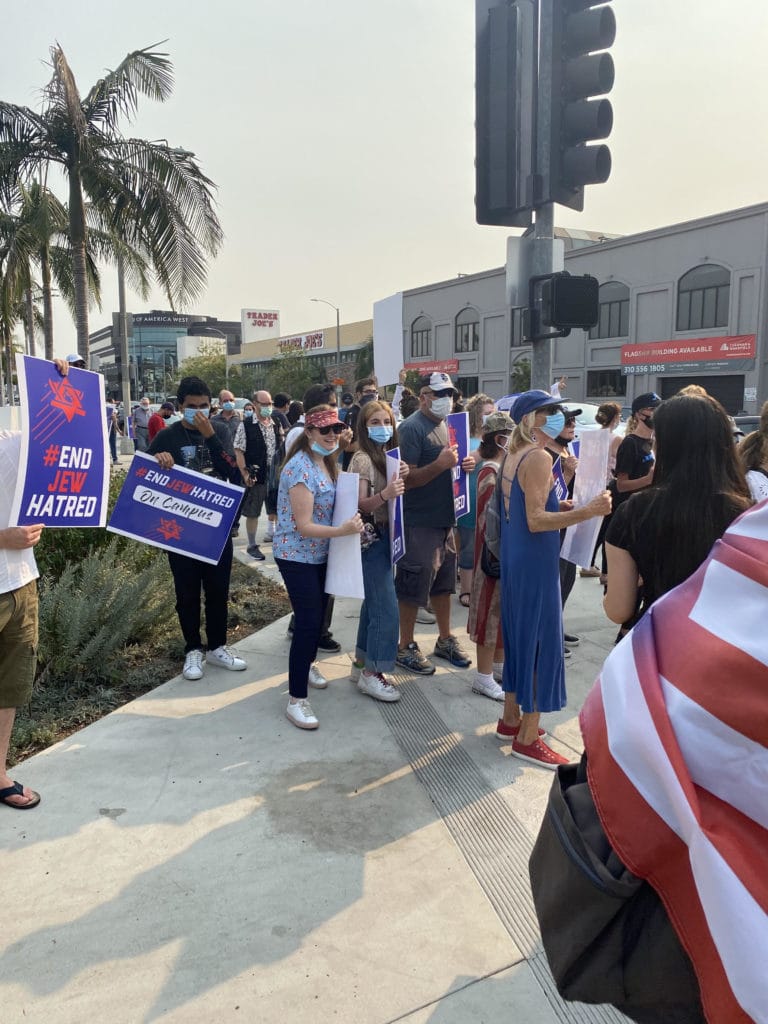
A protest against anti-Semitism at USC was held at The Grove on Sept. 7, with at least 100 people participating.

The protest was in response to USC student Rose Ritch announcing her resignation as student vice president in August, alleging that she was harassed on social media over her Zionist identity, including one comment she said calling for impeaching her “Zionist a–.” Rick Caruso, who heads the company that owns The Grove, is also the chair of the USC Board of Trustees.

The organizations hosting the protest included the Lawfare Project, the Institute for Black Solidarity With Israel (IBSI), Club Z, Yad Yamin, Beverly Hills Jewish Community Synagogue, and Herut North America.

Masha Merkulova, founder and executive director of Club Z, opened the protest, arguing Sept. 7 was just the beginning for the new End Jew Hatred movement.

“We are here to demand an end to Jew hatred in this generation,” she said. “We are tired of seeing Jews excluded and punished for our identity. We are sick when Middle East policies are being used to keep Jewish students out of spaces. We are fed up of showing up again and again for other marginalized [people] only to get cold shoulders when it’s our turn.”

She also called for action and consequences against anti-Semites.

“We will not allow bigots and racists to use Zionism against us,” Merkulova said.

Jennifer Karlan, a Los Angeles high school student and Club Z teen, spoke next, arguing that if the call to impeach Ritch’s “Zionist a—” was replaced with any other ethnic group, there would be serious consequences. But because Ritch is a Zionist, such action has not been taken.

“BDS [boycott, divestment and sanctions] and other Jew-hating groups have so successfully maligned and vilified the word Zionism so as to distort it from its meaning entirely,” Karlan said. “Zionism is not their word. Zionism is the word of the Jewish people.”

She equated Zionism to Jews as like flour to bread. “There is no Jewish people without our homeland,” Karlan said. “There is no Jewish people without the land of Israel.”

Karlan added that Jewish students on campus shouldn’t be forced to choose between their Zionist identity and being able to participate in student life on campus. She called on Caruso to take action to protect Jewish students at USC.

“Speak up for Rose, but more importantly speak up for Jewish students who hide their identity because they’re afraid of losing an important part of student life if they dare say they are Zionists,” Karlan said.

Joshua Washington, the director of IBSI, later spoke and argued that institutional anti-Semitism never ends with the Jewish people; the hatred eventually spreads to other ethnic groups.

“When I hear that Jewish students like Rose Ritch are being bullied by other students into choosing between being a Zionist and being Jewish, I think to myself, would anyone apply that same pressure to any other ethnic group?” Washington said. “Would those same students force a Kenyan American to have to choose between being Kenyan and supporting Kenya’s right to exist?”

Washington said that Jewish students are made to feel like they can be accepted on college campuses only if they’re “meek and quiet and you stay in your place.”

“I can tell you as a Black man, someone who won’t accept you because you’re strong is not someone by who you want acceptance. If someone will only bring you into the fold because you’re weak and defenseless, you can be sure that they will do everything they can to keep you that way.”

He added that there are many in the Black community who stand with the Jewish community against hatred.

“Historically, Blacks and Jews, our shoulders are always interlocked,” Washington said.

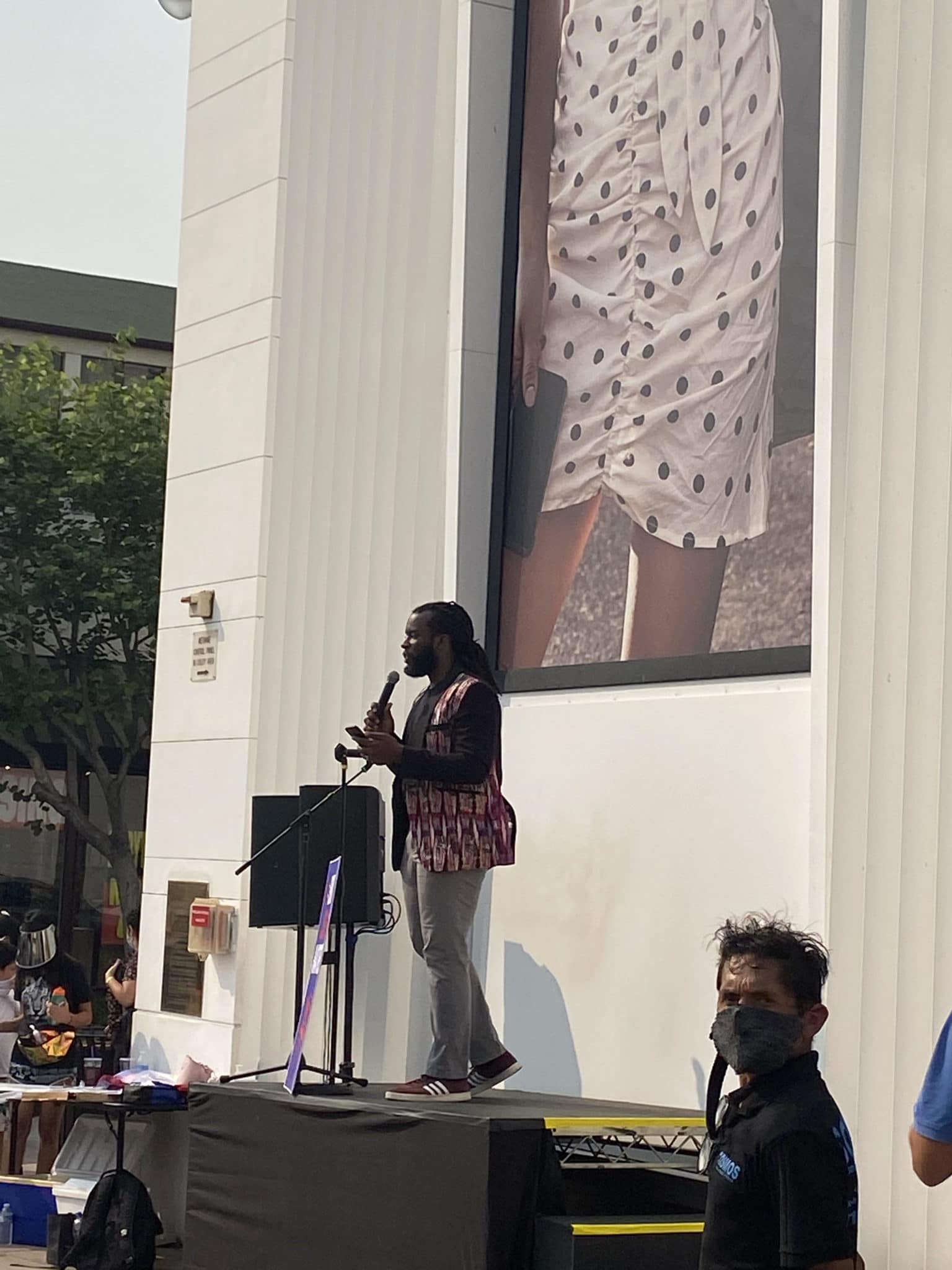
Joshua David Washington, director of the Institute for Black Solidarity With Israel, speaks at the End Jew Hatred at USC protest.

Journal contributor Micha Danzig also spoke, pointing out that a 2014 National Demographic Survey of American Jewish College Students found that 54% of American Jewish college students said they had witnessed or experienced anti-Semitism on campus. What happened to Ritch is just the latest example of a university allowing anti-Semitism to pervade on campus unabated, Danzig said.

“Our history has taught us that ignoring Jew hatred never makes it go away,” he said. “Within living memory of the Holocaust, being an open Jew-hater in Europe went from being something beyond the pale to something unfortunately commonplace. That recent history has shown us how letting anti-Zionism give false cover to hate created a Europe where being openly Jewish is often a risky proposition, and where every synagogue and Jewish institution needs armed guards.”

He called for administrators at universities across the country to adopt a zero-tolerance approach to anti-Semitism.

“Jew hatred will [be] treated by all college administrators, at schools like USC, the same way they treat all other forms of harassment or discrimination based on a person’s faith, ethnicity or race,” Danzig said. “Nothing more and nothing less.”

Gerard Filitti, senior counsel for the Lawfare Project, lauded the turnout at the protest and called for a civil rights movement for the Jewish people.

“This is where we start doing that: by standing together and fighting instances of hate, one at a time,” Filitti said.

Another speaker was Lana Melman, CEO of Liberate Art, an organization that fights against cultural boycotts of Israel. Shayna Lavi, who was told during a 2019 UCLA guest lecture that she is a white supremacist because she’s a Zionist, also spoke at the protest, as did her sister, Talia Lavi, who introduced a Black and Jewish Unity initiative.

After the speakers, protesters marched across West Third Street and Fairfax Avenue holding “End Jew Hatred” signs as several cars honked in solidarity.

‘End Jew Hatred at USC’ Protest Held at The Grove Read More »

Republican Congressional Candidate Laura Loomer Uses Holocaust Imagery to Attack Jewish Opponent Over Black Lives Matter Support

(JTA) — A new political advertisement for Jewish Republican congressional candidate Laura Loomer uses Holocaust imagery to attack her Jewish opponent, Democrat Lois Frankel, and calls Frankel “meshuggah,” Hebrew for crazy.

The ad by Loomer, a right-wing provocateur known for her anti-Muslim rhetoric, claims that Frankel is allied with the Black Lives Matter movement and attempts to link the vocal pro-Israel incumbent to a past platform from one Black Lives Matter coalition that accused Israel of genocide. The ad appears designed to play on fears that the Black Lives Matter movement will lead to anti-Semitism.

Loomer is challenging Frankel in a heavily Democratic South Florida district. Loomer, who calls herself an “investigative journalist,” has been banned from Facebook and Twitter for hate speech, and is also banned from the ride-share companies Uber and Lyft for anti-Muslim posts. President Donald Trump has endorsed Loomer in a district that includes Mar-a-Lago, the president’s Palm Beach home.

“Lois Frankel loves Black Lives Matter. That is Meshuggah,” begins the ad, which appears on the Loomer campaign website and YouTube. Later it calls Frankel “gornisht Lois,” using the Yiddish word for “nothing,” and says she “kneels to” a group that wants to end American foreign aid to Israel. The ad says Frankel is “incapable of protecting the Jewish community or Israel.”

In fact, the genocide accusation and call for ending aid came from the 2016 platform of the Movement for Black Lives, a coalition of organizations that aims to formulate policy for the Black Lives Matter movement. It is not representative of all of Black Lives Matter, which is a loose grassroots coalition, and does not speak for Black Lives Matter as a whole. Its 2020 platform does not mention Israel.

Frankel, who took office in 2013, has historically been a favorite of pro-Israel groups. In 2016, soon after the Movement for Black Lives published its anti-Israel platform, the prominent pro-Israel political action committee NORPAC called Frankel an “ardent supporter of Israel’s status in the international arena.” Mark Mellman, CEO of the Democratic Majority for Israel, which supports Frankel, said the Loomer ad was “wholly and completely dishonest” and called Frankel “a key advocate of a strong U.S.-Israel relationship.”

Later in the ad, a narrator says of Frankel, “Maybe she thinks if she makes nice, they’ll be nice to Jews in the end,” adding “Sound familiar?” as images of a Nazi rally and Jewish concentration camp inmates flash across the screen.

The ad calls Loomer “a real mensch.”

Republican Congressional Candidate Laura Loomer Uses Holocaust Imagery to Attack Jewish Opponent Over Black Lives Matter Support Read More »

BBC Arabic Producer Admits Retweeting ‘Inaccurate’ Photo Against Israel

A senior digital producer for BBC Arabic admitted to The Jewish Chronicle (JC) that she had retweeted an “inaccurate” photo criticizing Israel.

The JC reported on Sept. 8 that the producer, Rosie Garthwaite, had retweeted a tweet from January showing a map of Palestinian land shrinking since Israel’s founding in 1948 and contracting even more should President Donald Trump’s peace plan be implemented. The tweet had read, “I think as usual there was a White House spelling error. I think #Kushner meant ‘PIECE PLAN’ not #PeacePlan.”

“#Kushner” is a reference to Jared Kushner, a White House senior adviser and Trump’s son-in-law.

“The first map wrongly suggested that after the end of the Ottoman Empire all of the land in what is now Israel, the West Bank and Gaza was controlled by the Palestinians,” the JC reported. “The final 2020 map deliberately underplayed Palestinian territory in order to make Israeli ownership of land seem more extreme and unfair.”

The BBC said in a statement to the JC that Garthwaite has since rescinded her retweet because “she realized it was inaccurate.” Garthwaite confirmed this to the JC.

However, the JC report highlighted other tweets from Garthwaite regarding the Israeli-Palestinian conflict, which included a 2017 tweet sharing a post that read, “Happy one hundred years of British duplicity in the Middle East” on the 100th anniversary of the Balfour Declaration. That declaration stated that the Jews have the right to their own homeland in what was then the territory of Palestine.

Other tweets from Garthwaite highlighted in the report include sharing an article in 2019 that called Palestinian activist Ahed Tamimi an “icon” and sharing a post in a 2018 tweet accusing Israel of violating the terms of a ceasefire with Hamas.

Garthwaite currently is working on a documentary for BBC Arabic focusing on how two Israeli organizations — Elad and the City of David — have been working to build Israeli settlements and conduct archeological digs in East Jerusalem. She considers this illegal under international law because East Jerusalem is occupied territory, according to the JC.

The international community — including the United Nations Security Council, the U.N. General Assembly, the International Committee of the Red Cross and the International Court of Justice — has condemned the establishment of settlements in the occupied territories as violations of the Fourth Geneva Convention and international declarations.

Doron Spielman, vice president of the City of David, alleged in a letter to the BBC that the Garthwaite frequently asked his organization biased and fallacious questions, which is why he is concerned that her documentary will “vilify Israel, Jewish history and Jewish charities and present a number of false and misleading claims,” the JC reported.

British researcher David Collier tweeted, “Another @BBC employee caught spreading lies with raw anti-Israel propaganda. The first thing the BBC should do is stop any Israel related program she is working on. It is impossible to calculate the damage these ‘journalists’ and the BBC have done to the truth. Shameful.”

The JC had previously published a report on Sept. 2 highlighting BBC World News reporter Nimesh Thaker using an anonymous account to retweet a tweet criticizing his colleague, BBC 5 Live presenter Emma Barnett, for engaging in “the same old ‘antisemitism’ excuse whenever people criticize Israel.” Barnett had said in July that rapper Wiley’s anti-Semitic tweets “burn deep” for her since her grandmother fled persecution by the Nazis in Austria and her husband’s grandmother “survived unspeakable torture in Auschwitz.”

International human rights lawyer Arsen Ostrovsky sarcastically tweeted that sharing inaccurate information against Israel is “a standard job requirement there [at the BBC].”


Sussex Friends of Israel tweeted, “If only a report had been commissioned that looked into the possibility of an anti-Israel bias at the BBC. If only such a report existed we might well be able to judge whether the BBC does indeed hold the Jewish state to a ‘double standard’ other countries are not held to.”


The report that Sussex Friends of Israel referenced is an apparent reference to a 2004 internal report from journalist Malcolm Balen investigation allegations of anti-Israel bias at the BBC. The report has never been publicly released.

BBC Arabic Producer Admits Retweeting ‘Inaccurate’ Photo Against Israel Read More »

david suissa podcast curious times

Pandemic Times Episode 85: Can the Pandemic Era Deplete Us?

New David Suissa Podcast Every Monday and Friday.

Why the COVID-19 crisis is so difficult to manage and how best to approach it.

How do we manage our lives during the coronavirus crisis? How do we keep our sanity? How do we use this quarantine to bring out the best in ourselves? Tune in and share your stories with podcast@jewishjournal.com.

Pandemic Times Episode 85: Can the Pandemic Era Deplete Us? Read More »

Rose Ritch Is a Clarion Call to End Jew Hatred on College Campuses

A little more than a month ago, Rose Ritch, the vice president of student government at USC resigned, citing a relentless and anti-Semitic campaign of cyberbullying and public attacks on her simply because she identified as a proud Jew and Zionist.

Following her public resignation letter, USC President Carol Folt sent out a letter condemning the bullying of Ritch and announcing the creation of a “Stronger than Hate” program by the USC Shoah Foundation. Otherwise, USC has done next to nothing to make its Jewish students not feel as though they have to hide their Jewish identity and support of Israel in order to be able to freely and fully participate in student government at USC.

If USC truly wants to be “stronger than hate,” then it must make meaningful changes, such as requiring mandatory education on Jew hatred and the International Holocaust Remembrance Alliance’s definition of anti-Semitism. It also should create consequences for blatant anti-Semitism. To date, no one has been sanctioned, censured, or expelled for harassing Ritch. If Jew hatred is going to stop, there must be consequences for those who engage in or promote such misconduct.

On Labor Day, I had the honor of speaking at a rally in Los Angeles as a part of the #EndJewHatred now campaign, a grassroots movement demanding an end to the tolerance of anti-Semitism on college campuses and insisting that the USC Board of Trustees make the school the first university to respond to Jew hatred and anti-Semitic harassment in the same way as they would to all other forms of bigotry.

The  statement below is adapted from my speech and explains that what happened to Ritch is far from an isolated incident. For too long, Jew hatred has festered on campuses without an adequate response from university administrations. Enough is enough:

“Most of us have heard the famous phrase “Houston, we have a problem,” which was uttered by Tom Hanks in the movie “Apollo 13” about that failed moon mission to the moon. Well, we have a Jew hatred problem, which is growing and spreading just like a virus.

In our Passover haggadah, our sages tell us that “in every generation they rise up against us to destroy us.” Our history has sadly proven the accuracy of that warning. Our history also has demonstrated that in every generation, we have a hard time listening to that warning.

Ten years ago, at UC San Diego (UCSD), there was an event where David Horowitz (CEO & Founder of The Freedom Center) was speaking to a group of students. During the Q&A session, a UCSD student publicly stated — on video — that she supported the idea of gathering all of the Jews in the world in Israel so that it would be easier to kill us all in one place.

What did the UCSD administration do in response to this student? Nothing. It just issued  a statement to the Los Angeles Times about the importance of “discourse and debate.”

Four years later, a National Demographic Survey of American Jewish College Students found that 54% of Jewish students reported experiencing or witnessing anti-Semitism on campus. That’s over half of Jewish college students in America. Did this insane figure lead to soul searching by college administrators across the country or some commitment by college presidents to end anti-Semitism on campus? No. They did nothing. And neither did the majority of the Jewish community.

Barely one year later, a student at UCLA, Rachel Beyda, was nominated to the university judiciary board. She was then subjected to a grilling by four members of the UCLA student council about how, because she was Jewish and involved with Hillel and a Jewish sorority, she could not be an unbiased judge. This grilling, which was provided on live TV to the rest of the student body, was followed by a 40 minute debate seeking to disqualify Beyda because of her Jewish affiliations.

What did the UCLA administration do in response? Nothing. All it did was issue a weak-kneed statement about how an “intellectual community” must “hold itself to a higher standard.”

A month later, at USC, a Jewish student reported in Dorm Room Television that she overheard a conversation between the director of the Women’s Student Assembly and the assistant director of Queer & Ally Student Assembly about having a speaker representing the Israeli viewpoint on a panel about Gaza. The Women’s Student assembly director said, “I honestly don’t want to use our funds for a Jew to speak.”

And what did USC’s administration do in response to this published article exposing such plain Jew hatred within the student government at USC? You guessed it. Nothing.

Rose Ritch is just the latest victim of anti-Semitism on college campuses. Because Ritch identified as a Zionist — meaning that she, like most Jews, believes in the existence of a Jewish state within the Jewish people’s indigenous, historical and religious homeland — she was subject to cyberbullying, with students claiming on Instagram and on other social media platforms: “warms my heart to see all the zionists [sic] from usc and usg [sic] getting relentlessly cyberbullied.” Another post claimed all the groups on campus that “r Jewish r also Zionist” and because of this, Jews must not join any campus Jewish organization, because doing so smears “blood on ur hands.” Yet another student posted about “impeaching [her] zionist ass.”

What happened to Ritch epitomizes the “new anti-Semitism.” Rabbi Jonathan Sacks said,  “Anti-Semitism is not an ideology … The best way of understanding it is to see it as a virus … Today, we are living through the fourth mutation. Unlike its predecessors, the new anti-Semitism focuses not on Judaism as a religion, nor on Jews as a race, but on Jews as a nation.”

The anti-Semitism in attacks on Israel and on Zionist Jews like Ritch is evident to all except the most intentionally hateful or obtuse. Simply replace the word “Israel” or “Zionist” with “Jews” and observe the similarity with anti-Semitic remark. In the 1930s, Nazis and anti-Semites like Henry Ford claimed that “Jews were conspiring to control all governments.” In the 21st century, anti-Zionists regularly make some form the claim that Israel is controlling or trying to control foreign governments. In the Middle Ages and for centuries thereafter, Jews were labeled as “baby killers.” Now, anti-Zionists libel Israel, the embodiment of the Jewish collective, as the “baby killer.” These anti-Semitic canards, amongst many others, have been recycled into an “anti-Zionist” barrage of lies.

Make no mistake — slander and libel are what fuels Jew hatred. Every historic crime against the Jewish people, from our expulsion from England in the 13th century to the Holocaust, was preceded by strings of lies.

But it is our apathy to this libel that lets it grow. Enough is enough. For 10 years now, hate crimes against Jews have been the most common hate crimes in America per capita. In 2018, according to FBI hate crime data, Jews in the United States were 2.7 times more likely than African Americans and 2.2 times more likely than a Muslim-American to be victims of a hate crime.

And 2019 only got worse. The Anti-Defamation League’s (ADL) 2019 “Audit of Antisemitic Incidents” found that the total number of anti-Semitic hate crimes in 2019 increased 12% from 2018, with a frightening 56% increase in assaults. The ADL study found that there were, on average, as many as six anti-Semitic incidents in the United States for each day in the calendar year — the highest level of anti-Semitic activity ever recorded by ADL.

Our history has taught us that ignoring Jew hatred never makes it go away. Within living memory of the Holocaust, being an open Jew-hater in Europe went from being something beyond the pale to something unfortunately commonplace. That recent history has shown us how letting anti-Zionism give false cover to hate created a Europe where being openly Jewish is often a risky proposition, and where every synagogue and Jewish institution needs armed guards.

In the past few weeks alone, at least half a dozen synagogues in the United States were vandalized, and the Chabad center at the University of Delaware was deliberately burned to the ground. Is this what we want for the future of Jews in America?

The answer to that question must be a resounding no. That means that the response to the Jew hatred experienced by Ritch and so many other college students must be clear and unequivocal: there will be zero-tolerance for Jew hatred. Jew hatred will treated by all college administrators, at schools like USC, the same way they treat all other forms of harassment or discrimination based on a person’s faith, ethnicity or race. Nothing more and nothing less.

Rose Ritch Is a Clarion Call to End Jew Hatred on College Campuses Read More »

Save Newsom From an Even Worse Mistake

No governor of California has ever faced the enormity of the challenges that Gavin Newsom has confronted over the past six months. Even our most devastating natural disasters in the past caused instantaneous destruction followed by months and years of rebuilding and recovery. But the COVID-19 pandemic is the equivalent of a daily emergency that continually repeats — and will for months, if not years on end.

The economic, health and societal complexities posed by the coronavirus are unparalleled in our state’s history. But also consider our housing and homelessness crises; a wrenching discussion over racial justice and police reform; out-of-control wildfires and rolling blackouts; as well as a federal government whose attitude toward California ranges from uncooperative to downright hostile.

Under these unforgiving circumstances, Newsom made some decisions that were admirable — shutting down the state during the early stages of the coronavirus — and others less defensible, such as bowing to pressure from local governments to reopen prematurely. It will be years before a fair judgment on his stewardship can be rendered.

But before the end of September, Newsom will make a grievous mistake. Worse, it appears there is no way to prevent this entirely avoidable but almost inevitable misstep; the best possible outcome is to help him mitigate the damage that error will cause. 

In the closing hours of this year’s legislative session, the California State Senate voted to pass Assembly Bill 331, which will establish a mandatory ethnic studies class for public school students. During an important national debate over race relations, there is an understandable argument for such a requirement. But while efforts by the Jewish Legislative Caucus and the Jewish Public Affairs Committee of California (JPAC) have improved the bill, the legislation Newsom almost certainly will sign still authorizes a model curriculum likely to exclude the Jewish experience from a discussion about the state’s diversity — and all but ignore the threat of anti-Semitism in lesson plans designed to address prejudice and discrimination against underrepresented communities.

As I’ve written before, the pretense for ignoring Jews (as well as Armenians, Sikhs, Indian immigrants and numerous other ethnic groups) from this discussion is dubious. Arguing that the field of ethnic studies in higher education has traditionally focused only on the experience of Black people, Latinos, Asian Pacific Americans and Native Americans conveniently ignores the distinction between a university student voluntarily choosing to study these four particular ethnic communities and requiring high schoolers to be taught about only these four groups.

Newsom already signed similar legislation for the California State University system, breaching long-held historical precedent that politicians should not interfere with academic content. In the current political climate, it’s difficult to imagine a situation in which the governor doesn’t also sign AB 331. Rather than wasting time, energy and oxygen attempting to convince Newsom to veto a bill he clearly is predisposed to sign, a much better strategy for the state’s Jewish community would be to focus our efforts on enlisting the governor’s assistance in rescuing the current draft curriculum from those who have worked to keep out Jews.

There is a successful precedent for such an approach. Last year, when the original ethnic studies draft included numerous anti-Semitic and anti-Israeli references, pressure from the Jewish Caucus and JPAC caused Newsom to call for a sweeping overhaul of that proposal. This year’s version has removed most (but not all) of the objectionable language, but the Jewish experience still is noticeably absent.

At some point in the next few weeks, Newsom is likely to make an unnecessary but predictable mistake by formally authorizing this version of ethnic studies legislation. Community leaders are appropriately registering their concerns with the state Department of Education and elected State Superintendent Tony Thurmond. Californians who believe in a truly comprehensive study of our state’s remarkable diversity should join those efforts, but they also should contact Newsom’s office directly to try to persuade the governor not to worsen his error.

California’s governor speaks regularly and eloquently about the importance of our state’s multi-ethnic heritage. Now is his chance to show us that he means it.


Dan Schnur teaches political communications at UC Berkeley, USC and Pepperdine. Join him for his weekly webinar “Politics in the Time of Coronavirus” at 11 a.m. PDT on Thursdays. Register for it here.

Save Newsom From an Even Worse Mistake Read More »

Life as a Female Persian Rabbi

It’s not every day you meet a Persian female rabbi in a traditional community. So, one of the first questions I asked 34-year-old Rabbi Tarlan Rabizadeh was: “What’s the worst thing anyone’s ever said to you?”

“Someone in the Persian community once came up to me and said, ‘You’re becoming a Reform rabbi? Shame on you,’ ” Rabizadeh replied. But the most difficult comment came from an elderly Persian rabbi who officiated at her grandfather’s funeral. “Some things,” he said, “a woman just shouldn’t know.”

I first met Rabizadeh in 2019 at the American Israel Public Affairs Committee (AIPAC) Policy Conference in Washington, D.C., when I led a delegation of young Iranian-American Jewish leaders from 30 Years After’s Maher Fellowship. Rabizadeh spoke in front of 18,000 pro-Israel advocates. For the 30 Years After attendees, the sight of an olive-skinned, curly-haired, young, Persian female rabbi left them goggle-eyed. Her existence was even more extraordinary because her name is so Persian.

Born in Santa Monica, Rabizadeh was raised in a traditional Persian family, and her first language was Persian. Her family belonged to Nessah Synagogue, which was founded by the late Hacham Yedidia Shofet, the former chief rabbi of Iran, when the shul still was located in Santa Monica. 

“As Persians, most of us don’t fit under strict denominations like Orthodox, Conservative or Reform,” Rabizadeh said. “Those are more Ashkenazi constructs.”

This may explain why some Persian Jews in the U.S. don’t know much about the Reform movement. In Iran, most Jews practiced some form of Judaism, but there was a dichotomy, which began under the secular, Western-oriented Shah Mohammad Reza Pahlavi, who reigned from 1941 until his overthrow in 1979.  This dichotomy was between Jews who observed halachah and those who saw piety as a relic of the past — a time when Jews were confined to ghettos all over Iran.

Rabizadeh’s great-grandparents founded one of the largest synagogues in Shiraz — Rabizadeh Synagogue. When I mentioned that my husband and his family, who also are from Shiraz, belonged to her great-grandparents’ shul, Rabizadeh teared up. That’s the thing about Persian Jews. Even among younger people, our stories of Jewish life and community often are tied through Old World connections.

Until she was a teenager, Rabizadeh was content with her knowledge of Judaism. But as a sophomore at Milken Community High School, she was deeply moved by a class taught by Rabbi Sharon Brous, who later co-founded IKAR.

“I was annoyed by the biblical concept of ‘na’aseh v’nishmah,’ in which the Israelites’ declared, ‘We will do and we will listen to God’s decrees,’” Rabizadeh said. “I questioned why ancient Jews seemed to pledge blind devotion, and the way [Brous] answered the question made me feel there was so much more I could learn.” 

One morning, she told her parents she was going to be a rabbi. She was 16.

“I don’t self-identify as Reform. I’m just Jewish.” — Rabbi Tarlan Rabizadeh

“My dad stopped brushing his teeth and just looked at me. Finally, he asked, ‘Are you going to work at Chabad?’ My mom, who was worried about [kashrut], asked, ‘Does that mean you won’t eat at our house anymore?’ ”

I can’t blame Rabizadeh’s parents. If they’re anything like mine, they’re unconditionally loving, but they probably believe their Jewish experiences are enough and wonder why their daughter wants more.

Rabizadeh continued, “I think their lack of initial understanding came from the idea that being religious might not be a good thing, and that it held people back in Iran. And they didn’t understand what Reform Judaism [was].”

Ironically, Rabizadeh had to “break out” from the Persian community to gain the tools to serve its needs. She graduated from Boston University in 2008 with a degree in public policy and education, and a minor in Hebrew. She returned to L.A. and worked in interior design before attending Hebrew Union College-Jewish Institute of Religion (HUC-JIR), where she received a master’s in Jewish Education in 2013. A few years later, she decided to fulfill her lifelong dream and attended rabbinical school at HUC-JIR in New York City. She was ordained in 2018.

“I think I was the only non-Ashkenazi person for the three years I was at HUC,” she said. “One of my peers called me a ‘token of diversity.’ Another bought me a Yiddish dictionary as a parting gift. At the end of the day, it was Ashkenazim who gave me a chance to become, well, me.”

During a visit to North Carolina to perform Shabbat services as part of her rabbinical internship, Rabizadeh met Jews who asked when she’d converted. “They’d never seen a Persian Jew. So I playfully retorted, ‘Does it look like you wandered 40 years in the desert, or me?’”

In 2018, Rabizadeh moved to San Francisco to serve as a Jewish Emergent Network (JEN) rabbinical fellow at The Kitchen, where she learned how “to start a community from the ground up.” She led services, taught conversion classes and officiated at funerals. When the fellowship ended this July, she moved back to L.A. with a vision: to create a nondenominational community that would attract Persian and Ashkenazi Jews.

“This is it,” she said. “I am fulfilling my dream. I had to leave to find my voice. Now I am ready to be back home.” She hopes her project will be a blend of Persian and Ashkenazi communities. “I want to bridge those worlds,” she said. “I want to do something that will last generations.”

Rabizadeh’s journey has come full circle. She’s currently back at her alma mater, Milken, teaching Talmud and Bible studies to ninth and 10th graders. She officiates at life-cycle events but won’t perform marriage ceremonies on Shabbat. “I don’t self-identify as Reform,” she explained. “I’m just Jewish. I don’t know what box I fit into anymore. My dad says I’m a closeted Orthodox Jew.”

Today, though, she said, her parents are proud of her path. “I realized that the traditions I was taught at home stemmed from many talmudic passages I learned during rabbinical school. My parents’ home and my path aren’t mutually exclusive.”

The Iranian-American Jewish community has changed, too. In the past decade, a new generation of progressive young Iranian-American Jews actively have been searching for ways to honor rich traditions while embracing newer American realities. Some of them just might help Rabizadeh realize her dreams.

“Now that I’m back in L.A., I hear Persians say to me, ‘I’m so proud of you.’ I don’t know where they were 10 years ago,” she said.

At the same time, she’s compassionate toward the skeptics because she knows it takes time to soften hearts. Her greatest weapon in dealing with mostly older, disapproving Persians? Her last name. She introduces herself to community members, some of whom can’t help but smile upon hearing “Rabizadeh,” which, in one Persian translation, means “a descendant of rabbis.”


Tabby Refael is a Los Angeles-based writer, speaker and activist.

Life as a Female Persian Rabbi Read More »

New Initiative Will Significantly Lower Price of Jewish Teen Trips to Israel

(JTA) — A new initiative will significantly lower the cost of group trips to Israel for Jewish-American teens.

The Jewish Education Project announced Tuesday that it received a $20 million gift from The Marcus Foundation for its RootOne initiative. The funds will subsidize trips by five Jewish youth groups — the pluralistic BBYO, the Orthodox NCSY and the Reform NFTY, along with USY and Ramah, both affiliated with the Conservative movement.

With the subsidies, the groups can lower the cost of the trips by $3,000 per participant. The cost typically ranges from $4,500 to $8,000 for trips lasting three to six weeks.

The initiative hopes to increase the number of teens participating in the trips by 40% every year, according to a statement.

“We want young people stepping onto their college campuses with deep connections to Israel and strong Jewish identities,” Marcus Foundation Chairman Bernie Marcus said in the statement.

The first trips financed through the initiative are expected to take place next summer.

New Initiative Will Significantly Lower Price of Jewish Teen Trips to Israel Read More »