fbpx

August 11, 2020

Community Responds to Kamala Harris as Biden’s Vice Presidential Pick

Presumptive Democratic presidential nominee Joe Biden announced on Aug. 11 that California Sen. Kamala Harris would be his vice presidential running mate. The 55-year-old Californian is the first Black female to be named to a major party ticket in U.S. history. (She is biracial; her mother is from India and her father is from Jamaica. She also is married to a Jew).

The Journal reached out to local community members immediately after the announcement. Here’s what they had to say: 

Biden made a perfect choice in Kamala. She is tough, indefatigable, principled, smart and ambitious. As a Black woman and a first generation American, Kamala is aligned with many issues at the core of our Jewish and American democratic ideals and values. She was a consistent supporter of Israel during her Senate tenure. As a prosecutor, Kamala also understands law enforcement and can be instrumental in helping our country come to grips with systemic racism and to re-think the way we deal with inequities in our policing and criminal justice systems. As a Jew, as a feminist, as a Democrat, and simply as an American, I feel that Kamala was an excellent choice.
Janice Kamenir-Reznik, chair, Jews United for Democracy & Justice, co-founder, Jewish World Watch

I laughed. I cried. She’s from my state. She’s from Oakland, where I have family and sports teams I root for. She’s fierce. She’s strong. She’s so smart and she’s fearless. I am so excited. And also I am nervous because there is still so much hate — against women, against women of color. I pray our need for change is stronger than that hate. And I worry that she might be seen as “too” liberal. Is she “too” all of the things people on the fence are already worried about? I don’t know. I’m over the moon, essentially. Let’s turn this ship around!
Mayim Bialik, actress and neuroscientist

Sen. Kamala Harris is an excellent choice. She’s smart, articulate, willing to speak truth to power. That she is a woman of color makes the case for her candidacy even stronger. Her policy choices may not be progressive enough for some (and too progressive for others), but what is clear is that Sen. Harris brings to the office strong government experience, will fight to bring our country back to the democratic values we hold dear and is a true friend to those communities whose rights have been under attack for far too long, including the Jewish community and communities of color. 

Her sensitivities to racism and anti-Semitism are keen and will guide her choices. My daughter and I have been fans of Kamala Harris from the beginning and I could not be more excited to share the experience with her of voting for a Black woman for vice president of the United States.
Tzivia Schwartz Getzug, community activist

She is smart, charismatic, energetic and strategic. She has principles but she is not rigid. She understands that politics is the art of the possible. The one time I met her, at a reception during her campaign for attorney general, we got into a serious conversation about the importance of Jewish community support for public education. When I tried to end the conversation, so she could go meet people who could donate to her campaign, she instead stayed focused on a one-on-one conversation with me —  an under-paid civil rights activist — because the issue at hand was more critical than chasing dollars. 

In addition to caring about issues that matter, she has an important virtue at this moment in our history: as a Black, Southeast Asian woman, the child of immigrants, married to and raising children with a white Jewish man, she understands something fundamental about America and the ways that, at its best, it embraces and honors the aspirations of diverse peoples. 

As a multiracial person myself, I know how that  impacts one’s understanding of American realities and American possibilities. With friends and relatives of different racial, religious and cultural backgrounds, her selection is a statement of optimism about our open, inclusive, multiracial American future, not the harsh, fear-driven, white supremacist past that Donald Trump is appealing to. A deeply held American principle is “E Pluribus Unum” — out of many, one. She understands that because she has lived that.
Eric Greene, civil rights activist, diversity consultant and board member of Jewish Multiracial Network

My views about any political candidate are always considered through the prism of their attitude toward Israel. Nowadays, that is the real barometer of anti-Semitism, and I was therefore pleased to read that Sen. Harris has been a strong supporter of AIPAC, and that unlike some on the left-wing of her party, including other presidential candidate hopefuls, she has never suggested conditioning aid to Israel as a way of leveraging Israel to change its policies. Sen. Harris also firmly opposes U.N. votes against Israel or any kind of strong public criticism targeting Israeli policy.
Rabbi Pini Dunner, senior rabbi, Beverly Hills Synagogue

I’m thrilled that Sen. Kamala Harris has been selected and I cannot wait to see the first woman and first person of color elected as vice president of the United States.

Sen. Harris is a progressive powerhouse woman of integrity and a good friend of the Jewish and pro-Israel communities, and I am immensely proud of her service to the people of California. Being on the presidential campaign trail with Kamala, I got to experience that rare combination of brilliance and conviction, fearlessness and focus.

Kamala will continue to fight for equity and justice and the rule of law. The Biden-Harris administration represents a new day for America and I am inspired to make that a reality.
Naomi Goldman, IKAR and Heart of LA Democratic Club Board member

Sen. Harris is an inspired choice. As a fellow lawyer and activist for workers and immigrants, I have long admired Sen. Harris’ dedication to protecting our most vulnerable. In our conversations, she also has shared with me her commitment to a strong U.S.-Israel alliance, which began for her as a child collecting donations for JNF boxes to plant trees in Israel, and continued to her first act as a U.S. senator, sponsoring a bipartisan resolution objecting to U.N. Security Council Resolution 2334 that wrongfully deemed the Western Wall as illegally occupied. And, as a fellow child of immigrants, Sen. Harris’ nomination renews my faith in the American Dream, where, to paraphrase Ruth Bader Ginsburg, in America, the only difference between an immigrant and the vice president is a generation.
Sam Yebri, President, 30 Years After 

Community Responds to Kamala Harris as Biden’s Vice Presidential Pick Read More »

Kamala Harris Was the Safe and Favorable Choice

It is a mark as to how much the world has changed over the past few months that Joe Biden’s selection of the first African American woman in history to join a major party ticket was considered to be his safest choice.

Kamala Harris will not have a large impact on the presidential race — which is exactly what Biden wants. While her place on the ticket is of tremendous historical import, it’s difficult to see many swing voters making or changing their decision based on the fact that she is the Democratic vice presidential nominee. This is not meant to diminish Harris: The only two running mates who have significantly impacted a presidential campaign in the last half century are Thomas Eagleton and Sarah Palin, neither of whom did so for the benefit of their party. The last vice presidential selection who helped the ticket was Lyndon Johnson, and a phenomenon that occurs every 60 years can safely be classified as the exception rather than the rule.

Biden is holding a comfortable lead in the polls and has no interest in putting that lead at risk. Given his experience as Barack Obama’s vice president, he understood the obligation of picking someone who would be prepared to assume the responsibilities of the presidency if necessary. He also recognized the critical role that African American voters played in his nomination, the dramatic reconfiguration of the national political landscape in the aftermath of George Floyd’s death, and how the unprecedented selection of a woman of color could motivate a progressive Democratic base that has been less than enthusiastic about supporting an older white man.

Senators and governors historically have been seen as possessing the necessary experience for the presidency, and Harris is currently the only African American woman in the country to hold either job. Naming a qualified white woman such as Gov. Gretchen Whitmer of Michigan or Sen. Elizabeth Warren of Massachusetts wouldn’t have done nearly as much to inspire the Democratic base as a woman of color. While the nomination of a Latina or an Asian Pacific candidate would have been equally historic, the recent national debate regarding race relations has created an environment where an African American nominee has much more of a motivational effect. (Harris’ father is from Jamaica; her mother is from India.)

Other African American women who were considered brought risks of their own. Rep. Karen Bass’ positive comments about Fidel Castro would have put Florida out of reach. Putting a candidate like former National Security Advisor Susan Rice, who never has sought elected office, in a national spotlight could have been a significant gamble as well. And Biden would have been hard-pressed to argue that Rep. Val Demings of Florida, Mayor Keisha Lance Bottoms of Atlanta and former Georgia state legislator Stacey Abrams had the experience necessary to be one heartbeat from the presidency.

Joe Biden is holding a comfortable lead in the polls and has no interest in putting that lead at risk. 

If Biden wanted a candidate with acceptable presidential-level credibility and sufficient motivational capacity, his pool of candidates was exactly one. Harris has raised suspicions among his allies that her future presidential prospects often might come before the needs of a Biden White House. But ambition in a politician is no crime: It might even be a prerequisite. And it would certainly not create the types of potential difficulties on the campaign trail as would the vulnerabilities of his other alternatives. 

Biden decided to opt for caution, which is a luxury available to front-runners. But that leads us to one last historical note, which might be the most important of all. The other two women who were vice presidential nominees of a major party —  Geraldine Ferraro and Sarah Palin — were chosen by presidential candidates with nothing to lose. Walter Mondale and John McCain were running well behind in their respective campaigns and both were eager to find a way of altering the dynamic of their races.  

This makes Harris the first woman in our history to be selected for this spot from a position not of weakness and desperation but of confidence and strength. Regardless of how one plans to vote this fall, that is a breakthrough worth noting and savoring.


Dan Schnur teaches political communications at UC Berkeley, USC and Pepperdine.

Kamala Harris Was the Safe and Favorable Choice Read More »

Anti-Semitic Note Reportedly Left on N.Y. Assemblymember’s Vandalized Office

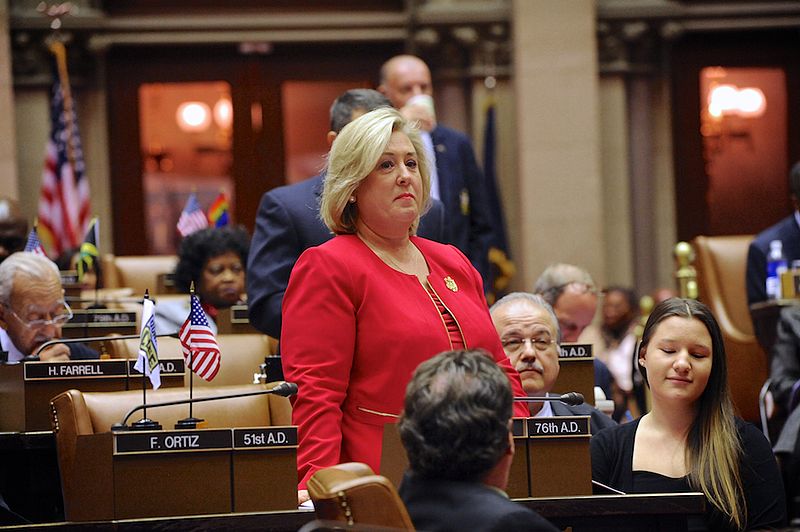
An anti-Semitic and sexually explicit note reportedly was left on the door of New York Democratic Assemblymember Rebecca Seawright’s Manhattan office on Aug. 11.

The New York Daily News reported that the note read, “Rabbi pays c—sucking Rebecca in cash and kind.” White paint also was splattered on the outside of the office.


Seawright said in a statement, “We will never be intimidated by this criminal act. We have called for a hate crimes investigation. We stand before you today to denounce this disgraceful and hateful crime. We will remain vigilant.”


New York Democratic Assembly Speaker Carl Heastie also denounced the note and vandalism in a statement.

“These actions are completely unacceptable and un-American,” he said. “The Assembly Majority condemns this disgraceful behavior and will continue to work to ensure New York remains inclusive and welcoming for all.”

Democratic Assemblymember Sean Ryan also tweeted, “Very sorry to see this happened at the office of my colleague Assemblymember Rebecca Seawright. There is absolutely no place in New York for anti-Semitism.”


The City of New York Community Board 8 (CB8) Manhattan, an agency that helps resolve municipal delivery service complaints, similarly condemned in a statement what happened to Seawright’s office.

“CB8 deplores the rise in anti-Semitism spreading across this City and our country,” the statement read. “New York City’s religious, ethnic, racial, economic, and age diversity should lead to tolerance, mutual respect, and concern for each other’s well-being. New York City has no place for hatred and intolerance.”

The statement concluded: “We stand firmly with Assembly Member Seawright in condemning all forms of anti-Semitism.”


Seawright had hosted a virtual town hall on anti-Semitism in July as well as in 2019.

Anti-Semitic Note Reportedly Left on N.Y. Assemblymember’s Vandalized Office Read More »

HolocaustFaceMasks.Com Stops Selling the Masks and Plans to Shut Down

(JTA) — A website dedicated to selling face masks featuring images of the Holocaust has stopped selling the masks and said it would shut down on Aug. 11.

HolocaustFaceMasks.com, which had sold fewer than 10 masks as of July 29, had marketed masks emblazoned with famous pictures of the Holocaust. One showed a child with his hands raised at gunpoint and an image of crematoria at a concentration camp.

The site stopped selling the items apparently because of the backlash it received.

“We have removed items with the most complaints, and our other items will remain available until we close the website August 11,” its homepage said.

The message defends the intention behind the site and appears to implicitly criticize Jews who objected to it. The site’s founder told the Jewish Telegraphic Agency in July that he believes requiring face masks could lead to something like the Holocaust “or even more sinister.”

Anti-Semitism watchdogs have called such comparisons an unacceptable trivialization of the Holocaust.

“Unfortunately and understandably, many had emotional reactions to the original designs and the concept behind them was not considered,” the message on the site reads. “The reaction to demand that people should not be able to express their opinion that tyranny is afoot, is troublesome. This reaction is especially troublesome when it is made by those who claim to have the strongest associations with one of the most tyrannical events in human history.”

HolocaustFaceMasks.Com Stops Selling the Masks and Plans to Shut Down Read More »

Hungary’s Largest Jewish Group Expels Rabbi Who Said Zionism Is Causing Another Holocaust

(JTA) — Hungary’s largest Jewish group expelled a rabbi who has accused Israel of appropriating the money of Holocaust victims and putting Diaspora Jews in danger.

The rabbinical council of the Mazsihisz umbrella announced in a letter to Israeli Ambassador Yacov Hadas-Handelsman that it was “terminating its relationship” with Rabbi Gabor Finali. The letter said it was “an indefinite suspension” of Finali, 43, who since 2017 has served as the resident rabbi of a Mazsihisz-affiliated congregation, the Ohel Avraham Synagogue in Budapest.

It’s an unusual development for Eastern and Central Europe, where leaders of Jewish communities are rarely expelled and seldom express acrimonious public criticism of Israel.

The most controversial remarks by Finali, who supports multiple left-wing causes, came in July on his Facebook page.

“Israel took all the benefits and most of the compensation from Germany for the death and suffering of our relatives,” he wrote. “The chaos that Israel has been causing since 1948 is the reason for most, if not all, attacks on Jews in the Diaspora. The money spent on security until recently (2018) was because we suffer the consequences, we’re the soft targets … Herzl’s mission failed because it didn’t stop the Holocaust, but soon it will lead to a new one.”

Finali apologized for and retracted the post, but Mazsihisz in its letter to the ambassador last week said it was cutting its ties with the rabbi because he “is more loyal in his writings to the enemies of Israel than to Israel.”

Finali belongs to the Neolog denomination of Judaism, a stream that evolved in Central Europe in the 19th century and is similar to Masorti, or Conservative, Judaism.

In a 2018 interview with the Szombat Jewish magazine, Finali said: “The state of Israel lives and thrives thanks to God, I wholeheartedly support its existence,” but added he doesn’t consider it to be “a pure virgin.”

Hungary’s Largest Jewish Group Expels Rabbi Who Said Zionism Is Causing Another Holocaust Read More »

Facebook Says It Is Updating Hate Speech Policies to Include ‘Stereotypes About Jewish People Controlling the World’

Facebook announced in an Aug. 11 statement that the social media giant will be updating its hate speech policies to include “stereotypes about Jewish people controlling the world.”

The statement promoted Facebook’s latest Community Enforcement Standards report on how its policies were enforced from April to June.

“Our proactive detection rate for hate speech on Facebook increased 6 points from 89% to 95%. In turn, the amount of content we took action on increased from 9.6 million in Q1 to 22.5 million in Q2,” the statement read. “This is because we expanded some of our automation technology in Spanish, Arabic and Indonesian and made improvements to our English detection technology in Q1.”

Facebook has developed new teams and task forces, such as the Facebook Inclusive Product and the Diversity Advisory Council, to ensure that the platform fosters an inclusive environment.

“We’re also updating our policies to more specifically account for certain kinds of implicit hate speech, such as content depicting blackface, or stereotypes about Jewish people controlling the world,” the statement read. “We also continued to prioritize the removal of content that violates our policy against hate groups. Since October 2019, we’ve conducted 14 strategic network disruptions to remove 23 different banned organizations, over half of which supported white supremacy.”

The social media giant’s statement added that Facebook’s reports will start being subjected to third-party audits in 2021 to ensure that their statistics are accurate.

“As the COVID-19 pandemic evolves, we’ll continue adapting our content review process and working to improve our technology and bring more reviewers back online,” the statement concluded.

Arsen Ostrovsky, executive director of the Israeli-Jewish Congress, tweeted, “Bravo @Facebook for announcing this new policy to tackle hate speech on your platform. It is certainly a step in right direction. But insofar as #Antisemitism is concerned, it is imperative that next, Facebook #AdoptIHRA [International Holocaust Remembrance Alliance] definition as a base standard.”

On Aug. 7, 128 Jewish and pro-Israel organizations signed a letter posted to the Stop Anti-Semitism.org website calling on Facebook to adopt the IHRA definition of anti-Semitism, which states that certain criticisms of Israel are anti-Semitic.

“The full IHRA working definition of anti-Semitism provides Facebook an effective, neutral, and nuanced tool to protect Jewish users from hate speech and imagery that incites hate and oftentimes leads to violence,” the letter stated. “While the impact of online hate speech, misinformation, and disinformation on our society continues to be researched and explored, we cannot afford to lose any more time in fighting this bigotry and preventing violence.”

Monika Bickert, head of global policy management at Facebook, wrote in a letter to Stop Anti-Semitism.org on Aug. 11 that Facebook has found the IHRA definition of anti-Semitism to be “valuable” in crafting its hate speech policies.

“In some respects, our Community Standards go further than the IHRA definition — for example, expressions of dismissal (e.g. ‘I don’t like Jews’),” Bickert wrote. “Under this policy, Jews and Israelis are treated as ‘protected characteristics’ — with the result that we remove attacks against them when identified by our proactive detection technology or reported to us by one of the more than 2.6 billion people who use Facebook around the world.”

Stop Anti-Semitism.org thanked Facebook for responding to them.

“We look forward to working with @Facebook to ensure #antisemitism is eradicated from your platform and the #IHRA definition is fully adopted by your organization,” the watchdog group added.

Facebook Says It Is Updating Hate Speech Policies to Include ‘Stereotypes About Jewish People Controlling the World’ Read More »

L.A. Jewish Iranian Women Speak Out About Divisions and Unity

American Jewish University (AJU) hosted an online panel on Aug. 3 with two Jewish Iranian women as part of its B’Yachad Together series. Titled “Two Emerging Persian Voices Talk Honestly About Divisions and Unity,” associate director at the American Jewish Committee Los Angeles (AJC-LA) and lecturer at the Academy for Jewish Religion-CA Saba Soomekh and Switch and Paymaxs founder and AJC board member Liana Kadisha Cohn spoke with AJU Chief Innovation Officer Rabbi Sherre Hirsch.

In deciding to host the two women, Hirsch told the Journal, “It was a natural thing that [we] started highlighting all the different types of Jews and communities that are out there. [I said,] ‘Saba and Liana, both of you are such shining examples of Persian women who have really been exemplary.’ And [they have] done it [their] own way. Liana for going to Stanford, speaking Mandarin and working on an Israeli ambulance, Saba being an academic, teaching at UCLA. They’ve broken ground [for] any person, let alone Persians, let alone a woman. So, I said, ‘What would it look like if we had a conversation?’ ”   

Hirsch added that her interest in the Persian community dates back to 1996 when she became the first female rabbi at Sinai Temple, which had a congregation with a strong Iranian contingent. She remained at Sinai Temple for eight years and said many congregants thought she was Iranian. They spoke to her in Farsi and she gave a speech from the pulpit about what Ashkenazi Jews could learn from Iranian Jews. Since then, she said, she has admired the intimacy and connection that people from the Persian culture bring to their Friday night Shabbat meals and to their Judaism as a whole.  

Introducing Soomekh and Kadisha Cohn at the event, Hirsch revealed that she had known them both for many years and was “kvelling,” to introduce them. “I was your teacher and now I get to be your student,” she said.

Hirsch then asked them about the origins and definitions of Sephardic, Persian, Iranian and Ashkenazi culture and history. Although many Iranian Jews identify as Sephardic, Soomekh debunked the idea that they were Sephardic unless their families were from Spain or Portugal (the Iberian Peninsula). Rather, she said, it’s the term Mizrahi that should be used. She noted it’s a term used less in America but all the time in Israel. “It literally means ‘Jews from the East,’ ” she said. “Sephardic and Mizrahi are actually very different terms because the Mizrahi Jewish community, specifically the Iranian Jewish community, goes back to Iran — at that time Persia — from 2,700 years ago. We are the oldest community in the Diaspora.”

“Not all Jews are white or look white. A lot of people I had met had not even known that there were Iranian Jews.” — Liana Kadisha Cohn

She then went on to say, “Persia doesn’t exist anymore … but Persian Jews use that term because I think it invokes a time when they felt they lived in a country where there was religious pluralism and where Judaism, or at least the Jewish community, was being respected.”

When Kadisha Cohn’s parents arrived in Los Angeles, they stayed in a motel before realizing their children had been out of school for close to a year. That’s when they enrolled them in school and began their life in L.A.

“Finally, they realized they’re not going back,” Soomekh added.

The women also addressed common stereotypes including that “not all Jews are white or look white,” Kadisha Cohn said. “A lot of people I had met had not even known that there were Iranian Jews.” 

They also spoke about insularity within the community, in addition to the misconception that all Iranians are wealthy. Some do not have money for rent, food and basic necessities, Soomekh said, adding, “We’re not a homogenous community.”


Michelle Naim has a bachelor’s degree in English-Journalism from Yeshiva University and is a former Journal intern. She’s on Twitter at @michnaim.

L.A. Jewish Iranian Women Speak Out About Divisions and Unity Read More »

Here are 5 Jewish Things to Know About Joe Biden’s VP Pick Kamala Harris

Note: The original version of this story was written in January, when Kamala Harris was being floated as a potential Democratic vice presidential candidate.

Former Vice President and presumptive Democratic presidential nominee Joe Biden announced Aug. 11 that Sen. Kamala Harris will be his running mate. The California senator is the nation’s first Black and Asian American woman on any major U.S. party’s ticket.

Harris, 55, is a progressive on most issues who draws some ire from the left for her tough-on-crime posture when she was California’s attorney general. She pleased Democratic hearts, meanwhile, with her tough treatment of President Donald Trump’s second Supreme Court nominee, Brett Kavanaugh, during his Senate confirmation last year.

The daughter of a mother who immigrated from India and a father who immigrated from Jamaica, Harris has some Jewish nuggets in her history.

She smashed a glass at her wedding

She met her Jewish husband, Douglas Emhoff, on a blind date in San Francisco, arranged by friends. They married in 2014 — Harris’ sister Maya officiated — and smashed a glass to honor Emhoff’s upbringing. It was her first marriage and his second — Emhoff has two children from his first marriage.

You thought Jews can be parochial? “Most eligible Indian American bachelorette marries fellow lawyer” is how one Indian American media outlet reported the story.

Emhoff took the Washington, D.C. bar exam in 2017 so he could work in the same city.

Emhoff’s Twitter feed is pretty much “I love my wife” all the time (take that, Kellyanne and George Conway).

She did the blue box thing

“So having grown up in the Bay Area, I fondly remember those Jewish national fund boxes that we would use to collect donations to plant trees for Israel,” she said at the American Israel Public Affairs Committee in 2017. “Years later when I visited Israel for the first time, I saw the fruits of that effort and the Israeli ingenuity that has truly made a desert bloom.”

No mention why Harris was a blue box girl growing up — and Google was no help. JTA has put a query into her office.

She’s more AIPAC than J Street

Since being elected in 2016, Harris has spoken twice at the annual policy conference of the American Israel Public Affairs Committee. Her 2018 speech, with the California delegation, was off the record (itself not unusual, although critics of Israel were unnerved), but she gave a good picture of where she stands in her 2017 speech.

She’s for two states — so is AIPAC, although, sometimes less than emphatically — but she doesn’t believe in big-footing either side.

“I believe that a resolution to this conflict cannot be imposed,” she said. “It must be agreed upon by the parties themselves.”

More than half of the Democratic caucus in the Senate gets the endorsement of J Street, the Jewish liberal lobbying group that believes pressure is necessary to start peace talks. J Street did not endorse Harris. Her only association with the group was in November 2017, when she was one of 17 local and federal politicians on the host committee (i.e., “yes you can stick my name on the invitation”) of a party thrown by J Street’s Los Angeles chapter. She also met a year ago in her office with the group’s director, Jeremy Ben-Ami.

Harris also co-sponsored a Senate resolution in early 2017 that essentially rebuked the Obama administration for allowing through a U.S. Security Council resolution condemning Israel’s settlement policies.

She supported the Iran nuclear deal, although she was not a senator in 2015 when Congress voted on it, and is on the record opposing the Boycott, Divestment and Sanctions movement targeting Israel.

Harris also digs Israel’s Supreme Court building.

“The beauty of the architecture and spirit of design left a lasting impression — the straight lines in the building represent the immutable nature of truth, while the curved glass and walls were built to represent the fluid nature of finding justice,” she told the J. The Jewish News of Northern California in 2016. “The Court, like Israel, is a beautiful home to democracy and justice in a region where radicalism and authoritarianism all too often shape government.”

She’s big on tackling hate crimes

Harris created a hate crimes unit as San Francisco District Attorney and made hate crimes a focus of her work as the state’s attorney general. (Harris reported that in 2012 anti-Jewish hate crimes were the most commonplace religion-based hate crime.)

One of her first successful Senate actions was to get passed a non-binding Senate resolution that named religious institutions as possible targets of hate crimes, and urged better hate crime reporting, a key demand of Jewish civil rights groups over the years.

Her big sisters are Jewish

Well, in political terms, anyway. In October 2016, she got key endorsements from the state’s two Jewish senators — Barbara Boxer, who was retiring and whom Harris would replace, and Dianne Feinstein, the state’s senior senator. This was important because in California’s “jungle primary” system the two top vote-getters in the primaries get on the November ballot even if they are of the same party. Harris was facing a popular Democrat, Rep. Loretta Sanchez, in the general election.

Additional reporting by Erin Ben-Moche 

Here are 5 Jewish Things to Know About Joe Biden’s VP Pick Kamala Harris Read More »

david suissa podcast curious times

Pandemic Times Episode 77: How Candid Should We be in Times of Crises?

New David Suissa Podcast Every Monday and Friday.

Reflections on how to approach a confluence of crises making us all dizzy.

How do we manage our lives during the coronavirus crisis? How do we keep our sanity? How do we use this quarantine to bring out the best in ourselves? Tune in every day and share your stories with podcast@jewishjournal.com.

Pandemic Times Episode 77: How Candid Should We be in Times of Crises? Read More »

Lisa Loeb’s Album for Pandemic Times: ‘A Simple Trick to Happiness’

When Grammy Award-winning singer-songwriter Lisa Loeb debuted her 15th album, “A Simple Trick to Happiness,” in February, she didn’t anticipate her songs would resonate so deeply during the coronavirus pandemic.

Each of the 11 songs on the album preaches finding purpose, meaning, pleasure and happiness in daily actions, no matter the circumstance. With songs like “This Is My Life,” “Shine” “The Upside” and “Another Day,” Loeb connects people during a time of isolation with upbeat acoustic melodies and calming, feel-good vibes. 

“A Simple Trick” came to fruition after Loeb spent the last few years writing and performing children’s music. Yearning to make a “grown-up record,” she told the Journal it can be daunting to write new music about evolved emotions, but she decided to write about subjects relevant to her that she knew her fans would also connect with.

“Life is not perfect but we find a place to shine,” she said, referencing the main theme of the album. “We find things in ourselves that make us strong. … Sometimes our life can be unusual and we’re trying to make sense of it. Then you take a step back and go, ‘Oh, my gosh, but this is my life; this is cool.’ ”

Raised in Dallas, the Los Angeles transplant said she also gained inspiration from her local community of parents and friends whom she used to run into at Trader Joe’s, and her two elementary-age kids’ school and baseball games. 

“You end up having a lot of meaningful conversations while you are waiting around for your kids, especially before COVID,” she said. “Sometimes someone would say something brilliant to me that they thought was no big deal. … I wanted to capture those moments in the songs. I wanted songs you could carry around with you throughout the day.”

Loeb had to cancel her plans for an in-person tour due to the pandemic, but she isn’t letting it keep her from connecting and sharing music with her fans. On Aug. 15, from the comfort of her home and with the help of the web-based performance venue StageIt, she will kick off her “One Night Only” virtual concert. Playing songs from the new album, older catalogue songs and fan requests, she will interact with fans on social media. 

During quarantine, Loeb has been jumping on Facebook and Instagram live to share music, thoughts and interactions with her fans. She’s also been on Cameo, which allows her to send them personalized messages. 

“I get to know people’s names and who they are, where they live, what’s going on in their lives and … we’re trying to figure out what the best way to connect is,” she said.

Loeb also decided to create a quarantine music video for her song “The Upside,” which was released on YouTube on July 25. The song features young dancers from Groove at Creation Station, Everybody Dance & Dance Lab, the Harlem School of the Arts dance program, the Grrrl Brigade, Children’s Ballet Theater and Fancy Feet Dance Studio.

“It’s about appreciating life,” she said. “The kids really expressed themselves. We are all in a different place but we are all connected.”

While quarantining with her husband, Roey Hershkovitz, and their children, the songwriter is “appreciating life” by cooking, baking, learning a new language, dancing and sharing music with her kids. Loeb introduced them to soft ’70s rock while they introduced her to “Hamilton,” Billie Eilish, Lizzo and Haim.

“I’m inspired all around me all the time,” she said. 

She’s also viewing her own music and experiences through a Jewish lens. She notes that her song “Shine” reminds her of the upcoming High Holy Days and how “looking inward” can provide great strength from within. Celebrating Shabbat with her family is another tradition Loeb has embraced during the pandemic.

“I thought, ‘Well, we’re all at home, let’s start doing Shabbat,’ ” she said, taking a pause to glance at her phone to confirm her grocery delivery service included grape juice for Shabbat. “We do it most Friday nights. I think it’s a nice tradition. Like all the Jewish activities and traditions, I’m in a constant journey to understanding the essence of the holidays and what they mean to me and what it means to humans and what it can mean to your kids.” 

“Obsessed” with the High Holy Days, she said she appreciates how all the holidays in the Jewish calendar are connected. “I take it seriously. I think it’s exciting to have this time of year that has this inward and outward examination of your life and how you act and what your life is about,” she said.

Thinking about her own life’s journey, Loeb noted one of the many things she’s learned along the way as a songwriter is how much she loves collaborating with others. 

“Although I used to take pride in doing everything myself … I think the song is more important than myself,” she said. “I really have embraced that through making songs on my kids record and definitely with this current record, really being able to collaborate with others.”

Loeb sings “Doesn’t It Feel Good” with pop artist Michelle Branch. Loeb first heard about Branch when, at 13, she sang for Loeb backstage at one of her concerts. “I’m so excited for her success and everything she is doing,” Loeb said. “She is a fan of mine and I am a fan of hers.”

Regardless of where she is — and these days, she is at home — you will likely find Loeb authentically sharing her music on social media, with an array of instruments behind her, ready to connect with her fans and discuss a few simple tricks to happiness.

“One Night Only”World Tour begins Aug. 15 at 6 p.m. Pacific time through StageIt. For more information and to join Lisa Loeb’s fan club, visit her website. To connect with her on Cameo, click here.

Lisa Loeb’s Album for Pandemic Times: ‘A Simple Trick to Happiness’ Read More »