fbpx

August 3, 2020

Amazon’s ‘Hunters’ Renewed for Season 2

“Hunters,” Amazon’s thriller about a band of Nazi hunters in 1977 New York, has been picked up for a second season. The hit drama from creator David Weil, executive producer Jordan Peele and starring Al Pacino and Logan Lerman, was inspired by Weil’s grandmother, a Holocaust survivor.

“She would tell [my brothers and I] about her experiences during the war. They were stories of great good versus terrifying evil. But they were stories of hope and courage and survival,” Weil told Deadline. “Growing up, I could see those stories through the prism of superheroes and comic books. That’s how I understood who she was, this superhero in my mind.

“I am beyond grateful to Jen and the Amazon family for their continued extraordinary support of Hunters,” Weil said in a statement. “Alongside our magnificent cast, incredible crew, and brilliant writers and producers, I am more eager than ever to share the next chapter of the Hunters saga with the world.”

The first season’s cast featured Tribe members Logan Lerman, Josh Radnor, Saul Rubinek and Carole Kane; no casting for Season Two has been announced. 

“With ‘Hunters,’ David Weil’s bold vision and fearless imagination powered a thrilling, twisty, action-packed first season that engaged Prime Video customers around the world,” Amazon Studios chief Jennifer Salke said. “We are thrilled that David, Jordan and the Hunters will be back with us for more.”

Amazon’s ‘Hunters’ Renewed for Season 2 Read More »

LAMOTH to Present ‘The Holocaust & Italy’ Film Series and Panel Discussions

The Los Angeles Museum of the Holocaust will highlight three Shoah-related movies followed by live Zoom discussions this month in the “Teicholz Holocaust Remembrance Film Series: The Holocaust & Italy,” presented in conjunction with the Italian Cultural Institute of Los Angeles. The films and discussions are free.

The series kicks off on Aug. 6 with Vittorio De Sica’s 1970 classic “The Garden of the Finzi-Continis,” which won the Academy Award for Best Foreign Language Film and the Golden Bear at the Berlin Film Festival. It also received an Oscar nomination for its screenplay about a wealthy Jewish family that shut out the world in chaos outside their garden walls. Journalist Teicholz will discuss the film with Nancy Harrowitz, Boston University Professor of Italian and Chair of the Department of Romance. Register here.

On Aug. 13, LAMOTH presents “Syndrome K,” a 2019 documentary about a fake contagious disease that three Roman Catholic doctors made up as a ruse to hide Jews in a hospital affiliated with the Vatican. Ray Liotta narrates. Teicholz will interview filmmaker Stephen Edwards. Register here.

The final film is 1997’s “Life is Beautiful,” which won Oscars for Best Foreign Film, Best Actor (Roberto Begnini) and Best Original Dramatic Score. It was also honored with the Grand Prize at the Cannes Film Festival for its story about a father who uses humor to protect his son from the horrors of a concentration camp. The film is available on HBO NowHBO on AmazonDirectTV, and YouTube. Andrea Malaguti, Associate Professor of Italian and Film Studies, at the University of Massachusetts Amherst, is the interviewee. Register here.

Each Zoom discussion will begin at 5 p.m. PDT.

LAMOTH to Present ‘The Holocaust & Italy’ Film Series and Panel Discussions Read More »

Niall Horan, the 1975 and More British Pop Stars Condemn Anti-Semitism After Rapper Wiley’s Tweets

(JTA) — Hundreds of British musicians and music industry leaders have signed an open letter condemning anti-Semitism and other forms of hate in the wake of the scandal involving English rapper Wiley, who was banned from Twitter for posting anti-Semitic tweets.

Among the letter’s signers are former One Direction member Niall Horan, pop rockers The 1975, Lily Allen, Rita Ora, Lewis Capaldi and James Blunt, in addition to Universal Music, Warner Music and Sony Music.

“Whether it be systemic racism and racial inequality highlighted by continued police brutality in America or anti-Jewish racism promulgated through online attacks, the result is the same: suspicion, hatred and division,” reads the #NoSilenceInMusic letter, published Saturday.

“From slavery to the Holocaust we have painful collective memories. All forms of racism have the same roots — ignorance, lack of education and scapegoating.”

The display of solidarity from prominent British pop stars, songwriters, producers, managers, record labels and publishers, most of them not Jewish, comes a week after Wiley’s Twitter spree drew widespread attention. Many British Jews boycotted Twitter for 48 hours last week to protest the platform, which allowed the tweets to remain up for days before deleting them and then banning Wiley entirely. The rapper said he had been lashing out because of his anger at his Jewish manager.

Niall Horan, the 1975 and More British Pop Stars Condemn Anti-Semitism After Rapper Wiley’s Tweets Read More »

Special Envoy Elan Carr Discusses How to Fight Rising Anti-Semitism in AJC Webinar

United States Special Envoy to Monitor and Combat Anti-Semitism Elan Carr discussed the fight against rising anti-Semitism in an Aug. 3 American Jewish Committee (AJC) Zoom webinar.

Carr said his office has assistant envoys assigned to different aspects of anti-Semitism. For instance, one envoy focuses solely on the boycott, divestment and sanctions (BDS) movement while others concentrate on the Middle East and online anti-Semitism.

“My office is three times larger than my predecessors’ and it’s because there really is a focus on this on the part of the [Trump] administration,” Carr said. “They are determined to give anti-Semitism no quarter.”

He then discussed how his family fled from Iraq to escape anti-Semitism in 1950, saying, “My mother as a young girl saw her father be arrested and go to prison for no reason other than being a Jew, and the rest of my family fled across the border to Iran, a very different Iran, the Iran of the Shah that was helping Jews escape and giving Jews asylum… the Iran of today, the Islamic Republic, is the world’s chief state sponsor of not only terrorism but anti-Semitism.”

Carr spoke about three sources of anti-Semitism: ethnic supremacism, commonly seen in far-right neo-Nazis, which resulted in the Tree of Life synagogue and Chabad of Poway shootings; far-left anti-Semitism expressing hostility toward Zionism, which Carr said has resulted in harassment of Jewish students on college campuses; and militant Islam, which he said was the main source of violence against Jews on the streets of Western Europe.

“Jew-hatred is Jew-hatred, and it doesn’t matter what ideological clothing it wears,” Carr said, noting that the main way people are radicalized into becoming anti-Semites is through the internet.

“Jew-hatred is Jew-hatred, and it doesn’t matter what ideological clothing it wears.” — Elan Carr

“The process of radicalizing a young man on the internet is one-third the time that it takes to radicalize someone by traditional means — meetings and movements and offline stuff,” he said.

Carr acknowledged that while the First Amendment protects hate speech, illegal hate speech such as incitement can be prosecuted. He said he has had discussions with prosecutors worldwide about implementing tolerance programs for those convicted of minor crimes, such as a skinhead shoplifting a beer. He said he had personally seen such programs change the lives of people during his 13 years as a deputy district attorney for Los Angeles.

“I think the law enforcement community has a real role to play here in not only enforcing our laws but in intervening in the lives of young people who are getting radicalized and cutting that process of radicalization off,” he said.

Carr argued that the best way to go on the offensive against anti-Semitism is to highlight the Jewish community’s contributions to humanity. “You can’t tell the story of the United States of America without talking about the Jewish values that informed our founding and our mission to this day,” he said. “You can’t tell the history of England or France or Germany or Poland or Hungary without talking about the profound and indelible contributions that the Jewish communities have made to these countries. Why don’t we teach that? Why don’t we drive into every classroom and every city an understanding of what that history is?”

He continued, “If we’re serious about making our world a better a place, if we’re serious about elevating the Jewish condition … fighting this great evil has to be step one.”

Special Envoy Elan Carr Discusses How to Fight Rising Anti-Semitism in AJC Webinar Read More »

Jewish Agency Chair Says Seth Rogen Apologized for Israel Comments, Rogen Denies Apologizing

Jewish Agency chairman Isaac Herzog said he had a private conversation with Seth Rogen and the actor apologized for his recent remarks about Israel. Herzog made the announcement in an Aug. 2 Facebook post. However, Rogen has denied apologizing.

Rogen sparked controversy when he said on Marc Maron’s July 27 podcast that he “was fed a huge amount of lies about Israel my entire life” and that if Israel “is truly for the preservation of Jewish people, it makes no sense.”

Herzog wrote that he and Rogen had a private conversation over the weekend and that Rogen said he didn’t mean to downplay Israel’s right to exist and that Rogens’ “words were meant as a joke, taken from a critical, humorous exchange with a fellow Jewish comedian, he was misunderstood and apologized for that and I accepted his explanation.”

Herzog also stated that Rogen expressed concern over rising anti-Semitism worldwide and that he often jokingly asks questions about everything because it’s a Jewish tradition to constantly question everything.

“He told me that while he was speaking in jest during the noted conversation, we cannot ignore the fact that Jews outside Israel often have to stand at the forefront and explain the State of Israel, and sometimes they do not know how nor what to explain,” Herzog wrote.

https://www.facebook.com/161648040544835/posts/3254719591237649/

However, in an Aug. 3 interview published in Haaretz, Rogen said that while he was sensitive to Jews thinking that he didn’t believe in Israel’s right to exist, he never actually issued an apology to Herzog. He told Haaretz that his comments were specifically referencing the Jewish education he received.

“I talked to my parents about it actually just yesterday and I was like, ‘Do you feel that what we were given … was a complete story?’” Rogen said. “And they said ‘No. Looking back, at the time, you were given a less complex view of the situation than maybe you could have been given.’”

He added that he understands “how it’s uncomfortable for some people to hear me say that I was not given that education.”

As for his remarks about how it didn’t make sense for Jew to all be in one place, Rogen said that he was repeating a joke that Israelis often make. “When you take a comedic monologue and treat it as if it’s not based in humor, there are probably some very questionable thoughts in there,” Rogen told Haaretz.

He also told the paper Herzog had told him that their conversation would be completely private and the details of it wouldn’t be shared with anyone. “My mom implored me to call this guy and I did and told him I thought this was a private conversation… at no point did I give him permission to publish any part of the conversation.”

A source close to Herzog told Haaretz that the Jewish Agency chairman accurately described Rogen’s conversation and that Rogen gave him permission to make the details of the conversation public.

Jewish Agency Chair Says Seth Rogen Apologized for Israel Comments, Rogen Denies Apologizing Read More »

A Good Death

Home Shalom Monday Message #19

Home Shalom promotes healthy relationships and facilitates the creation of judgement free, safe spaces in the Jewish community. Home Shalom is a program of The Advot Project.

Please contact us if you are interested in a workshop and presentation about healthy relationships, self-worth or communication tools.

“There is no person who does not have his hour and nothing that does not have its place.”–Mishnah Avot 4:3

The synagogue in a small town was looking to engage a new rabbi. They finally found a candidate that they liked, so they called a town meeting to vote approval of the new rabbi. When the secret ballot was counted they discovered that the entire town had voted “yes” except for one person. So, wanting to make it unanimous they called another town meeting and asked everyone to vote by writing their names on the ballots. When they counted all the ballots they discovered that the one individual who had voted “no” was someone named Moshe Cohen. The leaders of the town decided to call on Moshe Cohen but when they asked each other if anyone knew him they realized that no one was exactly sure who Moshe Cohen was. No one seemed to know him or where he lived, or what he did for a living. After a week of asking all over town, they finally found a shoemaker who said Moshe Cohen was one of his customers, and that he lived in a house on the end of the last street in town.

Once they learned where he lived, a delegation of town elders was sent to visit Moshe to try and convince him to change his vote in favor of the new rabbi. The group of elders went to the last street in town, marched down to the last house on the street and knocked on the door. When a man opened the door and invited them in for tea they asked, “Are you Moshe Cohen?” “I am,” he said, and so they went in for tea. They explained at length why they had come and why it was important for them that Moshe change his vote to “yes” so that the town’s vote would be unanimous. “Sure,” replied Moshe, “I’m happy to vote yes for the new rabbi.” The chairperson of the selection committee was immediately irritated at how easily Moshe had agreed to change his vote and demanded to know why he had voted “no” in the first place.  “Well,” smiled Moshe, “if I had simply voted ‘yes’ on the first secret ballot, would any of you know who Moshe Cohen is today?”

Everyone wants to be someone in the eyes of others. Perhaps the greatest miracle of all is that each of us is a one of a kind person that has never existed before and will never exist again. Our uniqueness is a precious spiritual gift that only we can share with the world. That is why we constantly remind every child and adult with whom we work that what they say matters, what they do matters and who they are matters. It is also why our Talmudic sages taught us that “There is no person who does not have his hour and nothing that does not have its place.” Today may be your day, so take every opportunity to make this hour your hour as well.


Rabbi Steven Carr Reuben Home Shalom; Naomi Ackerman The Advot Project

Home Shalom Monday Message #19 Read More »

Israeli Army Says It Thwarted Attack on Syrian Border by Infiltrators Who Planted Explosives

JERUSALEM (JTA) — The Israeli army said it thwarted an attack on the Syrian border by four infiltrators who planted explosives.

Israeli soldiers on the ground and in the air simultaneously fired on and hit the men, the Israel Defense Forces said in a statement. The IDF had tracked the group on Sunday night. The explosives they placed along the border fence were likely meant to be detonated as an Israeli patrol went by.

An Israel Defense Forces spokesman, Brig. Gen. Hedi Zilberman, also said that in recent days, the military has identified “a number of suspicious approaches to the fence, disguised as shepherds.”

It is not known what terror group was responsible for the attempted attack.

“The Syrian regime is responsible for any action taken from its territory, and therefore the State of Israel considers it responsible for this incident,” Zilberman said.

Also on Sunday evening, a rocket fired from Gaza was intercepted by the Iron Dome missile defense system. The rocket was launched toward the southern Israeli city of Sderot as dozens of cars gathered for the inaugural showing of a movie at the city’s new drive-in theater, which was established due to coronavirus restrictions.

Fragments from the interceptor missile landed on a car parked on a city street, breaking its back windshield.

In the early hours of Monday morning, the Israeli military retaliated, launching airstrikes on Hamas targets in the central and southern Gaza, including a cement factory used to build tunnels between Gaza and Israel, and what the military described as “underground infrastructure.”

It was the first rocket fired at Israel from Gaza in about a month.

Israeli Army Says It Thwarted Attack on Syrian Border by Infiltrators Who Planted Explosives Read More »

‘Unorthodox’ Creator Anna Winger on Celebrating Eight Emmy Nominations

The limited series “Unorthodox,” about a young woman who leaves her marriage and the Charedi community, became a critical and popular success after its March premiere on Netflix. Now, it has been honored with eight Emmy Award nominations.

Berlin-based creator-writer Anna Winger was on vacation with her family in the French countryside when she received the news that the series, lead actress Shira Haas, director Maria Schrader and her script were among the nominees. “I got out of the pool and my phone started blowing up. We were all on a group chat, the actors, our editors, designers, everybody. I was smiling for 24 hours,” she told the Journal.

Haas, at home in Tel Aviv, watched the nominations announcement live with co-star Amit Rahav, her on-screen husband and real-life good friend, and posted their ecstatic reaction on Twitter. “It’s so rare that you get to create something that’s so intimate and then it’s recognized like that,” Winger said. “It’s unexpected and thrilling. I’m so gobsmacked.”

As happy as she is about her own nomination, “I feel like we share all of them, you know? It was a really collective process so as far as I’m concerned, the nominations are for the whole group,” she said. “We’re so proud that so many people watched the show in the first place and loved it. But it’s really nice to have the work recognized by the [Television] Academy and our peers. I hope that we can keep working on great projects that are meaningful.”

Winger was surprised and gratified that the series was embraced globally. “It crossed borders of faith and culture, and people found the story relatable and identified with Esty and her journey,” she said, pointing out that Google searches for “Unorthodox eruv” and “Unorthodox Passover” increased. “A lot of people told me how much they learned from it. We never set out to make an anthropology of this community, but the thing that was surprisingly satisfying was that people all over the world connected to it.”

“We never set out to make an anthropology of this [Jewish] community, but the thing that was surprisingly satisfying was that people all over the world connected to it.” — Anna Winger

While the English dialogue was dubbed in international versions, the Yiddish was not. “It was satisfying and surprising for us that people didn’t see it as an obstacle to relating to the characters and understanding the show,” Winger said. They weren’t put off by the language. It was very important to us that it be in Yiddish. It’s part of our culture and we wanted to be part of bringing it back. It’s such an expressive language with so many words that are now incorporated into English. I was really excited that people got into it.”

There are no current plans for an “Unorthodox” sequel, but Winger has several other projects in the works about Jewish identity. She has optioned two books, one set in London after World War II “at this post-apocalyptic moment when a lot of young people had to reboot their Jewish lives from scratch. The other is about Jewish refugees in Marseilles in 1940.” 

Winger, who has her own production company, is developing and writing additional movie and television projects. “There’s a series set in Paris and London with some Jewish characters and an Israeli element as well,” she said, noting that she’s been making considerable writing headway during her time at home since the beginning of the COVID-19 pandemic.

It’s more than likely that “Unorthodox” cast members will play some of the parts. “I think that many of them will be a part of anything I do next,” Winger said. “There are a couple of roles that I’ve thought of specifically for Amit, Shira and Jeff [Wilbusch]. They’re so talented, as are some of the young German actors in [‘Unorthodox’].”

Winger also is an executive producer on “Suspicion,” the Apple TV+ remake of the Israeli drama “False Flag,” starring Uma Thurman, which suspended production because of the pandemic. “I ran the writers’ room in Berlin in the summer of 2018 as we were reimagining the plot, but was less involved after that because of ‘Unorthodox,’ ” she said.

A thriller, about the kidnapping of the son of an American businesswoman played by Thurman, “it couldn’t be more different than ‘Unorthodox’ but it’s been a lot of fun to work on,” Winger said. “With adaptations, I think you have to kill the original and reinvent it; make it your own. It has become its own animal. It wasn’t easy to remake a show that was already really good.” With shooting tentatively set to resume this fall under COVID-19 production rules, “the challenge is to figure out how to shoot it under the circumstances,” Winger said.

Although Winger has been grateful for the technology that has enabled her to stay connected with family, friends and colleagues during lockdown and virtually visit synagogues and JCC’s all over the country to promote “Unorthodox,” the fact that the Emmys ceremony will be a cyber affair instead of a Hollywood gala is a disappointment. 

“It stinks. There’s no two ways about that. I can’t believe the year we’re nominated is the year with no ceremony,” she said. “Would I have liked to get dressed up and drink champagne with everyone I worked with? Definitely. But it is what it is. [The producers] have some cool ideas about how to bring the world together for this, virtually. I assume they’re still figuring it out but I’m sure they’ll come up with a great way to do it.” 

Even though the Emmys won’t have the usual glitz and glamour, Winger still plans to dress for the occasion. Look for her in a dress “with plenty of sparkle.”

The 2020 Primetime Emmy Awards” will air Sept. 20 on ABC.

‘Unorthodox’ Creator Anna Winger on Celebrating Eight Emmy Nominations Read More »

david suissa podcast curious times

Pandemic Times Episode 75: What is the Secret to Jewish Resiliency?

New David Suissa Podcast Every Monday and Friday.

Reflections on the worsening times and how the Jewish approach to resiliency can guide us.

How do we manage our lives during the coronavirus crisis? How do we keep our sanity? How do we use this quarantine to bring out the best in ourselves? Tune in every day and share your stories with podcast@jewishjournal.com.

Pandemic Times Episode 75: What is the Secret to Jewish Resiliency? Read More »

The Allure of the Onion: Perfectly Piquant ‘Pizza’

The cliché is that the secret ingredient of good food is love. For us, there is one essential ingredient that takes food to epicurean heights: the humble onion. Sautéed, caramelized or even raw, the addition of onions uniquely enhances the flavor of any dish. 

Every roast, every chicken, every stew, every soup starts with onion. It’s engraved in stone for a Sephardic cook. 

Onions have made appearances throughout history. The tale is told in traces of onion found in the Bronze Age settlements of China as well as the Sumerian text about the hapless man who plowed over the city governor’s onion patch. In ancient Egypt, onions were an object of worship that symbolized eternity and were buried with the pharaohs. In the desert, our ancient Israelite ancestors mourned the onions and leeks and garlic that they had eaten so freely in Egypt. In ancient Greece, before competing in the Olympics, the athletes would consume copious amounts of onions, drink onion juice and rub onions on their bodies. Pliny the Elder wrote about onions growing in the gardens of ancient Rome and about the Roman belief that onions could cure many maladies. Roman gourmet Apicius included many references to onions in one of the first recipe books known to man. In the Middle Ages, onions were prescribed to alleviate headaches, snakebites and hair loss and were currency for rent payments and wedding presents. 

Nowadays, the health benefits of this superfood are undisputed. Onions contain high amounts of quercetin, a powerful antioxidant that is thought to prevent inflammation and other chronic diseases. The sulfur in onions facilitates the removal of toxins in our bodies and vitamin C and phytochemicals help to boost our immunity. 

Sharon Gomperts: One of the hottest trends in the kosher food world is candied beef “bacon.” Whenever we’d take our girls out for dinner, that’s all they wanted to eat. I get the obsession. The combination of umami meaty flavor and sweet crunch is thoroughly addictive.

I tried to think of a way to replicate this incredibly flavorful taste experience, without using the typically fatty pieces of meat used for this “facon” (fake bacon).

And thus was born my candied pastrami pizza.

I have a penchant for simplicity, so my recipe comes together with easy preparation and the assembly of store-bought ingredients. Caramelizing the onions, baking the pastrami with dark brown sugar and layering everything with a Dijon mustard and mayo dressing on a seeded lavosh bread results in a  flavorsome treat. 

Rachel Sheff: Corsica is blessed with beguiling blue shores and granite mountains dotted with terra-cotta roofs and emerald green trees. The summer of my 18th year was spent in the blissful setting of this Mediterranean island. My cousin Alia and her husband, Dimitry, were working at the Club Med there and they invited me for what proved to be one of the best summers of my life. 

Most famous for being the birthplace of the French emperor Napoleon Bonaparte, Corsica has the most beautiful, most delicious food. Its location southeast of France and west of the Italian peninsula resulted in each country ruling over it at various times, starting with the ancient Romans. Both countries left their imprint on the cuisine with an emphasis on fresh fruit and vegetables, olives and olive oil. I tasted the freshest goat cheeses there — and when I say fresh, I mean you could see the goats roaming the rocky cliffs of the resort.

It was there that I discovered pissalediere, a French pizza made with caramelized onions, anchovies and black olives. Traditionally prepared with a thick bread dough, the ones at Club Med were served on puff pastry. Over the years, it has become one of my favorite dishes to prepare because it’s a crowd pleaser and a family favorite. I have to hide it, otherwise it won’t make it to the table. It is so simple and adapts to whatever ingredients you have on hand. Add cheese and arugula to make it brunch worthy. Or you can keep it pareve like the one I made with grilled eggplant, caramelized onions and a light smattering of matbucha to serve as a first course on Friday night. 

Get creative and enjoy.

CANDIED PASTRAMI PIZZA
3 tablespoons avocado or almond oil
2 purple onions, diced
1 teaspoon sugar
1 pound sliced pastrami
4 tablespoons brown sugar
2 tablespoons maple syrup
Canola spray for greasing
1 package seeded lavosh flatbread

Dressing:
3 tablespoons Dijon mustard
3 tablespoons mayonnaise
1/2 teaspoon turmeric
1/2 teaspoon garlic powder
Pinch of salt and pepper

Preheat oven to 300 F.

Heat oil over medium heat.

Add diced onions, fry for 5 minutes, then add sugar. Lower heat and cook for 15-20 minutes until onions are soft and translucent.

Arrange pastrami in slightly overlapping layers on two greased baking sheets. Sprinkle evenly with brown sugar, then drizzle with maple syrup.

Bake 10-15 minutes until crisp.

Dressing: In small bowl, combine mustard, mayonnaise and spices.

Cut lavosh into rectangles.

Spread thin layer of mustard dressing on lavosh.

Top with onions and hot pastrami.

Serve immediately.

Serves 12-16.
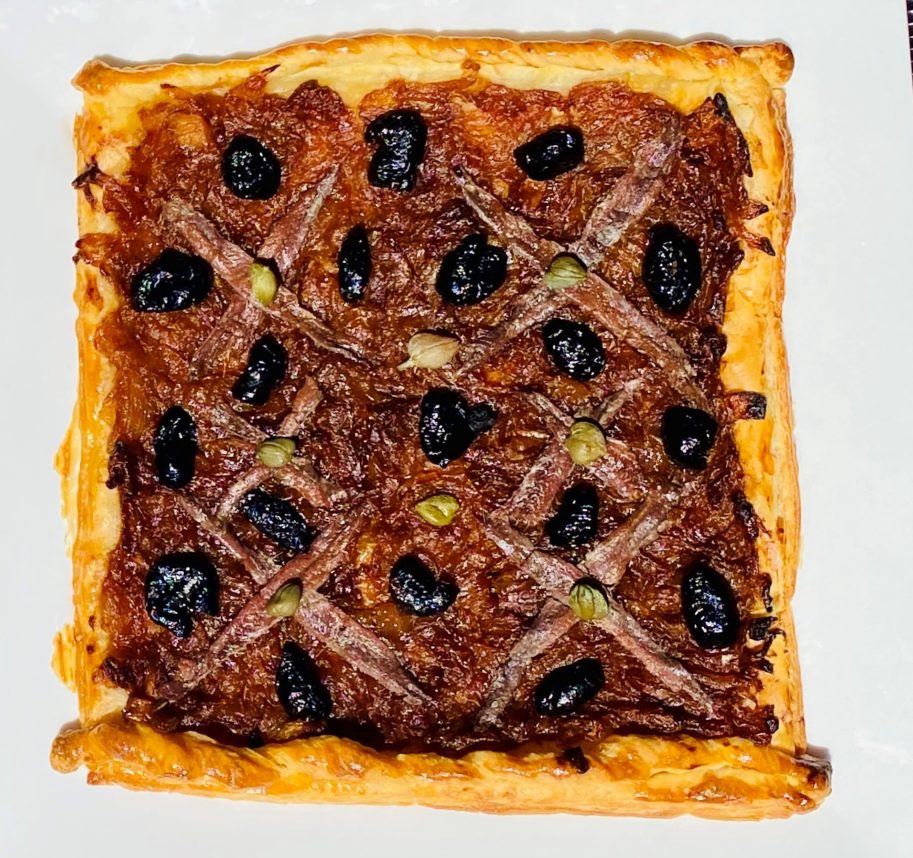
ONION PISSALADIERE
1/4 cup olive oil
3 medium onions, thinly sliced in food processor
1 tablespoon thyme leaves
1 teaspoon salt
1/2 teaspoon pepper
1 garlic clove
1 tablespoon balsamic vinegar
1 sheet puff pastry
1 can good quality anchovies (preferably Spanish)
1/2 cup oil-cured black olives, pitted and halved
Capers, for garnish
1 egg yolk, to brush edges of pastry

In large sauté pan, heat olive oil. Add onions, thyme, salt, pepper and whole garlic clove and cook a few minutes. 

Cook on low heat 45 minutes until onions are soft, sweet and browned, stirring every 5-10 minutes. 

After 20 minutes, remove garlic, finely chop it and return it to pan.

Add balsamic vinegar.

Preheat oven to 450 F.

Roll puff pastry dough into an approximate 10 x 15 inch rectangle. Place pastry on parchment-lined baking sheet and, using fork, pierce holes all over center so pastry doesn’t puff in center.

Bake 8-10 minutes, then remove from oven. If the pastry is puffed in center, gently push it down using a rubber spatula. 

Spread cooled caramelized onions into thin layer, leaving half-inch border all around. Arrange anchovies, then olives and then capers. Brush edges with egg yolk. Bake 10-15 minutes until edges are puffed and golden. Can be reheated before serving, but best served straight from oven.

Serves 9-12.

EGGPLANT PISSALADIERE
Prepare puff pastry as for onion tart. Spread baked dough with 1/2 cup of favorite matbucha salad, thin layer of caramelized onions, then top with grilled eggplants. Bake 10-15 minutes.


Other toppings can include cheese, sundried tomatoes, peppers, broccoli and roasted fennel.

Rachel Sheff and Sharon Gomperts will answer cooking questions on Instagram at SephardicSpiceGirls or on Facebook at Sephardic Spice SEC Food. They have collaborated on Sephardic Educational Center projects and community cooking classes.

The Allure of the Onion: Perfectly Piquant ‘Pizza’ Read More »