fbpx

June 17, 2020

My Grandparents Were Victimized by Nazis. Why Am I Afraid to Call Myself the Grandson of a Survivor?

Every year, a group of a few dozen mostly older Jewish people comes together around June to hold a ceremony. No Israeli politician ever finds time to join them. Perhaps they are busy. Still, it is strange that out of a 120 members of parliament, not one finds this gathering important enough.

Every year, one survivor will get up to the microphone and speak. A heavy Iraqi accent will make it difficult to understand what he or she is saying. Like clockwork, the speaker will start tearing up as they share the horrors they have endured, likely when they were just a teenager. In the burning sun of the peripheral town of Or Yehuda, Israel, they will read a prayer for those who did not survive, conclude the ceremony, and walk back to their homes.

On the walls of the small Heritage Center for Babylonian Jewry, where this ceremony takes place, there’s one testimony from 1941. It is old, and a few of the letters are missing. It reads:

The door suddenly broke open.
My mother stood by the door and I stood behind her …
Our neighbors ente[r]d, and so did other Arabs …
My mother said to them (in Arabic):
“The house and everything in it is yours. Just don’t hurt us.”
They started taking out objects one after the other.
In the midst of the looting, a policeman in uniform entered …
He stood there and cursed our religion and
Palestine (in Arabic). Mother kept begging …
He shot her in the head and she fell.
I fled and stood behind the policeman.
My olde[r] sister ran towards her: “Mother, mother!”
(A rioter was standing on the roof) he took hold of my younger brother and wanted to slaughter him …
My (other) sister begged:
“Child, child, why are you killing him?”
My cousin wanted to go upstairs. The rioter opened her belly
and everything fell out.

The reason that this ceremony – unlike many of the other ceremonies for victims of anti-Semitic violence – does not get any serious recognition, even in Israel, is that it memorializes the invisible: the Mizrahi community, the Jews of the Middle East and North Africa.

This ceremony commemorates the two days of violence that the Jewish community in Iraq faced in June 1941, known as the “Farhud” (in Arabic: violent dispossession) and the public hangings of Jews in Iraq in the 1960s and ’70s.

During these massacres, Iraqis killed hundreds of Jews and tens of thousands were injured. But our story – my grandmother’s story – was never told.

But the truth is, that while I know the history of pain my Ashkenazi friends’ grandparents endured, they don’t know mine.

For this year’s ceremony, the group invited me to speak. When they introduced me, they referred to me as a grandchild of a survivor. Being “grandchild of a survivor” is a title many of my friends in Israel have − all of them Ashkenazi Jews whose grandparents survived the Holocaust. However, I’ve never been included in that group. It didn’t matter that my relatives, too, had survived the Nazis. My Tunisian father’s grandparents were sent to a forced labor camp of the Vichy regime during the Holocaust. They were due to be shipped to death camps in Europe. My Iraqi grandparents also were victimized by the Third Reich; they survived the Farhud, which was incited by Nazi supporters in the regime.

But the truth is, that while I know the history of pain my Ashkenazi friends’ grandparents endured, they don’t know mine. While I know the names of the death camps and the horrific violence that happened to the Jews in Europe, my friends don’t even know what the Farhud was.

It breaks my heart. It should break every Jewish person’s heart.

I am not sure if there’s an intentional agenda behind erasing the Mizrahi Jewish community’s history from international academia and public discourse. Our exclusion does not feel deliberate on most days. But when we point out our absence from the conversation and are shamed as “divisive,” it’s hard not to see this erasure as an act of malice. As a grandson of a survivor, I have a responsibility to keep trying to get the world to bear witness, just as I have to the many Ashkenazi Jews who were slaughtered in the Holocaust.

Every Mizrahi Jew feels personally responsible for building the memorials that are never financed, writing eulogies that are never published, and bearing witness for our dead the world does not want to see.


Hen Mazzig is an Israeli writer, speaker and activist and a senior fellow at the Tel Aviv Institute. Follow him: @HenMazzig

My Grandparents Were Victimized by Nazis. Why Am I Afraid to Call Myself the Grandson of a Survivor? Read More »

‘Saving Israel’: Free Book Talk on the Untold Story of Israel’s Fight for Independence with Author Boaz Dvir

Filmmaker Boaz Dvir is known for his documentaries, including “Cojot” and “A Wing and a Prayer,” but the Penn State University assistant professor of journalism is also the author of the book “Saving Israel: The Unknown Story of Smuggling Weapons and Winning a Nation’s Independence.” On June 18 at 12 p.m. PDT, Dvir will discuss this heroic mission via Zoom in a free event sponsored by the National Museum of American Jewish Military History.

Telling the story behind “A Wing and a Prayer” in greater depth, Dvir’s book follows the efforts of American World War II veteran Al Schwimmer and others to buy decommissioned airplanes, rehab them, recruit pilots to fly them and obtain the weapons and ammunition Israel needed to fight for its independence. 

Click here to register.

‘Saving Israel’: Free Book Talk on the Untold Story of Israel’s Fight for Independence with Author Boaz Dvir Read More »

Divorces Should Be More Like Weddings

I’ve been to at least a few dozen weddings and I tear up almost every time. Besides a birth, few events match the love and hope that a wedding does. With all of my heart, I hope and pray for the best for the new couple. I hope they last forever. I wish them shalom bayit (peace in the home). 

But sometimes it doesn’t work out. At certain times marriage is like riding a bucking bronco. You just have to hold on for dear life otherwise you might end up with brain damage. No other relationship comes close to the depth of marriage. 

Sometimes people need or want to call it quits. Sometimes a spouse almost or does kill the other. 

If a couple divorces, I think some of their family members and close friends who attended the wedding should be invited to part of the proceedings. And those guests should take sides. After all, most of us take sides anyway. We listen to hour after hour about how horrible the spouse is so we should get some reward for time served. 

Divorce proceedings tend to be much more dramatic and interesting than weddings. There’s yelling, screaming and crying — and that’s just lawyers trying to get paid. Often, spouses don’t hide how much money the divorce is costing them. “This SOB is costing me close to 2 million.” That becomes the mantra: “2 million.” Every few minutes, the spouse mumbles, “2 million.” 

For many couples, instead of marital bliss, they have marital blisters.

Perhaps at their final court appearance, their mothers, if they’re still alive, should again break a plate — over each other’s head. If not that, then maybe the couple should consider stepping on each other’s wedding ring finger. If they divorce within six months after the wedding, all of the gifts they received should be posted online where wedding guests can pick something nice for themselves. Also, friends and family should be privy to what went wrong in the marriage so the “I told you not to marry him/her” group gets some satisfaction. 

At almost every wedding I’ve attended, the clergy will talk about what an incredible person the bride or groom is and how lucky the other person is to have found this Eighth Wonder of the World. If this turns out to be a crock, the clergy should be fined from $28,000 to $41,000 to cover the cost of therapy.

For many couples, instead of marital bliss, they have marital blisters but they can learn to maneuver. A person in my community gives private talks to men who are about to take the plunge. The talk lasts six hours over a two-day period. It explains to the husband-to-be that he probably is marrying a person who occasionally might go insane but that eventually marital bliss will return (hopefully).

Women don’t need a six-hour talk. They intuitively understand that they are marrying someone who’s been screwed up by his parents and her job is to take apart this person and then patiently reassemble him. But like anytime you assemble something, you might find that there is a missing piece or two and you’ll have to live with that. 

One thing that helps a marriage is common goals, a moral system you both agree on. If both are dedicated to becoming better people and living some sort of a holy life, this could help. The rabbis are clear that if you want a good marriage, you need to incorporate God into the mix. After all, he put you two together so he just might know how to keep you together. 

Marriage is so tough that the rabbis tell us God actually comes down and is under the chuppah with you. Any time God personally shows up, it’s a big deal. So, you’d better get cracking. Living with a person is like living in a foxhole. So, like in a foxhole, keep praying, keep your head down, do the necessary hard work and, God willing, it will work out for both of you. You know what they say, “There are no atheists in a foxhole.”


Mark Schiff is a comedian, actor and writer.

Divorces Should Be More Like Weddings Read More »

Petitions Launched Calling on FSU Student Senate President to Resign Over ‘F— Israel,’ ‘Stupid Jew’ Social Media Posts

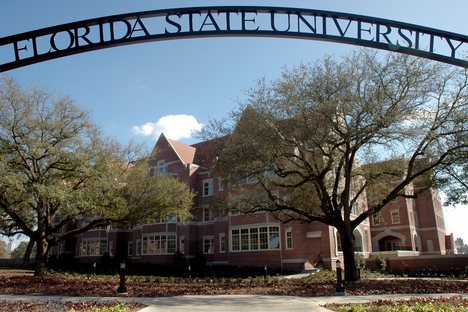
Two petitions have been launched calling on Florida State University (FSU) Student Senate President Ahmad Daraldik to step down from his position over his past social media posts that have been criticized as anti-Semitic.

The social media posts in question include a post from August that said, “#f—theoccupation #f—israel” and a 2013 post stating, “Stupid Jew thinks he is cool.” Additionally, according to the Algemeiner, Daraldik seems to have a website on which he wrote, “The contemporary Holocaust in Palestine is very similar to that of Germany.”

One petition, titled “Remove Ahmad Daraldik from FSU Student Senate,” states: “Eldeek says, ‘F— Israel’ ‘Stupid Jews’ and compares the Israeli government to Nazi Germany’s genocide on the Jews. These anti-Semitic remarks are not welcomed on FSU’s campus, in the United States, and most importantly, on this EARTH!”

This petition has nearly 5,000 signatures.

The other petition, titled “Condemn Anti-Semitic FSU Senate President Ahmad Daraldik,” similarly pointed out the “f— Israel” and “stupid Jew” posts and noted that the “stupid Jew” post featured an image that turned out “to be a fake photo of an Israeli soldier holding a gun at a young girl. The image was part of a Palestinian propaganda campaign referred to as ‘Pallywood’ in which Palestinians staged photos to spread lies about Israel.”

It added: “Daraldik must be removed from his position immediately. We MUST do better. Allowing Daraldik to continue his presidency means our student body supports hostility and racism on campus. We cannot stand for this.”

Daraldik will face a potential vote of no confidence in the FSU Student Senate on June 17.

FSU Students for Justice in Palestine (SJP) defended Daraldik in a June 12 Facebook post, condemning calls for him to step down “as racially and politically motivated to smear and silence Palestinian students and critics of the state of Israel.”

“We are calling upon our student senators to vote NO in the upcoming vote of no confidence in Ahmad Daraldik’s Senate presidency,” the pro-Palestinian group wrote. “As a diverse group of Palestinians, Jews, Muslims, black and brown people of color and working class students, we are confident in Ahmad’s leadership and unyielding advocacy for marginalized students.”

The post linked to a statement in which FSU SJP defended Daraldik’s “f— Israel” post as him criticizing “Israeli military occupation” and that the “stupid Jew” post was written when Daraldik was 12 years old. The statement concludes with the line, “From the river to the sea, Palestine will be free.”


https://www.facebook.com/212256695467874/posts/3652713631422146/?d=n

According to Campus Reform, Daraldik defended his “f— Israel” post in a video, explaining that he was reacting to being stopped at an Israeli checkpoint when he tried to enter the West Bank.

“I was dehumanized, I was humiliated, and I was upset,” Daraldik, who is a Palestinian American, said. “So yes, I took a photo with the statue of Nelson Mandela given to my people from the people of South Africa as a symbol of hope to end the apartheid. I made the post on Instagram to release my frustrations about the situation that persecutes my family, my friends, and all those considered second-class humans in our own country.”

He added that those calling him anti-Semitic are defaming him for criticizing “a racist system that continues to commit human rights violations and was created through the genocide of my people.”

StandWithUs CEO and co-founder Roz Rothstein denounced Daraldik and FSU SJP.

“As the daughter of Holocaust survivors, I will never accept anyone promoting vicious lies that equate the Jewish state with those who murdered my family and millions of other Jewish people,” Rothstein said. “While countless Palestinians and Israelis have suffered trauma due to the conflict, this is never a legitimate excuse to exploit other people’s pain and spread more hate. SJP and everyone who signed their statement should be utterly ashamed for defending this blatant anti-Semitism.”

Noles for Israel President Cindy Chamides told Campus Reform that although she sympathizes with whatever trauma Daraldik has experienced, it doesn’t justify him “saying and writing things that are blatantly anti-Semitic. For those of us who are descended from Holocaust survivors, it’s especially painful for an elected leader to lie about and exploit what our families went through for his own political agenda.”

She called on Daraldik to resign and “learn from his mistakes.”

Florida State University’s Office of Admissions tweeted in response to a Twitter user highlighting Daraldik’s ‘Stupid Jew’ post, “Florida State University does not condone this type of behavior. We take matters like this very seriously, and have informed FSU’s Office of Student Conduct and Community Standards.”


Daraldik became FSU Student Senate president after the Student Senate removed the prior president, Jack Denton, from office on June 5 after messages he sent in a GroupMe chat emerged of him stating that the Black Lives Matter movement’s support of transgenderism and the American Civil Liberties Union’s (ACLU) support for abortion are antithetical to Catholic doctrine.

Petitions Launched Calling on FSU Student Senate President to Resign Over ‘F— Israel,’ ‘Stupid Jew’ Social Media Posts Read More »

The Imprints We Leave Behind: Honoring the Father I Never Met

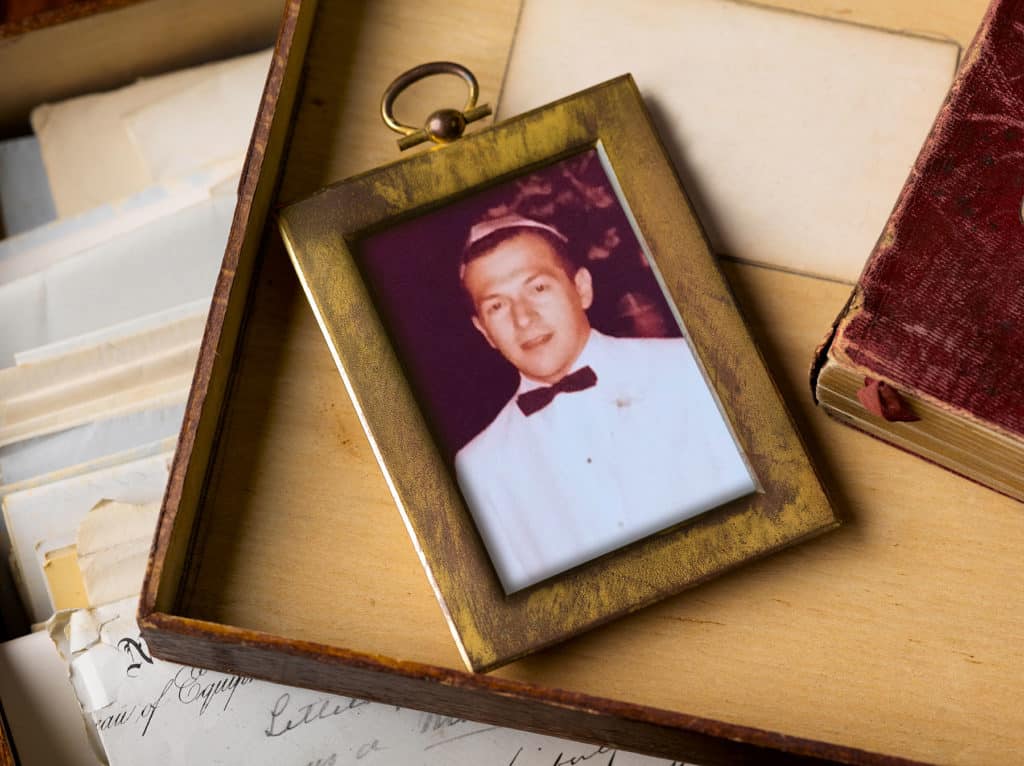
My father died on Feb. 11, 1962, and I was born nine months later on Nov. 9. Loving my mother and bringing me into being was his last act of grace and generosity.

The stories about my father, Samuel Benkovitz, always have flowed like sweet Passover wine. They were mostly tales of delight and frolic, friendship and loyalty, tenderness and care, allegiance to Jewish tradition and a sense of playfulness that made for a lovely recipe of a life, of a man. They always told of his sweet smile and his sparkle and his tender face.

Sam met my mother where she worked in a department storein Pittsburgh, recently departed from her college studies after her parents divorced and the tuition and support money ran out. My mother was and is whip smart, nobody’s fool, compassionate and brave. She was and is beautiful to her core, the embodiment of a woman of valor. Together, they fused hearts and souls and gave me life.

The first years of my life were an adventure for me and rugged for my mother. We lived in a boarding house on Ardleigh Street in Philadelphia with other families and couples in an old and cozy converted Victorian house. There were screen doors everywhere and life happened in the streets and in the apartments of our neighbors. Every spring, from the tenderest age, I boarded a plane to go to my father’s family in the Pittsburgh neighborhood of Squirrel Hill for Passover, where I ate kosher for Passover at home and dinners out with white tablecloths at Tambellini’s and Poli’s and Sodini’s. It was the butterfly-shrimp dinners and cocktail sauce and homemade gefilte fish and red horseradish that sealed my love for Judaism, Passover and the exquisite pleasures of family and tradition, celebration and the joy of meals and family love.

In those moments, my father was present. I carried his name with pride through the streets of Pittsburgh, and people young and old loved to tell me stories of the father I embodied and loved but never knew.

The delicate eggs he cooked for his niece Rose Linda, who adored him. The thoughtful trinkets he would bring back from trips to New York for his sister-in-law Evelyn, who set the most majestic, joyful and celebratory seder table. A cut-glass cruet set of oil and vinegar. A blue-enamel plate to bring life and light to the festive table. Tangible love notes that outlived him and contained his presence for years to come.

The tactile imprints he left behind are gone. The snowy hillside where he suffered a heart attach and said goodbye to this world has thawed and frozen many times since that mournful day. It used to bother me that I didn’t have more pictures, more things, more intricate understanding of the specific chronology and detail of my father’s life. Only a few precious items have weathered the bumpy road. His collection of books that I have yet to read. His Merchant -Marine yearbook from 1945, a watch with his name on it from that same year. On the back, it reads “Samuel Benkovitz.” The gifts he gave and the objects that passed through his hand now scattered in unknown places.

But I remind myself that the imprints we leave behind are smooth and silky, foggy and vaporous, turgid and sturdy even if not always visible or touchable. Helen Keller, a soul who deeply understood what lay beyond the tangible, visible world, said, “The best and most beautiful things in the world cannot be seen or even touched — they must be felt with the heart.”

I have seen the imprints of the past rest in the hearts of the living. I have seen how anguish and bitterness can take hold of a human heart and turn it against its fellow woman and man. The brutalities of the past have left us all as vessels for the truths and memories of things past. The Holocaust, slavery and racism, generations of institutionalized misogyny, abused power and greed have passed from the cups of our ancestors and overflowed into ours.

And beside them is the gentle touch of what humans do better than anyone. We are capable of marveling at the magnificence of love and one another. The mystery of conception and the transcendence of adoption. The impossibility of true love and the miracle of deep love, despite the impossibility, between women and men, women and women, men and men who find a soulmate to travel the turbulent and beautiful sea of a life with. The families we embrace and the families we create. The sacrifices we make and the stands we take to forge a more just, more dignified and more humane world. The tenderness we offer that becomes a silky comfort to the soul of another. Like a cloud. Like a holy touch.

I carried his name with pride through the streets of Pittsburgh, and people young and old loved to tell me stories of the father I embodied and loved but never knew.

How we carry these relics defines us. Whose pain we honor defines us. Whose love and decency and kindness becomes our human instrument and the music of our lives that we play defines us.

We carry the stories and the hopes and dreams of those who came before us. They are calling to us if we put our ear to the sky and to the ground. They will guide our hands for good and evil, so we must pay attention to the signals and understand their instructions and the damage or humanity that informs them.

We must listen for the lessons they carry and want to share with us. They hold the instructions from our ancestors and the angels. But to hear them, we must be quiet and slow enough for the thickness of poetry’s pour. Anticipation. Turn our ears to the beating hearts of their souls, still audible if we are willing to stop, still and listen.

The words of Abraham Joshua Heschel in his poem “The Forgotten” have always carried this sentiment for me:

Man, forgotten by everyone
Like a gas lamp burning in daylight
They had forgotten to extinguish it
Today he smoldered at my door
Softly beat his heart
Open, open your friendship with me
There is still, in my love,
so much room and so many words for you
Your entire world can fit
Into my open spread-out arms
Come, plant your gaze in me
Make a home for yourself in my memory

With our ancestors and the people we have loved and lost in our hearts, with our fathers and grandfathers and mothers and grandmothers, let us listen for the stories they hold for us and the mysteries they can reveal. Let us accept their encouragement and comfort and gentle handing of our family’s and human family’s baton.

Let us plant their gazes in us, and may we understand what they see and know, learn what they know. Not only walking in their shoes, but beating with their hearts and resonating with their struggles, by offering them deep and compassionate listening. And then, let us reassure them we will carry their gifts forward and discard that which no longer serves — the fears, the biases and the injuries that collect over time and can be released, each generation anew.

And so, in honor of Father’s Day, I would like to end with a letter to the father I never met, Samuel Benkovitz, z”l. 

Dear Father,

I never met you, really, but I have known you all my life. Over and over again. Story after story told to me from my earliest years until even yesterday, as I gathered facts, gathered knowledge, gathered proof of you — from my mother, your nieces who adored you, your cousin and her husband who loved you dearly. I never talked to them until I sat down to write this: a Father’s Day letter of love and appreciation to you — a father I have never met and a father I have known since the day my heart first beat, just days after your heartbeat for the last time.

They tell me you were playful. I smile to imagine it. I learn you were beloved by every member in your sturdy and proud Russian immigrant family. They share eagerly that you were adored by your friends. They say no one ever, ever, ever had a harsh word to say about you. Not only after you died, as is often expected, but for the 37 years you lived.

Writing this piece inspired me to talk to people from your “old country.” Family and friends I had not seen since childhood. 

I am told you were independent and the first to leave the family fish business, Benkovitz Seafoods, to make your own way. I have learned you loved beautiful women and, thankfully, my mother, so together, you gave me life. You loved fun. You were a good friend. You had great style and some swagger. You drove a white Mercedes after the war, kicking up a lot of dust in the small Jewish community where you were raised — Squirrel Hill in Pittsburgh, home of the sadly famous Tree of Life synagogue. Like me, you were too young, a fatherless child who I imagine longed, as I did, for your father’s heartbeat and loving, guiding presence.

You smoked filter-less Camel cigarettes and lit them with a Dunhill lighter. Several packs a day. Your father died young, failed by his own heart. Your heart failed you, too, on a snowy mountain in northern Pennsylvania on a weekend ski trip with my mother. There was a storm, and the volunteer paramedic crew in Seven Springs, Pa., was ill-prepared and lacked the resources and training to respond.

But there you were on a blustery mountain top. On skis, looking like someone who took a normal spill, pole and skis akimbo, crisp, cold snow on your skin, wind in your hair. I will never know how long you waited to be recognized and seen for who you were: A dying man in need of rescue. That not knowing will tug at my heart always. I cannot ever remember not knowing that if you had that same heart failure today outside of Cedars-Sinai, they would have treated you and sent you home. 

They tell me you were playful. I smile to imagine it. I learn you were beloved by every member in your sturdy and proud Russian immigrant family. They share eagerly that you were adored by your friends.

Writing this piece inspired me to talk to people from your “old country.” Family and friends I had not seen since childhood. Yesterday, I learned that you loved smooth jazz and particularly loved the song “Mack the Knife.” Recorded in German in 1930 by Lotte Lenya, it is a Kurt Weill song from “The Threepenny Opera” that made it to the top of the American charts in a pop version by Bobby Darin decades later. It is a dark, sly song with murder and darkness and elegant twists and turns. It was, years after you listened to it, the opening song of the movie “Quiz Show,” the last film I set-decorated just before the birth of your granddaughter Rebecca.

My last movie before becoming a mom and when the most exquisite chapter of my life began. When people asked me what movie I was most proud of, I often listed “Quiz Show,” a tale of greed and ambition, class and privilege, and fathers and sons. I watched the film a few weeks ago to share it with my stepfather, Bill, and my mother. When the film begins in a Chrysler dealership, the Soviets have beaten the Americans into space, and the film’s hero has his eye on the illusive American dream. The radio is switched on and the big-band sound of your song, “Mack the Knife,” fills the showroom. Suddenly, the viewer is transported as we embark on a journey, an American morality tale of good and evil, anti-Semitism and bias, prejudice and bias, corruption and greed that goes all the way to the American Supreme Court.

I never knew why I loved that song so much every time I heard it. Now I know.

Thank you for the gift of this life and for finding my mother in the crowd. Thank you for the daily gift of seeing the world through your eyes and for teaching me and showing me by your example, “virtually,” as they say in pandemic times, that kindness and love are everything. That life is precious and briefer than we can ever understand until we grieve and mourn. And that we honor life and our creators by making our names a blessing.

Love,

Your grateful and loving daughter, Sam


Samara Hutman is a co-founder of The Righteous Conversations Project and the director of Remember Us: The Holocaust Bnai Mitzvah Project, a California nonprofit dedicated to passing the flame of Holocaust memory to the next generation.

The Imprints We Leave Behind: Honoring the Father I Never Met Read More »

Poway Shooting Victims and Survivors Sue Gunmaker, Alleged Shooter and His Parents

(JTA) — Victims and survivors of the shooting attack on the Chabad of Poway have filed a lawsuit against the gunmaker Smith & Wesson and the gun store in San Diego that sold the suspected shooter his firearm.

The lawsuit, filed Monday in San Diego Superior Court by the gun control advocacy group Brady United, also targets alleged shooter John Earnest and his parents.

Lori Kaye, 60, was killed in the attack on April 27, 2019. Three people were injured, including the rabbi of the San Diego-area synagogue, who lost a finger.

The lawsuit asks for monetary relief and demands that all parties reform their business practices.

Earnest has pleaded not guilty to federal hate crime charges, which make him eligible for the death penalty if convicted.

Following the attack, he told a 911 dispatcher that “I’m just trying to defend my nation from the Jewish people … They’re destroying our people,” according to the affidavit. He then told the dispatcher that “the Jewish people are destroying the white race.”

The lawsuit alleges “irresponsible and unlawful conduct by a firearms manufacturer and seller for making, marketing, or selling weapons in an unsafe and illegal manner,” the Times of San Diego reported. It also claims that San Diego Guns unlawfully sold Earnest, 20, the rifle used in the shooting, as he lacked a valid hunting license to buy such a weapon at his age.

Smith & Wesson illegally designed and marketed its M&P 15 Sport II rifle to appeal to a “dangerous class of would-be mass shooters,” including by falsely associating the product with the U.S. military and law enforcement, according to the lawsuit.

The suit also alleges Earnest’s parents “negligently facilitated their son’s (the shooter’s) ability to gain access to one or more pieces of weaponry/tactical equipment used in the incident, upon information and belief, having prior knowledge of his avowed, virulent anti-Semitism and propensity for violence.”

Poway Shooting Victims and Survivors Sue Gunmaker, Alleged Shooter and His Parents Read More »

June 19, 2020

CLICK HERE FOR FULLSCREEN VERSION

June 19, 2020 Read More »

Ripple Effect: Time

I consider myself lucky because I run an amazing organization. It is an organization that I founded, called The Advot Project.

I wear many different hats running it.
It is one of the major ways I hope to make this world a better place.
I want to make this world the best place it can be, but there simply is not enough time.

I am the mother of three teenage girls. Each one could not be more different from the other. Each one needs my time in a different way.

I belong to a wonderful synagogue; I love this spiritual community from the bottom of my heart.  The people there are my people, period, full stop.

I try to go to pray every Saturday even though I often spend more time schmoozing than praying. Those Saturdays used to be sacred time for me, a time and place where I can disconnect and reconnect all at the same time. Losing that time during the pandemic was not easy.

I used to travel, run workshops, perform and speak about the work of The Advot Project. Traveling creates an interesting time warp. The amount of time you spend in the airport and getting to your seat, compared to the amount of time you actually sit in your seat, and the amount of time you are at your destination, can be totally unbalanced.

I’ve been traveling since my kids were young. I used to try and make my time away as short as possible. What that meant in reality was that often I spent more time in the air than at the place I was going to.

Traveling? It seems as if I haven’t done that in about 20 years.  

I haven’t traveled since the beginning of this pandemic. And yet the actual time is not even six months.

Time flies.
No one can stop time.
Time is precious.
Time is all we have.
There is never enough time.
Don’t waste time.
I am blessed with a village that I love to no end.

As my responsibilities and The Advot Project grow, I have less and less time to connect, talk and do things with that special village of mine.

I was never on committees at my children’s schools. Seriously, I never had the time.

I look at my children who are growing up so fast. For the life of me I don’t know where the time went.

Then I sit with my students who talk to me about time, about sitting time, about doing time, and what happens when all you have is time. Time takes on a new meaning.

I struggle desperately to manage my time. I want so much from this one life that was given to me.

A few years back I met an extraordinary woman who was going through a difficult time. She really seemed like a kindred spirit and I felt that professionally we could have a deep and meaningful relationship. I reached out to her a few times, but never really got a response. Recently our paths crossed again, and I knew that my initial feeling was absolutely right. We are starting a wonderful working relationship because now, is the right time.

I have said over and over that change takes time to happen.
Change does not like to be rushed. What I have learned from my students is that real change is slow, sometimes painfully slow. For change to happen, you must take the time. Time to let it grow. Time to nurture it. Time for it to bloom.

“People will not come to see our show,” she told me.

“No one takes the time to hear me, ever!” she added.
“I promise you they are coming,” I tell her. This was a program culmination that we combined with a fundraiser. We were selling tickets for this event and doing it at a big venue. At the time that her fear kicked in, we had already sold out.

“This time everyone will listen,” I tell her. “They will not come, Ms. They never do. You are seriously fucked because this is one big ass place to fill.”

I remember looking at this girl who at the time was the age my kids are now. She was moved from foster home to foster home her entire life.

Promised again and again that things will be better, yet time after time, she was disappointed, neglected, and hurt. No one was giving her the time of day.

I think of how much of my time is spent doing, taking, bringing, schlepping for and/or with my kids. But no one did that for her.

In the end, the theater was full. It was remarkable. Everyone who was supposed to come came. To be honest, I too was worried that people would not show up, not because I have been disappointed like my student, it’s because I worry. I want the world to celebrate these kids and sometimes that just can’t happen. People are busy and can’t always make the time. Such is life.

After the show she was sitting backstage alone. She looked sad and so incredibly young. I came in and told her to join us upstairs.

She said, “Ms., I want to hold this day in time.” She was crying. “This was fun.” Oh, it was so much more than fun. It was truly glorious. “Now what?” she asked me. 

“We celebrate!” I say.

I look at her troubled face. There have not been many times of celebration in her life.

“There is a reception upstairs.” I explain what a reception is and why.

I take her hand and I say, “Time to meet your fans.”

Sadly, she did not have such a great time upstairs. It was overwhelming and a little too much for her.  When you are not used to getting attention, it’s hard to suddenly receive it.

Time has changed her. Years later, she still is not crazy about getting attention, but she isn’t as overwhelmed any more. Sometimes I take her with me to speak in public. She is strong and well-spoken and is no longer a frightened little girl. 

Time will teach us. Time will prepare us. 

We are currently witnessing an important moment in time.
This is a time to listen, a time to protest, a time to give space for very deep wounds to heal. 

It is time, finally, after decades of wrong, to make it right.

Ripple Effect: Time Read More »

Incoming Knesset Member Who Said Women’s Immodesty Causes Breast Cancer and Miscarriages Resigns After Outcry

JERUSALEM (JTA) — An incoming member of the Knesset from the Sephardic Orthodox Shas party resigned his candidacy after coming under fire for public lectures that demeaned women.

Rabbi Baruch Gazahay, who had been poised to enter the Israeli parliament on Tuesday, announced late that day that he would remove himself from the party’s list.

Gazahay said in a lecture recorded in 2016 that “A woman who was used to revealing her upper parts usually is reincarnated as a cow, whose upper parts are exposed.”

He also said regarding modesty for women: “That is why women have to be covered up there. This is one of the reasons women suffer from breast cancer, because everyone looks at them and it causes the evil eye. It is also one of the reasons why women – God forbid – have miscarriages. They post pictures of themselves on Facebook showing their exposed bellies.”

Gazahay’s YouTube channel features many videos that criticize or mock women up to 2019, The Times of Israel reported.

Gazahay, 38, heads a Beersheba yeshiva. He was born in Ethiopia but arrived in Israel as a baby, the Kan public broadcaster reported. He became religiously observant as an adult.

Shas party head Aryeh Deri said earlier Tuesday that he had spoken to Gazahay and “made it clear that these remarks are unacceptable and do not represent the Shas movement, and Rabbi Gazahay understood this.” Deri also said that Gazahay said the quoted remarks were just a few sentences out of hours of lectures and were taken out of context.

Incoming Knesset Member Who Said Women’s Immodesty Causes Breast Cancer and Miscarriages Resigns After Outcry Read More »