More than 400 Jewish and Israel studies academics have signed a statement denouncing potential Israeli annexation of parts of the West Bank as “apartheid” and say it would be a “crime against humanity” according to international statutes.
“Representing a spectrum of viewpoints, we write in opposition to the continuation of the occupation and the stated intention of the current elected government in Israel to annex parts of the West Bank, thereby formally (de jure) creating apartheid conditions in Israel and Palestine,” the statement reads.
It continues, “Under these conditions, annexation of Palestinian territories will cement into place an anti-democratic system of separate and unequal law and systemic discrimination against the Palestinian population.”
Israel’s government may begin the process of annexing parts of the West Bank on July 1, an action Prime Minister Benjamin Netanyahu has repeatedly promised to take. The Trump administration gave a green light to annexation when it released its Middle East peace plan this year, but figures in the administration are divided about the move.
Palestinian leadership, which views the West Bank as the territory of its state, has decried the move as illegal and a death blow to any future peace process.
The letter was signed by a range of liberal and left-wing Jewish studies scholars across North America, Europe and Israel. They include prominent professors such as New York University’s Hasia Diner, Stanford’s Steven Zipperstein and Dartmouth’s Susannah Heschel, the daughter of Rabbi Abraham Joshua Heschel, one of the most prominent rabbis of the 20th century.
“We want to shape the conversation on campus and in the culture around democracy,” said Zachary Braiterman, a Jewish studies professor at Syracuse and a co-author of the letter. “And if the government in Israel decides to annex territory and develop isolated enclaves of Palestinian territory without giving people the right to vote, as scholars committed to Jewish studies and Israel studies, we want to commit ourselves to democracy.”
An open letter organized by three Jewish activists is calling on the Jewish community to take a number of actions, including endorsing Black Lives Matter and increasing diversity within organizations, to fight racism.
Published Friday, the letter has been signed by 52 people affiliated with Jewish organizations and more than 900 people who include “Black Jews, Non-Black Jews of Color, and our allies.” The letter asks Jewish organizations, federations and initiatives to commit to fulfilling seven actions within three years.
They are endorsing Black Lives Matter; establishing racial justice as an organizational pillar; having a fifth of staff, senior leadership and board seats be filled by people of color; participating in anti-racist education; investing a fifth of all grants in organizations led by people of color; creating racial justice requirements for grant organizations, including “a commitment to replacing contracts with police departments with alternative structures of community safety”; and developing a five-year, $1.5 million “communal accountability” initiative.
The letter was organized by Lindsey Newman, director of community engagement at the Jewish diversity organization Be’chol Lashon; Aaron Samuels, co-founder and COO of the black media company Blavity; and Rachel Sumekh, the founder and CEO of the hunger relief organization Swipe Out Hunger.
“We chose these proposals because we believe they are achievable and if put into practice would make significant inroads toward making the Jewish community anti-racist,” the organizers said in a statement to the Jewish Telegraphic Agency. “Most, if not all, of our proposals are based on interventions that various Jews of Color have long been asking for and many Jewish organizations have already successfully put some of these proposals into practice over the past few decades.”
Earlier this month, 130 Jewish organizations signed a letter pledging to work to end systemic racism in the aftermath of the death of George Floyd, a black man whose death in police custody led to anti-racism protests across the world.
Protesters have been a daily sight in Brooklyn over the last few weeks. But the protesters blocking traffic Thursday on the streets of the New York City borough’s Orthodox neighborhoods were a little younger than usual.
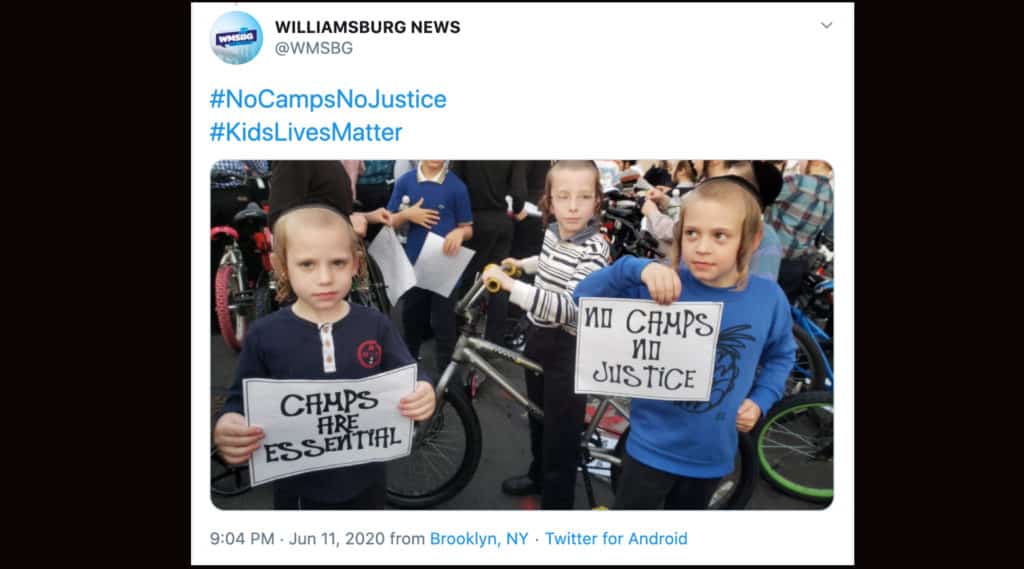
Their shouting — “We want camp!” — quickly made their aim clear: Orthodox children were rallying to call on the city to allow summer camps to operate despite the coronavirus pandemic.
Many of the children carried printed signs with just one word: “Camp.”
But others carried signs alluding to the very different protest movement, for racial justice, that has been flooding many Brooklyn streets with protesters for weeks. Some social media posts promoting the camp rallies, which are set to continue today, used the hashtag #KidsLivesMatter.
Hundreds of Hasidic children in #Williamsburg#Brooklyn are Cycling/marching demanding @NYGovCuomo to open Sleepaway Camps! children have been home for close to 100 days without their teachers, friends & proper educational & social structure, Open Sleepaway Camps!#GiveKidsSummerpic.twitter.com/1v7uhFL8rg
Videos posted to Twitter showed young boys on bikes and scooters riding through the streets of Williamsburg and shouting. In a video shared by the Orthodox news site Vos Iz Neias, children gathered on a street in Borough Park after dark. In another video shared by Orthodox journalist Jake Turx, children blocked traffic on a Borough Park street in front of a yeshiva.
“We want camp,” they shouted as a city bus honked.
Turx tweeted that the rallies were designed to preempt intervention by city authorities who have sought to enforce social distancing rules at playgrounds in Orthodox neighborhoods at a time when mass protests have unfolded across the city.
“Because it’s a protest, it means the cops can’t stop them, and also the virus can’t affect them,” Turx wrote.
The protests were organized to call on Mayor Bill de Blasio to allow summer camps to operate after three months of lockdown as a result of the COVID-19 pandemic. (The protest organizers are unclear at this point.) New York’s governor, Andrew Cuomo, has said day camps can open with social distancing in place. He has not yet announced whether overnight camps, which many Orthodox children attend, can operate.
Orthodox lawmakers have become increasingly vocal about opening summer camps and city playgrounds. They say both are needed to relieve Orthodox families, who often have as many as 10 children, living in small apartments.
State Sen. Simcha Felder wrote a letter Thursday to de Blasio saying “we can no longer tolerate the excessive restriction of closed playgrounds.” Access to many green spaces in the city has been restricted because they contain playgrounds, which are closed to stop the spread of disease.
In recent weeks, closed playgrounds in Orthodox neighborhoods have become sites of tension with city officials sent to enforce closures.
State Assemblyman Simcha Eichenstein posted a video to Twitter this week calling on Cuomo to allow camps to open.
“Our children have now been home for 86 long days,” he said. “Let’s work together and find a way for our children to enjoy our sleepaway camp this summer.”
The rallies are set to continue starting at 2 p.m. today, according to one widely followed Twitter account in the Satmar Hasidic community.
A conversation with prominent attorney Patricia Glaser on her efforts to help fund COVID-19 research at Hebrew University.
How do we manage our lives during the coronavirus crisis? How do we keep our sanity? How do we use this quarantine to bring out the best in ourselves? Tune in every day and share your stories with podcast@jewishjournal.com.
Rabbi Alter Yaakov Schlesinger, a Chasidic rabbi, was stabbed multiple times on June 12 while he was standing in front of a bank in London, multiple news outlets reported.
The Jewish Chronicle (JC) reported that an unidentified man in his 40s began to stab Schlesinger, who is in his 50s, with a 7-inch knife until two construction workers restrained the assailant. Schlesinger has been hospitalized and is reportedly in stable condition. The suspect has been arrested.
Video footage of those that helped restrain the man who stabbed an orthodox Jewish nan in hackney this morning (warning strong language)@GnasherJewpic.twitter.com/v5JW7hZR1k
— Self Declared Zionists (@SussexFriends) June 12, 2020
Law enforcement currently is investigating a possible hate crime motive into the attack, but are not classifying the incident as a terror attack at this time. Some witnesses said that Schlesinger was targeted because of his religion.
“I’m Jewish myself, and I can see another Jewish man shouting, ‘Hold him, catch him, he’s got a knife! Stabbing!’” construction site manager Lazar Friedlander, who was one of men who witnesses said restrained the suspect, told Britain’s Daily Mail newspaper website. “There were a couple of other people trying to grab him. Me and my brother managed to force him down and put his hands behind his back until the police came.”
He added: “I wouldn’t call myself a hero. You act in the heat of the moment.”
StandWithUs Israel Executive Director Michael Dickson tweeted, “Please don’t be more outraged by statues of historic racists than you are about the ones who seek to kill those different from them today.”
Stabbed to the body and head because he is a Jew.
Please don’t be more outraged by statues of historic racists than you are about the ones who seek to kill those different from them today. https://t.co/81mDZkrmic
British pro-Israel researcher David Collier also tweeted that Schlesinger was reportedly attacked “in an area were local MPs [members of parliament] have called anti-Semitism ‘a smear’ against the left. A dangerous rise in anti-Semitism + a loss of control on our streets = real trouble.”
Breaking Orthodox Jewish man has been stabbed in Hackney in an apparent antisemitic attack
In an area were local MPs have called antisemitsm 'a smear' against the left
A dangerous rise in antisemitism + a loss of control on our streets = real trouble.
In February, the Community Security Trust (CST), an anti-Semitism watchdog, released a report stating that there were 1,805 anti-Semitic incidents in the United Kingdom in 2019, a 7% increase from 2018.
“2019 was another difficult year for British Jews and it is no surprise that recorded anti-Semitic incidents reached yet another high,” CST chief executive David Delew told Britain’s The Guardian’s newspaper website. “It is clear that both social media and mainstream politics are places where anti-Semitism and racism need to be driven out, if things are to improve in the future.”
Rapper and actor Ice Cube, born O’Shea Jackson, responded to criticism of some of his recent social media posts being anti-Semitic, saying that he’s “been telling my truth.”
Among the recent tweets in question include a tweet of a Star of David with a Black Cube of Saturn — which is a symbol for occult worship — and an image of six old white men with hooked noses playing a board game on top of African American men. Ice Cube also tweeted out praise of Nation of Islam leader Louis Farrakhan.
The Honorable Louis Farrakhan continues to warn America to this very second and he’s labeled one of your “evil names” and you turn your ears off. Why is the truth so offensive that you can’t stand to hear it? pic.twitter.com/dhkMZTCyLQ
Temple University professor Marc Lamont Hill, who was fired from CNN in 2018 after he called for a “free Palestine from the River to the Sea,” tweeted on June 10, “This is his [Ice Cube’s] second anti-Semitic post in a week. Conspiracy theories of Jewish global domination are textbook anti-Semitism.”
Sadly, no. This is his second antisemitic post in a week. Conspiracy theories of Jewish global domination are textbook antisemitism. https://t.co/2EACMnehVK
Ice Cube tweeted in response, “What if I was just pro-Black? This is the truth brother. I didn’t lie on anyone. I didn’t say I was anti anybody. DONT BELIEVE THE HYPE. I’ve been telling my truth.”
What if I was just pro-Black? This is the truth brother. I didn’t lie on anyone. I didn’t say I was anti anybody. DONT BELIEVE THE HYPE. I’ve been telling my truth. https://t.co/1SnGaGacM9
On June 10, actor Michael Rapaport defended Ice Cube on Twitter, stating: “Yo @icecube ain’t Anti-Semetic [sic]. He’s anti-asshole. Let the OG [original gangster] Disruptor Disrupt!”
Pro-Israel activist and international human rights lawyer Arsen Ostrovsky tweeted, “One can be pro-Black without also being a racist & anti-Semite, which is — sadly — the path you seem to be on. That only takes away from whatever good you are trying to achieve. Please listen to those well-intentioned people, who are merely trying to express these concerns to you.”
One can be pro-Black without also being a racist & Antisemite, which is – sadly – the path you seem to be on. That only takes away from whatever good you are trying to achieve. Please listen to those well intentioned people, who are merely trying to express these concerns to you.
Associate Dean and Director of the Ed Snider Social Action Institute of the Simon Wiesenthal Center (SWC) Rabbi Abraham Cooper condemned the images Ice Cube has tweeted out.
“I was among the first to confront ICE CUBE on anti-Semitism many years ago for anti-Korean and anti-Semitic lyrics,” Cooper said in a statement. “A few years ago, the now famous actor and I met at an SWC event and felt that a page had been turned.”
However, “the latest spate of anti-Semitic tweets and his recent greetings to America’s godfather of anti-Semitism, Louis Farrakhan are deeply troubling, especially at a time when there is a clarion call from the streets of our nation for renewed steps to eradicate anti-Black racism — a call we wholeheartedly support,” he added. “But spewing hate against another minority, in this case Jews, is unconscionable, unwarranted, and in these times of crisis, downright dangerous.”
The American Jewish Committee tweeted, “.@icecube ‘people lose their minds’ because you’re spreading lies, not truth. At a critical inflection point to seek racial justice in our country, keep your anti-Semitic conspiracies to yourself.”
.@icecube “people lose their minds” because you're spreading lies, not truth.
AMSTERDAM (JTA) — Following internal debate, a large Dutch church group retracted and apologized for its call for EU sanctions against Israel.
The Council of Churches, an umbrella of 18 churches and denominations, issued its unusual apology in a statement Thursday. The group took back its letter from last month to Foreign Minister Stef Blok urging him to scrap trade deals between the European Union and Israel if Israel applies its civilian laws in West Bank lands, a move some call annexation.
“We’re sorry that the letter brought to the minister’s attention has led to concern and confusion,” the council wrote in the statement.
The letter to Blok was a copy of an open letter published by the Geneva-based World Council of Churches, of which the Dutch council is a member.
Had the Dutch Council written its own letter, the retraction read, “it would have conveyed more carefully the ideas we wanted to express.”
“We don’t wish to speak over specific sanctions or penal action, this is the responsibility of the political domain,” the statement said.
Three churches said that Thursday’s statement does not reflect their views. Two had vocally protested the letter to Blok, along with the Christians for Israel group.
The kingdom’s main interfaith organ, the Council of Jews, Christians and Muslims in the Netherlands, in a statement expressed “relief that [the council] successfully found its way back to the middle ground.”
The council’s statement reiterated its concern about what it called Israel’s annexation plans.
We’ve been in the shadow of this mountain for almost a year.
And now, with specific instructions (our history is never detailed without specific instructions) we walk away towards a place we once did not know, and now is a vague memory. A place, that if you were to look at on a map should only take a day or so to get to.
But this is the one task that doesn’t come with specific instructions. And so a generation of people disappear into the desert, as we make our way with manna raining out of the sky, because who doesn’t love a free meal? And apparently the answer is us because the journey is arduous (it’s so much easier to sit at the base of a mountain than to follow a cloud into the wilderness) and we won’t take a step further without meat. So Moses appeals to God, and God promises meat will soon come out of our noses, which sounds like a lot of meat, but, despite my vegetarianism, I don’t even want to eat a cucumber that came out of someone’s nose.
But at least we know the suggestion box is working.
And on the way, after quail meat flies out of the sea for us to gather up and eat, but not gluttonously because that leads to death by plague, Moses decides to become celibate which, honestly, is six or seven other poems worth of discussion, but suffice it to say his sister, Miriam isn’t pleased, and complains, because that’s what we do in every situation, complain, and though the punishment seems a strange match for the crime, she gets leprosy.
So, I guess, watch your tongues of dissatisfaction, and enjoy whatever rains out of the sky for you to eat, as most people don’t have the benefit of anything they need raining out of the sky, even rain, am I right Californians?
And let’s cry for help for anyone with any affliction.
Like Moses did for his sister. The fewest words are all we need. Please, God, heal her, or him, or them.
Make us whole as we march to the sound of Your trumpets towards a land we’d like to know again.
Before the recent uptick in coronavirus cases when Israel recently reopened much of the country, it had fared particularly well during the pandemic. According to the founders of COVID-19 Solutions, one reason for this is the country’s glut of innovative minds fighting the pandemic. COVID-19 Solutions acts as a marketplace, presenting a plethora of Israeli-tested initiatives for people around the world to use as a model. Established a little over a month ago by three nonprofits — the Reut Group’s Peoplehood Coalition, ACT-IL and ISRAEL-is — the online platform shares Israeli technologies and know-how.
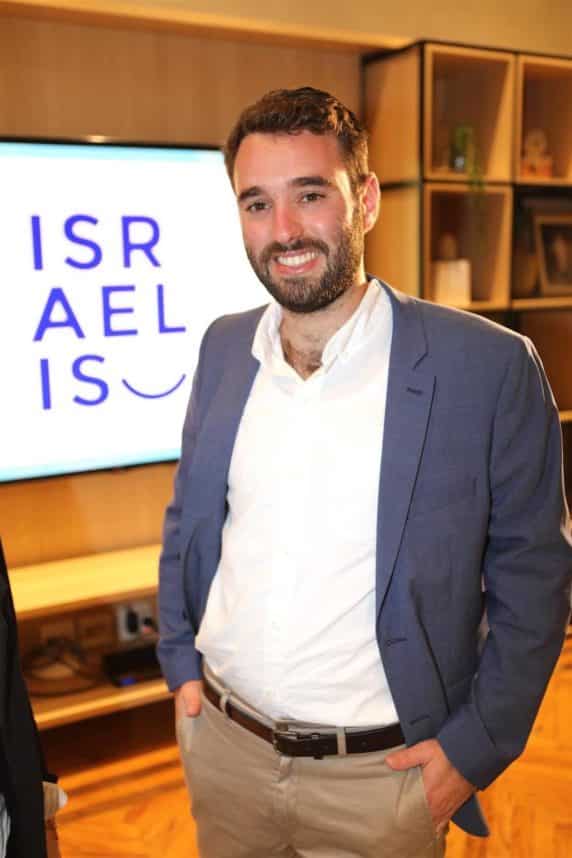
For Eyal Biram, CEO of ISRAEL-is, the project has the added bonus of boosting Israel’s image in the international arena. This is a happy biproduct for Biram, whose nonprofit trains soldiers to become ambassadors for Israel while on their post-military trek. He founded ISRAEL-is three years ago after being discharged from the army, where he served in the elite Sayeret Matkal unit.
On the first night of his trek in the Philippines, Biram met two fellow travelers from France. When they heard he was Israeli, one walked away and the other “just sat there with his beer looking angry,” Biram said. The only thing they knew about Israel were horror stories from the 2014 war with Hamas. Biram knew then he had to do something to change people’s view of Israel. ISRAEL-is has given some 35,000 active and ex-soldiers PR training.
In March, however, when Biram realized that no one would be traveling for the foreseeable future, he knew he had to pivot. At first, he was involved in rescue efforts, extracting hundreds of stranded ex-soldiers in Peru. But when that was over, he didn’t know what to do. After speaking with former ambassador the United Nations, Dore Gold, he realized that he still could utilize Israel’s strongest diplomatic weapon — its ingenuity — without going anywhere.
When we share Israeli innovation, we’re essentially creating diplomatic tools for Israel.
“I wanted to know how we could continue to influence people’s ideas about Israel,” Biram said. “When we share Israeli innovation, we’re essentially creating diplomatic tools for Israel.”
The Israeli initiatives showcased by COVID-19 Solutions run the gamut from solutions to crises in the agriculture sector, social, technology and tourism. Users from around the world can join free webinars to learn from experts on a range of topics or join hackathons to build solutions themselves. In one case, Ilan, a member of Argentina’s Jewish community, signed up to hear Israeli volunteer organization One Heart discuss ways to help those in need during the pandemic. He then recruited a group of friends to distribute food and supplies to vulnerable populations. He filmed the results and posted them on the group’s Facebook page, which according to Biram, acts as a hub of support and inspires more people to start projects in their own communities. Biram said people from all over the world have reached out and thanked COVID-19 Solutions.
In one video, Mustafa from Baghdad is heard praising COVID-19 Solutions. “I got to know a new people in a positive way,” he said. “I hope to know more about them and expand on the unity and love between our two brotherly nations.”
Being involved in the project has been “one of the most moving experiences of my life,” Biram said. “I never imagined that a connection of this kind could be created among young people all over the world.”
Exact unemployment figures may be hard to come by but there’s no question a lot of people are out of work because of COVID-19. Rachelle Cohn-Schneider has been a career counselor with JVS SoCal since 1999 and told the Journal, “We have a reputation for being the place to go in the Jewish community when you are needing this type of help. We don’t turn anyone away. We are nonsectarian and nondenominational.” The Journal spoke to Cohn-Schneider about where to begin, resumé do’s and don’ts and the importance of gratitude.
Rachelle Cohn-Scheider
Jewish Journal: Where would you recommend people start? It can be overwhelming.
Rachelle Cohen-Schneider: The unemployment whole entanglement issue is sometimes the first place to start. You know, are you qualified for unemployment? It’s almost like Maslow’s hierarchy [of needs] of food and shelter, making sure that’s in check. There’s the whole mental health support besides financial support. Getting that foundation is really important before you can face an interview or applying or thinking about your resumé.
JJ: Are there particular websites you like?
RCS: There’s not a magic bullet. Indeed, LinkedIn and ZipRecruiter are the big job search places. But then I talk a lot about how to use LinkedIn and creating a LinkedIn profile and preparing yourself to do phone or video interviews. You know, readying yourself before you even start looking.
JJ: What does “readying yourself” mean?
RCS: A skill assessment or inventory about, do your skills fit other industries? Updating your resumé and/or LinkedIn profile if you haven’t done that recently. I use LinkedIn as a research tool both to find people that you can connect with, to look at people’s backgrounds, to find out who works for certain companies, to see if you know anybody, to network, to reach out to people. A lot you can do through LinkedIn that’s not looking for a job, but building a foundation. I think people immediately get on Indeed or Idealist — which is known for nonprofit jobs — or ZipRecruiter or LinkedIn jobs and just start looking madly. Part of my job is to clarify what it is you do, what it is you do well, what it is you have a reputation for, before shooting arrows out there blindly.
JJ: Should you tell everyone you know that you are job hunting or be more strategic?
RCS: I think it is good to tell everyone you know. But it’s not just, “Hey I’m out of work.” People make the mistake of putting the responsibility on others. That’s where that foundation of really thinking about what you do, what you do well, is critical, because then you are saying to a friend, “This is what I do well. I am wondering if you know anyone who might find that useful.”
Even if you sent out some targeted emails or made some phone calls, it’s not, “Did you know I was laid off?” You have to spin it somehow. On the phone and video, you have to put on, not a show, but show likability and [positivity] and graciousness. That’s true under all circumstances but it’s harder now to be able to express what you are grateful for.
I’m telling people to give themselves a little bit of a break each day and to move completely away from even thinking about the job search, and what they can do to practice their own mental health or meditation or self-help. That’s even more important now.
JJ: If it’s been a long time since you have updated your resumé, what do you need to know?
RCS: There are a lot of templates out there and a lot of help with writing resumés. But I think keeping it simple. The old chronological format is the best. That’s what most employers are most familiar with. But tailoring your resumé to meet the needs of the employer, and cover letter, are so important. I teach a lot around having some highlights on your resumé at the top. You spoon feed to an employer, here’s what I can do for you — having some bullet points that kind of pull yourself together.
JJ: What do you call that section?
RCS: “Summary” or “Highlights of Qualification.” And I remove an objective from a resumé because most people’s objective is so general and not about what you can do for an employer but what an employer can do for you.
JJ: What if your industry has been decimated and you’re looking to switch gears. How upfront should you be about this?
RCS: I do think that I would mention it now in a cover letter. We are in a different time when there’s, I think, more flexibility and understanding of that. So I would say something to the effect of, “With the recent changes in the economy and with the pandemic, the career that I had worked hard toward is no longer available and I find myself in a place of needing to take my skills into a new industry and I’m extremely hard working and I have a reputation, and I’m grateful” — I love using the word “grateful” — “I’m grateful for the years that I’ve had at XYZ.”
I don’t want to give the impression I am [Pollyanna-ish]. There’s a whole, like, the stages of death and dying, that people go through during this unemployment crisis, of losing jobs that they have built their whole careers around.
JJ: Why is that positive spin as well as expressing gratitude important?
RCS: You’ve got to be able to prove to an employer two things: that you can do the work they are in need of filling and that you can be somebody, at least in an interview, that you walk away from thinking, “I gave this my very best shot. I did the best that I could. I feel I was likable. I was positive.” That’s all that you really can do. The rest really is out of your control.