fbpx

June 1, 2020

Steven Lowenstein, Distinguished Jewish Historian and National Book Award Winner, Dies at 75

Steven Lowenstein, a distinguished Jewish historian and accomplished social worker died on May 31, the 8th day of Sivan at the age of 75.

Born in 1945, weeks before the end of the war, his parents Max and Yetta had emigrated to the United States from Nazi Germany just in the nick of time. His father was a chaver, the title given to learned scholarly Jews in Germany. He grew up in what was euphemistically called the “Fourth Reich” or “Frankfurt on the Hudson,” Washington Heights, N.Y. in an Orthodox community comprising Jews who had the wisdom and good fortune to leave Nazi Germany  and sought to preserve in this New World elements of the world they were forced to leave behind. German was the language of the street and the synagogue. The synagogue of his childhood was Shaare Tikvah, the Gates of Hope. His parents and neighbors were displaced men and women, living freely in an American exile. They were joined within the next five years by Holocaust survivors.

The melodies of his youth were from Frankfurt, the pronunciation, the sense of dignity and decorum identical, top hats and morning suits were seen in the synagogue. One could hear the echo of their voice in Lowenstein’s prayers, even as he adopted the Sephardic pronunciation of contemporary Hebrew. He sounded alte/neu — old/new worldly, authentic to his very being, combing the world of his childhood with the world in which he lived.

A Yekke by birth, Lowenstein saw the community from within. He studied that world and transmitted its ethos and history into English, explaining it brilliantly to an American audience.  The scion of a shattered world, he sought to make it whole. As a child he heard fascinating stories, painful stories, moving stories. He was to collect stories to the end of his life.

Lowenstein was a graduate of Bronx High School of Science, then, as now, the best high school in New York City. He entered City College, a natural progression for him and many of his classmates from Manhattan, where he received his BA and went on to Princeton where he received his MA and Ph.D.

He married Marilyn Grollman in 1974 and had two children: Ruth Lowenstein Glasser (Rabbi Yaakov) Kenneth (Penina)Lowenstein, who gave them nine grandchildren. Marilyn died in 2007 from pancreatic cancer, the very disease that was to take Lowenstein more than a dozen years later.

After teaching at Columbia University and Monmouth College, and working as a researcher at the nonprofit YIVO Insttute for Jewish Research and Leo Baeck Institute in New York, Lowenstein came to Los Angles in 1978 to begin a 30 plus year career at American Jewish University where he served as Isadore Levine Professor of Jewish History. He was the author of a large number of scholarly works, including “The Jewish Cultural Tapestry: International Jewish Folk Traditions,” “The Berlin Jewish Community: Enlightenment, Family and Crisis, 1770-1830,” and “Frankfurt on the Hudson: The German-Jewish Community of Washington Heights, 1933-1983, Its Structure and Culture.”

Winner of the National Book Award, “The Jewish Cultural Tapestry” revealed a mastery of Jewish tradition and narrative on five continents. It vividly captured the diversity of Jewish life in the many lands in which Jews have lived and how woven together unity was maintained within diversity.

His career at AJU included his service as the dean of the college. He stepped in to provide badly needed continuity and leadership after the short-lived tenure of recent predecessors.  A popular teacher and a scholar at the prime of his creativity, his beloved wife had died and he was living alone when he took a bold step of retiring, not retiring from, but retiring to and reinventing himself, reimagining himself. He returned to school pursuing a masters in social work. The oldest student in his class, probably with more publications and a more distinguished scholarly record that even the most accomplishment of his teachers, Professor Lowenstein—now Mr. Lowenstein — sat in the classroom, worked with students and teacher’s assistants younger than his own children and continued to learn, fascinated by what he was learning, even more by what he could do with what he was learning.

One would have imagined that given his life-long immersion in the Jewish community and his dedication to the Jewish people, he would have chosen to work in the Jewish community, but no. Lowenstein spent the next decade working with drug addicts on skid row and the homeless — people far removed from his former world. He was constantly amazed not only by what he had to offer but what how much he had to learn. And learn he did. His conversations had a new intensity, his life a new vitality.

On a personal level, over the last years, Lowenstein found solace and joy in his relationship with his “sweetheart” Rabbi Patricia Fenton who was a source of strength, care and love.

Lowenstein never abandoned his scholarship. He continued to write and research German Jewry. In November, a group of scholars from Hebrew Union College, American Jewish University, UCLA and USC gathered to honor Dr. Steven Lowenstein on the forthcoming publication of his major work, “The Population History of German Jewry: Based on the Collections and Preliminary Research of Professor Osiel Oscar Schmetz.” Naturally, he insisted on giving credit in the title to the work of a predecessor but he built upon Schmetz’s foundation, enlarging the scope.

Lowenstein’s significant contribution was to ensure his readers did not drown in the comprehensive, encyclopedic, overwhelming information. He absorbed the details and gleaned from those details the story of German Jewry from 1815 to 1939, including German Jewry during industrialization, urbanization, migration (migration and outmigration primarily to the United States), revolution, emancipation, democratization, escape, exile, persecution and ultimately, deportation and annihilation.

He illuminated whatever he touched. He made the demographics come to life.  It was not about statistics but about real people, real communities

When illness struck, Lowenstein had no illusions as to the trajectory of his disease. He knew his life would end but accepted that fate with serenity, a believing Jew to the end. He wanted, however, to live to see three goals completed.

A celebration of his final work by colleagues and friends at his beloved congregation B’nai David, his spiritual home throughout his life in Los Angeles, where he was the gabbai and where he could be found daily. His revered Rabbi, Yosef Kanefsky, introduced the event; the bar mitzvah of Kenneth’s oldest son Nahum Moshe in February moved from Cleveland to Los Angeles so he could attend, and the publication of his final book. He was informed that it would be published by Academic Studies Press, but days before his death.

Not a man given to praise easily, David Myers, fellow historian and friend summed up the quality of Lowenstein’s scholarship: “Steven Lowenstein was one of the most important Jewish social historians of our time.  He has also had a remarkable second career, as a social worker, on Skid Row.  In both cases, he was a collector of human stories, which he reconstructed with extraordinary skill and sensitivity.”

His daughter Ruth recalled him as father and grandfather, never happier than playing on the floor with his grandchildren, teaching by example the values of tradition, telling story after story and illustrating with each story the sacred value of each individual.

Too few in years, still he lived a life that was complete with family and friends, scholarship and accomplishments, love and tradition. He taught others, cared for others and gave to others. He knew how to live and why to live so he could die with his work complete, his life an organic whole, in his own words, a tapestry.

Steven Lowenstein, Distinguished Jewish Historian and National Book Award Winner, Dies at 75 Read More »

We Must Sweep Away the Racism Along with the Broken Glass

Each morning, it seems we are waking up to a different city than the one we lived in a few days ago. Of course we must acknowledge that far too many citizens have for too long been living in a different reality than the blessed one most of us inhabit.

That imbalance, which is deeply unjust and undermines the lofty stated values of our nation, is the source of today’s pent-up outrage, pain and sadness. We were afraid, justifiably, over the last few nights. For our well-being. For our neighborhoods. For our shuls. There is reason to fear that the unrest may still impact us. And we must also confront the fact that so many in our society, just because of the color of their skin and the accident of their birth, are afraid many nights. For their well-being. For their neighborhoods. For their livelihoods.

We will not solve this centuries-old societal malady, imbalance, injustice and conflict today or this week.

We will not solve this centuries-old societal malady, imbalance, injustice and conflict today or this week. We, as the extended Jewish community, will not ourselves bring peace to Los Angeles or the nation. But we also cannot refrain from our duty to do the right and the good, to listen to others’ pain, and call out injustice when it is obvious, and to call out and refuse to tolerate lawlessness when it spills out from righteous and legally protected protest. We cannot stand idly by and wait for others to do tikkun — the sacred role of fixing what is broken.

Tens of thousands of us have spent many of the last nights within a few hundred feet of pretty terrifying and damaging looting. Many of us are living through a trauma within the larger trauma of COVID-19. And again, we must search our consciences and hearts to find solidarity with so many in our society who are traumatized by injustice, racial profiling and the brutality that has claimed far too many lives of people of color. Our nervousness about the former does not absolve us of reckoning with the latter. And our sensitivity to the latter does not preclude our focus on the former. We can, as Hillel taught us, both be for ourselves and for others. We must. Simultaneously.

I am hurting. As a resident of this city, I am hurting. As a citizen of this nation, I am hurting. As a man who considers assessing another’s worth, and treating another’s person as a result of the color of their skin to be about the foulest way to express one’s humanity, I am hurting. As a leader who tries to stand for important issues while maintaining stances of nuance and clear-headedness, I am hurting as I witness yet another moment where society devolves into screaming matches, out-outraging the other, and the good and the just and the righteous and the obligatory deteriorating into lawlessness, violence and mayhem.

Sunday morning, members of my shul, Temple Beth Am (along with many members of many local Jewish communities) spent hours sweeping up broken glass, recommitting ourselves to our neighborhood and bringing deeply-appreciated comfort and care to small business owners up reeling from the violence. The work felt like a mitzvah, nothing less.

At the same time, Jews know that broken glass always means more than one thing. If we focus only on the lawlessness of those who diverged from the peaceful and just protests, and absolve ourselves from the obligation to look inward, into the crevices of our own souls that may unconsciously or consciously harbor hatred, racism and bigotry…If we focus only on sweeping away the glass shards of neighborhood stores and then look away as too much of society tries to sweep away years, decades, centuries of racist policies, thuggery and brutality….If we focus only on condemning those that exploited rage to wreak havoc and commit robbery without condemning those who committed the sins that serve as the engine of the protesters’ indignant rage…then we are only conveniently righteous.  And we will condemn ourselves, and our brothers and sisters, to a never-ending cycle of broken glass, sweeping up glass, broken society and empty promises of liberty and justice.

We must come together in this moment. For the blessed and tortured memory of George Floyd. For the good of our city. For the well-being of our conscience. And, yes, for the officers of public safety, including the overwhelming majority of police in our city and every city who are decent people, risking their lives to protect ours.

We must stand against racism, eradicating it in our midst and even where it hides in our souls. We must continue to think and act both righteously and wisely. We must do all this as Angelenos. As Americans. As humans. As Jews. I write this with a heavy heart, and with great love for my fellow Jews, my fellow residents of this great city and my fellow citizens.


Rabbi Adam Kligfeld is the senior rabbi at Temple Beth Am. 

We Must Sweep Away the Racism Along with the Broken Glass Read More »

Shakshuka: The Breakfast of Kings

The bright azure and gentle waves of the Mediterranean beckon from beyond the floor-to-ceiling windows but there is a more tempting challenge from where a visitor stands: to navigate the breakfast buffet of the Sheraton Tel Aviv.

The gastronomic extravaganza is endless. Freshly baked loaves of bread with butter and preserves, flaky sweet pastries and sesame seed coated bourekas. Smoked whitefish, lox and cured herring. Exquisitely salty and creamy white T’zfatit and Bulgarit (feta-type) cheeses, thinly sliced yellow cheeses and pungent blue-veined cheeses. Yogurts and labneh and those little Dani chocolate and vanilla pudding cups that make you feel like a kid again.

There are mounds of oranges and apples, bowls of aromatic dewy green melon, cantaloupe and sweet, juicy watermelon, as well as dried fruits, nuts and seeds. There are grilled eggplants, fried potatoes and stewed tomatoes and an immense array of cucumbers, peppers, radishes, cherry tomatoes and greens, as well as eggs, any way you please.

One of the most pleasurable and memorable experiences of any Israeli vacation is breakfast. Whether you’re eating among the Jerusalem stone-and-mosaic tiles in the Spanish courtyard  of the Sephardic Educational Center in the Old City or taking in the Jerusalem hills from the veranda of Cafe Rimon at the Mamilla Mall. Whether you’re people watching from Aroma on Ben Yehuda Street in Tel Aviv or at the Baghdad Cafe overlooking the green hills of Sefad or at a little cafe on the shores of the Kinneret, your morning repast is sure to be delicious.

Born in the communal dining halls of the kibbutzim in the early years of the last century, the Israeli breakfast has been described as Israel’s culinary gift to the world. While the huge hotel breakfasts are an occasional treat, the more typical serving of salad, cheese and eggs is a great nutritional start to the day. They are a far cry from the sugary cereals, bagels and doughnuts that rushed Americans grab on their way to work.

The undisputed star of the Israeli breakfast is shakshuka. In the Berber languages, shakshuka means “mixture,” which is reflected in this dish of eggs poached in a bright red pepper and tomato sauce with lots of onion, garlic and spices thrown in for good measure. A simple, rustic dish served in a little iron skillet, the humble shakshuka was brought to Israel by immigrants from the North African countries of Tunisia and Libya.

When the sprawling restaurant Doctor Shakshuka opened in the early 1990s, near the Jaffa Clock Tower and the Shuk Ha’Pishpashim (Jaffa flea market), shakshuka became ultra-popular in Israel and catapulted its Libyan chef/owner, Bino Gabso, to international fame. It has become ubiquitous on menus in Israel and has achieved iconic status worldwide.

Besides, the original red shakshuka, Israeli chefs serve it green (with spinach and other fresh herbs), with mushrooms, with Yemenite spice blend hawaiij and even with hummus, called humshuka.

We cooked a yellow shakshuka featuring bright orange and yellow peppers, tomatoes, onions, garlic and a blend of turmeric, cumin, allspice and sweet paprika. If you feel like extra heat, add hot pepper flakes, s’chug or Cholula hot sauce. Although Israel has shut her borders till late July, you can still indulge in an Israeli breakfast with our super-easy shakshuka. Just make sure you have fresh bread to sop up all that delicious sauce.

YELLOW SHAKSHUKA
3 tablespoons olive oil
1 large onion, thinly sliced
5 garlic cloves, finely chopped
4 Roma tomatoes, finely diced
1 orange bell pepper, sliced
1 yellow bell pepper, sliced
1 teaspoon turmeric
1 teaspoon paprika
1/2 teaspoon cumin
1/2 teaspoon allspice
1 teaspoon salt
1 13 1/2-ounce can coconut milk
1/2 cup water
8 large eggs

In large frying pan, heat oil and sauté onions till golden. Add garlic, tomatoes and peppers and sauté until peppers are soft. Add spices, coconut milk and water, stir well until sauce is thick. For each egg, create a well in sauce, crack egg into glass, then gently slip into pan.

Cover pan and cook on low heat until egg whites are set but yolks are still runny.


Rachel Sheff’s family roots are Spanish Moroccan. Sharon Gomperts’ family hails from Baghdad and El Azair in Iraq. Known as the Sephardic Spice Girls, they have collaborated on the Sephardic Educational Center’s projects and community cooking classes. Join them on Instagram at SephardicSpiceGirls, or on Facebook group SEC food. 

Shakshuka: The Breakfast of Kings Read More »

ADL Report Highlights Extremist Groups Participating in George Floyd Demonstrations

On June 1, the Anti-Defamation League (ADL) released a report highlighting the various extremist groups infiltrating the protests and commenting on them against the death of George Floyd.

The report explains that while most of the demonstrations have been peaceful and should be classified as extremist events, “some individuals and groups, including a scattering of extremists, are taking full advantage of a national crisis to advance their own violent agendas.”

Among the extremists who have appeared at the demonstrations were white supremacists; the report points to an apparent neo-Nazi shouting “Heil Hitler!” to peaceful protesters in Denver as an example. The report also points to the Nationalist Social Club, a neo-Nazi group, handing out stickers during the weekend demonstrations in Boston. Some white supremacists online are using the demonstrations to call for a race war.

The report goes onto state another extremist group that has participated in the demonstrations is a group called “boogaloos.” The ADL describes boogaloers as “anti-government and vehemently anti-police,” adding that “many boogalooers have seen the protests as an opportunity to further their anti-police crusade and make common cause with others angry at police.”

There also are certain right-wing militia groups, such as the Oath Keepers, who view the protests with disdain. Such militias have called for action against the demonstrators, saying they “are hired domestic terrorists bought and paid for by the socialist conglomerates in America.”

Additionally, the report highlights anarchist groups such as The Base, which has been attempting to hijack the demonstrations to “destroy” a “corrupt” system. The Base is less attached to any particular cause (antiracism, etc.) than it is to the fundamental dismantling of the state. There also is a group calling itself “Antifa,” which is short for anti-fascist, that has appeared at the demonstrations.

“Focused on social justice issues, antifa are a loose collection of groups, networks and individuals who believe in active, sometimes aggressive opposition to far right-wing movements,” the report states. “They have been especially active since the 2016 presidential election.”

President Donald Trump designated Antifa as a terror organization on May 31.

ADL CEO Jonathan Greenblatt tweeted, “So many people are showing up & making their voices heard. Our Center on Extremism is keeping tabs on the extremists who could use the civil unrest to advance their #hateful agendas.”

The demonstrations have been in response to the death of Floyd, 46, on May 25. He died after a white Minneapolis police officer pressed his knee on Floyd’s neck for nearly nine minutes. The officer, Derek Chauvin, was arrested on May 29 and charged with third-degree murder.

ADL Report Highlights Extremist Groups Participating in George Floyd Demonstrations Read More »

Jews Are Fasting to Honor George Floyd

Jewish activists throughout the United States will hold a communal fast on Tuesday, June 2, to honor George Floyd, a black man who died after a police officer knelt on his neck for nearly nine minutes.

In a Facebook post, the organizers wrote: “We call on our Jewish siblings to step up with our fellow Jews of color and with black communities. We ask for people to fast (SAFELY) as we call for justice.” Organizers decided to hold the event on June 2 as it marks the conclusion of George Floyd’s shiva or week of mourning. The fast will take place from sunrise to sunset.

As a Jewish community, we know that silence is assent and we will not be silent. Public fasts have been called in the past to mark injustices and to call for change in society,” the post states. 

The fast was organized by Rabbi Jeremy Markiz. Over the past year, he has been part of a local group of young Black and Jewish leaders building bridges and solidarity.

“The Jewish tradition has used fasts to mark past injustices and call for change,” Markiz told the Journal. “We use fasts to focus on the essentials. That essential piece right now is that our black neighbors and our fellow Jews of color have been suffering.”
He added, “As a white Jew, I don’t have the lived experience of the anxiety around merely walking down the street that my black neighbor does.” Markiz added he sees the fast as a grounding force in the Jewish community.
“A fast is something that many of us can do in one way, shape, or form,” he said. “Of course, people should be safe and only take on something that they can do safely, especially during COVID-19.”
He added the fast will help him focus on police brutality and give him space to discover meaningful ways to help. “There will be no point in the day that I will not be thinking about George Floyd, Antwon Rose Jr., and my black friends and neighbors,” Markiz said. “Their pain has to be my pain. Their needs must be my needs.”
The event also calls for Jews to support local black organizations, call their local representatives, and bolster police review boards. Markiz also recommended that activists read “How to Be An Antiracist: by Ibram X. Kendi or “White Fragility” by Robin DiAngelo. 

“Fasts are just a place to start,” Markiz said. “Not an end to themselves.”

Jews Are Fasting to Honor George Floyd Read More »

Downtown L.A. Jewish-Owned Bike Store Looted

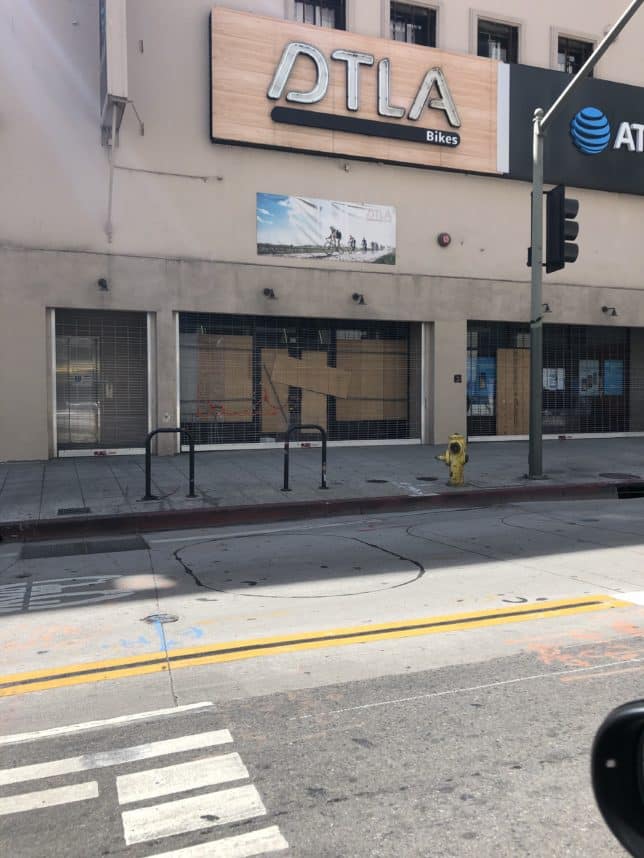
Yehuda Masjedi, who lives in Pico-Robertson, turned off his phone in the run-up to the Shavuot holiday on May 28. When Shabbat ended, he heard about the protests, riots and looting in downtown Los Angeles, and feared for the safety of his bike shop, DTLA Bikes.

Masjedi frantically phoned his employees, who said his store had been spared. However, at 5:29 a.m. May 31, Masjedi received a phone call.  “I knew exactly what was happening,” he told the Journal. “The alarm company told me the alarm had been set off. I jolted out of bed in my PJs, got into my car and drove straight to downtown. I felt like I needed to see my shop. This is my livelihood and my employees’ livelihood. I needed to make sure everything was OK.”

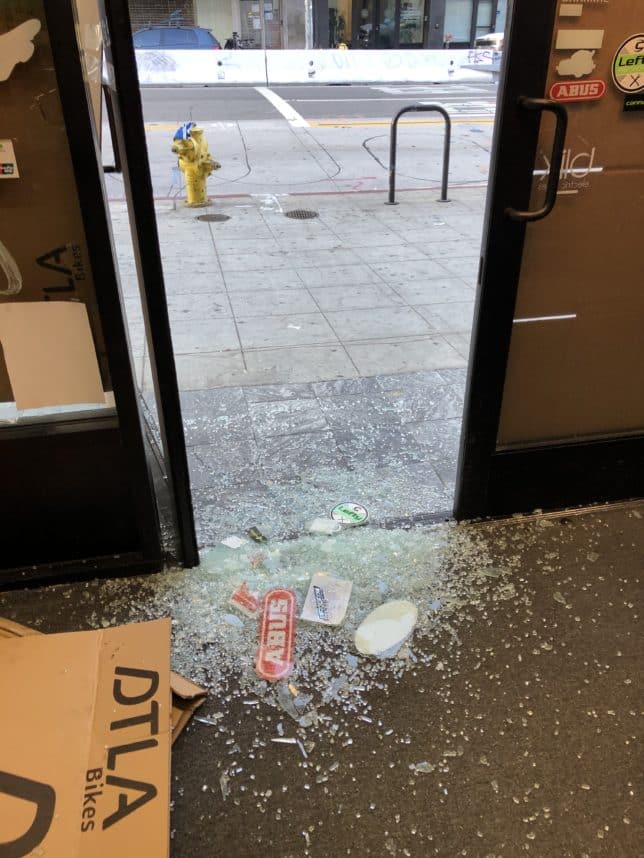
Upon arrival, he saw that his security gate was still down but it had been cut and there was broken glass on the ground. He called the police and waited for them in his car.

“The store next to me is an AT&T store and it was totally ransacked,” Masjedi recalled. “I’m seeing random individuals go in there and grab stuff and leave around 6 in the morning. I notice three people walking toward my shop. I usually can recognize bike thieves by the way they walk. When you’re in business 10 years, you know what people look like when they’re going to steal something.”

“Out of nowhere, I start yelling at these people, ‘What are you doing? This is my livelihood! You are the scum of the Earth. How dare you break into my business?’ I wasn’t thinking about anything, obviously. Luckily they bolted.”  — Yehuda Masjedi

Then, Masjedi said he saw bolt cutters in one of their backpacks. He watched them pull out the bolt cutters and get ready to cut the door. There were police on both corners of the street and the National Guard driving by but Masjedi said they were distracted.

Photos courtesy of Yehuda Masjedi

“Out of nowhere, I start yelling at these people, ‘What are you doing? This is my livelihood! You are the scum of the Earth. How dare you break into my business?’ I wasn’t thinking about anything, obviously. Luckily they bolted.”

When the police finally arrived, Masjedi went inside to assess the damage. All of the bikes were still there. “From the security footage I saw, they broke in, shattered the glass, noticed all my bikes were locked up, heard the alarm and bolted,” he said.

Masjedi spent May 31 cleaning up his store and serving customers. After receiving alerts from the city for a 6 p.m. curfew, he heard more protests and told customers to leave and come back the next day.

Photos courtesy of Yehuda Masjedi

Masjedi said his customers have been checking in on him and volunteers were helping to clean up the neighborhood. He said he was “totally one of the lucky ones. We were on the main looting street. That’s where all the big-box stores are. The majority of them were ransacked. I felt very lucky nothing was taken.”

The bike store was Masjedi’s dream. He left an unfulfilling job in real estate to open the store 10 years ago. He sells his own line of bikes with Jewish names like the DTLA Rambam Commuter, the DTLA Sephira 7 and the DTLA 1 Love 2020. He said that during the coronavirus pandemic, he’s been slammed with orders now that gyms are closed and parents want to get outside and ride with their kids. He said he has faith that everything will work out.

“I truly believe all this is coming from HaShem,” he said. “It’s more proof that humanity’s getting to a better place eventually. We just have to sort out who will do good and who won’t. We’re praying that overnight, nothing will happen to the shop.”

Downtown L.A. Jewish-Owned Bike Store Looted Read More »

Local Organization Sets Up Fund for Looted, Jewish-Owned Stores

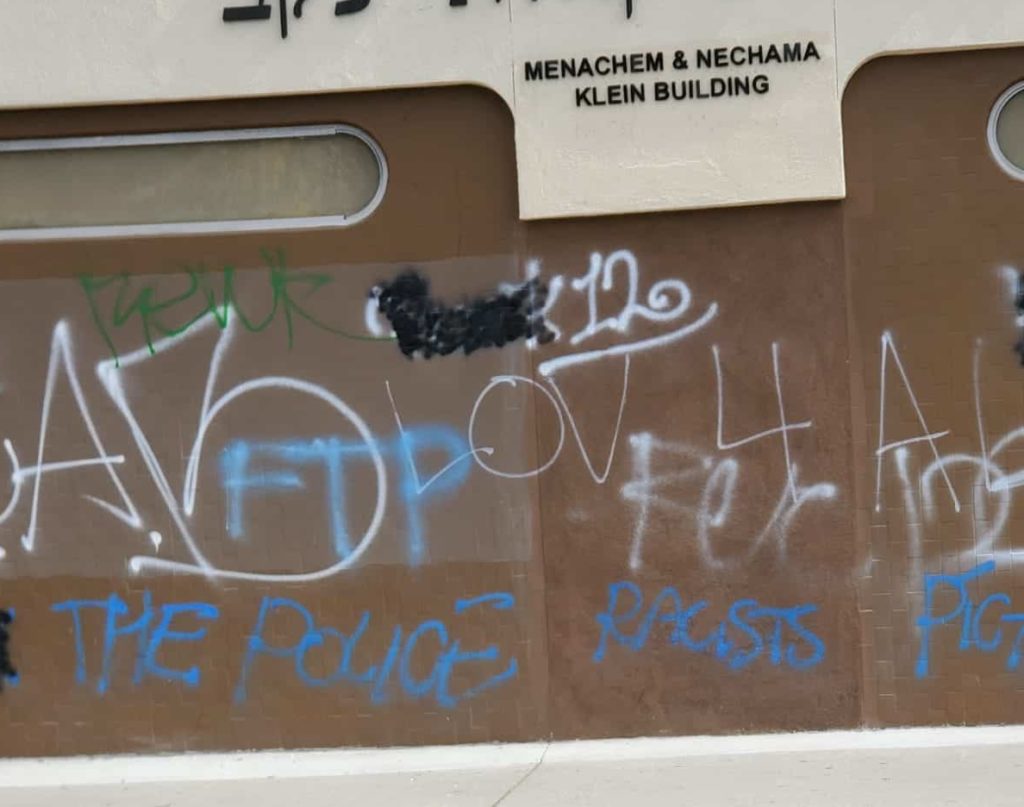
As looters made their way down Beverly Boulevard during the George Floyd protests on Saturday May 30, they broke into Jewish businesses, sprayed graffiti on synagogues and schools and caused thousands of dollars of damage.

On Sunday, Malkiel Gradon, who runs the Chasdei Elimelech organization, set up a GoFundMe campaign to help them. In just 24 hours, he brought in more than $23,000 of his $175,000 goal.

“I want to see the businesses in our community back up and running and not forget about what happened, but let the world know we won’t be deterred because of a group of people rummaging through our neighborhood,” Gradon told the Journal. “Everyone is hurt to see that this happened in our neighborhood and we are trying to look past it and move on.”

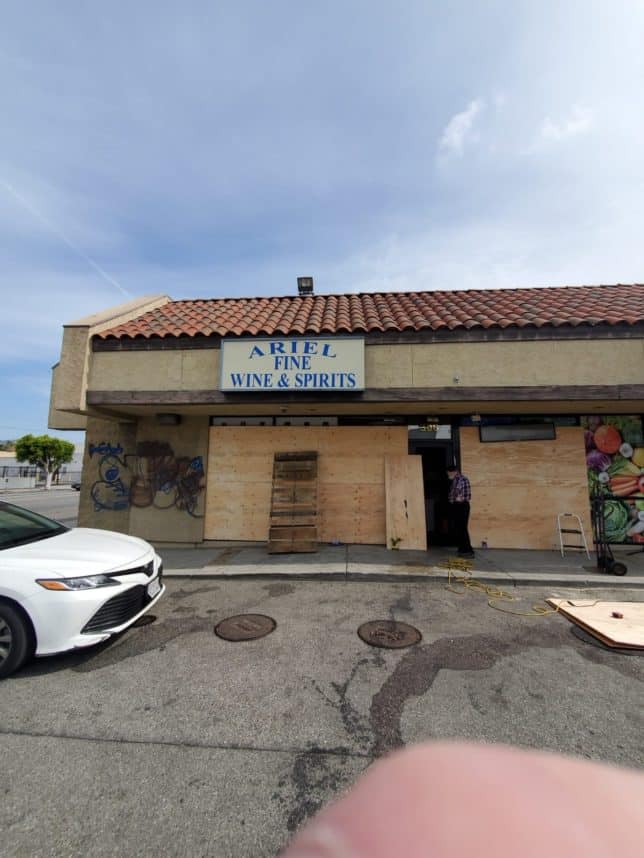
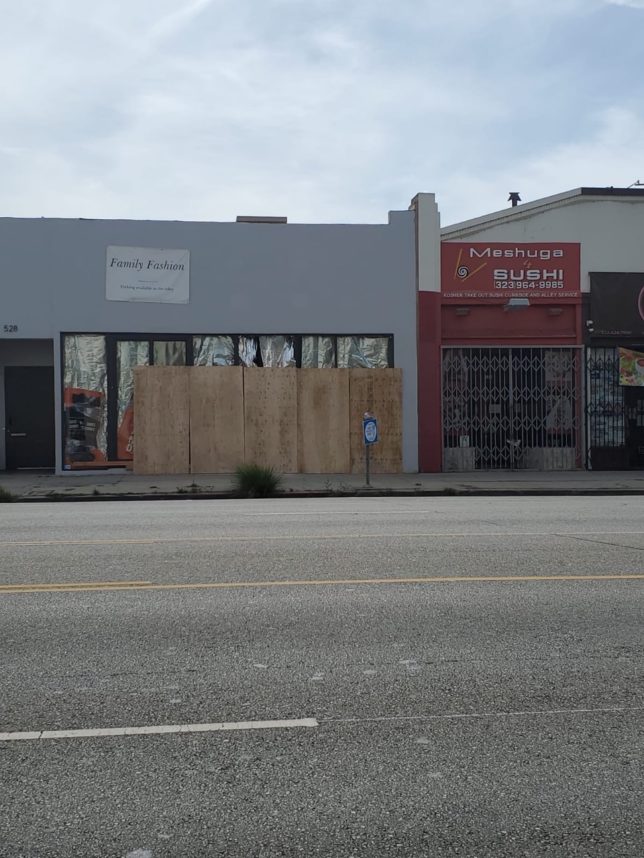
The businesses looted included Ariel Glatt Kosher Market, The Hat Box, Family Fashion, Fish Grill, Go Couture, Syd’s Pharmacy and Mensch Bakery and Kitchen. Schools and synagogues that were vandalized included Bais Yaakov School for Girls, Bnos Devorah High School, Young Israel of Hancock Park and Ohr Eliyahu Academy.

“They will have to go through insurance,” Gradon said.  “But there are still deductibles and things that insurance will not cover.”

Photo courtesy of Malkiel Gradon

Ariel Market was one of the hardest hit, incurring tens of thousands of dollars worth of damage. According to Gradon, people smashed and stole the market’s entire computer system and liquor bottles, and trampled products.

Aryeh Rosenfeld, who owns Family Fashion and The Hat Box, said that looters smashed his windows and glass cubbies, damaged the air conditioning system and stole the cash drawers, the iPad checkout stand, suits and hats. They threw yarmulkes onto the street and merchandise around the store.

“I want to see the businesses in our community back up and running and not forget about what happened, but let the world know we won’t be deterred because of a group of people rummaging through our neighborhood.” — Malkiel Gradon

When Rosenfeld heard about what had happened, he drove to his store and caught looters taking one of his computers. “I chased them across the street and yelled at them to drop it,” he said. “They did, and then ran away.”

Rosenfeld is still operating his stores, but he doesn’t know when he’ll be able to take the boards down to protect them. “I was closed for almost 10 weeks [because of COVID-19],” he said. “I lost all my income already from that. It hit me really hard. It was nice to be open. It was a pretty good week [when I reopened], but this was a lot. It was very bad timing.”

The business owner said he feels the need to protect his businesses and others because of the slow response time and lack of help from the police. On Sunday night, he was driving around the neighborhood with other volunteers and looking for looters when police stopped him.

Photo courtesy of Malkiel Gradon

“Me and my friend got pulled out of the car by gunpoint,” he said. “We explained to the cops that we got looted and we were trying to prevent people from coming around. They let us off but told us we couldn’t go out, even though we were doing a good thing. They said the first night was so busy and overwhelming that they weren’t able to respond, but on Sunday night, they said they were available and we don’t have to be scared anymore.”

Gradon is aiming to raise at least $3,000 for every business owner. He has lived on Detroit Street in the La Brea-Beverly Jewish community for more than 30 years, and since the beginning of COVID-19, he’s raised more than $80,000 to help his neighbors with their bills during the crisis.

He started his organization, Chasdei Elimelech, in honor of his 11-year-old son Eli who passed away from cancer in 2016. Now, he wants to use his organization and this money to make sure everyone can recover from the damage.

“I’ve been involved in the community for many years,” he said. “Whatever I can do to help, I will continue doing it.”

To donate to the fundraiser, visit the website.

Local Organization Sets Up Fund for Looted, Jewish-Owned Stores Read More »

My Shabbat of Shattered Glass

The death of George Floyd, an African American man who was suffocated while being apprehended by a Minneapolis police officer, sparked protests all over the country. I outrightly condemn Floyd’s heinous death and I hope that the police officer(s) responsible will be brought to justice.

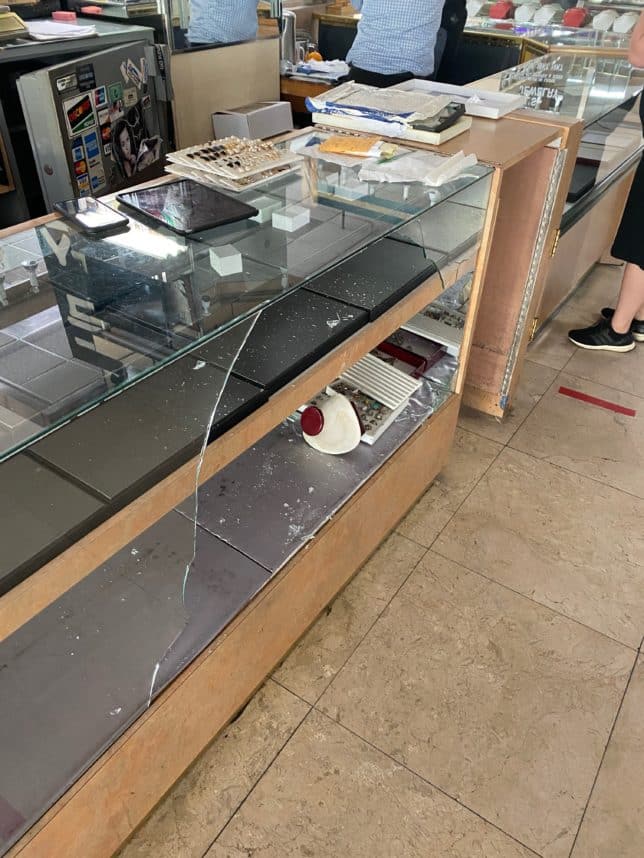
What my father, Michael Naim, had to experience on the morning of May 30, however, was not protest. It was destruction. My dad has worked in the same jewelry booth at 700 S. Hill St. in downtown Los Angeles for as long as I can remember — 1999, to be exact.

Since I was a little girl, excitement filled me when I got to spend the day at “Dad’s office.” Shiny rings and earrings sit in the glass showcase I have grown to appreciate with all its smudges and scratch marks. My father’s cheerful and caring voice always makes me feel at home when he asks a new customer, “How can I be of any help today?” I don’t tell him this, but I often tear up just watching him these days. I don’t know why, but I suppose the secret is out now.

On Shabbat morning May 30, my father, a proud Jew, woke up to see six missed calls from his colleague in the booth directly adjacent to his. Shortly thereafter, he got a text message from the same colleague clarifying the purpose of her multiple calls: “It’s an emergency,” she said. After seeing the urgent message, my father called her, only to have her tell him their jewelry plaza had been looted. “Hurry and rush downtown,” she cried. “They have broken your showcase windows and I see some silver bracelets on the floor.”

“I was surprised I was invaded,” my father told me. “Although I knew there was going to be a demonstration, I didn’t think that this was going to come out of it,” he said.

We found out about this exchange only after my dad returned home much later that day. Not long after he had gotten in his car to drive to his downtown booth, I woke up and sat on the couch with a book in hand. I heard the phone ringing repeatedly from a distance, but because of Shabbat observance, I ignored the calls.

Suddenly, my youngest brother, Ariel, yelled, “Dad is on the phone. He says it’s an emergency.”

There was nothing that could have prepared us for that day but I did know that a hardworking man did not deserve to have his business destroyed by people carrying bats, wanting only to cause mayhem that night. In one night, everything that my dad built had been broken.

I knew something was very wrong, watching my mom’s worried face as she spoke to my dad. She nodded, put one hand on her cheek and hung up.

What happened next is a blur: I woke up my brother, Ethan, from his deep slumber on a day he probably would have slept into early afternoon. He hurriedly brushed his teeth and put on shorts and a T-shirt. Before I knew it, Ethan and my mom were pulling out of the driveway.

Photos courtesy of Michelle Naim taken by her father.

As the oldest daughter, I was told to stay home with Ariel. I asked him how he felt. He said he was scared and hoped that they would be safe. “Me too,” I said.

There was nothing that could have prepared us for that day but I did know that a hardworking man did not deserve to have his business destroyed by people carrying bats, wanting only to cause mayhem that night. As I wrote in my Facebook post: “[My father] came to the United States of America so that he could create a future. And, in one night, it was broken by people who did not use their hands as gestures to speak up, but as weapons — to carry axes and shatter glass.”

In one night, everything that my dad built had been broken.


Michelle Naim has a bachelor’s degree in English-Journalism from Yeshiva University and is a former Journal intern. She’s on Twitter at @michnaim. 

My Shabbat of Shattered Glass Read More »

Home Shalom Monday Message #10

Home Shalom is dedicated to raising awareness of domestic abuse in the Jewish community, encouraging every synagogue and Jewish institution to become a safe sanctuary and providing tools for teens to master the skills of creating healthy relationships. Home Shalom is a program of The Advot Project.

“The prisoner can’t free himself from prison.” Talmud Berahot 5b

The quote above comes from a story told in the ancient Jewish writings of the Talmud that reveals a fundamental truth about life. Rabbi Yohanan who was known as a powerful spiritual healer heard that his dear friend Rabbi Hiyya was very sick so Rabbi Yohanan came to his bedside, prayed over him then said, “Give me your hand,” and he raised him up and he was healed of his sickness. As the story continues, it so happened that Rabbi Yohanan himself became sick so his friend Rabbi Hiyya came to visit. When he saw Rabbi Yohanan’s condition he prayed over him and said, “Give me your hand,” and he, too was raised up and was healed of his sickness. He then asked Rabbi Yohanan, “Since you are known to be a powerful healer, why couldn’t you simply heal yourself?” and Rabbi Yohanan replied, “The prisoner can’t free himself from prison.”

The lesson in this ancient Talmudic tale is a powerful one. Four hundred years ago it was echoed by John Donne in his famous poem (excuse the sexist language of the time), “No man is an island.” The profound truth that this story teaches is that a society stands or falls together. We need each other to be whole, to be complete, to thrive as individuals, as a community, as a country, as a world. If this current pandemic has taught us anything, it is surely that there are no such things as borders, or boundaries, or “us” and “them,” anymore for we are all in this together. Regardless of race or religion, culture or custom, language or lineage we are all simply human beings doing our best to create lives of meaning and purpose in an increasingly challenging and sadly once again, violent world. “The prisoner can’t free himself from prison,” reminds us that what it means to be part of a community is to recognize that each of us must lift up each other and stand up for each other when times are difficult.

Our entire country has been rocked this past week by yet another senseless racist death of George Floyd, an unarmed black man at the callous hands of one policeman while others stood by watching and doing nothing. Communities across the nation are on fire once again, 28 years after Rodney King’s fateful plea, “Can’t we all just get along,” continues to fall on deaf ears and boys and men of color continue to fear for their lives every single day. How poignant to remember the ancient words of the Talmud, “A prisoner can’t free himself from prison,” at this very moment, remembering that those in power will only change when enough of us who care stand up and insist that, “life, liberty and the pursuit of happiness” is the God-given right of all regardless of race, or economic status, culture or gender.

Rabbi Mordecai Kaplan once said, “One must have indomitable faith in human nature if we are not to be embittered by its savageries.” Yes, we do and we must have faith in human nature and believe that standing together we can raise each other up and let the essential divine spark that is within us all shine the light of justice and compassion where it is so sorely needed in our community. Now is not the time to suffer alone, but rather to open your heart to those who matter in your life and have faith that what comes from one heart will always touch the heart of another. Let us know if we can be there for you, call the numbers below if you need them and we will free each other from the emotional, spiritual and physical prisons of our lives.

Rabbi Steven Carr Reuben, Home Shalom
Naomi Ackerman, The Advot Project

Home Shalom Monday Message #10 Read More »

‘We Will Not Sit Idly By’: Jewish Organizations React to Demonstrations Over George Floyd’s Death

Multiple Jewish organizations have released statements reacting to the demonstrations occurring all over the country and in the Los Angeles area after the death of 46-year-old George Floyd.

Floyd, an African American, was declared dead at a hospital on May 25 after a white Minneapolis police officer pressed his knee on Floyd’s neck for nearly nine minutes. The officer, Derek Chauvin, was arrested on May 29 and charged with third-degree murder.

Anti-Defamation League (ADL) Los Angeles tweeted on May 30, “ADL is heartbroken at the ongoing horror of racism in our country and among elements of police forces. We acknowledge the right to protest peacefully. But destruction is not the answer; community empowerment is.”

American Jewish Committee Los Angeles (AJCLA) said in a May 30 Facebook post, “As some protesters in Los Angeles today have resorted to violence, vandalism, and destruction of property, we join with Mayor Eric Garcetti in appealing for calm across our city. However justifiable their outrage over the murder of George Floyd earlier this week, there is no justification for lawlessness in LA or anywhere.”

In a subsequent May 31 post, AJCLA condemned President Donald Trump’s rhetoric, stating, “We need our leaders to summon the best in us. President Trump, dividing a country and pouring fuel on the fire are not the ways to go. We need to unite and, yes, honestly confront our shortcomings.”

The Simon Wiesenthal Center tweeted on May 30 that nobody “has the right to use this tragedy to commit acts of violence, looting and theft. This desecrates the memory of #GeorgeFloyd. Looting and burning private property is not a legitimate form of protest,” adding, “Icons of civil rights movement, Dr. Martin Luther King + other leaders [such] as Caesar Chavez + Americans who gave their lives to the fight for equality, must be crying tonight. We support our elected officials + police in bringing back law + order to the streets of American cities.”

Rabbi Yonah Bookstein similarly denounced the violence and looting. “Praying for peace and safety for all our community,” he tweeted on May 30. “Injustice and racism is worth protesting. Violence and looting is wrong and immoral. Those who are looting and burning are terrorizing all of us.”

He added in a subsequent tweet that while Shavuot was peaceful, those who observed the holiday in Los Angeles could see the helicopters swirling above the city and knew “all was not OK with Los Angeles.”

The Jewish Federation of Greater Los Angeles issued a statement after Shabbat and Shavuot on May 30 stating, “Our tradition teaches us that all humans are created in the image of G-d. We mourn the senseless death of George Floyd. Our tradition calls upon all of us to work alongside our neighbors to create a more just world. We stand with the black community and all communities of color.”

StandWithUs issued a May 31 statement condemning the killing of Floyd.

“The video showing a (now former) police officer kneeling on George Floyd’s neck while three others stood by and let it happen is disturbing beyond words,” the statement read. “It illustrates the urgent need for accountability and justice in this and other similar cases.”

The pro-Israel education group added, “It is clear that the killing of George Floyd, following the shootings of Ahmaud Arbery and Breonna Taylor, has once again ripped open deep wounds in America, particularly for the black community. We hope this will become a catalyst for people of all backgrounds to come together and work towards a more just society that will heal those wounds.”

Union for Reform Judaism Senior Vice President Rabbi Jonah Dov Pesner also said in a May 30 statement, “The national rage expressed about the murder of Mr. Floyd reflects the depth of pain over the injustice that people of color — and particularly black men — have been subjected to throughout the generations. In recent months we have seen, yet again, too many devastating examples of persistent systemic racism, leading to the deaths not only of Mr. Floyd but of other precious souls, including Breonna Taylor and Ahmaud Arbery.”

Pesner went on to honor other unarmed black men who have died at the hands of law enforcement, including Eric Garner, Walter Scott and Michael Brown.

“The list feels endless, and so, too, is our despair,” Pesner said. “But as we recite the mourner’s Kaddish for them all, we say now, again: We will not sit idly by.”

‘We Will Not Sit Idly By’: Jewish Organizations React to Demonstrations Over George Floyd’s Death Read More »