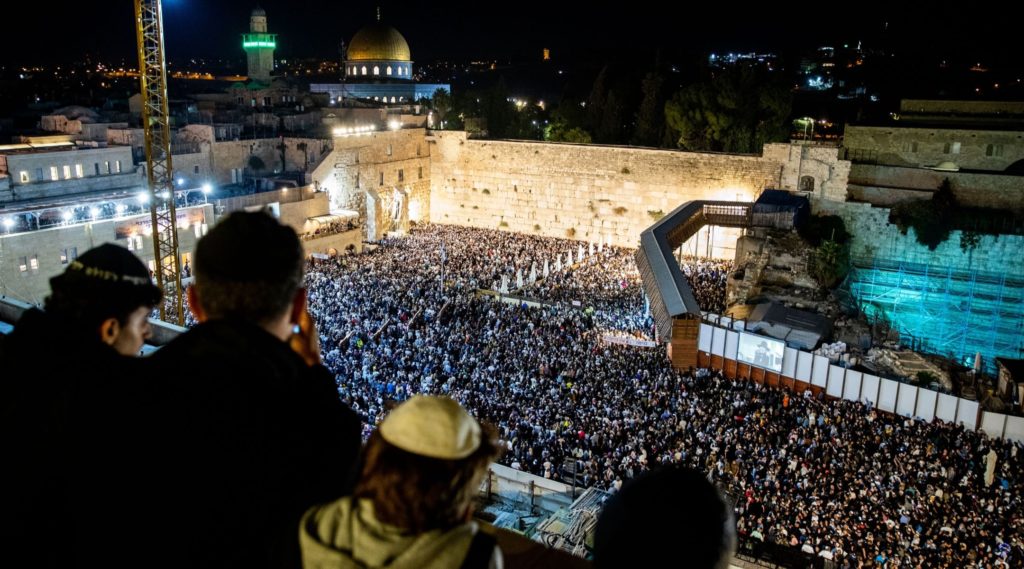
Israel’s capital, Jerusalem, is also the nation’s most populous city, with 924,800 residents, according to data released by the Central Bureau of Statistics ahead of Jerusalem Day 2020.
One out of every 10 Israelis lives in Jerusalem, and 560,000 of the city’s residents are Arabs, according to the report. Still, the city has suffered from negative population growth for years, and thus far 2020 has seen 8,400 residents move away.
Jerusalem’s birth rate is higher than the national average with the average number of children in Jerusalem families standing at 3.9, compared to 3.09 elsewhere in Israel. The average Jerusalem household has 3.84 members, compared to the national average of 3.24. Jewish women in Jerusalem give birth to more children than Arab women in the city—4.41 children on average compared to 3.14.
The capital’s housing stock is limited, and home prices there are among the highest in the country. In 2019, the city saw only 2,452 housing starts, a drop of 16.6 percent compared to the previous year. The average cost of a three-bedroom apartment in the city is NIS 2.15 million ($612,000), compared to the average of NIS 1.83 million ($521,000) elsewhere.
Only 50 percent of adults in Jerusalem are employed, a much lower number than the national average of 63.5 percent. However, Jerusalem boasts one of the highest percentages of residents who work locally rather than commuting: 88.7 percent.
A total of 79,950 students are enrolled in Jerusalem elementary schools, 53,000 of whom are in haredi frameworks, with another 14,200 in religious Zionist schools and only 12,700 in secular public schools.
The population of Jerusalem is young, with a third (33.5 percent) of residents aged 0-14. In Haifa and Tel Aviv, the percentage of city residents age 14 and under stands at 19.9 percent and 18.5 percent, respectively.
It also turns out that Jerusalemites love to shop online. Ahead of Jerusalem Day, eBay has released data on the shopping habits of Israelis, and Jerusalem is second only to Tel Aviv in the number of eBay purchases. Haifa residents came in third.
Since Jerusalem Day 2019, residents of the capital have bought more than 950,000 items on the popular e-commerce site. The most popular eBay items for Jerusalemites are earbuds/headphones, watches, clothing, CDs and computer games.
Jerusalemites also use the platform to sell. In the past year,m they have sold more than 3 million items, including 178,000 kipahs—65 percent of which were purchased from the United States.
This past year, Jerusalem residents have also sold 47,000 items featuring the Star of David. A total of 2,200 Star of David pendants were sold, mainly to customers in the United States, Britain and Israel. More than two-thirds (68 percent) of the Israeli flags sold were purchased by Israelis living in the United States.
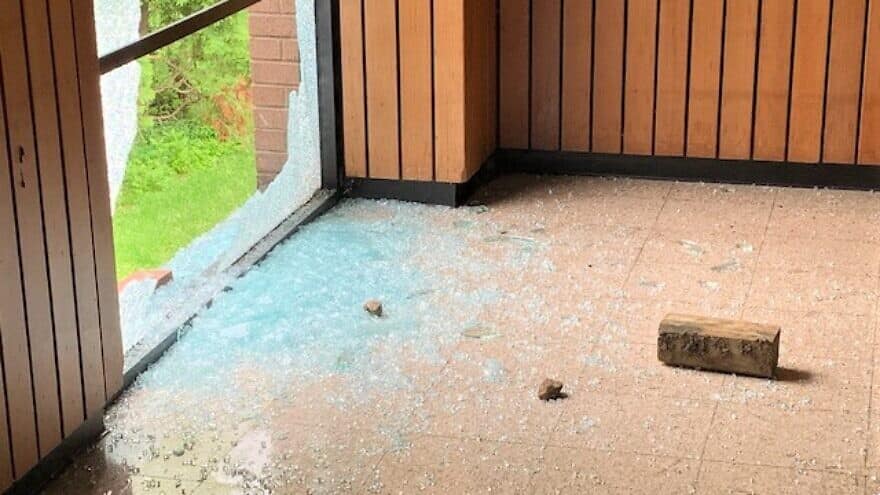
Police in Peoria, Ill., are investigating nine broken windows at a synagogue in the city.
Authorities believe the vandalism at Congregation Anshai Emeth, which houses the Hebrew Day School, occurred between Tuesday and Wednesday afternoon, when it was reported to law enforcement.
“It is under investigation by a detective, and at this point, there is no suspect information,” said Officer Amy Dotson, public-information officer for the Peoria Police Department. “No entry was made, and nothing in the chapel appeared to be disturbed.”
She said the windows were broken by either rocks or bricks, and among the rooms impacted were classrooms and a kitchen.
Dotson added that “we do have issues with kids and vandalism. I wouldn’t say it’s prevalent to houses of worship, but it isn’t completely uncommon. It is typically a juvenile delinquent situation.”
Synagogue president Steven Marx told a local television station, WMBD, that “the vandal or vandals used bricks or rocks to break a lot of windows and tried to break one door. It just seems to be simple vandalism, but the target, of course, makes you wonder.” He confirmed this on Friday with JNS, noting that estimates for the damage have not yet been made.
As of press time, no motive had been associated with the incident. Officials have said as of now there is no indication of anti-Semitism.
Indeed, following a post on Facebook about the incident in which some expressed concern that this was a hate act, someone using the synagogue’s Facebook account responded, “Maybe they didn’t target us as Jews.”
On Thursday evening, the Anti-Defamation League Midwest indicated its awareness of the incident and planned to speak with both law enforcement and members of the congregation.
On his personal Twitter account, David Goldenberg, ADL’s Midwest regional director, said: “The investigation is underway and motives for this vandalism are unknown at the moment, but we know it occurs at a time when anti-Semitic incidents are up 340 percent in Illinois since 2016.”
In 1969, Arnold Resnicoff went straight from Dartmouth to the Mekong Delta with the U.S. Navy, and from there to the Jewish Theological Seminary to become a rabbi.
He was among a small group of veterans who advocated for the establishment of the Vietnam Veterans Memorial in the National Mall here, in part because he wanted to heal the wounds the war opened among Americans. In 1982, in uniform — he had reenlisted as a chaplain — he delivered the closing prayer at the memorial’s dedication.
Now he will deliver the invocation at the memorial’s first-ever virtual Memorial Day commemoration.
Resnicoff, 73, said he will allude to the coronavirus pandemic that is keeping veterans from attending the event in person, as well as the divisions that have stoked tensions among Americans in recent years.
“Almighty God, during this time of sickness, even as we seek a cure for illness that infects our bodies, we must battle hatred and injustice – evils that afflict our souls,” Resnicoff will say in a prayer he shared with the Jewish Telegraphic Agency.
“The Wall has become America’s version of the Kotel: sacred ground; holy space,” Resnicoff said in an email. “We leave notes at the Wall like we do in the cracks of the Kotel. So many people leave small memorabilia at the foot of the Wall that the National Park Service uses a warehouse to store them.”
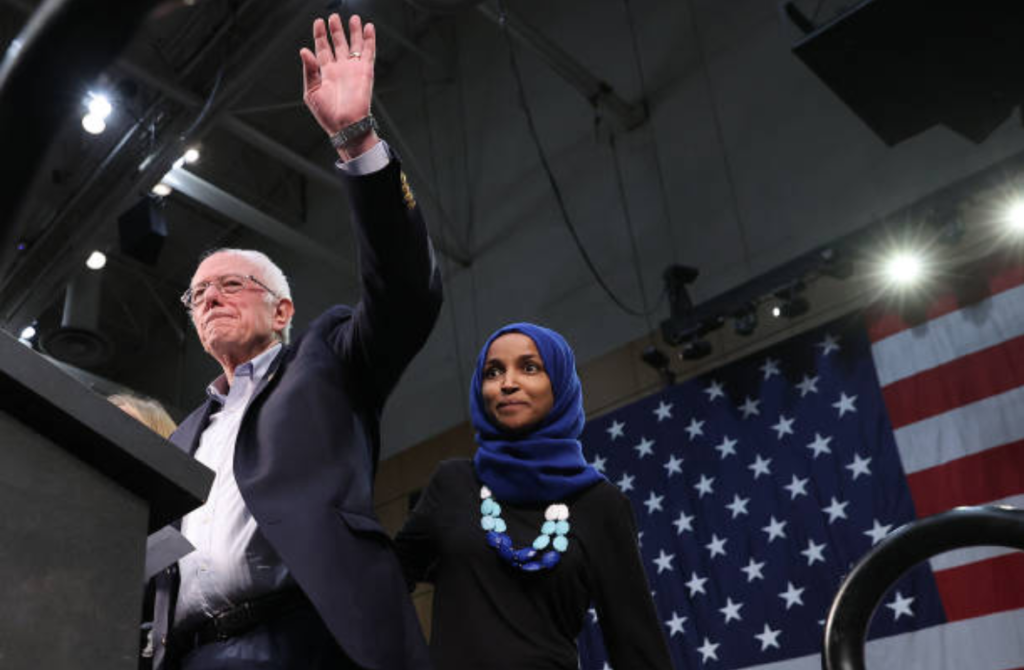
Eighteen Senate Democrats warned Israel that moving ahead with annexing parts of the West Bank would “fray” bonds with the United States.
The letter released Thursday is addressed to Prime Minister Benjamin Netanyahu and Defense Minister Benny Gantz, the prime minister-designate.
“We write to express our grave concern with provisions in the recently concluded government agreement to consider unilateral annexation of Palestinian territory as early as this July,” the letter said. “As friends and supporters of Israel, we caution you against taking unilateral steps that would fray our unique bonds, imperil Israel’s future and place out of reach the prospect of a lasting peace.”
Israeli Prime Minister Benjamin Netanyahu delivers a statement in Ramat Gan, near Tel Aviv, Israel September 10, 2019. REUTERS/Amir Cohen
Two of the signatories, Brian Schatz of Hawaii and Bernie Sanders of Vermont, are Jewish.
Sens. Chris Murphy of Connecticut, Chris Van Hollen of Maryland and Tim Kaine of Virginia initiated the letter.
Netanyahu has said he would like to launch annexation of some parts of the West Bank by July 1. He has since tamped down those expectations by saying he will abide by the peace plan released in January by President Donald Trump, which requires Palestinian agreement to a deal as long as the Palestinians join the talks within four years. The Palestinians have shown no inclination to do so.
The letter was toned down from an earlier version, according to Jewish Insider, because senators were reluctant to sign on to tough language, including that the signatories “would sadly conclude that Israel no longer values the bipartisan support that Congress has provided it for decades.” Even so, it accumulated fewer than half of the Democratic caucus.
Sen. Dianne Feinstein of California, who is Jewish, sent a separate letter this week cautioning Israel that annexation would harm its security, but did not warn of any fraying of ties with the United States.
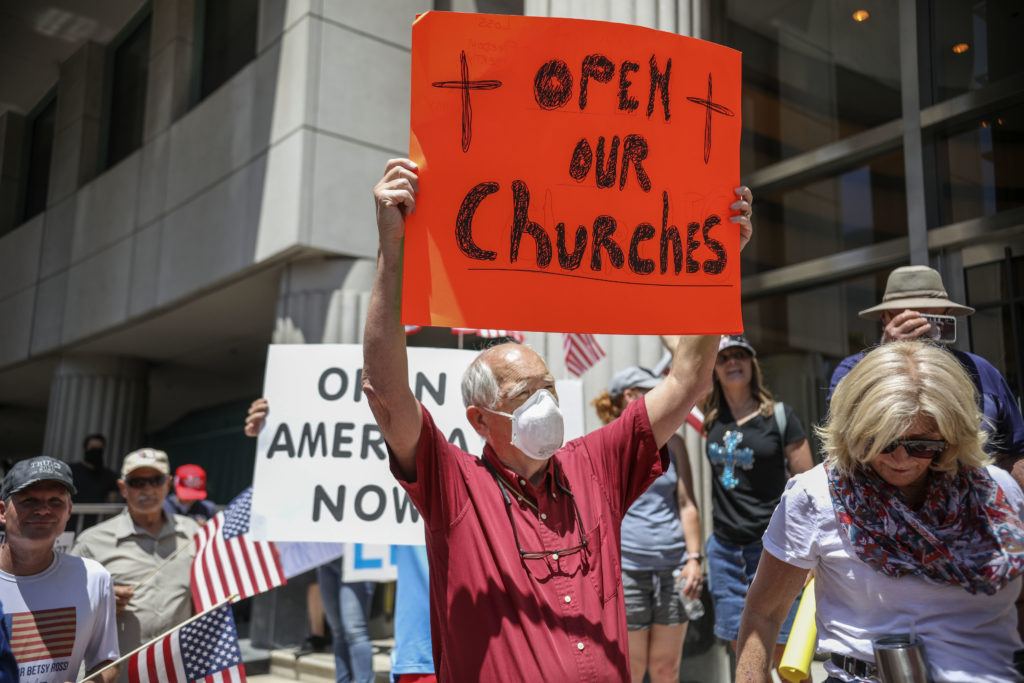
President Donald Trump wants synagogues and other houses of worship to open their doors — but many Jewish leaders say his pressure won’t affect their timelines.
The president went on the offensive Friday, telling governors that he would override them to require houses of worship to be allowed to reopen after closing to stop the spread of the coronavirus. (He does not have that authority.)
“Today I’m identifying houses of worship — churches, synagogues and mosques — as essential places that provide essential services,” Trump said during a White House news conference. “Some governors have deemed liquor stores and abortion clinics as essential, but have left out churches and other houses of worship. That’s not right.”
Trump was taking a firm stand in an emerging battle over whether religious services should be considered “essential.” As stores and restaurants reopen in some places, religious leaders have questioned why they cannot gather people as well.
But mounting evidence suggests that religious services, with people of all generations singing together in confined spaces, could provide a perfect storm for coronavirus transmission. And Jewish leaders from all denominations rejected Trump’s entreaty Friday afternoon, even as debate over how and when to resume services has begun to divide some observant communities.
Rick Jacobs speaking at the 2013 URJ Reform Biennial, Dec. 12, 2013. Photo courtesy of URJ.
The leader of the Reform movement released a statement in response to Trump’s remarks saying the country’s largest Jewish denomination “will continue to look to the wisdom of medical professionals to guide us on when reopening our synagogues can be done safely in keeping with our values.”
“While we long to gather in person, we believe that there is no higher value than pikuach nefesh, saving a life,” said Rabbi Rick Jacobs, president of the Union for Reform Judaism.
Rabbis from other denominations responded on social media in the hours before Shabbat. “Yes, our synagogue is essential. We are open,” wrote Rachel Blatt, the rabbi of Congregation Kol Ami, a Conservative synagogue in Tampa, Florida, on Facebook. “The building we meet in, however, is closed. Join us on zoom where we have been and continue to pray, to study, to sing, and to gather safely.”
The responses were in keeping with how most synagogues have handled the path to reopening up to now. Many synagogues were quick to close once the pandemic hit and have remained closed even as governors have relaxed restrictions.
This week, as more states began lifting restrictions, Jewish leaders again rejected imminent reopenings. Rabbis in Massachusetts said they would not resume services after the governor there added houses of worship to the first phase of the state’s reopening plan. Rabbis in Minnesota and Riverdale, a heavily Jewish area of the Bronx in New York City, also rebuffed looming invitations to hold small-scale services in open letters this week. And the Orthodox Union reiterated its guidance to wait at least two weeks after reopening before holding in-person religious services, to make sure cases do not rise.
Yet in some Orthodox communities, where online services are not possible on Shabbat and do not allow people to fulfill certain obligations during the week, tension has continued to deepen over whether to allow limited communal prayer.
In Cleveland, where rabbis openly disagreed with each other last week over whether to allow outdoor prayer services, dozens of local Jewish doctors this week issued an open letter emphasizing that the coronavirus can spread even if people all wear masks.
And after New York state began allowing gatherings of up to 10 people this week, a group of 27 rabbis on Long Island sent a letter to congregants reiterating their decision to wait at least 14 days before resuming services. They had sent an initial letter last week amid disagreements over whether to allow services to resume outdoors with participants joining together from their own yards and porches.
Jewish residents in the Crown Heights neighborhood of Brooklyn, N.Y., participate in a “porch minyan,” April 30, 2020. Photo by Dovid Zaklikowski.
In a few places, some synagogues are indeed taking steps back toward communal prayer. Some Atlanta-area Orthodox synagogues held services in their parking lots this week, the Forward reported. In Brooklyn, the New York Times covered a prayer service with 10 men on Friday at the Aliya Institute in Crown Heights. And in South Florida, one Orthodox rabbi, Efrem Goldberg, penned an emotional ode to his synagogue, Boca Raton Synagogue, outlining what its outdoor services would look like.
“This coming week, if all continues to go well, we will return to your campus, but we still cannot enter your premises,” he wrote. “We will be together in makeshift minyanim, but we will still be separated by at least 8 feet. Instead of hugs or handshakes, we will be lucky to say hi. Instead of a reunion, we will experience a tease. Instead of feeling we are back, we will still feel like we don’t know where we are. Instead of dancing, we will be distancing. Rather than see into each other’s hearts we will be staring at one another’s masks.”
Ariel Kohane wears a Donald Trump yarmulke while attending the Conservative Political Action Conference at the Gaylord National Resort and Convention Center on Feb. 24. Photo by Win McNamee/Getty Images
With the holiday of Shavuot, a major Jewish festival that celebrates the giving of the Torah and is marked in many synagogues with all-night Torah study, next Friday, the opportunity to congregate in synagogues again may prove tempting.
Chabad of South Broward, located near Goldberg’s synagogue in Florida, distributed a registration form this week that asked potential attendees to commit to complying with strict health rules.
“Our community’s health and wellbeing is our top priority and therefore [we] are requiring these strict guidelines be followed with no exceptions in order for the Shul to im’H continue to open,” the survey said, using an abbreviation for the Hebrew words meaning “if it will be God’s will.”
After Trump spoke, the Centers for Disease Control released long-promised guidelines for on how houses of worship can reopen safely. The guidelines include suggestions that congregants wear masks, that houses of worship limit attendance and that communal singing be minimized.
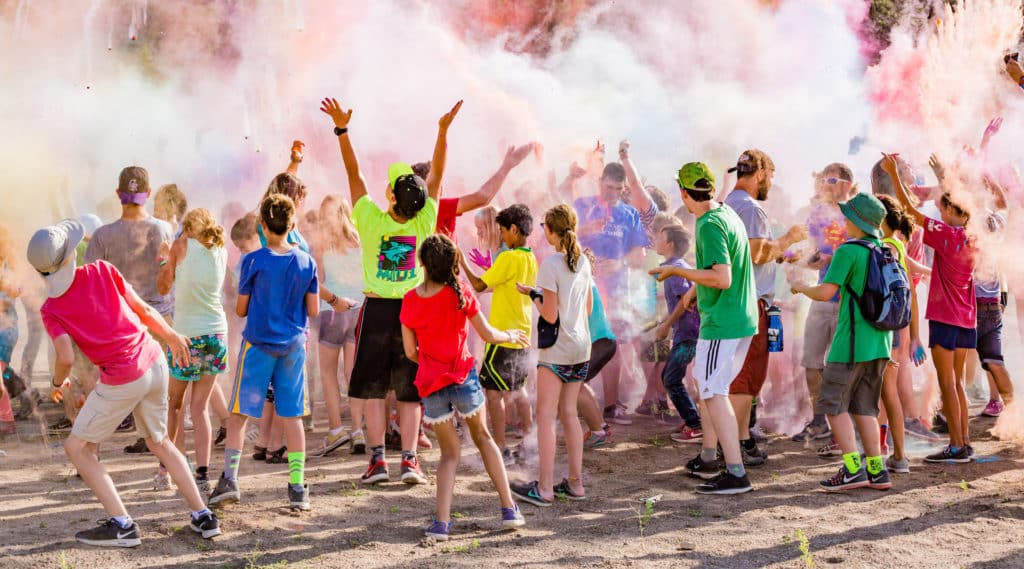
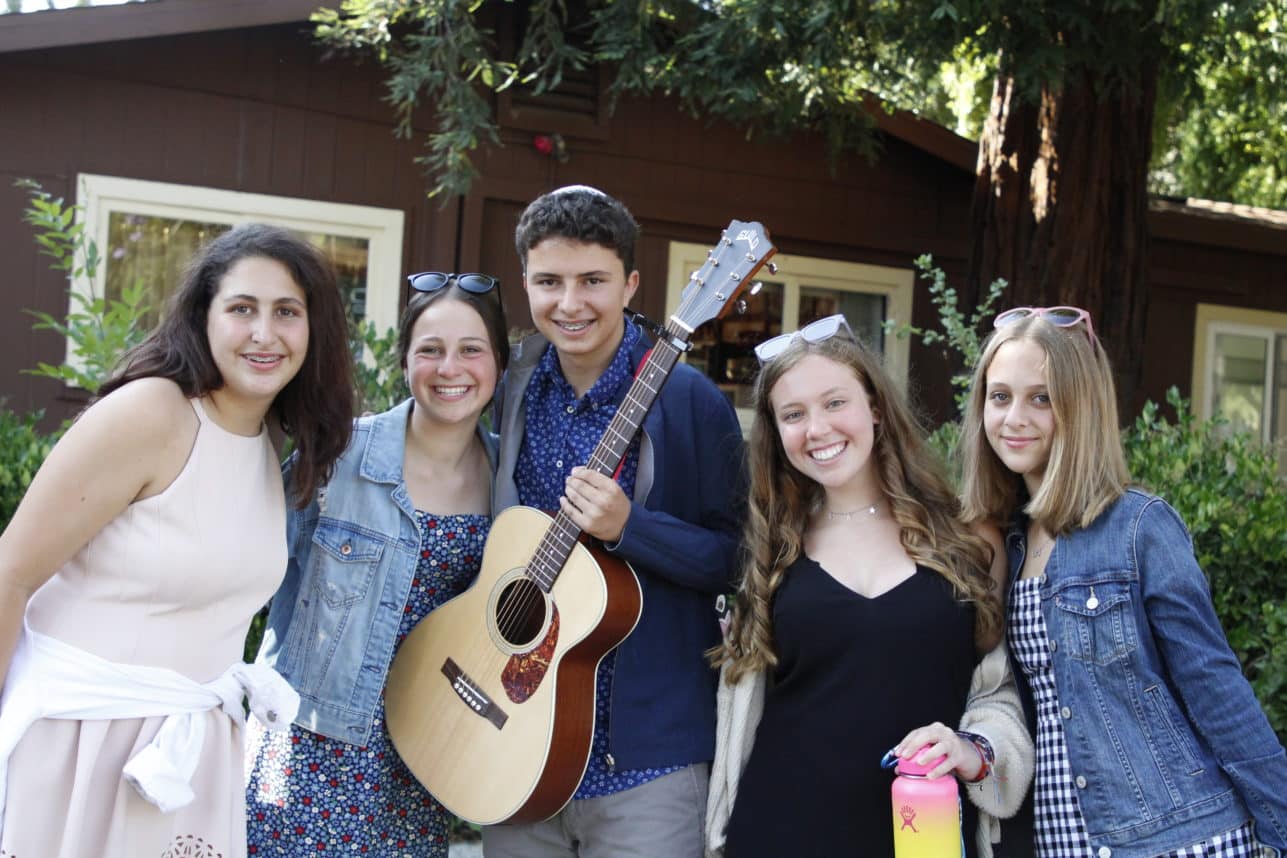
Every summer, tens of thousands of American Jewish kids leave their homes, board buses and planes, and spend a month or two together on a campground in the middle of nowhere.
They might not go to synagogue at all during the rest of the year, but on Friday nights, they and their friends will dress in white, gather by a lake and pray together to welcome Shabbat.
Regardless of what they eat at home, all of their meals will be kosher. They may even go to a daily Jewish class.
And during the rest of the day, whether they’re playing soccer, swimming, carving wood or just hanging out, these young Jews will pepper their words with Hebrew, talking about their madrichim (counselors), a trip to the mirpaah (infirmary) or what they’re doing for their next peulah (activity).
The kids — 80,000 of them, as of 2018 — attend hundreds of American Jewish summer camps across the country. The camps, which run anywhere from two to eight weeks, are a centerpiece of American Jewish culture.
Rising sixth-graders at Camp Ramah in California on the beach during an overnight trip. The camp has said “we cannot open camp in mid-June or run our summer sessions as scheduled.” (Courtesy of Ramah in California)
A 2013 study found that more than a third of American Jews have attended Jewish overnight camp. In many cases, children attend the same camps as their parents.
“My camp prided itself on its return rate,” wrote Maddy Albert in an essay on the Alma website about her initial feelings regarding camp. “The familial utopian feeling comes with a tacit agreement that you won’t leave, and when you have to go back home at the end of the summer, you will be heartbroken.”
This year, the heartbreak has come early.
Due to the COVID-19 pandemic, dozens of camps have announced that they are canceling their summers for the first time, with more expected. Some American states are barring overnight camps, and other camps are making the choice that because kids are used to living in close quarters at camp and running around with few limits, social distancing would be nearly impossible.
As camp is all about doing stuff together, those that have canceled are struggling to figure out how to replicate their summer experiences in a world where gathering and physical contact are prohibited, and people are encouraged to stay in their homes.
Some camps are looking into converting their grounds into family retreats, so families can conduct socially distanced activities together. Others are considering how to create a virtual camp.
“Tents, cabins, dining halls, sports courts, and praying places will remain empty; Torahs won’t be unscrolled; songs will remain unsung; the grass will stay green from a lack of foot traffic,” wrote Rachel Bear, a former camper and counselor, in an essay on Alma. “The loss of Jewish summer camp, while comparatively insignificant in the grand scheme of this horrific pandemic, is still a tremendous loss.”
The camps bring Jewish kids to a secluded green space, usually in the woods, far from the city, where they live in cabins with each other under the supervision of counselors who are just a few years older than them. Most campers, who are anywhere from 7 to 16, will see their parents only once during the entire time they’re at camp.
At camp, kids will participate in a mix of activities — from sports to arts and crafts to swimming to woodworking — and have plenty of free time. Some camps are more specialized, focused on athletics or hiking and climbing or tech.
Part of the appeal — for parents and American Jewish leaders — is that camp aims to make Judaism fun. While some camps have a heavy dose of prayer, Jewish study and strict kosher observance, campers do those things in the sun and near the water and soccer field. They’re wearing T-shirts and shorts while hanging out with their friends.
A 2008 study by the Foundation for Jewish Camp found that going to camp is an indicator for Jews to be more involved in an array of Jewish experiences. Adults who attended Jewish camps as children were more likely to go to synagogue, marry a Jew, donate to a Jewish charity, light Shabbat candles and feel attached to Israel.
Adults who attended Jewish camps as children were more likely to go to synagogue, marry a Jew, donate to a Jewish charity, light Shabbat candles and feel attached to Israel.
“The core elements are a sense of community, a sense of Jewish connection and a sense of adventure,” Carine Warsawski, a Jewish camp alum who now runs retreats at Jewish camps for adults, said in 2017. “When you finally get to explore and try new things, and see what you like, and make your own choices, that’s how you start to form who you are.”
The first Jewish camp was founded in 1893 as masses of Jews were immigrating to the United States from Eastern Europe. Camp provided a fresh-air refuge from the crowded urban neighborhoods where Jewish immigrants settled, and they proliferated in the 1920s. At first, the point of camp was to make Jewish kids more American, not make American kids more Jewish.
“The early Jewish camps were motivated by two concepts: bring inner-city kids out to the country, and ‘Americanize’ the children of Eastern European immigrants,” according to an article on the history of Jewish camps. “What made these camps Jewish was their demographics, not their programming.”
That changed beginning in the 1940s, as Jewish religious movements like Conservative and Reform Judaism started their own camps. Since then, the main goal of Jewish camp became Jewish experiential education.
Nowadays, many Jewish camps place a particular emphasis on Zionism and Israeli culture. Many camps will bring in contingents of young Israelis to work at camp. A few camps have Hebrew immersion programs. At others, it’s common for kids to sing Hebrew songs, do traditional Israeli dances and have staff mix some Hebrew words into their daily announcements.
Photo courtesy of Camp Ramah in California.
Some camps — with their communal living, outdoorsy spirit and Hebrew culture — aim to mimic the traditional values of Israeli kibbutzim, or at least the socialist kibbutzim of a couple generations ago. Some networks of camps take their oldest campers on a summerlong trip to Israel.
“Zionism is a central part of our core mission, as we nurture within our campers and staff members a deep and enduring love for Israel,” the leaders of the Conservative Jewish camp network Ramah wrote in an open letter in 2018. “Hebrew is a central element of daily life at Camp Ramah, and our campers and staff members spend significant time in Israel.”
But this year is different. As summer nears, it’s becoming increasingly clear that for many campers, summer as they’re used to it will not be happening, and one of the core parts of American Jewish life will be temporarily on hold.
“We have been holding onto hope that it might be possible for us to still get back to camp this summer,” Geoff Menkowitz, director of Camp Ramah Darom, said in a video message in April announcing the Georgia camp’s 2020 cancellation. “It has become clear that camp as we know it and love it is not possible right now.”