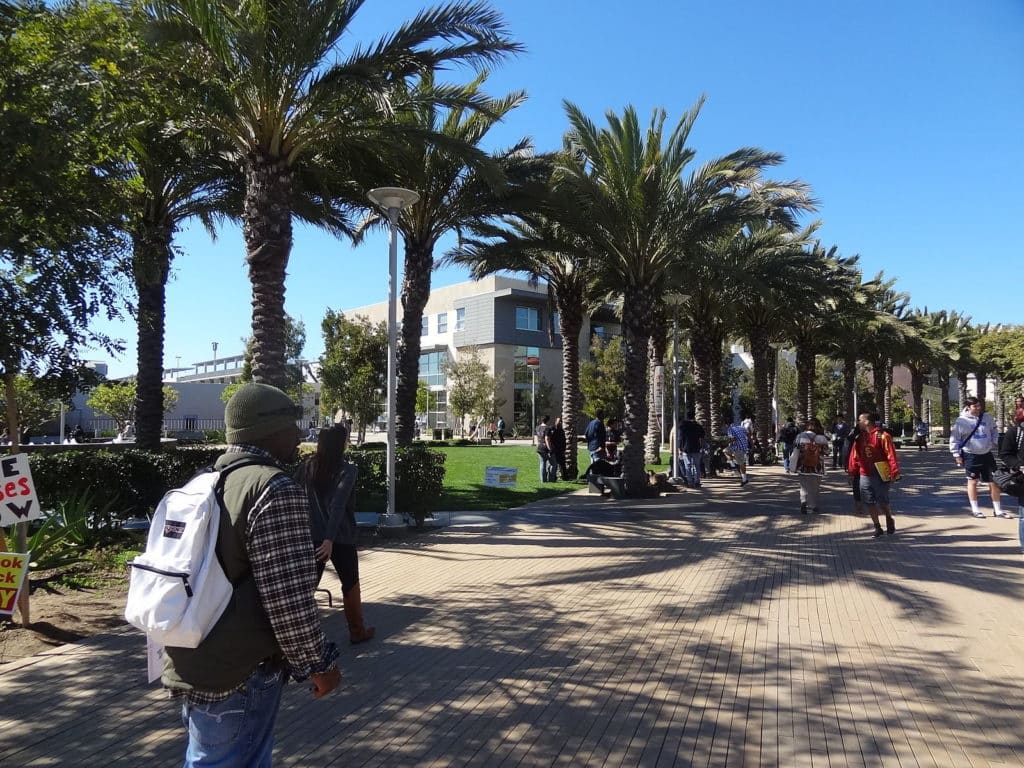
Santa Monica College’s (SMC) student government, Associated Students (AS), unanimously passed a resolution on May 4 condemning anti-Semitism.
The resolution, which was obtained by the Journal, acknowledges that anti-Semitism is on the rise worldwide and that Jews are being scapegoated for the COVID-19 pandemic. The resolution also acknowledges that the AS will not infringe upon students’ First Amendment rights and calls for SMC to include anti-Semitism in its anti-bias training for students, faculty and administrators
“The A.S. does not tolerate anti-Semitic harassment or discrimination, including on the basis of actual or perceived shared ancestry or ethnicity, religion, race, national origin, or cultural identity,” the resolution states, adding that “the A.S. advocates for SMC’s commitment to publicly denounce any incidents of anti-Semitism that occur and affect the SMC community.”
AS Secretary Nathan Silberberg, who is in his final year at SMC, sponsored the resolution. He told the Journal in a phone interview that he felt like the resolution was necessary because of various anti-Semitic incidents happening on campus and on social media.
Students for Justice in Palestine (SJP) “got into a lot of verbal altercations with a lot of Jewish students just based on the fact that we’re Jewish and a lot of us are Zionistic,” Silberberg said.
In 2019, Silberberg said that he was part of a group of Jewish students that brought their concerns about anti-Semitism to SMC’s Board of Trustees. The Board of Trustees acknowledged their concerns but didn’t have an answer on what to do about it, according to Silberberg.
“So that got me thinking, what can I do as student government?” Silberberg said.
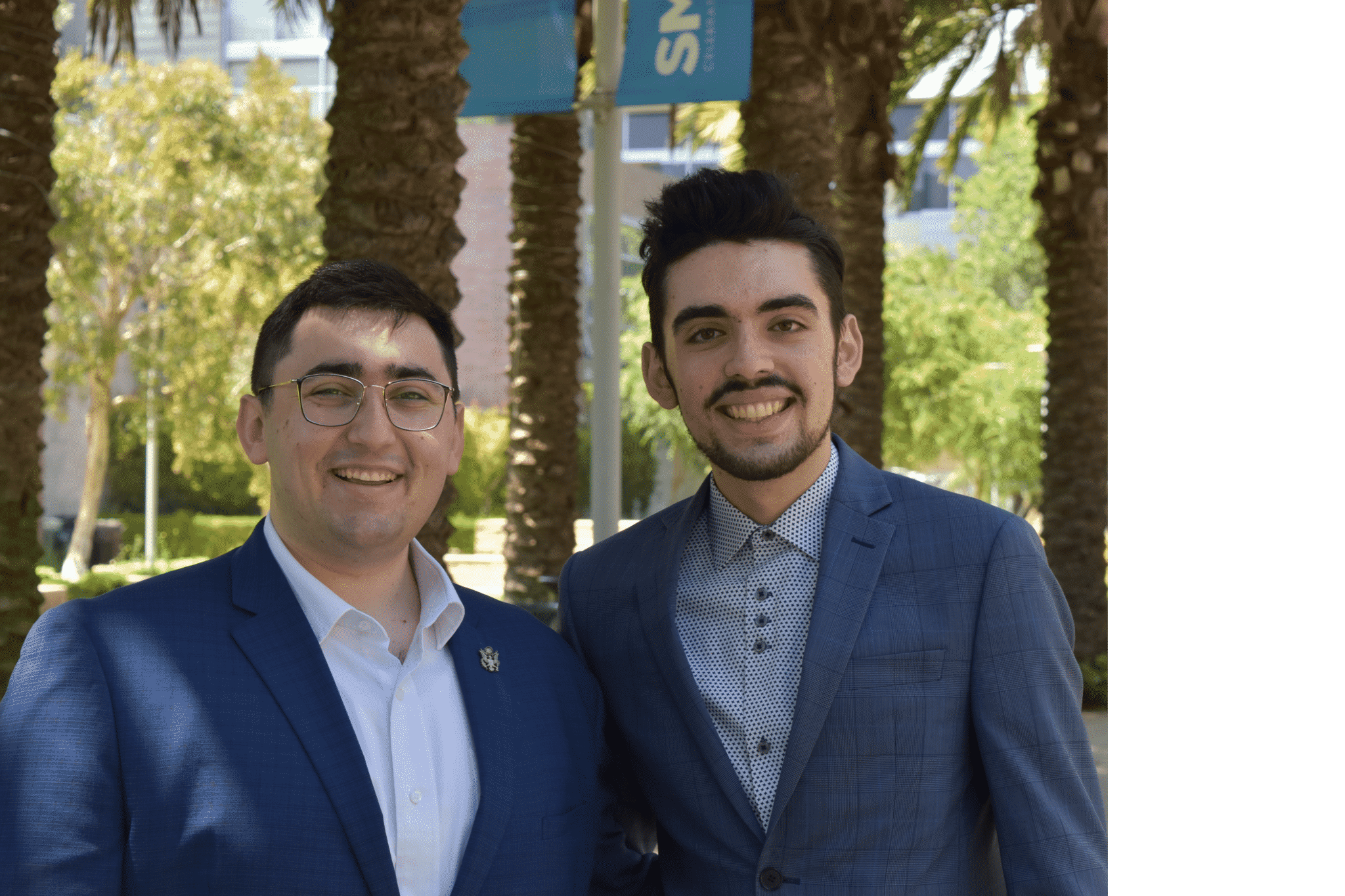
Silberberg with SMC alumnus and current UCLA student Itzchak Maghen. Photo courtesy of Nathan Silberberg.
He worked with the Brandeis Center on the resolution; the resolution initially used the International Holocaust Remembrance Alliance (IHRA) definition of anti-Semitism, which states that the demonization and delegitimization of Israel constitutes as anti-Semitism. The initial draft of the resolution also drew a link between anti-Zionism and anti-Semitism. However, the IHRA definition and any mention of Israel and Zionism had to be removed in order for the AS to pass the resolution.
Silberberg and the Brandeis Center decided to revise the resolution to include wording condemning anti-Semitic harassment based on ethnicity, ancestry and cultural origin.
“That’s giving a reference to Title VI laws based off harassment and discrimination, which the school already has in their school code,” Silberberg said. “So this was the best way the Brandeis Center and I thought it would be to get this resolution passed.”
He added that SJP and its lawyers said they were glad that any mention of Israel and Zionism was scrubbed from the resolution so it could be “apolitical,” which left a bad taste in Silberberg’s mouth.
“At the same time, I knew I needed to protect Jewish students somehow,” Silberberg said.
The resolution does expire on July 31, when Silberberg’s term ends, but Silberberg hopes that it can serve as a guide for future Jewish leaders on campus. He also hopes that the resolution will result in SMC administrators calling out anti-Semitism more often.
“I’m so grateful that I was able to do this because it wasn’t easy,” Silberberg said. “It’s not easy to be the person to stand up and speak. I used to be fearful of public speaking, but this was one of the happiest days of my life.”
UPDATE: A spokesperson for SMC said in a statement to the Journal, “Santa Monica College’s current in-person bias trainings address religious discrimination—which is a form of unlawful discrimination—and the college takes a very strong stance against unlawful discrimination and unlawful harassment; this can include anti-Semitism.”
The spokesperson added that “the SMC Board of Trustees, on May 5, passed the “Resolution To Reaffirm Santa Monica Community College District’s Commitment To Provide A Safe Environment For All Students And Personnel” (smc.edu/BOT). In addition, the #NoHateSMC campaign was launched March 24 in response to current events, including anti-Semitic incidents. ”
The spokesperson also pointed the Journal to the following video:
We get the news
the anxiety and science
the stats and predictions
much of it
each one of us and
on our own
in our present solitude and social isolation
What i am
curious
interested in is
how each of us is processing this experience
creating order inside
while the outside is in chaos
We can not control how Humanity as a whole will emerge
_not much has jolted over centuries so far in spite of similar repetitions every 100 years in history-
lives taken
loss of many experienced and mourned
but as Gandhi says
we can only start from ourself
What is this adversity/affliction/crisis doing to us
what path do we want to take
though our options
not clearly in sight
as we are still moving through it
Many gurus old and new _ and
In different contexts recommend practicing meditation
Meditation for the sake of coming to make more conscious decisions
Practicing more cautiously, wisely our right to make choices
Let us add awareness to the equation
While we are in it
We are not clear
We are but incapable to see beyond the now
Will we survive
what is what
where will we be taken to
What to be
who we want to emerge as
Let us pick up a flash light
a simple practice to lead the way in the darkness
to help us choose consciously and with awareness
each step of the way,
each thought,
each feeling we experience
It can pay off once we are out of this situation
– which we all know we subsequently will albeit as a whole
It is said ( possibly in the Bhagavad Gita):
you don’t even know of or recognize your courage
till right AFTER you have performed an act
My hope
My arrow pointed to the bull’s eye
that we all come to recognize
our wisdom
Our courage
Our higher consciousness and
With awareness
Once we are out of the bottle neck
It will not be a miracle if
In the meanwhile
and with all the challenges
we take every step,
NOT with fear anxiety and timidness but,
with as much awareness and Presence as we can muster
The Missouri state legislature passed a bill on May 14 barring the state government from providing contracts to companies boycotting Israel.
The bill, titled the Anti-Discrimination Against Israel Act, applies only to contracts wore more than $100,000 value and companies with more than 10 employees. The legislation passed the Senate on April 30 with 28 votes in favor and one against and passed the House on May 14 with 95 votes in favor and 40 against. Missouri Gov. Mike Parson, a Republican, is expected to sign the bill into law.
Jewish groups praised the law’s passage.
“The legislature has taken bold action to combat the insidious and hateful BDS [boycott, divestment and sanctions] movement that singles out Israel and encourages punitive actions against its economy and citizens,” American Jewish Committee St. Louis Regional Director Nancy Lisker said in a statement. “We look forward to Gov. Parson signing this important bill into law.”
She added: “Israelis and Palestinians want peace, they want investment not divestment, and they want for the whole region to prosper. Through this legislation both economies, Missouri’s and Israel’s, will continue to grow.”
StandWithUs CEO and co-founder Roz Rothstein similarly said in a statement, “Since Israel’s establishment in 1948, the Jewish state has faced countless efforts aimed at isolating and undermining its very existence. Missouri has made it clear that it will not tolerate singling out and targeting the world’s only Jewish state.”
Rothstein added: “We applaud the Missouri legislature and its citizens for taking this important action, rejecting the boycott, divestment and sanctions (BDS) campaign and acknowledging that a peaceful future cannot be anchored in a discriminatory movement.”
Christians United for Israel (CUFI) founder and chairman Pastor John Hagee similarly said in a statement, “CUFI’s more than 200,000 members across Missouri and more than eight million members across the country are grateful to the Missouri State Legislature for unequivocally saying ‘no’ to the anti-Semitic BDS movement. Taxpayer dollars should never be doled out to those who seek to destroy the Jewish state. We look forward to Governor Mike Parson swiftly signing this bipartisan, common sense legislation.”
Rabbi Daniel Bogard of the Central Reform Congregation in St. Louis, has a differing view. Bogard, who also is involved with J Street, said in Missouri Senate testimony in February that while he’s against the BDS movement, “I fear that by alienating and angering the liberal audiences that BDS seeks to engage and recruit, that this bill actually empowers the BDS movement. And I worry that any attempt to carve out a special status for Israel — the only nation-state of the Jewish people — only serves to ultimately reinforce the worst conspiracy theories of anti-Semites on the left and on the right.”
Missouri would be the 28th state to have an anti-BDS law in effect if Parson signs the bill into law as expected.
Update: This article was updated on May 15 to include a response from CBTL management.
On May 12, The Coffee Bean and Tea Leaf (CBTL) announced as of next month, it will no longer be offering full kosher certification in its stores. While all food and beverage items are currently kosher in most CBTL stores across Southern California (aside from certain franchised stores), come June 8, only certain items will continue to be kosher.
According to a company statement, CBTL had been doing “extensive consumer research” before the pandemic and “came to the decision to end our storewide kosher-only status and broaden our product offers. While this was initially scheduled to be a phased rollout, the economic impact of the COVID-19 pandemic has resulted in increased business pressures.”
Beginning June 8, CBTL will serve non-kosher bakery items. However, packaged coffees, teas and powders will still be kosher-certified through Kosher Supervision of America (KSA), and behind-the-bar beverages will be created using “a wide assortment of products made from kosher ingredients.” A variety of kosher-certified cold case options will be made available to guests as well.
CBTL has been a SoCal staple since it opened in 1963, and a kosher destination for customers in LA and surrounding areas. It currently offers a kosher version of the frappuccino called the Ice Blended, numerous baked goods including scones, bagels, cookies and challah on Fridays. At one point, the chain even opened up a Chalav Yisrael store near Hancock Park. CBTL noted in its May 12 statement, “We have long been committed to providing food and beverage offers that delight and inspire our guests, including the Orthodox community.”
In March 2017, the company began rolling back its kosher status. A handful of franchised stores including those at LAX, USC Cinema and Paramount Studios opted out of kosher certification. Two Jewish brothers who keep kosher used to own CBTL, but in 2019, the Philippines’ largest fast food chain, Jollibee, acquired the company for $350 million.
Samuel Friedman, who keeps kosher and lives in Long Beach, told the Journal he was disappointed with CBTL’s decision. “Long Beach has very few kosher options, just like the rest of Southern California [and] anywhere outside Los Angeles. It is one of the very few widespread pescatarian chains in SoCal with lots of vegetarian and vegan options. CBTL’s certification helps many of us keep kosher in these more ‘remote’ locations. I ask that CBTL reconsider its decision.”
Mia Adler Ozair is also not happy about CBTL’s decision, but said she understands the decision and hopes there can be some middle ground. “We are not entitled to kosher coffee shops,” she told the Journal. “They are for certain a luxury and these are business decisions, but perhaps the best way is to let CBTL know how much we value them in our communities and ask them to keep certain key stores kosher in LA, NY and other major cities within our religious neighborhoods.”
Filmmaker Arnon Shorr said he always felt comforted by the fact that whenever he was around LA, kosher food and drinks were just a few minutes away thanks to CBTL.
“By getting rid of their kosher food, they might save a few pennies, but they’ll lose the thing that made them truly unique among the nation’s great coffee shop brands,” he said. “And those of us who keep kosher in the cities where Coffee Bean operates, we’ll lose much more. We’ll lose the opportunity to feel, just a little bit, like normal folks, out and about, getting hungry, grabbing a sandwich.”
A representative from CBTL responded on May 15 to the following questions the Journal sent via email:
Is there any possibility of changing this decision after the shutdown ends? No. As we outlined in our announcement, this decision was a long time in the making and based on deep consumer research. Our decision to change kosher status was in large part based on that consumer feedback and the majority of our consumer preferences. This decision is not related to the current pandemic.
When you say kosher ingredients for behind the bar beverages, does this mean the beverages will be kosher certified or not? Will all behind the bar beverages have kosher ingredients or just some? The behind the bar beverages will not be certified. While the retail items (coffee/teas/powders) are certified through KSA, the behind the bar beverages are still made with Kosher ingredients.
Is there any possibility of keeping some stores in Orthodox Jewish neighborhoods kosher? No. In looking at the overall business needs while at the same time trying to maintain a consistent brand experience for our guests across all of our locations, non-kosher status will apply to all stores.
The land shall not be sold permanently, for the land belongs to Me, for you are strangers and [temporary] residents with Me. They say it’s a buyers market
but, truly, who can own anything
when the city can take it all away when the federales can eminently
domain a highway through your koi pond
when strangers from a strange land can manifest destiny you right into a genocide?
We build away the forests so people can
have tables and chairs and lawn furniture on top of lawn decks, on top of
manicured lawns, on top of the earth
that was here long before anyone conceived of zoning laws, and which
will be here long after we’ve
used up all the air. Someday the plants will laugh
at what we’ve done. Until they evolve
and the cycle cycles again. We own nothing despite our paperwork
telling us otherwise. So take no trespassing
signs with a grain of salt. The One True Owner reminds us
we are nothing but dust. We are
so easily scattered.
On May 19, the Jewish Women’s Theatre will present a free event via Zoom to highlight the work of Jewish nonprofit organizations, sharing their stories in a new installment of the Sunday Morning at The Braid series.
Beginning at 11 a.m., panelists Naomi Firestone Teeter, Executive Director of the Jewish Book Council in New York; David Raphael, Co-Founder and CEO of the Jewish Grandparents Network; and Michele Schipper, Executive Director of the Goldring/Woldenberg Institute of Southern Jewish Life will participate in a program entitled “Jewish Non-Profits: Making Mitzvot Across America.”
“At this unprecedented time when we are social distancing and often focused on all the things we are not able to do, JWT decided to create a panel that could educate us about some of the incredible things that Jewish community leaders across our country are doing,” JWT’s artistic director s Ronda Spinak said. “Now, thanks to Zoom technology, JWT can introduce viewers to three remarkable Jewish non-profits they might not know about, but definitely should.”
Next on the JWT’s virtual Sunday calendar is “Rabbinic Soul Sisters” on May 31, in which rabbis Toba August of Temple Shalom and Naomi Levy of Nashuva and Lev Eisha discuss their work and friendship that dates back 30 years to their freshman class at the Jewish Theological Seminary.
Visit their website to register and get information on how to join both events.
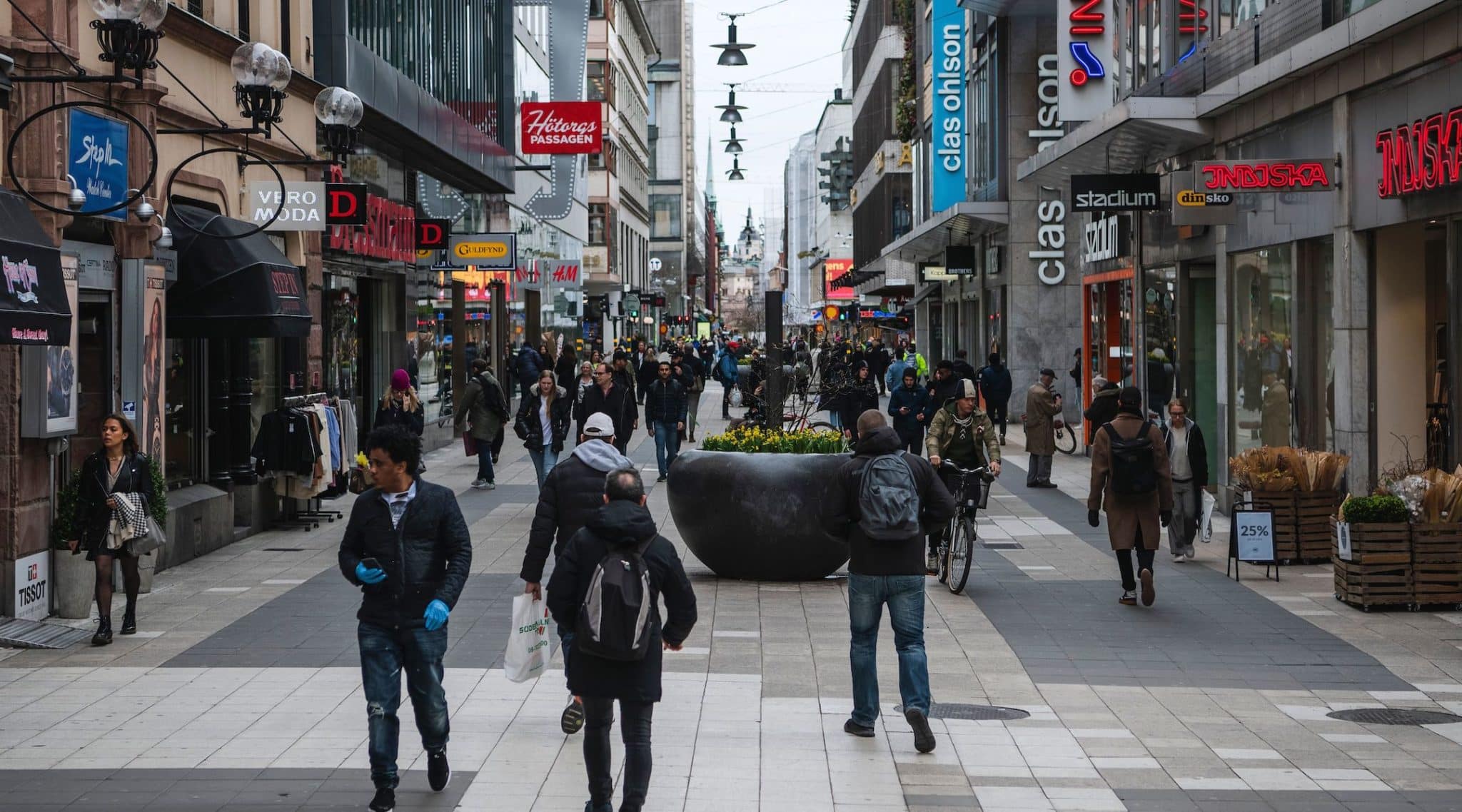
That’s because the country has taken one of the least restrictive approaches to the coronavirus pandemic in the world. As most of Europe has been on lockdown, Swedes have been going to school, shopping and gathering in restaurants and bars with minimal restrictions.
Some have praised the lax Swedish policy for lessening the economic toll of the virus, while others point out that it has led to a death toll significantly higher than those of neighboring countries.
Even as life goes on largely as usual, things have changed significantly for members of the country’s small Jewish community. Here are some of the ways.
Their own lockdown
Restaurants and other establishments are remaining open during the pandemic in Stockholm, May 8, 2020. (Jonathan Nackstrand/AFP via Getty Images)
The community, which numbers about 15,000 in a country of 10 million, has been treating the situation “like a crisis” since the pandemic first hit, said community leader Aron Verständig.
Most institutions have been closed since the middle of March after the community received information that those who had been diagnosed with the coronavirus had attended services in at least one of Stockholm’s three synagogues.
“Our rabbis said that from a halakhic perspective, you can’t have services if it means risking people’s lives,” said Verständig, who serves both as chairman of Stockholm’s Jewish community and as president of the Council of Swedish Jewish Communities.
Later that month, the community saw the impact of the deadly virus firsthand when it spread to Stockholm’s Jewish nursing home and elsewhere in the community, killing 17 in a short period of time.
Still, local Jews, like many other Swedes, have been largely positive in their views of the government’s response to the pandemic.
“Of course there is a bit of internal criticism in Sweden, but I would say that when I speak with people, both Jews and non-Jews, almost everyone thinks Sweden in large part is doing the right thing,” Verständig said.
Big losses
Restaurants and other establishments are remaining open during the pandemic in Stockholm, May 8, 2020. (Jonathan Nackstrand/AFP via Getty Images)
Despite acting quickly, the community hasn’t escaped harm. Among the 17 deaths in Stockholm’s tight-knit community at the end of March and beginning of April, most were residents of the Jewish nursing home.
The community of about 4,500 was left scrambling to bury the victims. The city’s Jewish burial society, or chevra kadisha, was not large enough to take on so many burials in a short span, and many members of the group were themselves older and at risk.
But that changed after Verständig put out a call for young volunteers.
“A lot of people stepped up and helped out,” he said.
Though the nursing home, which continues to be on lockdown, hasn’t seen any new cases since the beginning of April, the loss hit the community hard — especially as many of the victims were Holocaust survivors.
Verständig believes there were no more than 100 Holocaust survivors in Stockholm left prior to COVID-19, but 10 or 11 died in the nursing home.
“There were few Holocaust survivors left, but now we’ve lost a relatively big part of them,” Verständig said.
A synagogue closes for the first time
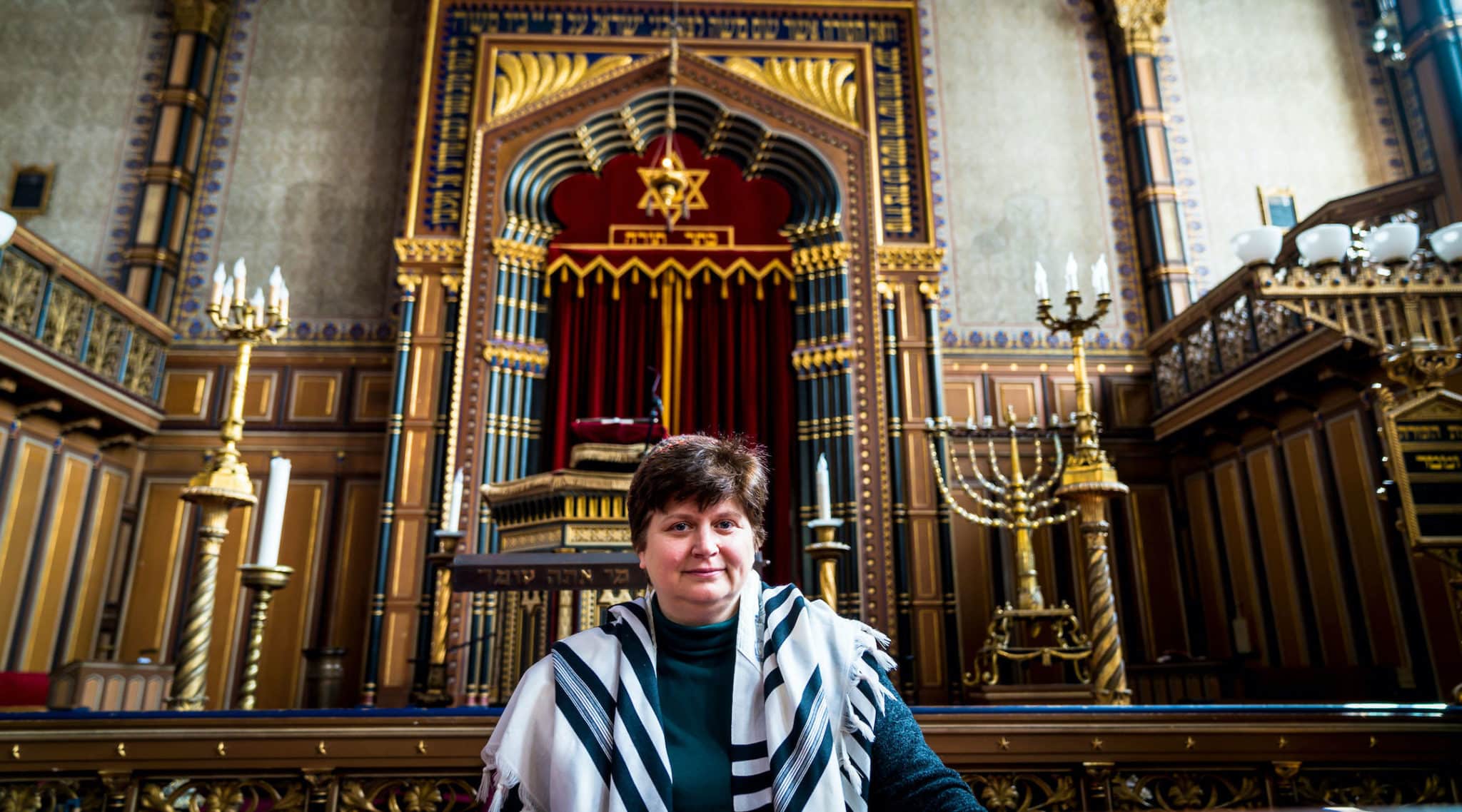
Rabbi Ute Steyer has been leading services for Stockholm’s Jews on Zoom. (Courtesy of Steyer).
For the first time in its history, Stockholm’s main synagogue is not holding any in-person services. Even during the violence and chaos of World War II, Jews gathered there regularly.
“During the synagogue’s 150 years of existence, we’ve never had to cancel services. It’s never happened,” said Rabbi Ute Steyer said.
Steyer has been organizing services on Zoom, and has been happy to see people who don’t regularly come to synagogue sign on.
“We’re starting to get into some kind of routine,” she said. “There are surprisingly many who are choosing to log on. I wasn’t expecting that.”
Still, she has plenty of challenges to deal with going forward. About 10 bar and bat mitzvahs have been postponed, and Steyer is trying to figure out how the kids will be able to celebrate their coming-of-age ceremonies as the synagogue reopens. Conversions and circumcisions may have to wait until the end of the pandemic. That’s all besides the grief that the tight-knit congregation is feeling.
“Everyone knows everyone. Everyone is related to everyone in some way,” the rabbi said. “So if someone has lost someone due to the coronavirus, everyone immediately knows about that, and who this person was and who his or her family was.”
The country’s only Jewish camp is closed for the summer
Kids do a range of typical camp activities, including boating, at Glämsta. (Courtesy of Glämsta)
But Glämsta is more than just a summer of fun and games. For many kids who live outside of Stockholm, it is the only time of the year they are surrounded by other young Jews and learn about their heritage.
In April, the Jewish community in Stockholm decided to cancel this year’s sessions due to the pandemic.
“Everyone is heartbroken and thinks it’s very, very sad. Many describe Glämsta as the most important Jewish institution to pass on yiddishkeit from generation to generation,” said camp director David Lejbowicz, who recently received a phone call from a mother who was in tears over the cancellation.
Still, the community won’t be completely without camp this summer. Lejbowicz is organizing a day camp in lieu of the regular sleepaway camp. Though the program will only be open to those residing in Sweden’s capital, more than 90 kids have already registered to attend.
“There’s a new spark [of hope] of hope because now there’s something positive, a positive goal,” he said.
Jewish school is still in session and people are happy about it
Sweden’s Prime Minister Stefan Lofven speaks during a press briefing on the coronavirus pandemic situation, in Stockholm, Sweden, May 13, 2020. (Pontus Lundahl/TT News Agency /AFP via Getty Images)
Like elementary and middle schools throughout Sweden, Stockholm’s Jewish school is still open. The Hillel School — which goes from nursery school to sixth grade and has nearly 400 students — has nixed large events, implemented student social distancing and is encouraging frequent hand washing, but otherwise is operating mostly as usual.
“The response has been very appreciative,” principal Kim Lichtenstein said. “From students who really don’t want to go to school during summer break or on the weekends, to parents who have been able to continue working, to the staff. Everyone has reacted positively about what we have done, really.”
Still, during a few weeks in the middle of March through the beginning of April, as the coronavirus hit Stockholm’s Jewish community, about half the staff and a third of students were absent. Some were sick or had sick family members, while others were scared to go to school.
“It was very different,” Lichtenstein said. “In some classes, there were three out of 20 students present.”
The city’s only kosher store remains open, but its owner is worried
People walk along a crowded street in Stockholm, April 1, 2020. (Jonathan Nackstrand/AFP via Getty Images)
The 200-300 households that keep kosher in Stockholm rely on Kosherian for buying meat and other delicacies. The store, which is housed in the city’s newly built Jewish community center in the trendy Östermalm neighborhood, is also popular among less observant Jews for its small Judaica collection and assortment of Israeli hummus and snacks.
Though the store is typically a place for socializing, things look different now — only one person is allowed to enter the store at a time.
“People usually want to stay and be social and talk. Now we’re trying to get them to shop, pay and leave,” said co-owner Benny Rung, who himself was hospitalized in April with the coronavirus.
Since kosher slaughter is illegal in Sweden, Rung imports all his meat, and he worries that the coronavirus will threaten his supply.
“There’s a lot of uncertainty,” he said.
A Jewish educational institute has gone virtual
Stockholm is home to Paideia — The European Institute for Jewish Studies in Sweden. The organization offers a number of programs for adults in Jewish studies, culture, Hebrew and Yiddish, as well as a government-funded general education program with a focus in religion and politics.
The institute decided to go virtual in the middle of March. Though there were initially some technical challenges, teachers and students have adapted in creative ways.
For example, a Jewish folk dance class is meeting virtually, and students can choose to dance along with the instructor or just watch as the instructor demonstrates new dances.
An introduction to Judaism class had a field trip planned to the synagogue, where students would attend Shabbat services and then attend a Friday night dinner. Instead, students watched from their computer as the teacher and her husband made a makeshift Shabbat dinner on a weeknight to demonstrate what it typically looks like.
The virtual classes have been a success with students, said Mina Szpiro, the institute’s education coordinator.
“Many are so happy and grateful that they can still get the intellectual stimulation and that they can continue with the course and continue being social with others,” she said.
(JTA) — The network of 10 Conservative Jewish Ramah camps in North America will lose approximately half of their collective annual revenue if they all need to cancel camp and refund tuition — a total shortfall of $27 million.
But Ramah leadership is confident that even without the 2020 season, the camps will be around for 2021.
“If we don’t run our camps, we’re going to mitigate about half of our expenses, but that leaves a lot of money to be raised,” said Rabbi Mitchell Cohen, the director of the National Ramah Commission. “We already know that all of our camps will be able to sustain that loss and will be able to open in 2021 and hopefully strongly rebound.”
Two Ramahs, in Georgia and Northern California, have officially canceled their summers, and several more are set to do so in the coming days and weeks. Across the country, dozens of Jewish camps have said that they will not be able to run this summer due to the COVID-19 pandemic.
Ramah camps each operate independently, but they’re all part of a network across the U.S. and Canada. Their collective operating budget is $60 million, the majority of which is financed by summer tuition. But the camps that have canceled have offered full refunds — as well as asking parents to forward what they have paid so far to next summer, or give all or part of it as a donation.
If camps refund all their tuition dollars, together they will be facing the $27 million budget hole. While they will be saving on the costs associated with running camp during the summer, the shortfall will hurt because the camps must spend a significant amount of their budgets during the remaining 10 months. Those costs include maintenance of the grounds, payroll, recruitment and expenses associated with preparing for camp.
Cohen, as well as individual camp directors, told the Jewish Telegraphic Agency that they will try to bridge the gap through loans, dipping into their cash reserves, donated tuition and other fundraising. All nine Ramah camps in the United States, plus the National Ramah Commission, have received federal relief loans from the Small Business Administration. There is a 10th Ramah, in Ontario, Canada.
“We are very confident that we’re going to make it through this,” said Jacob Cytryn, executive director of Ramah in Wisconsin, which will face a $2 million shortfall if it cancels, which is likely. “The exact specifics of how we’re going to do that, we still don’t know.
“Even if we don’t raise every penny that we’re trying to raise, the likelihood that we won’t be around for 2021 and beyond is remote.”
Other Ramah camps are facing similar challenges.
Camp Ramah in New England will face a $1.3 million shortfall on its $6.3 million budget if it cancels and refunds tuition. Ramah in California, which is separate from the Northern California camp, is also “facing a net multimillion-dollar shortfall,” according to its executive director, Rabbi Joe Menashe.
Menashe told parents this week that “we cannot open camp in mid-June or run our summer sessions as scheduled.”
Cytryn expects to overcome the budgetary obstacles and be at camp in 2021. But he added that the camp was in “uncharted territory” and has “no sense of what that might look like in actuality.”
Wilshire Boulevard Temple Camps Hess Kramer and Gindling Hilltop Camp officially have closed for the summer because of the coronavirus, the camp directors announced May 14.
“I am greatly saddened to share that we have made the painful decision to cancel our 2020, in person summer season. Our decision was not taken lightly and we share in the feelings of sadness with all of you,” camp Director Seth Toybes and Executive Director Douglas Lynn wrote in a joint letter to camp families.
Toybes told the Journal in May that, “if we can’t create a safe and meaningful experience, then we have to do what’s best for our campers.”
Cal State Channel Islands informed the Jewish summer camp it would not host any outside summer programs this year because of COVID-19. After reviewing the available information from the Centers for Disease Control and Prevention and the American Camping Association, (ACA) it decided to cancel summer plans.
WBT families will receive an email from the camp offering three options for camp fees. Families can choose to donate all or a portion of the camp fees to support one of the summer camps, roll them into next summer or apply for a refund.
“We know this is a sad decision. It will be especially tough for our campers and it is totally natural for anyone connected to camp to feel sad,” the letter concluded. “We hope that you’ll join us for the activities throughout the summer so we can smile together again soon. We look forward to seeing you virtually and again in person when the time comes, until then stay healthy and safe.”
Camp Ramah in California, which will not be able to start camp in mid-June or run summer programs as scheduled, released a statement of hope with the possibility of running a modified summer program for its campers this summer.
“At this point, we are hoping to operate a summer experience at camp in mid-July through mid-August, should it become possible. Our plan would be to offer two shortened sessions of equal length to accommodate both our first and second session campers.” They will notify camp families by June 2 on whether those programs will take place.
Photo courtesy of Camp Ramah in California.
Families also will receive an email from Camp Ramah by May 18 with options to keep their kids enrolled in the summer program or to request a refund. The camp also is encouraging donations to keep the camp afloat.
“If we are permitted to operate by the requisite agencies, we will then answer the question of should we open camp. In making this determination, we will continue to be guided by the five principles we have shared: health and safety, preserving the integrity of a camp experience, our values of equity and inclusivity, the feasibility of logistical operations, and safeguarding the financial health of Ramah,” the statement read.
For the first time since opening in 1951, Camp JCA Shalom will also not hold camp programming for the summer. In a statement sent to families May 14, President Larry Cohen, Executive Director Rabbi Bill Kaplan and camp Director Joel Charnick said that they would close all day camps and overnight camps based on the information provided from the CDC, state and local health authorities, and longer Safer at Home restrictions.
“The forthcoming operating guidelines for camps during this COVID-19 pandemic would prevent us from creating the magical summer camp experiences in the way that we have provided for generations,” the statement said. “Transformative experiences are the foundation of our mission, and we are heartbroken that we will not have the opportunity to provide these to thousands of campers and staff who participate in Camp JCA Shalom Overnight and Day Camps and Camp Gesher (for children from Russian-speaking Jewish families). Though we want nothing more than to run camp as planned, the health and safety of our community is our number one priority.”
Camp Bob Waldorf is canceling their in-person programs this summer but created virtual solutions for its registered campers involving Zoom and “Camp-in-a-Box” kits.
Also on May 14, Camp Alonim announced it would be canceling its first session, mini session and the first two weeks of the CIT, Gesher Gan Day Camp and Gesher Gan Internship Programs.
The camp, operated through the American Jewish University, is still planning to move ahead with its six-week in-person camp programs and family retreat programs with modifications. In a camp statement, Camp Director Aaron Goldberg said he hopes in-person programming beginning the week of June 29.
Like many of the other Ramah camps around the country and Canada, Camp Ramah in California made the decision to cancel in-person camp on May 22.
“While the likelihood was slim, we had hoped that a path forward would become viable. Sadly, we now know that no such opportunity is available to us,” the Ramah executive team wrote in a joint statement to families. “We are comforted knowing that the Ramah mishpacha (family) is made up of people, place, and spirit. At this point, we are confident that the people and spirit will carry us forward, and the givah will be there waiting for us. We pray for the health and wellness of everyone, and that we will be together again soon.”
The letter stated that an email will go out to camp Ramah families on May 27 outlining the next steps for refunds and donations. All Ramah families are eligible for a FULL refund with an invitation to donate partial or full tuition. They will also roll out plans for alternate summer programming on June 4.
This story was updated to include information about Camp JCA Shalom, Camp Alonim and Camp Ramah in California.
In September of 2018, I was arrested in an act of civil disobedience during the first day of Brett Kavanaugh’s confirmation hearing. I stood in a room full of senators and staffers and shouted that confirming Kavanaugh to the highest court would mean not only an end reproductive freedom for Americans but an end to religious freedom as well.
I was right.
In 2016, the Supreme Court ruled 5-3 that the state of Texas could not impose arbitrary and unfair restrictions on abortion clinics, also called TRAP Laws (targeted restrictions on abortion providers), that create undue burdens on the patients seeking care in those facilities. This case, Whole Woman’s Health v Hellerstedt, upholds the standards that were set way back in 1992 with the Supreme Court Case Planned Parenthood v Casey that decided no restriction placed upon abortion access could create an undue burden for someone seeking care. In 2016, the Supreme Court affirmed the right of any person to seek timely and holistic abortion care in an abortion clinic.
My constitutional rights as a woman and a Jew are being stripped away, piece by piece.
So why is the Supreme Court currently deliberating on a near-identical case? Now, as they deliberate on June Medical Services v Russo, I once again fear that my constitutional rights as a woman and a Jew are being stripped away, piece by piece.
In both cases, Texas and Louisiana attempted to impose TRAP laws onto clinics. Specifically, one that would require abortion clinics to have admitting privileges to nearby hospitals. On the surface, this may seem like a good thing: in the case of an emergency, of course, a medical clinic should have access to emergency services.
There are a few problems with this idea. Firstly, this law goes far, far beyond what is medically necessary. The likelihood of a medical emergency occurring in an abortion clinic is extremely low, and most outpatient surgical centers in this country aren’t required to have admitting privileges. Additionally, the decision of whether or not to allow admitting privileges to an abortion clinic lies with the hospital. In some states, up to 40% of all hospitals are Catholic, meaning they are extremely unlikely to work with an abortion clinic. Regardless of the practicalities of how backward requiring admitting privileges is, they were deemed unconstitutional in 2016.
For there to be an identical Supreme Court case being decided on at this very moment is absurd. It’s not only a violation of my constitutional right to have an abortion, but it’s also a violation of my religious liberty.
Largely to the disbelief of fundamentalist Evangelical Christians and Catholics, they do not have a monopoly on religion in this country.
Largely to the disbelief of fundamentalist Evangelical Christians and Catholics, they do not have a monopoly on religion in this country. While their voices may be the loudest protesters of such things as racial justice, LGBTQ rights, and, of course, a woman’s right to choose, they aren’t the only voices. It is extremely important to know that there are people of faith inside abortion clinics. They are the doctors, nurses, support staff, and of course, they are the patients.
Pro-life and pro-choice activists gather at the Supreme Court for the National March for Life rally in Washington January 27, 2017. REUTERS/Aaron P. Bernstein
Jewish women, specifically, are not unfamiliar with this fight. We have been on the frontlines of the abortion justice movement since its inception. From Heather Booth founding the Jane Network to Ilyse Hogue, President and CEO of NARAL Pro-Choice America, Jewish women have committed themselves to the struggle for reproductive freedom.
What the Right refuses to understand is that abortion is not only permissible, in some cases it is required in order to save the life of the pregnant person. But this nuance about abortion, among many, many nuances in Jewish teachings on this subject, falls on deaf ears. But I know, as an American, my first amendment right to religious liberty is also the freedom from religion.
As an American, my first amendment right to religious liberty is also the freedom from religion.
It’s why I have spent so much time protesting, testifying, and writing about my right to reproductive freedom. Kavanaugh has proved my worst fears, just as I knew he would. Susan Collins (R-ME) insisted that the would-be Justice understood that previous rulings made by the Supreme Court were law-of-the-land. She went on record to say that precedent, “is a constitutional tenet that has to be followed except in the most extraordinary circumstances.” Yet Kavanaugh seems to have found that the opportunity to legislate women’s bodies to be the perfect extraordinary circumstance. Thus, on February 7th, 2019 Brett Kavanaugh voted to refuse a stay of a TRAP law in Louisiana, goingdirectly against the precedent set by the Supreme Court in 2016 in Whole Woman’s Health v Texas.
Kavanaugh has proven himself to be an enemy of Jewish women.
Steph is an activist and writer in D.C. and is proud to work for the National Council of Jewish Women.






 Los Angeles poet Rick Lupert created the