fbpx

May 2, 2020

Thoughts on Torah Portions Acharei Mot – Kedoshim – “Be Holy”


Thoughts on Torah Portion Acharei Mot – Kedoshim – “Be Holy”

“Be holy,” begins one the combined Torah Portions for today. “All right,” I might say. “But what exactly do I do next?”  I’ll take the long way around in advising what to do next.

I don’t always restrain myself when I am counseling someone who gives advice to a troublesome teenager. “My kid is lazy, so I told him to quit smoking pot and go out and get a job!”

With a person who does not mind being ribbed with a little bit of sarcasm, I respond, “And I am sure that did the trick. Your kid then said, “Whoa, dad, I never thought about that!  You mean, just stop smoking pot and go get a job?  Why didn’t I think of that? What a concept?  Ok!  Good to go!”

I ask the dad how often he has told his miscreant son to “stop smoking pot and go get a job”. “Well, two-three times a day for the past couple year – so a maybe a thousand times.” I say, “And how is that going for you?”

Doing something over and over again and expecting a different result may not be a sign of insanity, but it is a pretty close definition of unwise perseverance. Wise perseverance is tenacity. Starting a business, getting in shape, creating a work of art: sometimes we just have to stay at things a long time to get results. This hard work is not insanity – it is resolve and decisiveness. Once we have evaluated a course of action, we constantly evaluate what we are doing and why some small things might not be working. But we stick with in.

Rabbi Mordecai Finley

People who just perseverate typically are not wise in thinking about why things do not work and don’t spend the time figuring out how to make them work. The dad in this case was not giving up on parenting; he just did not know what to do next. So he kept doing the thing that did not work.

Irrational advice givers don’t know what else to do other than tell people what to do. Irrational advice givers feel helpless, and their giving advice is more a treatment of their own frustration than a well thought out plan to help another person. It is as if they are unconsciously thinking, “If I tell you what to do, at least I did something.”

Like in any addiction, the satisfactory feeling of “at least I, the advice giver, did something” departs quickly. We need another fix soon. Hence, more advice, lecturing, remonstrating and – you got it – criticism, complaining, condemning and needless conflict.

Here is something that does not work in counseling or advising others in general:  giving advice without a lot of preparatory work. Work on yourself, and work on understanding the other person.

Here is one piece of that necessary preparatory work: find out the significance of a behavior in the other person and truly listen without judgment. I counseled an irrational advice-giving parent with a pot-smoking child who came to me desperate for help, to start here: stop giving advice. Instead, I counseled him to ask the boy why he smoked pot – without interrupting, refuting, or advising. Dad found out what I predicted from long experience of working with families: the kid was in a lot of pain. Depressed, listless, a bit of despair. Nothing makes any difference. “I’ll never get a satisfying job, find true love, or feel good in general.” Pot takes the edge off of the pain of a life without meaning, a life of too much existential suffering.

The pot smoking is a bit like irrational advice giving:  you don’t know what else to do, so you medicate your own feelings. One addictive behavior follows another. The advice giver medicates his pain by giving advice; the pot smoker medicates his pain by smoking pot. A dance from hell.

Giving advice of any deep significance should only happen once a person has allowed you in, however symbolically and briefly, to the contours of their soul. By soul, I mean a deep interior region where, among other things, meaning and purpose in life get worked out in some mute and metaphoric way.

Once a person has let you into their world, sometimes all that is needed from the person doing the counseling, whether it be a parent, a friend, or a soul teacher, is a brief word, pointing out the north star, a sense of spiritual companionship.

Good counsel occurs when a space has been opened in the suffering heart for a word of truth. Opening that space is a delicate process, involving vulnerability and trust on one hand, and wisdom and empathy on the part of the person into whose hands the suffering heart has been placed.

When I read words of admonition in the Bible “Be Holy”, I try to imagine a profound and complex conversation that preceded these words. I imagine a lengthy period of suffering and spiritual seeking, of opening the heart to a wise counselor, who finally counsels, after much reflection, “Be holy.” It was not a commandment. It was not advice. Saying, “Be holy” was a way of being present, of reflecting back to a person the next stage in their soul journey.

“Be holy”, said without the deep preparation, is just advice, maybe an inapplicable and high sounding platitude, unless these are the truest words that can be spoken into your soul or the soul of another. Sometimes in a life evacuated of meaning, bleak in outlook, suffused with painful silence within the din of chatter, these words can awaken a dormant force. If these are the words for which your soul yearns, you don’t ask, “What do you mean by ‘holy’? That’s been covered.

Holiness stands for a way of experiencing the world, a world fraught with significance, full of enchantment and pain at the same time, awaiting your awakening.

Sometimes in the depth our journeys, we arrive at a moment, that might, from the outside, look like any other moment, but it is the moment. Something you must do, something you stop doing, some old way of thinking or feeling – the jig is up.

What happens next can open the new road. You consider deeply what it will take, what part of the ego-self will have to be sacrificed, what part of the soul will be born or reborn into the world. Those moments are unbearably deep and heavy, and yet as light as the presence of the Divine flowing through us. Holy moments.

If not now, when?

Shabbat Shalom,

Rabbi Mordecai Finley


Thoughts on Torah Portions Acharei Mot – Kedoshim – “Be Holy” Read More »

‘Unorthodox’ Star Shira Haas Wins Best Actress for Tribeca Festival Film

The Israeli movie “Asia” won three awards at the Tribeca Film Festival, including one for Israeli actress Shira Haas and the Nora Ephron Award, organizers announced on Wednesday.

“From the writing, to the directing, to the camera moves, to the direction for the acting, to the way Ms. Pribar told a story through non-speaking was just outstanding,” the jury said about Israeli director Ruthy Pribar’s first feature film, which revolves around a mother-daughter relationship.

“Her face is a never-ending landscape in which even the tiniest expression is heartbreaking; she’s an incredibly honest and present actress who brings depth to everything she does,” the jury said about her performance.

The Nora Ephron Award was created seven years ago “to honor excellence in storytelling by a female writer or director who embodies the spirit and boldness of the late filmmaker.”

“Asia” also won Best Cinematography in an International Narrative Feature for Daniella Nowitz. The jury said, “We were impressed with how the cinematography was supporting the emotionality of the story and was allowing us to really deeply feel with the characters.”

Haas, who now stars in the Netflix series “Unorthodox,” won Best Actress in the international category for the film.

“Her face is a never-ending landscape in which even the tiniest expression is heartbreaking; she’s an incredibly honest and present actress who brings depth to everything she does,” the jury said about her performance.

While the coronavirus pandemic forced the festival to reschedule, jury members were still able to view the films and vote on winners.

‘Unorthodox’ Star Shira Haas Wins Best Actress for Tribeca Festival Film Read More »

Coronavirus Has Disrupted the Lives of Young Adults With Disabilities, Who Thrive on Routine

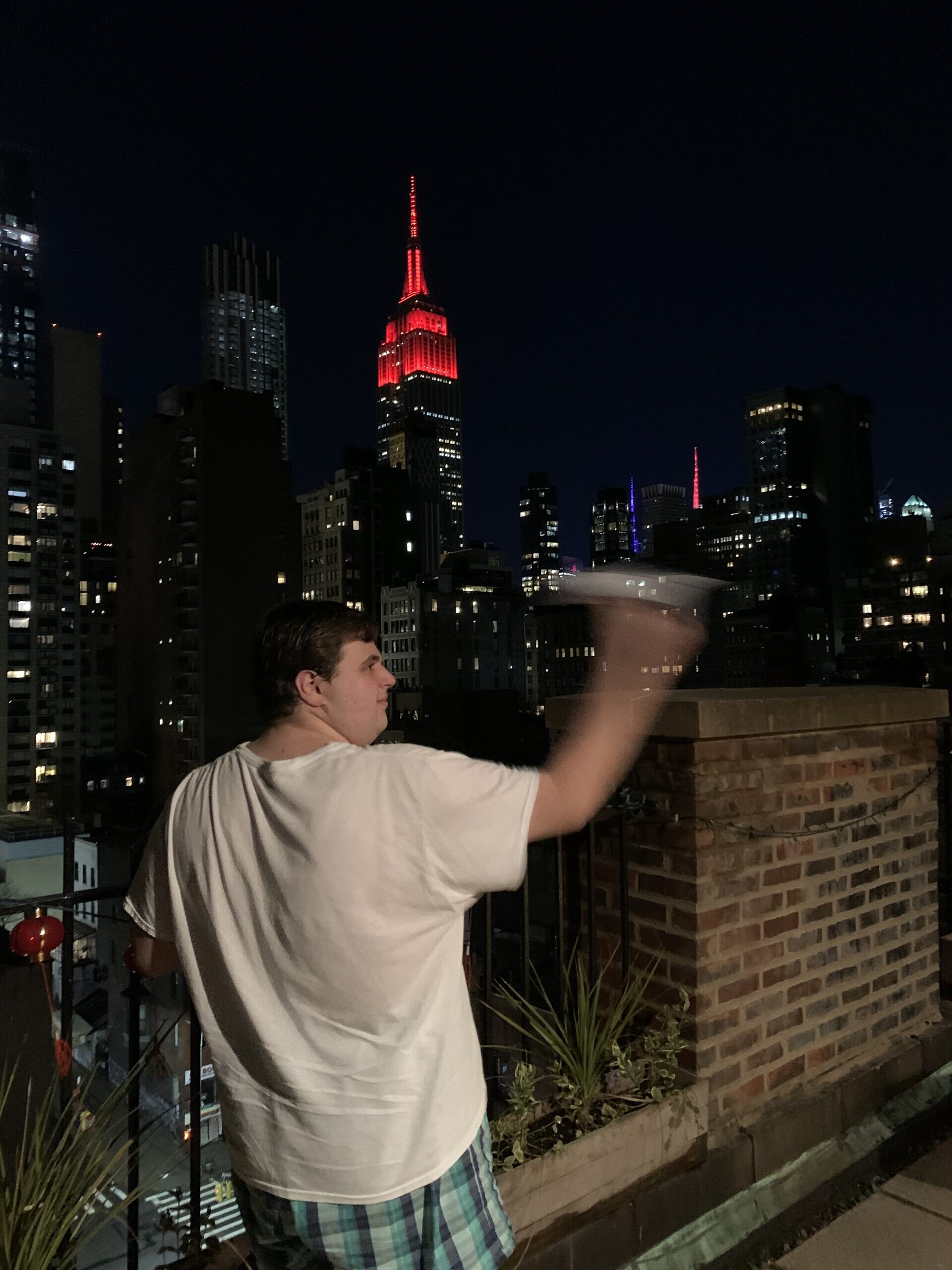
Max Wagenberg has had enough of the coronavirus. According to his mother, Helene Richter, the 21-year-old minimally verbal Manhattan resident with autism, searched for and found an “escape strategy” from the pandemic. “Last night, he came to me with this drawing of two birds and asked me to help him turn it into an airplane, he went out to the side of the terrace and launched it—watching it soar through the buildings—as he smiled,” reports Helene. “So many people with special needs can’t put into words what is happening around them.”

With routines disrupted, programs suspended and caretakers unable to report for work, people with disabilities, their families and professionals who work with them are experiencing new realities and experimenting with creative solutions.

With routines disrupted, programs suspended and caretakers unable to report for work, people with disabilities, their families and professionals who work with them are experiencing new realities and experimenting with creative solutions.

“Max has been doing a lot of drawing and calendaring and reading social stories. This has helped a lot,” reports Helene.

Molly Jacobs, a 23-year-old New Jersey resident with developmental disabilities has been dealing with a day habilitation program out of session and suspended until further notice. “The hardest part for her has been the unknown. She wants to know when the quarantine will be over, when will her program start again, and what is going to happen with camp. I don’t have the answers that she needs to feel secure and less scared,” notes her mother, Hannah Jacobs.

To help get through this difficult period, Hannah and Molly have developed new routines, taken advantage of technology and participated in special off-season summer-camp activities. “We focus on activities that we write on a daily schedule to give her goals to look forward to each day. The Zoom calls with her friends from both camp and her program have centered her,” said Hannah.

Max Wagenberg launching his paper airplane off his New York City terrace. Credit: Courtesy.

Molly is a longtime participant in the Tikvah overnight summer camping program at Camp Ramah in New England. “She loves the Havdalah services [for ending the Jewish Sabbath], which she wears pajamas to because ‘that’s what we do at camp.’ These are scary times for everyone, and for Molly, our focus is letting her know that it’s OK to be scared, and we are here to keep her safe.”

When 28-year-old Sammy Leibenstern’s day program was suspended, he left his group home in Santa Clara, Calif., and returned to his family’s home in Santa Cruz 45 minutes away. “He’s definitely enjoying the TV time,” reports younger sister, Ruby Hartman. “But it’s getting tough to also get him motivated, active and engaged in more thoughtful activities.” Ruby reached out on Facebook to many of her old Jewish summer camp friends who also knew Sammy from camp. She asked them to consider setting up a time to reach out to Sammy and was pleased with the outpouring of support and willingness to help.

‘They are prone to isolation’

Gabrielle Kaplan-Mayer, director of Jewish Learning Venture’s “Whole Community Inclusion” in Philadelphia, observes, “The coronavirus quarantine has impacted Jews with disabilities in a number of different difficult ways. First, many people with disabilities have coexisting medical conditions, which put them at high risk for the virus. People living in group homes, residential schools or community residence aren’t able to see their family and friends. Many school-age children and teens have lost access to special education and school-based therapies, and parents are struggling to home school as best they’re able. It’s an incredibly hard time.”

Many school-age children and teens have lost access to special education and school-based therapies, and parents are struggling to home school as best they’re able. It’s an incredibly hard time.

Stacey Spencer, the Inclusion Program Manager at Jewish Family and Children’s Service of Minneapolis, reports, “I am still working on creating a sense of community with our Caring Connections participants, who are Jewish adults with disabilities.”

Spencer is finding creative ways to create community when in-person events and in-person home visits are no longer possible. “I have made numerous check-in phone calls and virtual ‘home visits’ to our Caring Connections members and their families to provide them with support and to be able to assess their current needs. I set up a closed Facebook Group and invited our Caring Connections members, their families and staff to all join us,” she relates. “Our members were unhappy to hear that our annual Passover ‘Sing-a-long Seder’ scheduled for April was canceled. This was yet another disappointment and change they experienced while trying to adjust being quarantined at home.”

But she adds that “our seder leader was still able to perform our lively and interactive sing-a-long live for everyone to partake in. It was a wonderful and heartwarming event. They are modifying their lives to this ‘new normal’ much like the rest of us are trying to do.”

Shelly Christensen, also of Minneapolis, a disabilities inclusion professional who worked on the Ruderman Chabad Inclusion Initiative and wrote From Longing to Belonging—A Practical Guide to Including People With Disabilities and Mental Health Conditions in Your Faith Community. She echoes Spencer’s observation that people with disabilities are adapting to some of the same challenges the rest of society is dealing with. “All of us are adapting how we structure social connections. People with disabilities are just like anyone else,” she said.

While Christensen notes that many people are staying connected with friends, family and co-workers through Zoom and social media, and that there are groups on Facebook specifically to connect people with disabilities, she worries about people with disabilities who don’t have access to smartphones, tablets and computers, or who don’t know how to use such technology. She says “they are prone to isolation.”

She also worries about the potential loss of direct-support professionals if the professional or individual they are caring for is exposed to the coronavirus.

‘How to stay engaged, manage technology’

Rabbi Bentzion and Rochel Groner, co-directors of Friendship Circle, affiliated with the Chabad-Lubavitch movement, and ZABS Place (a Friendship Circle-run resale store) in Charlotte, N.C., are also finding ways to help those they work with tackle boredom and loneliness.

The rabbi reports, “We’ve taken all our Friendship Circle programs online and increased the number of virtual activities. And we’ve tried implementing one-on-one home-based skill-building activities for our coaches to do with our ZABS young adults. It’s been a little more challenging, but at least they get to see familiar faces.”

They add that “for the most part, the biggest challenge we’re hearing from everyone is figuring how to stay engaged in a routine despite being in quarantine.”

People with disabilities have been severely impacted by loss of jobs and are likely to experience the impact of severe unemployment even when the economy is more fully up and running.

Friendship Circle New Jersey executive director Toba Grossbaum gives a virtual cooking class for Friendship Circle families. Helping her with the program are three of her children, Gittel, Liba and Yudi. Credit: Courtesy.

The Groners, like Christensen, are finding that technology is sometimes difficult to use and can be unpredictable, which tend to complicate matters even more. Another challenge, they note, is how to manage the technology, which is sometimes delayed or has a learning curve for some of their constituents. They also point out that some young adults are much more isolated in terms of access and can’t participate in online activities.

While people with and without disabilities are primarily focusing on present-day realities, most are also imagining what a post-corona future will look like in terms of both social interaction and employment. People with disabilities have been severely impacted by loss of jobs and are likely to experience the impact of severe unemployment even when the economy is more fully up and running. At ZABS Place, the Groners anticipate that many skills will need to be retaught. “We’re not sure how our young adults will feel about having to ‘take a few steps back.’ That will also impact how quickly we can get up to speed as a store.”

What’s the future for the estimated 50,000 to 70,000 individuals with autism alone who turn 21 every year and no longer qualify for school-sponsored and funded services?”

Steve Keisman, senior vice president at the online site Identifor, and an independent transition and neurodiversity employment specialist, is concerned. “After nearly a decade of gradual attention and limited but increasing opportunity for people with neurodifferences in the workplace, that train hit a brick wall without warning in March of this year.”

He asks, “What will the ‘new normal’ look like for our community, especially the more impacted and those who are not STEM-oriented or savant? What’s the future for the estimated 50,000 to 70,000 individuals with autism alone who turn 21 every year and no longer qualify for school-sponsored and funded services?”

Hospitality, retail, food service and other areas of long-established employment for the neurodiverse will be slow to recover and will likely return in a very different way.

Keisman points out that hospitality, retail, food service and other areas of long-established employment for the neurodiverse will be slow to recover and will likely return in a very different way. Employment in hospitals, schools, restaurants, gyms and health clubs will also be reconsidered because of health concerns and risks. He recommends that concerned family members of people with disabilities continue to determine the specific skills, abilities and interests of the family member, and to explore various employment possibilities that might be a good fit when the economy unfreezes. (He also recommends online career-assessment tools like the free, game-based Identifor.)

Those in the disabilities field, along with their families, hope and pray that Max, Molly, Sammy and the tens of thousands of other Americans with certain challenges will soon return to their social, religious and vocational routines—and to the day when Max will longer need to draw pictures of birds in search of freedom.

Written by Howard Blas

Coronavirus Has Disrupted the Lives of Young Adults With Disabilities, Who Thrive on Routine Read More »

British Educational Publisher Withdraws Textbook Following Complaints of Anti-Israel Bias

British educational publisher Hodder Education has withdrawn a secondary-education textbook following complaints of anti-Israel bias.

According to Britain’s The JC newspaper, a report by UK Lawyers for Israel (UKLFI) said there was “misleading and confusing content” in the textbook, written by Steve Waugh and John Wright, and titled “Conflict in the Middle East 1945-95.”

Issues of concern included calling early 20th-century Jewish immigrants “settlers,” despite them entering legally and living on legally purchased land.

The source also refers to ancient Israel “Palestine,” which was not its name until the Roman conquered it in the first century BCE.

UKLFI stated it was informed by Hodder that the publisher had “decided to remove the book from sale and will reconsider its future” after UKLFI claimed that the book “frequently refers to Jewish terrorists when their actions were against military targets.”

“It is very important that children learning about this complex subject are taught in a balanced and accurate manner,” UKLFI director Caroline Turner told The JC. “We are pleased that another misleading and inaccurate school textbook, purporting to teach about Middle East history, is being withdrawn and reconsidered.”

This follows the withdrawal in February of another Hodder Education title, “Understanding History: Key Stage 3: Britain in the Wider World, Roman Times–Present,” which suggested that Israel may have been a “long-term cause” of the 9/11 attacks.

British Educational Publisher Withdraws Textbook Following Complaints of Anti-Israel Bias Read More »

Sacha Baron Cohen and Isla Fisher Donate 100,000 Masks to Healthcare Workers

British Jewish comedian and actor Sacha Baron Cohen and his wife, Australian actress Isla Fisher, helped donate a cargo of Personal Protective Equipment (PPE) that was airlifted to healthcare workers in the United Kingdom on Wednesday.

The couple partnered with Salesforce, DMGT and Mail newspapers to send by plane 100,000 masks and 50,000 coveralls to the United Kingdom through a charity called Mail Force.

Salesforce CEO Marc Benioff shared on Twitter photos of the cargo arriving at London’s Heathrow Airport and Cohen replied to Benioff’s Twitter post saying, “Isla and I are so happy to have such persistent and generous partners in getting this done. Businesses please follow and get PPE in through #ProjectHope in US or #MailForce in UK.”

The PPE was flown in from China. More equipment is expected to arrive in the coming days, reported the country’s Metro.

Britain has been suffering from a shortage of PPE for frontline health-care workers.

BBC investigation published on Tuesday revealed that the government of Prime Minister Boris Johnson “failed to buy the necessary protective equipment needed to cope with a pandemic,” and that “there were no gowns, visors, swabs or body bags in the government’s pandemic stockpile when COVID-19 reached the U.K.”

As of Friday afternoon, there were 177,000 confirmed cases of the coronavirus in the United Kingdom with 27, 510 deaths.

Sacha Baron Cohen and Isla Fisher Donate 100,000 Masks to Healthcare Workers Read More »

Israeli Biotech Company Starts Clinical Trials of CBD-Steroid Treatment for COVID-19

The Israel-based biotech company Stero Biotechs has started a small-scale clinical trial at Rabin Medical Center’s Golda Hasharon Campus in Petach Tikvah on the effects of a steroid-Cannabidiol (CBD) treatment on hospitalized COVID-19 patients.

“Steroid treatment is usually the first or second line of treatment for hospitalized patients. CBD enhances the therapeutic effect of steroid treatment and treats the bio-mechanism affected by the virus,” the company said in a press release announcing the clinical trial. “The initial study will evaluate the tolerability, safety and efficacy of the CBD treatment for hospitalized patients with COVID-19 Infections.”

Ten patients will be in the clinical trial; the treatment cycle will be for a few weeks with a follow-up period of the same length. Pending the trial’s success, the company plans to expand to a multi-center clinical trial with an additional 40 hospitalized COVID-19 patients, under FDA clinical trial guidelines and regulations.

“We estimate that our CBD-based treatment can enhance the current treatment of those patients who are suffering life-threatening conditions,” said Stero Biotechs founder and CEO David Bassa.

“Hospitalized COVID-19 patients are mostly being treated with steroids, and our study is planned to demonstrate the benefit of a combined solution with steroid treatments,” he continued. “We are hopeful that this study will lead to faster benefit for the growing number of COVID-19 patients in Israel and around the world.”

Stero Biotechs, founded in 2017 and headquartered in Israel, is a clinical-stage company that focuses on the research and development of novel CBD-based treatment solutions.

Israeli Biotech Company Starts Clinical Trials of CBD-Steroid Treatment for COVID-19 Read More »

Michigan State Lawmaker Apologizes for Comparing COVID-19 Policies to Holocaust

A Michigan state representative has apologized for a Facebook post last month comparing the possibility of Americans having to show documentation proving they are immunized against or don’t have the coronavirus to Jews being forced to wear a yellow Star of David during the Holocaust.

In an April 13 post that has since been deleted, Pamela Hornberger (R-Chesterfield) came down hard on Anthony Fauci, a member of the White House coronavirus task force, for stating a few days beforehand that it is “possible” that Americans may have to have documentation showing that they are protected from or don’t have coronavirus.

“Fauci wants vaccination cards,” wrote Hornberger on Facebook with a picture of the yellow Star of David that Jews were forced to wear during the Holocaust, and a link to an article about Fauci’s remarks. “Will they look like this?”

The state representative’s post was met with backlash from the Michigan Democratic Jewish Caucus.

“I was disturbed to see State Representative Pamela Hornberger’s deeply offensive Facebook post likening a potential COVID-19 tracking system to the yellow stars forced upon Jews by the Nazi regime during World War II,” said MDJC founder and chairman Noah Arbit in a statement.

On Thursday, Hornberger apologized.

“The post I shared on Facebook was actually from a friend who is Jewish,” she told JNS in a statement. “Today, when I was made aware of the controversy, I immediately deleted the post.”

“I reached out to the Republican Jewish [Coalition] to offer clarification and my sincere apologies,” continued Hornberger. “I would never purposefully undermine the severity of the Holocaust or the history of Judaism and Jewish people. I am sorry if my post or words could have been misconstrued as such.”

Arbit told JNS on Friday that Hornberger’s apology doesn’t pass muster.

“The notion that her post was ‘from a Jewish friend’ is a breathtaking and laughable crock of victim-blaming garbage,” he said. “Utterly despicable.”

Michigan State Lawmaker Apologizes for Comparing COVID-19 Policies to Holocaust Read More »

With Synagogues Shuttered, ‘Porch Minyans’ Grow in Brooklyn

The streets of Crown Heights in Brooklyn, N.Y., were eerily empty at 7 p.m. on Thursday. Normally, children are out playing and parents rushing home from work or errands, with crowds of people out now that the days are getting longer. But since mid-March, when local doctors advised the community to shut down because of the spread of the deadly coronavirus, this is the way it has been in the neighborhood, which has been inundated with cases of COVID-19.

With few cars on the road, other sounds can be heard during the day, such the murmur of prayer services. For the Orthodox, communal prayer services are like praying in synagogue. Theoretically, they can be held anywhere (think El Al flights to Israel), as long as it has a minyan—a quorum of 10 Jewish males over the age of 13.

With synagogues shuttered in communities worldwide, praying on the porch—or “porch minyan,” as it’s been dubbed—has become the new norm in many Orthodox communities across the globe. The one leading the prayers, known as the chazzan, says them in a booming voice so the words can be heard in other places farther away.

For the most part, such services have been received by non-Jewish neighbors with appreciation. “Our neighbours just delivered this lovely gift to all homes on our street,” Jennifer Dorner posted on Facebook, about those who were praying on the porches on her Montreal, Quebec, block, “as a token of appreciation since they’ve been coming out onto their porches to pray. But the singing and prayers have already been such a gift!”

Using only his first name so as not to draw attention, Michel, 71, an administrator at a local boys’ day school in Crown Heights, prays all three daily prayer services with a minyan. “This is davening for me,” he said, using the Yiddish word for praying, saying that without a minyan, his prayers don’t feel real. “That is the way I was trained from childhood, and that is the way I feel most comfortable doing it.”

From his porch, there is no minyan that he could pray with, so he goes to nearby ones mostly on other blocks. Michel rattles off the times and locations of several places where an afternoon prayer service can be found these days. He notes that for his own safety, some locations will not let him join since he is over the age of 65, and others say that only those who are their own porch can join.

‘It’s more about cabin fever’

Rabbis across the globe have banned the porch minyan on various grounds. In March the beit din, or rabbinical court, of Crown Heights made it clear that even an outdoor minyan is prohibited, saying “it is our opinion that individuals should daven alone in their houses at this time.” (One of the three rabbis who signed the letter succumbed to COVID-19.)

Despite this, as week upon week of staying home has started to wear people down, the “porch minyan” phenomenon has increased in the neighborhood.

“I can’t wrap my head around it,” says Eli Uminer, who himself has been sick with the coronavirus. “If it is a question of life or death, one is allowed to even desecrate Shabbos [the Sabbath]. In Jewish law, it states that you do this even if there is less than a one out of a thousand percent chance of dying.”

He says that while many remain on porches, some come from other streets and stand close to the home of the prayer leader. “I think that in terms of the virus, if done right it could be OK. But in reality, it never ends up that way; therefore, they should be banned.”

Uminer says that even without those conditions, for many, especially those in homes that are small and crowded with family members, “it’s more about cabin fever.”

The issue of crowding came to the forefront this week after a funeral for a revered rabbi in the nearby neighborhood of Williamsburg drew hundreds of Orthodox Jews from the Satmar community, leading to a stern rebuke from Mayor Bill de Blasio on Twitter. De Blasio later apologized for his remarks, which were widely condemned as anti-Semitic for singling out the Jewish community.

Under orders signed by New York Gov. Andrew Cuomo in March, public gatherings of any size or any reason are strictly forbidden.

Rabbi Yosef Braun, one of the three rabbis in Crown Heights who signed the original letter prohibiting the minyans, spoke about the topic in a Zoom class in April, saying that nothing changed from the ruling in March. He notes that it is too complicated and too difficult to keep social distancing, even on the porch. This is especially true during morning prayers, and on the Sabbath and holidays, when prayers are longer. During those times, he explains, it’s hard to keep a face mask on, people naturally begin to gather around each other, and he has even seen worshippers bring children—meaning a father could have to chase after them and mistakenly come dangerously close to others.

Braun says his home has a porch, and he could easily join a minyan. Nevertheless, he won’t do it because “besides the health concerns, there’s a host of halachic [Jewish law] concerns.”

Other rabbis have permitted these prayer sessions, including one of the local rabbis on the Crown Heights rabbinical board (who did not sign the original letter). Rabbi Berel Bell, a member of the rabbinical court in Montreal, initially wrote to his community in March, advising that they not hold outdoor minyans. More recently, however, he has joined one himself, and under certain conditions has permitted others to do the same.

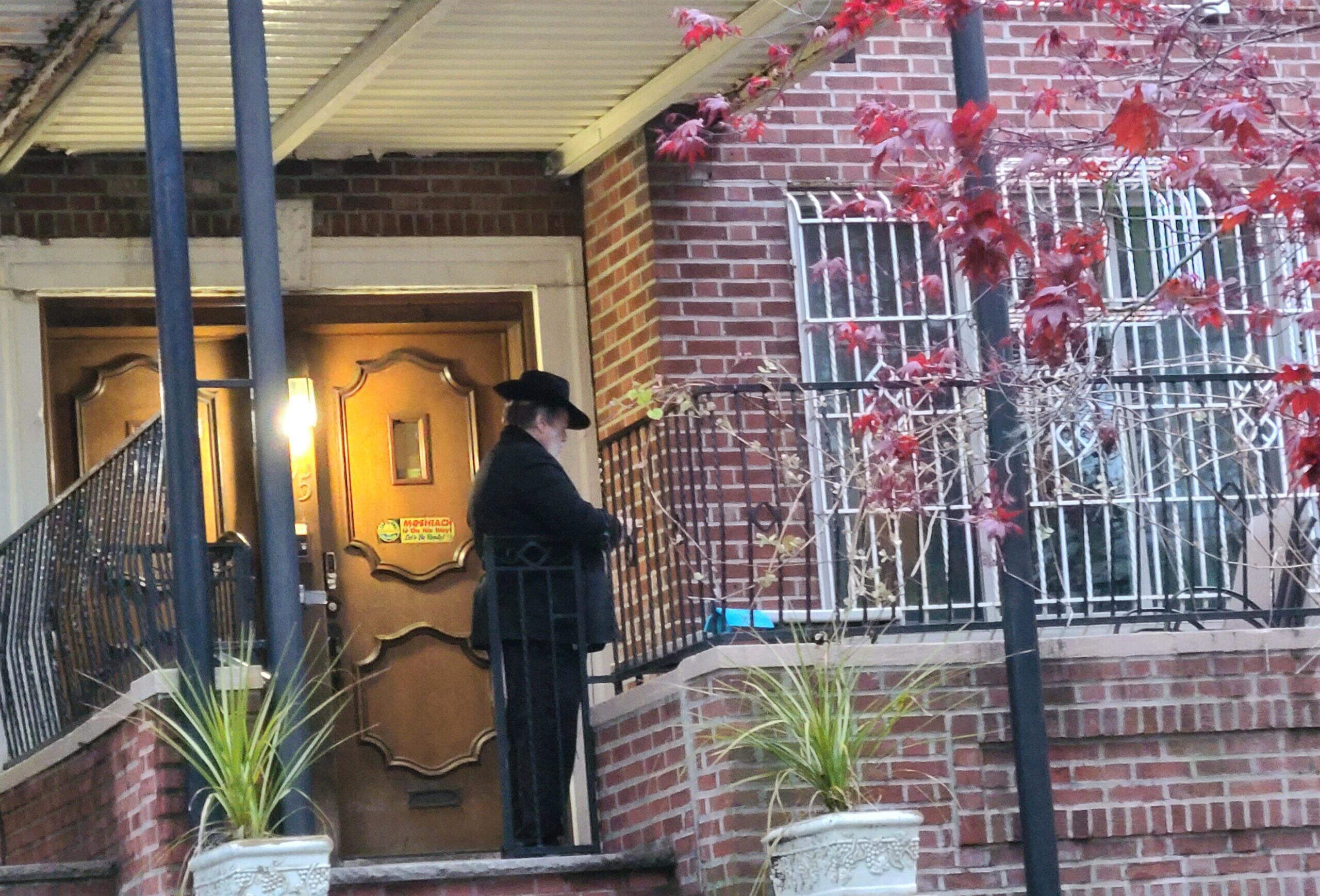
An Orthodox Jewish man in the Crown Heights neighborhood of Brooklyn, N.Y., joins a “porch minyan” on April 30. Photo by Dovid Zaklikowski.

‘A lot of things are weird’

In Crown Heights, which runs along Eastern Parkway—where on a spring day thousands might be walking—Michel says about health concerns, “I am not near people, there is social distancing, you are standing six feet away from people, and you cannot even have a conversation.”

Just before the afternoon prayer services on one street, Dr. Reuben Ingber notes that it was wonderful to have the possibility to pray from his porch with a minyan. “I don’t see anything wrong with it,” he says. “Do you want to join?”

Detective Vincent Martinos of the Crown Heights Police Department, agrees. He says the porch minyans have been fine according to the city’s ordinances. From what he has seen, people have been staying on their private property, wearing masks and keeping to social-distancing rules.

While he acknowledges some issues have occurred in the past six weeks at Chabad World Headquarters on Eastern Parkway, they were taken care of quickly. “Our community has done exceptionally well with social distancing,” he reports.

Michel says that even with the porch minyans, he is craving for more normal times, when everyone can go back to normal prayer services. He is especially looking forward to being called to the Torah, to look inside and kiss it, as is customary.

“It is weird,” offers. “A lot of things are weird today. But you have to live with the current situation.”

With Synagogues Shuttered, ‘Porch Minyans’ Grow in Brooklyn Read More »

25% of Americans Say Coronavirus Strengthened Their Faith. For Jews, It’s 7%.

A new survey found that only 7% of American Jews feel that the coronavirus crisis has strengthened their faith, as opposed to nearly a quarter of Americans as a whole.

The survey, published Thursday by the Pew Research Center, found that Jews had the lowest percentage of respondents whose faith has been strengthened by the crisis. Along with the 7% of Jews whose faith has grown stronger, 69% say their faith hasn’t changed much and 22% say they weren’t religious to begin with. A very small percentage, not represented numerically in the study, say their faith has gotten weaker.

In the United States as a whole, 24% of people say their faith has gotten stronger, 2% say it’s gotten weaker, 47% say it hasn’t changed much and 26% say they aren’t religious. The group with the largest number of respondents say their faith has gotten stronger is black Protestants, 56% of whom reported strengthening faith.

It’s possible that few Jews responded positively to the “faith” question because the question’s wording referenced “religious faith,” a terminology that tends to be less common among Jews than among Christians.

25% of Americans Say Coronavirus Strengthened Their Faith. For Jews, It’s 7%. Read More »