fbpx

April 17, 2020

ADL Condemns Release of Massachusetts Man Charged With Attempting to Firebomb Jewish Facility

Anti-Defamation League (ADL) New England Regional Director Robert Trestan issued a statement on April 16 condemning the decision to release a man who was charged with attempting to firebomb a Jewish-sponsored, assisted-living facility in Longmeadow, Mass.

The man, John Rathbun, was arrested and charged with attempted arson on April 15; prosecutors allege he was targeting Ruth’s House, located near a Jewish Community Center, a Jewish private school and three synagogues. Rathbun, 36, subsequently was released on bail.

A story posted on Masslive.com reported that federal prosecutors are appealing the decision, arguing that U.S. District Judge Mark G. Mastroianni’s decision to release the suspect “appeared to be based heavily on the COVID-19 pandemic, as opposed to established bail standards.”

The report continued: “There has been an earnest movement in this state and across the country to reduce incarceration rates in order to stem the spread of the coronavirus in prisons and county jails.”

Trestan argued that Rathbun’s release is dangerous since he’s being returned to his mother’s home, which is a five-minute drive from Ruth’s House.

“Based on the allegations, Rathbun represents a clear and present danger to the community,” he said. “Releasing this individual whose DNA-evidence was found at the scene, and who allegedly engaged in on-line platforms that included anti-Semitic and racial threats of violence, undermines the safety and security of the entire community. We fully support U.S. Attorney Andrew Lelling’s appeal and hope that the Federal Court will recognize the danger this individual poses.”

ADL CEO Jonathan Greenblatt similarly tweeted, “The attempted arson at a Jewish nursing home in MA is despicable and it is irresponsible that he was released to his mother’s home.”

Massachusetts State Sen. Eric Lesser (D-Longmeadow) tweeted that he is “in close contact with Federal, State, and local officials as well as community and spiritual leaders in Western Mass in regards to the attempted arson at Ruth’s House in Longmeadow. We cannot rest until people of all faiths and backgrounds feel safe.”

ADL Condemns Release of Massachusetts Man Charged With Attempting to Firebomb Jewish Facility Read More »

Letters: Plagues, Then and Now, 10 Best Things About a Zoom Seder

Plagues, Then and Now
It is interesting that this so-called 11th plague affects everyone. At the seders we participated in recently, we recounted the Ten Plagues meant only for our oppressors, that forced the Hebrews into slavery.

This message today may be for us to treat everyone with dignity and chesed regardless of religion, race, etc.

Remember Abraham, back in the day, greeting everyone with respect regardless of culture, etc.

Maybe it’s not a coincidence that COVID-19 arrived at this time.
Martin Hauptschein, via email 

Journal Woven Into Her Life
I was thrilled to see the wonderful photo of Tom Tugend and the story “A Long Way to Find Your Bashert” (April 10). I have followed his writing along with that of the late Marlene Adler Marks, Gene Lichtenstein, Michael Berenbaum and others.

As an intermarried woman raised in a German kosher household, I was ill at ease joining a temple in the early days. When our son was born in 1972, I, a former “Hidden Child” in France, knew that I had to raise him as a Jew. My dear husband was entirely agreeable.

First, I joined the Workman’s Circle with other rather secular members — some were former Red Diaper Babies (children whose parents were communists or sympathized with communists). It was “cool” but not enough. In 1978, we joined the fabled Temple Israel of Hollywood with the brilliant Rabbi Daniel Polish and Cantor Aviva Rosenbloom, the Jewish Joan Baez of her time. The services were warm and meaningful. Polish was the first to insist that I someday tell my story.

“But, but … Anne Frank has already done it,” I protested. He wisely said that sometimes it takes 50 years before these world-shaking events are recorded by the participants. And he added, “All great history is personal history.” I didn’t write.

Temple Israel of Hollywood was a good fit for me, but there weren’t many intermarrieds back then. I still felt like the outlier.

It was when the Journal was launched in 1986 that I could begin to sense that there was a larger “tribe” out there. That there were other intermarrieds seeking to find a connection. The Journal was the perfect fit.

I’m embarrassed to admit that after our Shabbat meals, I often read the Journal rather than go to Friday night services. When John Rosove became the head rabbi, it was another bonus because his writing began to appear in the Journal, as well.

But it was only Tugend’s fine writing that has lasted through these many years. He interviewed me in 1993 after I went to Berlin with a group of L.A. child Holocaust  survivors to meet German upstanders who wanted to learn more about the Jews who had fled Hitler’s maw.

What a pleasure it was to read Tugend’s story about finding your bashert, and to learn that he had left Berlin as well after his bar mitzvah.

One last thing: I did write my Hidden Child story, titled “Never Tell Your Name,” almost 50 years after it happened, just as Polish predicted. It was a bestseller in France.
Josie Levy Martin, Montecito

Food for Thought
The April 17 edition of the  Journal included two excellent letters under the headlines “Global Warming’s Role” and “Cruelty-Free Passover.” Our species has a millennials-long history of cruelty to animals dating back to the days of ancient Egypt and Rome.

We can all help to change this pattern by switching from a meat-based to a plant-based diet — which I did years ago. After a while, one simply loses one’s taste for meat. Please consider trying this.

Regarding global warming, the COVID-19 pandemic has had some positive consequences, including L.A.’s best clean air in many years. But if we simply go back to business as usual, then we will have squandered our chance to learn how to do things better. The only new car that anyone should buy should be electric (an EV). If you cannot afford a new EV, wait until you can or buy a used plug-in hybrid or EV. For the sake of slowing global warming, everyone, but we Jews in particular, should get off of oil because purchase of gasoline increases demand and, therefore the price of oil, thereby supporting Iran and other countries that are enemies of Israel.
Ben Zuckerman, Los Angeles

Timing Seders
My family, like many Jewish families around the world, celebrated Passover via Zoom. Usually during the holidays, most families turn away from digital screens to connect with loved ones in real life.

This posed an even more difficult challenge for my family because we are all over the world — Brazil, Israel, Australia and California — so finding an “appropriate” time that worked for everyone was pretty much impossible. My poor sister in Australia had to get her seder plate prepared at 6 a.m., whereas my aunt in Israel waited all day. We were all coming together for the first time since the coronavirus became serious and it was exciting to see everyone and have some kind of communal reunion.

The access to digital communication is a life-saver in these moments. But also not knowing when we would all be able to physically gather again made it all somewhat sad. We prayed and blessed each other and sang the Shehecheyanu.

We all made a great attempt at a very unusual seder, and that is something that I find to be so beautiful about Jewish tradition and culture — the continued trial of placing ritual and communion at the center of life in a world that is constantly changing — even when it is scary and confusing and you’re up at 6 a.m. eating bitter herbs!

I think about my ancestors who had to practice their rituals in hiding, my ancestors that had to run for freedom, all while maintaining their rituals and traditions. Judaism is a practice of adaptation and resilience — and what a time to be meditating on those two words.
Seder 2020 schedule: 5 p.m. — São Paulo; 6 a.m. — Melbourne; 11 p.m. — Tel Aviv; 1 p.m. — Los Angeles
Camila Sobral, via email 

10 Best Things About a Zoom Seder
1. Out-of-town family and friends can participate.
2. No need to polish silver.
3. No need to borrow dishes, silverware or extra chairs.
4. You have to get dressed only from the waist up.
5. You have to cook for less people.
6. No stressing over seating arrangements.
7. You don’t have to remember all the relatives’ names.
8. You can mute yourself (and make whatever comments you want.)
9. When the evening is done, you’re already home.
10. There is room at the seder table for everybody.
Jan Berlfein Burns, Los Angeles

Matzo Expiration Date
We contacted all the stores and they were all out of matzo. But my wife found some that had been on the back of a shelf for years. It was marked, “Sell by June 21, 3014.”
David Mamet, via email

CORRECTION

An incorrect photo of Dr. Lakshmy Menon ran on page 32 of the April 3 edition of the Journal.

Letters: Plagues, Then and Now, 10 Best Things About a Zoom Seder Read More »

Sefirat Ha-Omer: Making it Count!

“You shall count from the second day of Passover, when an Omer of grain is to be brought as an offering, seven complete weeks. The day after the seventh week of your counting will make fifty days.” — Leviticus 23:15-16

Counting the Omer refers to the biblical commandment to celebrate the new barley harvest by numbering and counting seven-times-seven evenings from Passover to the subsequent pilgrimage festival of Shavuot, which occurs on the evening after the Omer counting is complete. Forty-nine nights, counting each successive evening in a unique fashion (calling out first the number of days, then the number of weeks and days), we and our ancestors chip away at the long, slow, endless procession of days and nights leading from our leaving Egypt until our arrival at Mount Sinai according to one level of meaning, at the delivery of the barley harvest to the Temple in Jerusalem on another.

And we, too, in this age of self-quarantine, sheltering at home during this lengthy pandemic, we also are biding our time, counting our nights, hoping that this journey through the coronavirus will lead to a liberation, an emergence into freedom, community, and to breathing easy again.

Can we use this time of isolation to prepare for the great celebration that awaits us at its conclusion?

Maybe this is the year to take up the practice of counting the Omer (sefirat ha-Omer) if it is new to you. For those who have been observing this mitzvah in the past, this year can offer a deeper, additional layer of significance in the light of our current isolation.

We, like our ancestors, are on a journey that makes demands of us: to exhibit care for one  another, solidarity with our traditions and one another, responsiveness to what is right and proper behavior. Can we use this time of isolation to prepare for the great celebration that awaits us at its conclusion?

What if we think of this period of seclusion as sheltering in a grand, cosmic cocoon? Just as the caterpillar shelters in a self-built container in order to emerge over time as a radiant and  beautiful flying creature, so we can act now so that we emerge at the end better, more resilient, ready to soar in a new way.

Have we been too busy, too social to fashion our diet to reflect more healthy choices? Maybe this can be a focus of this time in the cocoon of sheltering? Has life made regular exercise impossible? Could this more settled time offer opportunities for calisthenics and walks previously postponed? Good books we’ve intended to read (or write?) Audio classes to savor? Time with a loved one (face to face or online)? A chance to learn with a hevruta (study partner)? Dipping into meditation? Leaning into prayer?

Since we have to endure this period of day-after-day seclusion, let’s rethink it also as an opportunity to live mindfully, with intention.

Just as the ancient mitzvah of counting the Omer provides a framework for marking our progress from Exodus to Revelation, so too our time sheltering in place can provide an opportunity for mindful growth, undertaken in a spirit of possibility and hope.

Tomorrow will come. We will survive this pandemic. We will emerge into the light of community and life once more.

Let’s make the choices now that will make that re-entry more satisfying, more reflective of our best values and our truest selves.

Let’s make the days count!


Rabbi Bradley Shavit Artson holds the Abner and Roslyn Goldstine Dean’s Chair of the Ziegler School of Rabbinic Studies and is vice president of American Jewish University in Los Angeles.

Sefirat Ha-Omer: Making it Count! Read More »

On Israel’s 72nd Birthday, We Must Fight For The Two State Solution

This is not a season that invites calm reflection. Too much is in play. The agenda is crowded with controversy. New possibilities tantalize but have yet to come into focus. We are inundated with talk of “competing narratives” alongside the growing controversies over quarantine, democracy, annexation, land, peace, income disparities and ethnic disparities.

It’s easy to get lost in these issues and they have become so much the focus of not only the daily news but of Israel’s story itself that the disposition to celebrate has come to feel insensitive, requiring an apology. But a celebration that must be shrink-wrapped in an apology is no celebration at all.

What then to do? The moment you cast caution aside and start listing the achievements, you bump into checkpoints. Say that Israel has fulfilled its destiny as a Jewish haven, and you will be told that it has done so only at the expense of the Other. Say that Israel’s economy has developed, and you will be told it’s because of foreign subsidies and at the cost of a tremendous income gap. Say that brainpower has emerged as Israel’s most important resource, and you will be told about the decline in Israel’s education system. Say that Israel has no partner for peace and you will be told to look at yourself in the mirror.

The moment you cast caution aside and start listing the achievements, you bump into checkpoints. Say that Israel has fulfilled its destiny as a Jewish haven, and you will be told that it has done so only at the expense of the Other.

All of this is against a growing background of spreading disenchantment now infecting large segments of opinion — so much so that “disenchantment” may be too tame a word. On college campuses, the moment anybody identifies as a Zionist, often they are classified as fascists and/or racists. Their eligibility to participate in an informed conversation regarding the Israel-Palestine conflict is not merely called into question but summarily rejected.

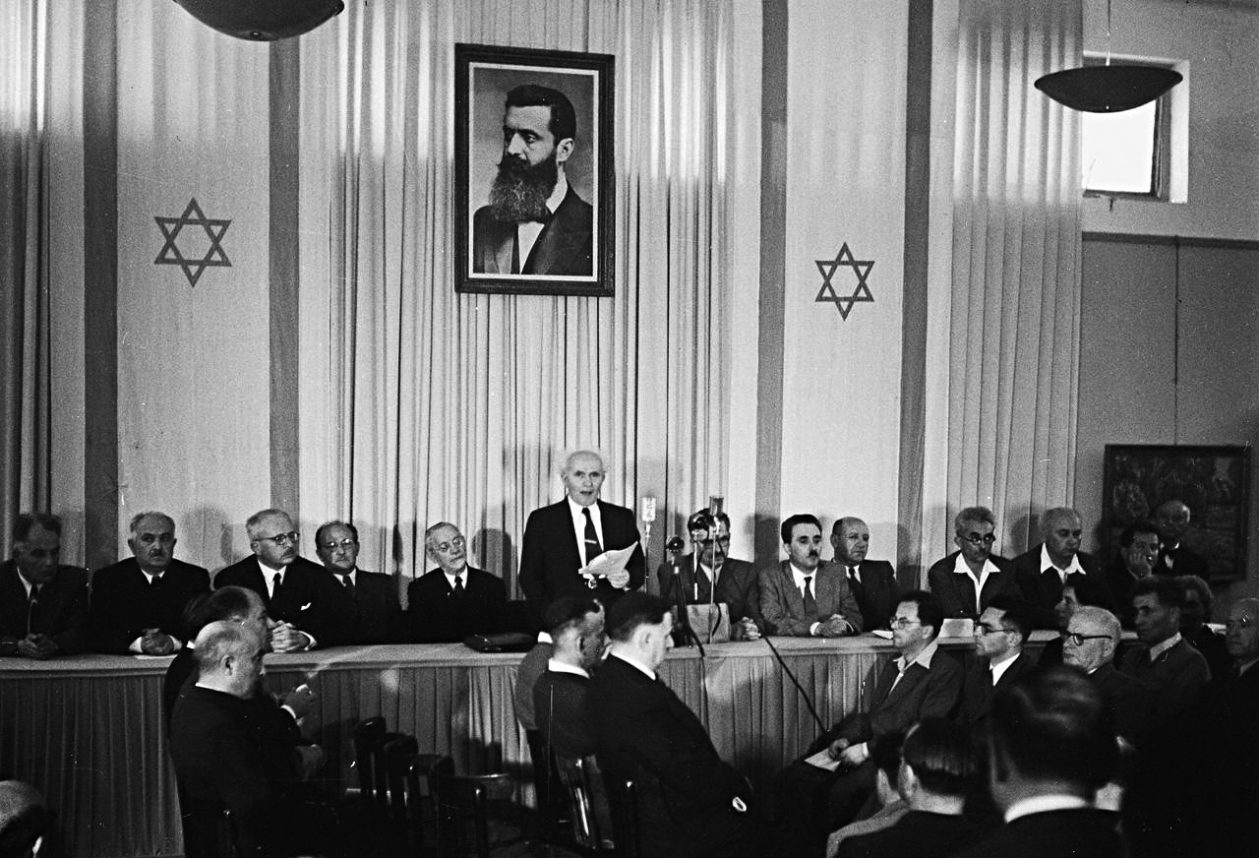
The 1948 signing of Israel’s Declaration of Independence in Tel Aviv. Photo from Wikimedia

Zionism has become “The Issue” — meaning that the very idea of a Jewish state has become the issue. In some quarters, that issue has become non-debatable. It is taken as axiomatic that endorsement of a Jewish state is illiberal, that “liberal Zionism” is an oxymoron, that the most liberal Zionist is, for all practical purposes, no different from the most retrograde neocon. In other quarters, the attack is less frontal, more nibbling. We may speak all we like about the need for Zionism. Such talk is greeted with profound skepticism. If the conversation is calm, we may be indulged in our efforts at justifying our beliefs. But that is more because the people we’re talking with are polite, not because we are persuasive.

It is taken as axiomatic that endorsement of a Jewish state is illiberal, that “liberal Zionism” is an oxymoron, that the most liberal Zionist is, for all practical purposes, no different from the most retrograde neocon.

We thought the battle for the legitimacy of a Jewish nation-state had long since been resolved. We believed that the Holocaust resolved it morally, that the United Nations Partition Plan for Palestine resolved it legally, that the existence and perseverance of the Jewish state resolved it existentially. Israel, we imagined, was no longer a question; it was now and forever an answer. We were evidently mistaken. The question lingers.

The idea of the Jewish state is a complicated one because the word “Jewish” designates both a religious and an ethnocultural identity, and the two aren’t readily separable.

Israel, we imagined, was no longer a question; it was now and forever an answer. We were evidently mistaken.

Many Jews have little devotion to Judaism as a religion. Many who consider themselves secular have at least vestigial ties to Jewish religious customs, ceremonies and language. You can’t have an intelligent conversation about Jewish culture that doesn’t include and, even in some measure, embrace Jewish theological understandings.

But the moment you accept that, you raise all kinds of red flags around the urge for Jewish national expression. Being an advocate of a Jewish nation-state is simply not the same as being an advocate of a Norwegian state. Norway for the Norwegians, Israel for the Jews? There are some similarities between Norway and Israel — historic trauma and cultural tenacity, among others. But haven’t the Norwegians always been in Norway? The establishment in 1905 of the Norway we know (separated in that year from Sweden) wasn’t followed by any “ingathering” of exiles; no great movement encouraging aliyah from Minnesota. There always have been Jews in Palestine/Israel. But the vast majority, in all the years of the Jewish exile, were elsewhere; not so the Norwegians.

SHADMOT MEHOLA, WEST BANK – JANUARY 28: An Israeli flag flies in a Jordan Valley Jewish settlement on January 28, 2020 in Shadmot Mehola, West Bank. U.S. President Donald Trump says he’s offering the “deal of the century” to revive a peace process between Israel and Palestinians. Palestinian authorities have boycotted negotiations with the Trump administration over what they see as its pro-Israel agenda. (Photo by Lior Mizrahi/Getty Images)

And that may offer a rationale for Zionism. Zionism is essentially a program of return and reunion. The separation of the people from the place was by force, the ties of the people to the place remained lively and then became urgent, and so it happened. Return could not have been to Oswego, N.Y., or Uruguay; return meant Palestine. Reunion did not mean a weekend retreat; it meant for life. And yes, Palestine was neither barren of others nor without claims by others. Those claims were valid but not necessarily competing. Indeed, along the way, there have been diverse programs to render them not merely compatible but mutually beneficial.

But sovereignty? A state? Why?

A simple thought-experiment, based on the assumption that the claims to presence-by-right of both peoples are of comparable validity: Under which sovereignty is there the best chance that the claim of the Other will be respected along with one’s own claim?

NEW YORK, NEW YORK – FEBRUARY 11: Palestinian President Mahmoud Abbas holds up a Vision for Peace map while speaking at the United Nations (UN) Security Council on February 11, 2020 in New York City. Abbas used the world body to denounce the US peace plan between Israel and Palestine. Donald Trump’s proposal for Israeli-Palestinian peace, which was released on January 28, has been met with universal Palestinian opposition. (Photo by Spencer Platt/Getty Images)

The true answer is neither. The true answer, as it has been pretty much since the Jews of the modern period began to act on their claim, is not the Palestinians. There is simply no indication, nor has there ever been, that in a Palestine under their sovereignty they’d have accepted the Jewish return. And whether the Jews intended the creation of the Arab refugee problem or that problem was the unintended consequence of war, it is clear today that under Jewish sovereignty the right of Palestinian Arab return will not be respected.

Accordingly, two states for two peoples. It is not land for peace per se but peace for the sake of life that prompts that solution. There is shame enough to go around, shame for what has happened to both peoples, shame for their own errors and misdeeds. Two states for the sake of peace. Peace for an end to shame. The maximalist dreams of some on both sides cannot be reconciled. Hence both sides must have their own distinctive sovereignty. The ultimate irony is the majority on both sides have come to understand and accept this.

That is all one needs to know. All the rest is not, “commentary.” All the rest is drivel. All the rest is a deadly postponement.

Two states for two people is the only respectful way of getting past the current sorrow, the ongoing distortion, the death and the dying of dreams and of people.

This is the 72nd anniversary of Israel’s independence, Yom HaAtzmaut. May the celebration of the 73rd be attended by growing recognition, not only on both sides but by those who have given up caring or have chosen to be deaf to the Other. The Jewish Other or the Palestinian Other. By all those who believe in the squaring of circles. By those who fantasize that in a one-state solution, two sets of rights that have come to be seen as mutually exclusive can be accommodated. That two states for two people is the only respectful way of getting past the current sorrow, the ongoing distortion, the death and the dying of dreams and of people.


Mark Bilsky is the deputy CEO of Americans for Peace Now.

On Israel’s 72nd Birthday, We Must Fight For The Two State Solution Read More »

COGAT Tells PA to Rescind ‘Slanderous Remarks’ Accusing Israel of Spreading Coronavirus to Palestinians

Coordinator of Government Activities in the Territories (COGAT) Maj. Gen. Kamil Abu Rukun called on the Palestinian Authority (PA) to rescind statements accusing Israel of intentionally spreading COVID-19 to Palestinians.

The Jerusalem Post reported that Abu Rukun said in an April 17 statement, “In recent weeks we have witnessed, and experienced, a variety of baseless complaints from senior figures in the Palestinian Authority, extending even to misleading and slanderous remarks against the IDF (Israel Defense Forces), the security establishment, the State of Israel, and the Israeli public.”

Recent remarks from Palestinian leaders include Prime Minister Mohammad Shtayyeh alleging that Israeli soldiers are spreading the virus by planting it on car handles. PA spokesperson Ibrahim Milhem also recently accused Israelis of being “agents of this pandemic,” stating that Israel is “throwing infected workers at the side of the road. Is this assistance? They come and arrest and spit in the streets. Is this assistance?”

Abu Rukun said, “We see those remarks and accusations as crossing a red line and disparaging the enormous efforts that Israel is making in the face of the shared challenge and crisis besetting the entire region. I call upon the Palestinian leadership to retract its baseless declarations.”

He added “that there could be repercussions in various spheres.”

The PA did acknowledge on March 17 that it had formed a joint operations room with Israel to fight COVID-19. COGAT also delivered 3,000 test kits and 50,000 masks from the World Health Organization (WHO) to the PA on March 25.

Additionally, the Post reported on April 16 that the Israeli government is providing a loan to the PA help it combat the virus; the amount of the loan was not publicly disclosed.

“It is our fundamental obligation in order to ensure the safety of all our peoples,” Israeli President Reuven Rivlin said. “This disease shows again and again that it does not recognize borders and that only through dialogue and sharing resources can we fight it.”

The Simon Wiesenthal Center tweeted, “World knows #Israel will come through to help #Palestinians. Too bad, Palestinians couldn’t rely on their own leaders to put their people, not hate first!”

COGAT Tells PA to Rescind ‘Slanderous Remarks’ Accusing Israel of Spreading Coronavirus to Palestinians Read More »

This Holocaust Remembrance Day, We Must Remember Hate Spreads Faster Than COVID-19

On this Holocaust Day of Remembrance, which falls on the 75th anniversary of liberation, I’d like to talk about my father. Mendek Rubin was a brilliant inventor, a wise and kind man who survived three torturous years as a slave laborer in seven Nazi concentration camps.

Born in the small town of Jaworzno, Poland, in 1924, he grew up during terrifying times, as fierce anti-Semitism generated in Germany fanned the flames of hatred in surrounding countries. After watching their gentle, sensitive 17-year-old son — my father — taken away by German soldiers, my grandparents soon were deported to Auschwitz, where they were killed, along with three of my father’s sisters and his brother.

Myra Goodman and Mendek Rubin
Family photo courtesy of Myra Rubin
Photographer Ruth Rubin-Harmer

When I was young, my parents never spoke about what had happened to them, although clues were everywhere. A profound sadness and an aura of secrecy permeated our house. My mother had a string of numbers tattooed in blue ink on the soft skin above her wrist, but no one ever told me what it meant. My Aunt Bronia also had numbers tattooed on her arm, and for a long time, I thought she was my father’s only sibling. The aura of sadness and secrecy felt even thicker at her house.

My parents remained silent because the pain was too overwhelming to face, and because they’d grown accustomed to mimicking the silence of the world around them as their families were being annihilated. My mother now is 91, and still insists no one cares. She is not surprised that two-thirds of millennials don’t even know what Auschwitz was.

My Aunt Bronia remained silent about the Holocaust for 50 years, but now, her life goal is to share her story with the world, yet she still censors the truth because the intimate details of torture and humiliation she and her sisters endured are more than most want to hear.

“We are all connected by love, and our heart as our center of gravity is always our truest and most helpful guide.” — Mendek Rubin

After my father died, I found an unfinished manuscript he’d written that spelled out his observations of the human race. He saw how much of humankind’s unbroken cycle of suffering comes from our identification with the ways we are different — a German, a Jew, a gypsy — mostly destructive illusions created by a continuous cycle of conditioning.

Photo from Wikipedia

My father observed how virulently contagious and hazardous these ideas can be. “The power of beliefs to create good and evil should never be underestimated,” he wrote. “Our beliefs become weapons we aim at other people and at ourselves. A threat to them can feel like a threat to our very lives. Just observe the willingness of so many people to blindly offer their lives in service of their beliefs. … Our demons are as old as history, and our inner world has hardly changed over the past centuries. … We are no closer to true insights about how to deal with the dark side of our nature.”

Now, we are contending with the dangerous coronavirus that does not differentiate by nationality, race, ethnicity or religion. It is spreading illness and death as well as fear, confusion, despair and isolation. We are all in this together, yet once again, we see hate rising — this time, against Asian Americans as some among us search for a scapegoat. We see the effects of the long history of racial injustice in the tragically high death rates of African Americans.

 We are all in this together, yet once again, we see hate rising — this time, against Asian Americans as some among us search for a scapegoat. We see the effects of the long history of racial injustice in the tragically high death rates of African Americans.

My father believed we are all children of a benevolent cosmos. “At the core of our being,” he wrote, “each of us is the divine individualized. We are all connected by love, and our heart as our center of gravity is always our truest and most helpful guide.”

Mendek would see this pandemic as a unique opportunity to recognize our interdependence and common humanity. On this Holocaust Day of Remembrance, let us come together with open hearts to journey toward a better tomorrow.


Myra Goodman is co-author with her late father, Mendek Rubin, of the recently released memoir “Quest for Eternal Sunshine: A Holocaust Survivor’s Journey From Darkness to Light.” She is the author of three cookbooks and co-founder of Earthbound Farm, the largest grower of organic produce in the world.

This Holocaust Remembrance Day, We Must Remember Hate Spreads Faster Than COVID-19 Read More »

How to Strengthen Relationships During the coronavirus pandemic

Whether you are living together with your significant other, or married, the coronavirus pandemic can put a strain on even the best of relationships. If your relationship had been tenuous before the crisis, the stress humanity is under at this given time in history can cause even further friction in your relationship and accelerate the pace to a separation or divorce. Many couples have already decided to split but cannot do so until the crisis ends either because of financial reasons or practical ones due to the quarantine.

Here are some tools to help you and your partner navigate living together through the crisis:

  1. Don’t make any rash or spontaneous decisions right now. None of us know how long this will last and you may regret it when normalcy returns. For those of you who started the divorce process, this is a good time for you to pause and reflect if divorce is really what you want.
  2. Listen and communicate to your partner. If possible, set aside a time each day when you can each express any feelings you have. It may be the fear of contacting the virus or concerns you have about your finances or children. Be sensitive and empathetic to each other’s feelings.
  3. Divide responsibilities whether taking care of the children, doing housework or paying bills so they are more balanced while you are both at home and one party is not harboring resentment against the other for doing what he or she perceives as more than the other.
  4. Give each other space. Whether living together in a small apartment or a large house, designate a space for each to be in and the hours he or she will be in that space. For example, one may work in the study or bedroom and the other in the kitchen.
  5. Take breaks when needed. Go for a walk, read, listen to music, take an online class, do a puzzle, meditate, play a game or watch a television show. There are endless possibilities.
  6. Limit your intake of the news online and on television. It will escalate your anxiety levels with all the bad news being reported.
  7. If you’ve already made a definitive decision to separate after the crisis, use this time to plan your future after the crisis. Will you each get your own attorney, hire a mediator or do your own divorce? How will you divide the property and debts? What will be the custody arrangements for the children? Who will stay in the house? The more you can do before you hire professionals, the more cost effective it will be later.
  8. If you cannot get along or work together during this time, or need imminent help, consider having an online session with a therapist or family law mediator to work out pressing issues that arise. If you need help dealing with your children’s emotional needs or how to break the news of your impending separation, consult a child psychologist or therapist.
  9. This is temporary. Remind yourself that this crisis will pass and you can move forward with your plans to separate or divorce when it is over.

Deborah L. Graboff, Esq. is a family law attorney and mediator with the Law Offices of Rosaline L. Zukerman. Her practice includes negotiating and drafting cohabitation, prenuptial and postnuptial agreements and helping couples resolve their support, custody and financial issues. She is on the board of the Jewish Federation of Los Angeles where she co-chairs the Legal Network and Community Leadership Institute.

How to Strengthen Relationships During the coronavirus pandemic Read More »

‘HoloCoin’ Cryptocurrency Offers Users to Buy/Sell Ashes of Jews Burnt in Holocaust

An anti-Semitic website that is now shut down offered users the opportunity to trade a cryptocurrency called the “HoloCoin,” a reference to the Holocaust, in which Jews and the ashes of Jews burnt can be purchased or sold.

TheHolocoin.net, which was purchased on April 2 and registered with the website-building platform SquareSpace, is no longer accessible. However, the valueless virtual currency is still being traded on trading platforms such as ForkDelta.

StopAntisemitism.org was one of the first to draw attention to the anti-Semitic cryptocurrency.

“This has to be one of the most vile and atrocious anti-Semitic incidents we have yet to come across,” Liora Rez, executive director of StopAntiSemitism.org, told JNS. “For someone to erect and orchestrate a plan where they can buy the ashes of dead Jews as currency on a trading platform clearly shows the blatant hatred of Jews that exists in society today.”

Holocoin.net offered two currencies—“JEWS” and “ASH”—and its founders are online users that go by the usernames “Smaug Hitler” and “30YearOldHimmler.” The virtual currency is being promoted as an “ERC-20” token, which means it is designed for use on the Ethereum platform, an open-source blockchain-based distributed computing platform, and may be transferred to a cryptowallet.

The cryptocurrency quickly found its way onto online forums and social-media sites.

page on the website Reddit that promotes HoloCoin describes it as “a cryptocurrency that recreates the Holocaust” and says that “15,300,000 JEWS were created, the team is airdropping JEWS and [it] is up to you if you wanna save them or let them burn.”

A thread on the site 4chan discussing the “HoloCoin.” Source: Screenshot via StopAntisemitism.org.

A thread on the website 4chan about the HoloCoin discusses those who purchased the cryptocurrency, saying, “Thank you to everybody who signed up and received your initial shipment of 500 JEWS. While initial shipments have ended, any wallet that registers according to instructions on TheHoloCoin.net will receive 50 JEWS every other week. JEWS may be purchased anytime.”

The message continued saying, “Any JEWS neither airdropped nor purchased will continue to burn at the rate of 4,107 per day—the rate at which 6 million are burned in four years. Thank you goyim for saving JEWS. Please continue to save JEWS, before they are burned and turned to ASH.”

The 4chan thread also features the cryptocurrency’s emblem: a large circle with “Remember The 6 Million” around its border with a large blue Star of David in the center, along with the letters “HC.” The banner photo for HoloCoin’s Twitter page has a Star of David that says “ash” around it, with a shadow in the background of the Pepe the Frog meme.

‘HoloCoin’ Cryptocurrency Offers Users to Buy/Sell Ashes of Jews Burnt in Holocaust Read More »

U.N. Rapporteur ‘Extremely Concerned’ About Rising Anti-Semitism During Coronavirus Pandemic

United Nations Special Rapporteur on Freedom of Religion or Belief Ahmed Shaheed issued a statement on April 17 saying that he was concerned about the rise of anti-Semitism during the COVID-19 pandemic.

Shaheed said, “I am extremely concerned to see that certain religious leaders and politicians continue to exploit the challenging times during this pandemic to spread hatred against Jews and other minorities. We must collectively reject anti-Semitism and other forms of intolerance and discrimination now.”

Anti-Semitic rhetoric regarding COVID-19 generally centers around the notion that Jews created the virus as a weapon to take over the world, Shaheed said.

He urged governments worldwide to work with the Jewish community to crack down on anti-Semitism.

“It is necessary to invest in preventive security measures and enact appropriate hate crime legislation,” Shaheed said. “I also reiterate my call … for endorsement by States of the Working Definition on Anti-Semitism and for its use in compliance with international human rights law.”

Shaheed also urged tech companies to police hate speech on their platforms, saying that “they must remove any posts that incite to hatred or violence in addition to identifying and reporting fake news.”

He concluded: “At this deeply challenging time, ensuring that all individuals are able to exercise their right to freedom of religion or belief without fear and to the greatest extent feasible while safeguarding public health is more essential than ever.”

The American Jewish Committee (AJC) tweeted praise for Shaheed’s statement.

A prominent UN expert has sounded the alarm that rising #antisemitism during the pandemic threatens the human rights and religious freedom of Jews and other minorities,” they wrote. “We welcome the statement by @ahmedshaheed calling for urgent action to combat hate.”

On Sept. 20, Shaheed published the first-ever U.N. report detailing the rising anti-Semitism globally.

“In some cases, individuals expressing such views have engaged in Holocaust denial; in others, they have conflated Zionism, the self-determination movement of the Jewish people, with racism; claimed Israel does not have a right to exist; and accused those expressing concern over anti-Semitism as acting in bad faith,” the report stated.

The report warned of white supremacist rhetoric metastasizing online and noted that some view the boycott, divestment and sanctions (BDS) movement as anti-Semitic, although the report highlights defenders of BDS and expresses opposition to anti-BDS laws. The report called for nations to adopt the International Holocaust Remembrance Alliance (IHRA) definition of anti-Semitism, which states that the demonization of Israel is anti-Semitic.

The Anti-Defamation League praised the report at the time, tweeting: “Thank you @ahmedshaheed for making clear how anti-Jewish sentiment and actions are a ‘serious obstacle to the enjoyment of the right to freedom of religion or belief.’ ”

U.N. Rapporteur ‘Extremely Concerned’ About Rising Anti-Semitism During Coronavirus Pandemic Read More »

david suissa podcast curious times

Pandemic Times Episode 21: Is the economic virus even worse?

New David Suissa Podcast Every Morning at 11am.

A candid reflection on the economic crisis gripping America, with 22 million jobs lost in the past month.

How do we manage our lives during the Coronavirus crisis? How do we keep our sanity? How do we use this quarantine to bring out the best in ourselves? Tune in every day and share your stories with podcast@jewishjournal.com.

Pandemic Times Episode 21: Is the economic virus even worse? Read More »