fbpx

March 14, 2020

ADL Publishes Guide on Anti-Semitic Tropes for Candidates and Congress

The Anti-Defamation League shared a new guide to contemporary anti-Semitism with Congress members and candidates running for national office in 2020.

Antisemitism Uncovered: A Guide to Old Myths in a New Era” examines “some of the most stubborn tropes about Jews, explains why they are dangerous, provides the backstory behind the myths and shows how they have evolved into the present day,” the ADL said in a statement.

The guide, distributed this week, explains the history of anti-Semitism and definitions of seven of the most common anti-Semitic tropes that have endured through the ages: myths about power, loyalty, greed, deicide, the blood libel, Holocaust denialism and the newest form of anti-Semitism, anti-Zionism and the delegitimization of Israel.

“We hope this guide will educate people, particularly those who influence the public debate, about what is, and what is not, anti-Semitism and why,” said ADL CEO and national director Jonathan Greenblatt. “This will help prevent the greater normalization of anti-Semitism and prevent extremists from seeing a green light to act on such hatred.”

Added Greenblatt: “As violence against Jews is already at historic levels, we call on all public leaders, particularly during this heated political season, to avoid invoking anti-Semitic tropes. The tropes this guide explains are the roots of anti-Semitism and have led to violence against Jewish communities around the world over centuries. Today, they are still modern drivers of anti-Semitic violence, finding voice in the tweets and public statements of elected officials, or resonating with the extremists who carried out violent attacks against Jews in Pittsburgh, Poway and Jersey City.”

ADL Publishes Guide on Anti-Semitic Tropes for Candidates and Congress Read More »

Jewish Organizations Rally Behind Italian Jews in Wake of Shutdown Due to Virus

Amid the ongoing coronavirus crisis in Italy, which has brought the country to a virtual standstill, prominent Jewish organizations continue to engage the Jewish community there.

Chairman of the Jewish Agency Isaac Herzog and chairman of Keren Hayesod Sam Grundwerg met on Thursday with the prominent Jewish leaders in Rome and Milan to voice their solidarity with those affected, a press release stated.

“The community leaders described the challenges and threats they are facing, and their immediate needs,” the statement read. “Coronavirus (COVID-19) has impacted the entire world. Italy, which is currently on lockdown, has been particularly hit hard and is experiencing a death toll of hundreds of people,” said the Jewish Agency.

The president of Rome’s Jewish community, Ruth Durgello, said the community is worried, but sounded an upbeat note: “We are a proud and ancient community in the midst of the worst situation we have faced since World War II,” she said. “We are in a state of complete uncertainty. We are trying to stabilize the situation but there is tremendous anxiety here about the danger of a complete collapse. General morale is very low. We know there is light at the end of the tunnel, but we don’t know how long the tunnel is.”

With a population of some 15,000, Rome is home to the oldest Jewish community in the world.

President of Milan’s Jewish community, Milo Hasbani, added: “Our schools and nursing homes have been shut for three weeks. We are organizing various support channels to help community members, especially elderly people who are in quarantine and can’t go food shopping. We are setting up distance learning for the children, investing in disinfectants and preparing the community’s security team for any scenario.”

“Expressing solidarity with Jews around the world and Italian Jewry in particular, Herzog and Grundwerg penned a letter (attached) stating that ‘All of Israel is responsible for one another,’ and that the organizations are teaming up to pledge their support during this difficult time,” the Jewish Agency said in a statement.

Herzog later said that he “had emotional conversations with the leaders of the Jewish communities of Italy, which are small and comprised of a relatively large number of elderly people who are encountering a challenge the likes of which they have not faced since the Holocaust.”

He added: “We have set up a special team to immediately analyze their most urgent needs, and together with Keren Hayesod we will work to help the community as quickly as possible. I urge our parallel Jewish organizations and Jewish communities worldwide to mobilize, given the extent of the need.”

The Jewish Agency further said that it was “working on assisting the community on three levels to meet their needs: assisting nursing homes; setting up distance-learning infrastructure for children and teachers who are quarantined; and helping the communities set up a hotline to help those in quarantine.”

A special team led by Shay Felber, director of the Jewish Agency’s Unit for Aliyah, Absorption and Special Operations, and Alex Kerner, Karen Hayesod’s emissary in Italy, will focus on provisions.

“It is always comforting to know that Israel is with us,” said Hasbani, “and especially the Jewish Agency and the assistance it provides.”

Jewish Organizations Rally Behind Italian Jews in Wake of Shutdown Due to Virus Read More »

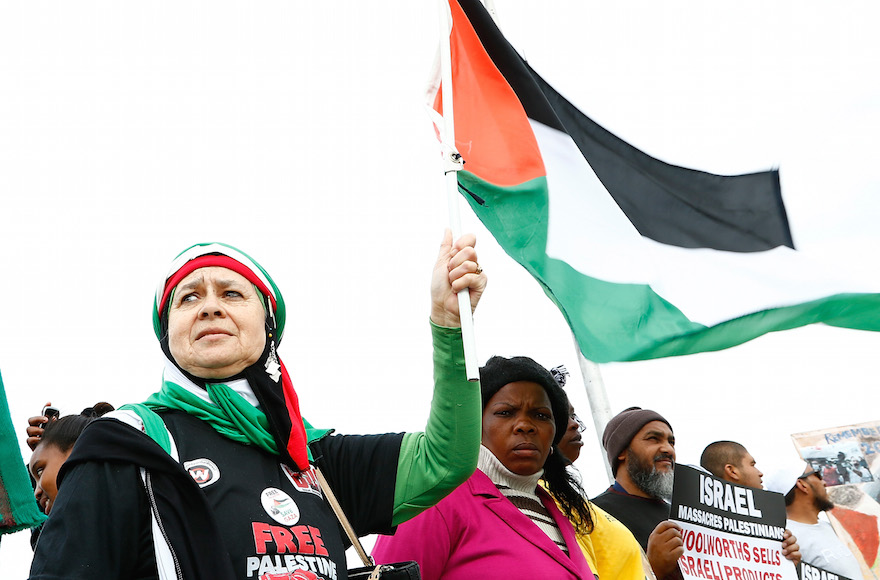
How BDS Has Taken A Foothold in Africa

The BDS movement, whose goal is for rest of the world to quarantine the State of Israel as though it was the coronavirus, is undergoing a “rebranding” in its South African heartland.

Last week, BDS South Africa—an NGO that enjoys significant influence within the ruling African National Congress—announced that it was adopting a new name, a new logo and a new(ish) mission. Henceforward, the group will be known as “Africa for Palestine.” Its understanding of what constitutes “Palestine” is displayed in its logo, which shows a Palestinian keffiyeh carefully folded into a map of the entire territory between the Mediterranean Sea and the River Jordan.

What’s with the organization’s redefined mission? According to a statement last week from BDS South Africa, the newly branded group—whose acronym, AFP, is suspiciously similar to that of Africans for Peace, a local grassroots group that is firmly opposed to the boycott of Israel—“will seek to build alliances and partnerships across the continent, reinforce direct support to Palestine and assist the Palestinian Diaspora.” The main means of achieving this is through “pushing back against Israel’s creeping infiltration into our continent.”

Leaving aside the “creeping” medieval echoes of this latter statement, one is struck by the sheer resentment underlying it. After the Jewish state developed close economic and political ties during the 1950s with African nations newly liberated from the shackles of European colonialism, Arab pressure forced Israel out of the continent for several decades. During this century, however, a combination of creative Israeli diplomacy, cutting-edge Israeli technology and development expertise, and a new determination among African leaders to set relations with Israel on their own terms (as opposed to those of pan-Arab or pan-Islamic organizations) have brought that period of isolation to a decisive end. The Israeli presence has mushroomed across the continent, and Jerusalem now has full diplomatic relations with 41 of the 44 sub-Saharan states.

Though the organization would never admit it, BDS South Africa/Africa for Palestine increasingly looks like a relic desperately pushing back against another “wind of change” sweeping the continent. Where Israel offers technology and material assistance from clean-water supplies to AIDS prevention, from post-natal clinics to higher education, the local allies of the Palestinian cause offer ideology—and nothing more.

But for the leaders of the BDS campaign in South Africa, ideology is all that matters. In a speech to the Islamist-backed “Palestine Expo” in London last July, Nkosi Zwelivelile Mandela—a South African parliamentarian and a leader of BDS South Africa—railed against Israel as the embodiment of “neo-imperialism.” He went on to quote an article written for the Egyptian press in 1964 by Malcolm X, which argued that the “ever-scheming European imperialists wisely placed Israel where she could geographically divide the Arab world, infiltrate and sow the seed of dissension among African leaders and also divide the Africans against the Asians.” Quite the global conspiracy, then.

In case there was any doubt about how the BDS movement views Israel’s legitimacy—there are still some people out there who think its purpose is to end only the Israeli “occupation” begun in 1967—here is how Nkosi Mandela put it. As Israel’s main supporter, the United States would never, he told his London audience, “recognize the view that the cause of the conflict dates back to 1948 with the creation of Israel (rather than Israel’s views of 1967 being the crucial point and the return of occupied territories being central to peace negotiations), and that the conflict has been a fight to bring home refugees to a Palestinian state.” In other words, this is a zero-sum game: If you are for Palestine, you must be against Israel.

It won’t have escaped notice that Nkosi Mandela shares the same name as—and is the grandson of—the late South African President Nelson Mandela. Nkosi Mandela regularly invokes his grandfather’s legacy in his bombastic speeches about the Palestinians, and dishonestly so. For while there is no dispute that Nelson Mandela was a supporter of Palestinian independence and an ally of the late PLO head Yasser Arafat, he was not—in marked contrast to his grandson—an eliminationist, but an advocate of two states side by side.

As I wrote in this column in 2013, on the occasion of Nelson Mandela’s passing, “Mandela’s memoirs are full of positive references to Jews and even Israel. He recalls that he learned about guerilla warfare not from Fidel Castro, but from Arthur Goldreich, a South African Jew who fought with the Palmach during Israel’s War of Independence. He relates the anecdote that the only airline willing to fly his friend, Walter Sisulu, to Europe without a passport was Israel’s own El Al. And the ultimate smoking gun—the equation of Israel’s democracy with apartheid—doesn’t exist.”

BDS South Africa’s shameful misrepresentation of Nelson Mandela as a militant anti-Zionist is simply one aspect of its broader campaign of defamation, in which no misconception, half-truth or outright lie is too wild if it helps with the demonization of Israel and Zionism. But justified anger at these tactics should also be tempered with the realization that the statements of BDS advocates become more strident after every failure they experience. For example, last November, BDS South Africa failed to persuade the University of Cape Town, one of the continent’s most prestigious institutions of higher education, to cut ties with Israeli academic institutions. In the same month, the group also failed to block the multimillion-dollar takeover of South African dairy giant Clover by an Israeli-led conglomerate, while another post-takeover campaign urging South Africans to boycott Clover products has been summarily ignored. No amount of rebranding will camouflage that.

Ben Cohen is a New York City-based journalist and author who writes a weekly column on Jewish and international affairs for JNS.

How BDS Has Taken A Foothold in Africa Read More »

Bernie Sanders Proves You Can Be a Victim of and Enable Anti-Semitism

The presidential campaign has already provided a lot of unpleasant moments, but what happened last week in Phoenix, Ariz., may have been the lowest point yet. During a rally for Sen. Bernie Sanders (I-Vt.), a man unveiled a swastika banner and began voicing anti-Semitic epithets while performing a Nazi salute.

The man, a well-known local white nationalist, was ejected from the event. But the incident shined a light on the growing willingness of radical right-wing extremists to spout their bile in public.

Yet while the appearance in the public square of what Sanders rightly termed “a symbol of what everything this country stands against” is horrifying, decent people can draw some solace from the fact that the incident was widely condemned. Sanders’s presidential campaign may be on its last legs, but you don’t have to share his Socialist views or support his candidacy to be shocked by the activities of neo-Nazis who target him because he is Jewish. Even one such instance of open Jew-hatred is one too many and a sobering reminder that the virus of Jew-hatred has proven more resilient over the centuries than even the most deadly illness.

Sanders was clearly a victim of anti-Semitism in this instance, and that should rivet our attention on the need to combat white-supremacist trolls, as well as to be wary of the possibility that some of them are armed, dangerous and willing to carry out mass murders like the Pittsburgh synagogue massacre in October 2018.

But amid the national concern over the spectacle of a Jewish candidate being taunted in this manner and the sympathy it understandably generated for Sanders, little or no attention has been paid to one ironic angle to this story. Though Sanders’s justified anger about the swastika was widely broadcast, completely lost in the furor is the fact that the man who seeks to be the first Jewish president has actually embraced the support he has gotten from notorious anti-Semites.

To even raise the issue of Sanders’s anti-Semitic backers has been denounced by some as an attempt to change the subject, a poor example of whataboutism or just in bad taste. But there’s no avoiding the fact that while Sanders and many others on the left are justifiably outraged about instances of right-wing anti-Semitism, they are indifferent or even willing to rationalize or excuse anti-Semites who are fellow left-wingers.

Sanders has campaigned with Reps. Ilhan Omar (D-Minn.) and Rashida Tlaib (D-Mich.). The pair is not merely the only open congressional supporters of the BDS movement that not only seeks to eliminate the one Jewish state on the planet, but whose rhetoric is drenched in the tropes of traditional anti-Semitism. They have both also engaged in rhetoric that is indistinguishable from Jew-hatred. Omar, in particular, with her efforts to demonize Jewish supporters of Israel as seeking to buy the support of Congress (“It’s all about the Benjamins”) has become one of the country’s most notable practitioners of anti-Semitism.

Yet Sanders has no trouble with either of them and has even praised them as role models, paying no mind to the fact that both are living examples of how anti-Zionism leads naturally to anti-Semitism.

Nor are they the only examples of anti-Semites in the Sanders realm.

Campaign manager Faiz Shakir is another supporter of BDS. Given that Sanders often says that he is a supporter of Israel but merely a critic of its government, it’s hard to understand why he would give such a senior position to someone clearly opposed to Israel’s existence.

Recently, the Sanders campaign also hired Phillip Agnew, another virulent BDS backer who has engaged in repeated slanders of Israel and a promoter of school curricula that calls for the Jewish state’s elimination and supports terrorist groups that seek to make that nightmare a reality.

Former Women’s March leader and Palestinian-American activist Linda Sarsour is a Sanders campaign surrogate, despite the fact of her long history of anti-Semitic utterances and willingness to make common cause with supporters of hatemonger and Nation of Islam leader Louis Farrakhan.

Another Sanders surrogate is Amer Zahr, a BDS supporter who has engaged in repeated slurs of Jews and Israel.

These facts don’t negate the fact that the Vermont Socialist has been targeted by anti-Semites because he is Jewish. Still, Sanders’s stubborn refusal to understand that anti-Semitism is present on the left as well as the right, undermines his credibility as someone seeking to combat hate.

It’s a common feature of political discourse that most people are blind to prejudice when it comes from political allies while denouncing it when the same comes from foes. Nor is this failing limited to the left; there are certainly those on the right who seem incapable of denouncing white nationalists or are too busy treating it as insignificant to lend their support to isolate such threats. Just as some on the left are only interested in hate that can somehow be tied—even if the connection is either doubtful or non-existent—to President Donald Trump, there are those on the right who only speak up against left-wing Jew-haters.

But surely, it is possible for rational persons to recognize and denounce both kinds of hate. But Bernie Sanders doesn’t seem capable of doing so. Even worse, he provides cover to Jew-haters who can boast they are advocating for the election of a Jewish president even as they engage in anti-Semitic hate and work for Israel’s destruction.

While it’s highly unlikely that Sanders will be the first Jewish president, he has, instead, achieved another more dubious distinction. While it doesn’t seem logical, Bernie Sanders has nevertheless proved that it’s possible to be both a victim of anti-Semitism and an enabler of the virus of Jew-hatred.

Jonathan S. Tobin is editor in chief of JNS—Jewish New Syndicate. Follow him on Twitter at: @jonathans_tobin.

Bernie Sanders Proves You Can Be a Victim of and Enable Anti-Semitism Read More »

ViacomCBS Cancels Linda Sarsour Women’s History Month Event

ViacomCBS canceled an event this week featuring former Women’s March leader Linda Sarsour, who is known for her support of the anti-Israel BDS movement and has been accused of spreading anti-Semitism.

The Women’s History Month event on Wednesday was specifically going to be hosted by the multinational media conglomerate’s Office of Global Inclusion, a source familiar with the situation told JNS, which first reported on the scheduled event.

ViacomCBS spokesperson Justin Dini told JNS, “This event was cancelled well in advance of Wednesday.”

Dini did not respond to a request for comment as to exactly when and why the event was cancelled.

ViacomCBS Cancels Linda Sarsour Women’s History Month Event Read More »