fbpx

March 13, 2020

Letters: Jewish? Not Necessarily, Israel on Campus

Jewish? Not Necessarily
The Feb. 21 cover featuring Bernie Sanders and Mike Bloomberg is a misnomer (“Jew vs. Jew,” Feb. 21). An accident of birth does not confirm your status as a Jew. In my view, neither of them represents any sides of the Jewish tradition or of our history.

While it is true that our history and tradition always has been religiously based with roots in holy writings, the sense of our peoplehood is an equal truth in defining Jewish identity.

Historically, we have struggled for survival as a people ever since Mount Sinai, most particularly in the past 2,000 years. Today the safety and security of the State of Israel is a singular most potent weapon we have to survive as a people. To compromise the security of Israel, label its leader, Prime Minister Benjamin Netanyahu, as racist (as Sanders has done), and return land that Jewish blood was spilled over is an act of betrayal against the Jewish people. Loyalty and support demands that Jewish survival must be the first priority, including recognizing Jerusalem as the historical and eternal capital of the Jewish people.

Let Israeli leaders decide the proper course of action to protect 7 million Jewish citizens from enemies that have no less than genocidal intentions. If you can’t do that as president of the United States, then choose between being Jewish and being president. Donald Trump already has made his choice — and he doesn’t even have the accident of birth.
Rabbi Zvi Block, Valley Village

Regarding the story “Jew vs. Jew,” being Jewish isn’t a factor from my perspective on their “qualifications” to be president. It wasn’t clear in the story how being Jewish affected either of them specifically. It is interesting to see two Jewish politicians of the same party be so different.

I admit it’s nice to see someone who is Jewish reach the possibility of a leading a major political party in this country. It’s a testament that one’s religion doesn’t matter.

On the other hand, we also need to be conscious of the possibility that a billionaire president who is Jewish or a socialist president who is Jewish may add fuel to the fire and incite many anti-Semites in this country. It is just the world we live in.

As for me, I am proud to say my politics lean toward what Judaism teaches us about “taking personal responsibly” versus expecting others to take care of you. I am Jewish and a Republican.
Alan Mann, Simi Valley 

Israel on Campus
Re: “Two New Weapons for Reclaiming Israel’s Posture on Your Campus” (Feb. 21): Thank you, Judea Pearl, for recognizing that a change in language from traditional associations with victimhood (“anti-Semitism,” for example) to “fighting words” (“Zionophobia,” for example) is the impetus of our ascension in the quest to assert safe spaces on our college campuses where Jewish students can know that their moral positions in support of Israel, an intrinsic part of Judaism, will be heard and respected.
Mina Friedler, Venice

Voting in Israel
If Sarah Tuttle-Singer wants the reader to be upset with the Israeli government for keeping her boyfriend from East Jerusalem waiting for seven years before giving him citizenship in Israel, she has failed (“An Israeli Arab Votes for the First Time,” March 6). With so much anti-Jewish animosity in the region, the government must be cautious in all its dealings with those who wish to be part of its society. In the end, after realizing his sincerity, he succeeded in voting, and her column shows the love of the Israeli people toward anyone who wishes to participate in its processes.
Clarisse Schlesinger, Los Angeles

Thank you for writing about this aspect of voting in Israel. When reading the column, I was surprised to discover that those from East Jerusalem had difficulty attaining citizenship. It was mainly interesting that the columnist’s friend had to wait and remain  committed for so long. This demonstrated the importance of voting to those who live in Israel, and I am glad to see that as well. I never knew the wait was as long as it is. I don’t think such a lengthy wait should be needed or is fair. Although now I can’t do much as a 14-year-old, I do hope that the time is shortened and that citizenship is granted much more easily.
Toby Shafa, Los Angeles

Rise of the Machines
Your cover story (“Wake up and Smell the Automation,” Feb. 28) reminded me of a scene from the 1933 film “Dinner at Eight” (co-written by Edna Ferber, George S. Kaufman and others). A fading doyenne of the theater (Marie Dressler) is conversing with sexy, not quite couth Kitty, played by Jean Harlow. They are walking into dinner when Kitty says, “I was reading a book the other day,” at which Dressler nearly does a prat fall. “Reading a book?!”  “Yes, a nutty kind of a book. The guy says that machinery is going to take the place of every profession!” “Oh, my dear,” says Dressler, giving her the once over. “That’s something you need never worry about.”
Carolyn Kunin, Pasadena

Radical Universities
Having seen UC Berkeley and other radical institutions disinvite and violently chase away conservative speakers, libeling them as “hate merchants,” would it be wise for Scripps College to adopt this violation of free speech approach (“Helping Spread a Deadly 1,000-Year-Old Virus,” March 6)? Would it not be better to expose Jasbir Puar, associate professor of women’s and gender studies at Rutgers, as totally out of touch with reality? I like the alternative suggestion that real scholars be called upon to debunk her pernicious thesis. Since this anti-Semitic myth is still widely used in the Middle East, it might be useful to get it out in the open and properly debunked as unsubstantiated by any evidence.

One nit: In 1132, William of Norwich was not an apprentice; he was born in February of that year and died in March 1144. Although he was called a saint by Thomas of Monmouth, a monk who arrived at the Norwich Benedictine monastery in 1150, William never was officially canonized.
Warren Scheinin, Redondo Beach

CORRECTIONS
A story about Israel-based business development guru Galit Horovitz (“The Business Development Guru Combining Wellness and Technology,” Feb. 28) should have said she and her partners are mapping out more than 450 startups at the intersection of wellness and tech.

A column about Los Angeles-area homelessness (“An Old Law Is Killing the Homeless,” March 6), should have said that a recent California Policy Lab analysis of survey responses by more than 64,000 U.S. adults in communities across the country found that 78% of people experiencing unsheltered homelessness reported mental health conditions.

Letters: Jewish? Not Necessarily, Israel on Campus Read More »

Jewish Federation Says It Will ‘Increase Communication’ in Response to Coronavirus

The Jewish Federation of Greater Los Angeles vowed to maintain constant communication with the community at large to ensure that communal bonds will remain intact despite the social distancing in response to coronavirus.

President and CEO Jay Sanderson said in a March 13 message to community members on Facebook that the Federation is “committed to answering these essential questions: How do we build community in a time of social distancing? How do we create meaningful Jewish experiences when our institutions are unable to open their doors? How do we care for our most vulnerable at a time when we can’t get close?”

He added that the Federation is going to delve further into helping the community.

“We will increase our communication to you to keep you more connected and better informed,” Sanderson wrote. “We may not see you at events or meetings, but we will continue to write to you and call you to check in and let you know about all that we are doing.”

Sanderson encouraged those in need of social services and financial assistance to contact its community call line, which will remain open during normal business hours.

“We will get through this crisis together,” he concluded.

Earlier in the day, Journal Editor-in-Chief David Suissa wrote a column urging people to find creative ways of connecting during this time of social distancing, quoting Rabbi Yosef Kanefsky as saying: “Every hand that we don’t shake must become a phone call that we place. Every embrace that we avoid must become a verbal expression of warmth and concern. Every inch and every foot that we physically place between ourselves and another, must become a thought as to how we might be of help to that other, should the need arise.”

Suissa also wrote that this Shabbat can be used as a time for people to connect with themselves spiritually.

“Shabbat reminds us that even if we must be socially isolated, we can be spiritually connected; even if we must be alone, we can add meaning and purpose to the very idea of being alone,” he wrote. “Shabbat is the light that shines through every crack, even a crack that has put a frightened nation on pause.”

Jewish Federation Says It Will ‘Increase Communication’ in Response to Coronavirus Read More »

Iran VP Tests Positive for Coronavirus

Iranian Vice President Eshaq Jahangiri and two other members of Iranian President Hassan Rouhani’s cabinet tested positive for coronavirus, the Associated Press reported on March 11.

The other two cabinet members who tested positive for the illness are Cultural Minister Ali Asghar Mounesan, and Industry, Mines and Business Minister Reza Rahmani. According to The Jerusalem Post, other Iranian officials who have gotten the illness include Deputy Health Minister Iraj Harirchi, top medical official Pir-Hossein Kolivand and two advisers to Ayatollah Ali Khamenei. One of the Khamenei advisers died from it on March 2.

Additionally, 24 members of the Iranian parliament have gotten the illness and two have died, according to the Post. Senior officials in Hezbollah, Iran’s Shiite terror proxy, also have reportedly tested positive for the illness, prompting Hezbollah leader Hassan Nasrallah to be quarantined as a precautionary measure.

Throughout Iran, there are more than 9,000 individuals who have tested positive for coronavirus; 354 have died, reports say. Satellite photos first obtained by The New York Times show that, since coronavirus has hit the country, Iranian officials have ordered mass graves dug totaling 100 yards in length.

The Iranian government has blamed the coronavirus outbreak on Zionists, alleging that “Zionist elements developed a deadlier strain of coronavirus against Iran,” according to the Post.

Iran VP Tests Positive for Coronavirus Read More »

A Moment in Time: Be Strong, Be Strong, And We Will Strengthen One Another

Dear all,
We are living in a time when many people are expressing fears and anxieties. COVID-19 has swept into our lives, disrupting so much that usually anchors us. This is affecting our work, our families, our leisure activities, and our souls.
It’s ok to be afraid. Were it not for our fear, we would live recklessly in the face of a very serious situation.
It’s ok to be anxious. Were it not for our anxiety, we wouldn’t take the precautions that are necessary to stay healthy.
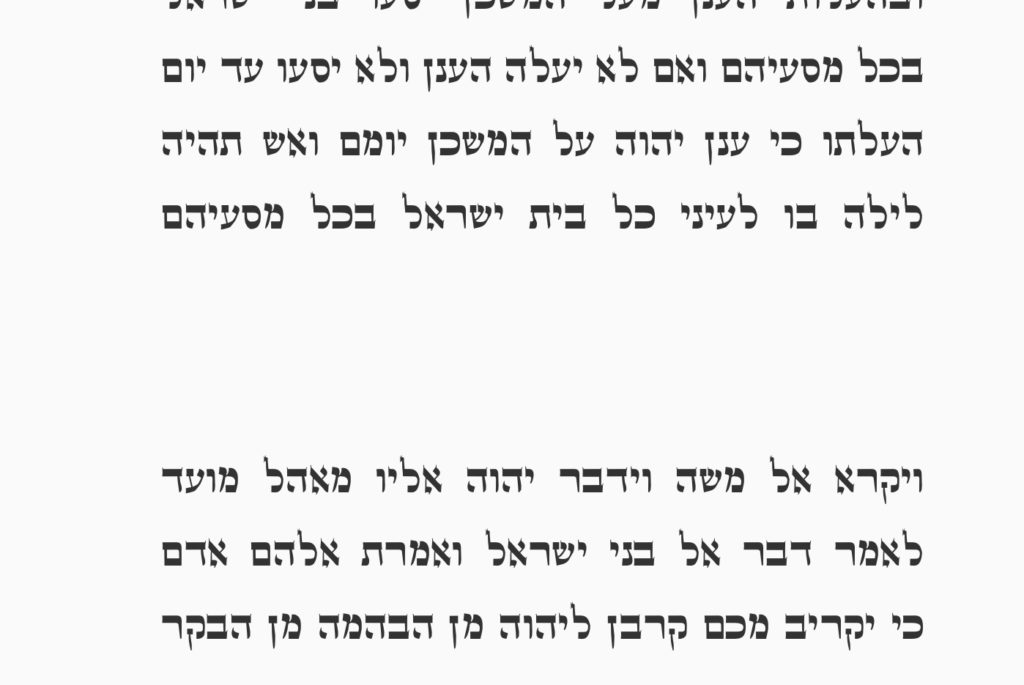
Whenever we reach the end of a book of Torah, we come to a big space in the text (pictured above). It is customary to say to words, “Chazak, chazak, v’nitchazek/ Be strong, be strong, and we will strengthen one another.”
My friend and colleague, Rabbi David Wilfond, taught me that is a way of saying that our words in Torah are like stepping stones. But when those words seem to end, we need support to reach the next section.
These are the same words of support I give to you now, and that I hope we can give to one another. Without the stepping stones in life we are used to, we need to be strong – and to offer strength to others.
We will get to firm ground again. This moment in time will pass. And we hold each other’s hearts within our own.
Sending you love, strength, and prayers for health.
With love and Shalom,
Rabbi Zach Shapiro

A Moment in Time: Be Strong, Be Strong, And We Will Strengthen One Another Read More »

Karlie Kloss’ Dad Solicited Coronavirus Tips for Jared Kushner on Facebook

A physician with family ties to senior White House adviser Jared Kushner said he solicited advice on Facebook for Kushner on how to deal with the coronavirus.

Kurt Kloss, whose daughter is married to Kushner’s brother, on Wednesday asked a group of fellow emergency room physicians on the social network for the advice on Kushner’s behalf, Politico reported Friday.

“I have direct channel to person now in charge at White House,” Kloss wrote in his post.

Hundreds of doctors responded and Kloss explained that Kushner, who is President Donald Trump’s son-in-law, had asked him for recommendations, according to Politico. Kloss sent Kushner 12 recommendations Thursday morning, according to the article.

Trump appointed Vice President Mike Pence to lead a task force to combat the spread of the coronavirus last month. But Kushner has taken a more active role as the virus continued to spread, two unnamed sources told Politico.

Trump has sent Kushner to deal with multiple sensitive issues, including Middle East politics, immigration and judicial reform, Politico noted.

In a post, Kloss said Kushner is “now directly involved in the response to this,” referring to COVID-19.

The closed Facebook group, EM Docs, has nearly 22,000 members. The posts about Kushner’s request have been removed.

“In his role as a senior adviser to the president, Jared Kushner is, of course involved in the coronavirus response, but he is not in charge of coronavirus research,” a White House official told Politico.

Karlie Kloss’ Dad Solicited Coronavirus Tips for Jared Kushner on Facebook Read More »

A Nation Presses Pause: Shabbat Shalom

They are the two words that may come to define our age: Social distancing. Long before disease experts were urging us to quarantine ourselves to fight the alarming spread of the coronavirus, we were already secluded in our digital cocoons.

The drug of social media and other digital treats have already done a great job of physically separating us. How poignant that the biggest health crisis of our time is now calling on us to do more of the same— to accentuate an isolation that has contributed to a rise in loneliness and depression.

Every expert I’ve spoken to has told me the same thing: We need to separate ourselves physically to combat the exponential spread of COVID-19. Yes, washing our hands and other safety measures are important, but the most decisive measure is “social distancing.”

Evidently, the world is listening. Our nation is pressing pause. Schools are closing, events are cancelling, sports leagues are suspending their seasons, more and more people are working from home. My email is flooded with announcements of new cancellations, from synagogue services to Hollywood events to theaters on Broadway.

The irony is hard to miss: At a time when we had already reached a peak of social isolation, a lethal disease has forced us to be further isolated.

The irony is hard to miss: At a time when we had already reached a peak of social isolation, a lethal disease has forced us to be further isolated.

Only this time, the isolation is to save our lives. We’re staying further entrenched in our digital bubbles not because of the lure of Twitter, Facebook, Instagram or Netflix, but because of self-preservation. The very phenomenon that is corroding our mental and emotional health is now the cure to secure our physical health.

This is separation on top of separation, distancing on top of distancing. It’s like telling cocaine addicts to take more cocaine to save their lives.

At moments of such confusion and darkness, we need deep and imaginative thinkers to show us some light. In a community message that went viral, my friend Rabbi Yosef Kanefsky did just that.

“The very last thing we need right now,” he wrote, “is a mindset of mutual distancing. We actually need to be thinking in the exact opposite way.”

Just as the coronavirus is calling on us to double down on our social distancing, Kanefsky wants us to double down in the opposite direction. How? Hear his words:

“Every hand that we don’t shake must become a phone call that we place. Every embrace that we avoid must become a verbal expression of warmth and concern. Every inch and every foot that we physically place between ourselves and another, must become a thought as to how we might be of help to that other, should the need arise.”

Instead of using this national pause to do more of what we already do, Kanefsky is urging us to go higher, to dig deeper, to find creative ways of helping others that don’t require physical contact.

“There is a crack in everything,” Leonard Cohen wrote. “That’s how the light gets in.”

Indeed, our nation is cracking. The economic fallout is scary. Things will get worse before they get better. It’s hard to see any light.

Indeed, our nation is cracking. The economic fallout is scary. Things will get worse before they get better. It’s hard to see any light.

For many in the Jewish community, this will be a Shabbat with little light— no synagogue services, no gathering with friends, none of the socializing we have come to expect.

And yet, there is light in this crack, too. We can engage during this “Corona Shabbat” with the more spiritual side of the day of rest, what Rabbi Abraham Joshua Heschel calls the “holiness of time.”

“There is a realm of time where the goal is not to have but to be, not to own but to give, not to control but to share, not to subdue but to be in accord,” he wrote in The Sabbath. 

When Kanefsky writes that Every embrace that we avoid must become a verbal expression of warmth and concern,” he is showing us an example of making our time holy. Shabbat is the ideal time to reflect on this holiness. Freed from our digital devices, we can double down on our humanity, we can contemplate the “realm of time” where the goal is “not to own but to give.”

Shabbat reminds us that even if we must be socially isolated, we can be spiritually connected; even if we must be alone, we can add meaning and purpose to the very idea of being alone.

Shabbat is the light that shines through every crack, even a crack that has put a frightened nation on pause.

Shabbat shalom.   

A Nation Presses Pause: Shabbat Shalom Read More »

Coronavirus Prompts Jewish Camp Organization to Stage Virtual Conference

The Foundation for Jewish Camp (FJC) has decided to cancel its March 15-17 conference in Baltimore and instead host a virtual conference on March 16.

According to a press release, the online Leaders Assembly conference will take place from 8 a.m. to 4 p.m. PDT and will enable participants to see the various speakers and breakout sessions as well as mingle with one another online.

“It is honestly humbling to see the astonishing amount of dedication and teamwork FJC’s staff has summoned in order to pull together this new format in such a quick and responsive manner,” FJC CEO Jeremy Fingerman said in a statement. “Especially during this time of unprecedented challenges, our virtual convening will help FJC lead the field to continue to innovate and adapt to demands of our rapidly changing world.”

FJC’s move is among a trend of Jewish events being held online instead of in-person as people engage in social distancing in order to stop the spread of the coronavirus. The Combat Anti-Semitism Movement (CAM) turned its scheduled March 15 event featuring Special Envoy to Combat and Monitor Anti-Semitism Elan Carr and former Israeli Diaspora Minister Natan Sharansky into an online event, where they will be announcing prizes for those who sent in ideas to help fight anti-Semitism.

Additionally, Sinai Temple Rabbi David Wolpe, musician Craig Taubman and others will host a virtual Shabbat gathering at 3 p.m. PDT March 13 that will be streamed on YouTube and Facebook.


Coronavirus Prompts Jewish Camp Organization to Stage Virtual Conference Read More »

U.S. Launches Retaliatory Strikes Against Hezbollah Militia Group

The United States engaged in retaliatory strikes against Hezbollah’s Iraqi militia on March 12 in response to an attack against a U.S. military base the previous day.

Two Americans — a soldier and a contractor — in addition to a British soldier died in the March 11 rocket attack on Camp Taji, just north of Baghdad. Fourteen people were injured, five of whom required serious medical attention, Reuters reported.

According to the Associated Press and USA Today, the U.S. targeted several Kataib Hezbollah sites, the group believed to behind the March 11 rocket attack. March 11 also would have been the birthday of Iranian Gen. Qassem Soleimani, who was killed in a U.S. military strike in January.

Defense Secretary Mark Esper told reporters on March 12 before the retaliatory strikes, “Yesterday’s attack by Iranian-backed Shia militia groups consisted of multiple indirect fires that originated from a stationary platform and was clearly targeting coalition and partner forces on Camp Taji.”

He vowed that the U.S. would hold the militia groups “accountable. You don’t get to shoot at our bases and kill and wound Americans and get away with it.”

President Donald Trump said before the strikes on March 12 that although it wasn’t completely conclusive that Iran was behind the strikes, “most likely it looks like it could be backed by Iran.”

U.S. Launches Retaliatory Strikes Against Hezbollah Militia Group Read More »

A Guide to Daily Living During the Coronavirus Pandemic


First of all, let me state that my own insightful wife Adi has warned me against writing up anything about this. There is a true glut of information (as well as misinformation) at the moment with everyone and their grandmother giving social media advice that range from things as Xenophobically racist and scientifically incorrect as “Stay away from Asians” to things as overprotectively unnecessary as “Buy all of the toilet paper you can and never leave your house again”.  

Have you noticed that some of the statistics being thrown around seem to contradict each other? How can it be that Coronavirus is killing over 3 percent in some stats but then in other places it is well under 1%? Why are we so concerned about this if we aren’t terrified of the flu which kills even more each year? Why are we closing schools if it doesn’t affect children?

Let me be clear, I am not an epidemiologist, and I do not work for the CDC. I am a nurse. I work with the general public in the city of Santa Monica. I have read the same news as you, so I know many are running for the hills panicking, while others are screaming at those first ones for creating a hysteria over this. None of us quite know what to make of it, because we only know what we read and are told. Well between the CDC, my job, and my colleagues who ARE epidemiologists and who talk to the CDC and County on a daily basis, let me try to make things a bit more helpful for us all.

And please keep in mind that things are changing rapidly by the day and hour, so my advice is based on what we know NOW, and could easily be different tomorrow when we have more information. In fact just in the time of my writing this I’ve had to make adjustments to increase precautions for all ages.


What are the actual statistics?
We don’t know. All of the data so far is from a rather rushed, small sample size. When you are taking a few hundred or a few thousand cases, and in a matter of weeks trying to create statistical conclusions, you are using the scientific method in an extremely rushed, inadequate way. And before that all of our data was being handed to us by China, with plenty of skepticism attached. In addition to that, we all know that the testing has been extremely hard to come by and limited, so clearly we cannot know how many ACTUALLY have caught this horrible virus, nor the actual mortality rate. If you wanted to know the percentages you’d have to take a large population and test EVERYONE there and see how many are positive. That’s not gonna happen, they are currently still quite strict as to who can qualify for the test in most places, so many and quite possibly most will never know if they ever actually had it. You can probably therefore deduce that whatever the mortality rate you read is actually quite a bit lower, as you can’t know what you don’t know; and we can assume we’re finding out about most if not all POSITIVE cases that result in death or hospitalization, but are certainly not finding out about many if not most of the ones which are mild enough to not seek medical attention. But as to what the actual numbers are? Nobody can tell you that without speculation and guesswork.

Yes we know that influenza (aka the flu) kills many each year. And we have a right to be exasperated with the millions who decline the vaccine (without a medical exemption) and take a risk with that while being terrified of catching this. But the fact remains we do not have a vaccine yet for this. We do not have any idea how many more will die from this. And we need to do what we can to keep it from spreading even MORE out of control like wildfire.

What we actually know
We know that those who are seriously ill or dying are MOSTLY elderly or have serious acute or chronic immunocompromising medical conditions. If you are someone who is prone to getting pneumonia you are more prone to getting this. If you are more likely to not survive a case of pneumonia you are more likely to be in danger here. What this means, as most of us already know, is that most of us are relatively safe from harm, but we have a responsibility to the rest of society, and our vulnerable loved ones, to protect them from actual harm. Let’s break this into general categories:


-Children 0-10 – For whatever reason they appear to not have severe illness because of this virus. On the other hand, they are the most likely to be sticking everything and every germ into their mouths, and onto their hands. So children are important not for their safety, but for the danger the germs they carry (that are causing only mild illness) can infect the vulnerable.

-Anyone (without immunocompromising or other major health conditions) under 60 – Again relatively unharmed. The majority seem to get between a mild cold and a bad cold. Not all but certainly most.

-Over 60 – This is where general medical conditions start to occur more likely. This is when any of us would start to be more prone to having health issues including pneumonia, so here is where people need to start taking extra measures to protect themselves.

-Over 80 – Here is the age where people not only are the most prone to having health issues, but those health issues are the toughest to get through. You don’t need to be a medical professional to realize that you are both more likely and in higher danger if you catch something such as pneumonia when you are 84 than if you were 44. This is the population we most need to protect, all the MORESO if it is someone over 80 who is already sick or immunocompromised.

Keeping those categories above in mind, here are my suggestions to help give you a life balance that is considerate to protection of the rest of society, while also not restricting you to a full-on quarantine.


What you should do

Over 80:
-Stay home AS MUCH AS POSSIBLE. Your social outings should stop, you shouldn’t go to your place of worship, and if you are a grandparent who takes your grandkids to kid classes you should DEFINITELY stop that. Remember what I said earlier about small children being the biggest receptacles of germs? That’s great for them, but right now it is the last thing a vulnerable person needs to be around, a whole group of kids coughing and snotting all over the place. And honestly I would suggest that anyone over 80 just not be around unhygienic children right now, period. Let me give you a personal example. My mother is not only over 80 but she battled Lymphoma this past year; she is immunocompromised. She is therefore the last person I would allow my 22 month old daughter Natalia to be around. She can FaceTime with her or, as Adi figured out, they can go on an outdoor walk together while keeping her in a stroller – assuming Natalia doesn’t have a cough. My own brother and sister-in-law are not coming in for Passover anymore because it would involved bringing the kids who simply should not be around my parents. It is a sad turn of events, but a necessary one. I have told my parents to not go to any more movies, concerts, museums or anywhere until this passes. We will shop for them. 

-Can they still have a social life? Sure, friends and family who know they have no fever and no cough can come over, wash their hands carefully when entering, avoid physical contact, and enjoy a nice evening together. As I said, just modify the behavior with extra hygiene, lack of the usual physical contact, and at all times staying away if sick.

Under 60:

-Stop large social gatherings. How large? Anything where you cannot control who else is with you, or if they are sick. Right now I would recommend avoiding going anywhere nonessential, where there are too many unknown variables. And the way to help stifle this is by lowering the opportunities for transmission. It appears to be within about 6 feet. So if you don’t need to go out for the time being, it might be the safest and wisest thing to do, not for your sake but for the others who may not practice hand hygiene who you come into contact with, and carry those germs to others.

If a friend comes over, great, but again make sure they aren’t coughing or sick, and washing their hands when they enter. But my usual huggy nature is on a temporary hiatus. And I will have to be “that guy” who reminds people as they enter my home to please take off their shoes and wash their hands as they arrive. I will shop if I need to, but try to order via delivery services. 

Between 60 and 80:
-Use your judgment. Is your general health closer to the under 60 bracket or the over 80 one? Have you had prior hospitalizations? Do you have serious medical conditions especially of the lungs or heart? Would getting pneumonia be  especially devastating? Then you should probably take the same precautions of the 80 plus year olds. Are you an active 68 year old who plays tennis and if you fell you’d get up and keep playing? You might be able to think of yourself more in the under 60 group. This is not an exact science, use informed logic.

Extra Tidbits:

-Let me be clear, nobody should be going out, at any age, if they have a cough or fever. We should all, at every age group, be staying home at all times if we have a cough of fever. And we should at this point just stay home when there’s no need to interact with the general public. This is how the disease spreads, a cough or sneeze expels the germs, those germs go onto our hands or wherever else they hit, and those germs stay there for some unknown amount of time. It could be up to a few days. So if I have a cough, I am not going out, and I’m not going to work, it is what needs to happen for the safety of others. If you are sick enough that you need to go to the doctor or hospital, call first, let them know you are coming, so they can prepare a safer entrance for you away from others.

-Washing your hands is still of primary importance. 20 to 30 seconds with warm water and soap is best. Hand sanitizer is good but second best. 

-When you get home, take off your shoes, leave them outside perhaps, why drag things inside. And when you first arrive somewhere, WASH YOUR HANDS. These instructions are rinse, repeat, pun intended.

-Just get used to not hugging, kissing or shaking hands for the time being. My compassionate and insightful Rabbi, Rav Yosef Kanefsky, gave a wonderful talk this past week at our synagogue Bnai David Judea, where he reminded us how every handshake and hug that we are NOT giving now is one that further distances us in ways we can not calculate from one another. It is therefore of the utmost importance that we are doing even MORE to make up for this. Our body language must be all the more warm, our words must express the things we often do not say aloud. We need to remind each other that we still care about and love one another, because with touch being lessened, we do not want the IMPACT of touch to be gone with it. While social-distancing is now crucial, it is equally important not to let others feel socially distant.

-Anyone who is not in the vulnerable population, please stop buying things in bulk as if you will not leave your home for months. You can still go to the market, but please use precautions. The people who actually NEED to stay home are the ones who need to stock up on things such as toilet paper; let’s not shame them as they actually are doing what is best by staying home for an unknown amount of time. But it is the responsibility of the rest of us not to deplete the supply of such items that we will continue to have access to, and prevent those who need to stay home from having enough.

-Do not walk around wearing masks unless you are sick and for some reason have to be out of the house. And do not walk around wearing gloves under any circumstance, as you are simply taking what you touch and spreading it everywhere else. 

Let’s look forward to the day we soon have a vaccine, but until then let’s take the aforementioned measures to slow things down and make our world safer for the millions who are at risk.

Boaz Hepner grew up in LA in Pico/Robertson and now lives here with his wife and baby girl. Thus, the neighborhood is very important to him. He helped clean up the area by adding dozens of trash cans that can still be seen from Roxbury to La Cienega. When he is not working as a Registered Nurse in Santa Monica, he can be found with his wife and daughter enjoying his passions: his multitude of friends, movies, poker and traveling.

A Guide to Daily Living During the Coronavirus Pandemic Read More »