fbpx

October 14, 2019

German Judge Fines Woman for Painting Over Neo-Nazi Graffiti

A German judge issued a $330 fine on Oct. 9 to a 74-year-old woman for covering up an instance of neo-Nazi graffiti in December.

The woman, Irmela Mensah-Schramm, is known as the “Graffiti Grandma” for constantly covering such graffiti for years. A complaint had been filed against for painting over the words “NS-Zone” with a heart; the “NS” is short for national socialism, which is what the Nazis called themselves.

The court offered Mensah-Schramm a deal for her to give more than $500 to a series of charities instead of paying the fine; Mensah-Schramm rebuffed the offer, telling a German broadcaster that taking the deal would send a message that her actions were wrong. She plans to appeal the fine.

Mensah-Schramm first removed a sticker that read “Freedom for Rudolf Hess,” who was the deputy to Adolf Hitler from 1933-41, in 1986. Since retiring from teaching special education in 2006, Mensah-Schramm has ramped up her activism, carrying a scraper and spray-paint at all times in case she sees graffiti or stickers promulgating neo-Nazi messages.

Freedom of speech has limits,” Mensah-Schramm told CNN in 2016. “It ends where hatred and contempt for humanity begins.”

German Judge Fines Woman for Painting Over Neo-Nazi Graffiti Read More »

SJP Protests Bard University Panel on Anti-Semitism

Bard College’s Students for Justice in Palestine (SJP) chapter protested an anti-Semitism panel taking place at the New York liberal arts college on Oct. 10. The panel featured Forward opinion editor Batya Ungar-Sargon, Harvard Yiddish literature Professor Ruth Wisse and Bard Hannah Arendt Center Associate Fellow Shany Mor.

In an Oct. 12 column in the Forward, Ungar-Sargon wrote that organizers of the Oct. 10-11 Racism and Anti-Semitism conference warned her that morning that student protesters were planning to interrupt her “Who Needs Anti-Semitism?” panel during the conference. 

“I was surprised they were not targeting the one on Zionism, but the one on anti-Semitism, the only panel of about 20 over the course of the two-day program where three Jews would be discussing the topic,” Ungar-Sargon wrote, adding that she was told that “security officers were not allowed to remove the students.”

Ungar-Sargon proceeded to mention that she spoke to the protesters before the panel, encouraging them to protest her Oct. 11 panel “Racism and Zionism: Black and Jewish Relations” instead of the anti-Semitism panel. A protester replied, “The conversation about anti-Semitism is already inherently about Israel,” which Ungar-Sargon argued is “a deeply anti-Semitic trope that has been voiced across the spectrum from David Duke to Louis Farrakhan to Jeremy Corbyn’s supporters.”

Ungar-Sargon then claimed that one of the speakers scheduled to be on her Zionism panel started “egging on” the protesters.

During the panel, around 20 protesters held signs that read, “Zionism = Racism,” among others, and interrupted the panel with chanting. The protesters were eventually forced to leave when “they chanted so loudly that we couldn’t proceed,” according to Ungar-Sargon; she was irked that the protesters “were applauded by several of our fellow conference speakers in the audience” and claims that at a party afterward one of the speakers accused her of “silencing Palestinians.” 

While conference organizer Roger Berkowitz and the Bard deans apologized to Ungar-Sargon afterward, she didn’t like that “not one of our fellow conference speakers got up and exercised their free speech rights to call the protest what it was. Not one came over to us after to express shock and horror that three Jews would be denounced for Israel’s actions while attempting to discuss anti-Semitism in America.”

The following day, Ungar-Sargon criticized the college during the Zionism panel and left the panel when she concluded her remarks.

“The next time someone says, ‘What have you done to help Jews as anti-Semitism has spiked across the nation, as Jews have been murdered at their place of worship and Orthodox Jews get beaten to a pulp day after day in Brooklyn,’ you can say, ‘I sat idly by as Jews were protested for trying to talk about anti-Semitism,” Ungar-Sargon said. “I allowed a Jewish woman to be held accountable — because of her ethnicity — for the actions of a country halfway around the world where she can’t even vote. I egged the protest on, in fact. And then I went to a party.’”

Anti-Defamation League CEO Jonathan Greenblatt praised Ungar-Sargon in an Oct. 13 tweet.

“Bravo @bungarsargon for sharing how she encountered ugly #antiSemitism at @BardCollege — at a panel on anti-Semitism no less,” Greenblatt tweeted. “It’s a case study on the very real issues facing Jewish students on college campuses today and shows how hate manifests on the far Left.”

The American Jewish Committee tweeted, “We are heading toward a great reckoning in U.S. higher education. Will all universities step up to stomp out antisemitism? Or will Jews be forced out of general American academia?”

Berkowitz disputed Ungar-Sargon’s account of what transpired during the protest, writing in a Letter to the Editor published in the Forward on Oct. 14 that he and other conference organizers attempted to dissuade the protesters from disrupting the panel, warning them that they would be removed if they did so.

“I communicated all of this to Wisse, as well as Ungar-Sargon, well ahead of the talk,” Berkowitz wrote. “Neither gave any indication that our plan was unacceptable.”

He argued that Ungar-Sargon implied in her column and on Twitter that she was “silenced,” which he said was false, pointing to the full video of the panel. Berkowitz also argued that the protesters weren’t being anti-Semitic, they were voicing a political disagreement.

“In her speech at the conference before leaving, Ungar-Sargon accused me and other conference goers of sitting ‘idly by as Jews were protested for trying to talk about anti-Semitism,’” Berkowitz wrote. “This is flatly not so.”

SJP Bard wrote in an Oct. 13 Facebook post that they “successfully disrupted” the anti-Semitism panel, saying that they “specifically targeted a panel that featured hardline [Z]ionist professor Ruth Wisse as the main speaker.”

SJP Protests Bard University Panel on Anti-Semitism Read More »

Sarah Silverman to Star in HBO Comedy Special, Late-Night Series

Sarah Silverman appeared in the HBO comedies “Mr. Show with Bob and David” and “The Larry Sanders Show” and 2013 stand-up special “We Are Miracles,” for which she won an Emmy.

Now she’s returning to the cable network with two new projects: a comedy special and a late-night series she describes as “weighing in on the mishugas” of the week and taking live video calls. “I’m as passionate talking about my face-washing routine as I am talking about why billionaires cost us money,” Silverman said. “Nothing’s off the table and nothing’s too high or low brow for me. I mean – look at my face – I’m literally all brow.”

Silverman, who will produce the series with Judd Apatow and Amy Zvi, is currently shooting romantic comedy “Marry Me” with Jennifer Lopez and Owen Wilson. She is also adapting her memoir “The Bedwetter: Stories of Courage, Redemption, and Pee” as a musical.

Sarah Silverman to Star in HBO Comedy Special, Late-Night Series Read More »

God’s Sukkah

God gathers us
In the great, big open landscape
Of the cosmos and beyond
Exposed— saying
This is My sukkah.

Our stone houses are makeshift
Our strength is fleeting
Our walls of safety will fall after a short or long time.
But God gathers us
In Her sukkah

And says This is real.

This is forever.

This is Me.

God’s Sukkah Read More »

University of Illinois Chancellor Condemns ‘Anti-Semitic Content’ in Housing Staff Meeting Presentation

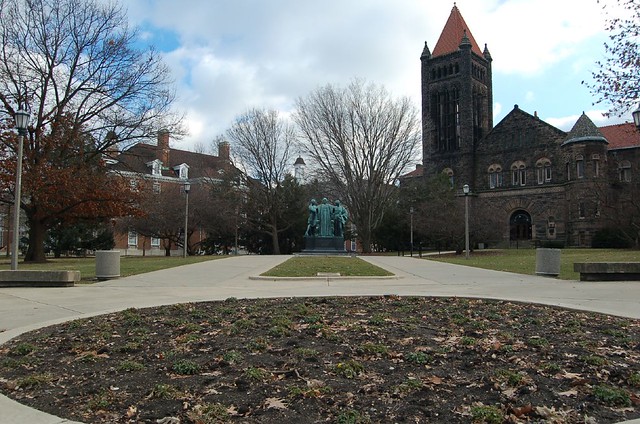
University of Illinois Urbana-Champaign (UIUC) Chancellor Robert Jones condemned the “anti-Semitic content” featured in a presentation during a Sept. 25 housing staff meeting as well as a swastika found on campus on Oct. 7.

According to Jones’ Oct. 9 email to university members, a student-worker gave the presentation “in a regularly scheduled, staff development program on diversity for Housing Resident Advisors that included 11 other student-employees and one full-time staff member.”

The presentation, titled “Palestine and the Great March: Palestinian Resistance to 70 Years of Israeli Terror,” equates Israel with South Africa apartheid and describes Israel’s Operation Protective Edge against Hamas 2014 as an “assault on Gaza.” It also defines Palestinian “martyrdom” as “death which is desired by a warrior, selected with all the awareness, logic, reasoning, intelligence, understanding, consciousness, and alertness that a human being has.”

Instead of fostering dialogue, [the presentation] incited division, distrust and anger,” Jones wrote. “The program allowed our students to enter an extremely challenging and potentially volatile situation without the preparation, training, education and professional oversight they needed to succeed. This is inexcusable and unacceptable. This is a failure to our students, and that is my responsibility.”

He also noted that the university was investigating a swastika that was discovered in the Foreign Languages Building.

“I want to state publicly and unequivocally that acts and expressions of anti-Semitism are acts and expressions of hatred and discrimination that are in direct opposition to our core values,” Jones wrote. “Bias and prejudice are antithetical to the educational foundations of our university and hurtful to our entire community. The idea that any individual feels threatened for expression of personal religious or ethnic identity is unacceptable. We will always recognize the rights of those on the campus to safely and freely express their perspectives and opinions. But we will also be ready to condemn statements and actions that violate our shared values and seek to demean, intimidate or devalue others in our community.”

The pro-Israel student group Illini Public Affairs Committee (IlliniPAC) said in an Oct. 10 statement on Facebook that the Sept. 25 meeting was required for all resident advisors (RAs) and the presentation was given as a Multicultural Advocate (MA) presentation. IlliniPAC pointed out that MAs are supposed to encourage “dialogue among students” and promote an “inclusive” environment.

“IlliniPAC’s major grievance with this particular event with this particular event was how it, with a violation of an MA’s duty and role, labeled Israel blanketly as a terrorist nation, and as a result did not facilitate any sort of conversational pieces of information for both sides of this very complex political debate,” the statement read. 

https://www.facebook.com/Illinipac/photos/pcb.2357607961011986/2357606227678826/?type=3&theater

IlliniPAC Executive Board Member Daniel Raab told the student newspaper Daily Illini, “When you are demonizing the state of Israel strictly without context of other nations, you are singling out the Jewish state, you are singling out 7 million Jews who live in Israel out of the whole world and the whole world’s problems: that’s anti-Semitism.”

According to an Oct. 13 StandWithUs Action Alert, Illini Hillel Executive Director Erez Cohen said in an email that he viewed the presentation as more troubling than the swastika, stating, “With content celebrating martyrdom which promotes the deliberate killing of Jews, this training is truly terrifying the day after a shooting at a synagogue in Germany, and one year after the largest massacre of Jews on American soil… how can students feel safe knowing that the staff in their first home away from their parents has been trained to support the killing of others?”

StandWithUs praised Jones for his response, but urged the university to adopt the International Holocaust Remembrance Alliance (IHRA) definition of anti-Semitism as well as “improve university responses to complaints of anti-Semitism.”

Students for Justice in Palestine (SJP) UIUC member Dunia Ghanimah told The Daily Illini that she’s the author of the presentation and defended it as “criticizing the [Israeli] government for committing terrorist acts, not the people.” She wouldn’t tell the student paper if she was at the Sept. 25 meeting.

SJP UIUC argued in favor of the presentation being shown at the Sept. 25 meeting in an Oct. 10 Facebook post.

“It is well within the scope of the role of the MA to raise awareness on Palestine and the Occupation,” the post read. “Conflating the two ideas of anti-Zionism and anti-Semitism undermines the larger movement for justice in Palestine that has been led by Palestinians of all racial, religious, gender, and sexual backgrounds. This conflation has been used in the past as a scare tactic against students and workers in the Palestine movement, and it is rooted in a false understanding of what the movement stands for and what it advocates for.”

University of Illinois Chancellor Condemns ‘Anti-Semitic Content’ in Housing Staff Meeting Presentation Read More »

Santa Claus Comes to Kol Nidre

In the lead up to Yom Kippur I was curious how I could teach my preschooler son about the importance and meaning of the holiday. In school he learned about apologizing and how to say ‘I’m sorry.’ At home we talked about how we could be kind to each other and the Earth in the coming year. 

The morning of Erev Yom Kippur arrived and we talked about how Dad was going to fast and how we were going to think about how we were sorry for some of the things we had done wrong this year. I asked my son if he had anything to say sorry for or if he had been a good boy. As soon as the words had left my mouth I instantly thought of Santa Claus.

On Yom Kippur we think about the spiritual scale, the balance of how we have measured up and where we have missed the mark. Or in other words, were we on the naughty or nice list? In many ways the concept of Santa Claus is a much kinder explanation of a morality judge. A jolly old guy who gives gifts based on how good you are vs. The Almighty God who weighs our sins and repentance and decides if we should live or die in the coming year. Not exactly something you can imagine being a theme of a Daniel Tiger episode.

If the point of teaching our kids about teshuvah is to inspire them to be ethical and moral humans, is Yom Kippur too harsh a concept too swallow? In an age of everybody wins and trophies are for participation, how do we explain the severity of Yom Kippur to our children in a way they would want to embrace. 

In the family services we attended they taught the children about how saying ‘sorry’ not only heals the person we have hurt but it also makes us feel better. Being kind is a blessing to others and for ourselves. That felt good to hear, that was something I felt I could continue discussing at home without tripping over my words. In the coming years we’ll have to decide how to tell the full story of Jonah and how to explain the solemnity of Kol Nidre. For now, we’ll begin and end with kindness, and we won’t invite Santa Claus into the synagogue just yet!


Marion Haberman is a writer and content creator for her YouTube/MyJewishMommyLifechannel and Instagram @MyJewishMommyLife page where she shares her experience living a meaning-FULL Jewish family life. Haberman is currently writing a book on Judaism and pregnancy titled ‘Expecting Jewish!’ to be released Winter 2019. She is also a professional social media consultant and web and television writer for Discovery Channel, NOAA and NatGeoand has an MBA from Georgetown University.

Santa Claus Comes to Kol Nidre Read More »

Led by majority-Muslim Azerbaijan, the Council of Europe resolves to preserve Jewish heritage

We are used to hearing a lot of bad news, especially during the last decade or two, regarding the relations among various religions. Much blood has been shed in different parts of the world in the name of one religion against the other/s, based on the radical interpretation/distortion of the religion and narrow-minded zero sum thinking. Pitting religions against each other continues to serve political, financial, ideological and other goals of many different groups, wherever they are: the Middle East, Asia, Europe or the United States.


However there are also good news regarding the interfaith understanding that need to be shared. Although good news are usually and quite unfortunately not considered the main revenue generators for the media, they should nevertheless be shared and spread to inspire more good in the world.


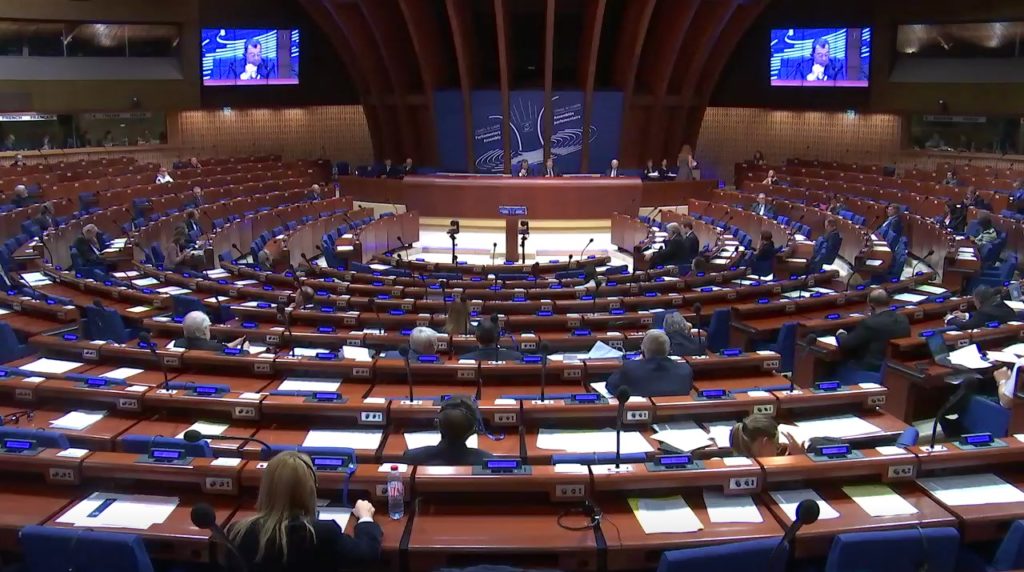
A piece of good news came a few days ago from Europe. The Parliamentary Assembly of the Council of Europe (PACE), which unites all 47 European nations from Azerbaijan to Iceland covering around 820 million people, held on October 4 a plenary session solely dedicated to preserving the Jewish cultural heritage across Europe.


“Jewish cultural heritage forms an integral part of the shared cultural heritage in Europe and its preservation is therefore the responsibility of all,” the parliamentarians said, adopting a resolution based on the report by Raphael Comte from Switzerland. “By ensuring the survival of these Jewish sites such as historic synagogue buildings – most of which have been neglected – the collective memory is also preserved, and this helps to raise young people’s awareness of their history and culture, while promoting intercultural dialogue and social cohesion,” the adopted text underlines. Finally, PACE invited the EU to cooperate with the Council of Europe to set up a mechanism for monitoring the state of Jewish heritage preservation, and to introduce an award for outstanding volunteer work on this heritage preservation.


The plenary session was chaired by PACE Vice President Samad Seyidov, who is also the Chairman of International Relations Committee of Azerbaijan’s Parliament and Head of Azerbaijan’s delegation to PACE. Mr Seyidov is one of the staunchest advocates of Azerbaijan’s strong friendship with the Jewish people and Israel.Two members of Azerbaijan’s delegation, Mrs. Sevinj Fataliyeva and Mr. Rafael Huseynov, spoke at the session.


Azerbaijan is a secular majority-Muslim nation, with an almost 95% Muslim population, the majority of which are Shia Muslims. This Caucasus nation is also blessed with a 30,000-strong Jewish community that have been living there in peace and dignity since over 2,000 years, making Azerbaijan today an inspirational role model for Muslim-Jewish peace, acceptance and harmony in the entire world.


Therefore, it should come as no surprise that Azerbaijani parliamentarians took the lead in PACE discussions advocating for more rigorous protection of Jewish cultural heritage in Europe, based on Azerbaijan’s own positive experiences and practices.


Mr. Rafael Huseynov said: “It is not a coincidence that today synagogues are operating not only in Baku, but also in various regions of Azerbaijan. Jewish graves dating back hundreds of years are respectfully preserved throughout the country… The successful fate of the Jewish cultural heritage in Azerbaijan is a striking example of the ethnic, religious and cultural diversity.”


Mrs. Sevinj Fataliyeva is one of the 20 female members of Azerbaijan’s Parliament (out of 125 members). As a woman, I am glad to see so many active and energetic women in our Parliament. After all, in 1919 Azerbaijan was the first majority-Muslim nation to grant the right to vote and to be elected to women. 


Here are some excerpts from Mrs. Fataliyeva’s speech at the PACE session:


“To preserve cultural heritage you need to respect it. Jewish heritage is one of the most valued and preserved in Azerbaijan. A number of joint organizations were founded for the purpose of preservation of Jewish heritage in the country. In particular, the Azerbaijan-Israel Friendship Center, the Jewish Agency “Sokhnut,” committees for the protection and preservation of Jewish traditions, religious schools, and the Jewish Cultural Center as well as “Eva” women’s society, “Alef” youth clubs, and “Hillel” Student Organization are actively operating, and a number of Jewish newspapers are published. In 2010, under the project of the Heydar Aliyev Foundation titled “Azerbaijan – Address of Tolerance”, the Chabad-Or-Avner educational center for Jewish children living in Baku was constructed for 450 students.”


“Another vivid example of preserving Jewish heritage is a village located near Guba city of Azerbaijan, called Red Village. Red Village is recognized as the center for the development and preservation of the material and spiritual culture of Mountain Jews in Azerbaijan and beyond.  It is no coincidence that this village is called the “Jerusalem of the Caucasus.”


“The obligations of the Republic of Azerbaijan on the protection and development of the Red Village’s Jewish community are reflected in the Constitution and laws adopted by the Parliament. In 1991 (after the collapse of the Soviet Union), the Azerbaijani government resumed work on the study of Jewish traditions in Red Village. In recent years, in addition to the general education program, several educational institutions studying Judaism have been established. The Law of the Republic of Azerbaijan on Education, adopted in 2009, provides for the right of ethnic minorities of Azerbaijan to establish educational institutions in their native language. These all show that preservation of Jewish heritage is both a tradition and part of state policy in Azerbaijan. We believe that if we don’t respect the culture and heritage of others, we won’t respect ours.”


Well said! The age-old principle of “Love your neighbor as yourself” should always be followed so that all nations, religions and cultures can coexist in peace, dignity, mutual respect and harmony.

Led by majority-Muslim Azerbaijan, the Council of Europe resolves to preserve Jewish heritage Read More »

STAY TUNED: Perception

 Q: I find that I get in my head a lot. It’s my default. I over-analyze and project. When it comes to acting, I find that connecting to my need, an as-if, and tapping into my vulnerability is the only way to break through the mental game, feel liberated, and really be grounded in my instrument. But every day is different. Some days the mental game feels far more powerful than my need, my as-if, my vulnerability. When these days happen, I notice this negative inner dialogue where I ask myself “Can you do this? Are you even good enough? You can’t do this. You’re not good enough” It’s painful and debilitating. When the negative mental talk comes into play, how do I break through and find my way back to the work, to my vulnerability, and to my instrument? 

This is a really powerful question, and one that I think all actors continue to revisit. 

When I was in the Actors Studio MFA Program at The New School, we had a class (it was televised on Bravo and called “Inside the Actors Studio”) where working actors would come and be interviewed by James Lipton and answer our questions. Julia Roberts came, and was talking about her journey as a young actor and meeting big directors for the first time for complex roles. James Lipton asked her, “How was she not nervous?” She said, 

“Oh I was always nervous, I just acted like I was confident.” 

It’s great that you talk about the “as if”. The “as If” is a technique Stanislavski coined describing an aspect of the actor’s technique. The actor acts as if they are in the character’s circumstances. In Erin Brockovich, Julia acted as if she was a single mother of three, she acted as if she was broke, and the as if’s get more specific as you develop your relationship to every aspect of the story. And she also spoke about using the ‘as if’ in real life. She acts ‘as if’ she’s confident. The ‘as if’ is very powerful, because it’s not pretending. Pretending you’re confident, wearing a false mask in life or in acting, is not authentic and is a dishonest armor that people can see through. Instead, the ‘as if’ actively takes something true from your inner life and connects it to the character’s circumstance. It is a way into action. 

A specific and honest impulse in yourself is engaged, that somehow informs how you express the words on the page and how you behave. 

The ‘as if’ is a conscious choice you make to ignite your imagination and connect you in a positive way. Another tool is removing judgement from the negative inner dialogue. “You can’t do this, you’re not enough,” is a gorgeous awareness of a vulnerable feeling that is relatable to every human being. There isn’t one person who hasn’t felt this way at some moment in their life. As an actor, your awareness is your character’s awareness. Your feelings become part of the character’s inner life. 

Because you are experiencing a truthful state, it is absolutely what the character is experiencing, too, in that moment. No matter who the character is, you share an inner life, you are the character. So, if you are feeling you are not enough in a moment, so is the character. And because this is a real feeling, it will always be inspired. You can always use it, no matter what. It is a part of the life in that moment. It lives as a sensation in the body and is affecting you. And because it’s truthful, personal, and specific, you have now struck gold. You are having a real moment. How does it feel? How does it live in the body? What does is make you want to do? You have just discovered a new aspect of your character. Now you might say: but this inner dialogue doesn’t serve the moment I’m in with the character? But it’s there so it will! Your wound, your vulnerability, will inform the character somehow. You can trust that the opportunity is to find out how it serves you. This is also the fun of it, and the way into a mysterious and unpredictable performance that only you can give. 

When an actor exposes her private truths, paradoxically, the character becomes most publicly relatable. Think about Joaquin Phoenix in “The Master” or Viola Davis in “Doubt”. It’s certainly not their circumstances that are universal; it is their responses to their circumstances that are so specific to their own humanity that we all feel it. It’s not logical, it’s more of a direct energy exchange that occurs when the actor is experiencing something personal and specific. The playing of general stereotypes does not transfer to the hearts in the audience. Part of your private truth in these moments is “I’m not enough”. So, let’s say you’re playing Ophelia in HAMLET, for example. Her character is trying to figure out how to get through to Hamlet, why he has changed. See how this inner dialogue you’re experiencing can actually become a revelation into her inner life? How can she get though the painful and debilitating mental dialogue that she is not enough, when she must act anyway? What a gorgeous inner struggle for the character, that you have discovered by observing and exploring something you’re experiencing. Feelings that don’t seem convenient in life, become absolutely interesting when creating art. 

You also speak of ‘projection’. This is a psychological term and you are right, it is something everyone does that is absolutely not useful to acting. It’s an unconscious way we try to control things, which is often a result of avoidance of self. The combatant to projection is to bring your concentration back to what you do have control over, which is perceiving your own instrument. Often actors judge their insides by other actors’ outsides. I’ve been fortunate to work with so many actors, and I know that public personas can be deceiving. Someone that looks like they have it all also has human struggles. It’s interesting to sense people, sense if their energy pleases you, be aware of how they make you feel. The actor’s work is to pay attention to their own responses, so you can create complex characters that have a myriad of feelings and awarenesses like you do. 

We are in the business of examining and sharing the human condition. Actors explore themselves. All of themselves. Your discovery may feel bad in life, but for the craft of acting, you have found a specific state of being that is true to the human condition. We study the human condition, all of it. The technique becomes to pay attention to all of the feelings, and lift them into art. A wonderful part of the art of acting is that our human flaws, when lifted by our creativity, become our gold.

Please send your specific questions about the art of acting to staytuned@gmail.com and Kymberly will respond to a different question each week! There are no invalid questions, as long as they pertain to your craft and life as an actor. 


Kymberly Harris is an actor’s director. She specializes in character-driven stories, whether the genre is drama, comedy, thriller, or action. Her extensive experience as a method acting coach to professional actors of all ages has led actors to seek her out to direct them towards their best performances in film, television, and theatre projects.

STAY TUNED: Perception Read More »