fbpx

October 8, 2019

Swastika Found At Yale Law School

Anti-Semitic graffiti was found at Yale Law School on the evening of Oct. 5., the Yale Daily News school newspaper reports.

The graffiti featured a swastika with the word “Trump” spray-painted in white on the side on the steps of the law school’s side entrance. It has since been removed.

Yale Law School Dean Heather Gerken condemned the graffiti in an Oct. 7 statement.

“Yale Law School has zero tolerance for discrimination or harassment of any kind, and symbols of hate have no place on our campus or in our society,” Gerken said. “We take an incident like this extremely seriously and are currently investigating.”

She added that there was no evidence that the graffiti came from someone in the Yale community.

Yale Friends of Israel also condemned the graffiti in an Oct. 7 Facebook post.

“On the eve of Yom Kippur, it is especially difficult for us to grapple with anti-Semitism,” the post stated. “Rather than focusing on the particular incident, we would like to invite you all to partake in an ongoing discussion on the condemning of anti-Semitism and all other manifestations of hatred in our communities.”

Jewish Chaplain at Yale Rabbi Jason Rubenstein said in an email to community members that the police don’t think the graffiti is part of a larger anti-Semitic effort. He added that the fact that the university views “this as an attack not just on Yale’s Jewish community, but on Yale itself and its values, which is some of the most powerful consolation we can receive as we figure out what this mean[s] for our community.”

Swastika Found At Yale Law School Read More »

Former US Ambassador Criticizes Trump’s Syria Move As ‘Extremely Damaging to US Credibility’

Former United States Ambassador to Turkey Eric Edelman criticized the Trump administration’s pending withdrawal from Syria as likely “creating a vacuum” that will be filled by bad actors in an Oct. 8 Jewish Institute for National Security of America (JINSA) National Leadership Conference Call.

On Oct. 6, the administration released a statement saying that they will no longer oppose Turkey’s northern Syria operation and make the Turkish government responsible for the captured ISIS terrorists in the region. Edelman, who served as the ambassador to Turkey from 2003-2005, said on the call that the announcement has “already raised enormous concerns” among Kurdish militias.

“We need to remember that the president likes to trumpet the fact that we defeated the Islamic caliphate… but that was purchased with essentially 11,000 Kurdish dead by our side,” Edelman said. He argued that President Donald Trump’s defense that the United States could simply go back into Syria if ISIS resurges under Turkish control doesn’t hold water, posing the question, “Who’s going to want to sign up to go do that fight a second time around if we walk away from this?”

Edelman added that the Kurds are holding 10,000 ISIS detainees in Syria, and they’re likely going to get loose since the Kurds are going to be fighting for their survival against Turkey.

“You’re going to be creating a vacuum that’s been filled by us and our allies over the last several years that will be filled by Russia” and Iran their allies,” Edelman said.

Additionally, Trump’s tweet threatening to destroy Turkey’s economy if the Turkish government does anything that’s “off limits” has “activated” anti-American sentiment in Turkey that has “insulated” Turkish President Recep Tayyip Erdogan from domestic criticism, Edelman argued.

“The whole thing is extremely damaging to US credibility,” Edelman said.

Former US Ambassador Criticizes Trump’s Syria Move As ‘Extremely Damaging to US Credibility’ Read More »

University of Pittsburgh Students Create Exhibit Commemorating Pittsburgh Shooting

A group of six University of Pittsburgh students created an exhibit commemorating the Oct. 2018 shooting at the Tree of Life synagogue in Pittsburgh that is on display through Dec. 6.

The exhibit, titled “To Those Who Grasp It: Student Responses to Oct. 27th,” features pamphlets from the Tree of Life synagogue, yarmulkes with “Stronger Than Hate” emblazoned on them and an anonymous student’s reflection note. There are also documents providing Pittsburgh’s history on anti-Semitism and white supremacy, the student newspaper Pitt News reports.

“We present to you, the student community of Pittsburgh, the ideas behind why the attack happened in the first place – the hatred, white supremacy, and antisemitism in our society today,” the exhibit’s website states. “We also present to you a topic in which we are all well versed – student responses to October 27th. We know how our friends responded, how our schools responded, how we responded.”

Additionally, attendees are encouraged to take stones to show solidarity with the Jewish community. It is Jewish tradition to place stones on the gravesites of the deceased.

Caroline Mead, one of the students involved with the exhibit and whose father was wounded by one of the shooter’s gunshots, said in a Oct. 6 speech at the opening of the exhibit, “The lives of the victims weigh heavily on our hearts, and it is through life that we can live through their message. Through life, we can live through their truth.”

She also described the sculpture of a tree featuring diamond-shaped mirrors etched into it as a way for attendees to “reflect on the severity of this event, and the impact that just one day can make.”

According to The Pitt News, the exhibit will be on display at William Pitt Student Union through Oct. 16 and will then be moved to the university’s Department of History until Dec. 6. The exhibit will also be displayed at Carnegie Mellon University at some point in 2020.

The shooting, which occurred on Oct. 27, resulted in 11 dead and six wounded. The alleged shooter, Robert Bowers, has pleaded not guilty.

Anti-Defamation League CEO Jonathan Greenblatt tweeted, “Thankful for these students, using art to bring awareness to the importance of remembrance. As we approach one year since the Tree Of Life massacre, this is a profoundly moving example of solidarity and support in the face of tragedy.”


University of Pittsburgh Students Create Exhibit Commemorating Pittsburgh Shooting Read More »

Canadian Synagogue Targeted with Swastikas and Anti-Jewish Symbols

(JTA) — Drawings of swastikas and other symbols were drawn in chalk on the grounds of a Canadian synagogue in Ontario.

The drawings, which were found in four spots at Beth Jacob Synagogue in Hamilton, were discovered Saturday morning when the rabbi arrived for Torah study before Shabbat services, the Canadian Broadcasting Corp. reported. The graffiti also included the word Jews with a line drawn through it.

Rabbi Hillel Lavery-Yisraeli told Canada’s Global News that surveillance camera footage showed four teenagers drawing the graffiti on Friday night.

The Hamilton Police hate crimes unit is investigating.

Lavery-Yisraeli said the synagogue hired a security guard after last October’s attack on the Tree of Life synagogue building in Pittsburgh killed 11.

Hamilton Mayor Fred Eisenberger is scheduled to visit the synagogue during Yom Kippur services.

The Global News reported that hate crimes and hate/bias incidents reported to Hamilton Police in 2018 targeting the Jewish community rose by 25 percent over 2017.

Canadian Synagogue Targeted with Swastikas and Anti-Jewish Symbols Read More »

How Pittsburgh Changed the Way American Jews Think About Security

WASHINGTON (JTA) — Here’s the sad paradox of the shooting nearly one year ago at Pittsburgh’s Tree of Life synagogue: The killing of 11 worshippers, the worst attack on Jews in U.S. history, hit a community that was one of the best prepared to handle such an assault.

In the year or so prior to the attack, Jewish community security officials had run dozens of training sessions that reached as many as 5,000 Pittsburgh Jewish residents. Many of the Tree of Life congregants knew not to stay in place during an attack, where to find the exits and to have a cellphone on hand to call 911 — despite the compromise to traditional Shabbat observance that requires avoiding the use of electronic devices.

“It was an incredible model that needs to be replicated,” Michael Masters, the CEO of the Secure Community Network, the security agency for the national Jewish community, told the Jewish Telegraphic Agency. “The loss of life would have been much more significant.”

The horror that was the Pittsburgh attack, and the fact that it might have been much worse, has served as a wake-up call for Jewish Americans. Here’s what’s changed in the last year as the attack’s Oct. 27 anniversary approaches.

Communities are paying more attention …

Masters told a Jewish Council for Public Affairs webcast last week that requests to SCN for assistance had quadrupled from 500 in the year before the attack to 2,000 since. Thirty-five federations had security directors a year ago; now 44 do.

“We’re working much more closely with federations on their security programs,” Masters said.

SCN, a program launched in 2004 by the Jewish Federations of North America and the Conference of Presidents of Major American Jewish Organizations, expanded in the months before Pittsburgh by hiring regional directors to target areas of the country where communities have less well-developed security operations. There are now five such directors, and more are in the works.

Attitudes have changed, too. Masters said he no longer encounters communities that believe attacks on Jewish institutions only happen overseas, or that enhanced security attracts unwanted attention, as he occasionally did before Pittsburgh.

“There’s now a general consensus on the importance of security,” he said.

… but are not quick enough on the draw.

Federations may be hiring more security directors, Masters said, but some are slow in getting around to providing them with the support necessary to run training sessions and threat assessments.

“We still have a lot to do to make people understand this is a collective responsibility,” he said. “Every organization should be training on key elements [of responding to attacks]: situational awareness, threat assessments, stopping the bleeding.”

Standardization is key, Masters said. It doesn’t help a community if the Jewish day school has a better security system in place than the summer camp the same children attend.

The normalization of violent anti-Semitism

Anti-Semitism appears more prevalent and knows no political home, said Jonathan Greenblatt, the Anti-Defamation League CEO. He cited the recent proliferation of attacks on Orthodox Jews in the New York area, especially in Brooklyn.

“You can’t just plug this into a political lens,” Greenblatt said. “There are no white supremacists and [far-left] activists in Williamsburg.”

The attacks are also happening everywhere. Masters noted the geographical breadth of a number of foiled mass attacks since Pittsburgh: Washington state, California, Ohio, Georgia.

“We see the diversity of these plots and where they’re taking root,” he said.

Protectors are playing nicer

The ADL was the lead Jewish group on security issues prior to the establishment of SCN and never fully relinquished that role. Occasionally there were turf battles. No longer: SCN and ADL now work closely together.

“We cannot go it alone anymore,” Masters said.

The ADL and the Jewish Federations of North America, SCN’s parent group, have convened a joint security task force co-chaired by two former Homeland Security secretaries, Jeh Johnson and Michael Chertoff. The task force will release its findings at about the time of the Pittsburgh anniversary, Greenblatt told JTA.

Recognizing white supremacists as the danger

Since 2017, when a group of white supremacists marched in Charlottesville, Virginia, the ADL has emphasized that the majority of terrorist violence in the United States since 9/11 have come from the far right. The Trump administration for a time seemed reluctant to accept this assertion, with the president in March dismissing white nationalist violence as a major threat and calling white supremacists “a small group of people.”

But that may have changed last month when the Department of Homeland Security released a new strategy document for confronting terrorism that acknowledged the threat.

“There has been a concerning rise in attacks by individuals motivated by a variety of domestic terrorist ideologies, such as racially- and ethnically-motivated violent extremism, including white supremacist violent extremism, anti-government and anti-authority violent extremism, and other ideological strains that drive terrorist violence,” the document said.

Masters welcomed the shift, saying in a statement that the document “rightly recognizes the growing threat of domestic terrorism, and specifically notes recent attacks on the Jewish community.”

Last month, the ADL released a report warning of the internationalization of white supremacy, with groups in the U.S., Europe and beyond forging ties and learning from one another.

“We drew the links of what was happening in our country and around the world and co-wrote the report with European institutions,” Greenblatt said.

Meanwhile, federal and state lawmakers are hastening to fund security for nonprofits. The federal program that disburses funds to protect nonprofits, most of them Jewish, now budgets $60 million — more than double what it did in the years since its 2005 launch, when the average was $15 million to $25 million a year. Florida, Ohio, New Jersey, New York, Maryland and Pennsylvania have also budgeted for nonprofit security grants.

Broader interfaith cooperation

It’s not only the Jewish community that is recognizing the threat from white nationalists. With the attack on two mosques in Christchurch, New Zealand, in 2019, and the shooting at an African-American church in Charleston, South Carolina, in 2015, other faith communities have become alert to the dangers.

This summer, the FBI convened the first ideas exchange forum with security officials from Christian, Muslim and Jewish communities. Masters emphasized the benefits of information sharing with police, while Salam Al-Marayati, the president of the Muslim Public Affairs Council, said Muslims tended to still be wary of law enforcement because of perceptions that police profiled Muslims after the 9/11 terrorist attacks in 2001.

Social media

The ADL is working closely with social media giants to mitigate the organizational and recruiting capacity that they lend to extremists. Facebook placed restrictions on its Facebook Live video app after the Christchurch gunman used it during the massacre. YouTube reportedly is altering algorithms that have directed viewers to radical right-wing content.

Greenblatt praised Facebook and YouTube for setting up mechanisms over the last year to quickly take down videos that glorify or promulgate violence, but said more needed to be done. He called on businesses ancillary to the social media giants to take action, saying that some companies now decline to provide extremist sites with security support.

“The ancillary businesses can take affirmative decisions about whether to be part of these ecosystems,” he said.

How Pittsburgh Changed the Way American Jews Think About Security Read More »

Girl with Degenerative Brain Disease Celebrates Bat Mitzvah at LA Hospital

(JTA) — A 12-year-old girl with a degenerative brain malformation celebrated her bat mitzvah at the Los Angeles hospital where she has spent most of her life.

Numa Beron was born with lissencephaly, which has left her unable to stand or speak. She was given three years to live, Cedars-Sinai Medical Center said in a statement.

“The Beron family are very fierce advocates for Numa,” said Dr. Gary Goulin, associate director of the Pediatric Intensive Care Unit, who has cared for Beron for seven years. “It’s clear they just love and adore her, visiting every chance they get and taking turns spending every night with her at the hospital.”

Family, friends, former teachers and much of Beron’s Cedars-Sinai medical team attended the bat mitzvah celebration, which included unicorn balloons and decorations, rainbow cupcakes and a video compellation of Numa’s life.

A family Torah scroll was brought to the celebration, and Numa was able to put her arms around it.

“This celebration was a way to show appreciation to everyone in Numa’s life,” said Iliana Beron, her mother. “By the grace of God, we are here and celebrating this miracle and this beautiful day.”

Girl with Degenerative Brain Disease Celebrates Bat Mitzvah at LA Hospital Read More »

Ben Platt, Zoey Deutch Sing ‘Yom Kippur Song’ to James Corden

Fasting on Yom Kippur can be mentally and physically draining but thankfully, nice Jewish Tribe members Ben Platt and Zoey Deutch are here to make it a little easier for you this 5780.

Deutch (“Set It Up,” “Zombieland: Double Tap”) and Platt appeared on “The Late Late Show With James Corden” Oct. 7 to promote their latest project, political satire “The Politician” now streaming on Netflix, and did a little rendition of Platt’s “Yom Kippur Song.”

Platt, a Tony, Emmy and Grammy winner, noted that growing up, his family— “the Von Platt family singers”— would often sing musical theater songs year round and for the Jewish holidays.

“I do have a Yom Kippur song that I wrote with my dear friend Molly Gordon [“Booksmart,” “Good Boys”] who is another amazing actor and we could give it a little sing for you right now,” Platt said.

https://twitter.com/BenSPLATT/status/1181581966694420480?s=20

Deutch, who also knew the words, joined in with Platt making it a duet that would make your bubbe kvell.

It seems a hearty Yasher Koach is in order for both. Watch the full clip below:

Ben Platt, Zoey Deutch Sing ‘Yom Kippur Song’ to James Corden Read More »

A New Way to Support Israel in 5780

Rosh Hashanah is time for introspection and celebration. We reflect on all that has happened in the last year—our deeds, our relationships, and our impact. At the same time, we celebrate the start of a new year, and the chance to make new choices that reflect our values. Now is the time to put into practice the resolutions that we make. I’m very blessed to say that in 5779, after over 40 years in investment management, my colleagues and I combined our professional experience with our deep passion for supporting Israel into a new venture: The Jerusalem Portfolio (TJP).

For years, our strategic wealth advisory firm, RVW Wealth, has been trusted by clients for delivering the highest quality investment management and related services. Now, we’ve channeled our pride for the Jewish state into an investment vehicle that gives individuals, foundations, and institutions the opportunity to own a stake in Israeli-focused companies. It allows investors to tap into Israel’s rapidly-expanding economy and reflect their values in their portfolios.

Through TJP, investors can own fractional interests in a diversified group of over 100 top-tier Israeli-focused public companies that are delivering world-changing impact. Companies like Check Point Software Tech, Elbit Systems Ltd, Novocure Ltd, Wix.com Ltd, and more—spanning sectors from healthcare and technology, to energy and cybersecurity.

The modern state of Israel is doing good in the world through innovation—and Israeli entrepreneurs are doing well. In fact, just this year, the technology sector of the Israeli market reached several all-time highs, as measured by the BlueStar Israel Global Technology (BIGITech)® Index. The record-breaking growth of the Israeli market tech sector underscores the value of investing in Israeli-focused public companies. With TJP, investors gain unprecedented access to the Start-up Nation’s market, including companies tracked by the BIGITech® Index.

Tax efficient, low-cost, and completely liquid, TJP empowers community members to easily create a new account, which is an ideal gift for simchas. For as little as $180, a permanent bond with the State of Israel can be established, and in time, the recipient of the gift can add to it. Each gift is accompanied by a beautiful customized certificate and a graphic depiction of Jerusalem. TJP also offers access to the Israeli economy for larger portfolios for individuals, foundations, and retirement plans. And as part of RVW Wealth’s mission to give back, we also donate a portion of TJP fees on each account to Leket, Israel’s national food bank that is actively working to alleviate nutritional insecurity in the country.

TJP was developed by and is part of RVW Wealth, LLC, a registered investment advisor, to provide clients and others an investment opportunity that would have the biggest impact, not just on their bottom line, but also in doing good through supporting Israel. Our team members are pure fiduciary advisors with no conflicts of interest, and RVW Wealth has a multi-decade track record of delivering the highest quality investment management and related services.

The entire RVW Team is filled with pride when we think about the outpouring of passion for The Jerusalem Portfolio and the new opportunities it provides. We are seeing just how much our community cares about the future of the Jewish state, and how many want to be connected to Israel by investing in its economy. Just a few months after our launch, more than 23,000 people liked our Facebook page, and every day we see how excited our fans are as they like, comment on, and share our posts.

This new year is a time when proud supporters of Israel can embark on a new path: to invest with both their hearts and their heads and celebrate the ability to be bold and put their money where their mouths are. The Jerusalem Portfolio gives investors the ability to own a stake in the vibrant Israeli economy, counter delegitimization of the Jewish state, and achieve their financial goals through a highly competitive asset class.

We are deeply dedicated to this portfolio. It empowers investors to tap into Israel’s rapidly-expanding economy, all while embracing an unbreakable, centuries-old bond with the Jewish State. In 5780, we invite you to consider investing not only in your own future, but in Israel’s too. On behalf of our entire team, shana tovah and wishes for a sweet year filled with joy and new heights.


Selwyn Gerber is the co-founder and chief strategist of TJP and RVW Wealth. For more information, please visit the The Jerusalem Portfolio. 

A New Way to Support Israel in 5780 Read More »

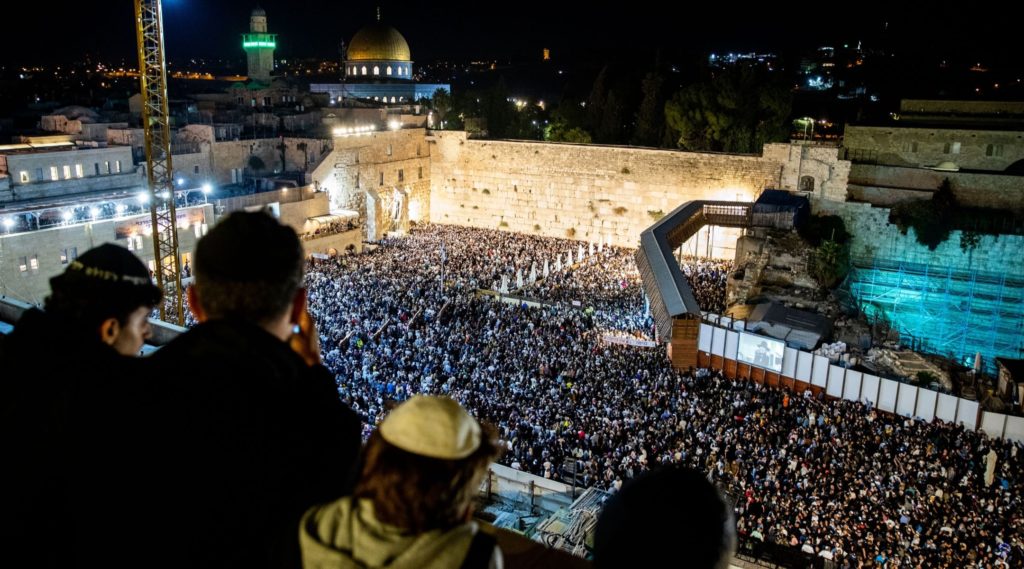
Tens of Thousands of Jewish Worshippers Pray at Western Wall on Eve of Yom Kippur

JERUSALEM (JTA) — Tens of thousands of Jewish worshippers gathered at the Western Wall in Jerusalem for the final selichot, or penitential prayers, before Yom Kippur.

The services began after midnight on Tuesday morning, and brought worshippers from around the country.

Yom Kippur begins at sundown on Tuesday and lasts for 25 hours.

In Israel, the country grinds to a halt. All stores and shops close, and public transportation ceases until the end of the observance. Ben Gurion International Airport shuts down for the 25 hours of the holiday. Israeli television and radio channels and broadcasters also shut down their broadcasts until sundown on Wednesday.

Thousands of Israeli children and adults revel in the empty roads, filling them with bicycles.

Tens of Thousands of Jewish Worshippers Pray at Western Wall on Eve of Yom Kippur Read More »