Israeli Singer Breathes New Life into Ladino Music
Israeli Singer Breathes New Life into Ladino Music
Israeli Singer Breathes New Life into Ladino Music Read More »

Israeli Singer Breathes New Life into Ladino Music
Israeli Singer Breathes New Life into Ladino Music Read More »

(JTA) — A California man who threatened in an online chatroom to kill Jews and to commit a mass shooting at a synagogue was arrested.
Ross Anthony Farca, 23, of Concord, California, said in the chatroom on the video game platform Steam that he wanted to emulate the Poway synagogue shooter “except with a Nazi uniform on,” The Mercury News reported.
He was arrested last week and charged with criminal threats and gun possession. Concord police said they found an AR-15 semi-automatic assault rifle with 13 magazines, a 3-foot sword, camouflage clothing, ammunition, and Nazi literature during a search of his home, that he shared with his mother.
He remains in custody at the Contra Costa County Jail in lieu of $125,000 bail, and pleaded not guilty at his arraignment hearing.
His screen name on Steam is “Adolf Hitler (((6 Million))).” He statements came to light via a cyber-tip to the FBI.
He said in his chats that he would livestream his massacre of Jews to the internet, and then murder as many police officers as he could before they killed or captured him.
“I would probably get a body count of like 30 kikes and then like five police officers because I would also decide to fight to the death,” Farca said in a post, The Mercury News reported citing court records. In other posts, he allegedly discussed picking a “better target than some random synagogue,” and referred to Jews as “subhumans.”
California Man Arrested After Threatening Synagogue Mass Shooting Read More »

(JTA) — Iran said Monday that it will break the uranium stockpile limit set by the 2015 nuclear deal in the next 10 days.
The Atomic Energy Organization made the announcement at the Arak heavy water nuclear facility. Its spokesman, Behrouz Kamalvandi, also said that Iran had already quadrupled its low-enriched nuclear output, the official state-run Islamic Republic News Agency reported.
Since the Trump administration pulled out of the Iran nuclear deal one year ago, Iran has pushed the limits of breaching the agreement with world powers. China, France, Russia, the United Kingdom, Germany and the European Union remain committed to the Joint Comprehensive Plan of Action.
In May, Iranian President Hassan Rouhani set a 60-day deadline for the powers to set new terms for the nuclear deal, including easing restrictions on Iran’s banking and oil sectors. Iran threatened that if the world powers failed to meet the deadline, it would remove caps on uranium enrichment levels and resume work at Arak.
Renovations have been completed on the Arak heavy water plant, which allows it to increase its capacity. In the next stage of nuclear technology development, Iran will use the extra heavy water, IRNA reported.
Israeli Prime Minister Benjamin Netanyahu on Monday called on the international community to reimpose sanctions on Iran.
“Israel stands at the forefront with the U.S., with moderate Arab countries and with other countries, in opposition to the Iranian aggression. Today Iran threatened to enrich uranium to higher levels beyond that which is permitted by the nuclear agreement,” he said. “Should Iran make good on its current threats, and violate the nuclear agreement, the international community needs to immediately impose the sanctions regime that was agreed upon in advance, the ‘snapback sanctions.’ In any case, Israel will not allow Iran to achieve nuclear weapons.”
Iran Says It Will Break Uranium Stockpile Limit Set by Nuclear Deal Read More »

Physician burnout has been in the news for many years. (I wrote about it eleven years ago.) In the last two decades the practice of medicine has become more difficult and less rewarding for many doctors. Though I know that physician burnout is increasing, I still find it shocking. We’re paid better than most. We’re generally held in high esteem. Why don’t more of us love what we do?
This month Dr. Danielle Ofri, an internist at Bellevue Hospital in New York penned a New York Times opinion piece that sounds the alarm about physician discontent. Her accusation is summarized well by the piece’s headline – “The Business of Health Care Depends on Exploiting Doctors and Nurses”. (The rest of my post is a reaction to her article. You might want to read it first and then come back here. I’ll wait.)
I find her charges entirely credible, as I’ve heard them corroborated by many colleagues and friends who work for large medical groups. The consequences are deeply disturbing. Physicians and nurses – who would be expected to be most aware of mental illness warning signs and of mental health resources– commit suicide at higher rates than most other professions.
I think good luck much more than wisdom led me to escape the sources of stress and frustration listed by Dr. Ofri. Like most doctors in training, I looked forward to the practice of medicine and had no interest in (and no training in) running a business. I took my first job at the UCLA Medical Group thinking that if I left the hiring and firing of office staff, the billing, all the details of running the business to someone else, I could concentrate on doctoring.
But I quickly learned that running the business is integral to patient care. Hiring excellent staff, deciding on which insurance contracts to accept, making sure the appointments are long enough, and myriad other administrative details directly determine the care I deliver in the exam room. I became an employee under the assumption that these details would be executed well, and that the administrators’, doctors’ and patients’ interests all aligned. I quit my job and went into private practice when I saw that this wasn’t so. Administrators have a strong interest to maximize volume. Doctors and patients have an interest in maximizing the quality of each encounter. Administrators have an interest in enrolling their group in as many insurance contracts as possible. Doctors have an interest in limiting their patient panel so that they can deliver excellent care and availability to each patient.
Dr. Ofri bemoans the enormous increase of administrators per doctor. But that simply reflects the exploding complexity of medical billing and insurance contracts. Dr. Ofri is right that these administrators are not creating value for the patient, but they are clearly creating value for the large medical systems which employ them. “If we converted even half of those salary lines to additional nurses and doctors,” she suggests, “we might have enough clinical staff members to handle the work.” Who is “we”? Dr. Ofri is not hiring the administrators. Her bosses are. Sadly, she does not have the authority to convert anyone, and there are no incentives for her bosses to act against their interests and instead follow the advice of an excellent NYT Opinion piece.
Dr. Ofri offers no solutions for physicians, and instead looks to the administrators for help. “Those at the top need to think about the ramifications of their decisions. Counting on nurses and doctors to suck it up because you know they won’t walk away from their patients is not just bad strategy. It’s bad medicine.” I hope administrators heed her plea, but I suspect they won’t.
My suggestion is much simpler. Unhappy doctors and new trainees should go where the happy doctors are – into private practice. Our practice has three physicians, two employees and zero administrators. We three have chosen an EMR that we actually enjoy using (appropriately named Elation). We are in control of our own schedules. We balance our work and our lives. We are directly responsible to our patients.
If we want happy doctors, medical training should teach the rudiments of business management – how to hire and manage employees, how to select and lease office space, how to lead a team. As it is now, everything about medical education prepares physicians to be dedicated, brilliant, unhappy employees.
For a generation doctors have fled private practice and entered jobs as employees. They gave up risk and autonomy for job security and a steady paycheck. They gave up the responsibility and burden of running a business to focus on patient care. Now it turns out that the administrators to whom doctors ceded their authority are making decisions that doctors don’t like. Doctors shouldn’t be surprised by that.
Doctor’s owe their patients excellent care, and they owe themselves a life outside of medicine and reasonable compensation. If we have failed to keep that balance, we have no one to blame but ourselves. We should look to no one but ourselves for solutions.
Learn more:
The Business of Health Care Depends on Exploiting Doctors and Nurses (New York Times, Opinion)
What’s Doctor Burnout Costing America? (Shots, NPR health news)
Beyond the Economics of Burnout (Annals of Internal Medicine, Editorial)
My post in 2008 on the shortage and discontent of primary care doctors:
On Being Doc And Being Happy
Why I’m Not Burning Out Read More »

The Israeli-Yemeni sister trio known as A-WA – comprised of sisters Liron, Tagel and Tair Haim — make Yemenite folk music with electronic beats and hip-hop influence. NPR recently described the group as “Imagine the band Haim meeting the late Ofra Haza, with some EDM thrown in for good measure.” Its first album, “Habib Galbi,” earned them a #1 hit in Israel, the first-ever for a song in Arabic.
I had the pleasure of doing Q&A with three members of the band in the midst of their most recent European tour. There are currently plans for A-WA to make a U.S. return in the near future.
Jewish Journal: Who or what made you want to pursue a career as a professional musician? A particular album or concert experience?
A-WA: We inherited our love for music from our parents, who used to play a lot of great music around the house, from Yemenite chants to ’60s and ’70s progressive rock, from Greek music to classical music, from Motown to Egyptian music. Our dad was always singing to us while playing his guitar, bouzouki or darbuka, and his special taste in music had exposed us to great vocalist and performers from diverse genres. Growing in such a musical house, we’ve been singing and dancing around the house and dreaming of eventually becoming international artists.
JJ: Your band is very hard to pin down when it comes down to genres. Is there a way you like hearing A-WA described?
A: Recently we’ve been describing our music as “Yemenite hip-hop.” A-WA distinctly had a global hit in Arabic, which I believe was the first #1 Arabic-language hit in Israel. Yet the band also sings in English.
JJ: Are the songs always written in a particular language?
A: We mostly write our lyrics in Hebrew and then we translate it into the Yemeni dialect. We feel like we’ve approved our Arabic while making ״Bayti Fi Rasi”, and we’re already thinking of combining some English and Hebrew lyrics in the near future.
JJ: Is there a career accomplishment you are most proud of?
A: We’ve had many exciting milestones and great accomplishments throughout our musical journey, but if we need to pick one, in particular, that would be the making of our new album “Bayti Fi Rasi.” This album is very close to our hearts and is a great accomplishment to us, from writing a full original Yemenite concept album to creating the music videos and leading the art-direction. Putting out the incredible life story of our great grandmother, letting our voices blend with hers, drawing a line between the generations, this has been such an amazing and emotional process to us.

JJ: What does the rest of 2019 look like for A-WA?
A: We’re going to be touring all year throughout Europe, Israel and the U.S. with the new album and the new show. We can׳t wait to meet up with both our previous and new fans around the globe and to share this musical experience of “Bayti Fi Rasi.”
JJ: When not busy with A-WA, how do you like to spend your free time? A lot of artists will tell me “I like to spend time with my family when I’m not busy with music,” but your band is unique in your bandmates also being your family…
A: In our free time we love spending time with our spouses, family and good friends. We love reading books, going to museums, going to the cinema and art shows, spending time in nature and making hand-crafts like drawing and sewing. For relaxation, we love meditating and Pilates.
JJ: Finally, any last words for the kids?
A: Enjoy being kids! Let your creativity grow and develop and give yourself the freedom to express your artistic parts. We grew up in a small village in the desert and there’s nothing like being connected to nature and animals. Remember to enjoy simplicity in times when the world is developing really fast.
More on A-WA can be found online.
A-WA’s Liron Haim, Tagel Haim and Tair Haim on Making Music that’s Diverse Read More »

We call this format a Timesaver Guide to Israel’s Coming Elections. This will be a usual feature on Rosner’s Domain until next Election Day, September 17. We hope to make it short, factual, devoid of election hype, and of he-said-she-said no news, unimportant inside baseball gossip.
Bottom Line
The pressure on the right to get 61 without Israel Beiteinu intensifies.
Main News
Avigdor Lieberman does it again. His goal – he says – is to make Likud and Blue and White form a unity government. The party with more seats will lead the coalition.
On the tight, factions battling with one another. It is not yet clear how many parties will run to the right of Likud. More than one is a problem for Likud’s prospects.
Haredi politicians keep saying that they would only join a Likud-led government. But they seem somewhat less rigid about it.
Labor race: Peretz, Shmuli, Shaffir, intend to run. And everybody is waiting for Ehud Barak’s decision. Meretz race: Zandberg vs. Horovitz.
Netanyahu getting ready (as of Monday morning) to appoint Peretz and Smotrich of the United Right as ministers. Peretz as Education Minister, Smotrich as Transportation Minister.
Sarah Netanyahu was convicted and has criminal record.
Developments to Watch
Iran: Sudden eruption of crisis can completely alter the course of the election. For more about this, listen to my conversation with Colonel Dr. Eran Lerman on Rosner’s Podcast.
Themes: Does the election shape as one on state-religion affairs? Netanyahu fears such scenario. Thus, he wanted Smotrich to vow not to make trouble as Transportation Minister and prevent Shabbat construction of infrastructure.
Personalities: The campaign is quite numb for now. It’s possible that Israel will truly turn to politics only two weeks before election day, when summer is over.
Forward Looking: what happens if teachers decide to strike when the next school year is supposed to begin, two weeks before Election Day? Their organisations signal that such action is under consideration.
The Blocs and Their Meaning
For now, things are exactly the way Lieberman wants them to be. There is no coalition without him, and unity government can be easily formed (with or without him).
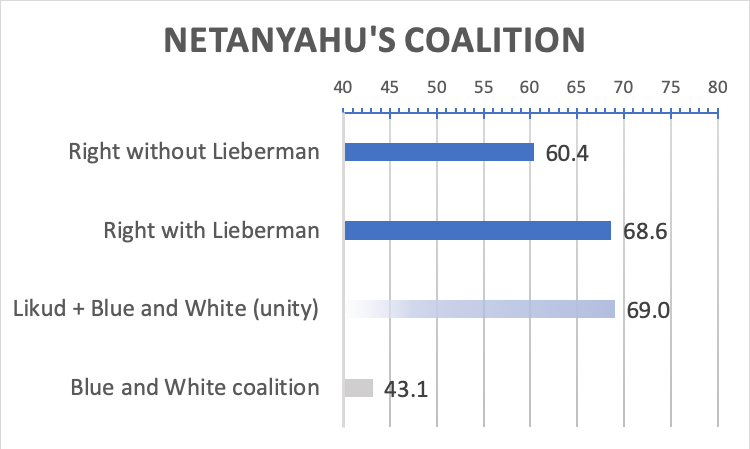
Two notes on methodology:
A Party to Watch
If you want to know why there is renewed talk about the possibility of Labor not be making it into the Knesset this time, take a look at the polls. The trendline is downward, and the more the race seems close, the more likely it becomes that Labor will fail to cross the threshold. Of course, a new leader might be able to boost Labor’s chances. Then again, if B&W look like a possible winner, we can expect the voters to look for victory rather than rush to save a dwindling Labor.

Election Handbook: Another Lieberman Surprise Read More »
