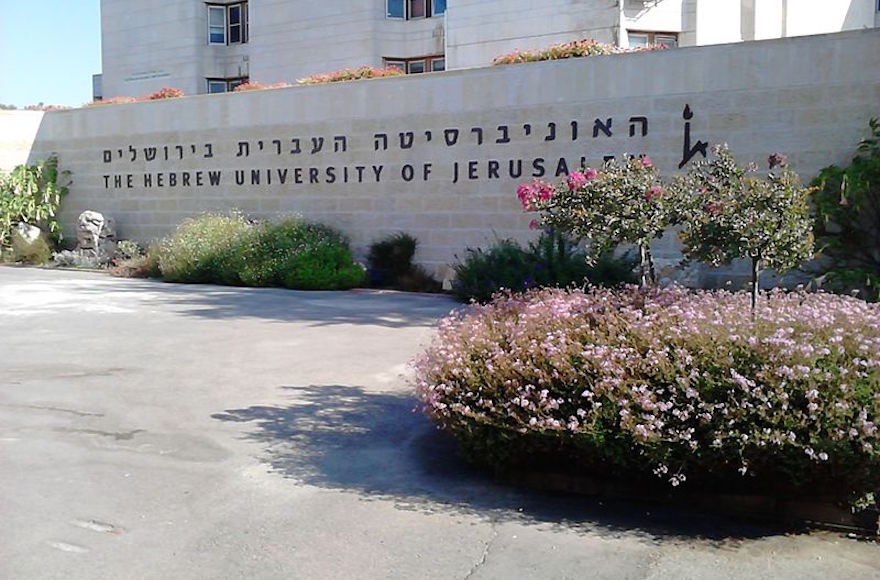
JERUSALEM (JTA) — The Hebrew University of Jerusalem will be home to an army base for intelligence officers after being selected to run a prestigious military academic program. But not everyone is happy about it.
As part of the Havatzalot project, the officers in training will wear their uniforms on campus and have separate living quarters monitored by security cameras and that can only be entered with a biometric pass. Participants agree to allow their professors to update the Israel Defense Forces about their grades and attendance.
The strict lifestyle will prevent the students from integrating into campus life, argue some at the university, and could intimidate Arab students and staff, say others.
The program includes a double major bachelor’s degree in Islamic or Middle Eastern Studies, and in mathematics, economics, computer science or philosophy for cadets training to be military intelligence officers. It is included as part of their army service. They also receive combat training, officer training and military intelligence training.
The cadets must commit to serving in the military intelligence corps for six years following completion of their studies.
A source identified as a “university representative” by Haaretz said that studying in uniform “causes a marked pedagogical difficulty and makes it difficult for the students to integrate socially into university life. We are asking that the decision to have students come to class in uniform be reconsidered.”
The IDF spokesman noted that the program has been hosted by the University of Haifa since its founding 12 years ago. “The conditions of the current tender are substantively identical to the tender on which the program has been based since its establishment,” the spokesman said. “The amazement over [the conditions] at this stage is surprising and beside the point.
It is scheduled to open at Hebrew University in October 2019.
From a historical and religious perspective, Passover may be the most sacred holiday of the Jewish calendar. The deliverance of the Jewish people from Egyptian enslavement and their ensuing journey through the desert back to their homeland marks a pivotal turning point in biblical history.
Aside from the biblical significance of the holiday, Passover, like many other Jewish holidays conveys a relevant ecological lesson, which might apply today more than ever.
Prior to the Israelites escape from Egypt, God brought a series of pests and natural disasters upon the land, imploring Pharaoh to release the Jewish people from his imprisonment. Each time Pharaoh refused to listen to God, and kept adhering to his own reckless way of life, another plague would be sent down to afflict the Egyptian Empire and its people.
While there is a clear moral doctrine behind this sequence of events, the narrative of The Ten Plagues also contains a crucial environmental component which is a shockingly accurate reflection of what is happening in the world today.
Listen to the Frogs
The first plague the Egyptian people found themselves grappling with, was that the water of the Nile had turned into blood. As the primary source of water for agriculture, the Nile is what made the emergence of ancient Egyptian civilizations in the desert first possible.
An ecological reading of the plagues brings us to today when human-induced contamination of rivers, lakes, and groundwater contributes to the deterioration of vital ecosystems, loss of habitat and biodiversity. Moreover, it facilitates water scarcity and presents a serious threat to human health.
Rabbi Yonatan Neril, founder and executive director of the Interfaith Center for Sustainable Development, emphasizes not only the importance of the ecological reading of The Ten Plagues, but also the order in which the plagues occurred.
“It is not a coincidence that the first part of the Egyptian ecosystem that God strikes is the water,” Neril says. “It is essentially the ultimate form of water pollution. It does not only become undrinkable for humans but also impacts all organisms that live in the water. The second plague is the plague of the frogs. These animals are amphibians and live both in water and on land, but primarily in or in the proximity of water. There is a connection between these two. The water of the Nile goes out of balance; therefore, the frogs go out of balance. They flee the water, move onto land and become a pest to the Egyptian society.
According to Neril, frogs play an essential role in the assessment of the health of an ecosystem. As indicator species, frogs are among the first animals to be impacted by any environmental changes in their habitat. Worldwide, a large number of amphibians (frogs and toads in particular) are threatened with extinction due to climate change mainly on account of their narrow tolerance to changing living conditions, temperature and diet.
“What we see at the moment, is very similar to what happened in the Bible. We are experiencing climate change already, but we haven’t really felt it yet. This also holds true for the first plagues and the Egyptian society. The plague of the water was a nuisance, but it went away. The plague of the frogs was a nuisance, which got into their houses, but it went away. If they had listened to Moses and learned from God’s signs, they wouldn’t have had to suffer the rest of the plagues. The frog was an indicator,” Neril adds.
All Hail Breaks Loose
Indeed, the remaining plagues did not only become more severe in terms of magnitude, but they encroached more and more on the Egyptian society and their lifestyle. The third plague, the plague of lice, already moved into a realm that had a direct effect on the people’s health, albeit, a rather inconsequential effect. Each of the following plagues brought more damage and devastation upon the human population of Egypt, all of which may be put in the contemporary context of man-made effects on the environment — ranging from wild animals running rampant to pestilences befalling man and beast to hail storms and locusts ravaging the country, leaving a swath of destruction in their wake. The longer the Pharaoh refused to conform to God’s will the more disastrous the consequences became.
In an environmental Torah commentary, Neril addresses the correlation of the seventh and the eighths plague, hail and locusts. In this context, Neril writes that the preceding hail might have triggered a locust outbreak. After periods of rain, the numbers of locusts naturally increase. In the ecological reading of The Ten Plagues, this process was facilitated by the melting of the hail.
Subsequently, the insects accumulated in the remaining patches of vegetation that had not been destroyed by the hail during the previous plague. Normally, solitary creatures, the locusts were now in close contact with their fellow species which led to the release of serotonin in their brains induced by a chemical reaction in their feces. As a result, the locusts turned into gregarious creatures swarming the land, wreaking havoc on crops and nature.
The formation of swarms of locusts is subject to studies by scientists around the world, who, indeed, have established a link between the serotonin levels in the nervous system of the locust and its propensity to swarming behavior.
Enslaved to Fossil Fuels
Further, Neril mentions the necromancers who were the wise men of ancient Egypt, and who may be considered the equivalent of today’s scientists. According to Neril, the necromancers pled with Pharaoh to listen to the signs and let the Jewish people go; otherwise, the repercussions will be catastrophic. The intransigence of governments and sluggish political decision-making when it comes to climate change, nowadays, is another element that ties in perfectly with the ecological reading of The Ten Plagues.
“In 1896, the Swedish chemist Svante August Arrhenius came up with the theory of climate change for which he won the Nobel Prize. This is already a 120 years ago. In 1965, climate scientists warned United States President Lyndon Johnson about the effects of greenhouse gas emissions and carbon pollution. So human society has known about this problem for at least 50 years,” Neril says.
“There is a deep linkage between the Egyptians enslaving the Israelites and how humanity today is in a way enslaved to fossil fuels and consumer society. As much as the scientists warn us that we need to change, every year our unsustainable lifestyle strengthens its tentacles on us”, Neril adds.
Lastly, there is the 10th plague, which is the death of all firstborn children of the Egyptian society. In a chronological sense concerning climate change, the final plague could be interpreted as the end of humanity or human civilization as we know it. However, Neril believes that this is the line that separates the ecological reading of Passover from today’s reality.
“We have to keep in mind that the comparison of The Ten Plagues and climate change only goes so far. In Egypt, it was the death of the firstborn, which is terrible enough, but the society eventually recovered from Pharaoh’s wrongdoings. In terms of climate change we have no second chance,” Neril stresses.
“I believe we still have time to turn things around. But the time is running out. It is like an hourglass. We cannot continue with business as usual. We need to react now and react appropriately. Otherwise, we are putting our lives, the lives of our children, the lives of our grandchildren and the lives of 15 million species on the planet in great danger,” Neril concludes.
In the first month, on the fourteenth day of the month at dusk, is the LORD’S Passover.
And on the fifteenth day of the same month is the feast of unleavened bread unto the LORD. *
The Passover seder is my favorite Jewish ritual.
That’s probably because I come from a Pesach-loving family who customized the Haggadah, created and maintained our own traditions, and made everyone — including “the stranger” — feel at home.
Wilen family seders famously featured silly songs, and, as we went around the table(s), a part for everyone to read, explanations for our intermarried cousins and Gentile friends, plus strict adherence to the Four Cups of Wine protocol.
[Shoutout to my Uncle Jules z”l, whose job it was to surreptitiously empty Elijah’s Cup when the kinder weren’t looking. After he died, I assumed this responsibility with appropriate awe for Ha Tishbi.]
Mostly I loved singing. I can’t claim any special expertise, but I’m pretty sure religious observances centered at home where everybody sings around the table are a unique Jewish tradition.
The kids, of course, sang the Four Questions, initially in the old Ashkenazi style, and later, with the modern melody and Sephardic pronunciation. If we were lucky, Mom, may her memory be for a blessing, might sing The Fir Kashes in Yiddish, the way she used to growing up on top of the grocery store.
We sang Seder standards like Dayenu, and Avadim Hayinu, and, towards the end of the night, Chad Gadya, a challenging chanson because the Wilen Mishpocha Minhag demanded the completion of the verses in a single breath.
Mom modified our Maxwell House haggadah with pasted-in lyric sheets for songs that you might know and obscure ones she got from the Sisterhood or _____? There was no Internet then, so maybe the fax machine at the office.
Did you guys sing Take Me Out of Egypt (to the melody of Take Me Out to the Ball Game)? Doesn’t everyone?
We always sang the “Negro spiritual” Go Down, Moses, too.
We believed then, and I still believe now, that no one is truly free until everyone is free.
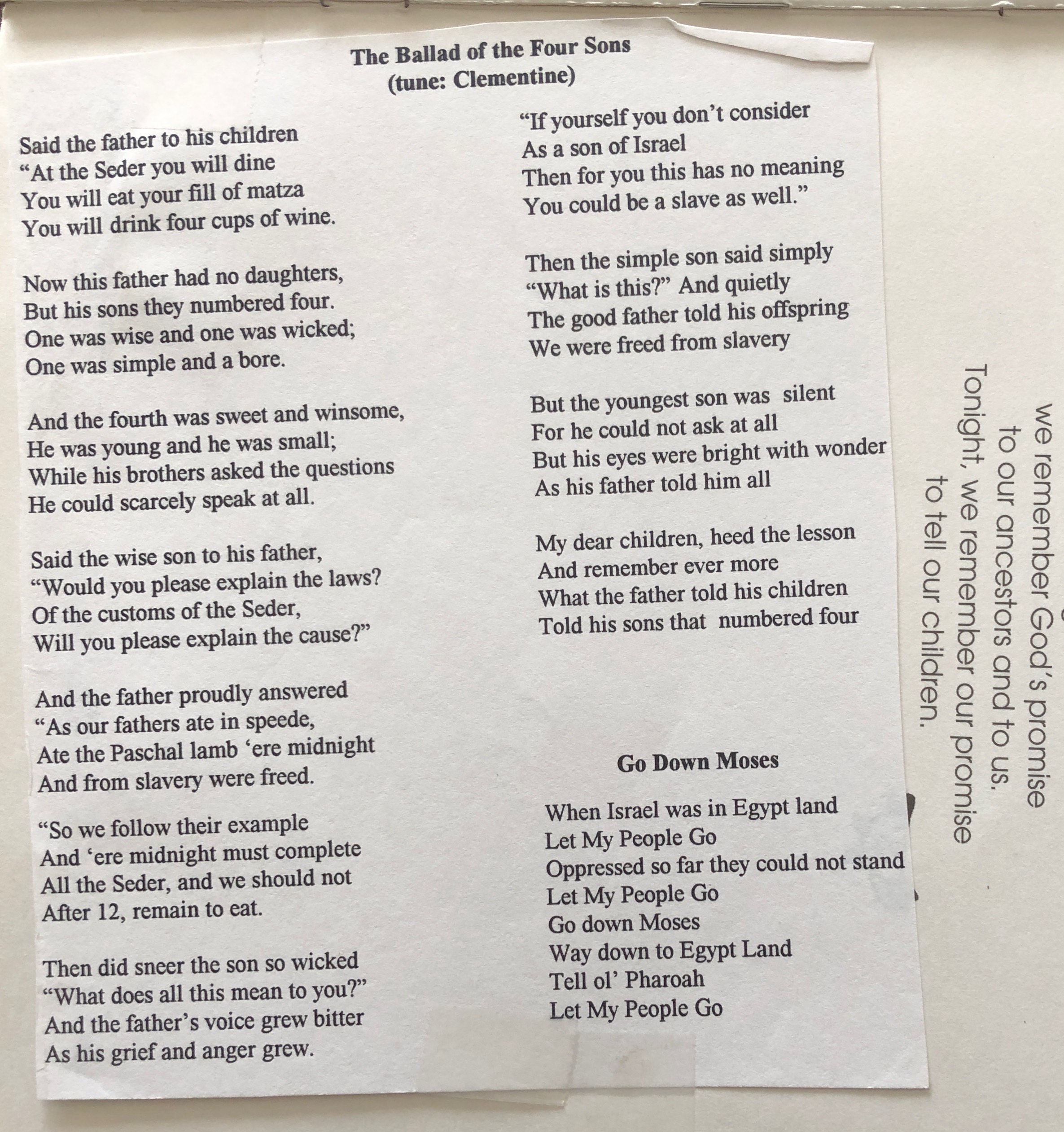
Do you know the Ballad of the Four Sons?
Mom glued the lyrics inside the front cover. Sing along!
We had our special family food traditions, too.
I hate hard-boiled egg whites, so my brother and I swapped my white for his yolk. My bro-in-law and others were not big gefilte fish fans, so Mom always offered chopped liver as an appetizing (?) alternative. Picky eaters could also opt for something she called “Swedish meatballs”, but I don’t think a Swedish chef was involved. Is Lipton a Swedish name?
Some folks just go straight to the chicken soup and matza balls, and in our family — B”H — we’ve got floaters! 😇
Mom made sure (and my sister carries on the tradition to this day) that extra soup carrots were always available for those who realize that these orange pirei ha adama absolutely MAKE the soup. [DON’T @ ME!]
But, Dennis, this post is about the music, right?
OK then. I could have included a hundred more music vids, but I decided that seven — one for each night — would suffice, i.e, dayenu.
Sing along with
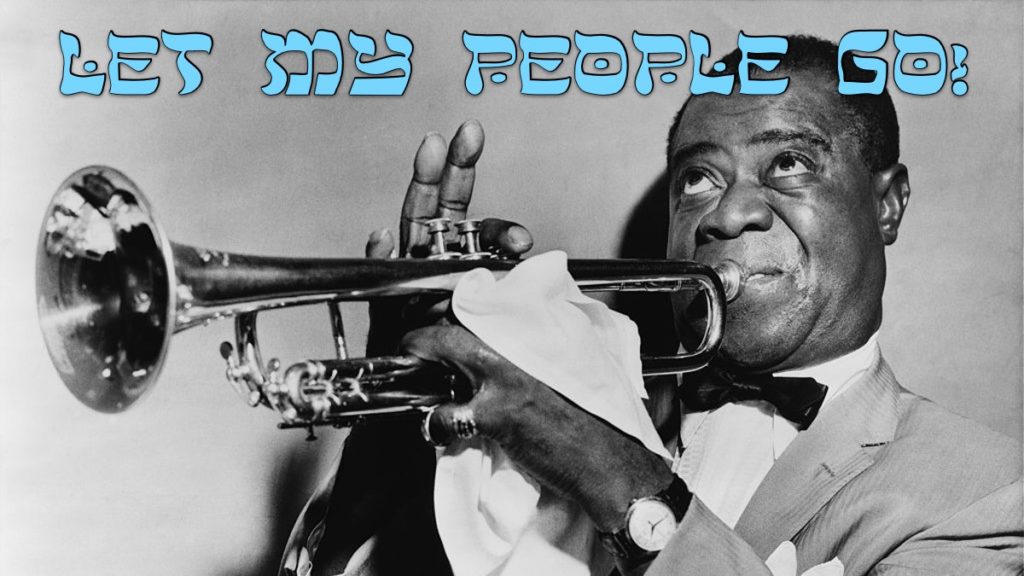
Louis Armstrong, who sets the stage with Go Down. Moses,
Dudi Feldman and Sruly Lipschitz as they welcome Eliyahu Ha Navi,
Daniel and Miri Stein’s attempt at The Four Questions,
Debbie Friedman’s version of the Passover story with Avadim Hayinu,
Doda Mollie as she runs down the Ten Plagues in The Frog Song,
The Maccabeats and their multi-style version of Dayenu, and feel the hope as
Ofra Haza closes our musical Seder with Yerushalyim Shel Zahav.
Bonus concert video from JEWMONGOUS: They Tried to Kill Us (We Survived) Let’s Eat!
Yes, you heard that right! Here are the lyrics:
We were slaves to pharaoh in Egypt
The year was 1492
Hitler had just invaded Poland
Madonna had just become a Jew
Moses was found on the Potomac
Then he marched with Martin Luther King
He came back to free us from our bondage
‘Cause S&M has never been our thing
They tried to kill us, we survived, let’s eat
They tried to kill us, we were faster on our feet
So they chase us to the border
There’s a parting of the water
Tried to kill us, we survived, let’s eat
Then the Pharaoh, who looked like Yul Bruyner
Heard the Jews were trying to escape
Charlton Heston came right down from the mountain
He said, “Pharaoh, you’re a damn dirty ape”
The menorah was almost out of oil
Farrakhan was planning Kristalnacht
The gefitle fish was nearing extinction
It looked like Moses and his flock were fehrkakt
They tried to kill us, we survived, let’s eat
They tried to kill us, we were faster on our feet
And we knew how to resist
‘Cause we’d rented Schindler’s List
Tried to kill us, we survived, let’s eat
We fled on foot, there was no time to tarry
Leavening the bread would take too long
All we had was egg foo yung and matzoh
While battling the fearsome Viet Cong
And so tonight, we gather to remember
The ancient Hebrews who paid the price
We have a Seder, each year in December
To commemorate our savior, Jesus Christ
They tried to kill us, we survived, let’s eat
They tried to kill us, we were faster on our feet
So we never did succumb to the annual pogrom
Tried to kill us, we survived, let’s eat
They tried to kill us, we survived, let’s eat
They tried to kill us, we were faster on our feet
So come on, blow the shofar
‘Cause they haven’t nailed us so far
Tried to kill us, we survived, let’s eat
Relaunched last year, the Playboy Club New York opened its doors 50-plus years after its initial early 1960s launch. In addition to a cocktail lounge and bespoke spirits library with an interplay of surprise elements hidden within, the after-hours playground is also home to fine dining. Among the top-tier talent that helped Playboy Club New York become a reality were creative director Richie Notar (of Nobu fame), executive chef Tabitha Yeh, sommelier Andrew Bell of American Sommelier and drinks consultant Fred Dex.
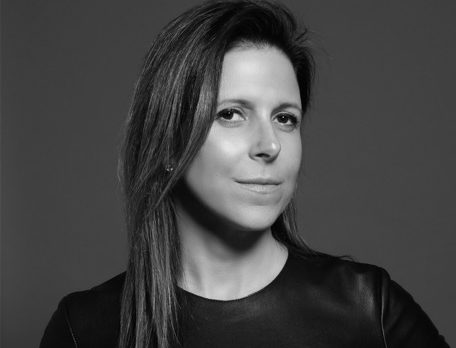
Nicole Levinson is the senior vice president of Brand Marketing and Partnerships for Playboy Club North America. Prior to landing in her current position, Levinson was a veteran of the luxury brand world, working with the likes of Christie’s, Sotheby’s, LVMH, Rolls Royce, Art Basel, JW Marriott and Ruinart, to name a few of prior credits. With Hospitality House, where Levinson was the Chief Operating Officer, she oversaw the firm’s marketing, operations and administration.
I had the pleasure of doing Q&A with Nicole Levinson about the Playboy Club New York – which hosts Backgammon Night every Tuesday night – and plenty more, including her bat mitzvah. Highlights from that Q&A are below.
Jewish Journal: You have consistently worked with luxury and upscale brands. What first drew you into that world?
Nicole Levinson: I studied Art History at Vassar College and always knew I wanted to be on the business side of the art world. When I decided to move on from the art world, I realized that one of the biggest learnings I had from working in the auction business was my early understanding of the luxury consumer, their attitudes and behaviors. The same art collector I had been marketing multimillion paintings to was staying at luxury hotels, driving art worthy cars, and sipping artisanal cocktails. I wanted to take that knowledge luxury world and build on it across other verticals.
JJ: And how did the opportunity to work with the Playboy Club brand come about?
NL: I was the Chief Operating Officer of a real estate company that worked with developers on putting restaurants into commercial and residential real estate to add value for their customers. The developer of Playboy had approached me when he brought the property to walk the space. He didn’t end up going with my firm but offered me a position to lead the marketing. In taking the COO position, I had taken a detour from my marketing career to round out my executive management skills but realized I was ready to return back to my first calling, Brand Marketing.
JJ: For someone who may been to one of the original Playboy Club locations, how does this relaunch version compare?
NL: Sadly, I had never been to the mansion or any of the past clubs. Part of me wishes I had the chance as I always get inspired when building heritage brands by exploring all part of a company. But I do look at in a positive way as well. It allows me to reinvigorate and reinvent the brand in a way that is inspired by the past but mostly looks to the future. I always say, we are not trying to build the Museum of Playboy but rather a venue that exudes the lifestyle and what makes the brand relevant to today’s evolving and discerning audience.
JJ: Do you have a favorite item on the Playboy Club menu?
NL: I love the truffle fries. It is my one weakness!
JJ: The Playboy brand is very synonymous with Los Angeles. Are there plans for the Playboy Club to expand out to L.A.?
NL: At one point in the history of the Club, there were over 30 Clubs worldwide. The brand was very successful and expanded very fast. And as it relates to Los Angeles, when [Hugh] Hef[ner] brought the brand out west, L.A. at the time was the center of Hollywood and celebrity. This time around, we are reinventing and reinvigorating the brand, and this needs to be highly strategic and carefully thought out so there are no missteps. Our plan is to really make NYC an iconic global destination that redefines what the Club means to today’s audience. From there, we would love to expand and would look to markets that help to tell the brand story as it relates to today’s day and age.
JJ: So what is coming up for the Playboy Club in the near-future? Events? Tie-ins with other brands?
NL: The Club has been the new home to all the iconic Playboy events that happened at the Mansion. We held our first Halloween event, which was a Masquerade Ball that used to happen at the Mansion. And we also held the Iconic Playboy New Year’s event, which was themed after our iconic Bunnies. Next up this summer, we have the iconic “Midsummer Night’s Dream” where the who’s who of L.A. would come to the Mansion in sexy lingerie and the men in smoking jackets. It is going to be wild to reinvent that event for the NYC landscape.
JJ: When not busy with the Playboy Club, how do you like to spend your free time?
NL: I never go very far from my roots and spend a lot of time viewing art and creating art. I love visiting art galleries in New York City in Chelsea and of course all the major museums. I also have an art studio in my home and love making art with my nine-year-old son.
JJ: As this is for the Jewish Journal, I feel compelled to ask: Did you have a theme for your bar mitzvah?
NL: OMG. I had the best Bat Mitzvah! It was a carnival theme with lots of fun games and treats. All I remember is playing “Coke and Pepsi” with the boys though!
JJ: Finally, Nicole, any last words for the kids?
NL: As a Jewish working mom, I feel proud of the achievements but I take nothing for granted. I share with my son everyday how important hard work is to achieving goals. He is a tier-1 Triple AAA Mite in ice hockey and he works so hard and keeps making his team and being asked to play in the best. I always reinforce this messaging to him so he reaches his dreams.
For membership info, upcoming events and other info on the Playboy Club, please visit www.playboyclubnyc.com.
Act.IL Los Angeles Media Room, which focuses on exposing anti-Semitism online, helped mobilize the pro-Israel community against efforts at Pitzer College to suspend the study abroad program at the University of Haifa.
Jessica Barazani, manager of the Act.IL Los Angeles Media Room, told the Journal in a phone interview that Act.IL – a joint venture of the Israeli-American Council and IDC [Interdisciplinary Connection] Herzliya – organized a petition and video campaign as part of their campaign against the resolution.
“We focused on academic freedom as the main subject of the campaign, and we just wanted to help the community and the students who are concerned about what was happening, because a lot of times students are afraid to speak out due to pressures of other organizations or they just feel that their voice alone won’t make a difference,” Barazani said.
Barazani added that they had been touch with students on campus while their Israel team did research on Pitzer, and then they filmed the video and drafted the petition. The petition received nearly 2,500 signatures.
While Act.IL was disappointed in the Pitzer College Council’s vote to suspend the program, President Melvin Oliver’s veto of the vote “showed that we ultimately achieved our goal of keeping the program alive,” Barazani said.
“We got a lot of comments from prospective students, donors, alumni, certain parents that this really went against the values of Pitzer, so we wanted to show that to President Oliver and show that there was a community who stood behind him and agreed with him in vetoing the resolution, so he didn’t stand alone in that,” Barazani said.
Barazani also pointed out that Oliver “included some phrases that we used in our campaign in his statement, phrases such as academic freedom, the exchange of ideas and… education being above politics.”
However, Mark Bailey, vice president for communications at Pitzer, told the Journal in an emailed statement, “President Oliver would like to make clear that his decision regarding Pitzer College’s study abroad program at the University of Haifa was in no way influenced by the Act.IL petition. President Oliver’s decision was made solely with Pitzer’s best interests in mind, namely enhancing intercultural understanding through direct engagement and dialogue.”
After Oliver’s veto occurred, Act.IL encouraged the community to send thank-you letters to Oliver to end the campaign “on a positive note,” Barazani said.
“The Act.IL global community is making an impact every day, and the latest example is our movement’s role in mobilizing thousands against Pitzer College’s attempt to suspend study abroad at Haifa University,” Yael Zur,director of Act.IL U.S. Operations, said in a statement. “The online and offline efforts made by our activists around the world are confronting prejudice, hate, and the demonization of Israel.”
This post has been updated to include the statement from Pitzer Vice President for Communications Mark Bailey.