fbpx

March 18, 2019

Israel’s Election Handbook: Netanyahu’s Leverage

We call this format a Timesaver Guide to Israel’s Coming Elections. This will be a usual feature on Rosner’s Domain until April 9. We hope to make it short, factual, devoid of election hype, and of he-said-she-said no news, unimportant inside baseball gossip.

Bottom Line
The Netanyahu coalition keeps gaining.

Main News
In a hotly debated move, the High Court bared a radical right-wing leader from running, and approved a radical left-wing candidate.

In the polls, the right-religious bloc gets a little stronger.

Benny Gantz’ phone was hacked by Iran. Details are sketchy, but rumors concerning the content that was stolen from the PM candidate are many.

Deadly attack in Ariel, violence in Gaza, put security, Palestinian issue, back on the agenda.

Most polls show that Moshe Feiglin’s libertarian Zehut gets into the next Knesset.

Developments to Watch

Material:  What happens in Gaza doesn’t always stay in Gaza. Demonstrations against Hamas, disquiet, protest, can lead to heightened tension near the border. Such tension is used by Benjamin Netanyahu’s opponents to argue does he is not tough enough and does not provide the security Israelis expect.

Political: The weakening of Kahol Lavan leads to tension within the party. The party is an amalgamation of different sections, and as the party struggles, they begin blaming each other for their misfortune.

Personal: Israelis were convinced that Gantz’ phone included personal material that could prove embarrassing to the candidate. If there is such material, it is very likely to be revealed by someone between now and Election Day. Campaigns are not good for secrets.

Political: As Kahol Lavan weakens, the Labor party gains. It is still far from being seen as more than a satellite to the left of Kahol Lavan, but if some observers (myself included) estimated that this could be the Labor’s last hurrah – the polls seem to suggest that this party is not yet gone.

Personal: Note the relative calm within Likud. No one challenges Netanyahu. And even his bitterest critic, Gideon Saar, is playing with the team.

The Blocs and Their Meaning

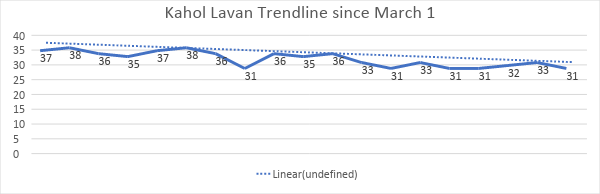
The trends seem troubling for those wanting Netanyahu gone. The Likud Party is not getting much stronger, but the gap between Likud and Kahol Lavan is closing. Without a significant gap – as Yair Lapid admitted a few days ago – it is hard to see President Reuven Rivlin denying Netanyahu a first shot at forming a coalition.

Moreover, the right-wing-religious bloc – Netanyahu’s natural turf – is getting slightly yet steadily stronger. The combined averages of right-wing and religious parties currently allows Netanyahu to form a coalition even if one of the smaller parties decides to stay out. This gives the PM an important leverage when he negotiates with his future partners. Look at the graph. If Kulanu, the more centrist of all other parties in the bloc, is unhappy with the outcome, Netanyahu could form a coalition without it. If Feiglin’s Zehut, the least predictable party, does not wish to join into a coalition that is surely not to follow its libertarian political script, Netanyahu could still go for a coalition.

Who is Netanyahu’s real enemy? The higher electoral threshold whose own coalition established. Too many parties in his bloc are dangerously close to the threshold. If one or two of them fail to get into the Knesset – for example, both Kulanu and Zehut – all bets are off.


Israel’s Election Handbook: Netanyahu’s Leverage Read More »

House GOP Members Introduce Resolution Condemning Rep. Omar

A handful of House Republican members put forward a resolution on March 18 that condemned Rep. Ilhan Omar’s (D-Minn.) “anti-Semitic comments.”

The resolution, authored by Reps. Greg Steube (R-Fla.), Jim Sensenbrenner (R-Wis.), Jeff Duncan (R-S.C.) and Louie Gohmert (R-Tex.), highlighted her 2012 “Israel has hypnotized the world” tweet, her February tweet suggesting that AIPAC buys off political influence and her Feb. 27 statement that Israel supporters “push for the allegiance to a foreign country” as examples of her anti-Semitic comments.

“Accusing Jewish people of being more loyal to Israel or to the Jewish community than to the United States constitutes anti-Semitism because it suggests that Jewish citizens cannot be patriotic Americans and trusted neighbors, when Jewish citizens have loyally served our nation every day since its founding, whether in public or community life or military service,” the resolution states.

The resolution also says that Speaker of the House Nancy Pelosi’s (D-Calif.) March 7 resolution condemning anti-Semitism, Islamophobia and other forms of bigotry was insufficient because it “failed to primarily and directly address Representative Omar’s anti-Semitic remarks in a resolution that should have been specifically about anti-Semitism so as to address the rising threat thereof.”

“Therefore, be it resolved that the House of Representative directly disapproves the anti-Semitic comments made by Representative Omar; rejects the perpetuation of anti-Semitic stereotypes in the United States and around the world, including the pernicious myth of dual loyalty and foreign allegiance, especially in the context of support for the United States-Israel alliance; condemns anti-Semitic acts and statements as hateful expressions of intolerance that are contradictory to the values that define the people of the United States; and seeks to ensure that the United States will live up to the transcendent principles of tolerance, religious freedom, and equal protection as embodied in the Declaration of Independence and the First and 14th Amendments to the Constitution,” the resolution concludes.

Rep. Omar’s office did not respond to the Journal’s request for comment as of publication time.

The full resolution can be read here.

House GOP Members Introduce Resolution Condemning Rep. Omar Read More »

U.N. Cuts Mic of Speakers Calling Out Anti-Israel Bias

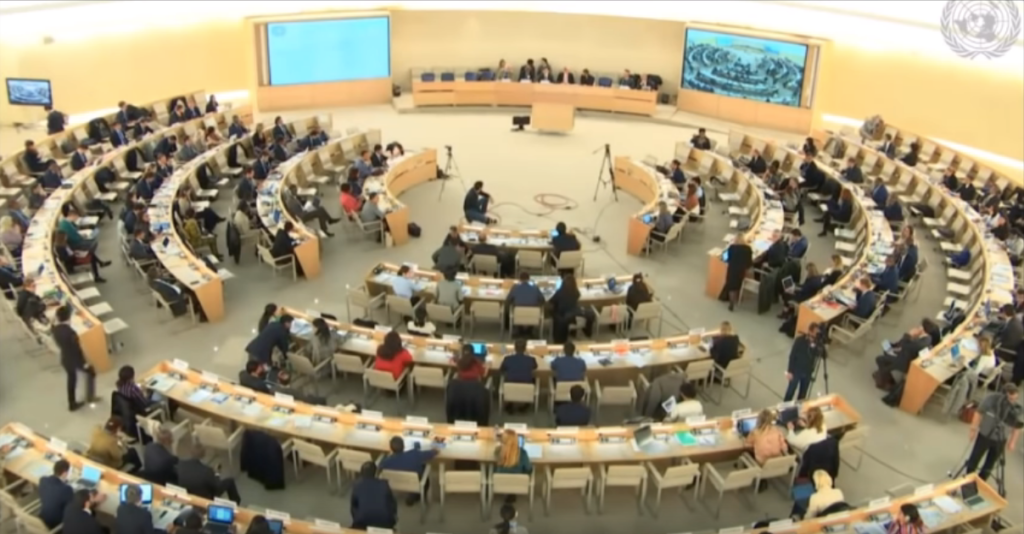
The United Nations Human Rights Council (UNHRC) cut the sound from the microphone when a couple of speakers criticized the anti-Israel bias permeating the body on March 18.

Activist Anne Bayefsky was rebutting a prior speech from United Nations Special Rapporteur Michael Lynk in which he used “Nazi and anti-Semitic tropes” against Israel; her microphone was frequently cut off throughout the speech. On two occasions UNHRC President Coly Seck told her to stop using “insulting comments.” Eventually Bayefsky’s microphone was cut altogether and she had to end her speech early.

Bayefsky told Arutz Sheva, “I attempted to draw attention to the horrible murder of Ori Ansbacher because she was a Jew, and the absence of any mention of her by the UN’s Israel investigator who claimed he was reporting on the ‘current human rights situation.’ The Council President’s response? He cut my mic! He interrupted me twice, calling my remarks naming the Council ‘expert’s’ analogies of Israelis to Nazis ‘insulting.’”

“I ‘insulted’ anti-Semites by attempting to draw attention to their anti-Semitism,” Bayefsky said. “As I would have ended my statement – if I had been allowed to speak – at this UN, anti-Semitism is not a problem. It’s a human right.”

https://twitter.com/AnneBayefsky/status/1107633947624816641

Additionally, Hillel Neuer, executive director of U.N. Watch, tweeted that his microphone was cut off shortly after he started speaking after he “tried to simply read out the names of the countries that spoke today in the debate against Israel.”

United States Middle East envoy Jason Greenblatt tweeted in support of Neuer:

https://twitter.com/jdgreenblatt45/status/1107780433469673478

https://twitter.com/jdgreenblatt45/status/1107780434149195777

The United States left the UNHRC in June, then-United Nations Ambassador Nikki Haley said the move was due to the body’s anti-Israel bias.

U.N. Cuts Mic of Speakers Calling Out Anti-Israel Bias Read More »

U.N. Condemns Hamas for Using Force Against Gaza Protesters

(JTA) — The United Nations has condemned Hamas for using force to squelch protests by Gaza Palestinians over new taxes, unemployment and electricity shortages in the coastal strip.

Hamas, which took control of Gaza in 2007, has arrested dozens of protesters and journalists.

Youth movements and groups that reject the militant group’s rule over Gaza have organized the demonstrations and are marching in the streets under the banner “We Want to Live!”

Nickolay Mladenov, the U.N. special coordinator for the Middle East peace process, criticized the Hamas tactics.

“I strongly condemn the campaign of arrests and violence used by Hamas security forces against protesters, including women and children, in Gaza over the past three days,” he wrote. “I am particularly alarmed by the brutal beating of journalists and staff from the Independent Commission for Human Rights (ICHR) and the raiding of homes. The long suffering people of Gaza were protesting the dire economic situation and demanded an improvement in the quality of life in the Gaza Strip. It is their right to protest without fear of reprisal.”

Other Palestinian factions over the weekend called on Hamas to allow peaceful public demonstrations and to release the jailed protesters. The factions also called on Hamas to halt the high taxes on goods entering Gaza, The Jerusalem Post reported.

Mladenov called for reconciliation between Hamas and Fatah, the ruling party of the Palestinian Authority led by Mahmoud Abbas, as well as the other Palestinian factions.

U.N. Condemns Hamas for Using Force Against Gaza Protesters Read More »

Sen. Cruz Calls UNHRC Israel Report ‘Absurd and Dishonest’

Sen. Ted Cruz (R-Tex.) called a United Nations Human Rights Council (UNHRC) report accusing Israel of war crimes at the Gaza border “absurd and dishonest.”

The U.N. Commission of Inquiry submitted a report to the UNHRC on March 18 concluding that Israel had violated international law for using “lethal force” against civilian protester during the Gaza border riots.

In a conference call later in the day with reporters organized by the Jewish Institute for National Security in America (JINSA), Cruz said that the report failed to acknowledge the fact “that both Hamas and Hezbollah use human shields as a tactic.

“They intend to exploit those human shields for when they are injured or killed when Israel defends itself,” Cruz said, arguing that Hamas knows that the media and the “useful idiots” at the United Nations will use the civilian deaths to attack Israel.

Cruz highlighted a May 17 New York Times headline that read, “‘Israel kills dozens at Gaza border as US embassy opens in Jerusalem” as an example of Hamas exploiting civilian deaths to create anti-Israel propaganda.

“The actual fact is that there were riots and violent attacks at Israel’s borders,” Cruz said, pointing out that the rioters, many of whom were Hamas terrorists, threw grenades, burning tires, and fiery kites in attempt to terrorize Israeli border towns. Hamas even acknowledged that they were behind these violent acts, Cruz said.

“And yet in the New York Times coverage, it was not acknowledged,” Cruz said.

Cruz also noted an instance in 2014 where Hamas used the basement of a Gaza hospital as their headquarters for operations, putting the Israel Defense Forces (IDF) “in an impossible situation” of choosing between letting Hamas operate there and continue terrorizing Israelis or risk civilian deaths by attacking the hospital that are then used by the media and the United Nations “to demonize and attack Israel.”

The report, Cruz contended, is yet another example of how “the United Nations has long been a reservoir of deep anti-Israel animus.” He said that the United States “has real skin in this game because the enemies of Israel are also the enemies of America” and that media coverage and the U.N. failing to acknowledge Hamas’ use of human shields increases the likelihood that the same strategy could be used against American troops. Cruz added that the U.S. receives “immense benefits” from Israel’s military and intelligence in fighting against those enemies.

“Truth is powerful,” Cruz said. “There is a reason why New York Times and other media outlets disseminate propaganda and lie.”

“I believe truth is stronger than lies and light is stronger than darkness,” Cruz said.

Following Cruz on the call was South Texas College of Law Professor Geoffrey Corn, who argued that the UNHRC report was based on two premises: That Hamas terrorists participating in the riots still counted as “civilians” and that the riots only constituted as an “imminent threat” if rioters breached the border. Corn said that it would be “very difficult” for the IDF “to let that border be breached and then try and close the breach.”

“The IDF didn’t take the position that every breach of the fence qualified as an imminent threat, but there must have been moments” where it concluded otherwise,” Corn said.

He added that use of force against an enemy like Hamas must be “robust” as opposed to a civilian.

Following Corn was retired U.S. Commander John Bird, who praised the IDF for thoroughly practicing the rules of engagement to minimize civilian deaths and that they were “policing themselves” on the matter, even going to outside legal avenues if they were concerned that mistakes were made. He also argued that the IDF “saved more lives” by preventing Hamas terrorists from breaching the border and attacking Israeli border towns.

“I think the U.N. played into the Hamas strategy of this hybrid warfare… that Israelis are on the wrong side of international law,” Bird said.

Sen. Cruz Calls UNHRC Israel Report ‘Absurd and Dishonest’ Read More »

Jewish Museum Berlin Honors Forgotten Jewish Peacemaker

The Jewish Museum Berlin has been bogged down in controversy in recent months for alleged anti-Israel activity.

Even Prime Minister Benjamin Netanyahu sent a letter to Chancellor Merkel, about the “Welcome to Jerusalem” exhibition (which I also critiqued), claiming it politicizes Jerusalem with a pro-Palestinian bias. The Museum and its director,  Prof. Dr. Peter Schäfer, is now under fire for holding a meeting with the Iranian Embassy’s Cultural Council in Berlin.

But a small exhibition on display at the entrance of the sister campus across the street from the Museum gives the viewer the best of what the Jewish Museum can offer, a tribute to a relatively unknown German Jew who quietly shaped post-World War I Germany.

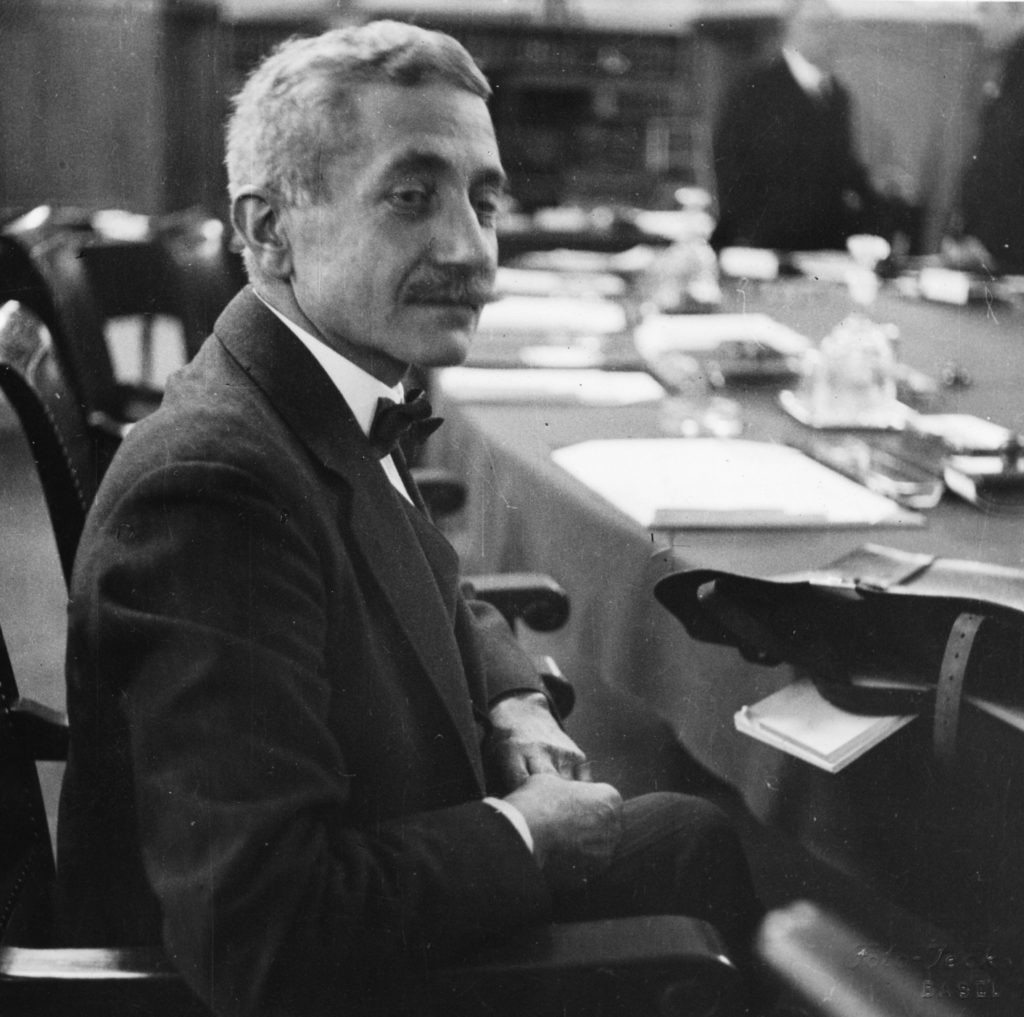
Born in Hamburg in 1871 to a Reform Jewish family with rabbinic roots, Carl Melchior was a banker and judge who was part of the negotiating team sent to the Paris Peace Conference in 1919 at the end of World War 1 to save the German people from the brink of starvation and to rebuild Germany.

The exhibition, entitled “The Jewish Fighter for a European Peace,” is on display through the end of April. Unfortunately, the exhibition and catalogue appear only in German, but English may be added should it travel in the future. The exhibition was curated by Christoph Kreutzmüller and Dorothea Hauser, from the Warburg Archive Foundation, Hamburg.

Kreutzmüller has served as the curator of the Holocaust section of the upcoming new permanent exhibition on German-Jewish Jewry. (The Jerusalem exhibition serves as a “placeholder” while the permanent exhibition is being renovated.) A former banker himself, Kreutzmüller has done extensive research on the Warburg banking dynasty in Hamburg to which Melchior was partner.

Together with the the Warburg Archive Foundation, Hamburg, he conceived of the exhibition to honor what he considers a forgotten peacemaker who sought to negotiate a pan-European peace.

At the Paris Peace Conference, Melchior worked closely with John Maynard Keynes of the British delegation.

“What caught our attention first was that John Maynard Keynes, the most important economist, published a little reflection on Melichor, and those reflections said how much he appreciated his fairness and his coolness,” Kreutzmüller told me at the exhibition. “He seemed to be a very witty—Einstein called him a witty—and fair–person.”

The exhibition features pictures of Melchior’s professional life in Hamburg, his negotiations at the Versailles Palace, and his subsequent meeting with diplomats in Paris over the course of fourteen years intended to improve Germany’s standing.

“Basically, he negotiated the end of the reparation payments,” Kreutzmüller said. “Wow. A few month later, the Nazis come and say: ‘We did it.’ Be he did it.”

For his efforts, Melchior was the second person to received the “Walter Rathenau Medallion” issued by the Weimar Republic for most honorable civil service. Rathenau was Germany’s Jewish foreign minister assassinated by Nazis in 1922. According to Kreutzmüller, Melchior could have also attained a similar position of power, but he preferred to keep a low profile, wary of meeting Rathenau’s fate.

Melchior’s work proves wrong the Nazi accusation that Jews were responsible for what they considered humiliating terms of the Versailles Treaty. In fact, Melchior advised, along with the other members of his German delegation, not to sign the treaty that was eventually accepted by the following Socialist Democrat-led government.

Melchior died of a stroke just a few months after Hitler came to power, but he already took several steps to stop them.

“He wrote a letter to [then President Paul von] Hindenburg saying: You’re tolerating this anti-Jewish policy, and this is ruining the esteem German has regained after World War I, and you ought to stop that. And Hindenburg never answered.”

Melchior founded with Reform Jewish leader Leo Baeck a Jewish welfare organization, and Kreutzmüller believes he would have tried to get as many Jews as possible out of Germany, as did his partner, Warburg.

In 1984, the Hebrew University of Jerusalem established the Carl Melchior Chair for International Policy, but mostly, people have hardly heard of him. If only the Museum would hold true to its name and dedicate more of its resources to such important German-Jewish figures instead of politicized, interfaith exhibitions, then perhaps the legacy of people like Melchior would be more justly redeemed.

Jewish Museum Berlin Honors Forgotten Jewish Peacemaker Read More »

Purim: When the Sin Becomes the Mitzvah

The festival of Purim is known for its carnivalesque tenor — a day of unmitigated joy, a celebration of Jewish survival. This exuberant expression of divine disclosure led the rabbis to view Purim as the final iteration of the theophany at Mount Sinai. But lurking right beneath the surface is a dark secret. Purim is a day when transgression becomes necessary — a day of aveirah lishma (sin for the sake of heaven).

The normative halachic tradition developed a series of directives (mitzvot ha-yom) to performatively shape what was viewed as the very core of the story that includes the expression of joy and the commandment to hate. The liturgical insertion for Purim, the Al’ha-Nisim prayer, is one of the oldest extant liturgical formulas. It begins with setting the day as a battle between good (Mordecai) and evil (Haman). It then moves to praising God for turning evil into good, introducing Purim’s distinctive quality of inversion (v’nahafoch hu). The prayer concludes with something we rarely see in classical Jewish texts: the celebration of murder in the hanging of Haman and his sons — “And they hanged him and his sons on a tree.” It is not surprising that some siddurim add an addendum in parenthesis about divine miracles, as if to say that the sages felt uncomfortable ending a prayer with the celebration of murder. But, in fact, that is part of what Purim is about.

Thus, the day celebrates survival and “commands” hate — the hatred of evil, the celebration of its demise and waiting for absolute evil (Amalek) to succumb to the power of good. There is something here that is dissonant to the Jewish ear. Although violence has always been a part of any human collective history, Judaism does not generally celebrate human violence in such an open, ceremonial and ritualistic fashion. The story’s surprising and unexpected turning of evil into good is part of the emotional charge that enables us to celebrate violence. But what of this inversion? How systemic is it? Can the divine power that is able to make evil into good also make the prohibited into the permissible? Does not Purim, with its focus on inversion, have an innate antinomian (anti-legal) strain? Inversion … rising above the binary of good and evil … divine absence revealed as divine presence (God’s absence from the story reveals God’s innate presence at the end) … v’nahafoch hu, the notion that everything is different than it appears (performed through wearing masks) — these motifs all point to something that erases the line that separates what we see and what really is, from evil to good, from prohibited to permissible.

The mitzvah to become inebriated (levasumei) on Purim, to achieve a state where there is “no difference between blessed (Mordecai) and cursed (Haman),” is another iteration of this same motif. The goal of inebriation in regard to Purim is to experientially enact the rupture of the binary that stands at the center of the entire rabbinic worldview (what is permissible and what is forbidden — issur v’heter). It is thus not far from “sin for the sake of heaven” (aveirah lishma). Much of what is written about Purim revolves around questions of good and evil, the nature and character of inversion, and the permissibility, even obligation, to celebrate death. Let us recall that the midrash has God chastising Israel for celebrating the death of the Egyptians at the Sea of Reeds. But on Purim we celebrate the death of the enemy. These questions illustrate what I am calling, Purim as aveirah lishma.

“Purim provides the occasion for a seismic and dramatic good/evil inversion that breaks the binary of ‘blessed’ and ‘cursed.'”

Averiah lishma is a much-discussed jurisprudential category, denoting instances when prohibitions can become temporarily permitted. Thus, aveirah lishma functions inside the halachic orbit, a legal category that leaves open the possibility that deviance can sometimes be required. My exploration of Purim as aveirah lishma will be based on my reading of a short essay in Rabbi Ya’akov Moshe Charlap’s “Mei Marom.” Charlap (1882-1951) was born and died in Jerusalem, having lived there his entire life. A respected member of the Old Settlement Jewish community — he was rabbi of the Sha’arei Hesed neighborhood in Jerusalem — he became a Zionist and a close friend (talmid chaver) of Rabbi Abraham Isaac Kook. He served as dean (rosh yeshiva) of the Yeshivat Mercaz ha-Rav Kook from its founding in 1924 until his death in 1951, after which the position went to Kook’s son, R. Zvi Yehuda Kook. Charlap wrote a number of important works including the multivolume “Mei Marom” dedicated to Torah commentary, essays on the festivals, and Musar. Before turning to Charlap’s rendering of Purim as aveirah lishma, I will offer a few brief reflections on the structural nature of aveirah lishma.

***

In his Hebrew essay, “Averah Lishma: Reflections in Law and Thought,” Rabbi Aharon Lichtenstein suggests three traditional responses to cases where one’s sense of divine mandate and halachah conflict, a condition that arguably enables aveirah lishma to become operative. The first response is that such a breach is simply impossible; halachah is the will of God, and thus halachah can and should provide the solution to all potential problems. The second response is that such a breach is indeed possible but has few, if any, practical implications. I understand this to mean that while halachah and divine will can be in conflict, in principle the instances where this occurs are minimal enough as to not pose any threat to the legal system. The third response is both more radical and more conservative than the first two. It suggests that one can actually come to know divine will outside of halachah, but one is still forbidden to follow it because one’s primary responsibility is to the law, “even though it may err.” In this third case, irredeemable conflict between one’s sense of divine mandate and halachah is affirmed and, by implication, that one’s sense of personal mandate may indeed better express divine will than normative practice. This is the space out of which aveirah lishma evolves.

There are, of course, numerous biblical passages that gesture toward the notion that transgressions can sometimes be permitted, often leaning on the verse in Psalms, “How can one act for God, they are desecrating your Torah” (Psalm 119:126). However, this and many other cases of aveirah lishma are episodic and thus cannot support a more systemic break with normative halachah. Thus, the law remains, even “as it may err.” Except, that is, in cases of aveirah lishma. In that case, the halachah is inverted and the aveirah becomes the halachah itself.

One illustration of aveirah lishma that views Purim as a peculiar case of “necessary transgression” comes from Charlap’s collection “Mei Marom.” In an essay about Purim titled “The Obligatory Hatred of Amalek as Aveirah Lishma in a Temporary Setting (hora’at shah),” Charlap begins with the following provocative statement:

There are times when it is impossible for the world to continue (kiyum ha-olam) in its complete purity except by means of transgression in a temporary setting (aveirah b’hora’at shah). And even though this temporary setting is Torah … nevertheless the act [of aveirah lishma] still contains a remnant of transgression. For example, we learn that a light that was kindled by a gentile on Shabbat cannot be used for the light of Havdalah, even though we hold that a gentile is not commanded on the Sabbath laws. To the contrary, “A gentile who keeps the Sabbath is liable to the death penalty (b.T. Sanhedrin 58b).” Nonetheless, there is still a hint of transgression in the light.

Charlap goes on to suggest that the commandment of becoming inebriated (levasumei) on Purim is similar, as the drunken state disables the ability to distinguish between good and evil. When Amalek emerges as an operative force that will try to destroy the world, a temporary situation (hora’at shah) is set in motion to oppose that force from being victorious. Such a situation and goal would require the transgressive to be temporarily permitted. Purim is thus a commemorative iteration of this “temporary setting.” It is the day when one must descend to pure physicality through inebriation, the day when one must celebrate survival and also hate; all of this dark energy so that the evil forces, or “sitra akhra,” will be chocked and consequently destroyed. For Charlap, the temporary situation (hora’at shah) instituted by the continued existence of Amalek exists at all times. Purim, however, is the one day of the year when Israel can have some deep impact on Amalek’s demise. However, they can do so only by acting in a transgressive manner that, in that moment, becomes obligatory. Purim provides the occasion for a seismic and dramatic good/evil inversion that breaks the binary of “blessed” and “cursed.” Purim is the day when the sin becomes the mitzvah.

For Charlap, the inversion — breaking the good/evil binary — is required to understand the hatred and even murder of Amalek, a centerpiece of Purim. Under normal circumstances, hatred, murder and debauchery are inexcusable transgressions, and it is only the divine command to hate Amalek that makes hatred and the aspiration of genocide into a mitzvah. And yet, Charlap writes that an element of transgression still remains in those behaviors on Purim (celebrating genocide and destabilizing the boundary between good and evil), even as Jews are commanded to perform them. The rabbinic notion of “the nullification of Torah is its fulfillment” seems operative here, as if to say that aveirah lishma is a category internal to the halachic system itself. Halachah, on this reading, cannot fully repair the world; its abrogation, as aveirah lishma, must accompany it.

Charlap uses the category “temporary setting” (hora’at shah) as the condition of aveirah lishma that defines Purim. But how are we to understand the structural parameters that constitute a temporary setting (hora’at shah) and how long does such a setting last? Here the category of “national emergency” may help. There have been four instances a national emergency has been declared in U.S. history (1933, 1950, 1970 and 1971). Even though none of them has ever been formally revoked, each time the society reverted to a normative legislative process once the emergency was no longer considered operative. Perhaps the lack of an official end to the emergency points to the fact that something about the state of emergency remains, just not enough to justify executive privilege to act outside the law. This remaining element of emergency after the return to normalcy (its nonrevocation) enables us to see the permitted actions of an emergency as essentially flawed, even if they may have been necessary. During normal times they remain operative but relegated to the realm of the prohibited. The presence, or resonance, of the emergency in that normal space illuminates its prohibitive state (i.e., it is always overruled as an acceptable mode of behavior). Charlap’s view is that the sin that becomes the mitzvah, yet still retains an element of sin even when it is in a mitzvah state, may resemble the actions taken in a state of emergency.

While Charlap doesn’t say all of this specifically, this is how I understand his reflections on Purim as aveirah lishma. It is significant to remember that, in general, Charlap often echoed his teacher Rabbi Abraham Kook on the paradigm of aveirah lishma to describe secular Zionism. Here, I think he is also echoing Kook by taking the idea of aveirah lishma in a slightly different direction. The secularism of Zionism is, by definition, transient and temporary. Elsewhere Charlap writes, “With the grace of God, God’s glory can be revealed in Israel through its status as a people and a nation, even in a secular form.” But the secular, according to Charlap, can never be truly holy. It may only be temporarily necessary.

“We are commanded on Purim to engage in transgressive acts, even, or precisely because, our inclination would be against doing them.”

Charlap adds another layer to this novel idea. He offers a metaphysical rendering of a temporary setting that would result in making a transgression a mitzvah without erasing all of its transgressive qualities. One might assume that the remaining remnant of transgression exists (although Charlap never says so explicitly). Accordingly, when the temporary setting abates, when normalcy returns, it can return to its transgressive status and not be permanently absorbed into the system of the holy. Here it is necessary to quote Charlap at some length:

Here is the general principle: The foundation of all mitzvot is to establish unity, and transgression establishes separation, all evildoers are scattered (Psalm 92:10). How does this work? A mitzvah can and must be established with the will of the soul and the body together. This exemplifies the true perfection out of which the supernal unity is revealed. A sin, however, can never exist from [that place of] unity. Thus, the soul is never in agreement with the body and its appetites. The sign of this temporary setting (hora’at shah) is when that unity is impossible to achieve [in a normal state]. On the one hand, there is the pain in that we are in a place where this sin has been [or has needed to be] turned into a mitzvah. On the other hand, there is joy that we are able to fulfill the will of God and God’s commandments specifically in this multitudinous manner that fulfills the very purpose of a temporary setting….  From here we can understand the sages when they teach, “One must become inebriated on Purim until one does not know the difference between cursed Haman and blessed Mordecai.” (b.T. Megillah 7b). The whole notion of inebriation is like a “temporary setting” that continues to exist as long as Amalek does. But when there truly is no difference between cursed Haman and blessed Mordecai, everything will be considered in the realm of blessed Mordecai. At that time, the temporary setting will end and the obligation to becomes inebriated will cease being operative.

In many ways, this counters what one might expect from Charlap, who was adept in kabbalistic literature. One might say inebriation of Purim brings one to a messianic consciousness. Charlap says no. Once that future arrives (when the “emergency” ends), the need for the aveirah lishma (pure physicality to destroy the Amalekite evil in that physicality) will become unnecessary and the act of inebriation will return to its prohibitive state. Alternatively, aside from Purim as a temporary state of inversion, Jews do not have the requisite power to confront Amalek through transgression. The normative system remains intact. The “inebriated” state returns to its prohibitive nature. In the end time, inebriation won’t be necessary because evil will have been eradicated. In normal times inebriation is not permitted, simply because it won’t be effective. The necessity of inebriation is only obligatory in a temporary setting (hora’at shah) that permits it — that is, the day of Purim itself. Until that time when hora’at shah is lifted, however, the temporary state which requires aveirah lishma remains, becoming operative once a year, on Purim.

This approach offers an interesting rendering of Lichtenstein’s third category of aveirah lishma. “One can actually come to know divine will outside of halachah, but one is still forbidden to follow it since one’s primary responsibility is to the law, even though it may err.” According to Charlap, Purim is a temporary state whereby one’s general intuition of divine will would incline against hatred and rupturing the binary nature of halachah, and yet “the law” on that day commands acting against those inclinations by hating Amalek and getting to the place where there is no difference between “blessed Mordechai” and “cursed Haman.” The reason is that the day represents the persistence of evil, which would require frontal and proximate engagement to destroy its efficacy by means of what would normally be sinful acts. And yet the temporariness of the moment is reiterated by the fact that a specter of transgression remains precisely in those acts that the law commands. In this sense, Purim becomes the quintessence of aveirah lishma, albeit in reverse.

We are commanded on Purim to engage in transgressive acts, even, or precisely because, our inclination would be against doing them. But it is only through such transgressions that Purim can achieve its purpose: to enable us to believe evil can be destroyed through inversion. But let us not think that transgressive halachah can extend beyond the “temporary setting” of that day. It cannot. And thus, after Purim the very thing that was the law on Purim reverts to its prohibitive state. The sign of this, for Charlap and Kook, is that the inversion is never complete, the permissible-transgressive act never fully loses its prohibitive nature, even in the act of mitzvah. The sin that becomes the mitzvah still remains a sin, albeit one that we are commanded to do precisely in order to alleviate the “temporary setting” that requires its performance.


Shaul Magid is the Jay and Jeanie Schottenstein Professor of Jewish Studies and Religious Studies at Indiana University and the Distinguished Fellow in Jewish Studies at Dartmouth College.


Purim: When the Sin Becomes the Mitzvah Read More »

Team Shalva Raises Money for Disabilities at Jerusalem Marathon

More than 1,000 marathon runners joined Team Shalva for the 2019 Jerusalem March 15.

Shalva, the Israel Association for the Care and Inclusion of Persons with Disabilities, broke a record having the largest group of runners in the 2019 “Winner” Marathon. More than 1,600 participants (of the more than 40,000 in the marathon) from Israel and abroad represented Shalva in various marathon tracks.  

Of the 1,600 participants, 650 runners came from all over the world, including the U.S., Canada, the U.K., Mexico and Australia. Members of Team Shalva ran in order to raise money to support Shalva’s programs for children with disabilities and their families and participated in the all the various tracks of the marathon, including the full marathon.

“The children feel themselves to be an inseparable part of the Jerusalem marathon, and from our point of view, it makes a significant statement for inclusion and acceptance,” Avi Samuels, chairman of Shalva, said in a statement.

This year marks the 10th anniversary of Team Shalva in the marathon and also the community run, which was initiated in the first year of the marathon by Shalva in cooperation with the Jerusalem municipality. Shalva is the largest and longest-running social organization in the marathon. More than  1,000 participants joined for the community run which is a 800 meter-track designed for families and people with disabilities.

The organization raised $1.5 million dollars from the event, which will go to finance future therapy sessions and programs.

“Participating in this marathon is a really unique, life-changing experience, and we are honored to have had so many people join us for this wonderful event and demonstrate their support for a more inclusive society,” Samuels added.

The Shalva Band, who was seen on “HaKokhav HaBa,” an Israeli interactive reality TV singing competition, led the Shalva contingency in the community run. The band is made up of eight musicians, young men and women, among them people with disabilities, who perform on stage together

Shai Ben Shushan, the creator and director of the group, was a soldier in an elite army unit, who was severely wounded in action. As a result of his own rehabilitative process, he decided to help others, using the potential of music to connect people with special needs to the population at large.

Team Shalva also had 300 runners from the Israeli Air Force, Jerusalem police and fire department and Magen David Adom marathoning with them this year as well as schoolchildren, home designer and Instablock creator Moshik Galamin and fitness coach Anat Harel.

“The marvelous energy of the community run was no doubt due to the Shalva children, which drew in the crowd with their love of life,” Samuels said. “My heartfelt thanks go out to all the people who got up early and came to hug us, among them members of the air force, police, fire department and the amazing emergency medical personnel…a special thanks to Mr. Moshe Lion, mayor of Jerusalem, who enabled us to continue this wonderful marathon tradition for its tenth year.”

Team Shalva Raises Money for Disabilities at Jerusalem Marathon Read More »

Supermodel Karlie Kloss Talks About Joining the Tribe 

Supermodel activist Karlie Kloss shared a small detail about entering the tribe on Andy Cohen’s Bravo show “Watch What Happens Live” March 14.

Kloss, who was promoting her new hosting gig on “Project Runway,” answered a fan question that she converted when she married Joshua Kushner after dating for six years.

“I joined the tribe, mazel,” Kloss said, before making a toast with her drink.

“Nice, you’re a nice Jewish girl!” Cohen replied. “I love it!

The Kode with Klossy entrepreneur tied the knot with Kushner in October for a small, 80-person Jewish ceremony in upstate New York, according to People Magazine.  People also reported that she converted in June prior to the engagement.

Kloss’ sister-in-law Ivanka, also converted to Judaism before marrying Jared Kushner in 2009.

Supermodel Karlie Kloss Talks About Joining the Tribe  Read More »

Israel Supreme Court Bars Far-Right Candidate From Elections

Israel’s Supreme Court voted to disqualify Michael Ben-Ari, head of the far-right Otzma Yehudit (Jewish Power) party, from running in national elections over his racism and racist incitement, JTA reported.

The court decided on Monday by a vote of 8 to 1 in favor of an appeal by the Reform Movement in Israel, represented by the Israel Religious Action Center (IRAC). That overturned a decision made by the Israel Central Elections Commission on March 12 to allow Ben-Ari to continue his campaign.

The appeal cited numerous examples of racism and racist incitement by Ben-Ari throughout his career. In arguments before the court on Thursday, Israel’s Attorney General Avichai Mandelblit said Ben-Ari’s racist ideas, which he desires to turn into reality, “constitute the candidate’s central and overriding goal … [and is] a defining expression of his identity as a candidate.”

In May 2018, Ben-Ari, who served in the parliament from 2009 to 2012 as part of the National Union Party, said that Arab citizens of Israel are a “fifth column” that wants to destroy the state.

Ben-Ari’s party, which follows the tenets of the banned Kach party and its leader Meir Kahane, joined with The Jewish Home and National Union parties to form the Union of Right-Wing Parties in a deal brokered in part by Prime Minister Benjamin Netanyahu.

Anat Hoffman, the executive director of IRAC, applauded the decision in a statement, saying, “Today, the Supreme Court sent an important message that racist incitement has no place in Israel’s democracy.  Our Torah teaches that all people are created in the image of God, without any qualifying statements, and we are proud to be the only Jewish movement working to enact this vision of equality in the Jewish State.”

Retired Haifa District Court Judge Menachem Ne’eman told Arutz Sheva that the Supreme Court decision to disqualify Ben-Ari is a “regrettable decision that would further harm public trust in the Supreme Court.”

“I can assume that those people who think like me that this decision is one that shouldn’t have been made will express their opposition by voting more massively for the list in which Ben-Ari was supposed to be included,” he said.

Israel Supreme Court Bars Far-Right Candidate From Elections Read More »