fbpx

February 7, 2019

Rosner’s Torah Talk: Parshat Trumah with Rabbi David Wolkenfeld

Rabbi David Wolkenfeld is the rabbi of Anshe Sholom B’nai Israel Congregation in Chicago’s Lakeview neighbourhood. He grew up in Manhattan, has a B.A. in History from Harvard University and has completed graduate coursework in Medieval Jewish History at Yeshiva University. He  studied at Yeshivat Hamivtar in Efrat and also at Yeshivat Har Etzion in Alon Shvut. He has semikhah (rabbinic ordination) from Rabbi Zalman Nehemiah Goldberg, and Rabbi She’ar Yashuv Kohen in Israel, and from Yeshivat Chovevei Torah in New York.

In parshat Trumah the people of Israel are called upon to contribute to the building of the temple – gold, silver, copper, dyed wool, animal skins, and more. On Mount Sinai, Moses is given detailed instructions on how to construct this Temple. In the Sanctuary’s inner chamber, was the ark, containing the tablets with the Ten Commandments. In the outer chamber stood the seven-branched menorah. Outside the sanctuary stood the copper-plated altar.


Previous Talks on Parshat Trumah

Rabbi Jason Miller

Rabbi Carl Perkins

Rabbi Michael Boyden

Rabbi Dov Asher

Rabbi Jason Strauss


Rosner’s Torah Talk: Parshat Trumah with Rabbi David Wolkenfeld Read More »

Report: Reps. Omar, Tlaib Could Prevent Anti-BDS Bill From Passing House

A recent report from Al-Monitor suggest that the legislation that cracks down on the Boycott, Divestment and Sanctions (BDS) movement, that the Senate passed on Feb. 7 could have some trouble passing the House of Representatives because of freshman Reps. Ilhan Omar (D-Minn.) and Rashida Tlaib (D-Mich.).

The Al-Monitor report mentions that Omar and Tlaib, both of whom openly support BDS, sit on two prominent committees that deal with the legislation: the House Foreign Affairs Committee and House Financial Services committee, respectively.

The report also highlighted a recent quote from House Majority Leader Steny Hoyer (D-Md.) that the legislation hasn’t been thoroughly vetted and that it’s not clear that it properly delineates between “free speech and the right of anybody to advocate the policy that they want and actions to hurt an ally of the United States.”

The bill, which passed by a margin of 77-23 in the Senate, would protect the right of states to refuse to provide contracts to businesses that boycott Israel, as well as provides billions of dollars in military aid to Israel and Jordan.

At the Israeli-American Council conference in November, Speaker of the House Nancy Pelosi (D-Calif.) said that she was “very pleased that our caucus has overwhelmingly been supportive of Israel” and that the pro-Israel community  shouldn’t worry about “a few people who may want to go their own way.” Senate Minority Leader Charles Schumer (D-N.Y.) also said that the House Foreign Affairs Committee would be in good hands for the pro-Israel community under Chairman Rep. Eliot Engel (D-N.Y.).

A spokesperson from Engel’s office told the Journal in an email that the BDS provision of the bill would fall under the the Financial Service Committee’s jurisdiction.

Neither Pelosi’s office nor or Rep. Maxine Waters (D-Calif.), who chairs the Financial Services Committee, office responded to the Journal’s request for comment as of publication time.

Report: Reps. Omar, Tlaib Could Prevent Anti-BDS Bill From Passing House Read More »

Letters: The American Divide, Lovely Addition to Table, Jimmy Carter’s Legacy

The American Divide
I agree with Dan Schnur that politics is a reflection of society (“America, We Need to Talk — and Listen,” Feb. 1). Most Americans agree that America has become a divided nation. That means American society has a serious structural problem.

Sometimes, architects and civil engineers have to find a solution to a building’s structural problem. In order to do that, they thoroughly examine the building, starting with its foundation.
So, my question to Schnur is: Why don’t you dive deep and examine the Constitution, which is the very foundation upon which American society is built? One article or even one word can have tremendous impact on the way the society develops. I think a thorough examination will explain why Americans “have become more wary and more suspicious of each other” and more entrenched in their “tribal instincts.”
Svetlozar Garmidolov, Los Angeles

Dan Schnur paints a very relevant picture of where our country is now. However, a point needs to be added.

The elite may get away with their policies for a little longer, but at some point, people will not take it, as the Civil War taught us.

Our Constitution begins, “We the People.” The further away we move from “we” to “I” creates an unsettling situation. This is not the future I want. Our children and grandchildren need a non-polarizing America.
Warren J. Potash, Moorpark 

Complex Homeless Situation
I empathize with Mariah Berlanga-Shevchuk’s concern for “unhoused” people on Venice streets (“Seeing Our Homeless Neighbors,” Feb. 1). As Jews, compassion for the less fortunate is part of our collective wisdom.

However, as a Venice resident and former site director of the JFS Israel Levin Senior Center on the Venice Boardwalk, I’m also concerned for “housed” fragile elderly, parents, children and others who daily face piles of used hypodermic needles, meth addicts, garbage-littered streets, anti-Semitic and racist rants, physical assaults, public defecation, and bike chop shops. Police are prohibited from enforcing loitering laws. 

The issue of “homelessness” is a complex one that the facile though well intended “counting of numbers” can’t adequately address. Many of the “unhoused” are drug addicts, mentally ill and opportunists who don’t want to abide by societal norms, or vagrants from other parts of the country who come to Southern California because of the weather and the generous services.  Most of the ones on Venice streets are young males. Few are families. 

Years ago, when I was a student at UC Berkeley, I was shocked to see people living on the streets. I mentioned my dismay to a co-worker at the San Francisco ACLU. She answered, “Who are you to say what a home is, or judge how people live?” I suggest that Berlanga-Shevchuk step outside of her bourgeois perspective in order to show compassion not only for the “unhoused” but for the “housed.”
Mina Friedler, via email 

Lovely Addition to Table
I loved Tsipora Ohr (Sydney) Edmond’s poem in Table for Five (Feb. 1). It was a brilliant interpretation of the verse in Mishpatim. I hope Edmond becomes a regular in Table for Five and in the Jewish Journal in general.
Theodore C. Friedman, Los Angeles

Anti-Semitism and Islamophobia
A phobia is an irrational fear — check any dictionary. That’s why Reuven Firestone’s attempt to explain away the justifiable fear of Islam by citing Christian attempts in the eighth century to denounce Muhammad as a false prophet and the Quran as not a true divine revelation is absurd (“Muslim Anti-Semitism; Jewish Islamophobia,” Feb. 1).

Islam burst out of Arabia in the seventh century and conquered vast areas by the sword, murdering and enslaving huge numbers of people and laying waste to great swaths of territory.
Islam, on a smaller scale, continues its march and violence today. Firestone, a professor of medieval Judaism and Islam, should know this.
Chaim Sisman, Los Angeles

Jimmy Carter’s Legacy
The historical revisionism of Jimmy Carter’s legacy is astounding (“Capturing the Mind and Heart of Jimmy Carter,” Jan. 18). It has been 40 years, and we are still living with the consequences of Carter’s follies. His anti-Semitic colors were exposed after he lost his re-election bid. To this day, he blames the Jews for his loss. By abandoning our ally and strategic partner in the Middle East, he paved the way for the violent Islamic revolution and the fundamentalism that put women back behind the veil and a whole nation under Shariah law. Having a base in Iran, Islamic fundamentalism metastasized throughout the world, sending millions fleeing their homelands. What did Carter’s naive policies achieve? Disaster. Despair. Death. That is his legacy.
Hallie Lerman, via email

Anti-Semitism of New Congress Members
The entrance of two Muslim congresswomen, Rashid Tlaib (D-Mich.) and Ilhan Omar (D-Minn.) onto the American legislative scene was swift and unambiguous. The highest order of concern for these two legislators, representing rather depressed districts in their respective states, was not their constituents’ well-being, but the geographic and social presence of a country far removed from the American shores: Israel.

Tlaib’s first action in her new congressional office was placing a yellow sticky note — with the word “Palestine” on it — over Israel on a world map. Then she proclaimed that those in Congress who support Israel, should decide what country they represent.

Omar “almost chuckled” at the claims that Israel is a democracy, as reported by JNS, on Jan. 31, and refused to apologize for her 2012 statement that “Israel has hypnotized the world, may Allah awaken the people and help them to see the evil doings of Israel.”

Of course, Tlaib and Omar are entitled to free speech. But with rights should come responsibilities, especially for those who walk the corridors of Congress. Their anti-Semitic tropes must be stopped by the Democratic leaders before they incite full-fledged hatred and bigotry, inside and outside Washington, D. C.
Vladimir Kaplan, via email

We have three new members of the House of Representatives who are clearly anti-Israel and anti-Semitic — where is the ADL in all of this?
Mitch Silberman, via email

Super Bowl Has First Jewish MVP
New England Patriots receiver Julian Edelman made history as the first Jewish Super Bowl MVP after catching 10 passes for 141 yards against the Los Angeles Rams in Super Bowl LIII.

Remarkably, this wasn’t Edelman’s first standout Super Bowl performance. In Super Bowl XLIX against Seattle, Edelman caught the game-winning touchdown pass from Tom Brady. His 337 career Super Bowl yards trails only Hall of Famers Jerry Rice and Lynn Swann.
Stephen A. Silver, San Francisco


Now it’s your turn. Don’t be shy, send your letters to letters@jewishjournal.com. Letters should be no more than 200 words and must include a valid name and city. The Journal reserves the right to edit all letters.

Letters: The American Divide, Lovely Addition to Table, Jimmy Carter’s Legacy Read More »

Sacred Spaces and Lost Arks – A poem for parsha Terumah (Aliyah 1) by Rick Lupert

…and have them take for Me an offering; from every person
whose heart inspires him to generosity…

Ever year at tax time
I enter a number into a box
equal to the number of dollars
I’ve decided to give away.

This is my offering and
it feels generous except for
the fact that this number
makes the other number

of dollars I owe go down.
This makes me suspect that
my bottom line takes precedence
over the inspirations of my heart.

On paper I’m all for the greater good
even if I don’t get points or
a tax deduction. But in my heart
it is rote and formulaic.

This is the problem when money
commingles with the machinations
of the heart. I’ve used the word heart
four times in this poem, but

it doesn’t seem like enough.

And they shall make Me a sanctuary
and I will dwell in their midst

This is why we have buildings
with open spaces and symbols
of our past adorning their walls.
You can take any place and

turn it into a sacred space
but if there aren’t the wings
of angels, carved out of gold
you have to use your imagination.

Which is actually what I do
most of the time. We don’t all
like the same colors, and in
certain circles gold is gauche.

So bring me the empty chair
in the forest, where the acacia wood
comes from and I’ll let Anyone
dwell in my midst.

As for how long a cubit actually is
it’s all an ancient approximation
at this point and we have enough
trouble with the metric system

to be bothered.

And you shall place into the ark the testimony,
which I will give you.

Everything in its place
my wife says, and I agree.
I thought it might be my
original idea until

I saw they thought it up
thousands of year ago.
I will put my keys in the
key box. I will find the

right jar for the woven wafers.
I will place the sacred words
into the sacred ark, made of
the sacred wood.

Everything sacred in its
sacred place. You have to
know where to go to
find what you need.


God Wrestler: a poem for every Torah Portion by Rick LupertLos Angeles poet Rick Lupert created the Poetry Super Highway (an online publication and resource for poets), and hosted the Cobalt Cafe weekly poetry reading for almost 21 years. He’s authored 22 collections of poetry, including “God Wrestler: A Poem for Every Torah Portion“, “I’m a Jew, Are You” (Jewish themed poems) and “Feeding Holy Cats” (Poetry written while a staff member on the first Birthright Israel trip), and most recently “Beautiful Mistakes” (Rothco Press, May 2017) and edited the anthologies “Ekphrastia Gone Wild”, “A Poet’s Haggadah”, and “The Night Goes on All Night.” He writes the daily web comic “Cat and Banana” with fellow Los Angeles poet Brendan Constantine. He’s widely published and reads his poetry wherever they let him.

Sacred Spaces and Lost Arks – A poem for parsha Terumah (Aliyah 1) by Rick Lupert Read More »

Judaism’s Special Sauce

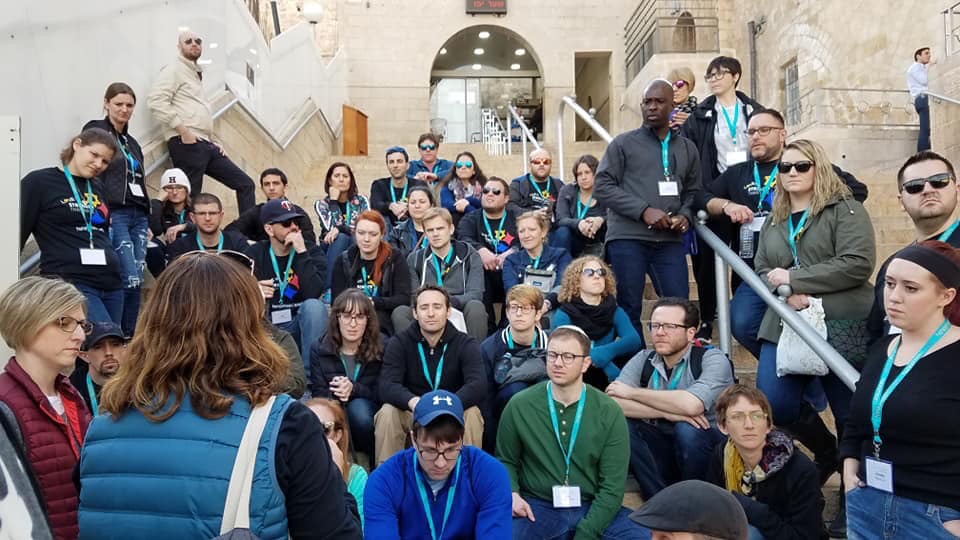
If Birthright is the burger, Honeymoon Israel is the special sauce. Before I explain this analogy, I would like to share a bit of my experience with Honeymoon Israel. In the Spring of 2018, I sought out to be the rabbinic leader of the HMI delegation from the Twin Cities. Humbly, I believed I would be one of many good community rabbis for the participants. I saw the benefit of what HMI could do for the Twin Cities’ silos and wanted to help. The other reasoning was a bit selfish. I was never eligible for Birthright and always wanted to have a young professional Israel experience. Also, I saw it as a learning opportunity for myself to be with Jews of all backgrounds and to get out of the Jewish bubble I had created.

During the trip, I never wavered from who I was as a rabbi. I believe strongly in openness to all those who walk into my synagogue. My congregants know that my love for them and their spouses is deep and honest regardless of my religious affiliation. They appreciate that the balance for Conservative rabbis is intense and real, but so is the entirety of pulpit life. Also, I tend to lean traditional when it comes to prayer and rituals and knew the HMI services and Shabbat observance would be a stretch. But I jumped in head first wanting to lead those ready to open their lives up to experiencing or re-experiencing Judaism; even if that meant using an iPhone during Friday night services.

The bonds I made with this group were authentic. For many, I was the first rabbi they had spoken to in their lives or since their Bnai Mitzvah. Certainly, none of them had ever shared a beer with a rabbi. For some I was a food advisor, some invited me to join them on dates, and others had deep soul-searching Jewish questions for me to answer.

At times I was skeptical about the return on resources the Jewish community had pledged to this program. I spent hours trying to dissect the program’s funding model, staffing model, and its ability to truly transform Judaism the way Birthright had done. By the end I was not just sold, I was emotionally attached to its mission. If Birthright is the burger, Honeymoon Israel is the special sauce.

Birthright is a magnetic Jewish venture that has become synonymous with American Jewry. Its mission has been achieved. Birthright is a burger. It tastes good. It is familiar to everyone. People will always love it even in its simplest form.

But the special sauce of engagement after Israel is at the epicenter of HMI. It is what keeps someone coming back. It is not another swipe left email type Jewish organization. HMI leaves the irresistible taste in a couples’ mouth that guides them to want more from their Jewish communities. These individuals are mature and ready to contemplate life as a Jewish couple and/or mixed-faith couple. They ponder how they want to raise their children and how they can give back.

The experience is not just going to Israel, it is owning Israel. It is seeing Israel as a place to bring their children or potential children. Israel is more than drinking in Tel Aviv or off Ben Yehuda Street (although it is that too); it is a Jewish homeland to internalize.

I have recommended this trip to people I know throughout the country; from Minnesota to Iowa to California. If we are to live in a world in which many young Jews drop their overtly Jewish identity the second, they walk onto a college campus. And a world in which intermarriage is a reality and something we must accept socially, HMI is the type of response I endorse and praise. It is not making large statements of policy. It is not worried about membership or declines. Rather it is about taking care of each individual soul as they are, a part of the changing organism that is the landscape of American Jewry.

Judaism’s Special Sauce Read More »

New York Yeshiva Vandalized, Set on Fire

A yeshiva in upstate New York was vandalized and set on fire on Jan. 28 in what is being investigated as a possible hate crime.

According to Jewish Telegraphic Agency (JTA) and Rockland/Westchester Journal News, Yeshiva Deah Yoreh in White Sulphur Springs, which is affiliated with Bais Medrash Ohr Chaim in Monsey, had several swastikas spray-painted on it while it was engulfed in flames. The yeshiva, which is on farmland, had two of its barns damaged in the fire.

Ohr Chaim spiritual leader Rabbi Aaron Lankry was reportedly too sickened by the incident to provide comment to the Rockland/Westchester Journal News.

There is no public information available indicating who was behind the incident.

New York Yeshiva Vandalized, Set on Fire Read More »

UK Guardian Changes Photo On Anti-Semitism Story After Facing Criticism

The UK Guardian changed the photo in a story about record high incidents of anti-Semitism after facing accusations of “victim-blaming.”

Jewish Chronicle writer Daniel Sugarman noted in a Twitter thread that the initial photo of the riots at the Israel-Gaza border gave the impression that, whether the Guardian intended to or not, Jews were to blame for the rising anti-Semitism in the UK:

https://twitter.com/Daniel_Sugarman/status/1093446809308053509

https://twitter.com/Daniel_Sugarman/status/1093447467268476928

https://twitter.com/Daniel_Sugarman/status/1093448310663364608

https://twitter.com/Daniel_Sugarman/status/1093449104531828737

https://twitter.com/Daniel_Sugarman/status/1093449668397334529

https://twitter.com/Daniel_Sugarman/status/1093450237031661568

https://twitter.com/Daniel_Sugarman/status/1093450992190930945

https://twitter.com/Daniel_Sugarman/status/1093452320589926400

Anti-Defamation League CEO Jonathan Greenblatt tweeted that the Guardian photo “unintentionally serves as a case study on the issue itself.”

“Anger with Israeli policies does not excuse #antiSemitism,” Greenblatt wrote. “Blaming the victim is never appropriate.”

Sugarman noted in the last tweet of his thread that the Guardian eventually changed its photo:

https://twitter.com/Daniel_Sugarman/status/1093453302421962752

As of publication time, the photo featured in the article was of a swastika beneath the word “Israel.”

The Guardian did not respond to the Journal’s request for comment as of publication time.

UK Guardian Changes Photo On Anti-Semitism Story After Facing Criticism Read More »

Report: Record High UK Anti-Semitic Acts in 2018

A new report from the Community Security Trust (CST), a nonprofit that focuses on Jewish safety in the United Kingdom, found that there was a record amount of anti-Semitic instances there in 2018

The Jerusalem Post reports that the CST found that U.K. anti-Semitic incidents increased by 16 percent from 1,420 in 2017 to 1,652 in 2018. Around 1,300 involved “abusive behavior, including verbal abuse, hate mail, anti-Semitic graffiti on non-Jewish property and anti-Semitic content on social media.” Of the more than 1,600 anti-Semitic incidents, 173 were due to hatred of Israel. An additional 148 were the result of the allegations of anti-Semitism plaguing the UK Labour Party.

The CST concluded that the number of anti-Semitic incidents was at its highest during the Labour Party’s debates over anti-Semitism and during the Hamas-led Gaza riots in April and May.

However, violent attacks and property damage against Jews declined by 17 percent and 16 percent, respectively.

A European Union poll in December found that 80 percent of UK Jews think that anti-Semitism is a serious problem in the country and almost one-third of UK Jews might leave the country as a result of it.

The Labour Party has been accused of insufficiently dealing with anti-Semitism in its ranks under leader Jeremy Corbyn, who has called Hamas and Hezbollah “friends” and laid a wreath for the 1972 Munich terrorists.

Report: Record High UK Anti-Semitic Acts in 2018 Read More »