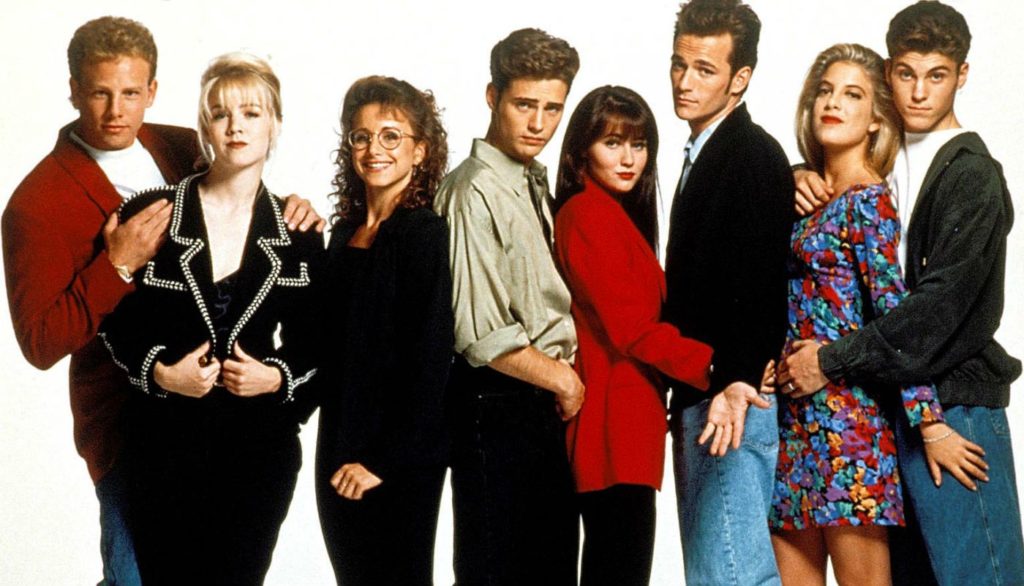
Following recent resurrections of “Charmed,” “Dynasty,” “Magnum P.I” and “Murphy Brown,” “Beverly Hills, 90210” looks to be headed back to the small screen, featuring some of the original cast reprising their characters. Tribe members Tori Spelling (Donna), Ian Ziering (Steve), and Gabrielle Carteris (Andrea) are reportedly on board, as are Jason Priestly (Brandon), Jennie Garth (Kelly) and Brian Austin Green (David).
Producers Mike Chessler, Chris Alberghini and Ghen Maynard are shopping the series to broadcast and streaming networks.
The hit 1990s series has been revived before: The CW aired “90210” from 2008-2013, featuring guest appearances by Spelling, Garth and Shannen Doherty. Spelling and Garth also teamed up for the short-lived detective comedy “Mystery Girls” in 2014.
Los Angeles City Councilman Paul Koretz has joined the chorus of pro-Israel voices denouncing hospitality company Airbnb for its decision to delist properties located in the West Bank.
In a Dec. 20 letter to Airbnb CEO Brian Chesky, Koretz said Airbnb’s actions demonstrate “prejudice, ignorance and hypocrisy. Simply put, this is an act of anti-Semitism and sets a double standard.”
“Airbnb, Inc. currently lists properties in Northern Cyprus, Tibet, the Western Saharan region, and other disputed territories where people have been displaced,” the letter continues. “However, Jewish settlements are being singled out for delisting by Airbnb, Inc. The decision made by your company is based on the position of taking one side in a two-sided conflict. There is no reason to ban the Israeli side’s listings and not the others, except on the basis of anti-Semitic sentiment.”
Koretz concludes the letter saying he will be calling on L.A. City Attorney Mike Feuer to see what options are available to “curtail or prohibit” Airbnb from operating in Los Angeles until “they have suspended their policy of singling out Jewish settlements.”
Beverly Hills City Council has also denounced Airbnb’s decision.
Comedian, actor, “Deal or No Deal” host and “America’s Got Talent” judge Howie Mandel returns to his standup roots next month with “Howie Mandel Presents Howie Mandel at the Howie Mandel Comedy Club.” This is his first solo standup special in 20 years. Taped at Mandel’s eponymous comedy club in Atlantic City, N.J., it will premiere Jan. 18 on Showtime.
Mandel also will join “A.G.T.” co-stars Mel B., Simon Cowell, Heidi Klum and new host Terry Crews for the spinoff competition “America’s Got Talent: The Champions,” which premieres Jan.7 on NBC. Memorable fan-favorite acts from past seasons of “A.G.T.” will compete against winners and finalists from international editions of the “Got Talent” franchise for the chance to be crowned the winner.
‘Discontinued,’ a show from the creator of the popular Netflix docuseries “The Toys That Made Us,” premiered on Dec. 16 on The CW. The special – hosted by YouTube star Andre Meadows – is a humorous and informative look at the rise and fall of the world’s most famous (and sometimes infamous) discontinued foods, toys, customs and businesses. The show takes viewers down memory lane recounting the rise and fall of these fallen pop culture titans, with the help of surprise special guests, “insider” experts, and a bevy of hilarious comics.
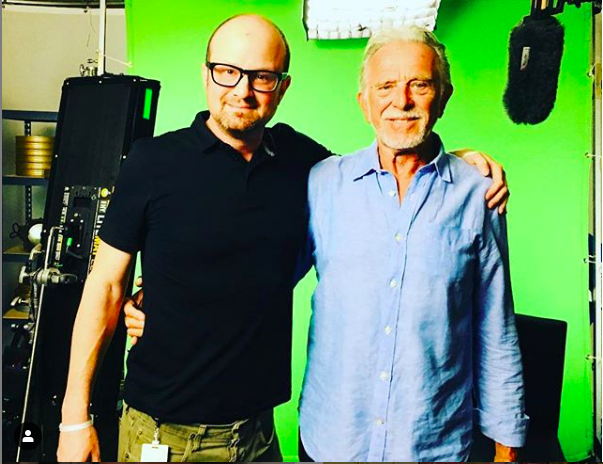
Creator and director Brian Volk-Weiss has worked on plenty more projects than “Discontinued” and “The Toys That Made Us,” to say the least. He is the founder and current CEO of Comedy Dynamics, through which he has produced stand-up specials and/or comedy albums for the likes of Marc Maron, Ali Wong, Kevin Hart, Jim Gaffigan and Bob Saget, to name a few comics. In fact, when you look at the Grammy nominations for “Best Comedy Album” for the past few years, Volk-Weiss seems to have worked on more of the nominated albums than not.
I had the pleasure of speaking with Volk-Weiss – a New York native based in Los Angeles – by phone the day after “Discontinued” aired on The CW.
Jewish Journal: “Discontinued” seems like a great continuation to “The Toys That Made Us.” Was that intentional?
Brian Volk-Weiss: No. In fact I came up with “Discontinued” at least four, maybe as many as five years, before “Toys That Made Us.” So we had made a tape, I had taken it out to market, it did not sell, and as any good or bad producer will do I just kept over and over again trying to sell it. It is connected to “Toys That Made Us” in that the success of “Toys That Made Us” reflected well on our company for producing nostalgia and pop culture programming instead of just comedy, straight-up comedy.
So I was having a meeting, or a lunch I should say, with an executive at the CW who I have lunch with twice a year for like three or four years, and he was telling me how much he loved“Toys That Made Us,” and I was like, “Thank you, thank you, thank you, thank you.” And then basically he was like, “Well what else you got?”… I pitched him “Discontinued,” and they loved it even though the tape was so old there was a section in the tape where we predicted things would be discontinued, and almost all of them had already been discontinued; like Radio Shack, or Blackberry, and stuff like that. So yeah, that’s how that all came about.
JJ: And I see in the end of that first episode, that you had to update that Toys-R-Us came back to life. When did you finish the episode compared to having to do all the retakes?
BV-W: Well, we actually locked the episode, at the most, four days before it aired. So we delivered it right until the very end. The Toys-R-Us thing, I’ll be completely honest with you, in my opinion it’s just, it’s bulls**t… It’s like, the way every four or five years you hear that Pan Am is back, and then you find out some regional air carrier auctioned the rights to the name and slapped it on the side of their plane, and two planes flying between Bozeman, Montana, and Chicago is Pan Am.
It’ll be very similar with Toys-R-Us in that it can’t come back, because the real secret to Toys-R-Us, which is all but impossible to replicate, is the distribution model they had. So that has been completely shut down and disbanded. The trucks are gone, the fulfillment centers have been sold. All of that is gone. So you’re left with a brand that every Christmas Target, or Walmart or Amazon will license and be like, “Toys-R-Us is back.”
So that all being said, I didn’t want people criticizing the show saying, “Oh, they got it wrong, Toys-R-Us isn’t discontinued.” So we added that little tag at the very end.
JJ: Well what do you think the fate is going to be of Blockbuster? When I was in Denmark a couple years ago, I saw that they did have Blockbusters there.
BV-W: Yeah, I think Blockbuster is not coming back. I think that in certain markets with certain specific variables to that market, it’ll exist until they stop making VHS tapes or DVDs, which is very soon. I am sure, five years at the most, probably two or three remain for DVD and Blu Ray production, in a meaningful way…
We put this in the show, but they were killed largely because of late fees and other things like that. Everybody thinks Netflix put them out of business. Netflix may have been the final straw, but I mean… They started to lose their leverage probably five years before they went out of business, and if they had pivoted at that point they would have survived. So it wasn’t just Netflix. Netflix was part of, but far from the only thing.
JJ: So I only had the pleasure of seeing your first episode. How many episodes are there going to be of the show? Any idea?
BV-W: Well it’s a “backdoor pilot.” So similar to the reboot of ‘Battlestar Galactica,’ if the show does well there will be more. And if it doesn’t do well, there won’t be more.
JJ: Well, best of luck with all that. If it didn’t go, you’re the kind of person that has so many projects going on at any given time that it’s really inspiring and amazing. So I’m curious what you would identify as primarily. Are you a producer? Are you a director? Are you a studio head? How to you like to be thought of?
BV-W: I’m basically going to use your terminology. I’m a studio head who every now and then directs and every now and then produces. You know, the thing about producing, if I’m being completely candid — which I always am — but when you’re a producer… Sometimes you produce something and all you get is a “special thanks” credit. Sometimes you don’t do anything and you get a producer credit…
So it’s one of the reasons why there’s a lot of confusion as to what producers do, but by the nature of my job and the fact that I own the company, I get to be a “producer” on everything. That being said, there are certainly some shows where I’m involved on a minute-to-minute basis, and then there are some shows where I’m not. ‘Toys That Made Us’ and “Discontinued”is definitely one of the shows where I’m involved minute to minute.
JJ: When you came out to Hollywood in the first place, I know that you had some interesting credits in terms of costuming and being a production assistant. What was the plan at the beginning? Did you want to be a comedy writer or a director?
BV-W: When I got out here, I just wanted to direct. All I ever wanted to do was direct. That was directly connected to seeing “Star Wars”at such a young age. I was barely three when I saw it… I didn’t know this word when I was three years old, but I basically thought the movie is what you and I would call a “documentary.” I thought it was real…
My mom was getting freaked out about me… People would be like, “Hey, what do you want to be when you grow up?” And I was like, “Oh, I want to join the rebellion and fly an X-Wing.” So my mom got me this book that showed me C3PO with his mask off… So ever since I read that book I wanted to be a director. That’s what I studied in college.
Then I got out to L.A. and I basically realized that my brain and outlook in life is better suited to producing, because when you’re directing, you’re really focused on one thing for a year or two. But when you’re a producer, you’re focused on lots, and lots, and lots of things… My brain is wired not to work on only one thing at a time.
And the other thing also I would say, is it was just so much riskier to try and become a director than to do the path that I did do. Because basically back in 1998 when I got to L.A., for me to have made a film it would have to have actually been on film. I would have had to have maxed out $100,000-$200,000 worth of credit cards…
Then this is the third thing, I don’t know if I was that talented. Or even if I was talented, I don’t know if what I would make as a movie would be popular with whoever was running Sundance, let alone the general public. So it was all of these things combined where I was like, “Nah, I’m going to produce.”
JJ: Well what exactly was it that took you to the comedy path, specifically?
BV-W: I always liked comedy… It was far from my favorite genre. I always liked it, I always respected it, I always thought it was great. I was really into Bill Cosby, and George Carlin and, of course, Eddie Murphy. But it wasn’t like a crazy thing for me, it was just something I was into a little bit. Science fiction was like my big thing.
So basically, I was in Hollywood working for free for almost a year doing all these different jobs and I was almost completely out of money, and I had heard about this job that there was an assistant looking to replace himself that was getting paid… $200 a week cash, and I was completely out of money, and that’s why I took the job. And the job was assisting a manager who only represented comedians. So that was kind of random and lucky, and as I was working for him I started going to stand-up clubs and I loved it. I absolutely fell in love with it, and it changed the course of my career.
JJ: Was that manager Barry Katz?
BV-W: It was, indeed.
JJ: Got it. So that would explain how you wound up on the Dane Cook path.
BV-W: It does, indeed. That is exactly how it happened.
JJ: Well I have to say, I really admire the business model that you created with Comedy Dynamics, in terms of producing stand-up specials for people who HBO helped put on the map and then sort of forgot about in a way. It’s almost like that you’ve become the Rhino Records of stand-up. Is that a comparison that you mind?
BV-W: First of all, I take pride in you saying that. I don’t know if we deserve that credit just yet, but I know what you mean by that. I know the history of that company very well, and I take that as a compliment. Believe me.
JJ: Well I was curious about the Comedy Dynamics Classics arm of it, that you worked with Bill Hicks’ estate and Sam Kinison’s estate. For comics like that, is there a lot of unreleased material?
BV-W: Tons. I mean, Bill Hicks… We just literally put out a new Bill Hicks record two weeks ago. [Editor’s Note: Bill Hicks passed away in 1994.] And I would say we’ve put out at least one or two a year for the last five years. So yeah, that’s like, tons. Not everybody has that. Kinison does not have as much as Hicks.
But we’re doing a deal now, I can’t say yet who it is, but I mean we just got 19 boxes of material that literally barely fit in a gigantic trunk. So yeah, a lot of these comics… either they themselves or the people around them save everything. And we have been very lucky to get to do that kind of thing.
JJ: And is all of that going to persevere with the streaming business model? Or do you see Comedy Dynamics then having to change its path?
BV-W: I wish there was a word stronger than “persevere,” because it’s more than that. Streaming is allowing us… I mean, basically I would say before streaming it was like, propellers. And the advent of streaming maybe about six years ago was the beginning of the jet age. And what streaming is becoming this year, and is obviously going to be continuing for at least another four or five years, is like us having rocket engines…
The whole model, everything we’ve done is based on a book that I read in 2006 called “The Long Tail.” And I don’t know how familiar you are with that book or not, but it’s a business book, and the reason why I always mention what year I read it is because it came out a year before the iPhone. It came out the same year as YouTube. Netflix was not even thinking of streaming yet, probably. So it really predicted everything that came, and the main thing it predicted was this thing called “unlimited shelf space.”
So when I read the book, everybody had to go to Walmart or Target or Tower Records to get stuff, and those companies would only stock the product that would sell the best because they had finite shelf space. So what the book did was it predicted a time when there would be unlimited shelf space… That time really started about three years ago, four years ago, but it just kicked into high gear like this year… And it’s just going to keep blowing up.
So you know, we have a library. The library does what it does, but now instead of sending it to four places a month, we send it to 160 places a month. So that’s what streaming has created.
JJ: And over to you, is there anything that you miss about living in New York?
BV-W: I don’t know, everything. It’s the greatest city on Earth. I was just there last week. It’s the greatest city in the whole world. I wish I could do what I do there. And everyone says you can, but I can’t. Not what I do. I have to be here. And I’m not the biggest fan of Los Angeles. I’m going to be a little diplomatic right now, but I definitely miss the East Coast. I miss New York so much, and I’m pretty sure I’m going to be retiring out there. Hopefully.
JJ: So ultimately is there anything in your career you haven’t yet accomplished that you’re still hoping to do?
BV-W: I’d like to get at least nominated for an Emmy. I really feel sometimes that everybody I know has like five Emmys, but me, and I haven’t even been nominated so I would love that. It’d be great to get nominated for an Oscar, but you know, who knows?
I feel like I’ve had a very blessed career in terms of output. I’ve made a lot and it’s been well received by the public. I do not feel that we get celebrated for the quality of our work by the various award shows, and listen, it is what it is. I’m not angry or bitter or depressed about it. Nothing’s perfect. There’s people who have won a million awards and no one’s heard of them, so I would much rather be where we are than that… We’ve been nominated for a million Grammys, so we do have that and I’m very honored with that. But yeah, I’d like to at least be nominated for an Emmy.
And then the other thing I really want to do before I hang up the spurs, or the cleats, or whatever analogy you choose. I really want to make a big science fiction movie. I want to make a big, big, big movie that at least tries to do for the public what “Star Wars”did for me, and I am pretty sure that if I get the opportunity to do that’ll be the last thing I do before going to teach communications at a small school that nobody’s ever heard of.
JJ: (laughs) That’s great. So in closing, any last words for the kids?
BV-W: If anybody’s out there and they view what I’ve done in any way as good or inspiring or impressive or as accomplishing, if they feel that way about what I’ve done at all, the No. 1 thing that I would attribute what I have done is… and I don’t feel successful yet. I don’t feel accomplished yet, myself.
But if other people look at what I’ve done and they feel that way about me, and if they were to say… What’s the thing that you did that allowed you to do what you’ve done? It is literally that every day I came to work and I worked, and I fought. And no matter how bad things were, I’ve had bad days, I’ve had bad weeks, I’ve had bad years. I’ve just never stopped. I’ve never given up.
I’ve had bad moments where, and there’s a great song I quote, where I was down to my last match. And I’ve been down to my last match three or four times, and as long as you keep fighting you’ll always keep moving upwards. The majority of the people I know that have not succeeded, I would completely attribute it to they just quit. So as long as you never quit, you’ll always succeed…
Now I’m going to really get on my soapbox. But if you’ve been lucky enough to be born in this country, as long as you don’t quit… So I don’t know who’s going to read this or hear about this in other countries, but if you are lucky enough to be born in the United States, just don’t quit and you will succeed.
More on Brian Volk can be found by following Volk-Weiss on Instagram, Twitter and Facebook via @BrianVolkWeiss, while Comedy Dynamics keeps a home online at www.comedydynamics
I will lie with my forefathers, and you shall carry me out of Egypt, and you shall bury me in their grave.
The last choice we get to make
is where they will lay our bones.
After a lifetime of decisions –
Lefts versus rights, which brands of
major appliances to buy, ups versus downs,
skinny jeans or boot cut, vegetarian
versus carnivore, whose hand to shake,
whose soul to commingle with.
We write it all down in a final document
or, like Jacob did, tell it to our son –
the final, implied, verbal contract.
We can only hope, when we become
non-speaking dust, those entrusted
with what’s left of us, honor our choices,
bring us home to where we brought
our mothers and fathers, and mark
the location so the living will
never forget what we did.
Then Israel saw Joseph’s sons, and he said, “Who are these?”
Jacob, on his death bed
sits up like a lion
with the strength of a star
like the father of all grains of sand.
His grandchildren before him
like they are the sand.
He sees the future in their eyes.
Or more importantly that
there is a future.
A sea will open up.
A desert will be wandered.
Armies defeated.
A river crossed.
And more begetting than
would be polite to mention.
The promise will come true –
We’ll run out of stars to match
these young eyes.
On the verge of the forever sleep
his eyes about to close, knowing
his name will live on.
(JNS)Sodastream is planning to open a manufacturing plant in Gaza, its CEO announced on Thursday.
“We want the people in Gaza to have jobs—real jobs—because where there is prosperity, there can be peace,” said Daniel Birnbaum at the Globes Conference in Jerusalem, without going into detail.
In 2014, the originally owned Israeli carbonation-product company closed its factory in Judea and Samaria, and moved to a bigger plant in the Negev Desert.
Birnbaum said efforts to boycott Sodastream at the time only had a marginal effect on the company. These boycotts were, and still are, advocated by the anti-Israel BDS movement, which includes calls to not purchase products made in the West Bank.
The carbonation-product company was acquired this year by PepsiCo for $3.2 billion.
Depression AmongPersian-American Jews Depression and drug addiction are chemical imbalances and mostly related to genetics (“Silent Pain,” Dec. 14). According to drugabuse.com, the rate of alcohol and drug abuse among millennials and Generation X tripled from 1990. Also, the depression rate, according to Forbes, increased up to to 45 percent among younger generations. More than 60 percent of college students are on Adderall or a Selective Serotonin Reuptake Inhibitor (SSRI). The reason that these are mentioned is the unknown future for these kids: high competition; difficulty in finding the dream job or finding a job at all; not making enough money to live on their own; or coming from broken family (in general, constant stress), to name a few.
Depression and drug addictions are not only in the Persian-Jewish community, they’re everywhere. Do Iranian-Jewish families seek help? Yes, at a rate higher than American families. The No. 1 listeners of Farhang Holakouee, a famous psychologist in the Iranian community, are the Jews. The No. 1 clients of Iranian psychologists in drug-related and depression diseases are Jews. Persian Jews might not announce to the world that their kids go to psychiatric or psychologist, but they seek help.
This is within their right to privacy and considered confidential information. If the sick person seeks assistance, the recovery will be fast but when they don’t acknowledge the problem or cooperate, then they end up on the streets or in shelters.
You can inquire further by asking Iranian psychotherapists Shirin Nooravi and Foojan Zeine. Are depression and addiction the result of pushing kids to be perfect? Yes, to some extent but not entirely. Chinese parents are famous for pushing their kids to be perfect and achieve the highest goals. Is the rate of depression, suicide or addiction higher in their community? What about in the Latino community, in which being perfect is not normally a big expectation by the parents? According to reporter Tabby Refael, this latter community should have no problem.
Refael is right that sex, poverty, LGBT or depression and drug addiction are all taboos in the Persian-Jewish community, especially for those who have a daughter, but why? The Iranian-Jewish community is afraid of intermarriage. The confusion about those Refael mentioned and religion classifications are because of this fear. Persian Jews fear revealing that a non-Jew will marry their daughter or son.
Would you be happy if your son or daughter fell in love with someone who was addicted before or has a family history of depression running in their family? Also, whatever Iranian Jews do in the United States is copied from Americans, from lavish weddings, bar or bat mitzvahs, to funerals and excessive drinking of alcohol and drug use. Also, no worries! In less than 50 years, the Iranian-Jewish community will vanish, just like Iraqis and others who disappeared. So far, the Iranian-Jewish community is one of the strongest and most successful communities in the U.S. Minoo Moghimi, Moghimi is an occupational therapist worked in alcohol and drug abuse adult health daycare centers.
Tabby Refael’s excellent cover story sheds much-needed light on the pressures inherent in the Persian community to have the “perfect, over-achieving family” and the often-tragic consequences of those who don’t meet community expectations.
Tragically, this cultural phenomenon also extends to families who have children with developmental disabilities.
Twenty-five years ago, ETTA, a Southern California nonprofit that serves adults with special needs, recognized that something has to change. Under the direction of Manijeh Nehorai, who was a social worker in Iran and held high-level posts in the Iranian government before emigrating to the United States with her family, ETTA launched the Iranian-American Community Services Division to provide services to special needs members of the Iranian community and their families.
This division has been hugely successful in not only providing services, but in dispelling the negative Iranian community stigma of having a special-needs family member. It is through the hard work and dedication of people like Nehorai that Iranian families today hold their heads high and are proud of the joy and blessings that every family member brings. Michael Held, Executive Director, ETTA
As a Persian Jew, I would like to thank the Journal for Tabby Refael’s cover story. Refael is open, honest and raw about some taboo issues in the Persian-Jewish community. It takes vision and courage to understand these shortcomings and to discuss them openly, in the hopes that we better tackle these challenges. This story not only benefits Persian Jews, but non-Persians as well in bringing some understanding to the dynamics of this community.
Kol ha-kavod to Refael and kudos to the Journal for bringing this issue to the forefront. Angela Maddahi, Via email
Israel’s Worldwide Diplomatic Effort David Suissa expresses the conventional wisdom when he writes that “the U.N. is a cesspool of anti-Israel sentiment, virtually immune to any activism.” (“A Shameful Jewish Silence at the U.N.,” Dec. 14).
In fact, Israeli diplomats are the activists. They know that the U.N. reflects the views of its separate member-states and has no identity apart from them. Lately, however, Israel has a worldwide diplomatic effort underway, led by Israeli Prime Minister Binyamin Netanyahu, to win friends among U.N. members. A Journal article some weeks ago described this effort as yielding many successes with non-European countries.
Sometimes, as President Donald Trump reminds us, the best way to influence an organization is to engage its members individually. Barry H. Steiner, Professor Emeritus of PoliticalScience, CSULB
Berman observes how warnings regarding the rise of anti-Semitism on the left in Britain went unheeded with the result now that it is widespread and tolerated in the U.K.
Tragically, something similar seems to be happening here in the U.S., where, for example, among new legislators elected in the midterms are Rashida Tlaib (D-Mich.), who calls Israel “racist” and supports its replacement with a single, Arab-dominated state; and Ilhan Omar (D-Minn.), who has labeled Israel an “apartheid” state, damned it as guilty of “evil” acts and who is the first open Congressional supporter of boycott, divestment and sanctions.
Once, such extreme positions would have been news. Today, they are almost universally ignored. Thus, PJ Media’s David Steinberg has identified 105 news stories written in the immediate aftermath of Omar’s victory, not a single one of which even mentioned her extreme statements (or, for that matter, the abundant evidence of her having committed federal and state felonies).
Anti-Semitism flourishes where, among other things, the media normalizes anti-Semitism to the point of not even regarding it as worthy of mention, let alone investigation. Fighting the normalization of anti-Semitism is the enormous challenge that American Jews have before them. Morton A. Klein, National President Zionist Organization of America
Three men were arrested at Penn State University for the theft and vandalism of the nine-foot menorah in front of the Zeta Beta Tau fraternity house.
State College police received a report on the first night of Hanukkah, Dec. 2, about the vandalization of the menorah and have since filed three criminal complaints at a district court against those responsible.
Penn State’s college newspaper the Daily Collegian reports that “The menorah wasstolen from the fraternity house at 328 E. Fairmount Ave.” and that “a Zeta Beta Tau brother witnessed the incident. In an attempt to stop the individuals, the brother was then assaulted, according to a criminal complaint.”
Police are still looking for suspects in this vandalism case we first told you about on Friday. Someone removed and damaged a menorah at the Zeta Beta Tau house at Penn State. pic.twitter.com/ID2QTkg4BB
According to a statement provided by State College Police, David Kovacs, 20, Thomas Callahan, 19, and John Hamlin,19, “have been charged with misdemeanor theft by unlawful taking, receiving stolen property, and criminal mischief for their roles in the incident. Charges are pending against a fourth 20-year-old suspect.” All are Penn State students with the exception of Hamlin.
The Zeta Beta Tau president arranged for the return of the menorah to the original owners, prior to police involvement in the matter. The three men have cooperated with the police and the fraternity has taken internal action against them.
At this time the police said ethnic intimidation was not believed to be involved in the case.
Kovacs, Callahan and Hamlin have preliminary hearings set for Jan. 16, 2019.
What better way to bring in Christmastime than with a couple of Jews? James Corden of “The Late Late Show” released his third annual Christmas Carpool Karaoke video Thursday – and this one featured Tribe members Barbra Streisand and Adam Levine. Levine and Streisand were part of earlier Carpool Karaokes this season.
Cardi B, Paul McCartney, Shawn Mendes, Migos, Christina Aguilera, Michael Buble and Ariana Grande also made an appearance as they all sang along to “Christmas (Baby Please Come Home).”
“Happy Hanukkah! Happy Holidays! Happy Christmas!” Streisand said in between measures.
The Christmas classic, written by Jewish songwriters Jeff Barry and Ellie Greenwich in 1963, was originally performed by Darlene Love. It has since been covered by Mariah Carey, Cher, and Michael Buble to name a few.