fbpx

December 13, 2018

Rosner’s Torah Talk: Parshat Vayigash with Rabbi Zvi Romm

Rabbi Zvi Romm. is the rabbi of the historic Bialystoker Synagogue on Manhattan’s Lower East Side, the Administrator of the RCA-affiliated Manhattan Beth Din for Conversions, and an Instructor of Talmud in the Isaac Breuer College of Yeshiva University.

In parshat Vayigash, Judah approaches Joseph to plead for the release of Benjamin. Joseph reveals his identity to his brothers. The brothers rush back to Canaan with the news. Jacob comes to Egypt and is reunited with his beloved son after 22 years. Joseph gathers the wealth of Egypt by selling food and seed during the famine.

Watch it here:


Previous Torah Talks on Vayigash

Rabbi Mitchell Wohlberg

Rabbi Gary Glickstein

Rabbi Steven Schwartz

Rabbi Naama Kelman


Rosner’s Torah Talk: Parshat Vayigash with Rabbi Zvi Romm Read More »

NYU Jewish Center Temporarily Closes After Student’s ‘Anti-Semitic’ Posts

New York University’s (NYU) Jewish center, the Bronfman Center, was temporarily closed on Wednesday due to social media posts from an NYU student that were “anti-Semitic in nature.”

The Bronfman Center sent out an email on Tuesday night saying that they “became aware of several public online postings by an NYU student which were anti-Semitic in nature and potentially threatening.”

“Due to heightened tensions at NYU, we are taking all threats seriously and have notified NYU Public Safety and NYPD,” the email continued. “While we do not believe that there is a credible threat, we are taking every necessary precaution.”

A follow-up email from the Bronfman Center was sent out on Wednesday afternoon announcing that the center was back open after law enforcement and security experts concluded that there wasn’t a risk.

“In October, we tightened our security protocol,” the email read. “We will be pursuing additional measures, including modifications to our building and active shooter trainings. Better safe than sorry.”

NYU spokesman John Beckman said in a statement, “Late Tuesday night, the University became aware of some disturbing posts on social media.  There were no specifics in the social media posts, and we had no information about a particular threat against the Bronfman Center.”

“However, against the backdrop of the killing of Jewish worshippers in Pittsburgh and the national increase in anti-Semitic incidents, and in an abundance of caution, the Bronfman Center for Jewish Student life was closed while the issue was investigated and safety issues were evaluated,” Beckman continued. “Needless to say, we take these issues very seriously and act accordingly.  NYU condemns anti-Semitism and hate of all forms.  We have taken appropriate security precautions, and the Bronfman Center has re-opened.”

Beckman added that NYU is “actively reviewing [the] matter” but couldn’t discuss the specifics.

While the name of the student has not been made publicly available by the school, the New York Jewish Week reported that “several campus-affiliated groups have pointed to the same student as the source of the social media posts.”

“An anonymously run Facebook page called ‘SJP Uncovered’ posted screenshots of the following post from the student’s Twitter account on Dec. 3: ‘thanks to whoever got my account suspended just cuz i expressed my desire for zionists to die .and f**k twitter for not doing a better job of deleting entire accounts that do nothing but tweet violently racist things,” the Jewish Week reported.

Other screenshotted tweets from the student that SJP Uncovered highlighted included a tweet of the student writing “I love Hitler” and “I hope every zionist kkk*nt @ nyu is crying right now,” the latter being an apparent reference to the recent BDS resolution that was passed that has reportedly resulted in “inflamed tensions” on campus.

NYU Students for Justice in Palestine (SJP) and NYU Jewish Voice for Peace (JVP) both issued statements that the student has not been associated with either group and that they condemn his social media postings.

The Washington Square News, where the student in question was once an editor, wrote in a statement on their website, “It has come to WSN’s attention that tweets and posts written by a former editor of the newspaper have stirred fear in the Jewish community at NYU and caused the temporary closing of the Bronfman Center. We wanted to clarify that the editor in question no longer works for WSN, and we do not condone the statements made in the aforementioned tweets and posts. We apologize to any students affected by the statements.”

The student eventually issued an apology for his statements, writing, “people have been conflating my anti-Zionist views with anti-Semitism, pulling up Tweets from 4+ years ago — falsely associating them with what’s happening now and threatening to ruin job prospects for me, a person that [sic] extremely vulnerable due to socioeconomic reasons; and all while not having the slightest clue about what was actually said or by whom.”

“My views on Zionism do not reflect my views on Judaism,” he added.

He then apologized “to anyone that genuinely feels scared.”

“I would have done things differently had I known it would actually instill fear in innocent people,” the student said. “I’ve spoken to the Wellness Center, to Office of Community Standards and Public Safety. They all know that there is no threat of danger.”

NYU’s Realize Israel wrote in a Facebook post that they were “deeply troubled” by the student’s statements.

“As a result of these statements, the Bronfman Center for Student Life was temporarily closed last night and through this afternoon,” the post said. “The Bronfman Center serves as a home, and as of late, a safe haven for Jewish students on campus. Given the events of last week and the rising tensions and divisions on campus, this space has been even more important, and it has become even clearer that it is difficult to separate anti-Zionism from anti-Semitism.”

The post continued, “While the Bronfman Center has now reopened, we still feel concerned that recent events have opened the doors to racism and discrimination. While the individual who is associated with these statements is not a part of or affiliated with any of the campus groups that proposed last week’s BDS resolution, we have seen that a resolution that promotes alienation and segregation will only lead to increased hate crimes and hate speech.”

The student in question has not responded to the Journal’s request for comment as of publication time.

NYU Jewish Center Temporarily Closes After Student’s ‘Anti-Semitic’ Posts Read More »

The Siblings We’ll Risk for Food - A poem for Parsha Vayigash (Aliyah 1) by Rick Lupert

The Siblings We’ll Risk for Food – A poem for Parsha Vayigash (Aliyah 1) by Rick Lupert

let not your wrath be kindled against your servant,
for you are like Pharaoh.

Joseph has come so far since Egypt jail
since his arrogance with the coat
since the pit.

His brothers see him as Pharaoh.
They bow down before him.
His dreams have come true.

Joseph’s brothers want food like
it’s food. They’re almost willing to
trade their little brother for it.

The boy cannot leave his father, for if he
leaves his father, he will die.

It sounds like a codependent nightmare.
But you have to remember where Jacob
is coming from.

The other brother from the same mother,
as far as he knows, is decades ago
in pieces.

Only threads of a fine woolen coat
live in the house where he once
dreamed the future.

our father said, ‘Go back,
buy us a little food.’

In the end the stomach wins.
They say, even our kittens would eat us
if they had no kibble.

It doesn’t matter, your giant pyramids
your divine promise, your fantastical
number of camels.

It doesn’t matter, how many colors
you can afford to sew in your coat.
If your plate is empty

if your stomach rumbles
if sustenance is only a dream
you won’t make it out the front door.


God Wrestler: a poem for every Torah Portion by Rick LupertLos Angeles poet Rick Lupert created the Poetry Super Highway (an online publication and resource for poets), and hosted the Cobalt Cafe weekly poetry reading for almost 21 years. He’s authored 21 collections of poetry, including “God Wrestler: A Poem for Every Torah Portion“, “I’m a Jew, Are You” (Jewish themed poems) and “Feeding Holy Cats” (Poetry written while a staff member on the first Birthright Israel trip), and most recently “Donut Famine” (Rothco Press, December 2016) and edited the anthologies “Ekphrastia Gone Wild”, “A Poet’s Haggadah”, and “The Night Goes on All Night.” He writes the daily web comic “Cat and Banana” with fellow Los Angeles poet Brendan Constantine. He’s widely published and reads his poetry wherever they let him.

The Siblings We’ll Risk for Food – A poem for Parsha Vayigash (Aliyah 1) by Rick Lupert Read More »

Two Israeli Soldiers Killed by Terrorist

Two Israeli soldiers were murdered by a Palestinian terrorist on Thursday, and a third is in critical condition after being hit by the gunfire.

The terrorist shot at the soldiers at a Givat Assaf outpost before fleeing the scene. Sgt. Yosef Cohen, 19, and Sgt. Yovel Mor Yosef, 20, were identified as the slain soldiers.

Cohen’s stepfather, Rabbi Eliyahu Meirav, told The Jerusalem Post that Cohen had said during his last Shabbat, “I thank God for the merit he has given me to defend the Jewish people with my body.”

“Those were the last words he said here in our house,” Meirav said. “What a soul he was. That was the essence of the child.”

Mor Yosef was scheduled to go home on Thursday, but he volunteered to serve in order to give other soldiers some time off.

“He insisted on doing combat service, despite the situation in Israel,” Mor Yosef’s uncle, Sammy, told reporters. “He enjoyed his service, volunteered and gave it all.”

The IDF reportedly believes that both the Thursday shooting and the shooting on Sunday in the Ofra community that resulted in seven Israelis injured – including a pregnant woman who was forced to give premature birth to a baby that died days later – were both conducted by a Hamas terror cell.

“In the past few days a Hamas terror group cell managed to harm us and exact from us a heavy price,” IDF Central Command Chief Maj. Gen. Nadav Padan told the Times of Israel. “We will pursue them and settle the score with this cell.”

Two Israeli Soldiers Killed by Terrorist Read More »

A Moment in Time: Sometimes All You Need is a Hug

The following blog was originally published here: https://reformjudaism.org/learning/torah-study/vayigash/finding-guidance-and-direction-voice-within
״You’re Zachary, right?” Grandma asked. “What do you do?”
“I’m a rabbi,” I answered.
“What do rabbis do?”
I thought for a moment: “We teach, Grandma!”
(30 seconds later)
“I forget,” Grandma continued, “What do you do?”
“I’m a rabbi.”
“What do rabbis do?”
I reconsidered my first response: “We help people through life moments, Grandma.”
(30 seconds later)
“Tell me,” Grandma continued, “What do you do?”
I’m a rabbi.”
“What do rabbis do?”
I struggled to help her better understand: “We visit people who are in need.”
This was how the conversations were with Grandma in the sunset years of her life. Her mind was failing, but she still yearned for connections. Grandma would ask the same questions over and over. And each time, I answered in a different way, as though Grandma would hear it a different way and eventually understand. But it dawned on me… Grandma never needed to hear it differently.
I needed to hear it differently.
Her piercing question, “What do you do?” caused me to think, to really think, “Zach…. What dorabbis do?” And even more so, her question motivated me to receive the question God asked Adam in the Garden of Eden, Ayeka, “Where are you?” (Gen. 3:9)” Where am I in life? What am I doing? Is my soul-print on earth making a difference? Am I running around in search of meaning?
Adam couldn’t respond easily to God. He was afraid and hid. It took almost the entire Book of Genesis for humanity to better learn God’s question.
The Creation of the world is juxtaposed with story after story in Genesis of how humans mess things up by not having real connections. Cain murdered his brother, Abel. Isaac only saw his estranged brother Ishmael at their father’s funeral. There were no words. A generation later, Jacob and his older brother, Esau, embraced. But Jacob did no t’shuvah, no repentence for the stolen birthright or attempt at reconciliation.
But here, in Vayigash, Joseph is the first one to reconnect with full disclosure. He doesn’t hide. He doesn’t avoid. He doesn’t run. Joseph steps forward and says to his family, “I am Joseph…” (Gen. 45:1-3). “Come draw near to me… and don’t be troubled” (Gen. 45:4-5).”
So often we avoid difficult situations by ignoring them. We turn away rather than draw close. We hide rather than talk. But Joseph … he shows us that running leads to trouble. But embracing reveals God’s voice within.
And me… There I was, living as a rabbi, trying to find meaning in so many places. But God’s voice was there all along, shining through from my incredible grandma. “Hineini” I realized. “Here I am.” And with that, I drew close to Grandma and hugged her. Her trouble, for a moment in time, went away. And my journey reached a new milestone. I was no longer defining a rabbi. I was living a moment.
After all, sometimes, all you need is a hug.
With love and shalom,
Rabbi Zach Shapiro

A change in perspective can shift the focus of our day – and even our lives. We have an opportunity to harness “a moment in time,” allowing our souls to be both grounded and lifted. This blog shows how the simplest of daily experiences can become the most meaningful of life’s blessings. All it takes is a moment in time.

Rabbi Zach Shapiro is the Spiritual Leader of Temple Akiba of Culver City, a Reform Jewish Congregation in California. He earned his B.A. in Spanish from Colby College in 1992, and his M.A.H.L. from HUC-JIR in 1996. He was ordained from HUC-JIR – Cincinnati, in 1997. He was appointed to the HUC-JIR Board of Governors in 2018.

Rabbi Zach Shapiro

A Moment in Time: Sometimes All You Need is a Hug Read More »

Ten UC Chancellors Denounce Academic Boycotts of Israel

Ten UC chancellors signed a statement denouncing academic boycotts of Israel at the urging of the AMCHA Initiative.

The chancellors, including UCLA Chancellor Gene Block and UC Berkeley Chancellor Carol Christ, were signatories to a statement that read, “We write to affirm our longstanding opposition to an academic boycott of Israeli academic institutions and/or individual scholar.”

“Our commitment to continued engagement and partnership with Israeli, as well as Palestinian colleagues, colleges and universities is unwavering,” the statement read. “We believe a boycott of this sort poses a direct and serious threat to the academic freedom of our students and faculty, as well as the unfettered exchange of ideas and perspectives on our campuses, including debate and discourse on the Middle East.”

https://twitter.com/AdamMilstein/status/1073274002775441409

The statement was issued in response to a letter from the AMCHA Initiative, which had 101 signatories, calling for university presidents to sign a pledge against academic boycotts. The signatories wrote a thank-you note to the UC chancellors.

“Our 101 organizations applaud you for issuing a strong and unwavering statement condemning the implementation of an academic boycott of Israel on UC campuses, in response to our request,” the letter stated. “We especially appreciate your unequivocal declaration that an academic boycott of Israel ‘poses a direct and serious threat to the academic freedom of our students and faculty, as well the unfettered exchange of ideas and perspectives on our campuses, including debate and discourse regarding conflicts in the Middle East.’”

The letter continued, “Thank you again for your moral leadership, and for speaking up in defense of the academic rights of all students and faculty at the University of California.”

The Anti-Defamation League’s (ADL) Los Angeles bureau tweeted, “We commend Chancellors from all 10 campuses for their strong, proactive statement opposing academic boycotts of Israeli institutions & individual scholars. Thank you for prioritizing needs of students & pursuit of academic opportunity over politics.”

Max Samarov, executive director of research and campus strategy of StandWithUs, said in a statement sent to the Journal, “We applaud UC Chancellors for reaffirming their opposition to academic boycotts and their support for the free exchange of ideas.”

“Those who seek to cut Israeli academics off from the rest of the world or prevent students from studying in Israel are on the wrong side of history and engaging in bigotry,” Samarov said. “We urge all universities to increase academic exchanges and study abroad programs in Israel, in the face of this hateful campaign.”

Simon Wiesenthal Center Associate Dean Rabbi Abraham Cooper told the Journal in a phone interview that it was “an important statement.”

“In a sense, it’s a shame that it even has to be made, but the idea that places that are supposed to be caretakers for freedom of speech would be in the front lines of shutting down and shutting out academic airplay with the Israeli institutions of higher learning, it’s a shameful reality,” Cooper said.

Cooper added that the condemnation needs to become a UC policy that applies “to deans, to academic advisors, to professors.”

Judea Pearl, chancellor professor of computer science at UCLA, National Academy of Sciences member and Daniel Pearl Foundation president, said in a statement sent to the Journal that while the statement is a good “first step,” the chancellors should also “address the hostile climate that BDS activities are creating in the university, which adversely affect all pro-coexistence students and faculty.”

“At the very least, the chancellors should make it public and explicit that Israeli and Zionist students are welcome at the University of California,” Pearl said.

Ten UC Chancellors Denounce Academic Boycotts of Israel Read More »

SF JCC Evacuated Due to Bomb Threat

The Jewish Community Center of San Francisco (JCCSF) was evacuated on Thursday due to a bomb threat.

NBC Bay Area reports that both the JCC and the San Francisco Fire Credit Union was evacuated due to the threat; they’re across the street from each other.

JCCSF said in a statement on its website, “Due to a bomb threat at the SF Fire Credit Union across the street, SFPD [San Francisco Police Department] has requested that JCCSF evacuate 3200 California Street immediately. As of 11:03 am, the JCCSF has evacuated to our emergency location at the public library on Sacramento Street. Check back here for updates. We are closed until further notice. Thank you. This is not a threat directed towards the JCCSF.”

The NBC Bay Area report also notes that the SFPD is looking into other bomb threats throughout the city and that there have been bomb threats across the country on Thursday.

Witnesses on Twitter are saying that there are helicopters flying over the JCC:

https://twitter.com/SingsInSF/status/1073297602693685248

The Los Angeles Police Department (LAPD) reportedly believes that the email threats across the country are not credible.

More to come.

UPDATE: JCCSF has re-opened:

SF JCC Evacuated Due to Bomb Threat Read More »

“Few and hard have been the years of my life”

This week Jacob, the inveterate victim, meets Pharaoh after discovering that Jacob’s favorite son Joseph is not only alive but had become second in power only to Pharaoh in Egypt. (Parashat Vayigash)

Every Jewish parent I know would be thrilled to experience anything close to this, but listen to the conversation between these two old men:

“Pharaoh asked Jacob, ‘How many are the years of your life?’ And Jacob answered Pharaoh, ‘The years of my sojourn on earth are one hundred and thirty. Few and hard have been the years of my life, nor do they come up to the life-spans of my fathers during their sojourns.” (Genesis 47:8-9).

Poor Jacob! No matter what good might have come to him in his life, he defaults to negativity. The rabbis put these words into God’s mouth in response (B’reishit Rabbah 95):

“God said: ‘I saved you from Esau and Laban. I brought Dinah back to you, as well as Joseph – and you complain that your life has been short and evil? I’ll, therefore, count the words of Pharaoh’s question and add that number to the number of words in your response (33 words total) and then shorten your life by exactly that much so that you’ll not live as long as your father Isaac. [Isaac lived to 180, whereas Jacob lived only to the age of 147 – i.e. 33 years less].”

Jacob’s negativity is surprising given all the good he had experienced in his life including twice encountering God. The first time was in his vision of angels ascending and descending a staircase to heaven at Beth El (Genesis 28) and waking to realize that God had been with him all along and he hadn’t known it. The second was in his struggle with a being described as both divine and human at the River Jabok where he emerged with a new name – Yisrael (Genesis 32).

We might expect more gratitude from Jacob instead of his complaining especially since this conversation with Pharaoh occurred at the reunion of Jacob with his cherished son Joseph.

We all know people like this who see the world as if through a negative prism? Are we those people? Do we put greater emphasis on the half-empty glass or the glass that’s half-full?  Are we “Debbie Downers?” (ala SNL)

There are so many examples of people who focus on the negative: parents who pay too much attention to their children’s weaknesses and failings; marriages that dissolve because one or both partners refuse to let go of the breeches, the bad times and flaws of the other; our inability to transcend disappointment, frustration, aggravation, and failure.

In his book The Seven Habits of Highly Effective People, Stephen Covey notes that the most well-balanced, positive and proactive people, those who live happily and well with others at work and at home, tend to balance continually four dimensions of their lives;  the physical, spiritual, mental, and social/emotional.

As we prepare to conclude the secular year 2018, we might take this time to take stock and make adjustments, to tackle one or more of these four aspects of our lives and thereby improve our lot.

We may need mostly to better care for our bodies, eat the right foods, lose weight, get sufficient rest, keep stress at bay, and exercise more.

Perhaps spiritually we may need to find ways to sense more keenly the Ineffable in life’s mysteries, spend more time in communal prayer or by ourselves in meditation, relish the genius of the great artistic masters, spend more time on our own creative process, and in the natural world.

Perhaps we’ve allowed our minds to atrophy and our curiosity to languish by learning little that’s new and stimulating.

Perhaps socially and emotionally we could strive to become more empathic, less self-centered and self-referencing, and to serve others more selflessly without a quid pro quo.

There’s one more area that Covey doesn’t mention specifically but includes the physical and mental and is epidemic in our society – depression, a miserable scourge in the lives of millions. If this is your malady or someone near and dear to you suffers from depression, there is redress. Seeking bio-chemical help from qualified physicians is neither shameful nor a sin. To the contrary, doing so is wise and potentially efficacious in addressing the misery that those suffering from depression feel every day and every hour of the day.

The Midrash noted that Jacob’s negativity shaved years off his life. I would hope that each of us not allow ourselves to follow his example and fall into the same trap.

Shabbat shalom.


“Few and hard have been the years of my life” Read More »

These Jews Have Too Much Influence! 6 Comments on a New Survey


1.

A new survey by Shibley Telhami of the University of Maryland shows that an increasing number of Americans support a one-state solution for Israel and Palestine. “When one considers that many Israelis and Palestinians, as well as many Middle East experts, already believe that a two-state solution is no longer possible, especially given the large expansion of Israeli settlements in the West Bank”, writes Telhami, “it’s not hard to see why more people would be drawn to a one-state solution”.

Is this new finding important? It is and it isn’t.

It’s important because it shows that Israel fails to communicate its position to American audiences, especially Democratic voters and younger voters (of which 42% support a one-state solution).

It’s not important because the one-state solution is still not a viable option, and thus not an option.


2.

Telhami conducts his poll every year, and almost each time I write critically about it. This is because his polls, while pretending to be impartial, in fact raise the suspicion that they are an act of advocacy for certain positions.

Take the question of the one-state solution. What it offers is a mirage. “A one-state solution: A single democratic state in which both Jews and Arabs are full and equal citizens, covering all of what is now Israel and the Palestinian Territories.”

Sounds good? It does. In fact, I see no reason why Americans would not support such solution to a nagging problem. But what would happen had we told them the truth: “A one-state solution: An attempt to establish a single state that is likely to result in Jews and Arabs constantly fighting for control and spilling even more blood than today.” Would Americans still support it?


3.

Another choice offered to Americans is this: Do you favor the Jewishness of Israel more than its democracy” or “Israel’s democracy more than its Jewishness.”

Are you surprised to learn that, when presented with this false dichotomy, most Americans favor Israel’s democracy?


4.

Telhami argues (in Foreign Policy) that “What many read as a rising anti-Israeli sentiment among Democrats is mischaracterized; it reflects anger toward Israeli policies – and increasingly, with the values projected by the current Israeli government.”

I am not sure what this means. I am not sure what the difference is between “anti-Israel sentiment” and “anger towards… the values…” If someone is against the political choices of most Israelis, and against the values that most Israelis believe in, and against the policies most Israelis want – does it still not make him or her anti-Israel?

The trick Telhami uses here (and he is not alone in doing this), is placing the bar for being anti-Israel so high, that it becomes almost impossible to reach. In his book, only a person that calls for the elimination of Israel, or the destruction of it, is worthy of this title. That’s very convenient for people who want to vehemently oppose Israel without being tagged anti-Israel.


5.

I know that it’s becoming popular to argue, in left-wing circles, that being anti-Israel is not akin to being anti-Semitic.

But look at this question, and tell me if it doesn’t make you feel somewhat uneasy: “How much influence do you believe the Israeli government has on American politics and policies?”

The answer, of course, is that the Jews (and by this we mean the Jews of Israel – not the good Jews of America) might have too much influence. 55% of Democrats think they do. 44% of young Americans think they do. Would they also say that countries such as Russia, Saudi Arabia, Britain, or China have too much influence on American politics? I bet many of them would – but Telhami didn’t ask.


6.

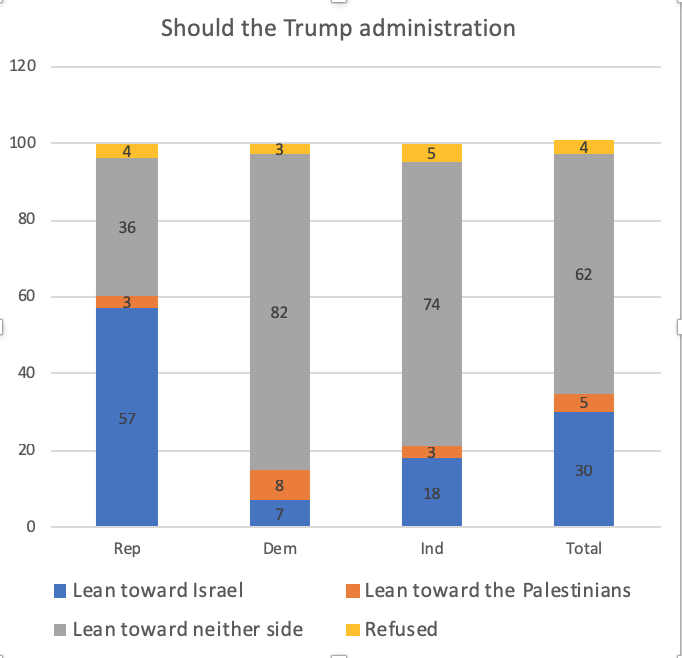
Americans want fairness, and hence many of them expect their government to “lean toward neither side” when “mediating the Israeli-Palestinian conflict.”

But how does one measure a “leaning?” Here is example: If the US government says “we would not tolerate Palestinian suicide bombers killing innocent people in Tel Aviv” – does this count as “leaning” towards Israel, because it’s critical of something that only Palestinians do? Another example: If the US government says, “we believe that Palestinian insistence on a right of return imperils any prospect for a successful peace process” – does this count as “leaning” towards Israel, because an impartial position would be to say “let’s compromise on a right of return for half the people”?

In other words: what if the US government does not “lean” towards the Israeli position but rather towards to more reasonable position that tends to be the Israeli position? Would Americans want their government to lean towards an unreasonable position for the sake of being impartial?

These Jews Have Too Much Influence! 6 Comments on a New Survey Read More »