fbpx

October 8, 2018

Bruce Powell: Teaching Kindness is as Important as Academics

For Jewish educator Bruce Powell, the keys to teaching and creating well-rounded Jewish children include modeling good values and kindness, and ensuring they receive a good Jewish education. 

“In a Jewish environment, ideally you’re going to be learning not just skills to be part of the Jewish community [but how] to continue to make contributions to the Jewish community through a Jewish values lens,” Powell told the Journal in a phone interview. 

However, he was quick to point out that a good education does not necessarily make you a moral and ethical human being. “Knowledge without values is very dangerous,” he said. “Values without deep knowledge is weak. But the combination of the two form a great character and a great education.”

Powell acknowledged that although Jewish students can receive a good secular education in public school and undertake Jewish studies and learn Jewish values elsewhere, a Jewish day school can give them the best of both worlds. 

“Certain [schools] in the more right-wing Orthodox community will not be as robust [in secular studies], but the Jewish education will be spectacular,” he said. “If you can learn Talmud, you can probably go to Harvard Law School and you’ll be fine.”

Since the late 1970s, Powell has helped create 26 schools in North America, working with Orthodox and non-Orthodox institutions. In Los Angeles, he founded and ran Yeshiva University of Los Angeles High School, Milken Community High School, and de Toledo High School — formerly New Community Jewish High School. 

Powell stepped down from his position at de Toledo at the end of the 2017–18 school year in June to focus on his Jewish-education consulting and coaching business, Jewish School Management, which he founded in 1998. 

Powell, 70, grew up in Los Angeles and received his bachelor’s, master’s and doctoral degrees at Southern California universities. He has spent the past 41 years living in the same home in Woodland Hills with his wife, Debby, where they raised their four children, all of whom attended Jewish day schools.

 “Knowledge without values is very dangerous.”  

— Bruce Powell

While Powell was raised Reform, he said he embraces different styles and nuances of Judaism. “I affiliate [with] two Conservative shuls, but I have tremendous love and affection and affinity for the Reform and Orthodox [movements],” he said. 

“My life vision is about Jewish education, Jewish peoplehood and the Jewish community,” he added. “Anything I can do for anybody who’s doing good stuff along those lines, I’ll do.”

Powell said his education philosophy is to replace the word “accommodate” with “embrace.” 

“If you’re coming to my home and you tell me you’re a vegetarian, I accommodate you,” he said by way of explanation. “You’re the other, [but] if I’m going to really embrace you, I’m going plan a meal that looks the same. And nobody [will know] which one is meat and which one is vegetarian.”

The concept, he said, extends to education. If each person is created in the image of God, they each have different gifts, whether they be artistic, athletic, or the ability to learn in a different way. It’s important, he said, to look at each child and embrace them, rather than accommodate them, so they feel like part of the extended family and not “the other.”

“God called the world into existence with words,” he said. “We can do that also. How we use our words. Which words we use. What those words mean. This is a philosophy of education that I think is very powerful and very Jewish.”

At de Toledo, Powell said, Advanced Placement kindness is of equal if not more importance than Advanced Placement academics. “Everyone is enrolled in Advanced Placement kindness and everyone is expected to get a 5 — the top score — when they graduate,” he said. “Because everybody is capable of being kind.”

The focus for parents, teachers and the community should be not just on kindness but character and dignity too, he said. “Typically, when a child comes home from school, what does the parent ask? ‘How was your day? What did you learn today?’ How many of us ask, ‘Did you do a mitzvah today? Were you kind to anybody today? Did you invite somebody to sit with you at lunch today?’ What would happen if we [started] to ask those questions? That’s one way of teaching kindness [and] the way teachers do it is by modeling it.”

To ensure teachers do just that, Powell said de Toledo teachers are required to embrace four criteria: know their subject, know how to teach that subject, have a sense of humor and think teenagers are funny.

The latter two are important, Powell said, because when a student says, ‘You’re so mean, you gave me a bad grade,’ a teacher can respond with something along the lines of, ‘No, I actually love you and I want you to get a great grade. We’re going to work on this together.’ 

“Treating that child as being created in the image of God — working with them, smiling and having a good sense of humor — changes the whole dynamic,” he said. “It’s so simple. Yet, it can be so complicated.”

“We all have a lot of work to do as a community to raise up our children on a good path,” he said. “It may be hard work, but this is a start.”


This story appeared in the 2018 Education Guide edition of the paper. 

Bruce Powell: Teaching Kindness is as Important as Academics Read More »
Milken’s Middle School Builds on Future of Education

How should students in the 21st century be educated? It’s a question that Milken Community Schools educators are taking seriously, particularly in their Middle School curricula.  

“Traditional education worked for hundreds of years. It doesn’t anymore,” Milken’s middle school Principal Limor Dankner told the Journal. “We’re preparing students for jobs that haven’t been imagined yet. Studies have shown that everything we’re doing now will be obsolete by the time these [middle-school] children [graduate] from university,” she said. “So the only thing we can give them are those life tools that they can then adapt to whatever situation they’re in.”

For Dankner, that meant creating the school’s X-Learning program. Now in its sixth year, X-Learning is a blend of traditional and progressive teaching practices that allows students to connect what they learn to their interests, address real-world problems, engage in action and cultivate their problem-solving skills.

“We are anchored in those core tenets,” Dankner said, “but we keep tweaking [the approach], based on feedback [and] the shifts in the needs of students.”

At the heart of the X-Learning philosophy is that creativity is learned, immersive learning is key, curiosity must be reignited, innovation requires risk-taking and rigor, and design is at the center of it all.

When kids are very young, they often don’t hesitate to ask questions, Dankner said. However, she added: “As they get older, schools teach children to stop asking questions and to start answering them. They are so accustomed to giving the right answer, they are stumped when you ask them a question and say, ‘There isn’t an answer. You have to be a divergent thinker, you have to think out of the box, you have to work with other people, you have to keep iterating, you have to persevere if you’re ever going to come up with an answer to this question.’ ”

An example of Milken’s X-Learning approach can be seen in how it goes beyond traditional geometry classes. Geometry students are put into teams to build and test bridges, because that’s one of the real-world application of geometry. “They are immersed, creative, engaged,” Dankner said. “They’re owning their learning.”

There are four components of the X-Learning process:

Identification: Allowing students to pursue curiosities they have about their world.

Exploration: Interviews, research, collaboration, team-building, articulation, writing and speaking.

Purposeful Play: For students to be successful, they have to experiment in a space that is low-stakes/no grades

Connection: Learning to connect with content, areas of study, peers and adults.

“Ultimately, middle-schoolers are defined by the connections that they make or fail to make,” Dankner said. “Those are so important to shaping their identity. We want them to find like-minded people their age and older in the community. We want them to find areas of study or things in the world that are meaningful to them, because that’s what’s going to motivate them to do something.”

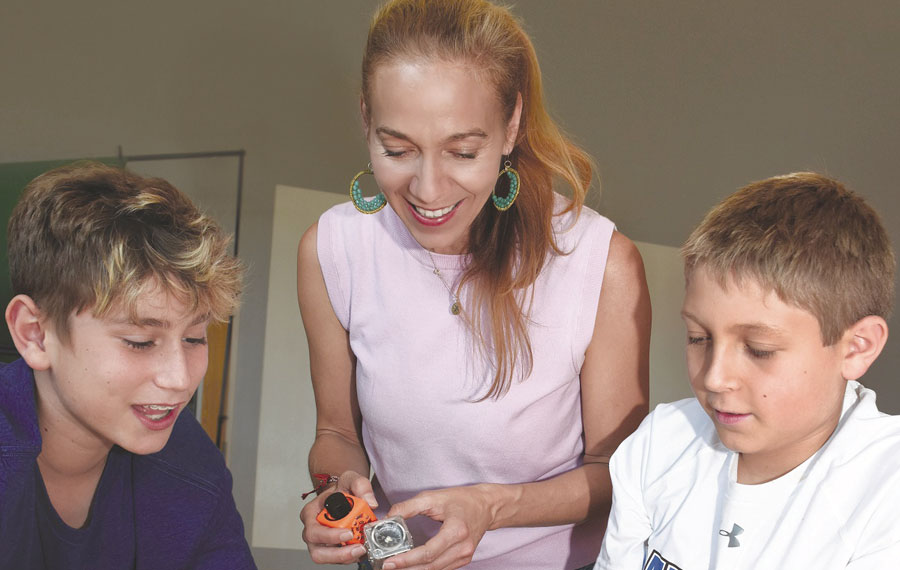
Every year, Milken participates in The X Project. The first semester is skill-building and the second semester is spent in exploration and research. Every middle-schooler identifies something they want to know more about or a problem that they want to solve. In March, they turn the entire campus into a conference center to showcase their work. Students have started businesses, developed apps and created gadgets, Dankner said. 

 “Not only are we fulfilling the curricula, but we’re

 going over and above the requirements.”

 — Limor Dankner

However, although innovation is key, Milken still teaches the basics.

“It’s not that we’re not teaching geometry, algebra or U.S. history,” Dankner said. “Not only are we fulfilling the curricula, but we’re going over and above the requirements. It’s the way in which we are reaching [and engaging] students that makes the material relevant, that gives them choice, that puts them in the driver’s seat and equips them with those skills that they will need to then utilize in future years.”

The students’ high standardized test scores and assessments indicate the school’s methods are working. “We keep raising the bar [in terms of academic rigor], and they keep rising to the occasion,” Dankner said. “And the test results are blowing us away. The more these kids are engaged in what feels like [and is] playful learning, the better they are doing academically.”

X-Learning also applies to Milken’s Jewish Studies department, too. 

“Our whole spiritual practice and our holiday programming is designed with X-Learning in mind. So, it’s student-driven. It’s student-generated and there’s ample choice,” Dankner said. “We don’t herd all 200 students for a Friday morning Kabbalat Shabbat or prayer. We have multiple minyanim and multiple choices for students, which they have self-identified as relevant and inspirational.”

Milken also has developed an entire course on Israel, called Innovation Nation.

“The course tracks the history of Israel, but looks at it from the perspective of Israelis as innovators,” Dankner said. “The students are not only learning about Israel’s history, culture and philosophy, but they’re understanding it in a very relevant way. They are looking at California innovations and where those innovations are aligned with Israeli innovations.”

Dankner said she gets requests from other schools in Los Angeles to share Milken’s X-Learning information. “They want to send their teams here, they want to learn more about it,” she said. “We’re definitely making a name for ourselves. People are recognizing the value in this.”

However, if other schools look at this type of teaching as an adjunct or extracurricular process, it’s never going to work, Dankner said: “We don’t teach anything here in addition to, we just teach students, and this is how we teach them,” she said.

 “You won’t find the Jewish Studies teachers doing their own shtick while the humanities teachers are doing theirs,” Dankner said. “Everyone is talking about how to integrate, how to present situations where students see the world as interrelated and not as separate compartments. It’s been an incredible ride.”


This story appeared in the 2018 Education Guide of the paper. 

Milken’s Middle School Builds on Future of Education Read More »

Education Guide 2018

Education Guide 2018 Read More »

Black Rhino by Lisa Niver, Kenya #AKTravel

How can you see Black Rhino, Maasai Warriors and Hula Hoops?

Please enjoy part 4 of my video journey through Tanzania and Kenya with Abercrombie and Kent Luxury Tailor Made Journeys.

Part OnePart Two, Part Three and now here is Part Four

Video #9: Will I Love a Safari in Maasai Mara?

#9 Safari in Mara Triangle July 14 2018 and staying at Sanctuary Olonana with Sanctuary Retreats

Staying at Sanctuary Olonana in the Maasai Mara: the rooms are gorgeous, breakfast is fabulous and they even have challah in Kenya. They have everything at Sanctuary Retreats. Cross your fingers we see a rhino today. We have seen 4 of the Big 5 so far.

For our game drive with Duncan, we saw a large family of olive baboons and zebras. We went through Oloololo Gate and explored. We saw elephants, zebras, a lion and a lioness, a water buck, another large male lion, spotted hyena, another lioness, grey crowned cranes, warthog, kingfisher and many many more elephants. At the end of this video playlist are movies of several animals who we spent a lot of time watching: See more footage of elephants, giraffe, lions and baby animals.

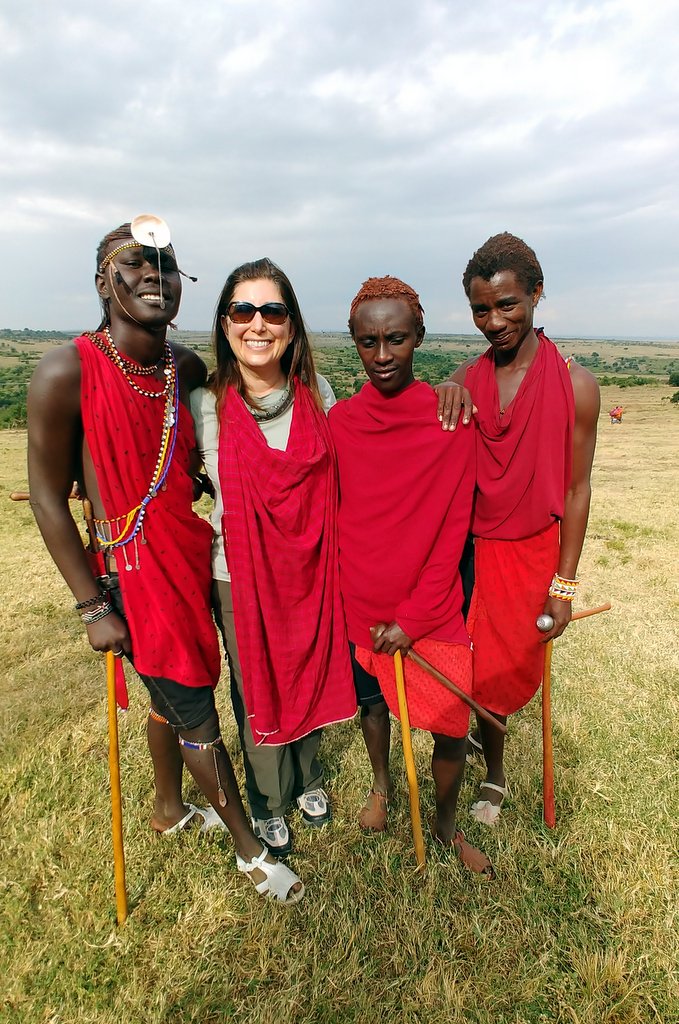
Lisa Niver and Kelly in Kenya #AKTravelIn the afternoon after lunch at Sanctuary Olonana, we visited a Maasai village. Chief Richard said I could bring my hula-hoop. See the next movie for more of our adventures with the men, women and children of the village.

I went to see the Sanctuary Olonana Spa which has outdoor treatment rooms so you can hear the sounds of the river and hippos as you relax. Remember your bathing suit because you can go for a swim or sit by the pool.

Watch my video from July 15, our final game drive when we did see the black rhino.
Happy Travels! Lisa

Video #10Do you want to visit to a Maasai Village?

From Sanctuary Olonana, we went to visit Chef Richard’s village.
He told us—“ As you know, there is Big 5. Do you know what is the Big 6?” Maasai Warriors!”
He was talking to us about polygamy.
You can marry more wives if you have enough cows. 10 cows for 1 wife, 20 cows for 2 wives.
We watched the Maasai Warriors do their jumping dance.I taught them to hula-hoop.
One warrior laughed so hard—he fell down!
We took photos with the men and then went to visit the women and children in the village.
I danced with the women and shared my hula hoop with them.

Lisa Niver and Maasai Warriors Kenya #AKTravelI loved learning Maasai: Supa means HELLO!
The children came to watch the women of the village dance and sing.
We were invited into the men’s meeting house and learned how they make fire.
I bought several beaded bracelets from the craft marketplace.
Thank you to the village for sharing their time with us and inviting us into their homes.

Video #11Do You Want to see a Black Rhino?

#11 We saw a Black Rhino on Our Final Game Drive July 15 2018

We woke up at Sanctuary Olonana and I wandered among the beautiful trees on property.
Sanctuary Retreats, Abercrombie and Kent, AK Philanthropy and Sanctuary Retreats Philanthropy have a commitment to the communities where they are building and working. They use local staff, have an organic garden and involve the community to pick their projects. We were able to visit the school that was built by the teams in Africa. The Maasai village owns the land where Sanctuary Olonana is located and receives money for each room night.

On our safari game drives, we saw the great migration of the wildebeest, hundreds of elephants and so many lions.

Giraffe by Lisa Niver in Kenya #AKTravelSanctuary Olonana has recently been completely renovated and reopened. I have been learning to speak Swahili and Maasai. The staff has been teaching me new words and I can say THANK YOU! Asante Sana. I loved eating breakfast with a view of the river with hippos!

Duncan took us on our final game drive and we saw Maasai with their cattle and then we found the elusive black rhino! We saw all of the Big 5 during our adventures in Tanzania and Kenya. I loved being on safari with Abercrombie and Kent. I cannot wait for your to come on your bucket list trip and enjoy the amazing animals, friendly people and the vast landscape.

Black Rhino by Lisa Niver Kenya #AKTravel

Video #12Do you want to Watch a Maasai Warrior Performance?

#12 Did we visit a Maasai Village in Kenya?
YES!
Watch the Maasai Warrior Performance with Hula Hooping Olonana, Kenya.
Did I teach Maasai Warriors to Hula Hoop?
Yes I did! What an amazing Abercrombie and Kent Small Group Journey!

We were invited to visit a Maasai Village while we were staying at Sanctuary Olonana.

I wanted to share the complete footage of the warriors.

Video #13 Do You Want to See the Maasai Women Sing?

#13 Did we visit a Maasai Village in Kenya?
YES!
Watch the Maasai Women sing and dance!

Did I teach Maasai Women and children to Hula Hoop?
Yes I did! What an amazing Abercrombie and Kent Luxury Tailor Made Journey we had in Tanzania and Kenya.

We were invited to visit a Maasai Village while we were staying at Sanctuary Olonana. I wanted to share the complete footage of the women dancing.

Click here to see all of my African Safari videos

Click here for more information and rates!

Part 1: Where Did I Travel on My First African Safari?

Part 2: Are You Ready? Today We Are Going to the Serengeti!

Part 3: What is the Best Way to Travel from Tanzania to Kenya?

How can you see Black Rhino, Maasai Warriors and Hula Hoops? Read More »

“The Chosen Wars – How Judaism Became an American Religion” by Steven R. Weisman – A Review

Steven R. Weisman does the American Jewish community and anyone interested in who we are and how we came to be who we are a deep favor. His history of the American Jewish experience (publ. 2018 – 266 pages) is a wonderful read. He covers the beginning of our history in the new world when Jews first arrived on American shores in New Amsterdam in 1654, spends much time on the dynamic 19th century, and brings it all into the present.

Weisman’s readable narrative is comprehensive. His nuanced discussion of events and trends as they reflect the influences of the American experience on our community gives insight into how we evolved from before the American Revolution through the Civil War into the industrial age and twentieth century as we strove to be at once American and Jewish.

He describes how we acclimated to the new world in every generation without losing a sense of Jewish meaning. He discusses radical and conservative religious, ideological, and practical responses to the myriad of challenges Jews encountered coming from Central Europe, Germany, Russia, and Sefardic lands over a period of two centuries.

Weisman discusses at some length the emergence of the American Reform movement, the founding of the Conservative movement, and how orthodoxy struggled to survive and then staked its ground as immigrant waves from Eastern Europe arrived during the twentieth century.

The title of the book (“The Chosen Wars”) is Weisman’s thesis. So often, there is a tendency to look back with nostalgia on our history and smooth the edges of controversy. To do so, however, is to mischaracterize history itself and especially Jewish history. He shows that we Jews were and continue to be argumentative and rarely unified even as we have aspired for unity.

He writes in the epilogue:

“Judaism’s flourishing in America was not foreordained or inevitable. Neither was it free from conflict and animosity. On the contrary, the disputes among Jews in America were emotional and personal. They were also very American…The Jews shaped their experience in America, and they were shaped by the America they found. The push and pull for Jews followed a historic tension.”

Steven R. Weisman is vice president for publications and communications at the Peterson Institute for International Economics. He previously served as a correspondent, editor and editorial board member of The New York Times. He is the author of “The Great Tax Wars: How the Income Tax Transformed America.

I recommend this volume highly. If you want deeper understanding about who we are as an American Jewish community, how we got here, and what contemporary challenges we face, this book will not only frame it all for you but inspire you with the hope that, indeed, we are NOT the ever-dying people.

“The Chosen Wars – How Judaism Became an American Religion” by Steven R. Weisman – A Review Read More »