fbpx

July 9, 2018

Trump Nominates Brett Kavanaugh for Supreme Court Vacancy

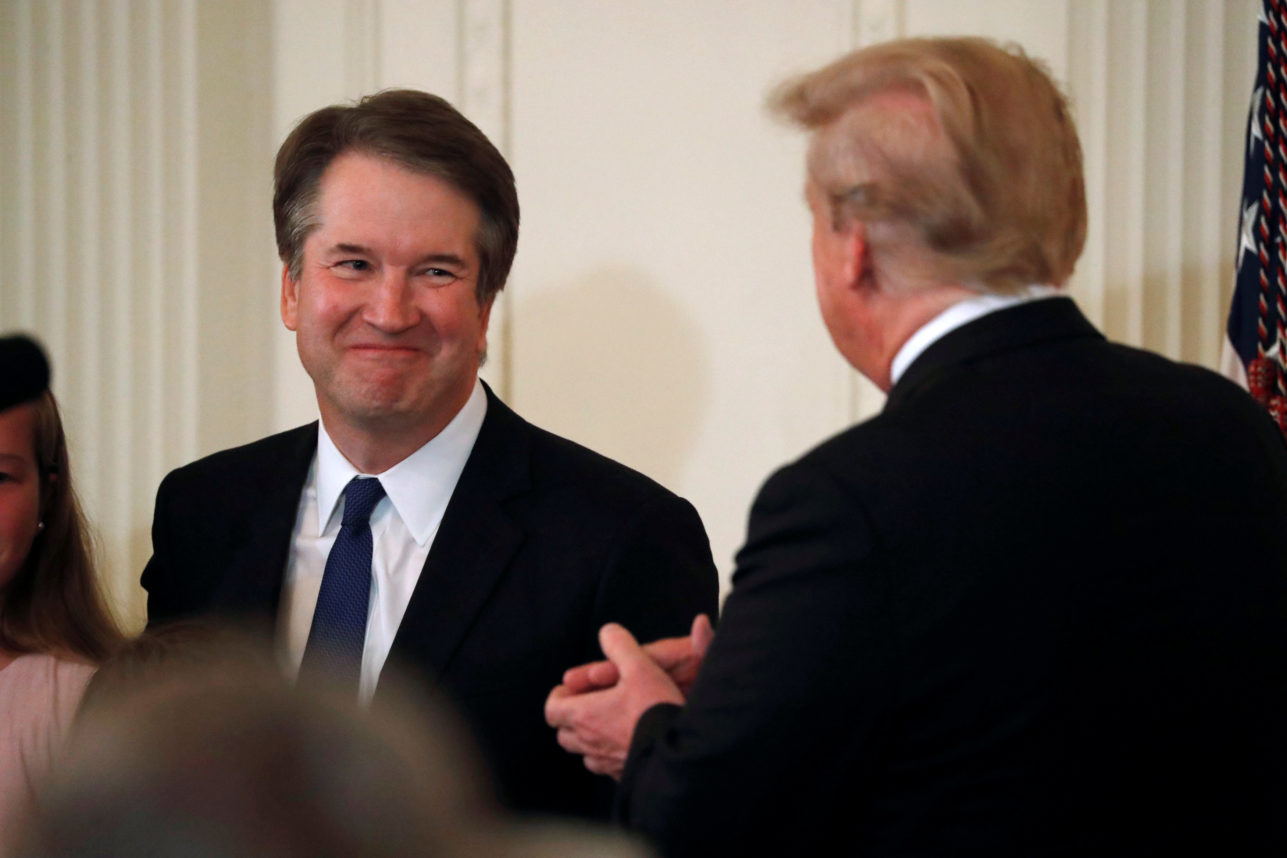
After a week of deliberation and speculation, President Trump has picked his Supreme Court nominee: Judge Brett Kavanaugh.

In front of a televised audience, Trump said that he was looking for a candidate who would faithfully follow the rule of law and called Kavanaugh a “judge’s judge.”

“The rule of law is our nation’s proud heritage. It is the cornerstone of our freedom. It is what guarantees equal justice,” Trump said. “And the Senate now has a chance to protect this glorious heritage by sending Judge Kavanaugh to the Supreme Court.”

Kavanaugh followed Trump by saying he was “humbled” by the nomination.

“My judicial philosophy is straightforward: a judge must be independent,” Kavanaugh said, adding that a judge must follow the law, not make the law.

“I will always strive to follow the Constitution of the United States and the American rule of law,” Kavanaugh concluded.

The Anti-Defamation League (ADL) expressed concern over Kavanaugh’s nomination.

“We are concerned that Judge Kavanaugh’s judicial record does not reflect the demonstrated independence and commitment to fair treatment for all that is necessary to merit a seat on our nation’s highest court,” ADL CEO Jonathan Greenblatt said in a statement. “Because he has written and spoken prolifically on many issues of deep concern, we believe his positions merit close scrutiny. These include his demonstrated hostility to reproductive freedom and his past support for greatly expanded and unchecked executive power. ”

Kavanaugh, a federal judge on the D.C. Circuit Court of Appeals, clerked for retiring Supreme Court Justice Anthony Kennedy. His record also consists of working on independent counsel Ken Starr’s investigations into the Clinton administration as well as on President George W. Bush’s White House counsel.

As a judge, Kavanaugh has tended to generally align with the constitutionalist line of thinking, however some conservative critics have expressed skepticism over some of Kavanaugh’s cases, most notably a 2011 case that ruled that the Obamacare individual mandate was a tax.

Trump Nominates Brett Kavanaugh for Supreme Court Vacancy Read More »

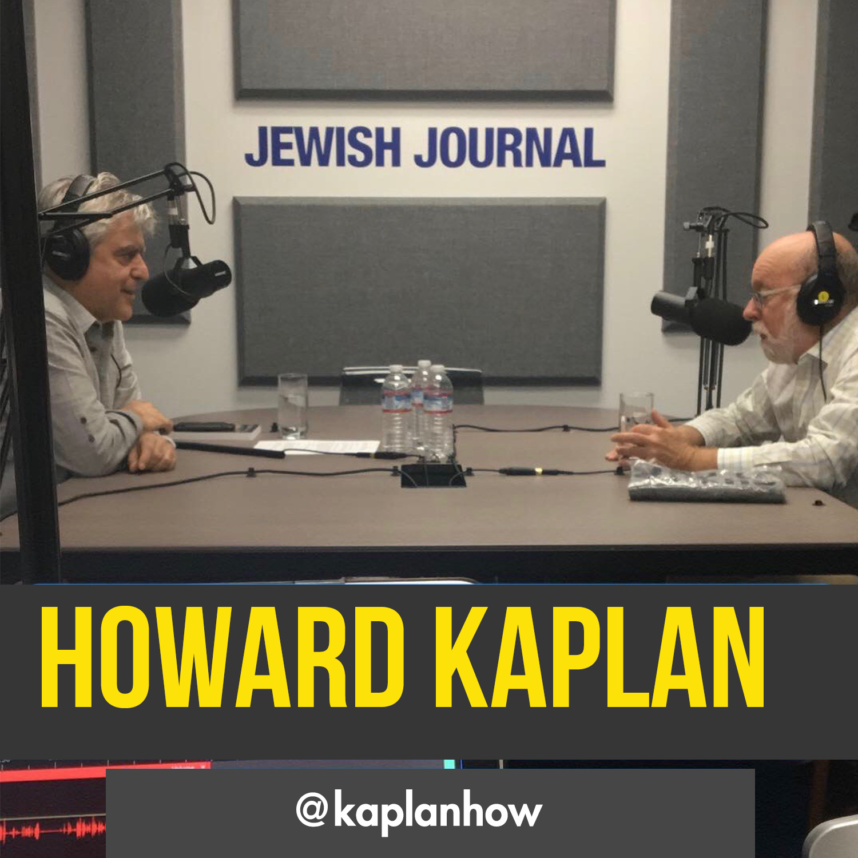
David Suissa and Howard Kaplan

Hot Take: Howard Kaplan on his new film Damascus Cover

[iframe style=”border:none” src=”//html5-player.libsyn.com/embed/episode/id/6792122/height/100/width/480/thumbnail/yes/render-playlist/no/theme/custom/tdest_id/689387/custom-color/dfdfdf” height=”100″ width=”480″ scrolling=”no” allowfullscreen webkitallowfullscreen mozallowfullscreen oallowfullscreen msallowfullscreen]

Howard Kaplan dives into his latest film Damascus Cover.

The film is about an Israeli spy, Ari Ben-Zion, haunted by the death of his son, is recalled to Jerusalem after a failed attempt to bring a mole back to Israel alive. Unsure how many of its operatives have been exposed, the Mossad assigns Ari to smuggle a chemical weapons scientist out of Syria. While in Damascus, Ari’s loneliness is relieved by Kim, a young American photographer. Within days of his arrival his mission goes wrong and to survive Ari reaches out to a deep cover agent code named, The Angel. He soon discovers that he is a pawn in a much bigger plan that will change him forever.

The film is directed by Daniel Zelik Berk and stars Jonathan Rhys Meyers, John Hurt and Olivia Thirlby.

Follow Howard on Twitter @kaplanhow and Facebook @HowardKaplanauthor for updated film release dates and theater information.

Follow David Suissa on Twitter @SuissaTweets

Check out this episode!

Hot Take: Howard Kaplan on his new film Damascus Cover Read More »

South Carolina Becomes First State to Have Formal Definition of Anti-Semitism

South Carolina made history on July 6 when its state government officially adopted a uniform definition of anti-Semitism, the first state in the country to do so.

Gov. Henry McMaster (R) signed a proviso stating South Carolina would adopt the State Department’s definition of anti-Semitism, which is as follows:

“Anti-Semitism is a certain perception of Jews, which may be expressed as hatred toward Jews. Rhetorical and physical manifestations of anti-Semitism are directed toward Jewish or non-Jewish individuals and/or their property, toward Jewish community institutions and religious facilities.”

The State Department also acknowledged that the delegitimization and demonization of Israel, as well as applying double standards to the Jewish state is also anti-Semitic.

The proviso was signed in order to help combat rising anti-Semitism on college campuses. Prior attempts to pass the law were met with resistance from organizations, such as the Foundation for Individual Rights and Education (FIRE), who were concerned that such law would infringe upon free speech.

However, the proviso merely works as a definition when it comes to targeted “harassment, assault, and vandalism,” StandWithUs argues.

“We have seen a marked increase in anti-Semitic incidents in 2017, according to the ADL. We have not seen a comparable increase in prosecutions for these crimes,” StandWithUs CEO Roz Rothstein said in a statement. “Law enforcement and administrators are often left powerless to act because of an unclear definition of what anti-Semitism is.”

Rothstein added, “We need to define anti-Semitism in order to defeat it. Thankfully, South Carolina is leading the way.”

Back in May, a bipartisan bill was proposed in Congress to officially establish the State Department’s definition of anti-Semitism at the federal level.

South Carolina Becomes First State to Have Formal Definition of Anti-Semitism Read More »

What This Rabbi Saw in Tijuana

Imagine being separated from your children, sent to another country and then able only to communicate with them via Skype. As you talk to them for the first time in weeks, they call out, “Mama Mama, when are you coming back?” and place their hands on the computer screen as if to touch you.

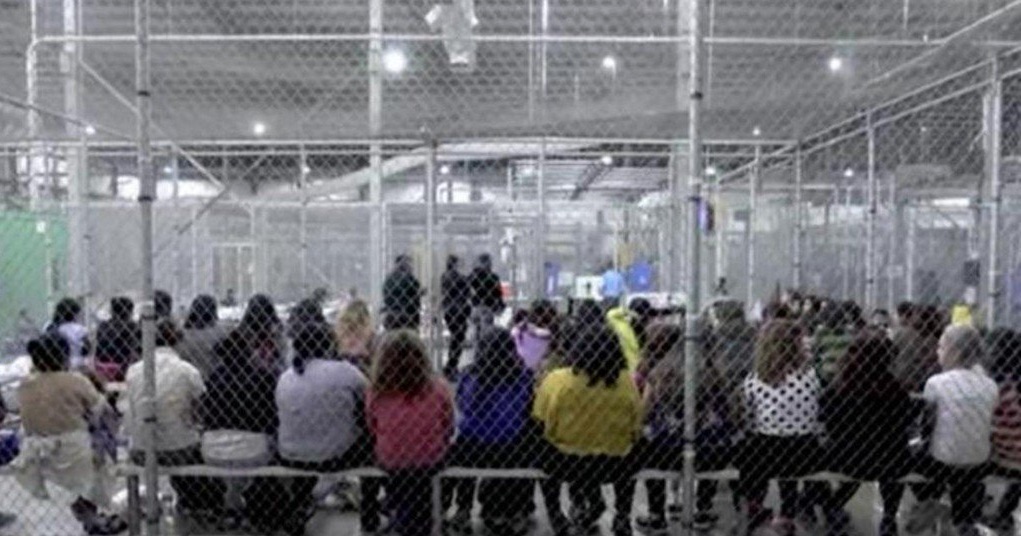
That’s what happened to Maria, one of the many women living temporarily in Tijuana’s Migrant Center Instituto Madre, a shelter that is coping with an influx of newly deported mothers struggling to reunite their families. After living in the United States for many years, Maria was deported to Mexico without her children, who are U.S. citizens. For weeks, she was so distraught that she cried unceasingly.  Finally, the migrant center obtained a computer, and set up a video call for Maria and her children.

Maria’s story is just one of several heartbreaking accounts I heard on Tuesday, when I was visiting Tijuana with more than 25 rabbis and cantors from T’ruah: The Rabbinic Call for Human Rights, in a special visit organized by T’ruah and the Jewish refugee organization HIAS. We went there to bear witness and to experience for ourselves what it’s like to go back and forth between the borders.

Our primary goal was to put a human face on the women, children and men we have been reading about, seeing in television reports, and hearing on the radio.

We spent the day immersed in the brokenness that is our country’s immigration system, learning about the the quagmire of legalities and administrative processes that I’m not sure I could navigate. Every single hour of this long day, a new wrinkle or complication was thrown into the already overwhelming situation.

The people at these shelters in Tijuana represent global immigration trends as well as those tragically affected by the current Zero Tolerance policy of the Trump administration.

Some, like Maria, have been deported from the United States, rounded up in a raid or arrested for a misdemeanor (such as expired vehicle tags).

Others have come up from southern Mexico, Central and South America. These are mostly women and children, who are escaping violence after their  husbands and brothers have been murdered by gangs. They seek asylum in the United States — not an easy process.

Once upon a time, there was a free and easy flow of movement, for both work and tourism, at our southern border. But we learned from the shelter directors how the U.S. immigration policy has undergone severe shifts over the years, and what once was a thriving relationship along the border with Mexico, with people easily crossing to work in the United States US from Mexico, and tourists from the United States US coming over to visit, is now like a militarized zone, complete with iron fences topped with barbed wire, and men with machine guns.

There is no question that under the Trump administration’s policies, the immigration system, which has been dysfunctional for years, has gone even farther, imposing inhumane and cruel practices that devastate the lives of real human beings.

It doesn’t have to be like this: We can’t get rid of immigration laws altogether, but we can make them more compassionate and easier to navigate — and there’s no rational reason to be cutting the number of legal immigrants allowed or going after all undocumented people.

In the Torah, Judaism’s sacred text, the single most repeated commandment has to do with our relationship with the stranger. Over the course of the Torah, the commandment gets more refined. It begins with “do not oppress the stranger” for “we were strangers in a strange land” but then it moves to “welcome the stranger” and culminates in “loving the stranger.”

At the video reunion of Maria and her children, the children cried, as their hands touching the computer screen failed to bring their mama back to them.  Maria created a distraction, by telling them about the cake she was baking at the shelter. She ran to the kitchen, grabbed the cake, showed it, and, for a moment, her babies smiled.

In this month that we celebrate the founding of this country, our country built by immigrants, it’s unconscionable that the Trump administration is causing such needless suffering. I promise I will not rest until this suffering is stopped.


Rabbi Jill Berkson Zimmerman teaches spiritual and mindful approaches to Judaism. She is an active member of the group T’ruah, the Rabbinic Call for Human Rights, and the Orange County Jewish Coalition for Refugees.

What This Rabbi Saw in Tijuana Read More »

Wonder Woman of Valor: Gal Gadot Visits Children in Hospital

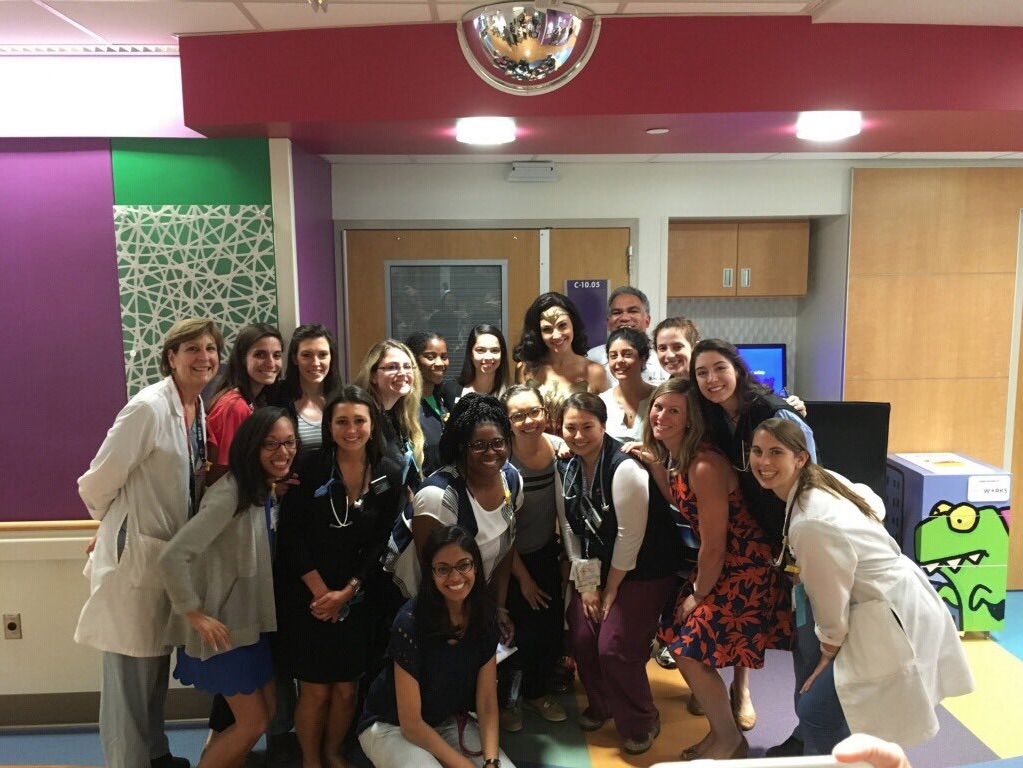
Taking a break from filming Wonder Woman 1984 in Washington D.C., Gal Gadot made some young patients’ day when she visited Inova Children’s Hospital in Falls Church, Va., dressed head to toe in her Wonder Woman regalia. Gadot, the mother of two daughters ages 6 and 1, cuddled with the kids and posed for pictures.

According to Inova’s director of Child Life Services, Jamie Gentille, Gadot spent over an hour with the patients, handing out stuffed animals and toys. “This was such a treat for the children and families – she held babies, played with kids, and chatted with teens. A few of the parents cried tears of joy after seeing their child’s face light up at this magical moment,” she said.

“One patient underwent a morning full of very serious procedures, and you could see her perk up immediately when she saw Gal walk into her room,” Gentille added. “Gal was such a lovely person, and brought such beautiful energy to our halls. She has a gift of making a special connection with every child she meets.

“Visits like this do more for our patients than we ever could,” Gentille said. “For a child to have the real Wonder Woman visit them in the hospital is truly magical – they will go home and remember this amazing experience, amidst all of the pokes and procedures. This allows children to heal faster and really just back to the business of being kids and being joyful. Gal has a family for life here at ICH!”

She’s now back at work on “Wonder Woman 1984,” which reunites her with co-star Chris Pine and director Patty Jenkins, with Kristen Wiig joining the cast as the villain. It’s due for release in November 2019. Gadot has a couple of projects set up after that, including the art heist thriller “Red Notice” with Dwayne Johnson. She’ll produce but may or may not appear in “My Dearest Fidel,” about an American journalist who becomes a confidant to former Cuban dictator Castro.

Wonder Woman of Valor: Gal Gadot Visits Children in Hospital Read More »

A New Jewish Health Care Directive

The first Jewish advance health care directive made its appearance in Genesis, when Jacob, nearing the end of his life, implored Joseph to bury him with his forefathers.

“Do me this favor. … Please do not bury me in Egypt,” Jacob declared. “When I lie down with my fathers, take me up from Egypt and bury me in their burial place.”

The way we care for those who are seriously ill has advanced since Jacob spoke with Joseph about 4,000 years ago. Our practices have changed a great deal, as well, in the decades since contemporary Jewish advance directives first were drafted in the early 1990s. These modern efforts, building on the foundations of our biblical ancestors, under-score how the need remains more crucial than ever.

Because of this need, my colleagues and I have developed an innovative new version — the Cedars-Sinai Jewish Ad-vance Healthcare Directive. We hope the document will be embraced by our Jewish patients and by diverse Jewish communities around the world.

To understand the nuances of this new advance directive, it is helpful to appreciate why a document like this is so essential.

Medical technology grows more sophisticated with each day, and with that comes the ability to intervene, cure dis-ease, mend bodies and prolong life. These interventions, however, are not always in a patient’s best interests.

Advance directives enable us to convey to our families and health care providers how we feel about our medical care if we are unable to actively participate in decision-making. They enable us to sort out what matters to us, including important end-of-life issues such as whether we desire extraordinary measures to prolong our lives — and if so, which ones we’re willing to accept. A legally binding personalized guide assures that our wishes will be followed even if we’re unable to articulate them.

So why a Jewish advance health care directive? The more the document can be formulated in a culturally and religiously sensitive manner, the better chance it has of actually being utilized and of accurately expressing patients’ goals, values and preferences. In 1991, the Rabbinical Council of America (RCA) developed an advance directive that reflected some of the Modern Orthodox community’s approach to mat-ters of health care and Jewish law. That document was followed a couple of years later by a version drafted by the Conser-vative movement. In 2003, Agudath Israel, an Orthodox organization, took a different approach by drafting a Jewish health care proxy form, which the RCA then emulated in revising its own document.

Each of these documents has value. Our new advance health care directive takes an entirely different approach. Instead of simply listing which medical interventions one does or does not want, it aims to capture the totality of a person’s values and preferences to be applied in various unforeseen circumstances.

Our aim has been to craft language in a way that is sensitive to the religious views of the patient. Because the Cedars-Sinai Medical Center version gives patients an opportunity to describe their values, it tells us about who our patients are, what is important to them, and what is not important to them.

The Cedars-Sinai Jewish Advance Directive provides a range of options. For example, individuals can appoint their own rabbi or a Jewish institution to assist with decision-making; patients also can indicate whether they want to donate their organs. The document is drawn up in a manner that is acceptable by the strictest interpretations of Jewish law while, at the same time, not obligating patients to follow Jewish law if that is not their wish.

My hope is that the user-friendly ad-vance directive will resonate with any Jewish patient who needs it, regardless of affiliation or persuasion.

This work is the start to a larger undertaking. Because Cedars-Sinai serves a broad and diverse community, it is our goal to produce more culturally sensitive and religiously appropriate directives for other groups so that all patients can ex-press their values as they work through some of the most profound decisions in their lives.

You can access the Cedars-Sinai Jewish Advance Healthcare Directive and a step-by-step guide by visiting the Spiritual Care Department at Cedars-Sinai (hard copies of the document are available to patients at Cedars-Sinai). The website also provides links to other traditions’ advance health care directives.

Rabbi Jason Weiner is senior rabbi and director of the Spiritual Care Department at Cedars-Sinai Medical Center. 

A New Jewish Health Care Directive Read More »

Lisa Niver Quebec City Walls 2018

Walking on the Walls in Québec City

“Traveling’s not something you’re good at. It’s something you do. Like Breathing.” Gayle Foreman

After graduating college, I went on a road trip with my boyfriend through Canada. I loved our brief stay in Québec City and have always wanted to return. When Travel Classics Montreal offered a pre-conference trip to Québec City, I knew I would be going. Although my grandfather was born in Montreal, the conference would be my first visit to that city.

Auberge-Saint-Antoine in Quebec City by Lisa NiverWhere did we stay in Québec City?

For our visit, we stayed at the family owned museum boutique hotel, Auberge Saint Antoine which is located in the historic and charming lower town of Québec City.

VIDEO: Stay at Auberge Saint-Antoine in Québec City

Fairmont Chateau Frontenac is 125 years young and was built as one of the original grand railroad hotels by Canadian Pacific Hotels.

VIDEO: Join me in Québec City at Fairmont Le Chateau Frontenac

What did we see?

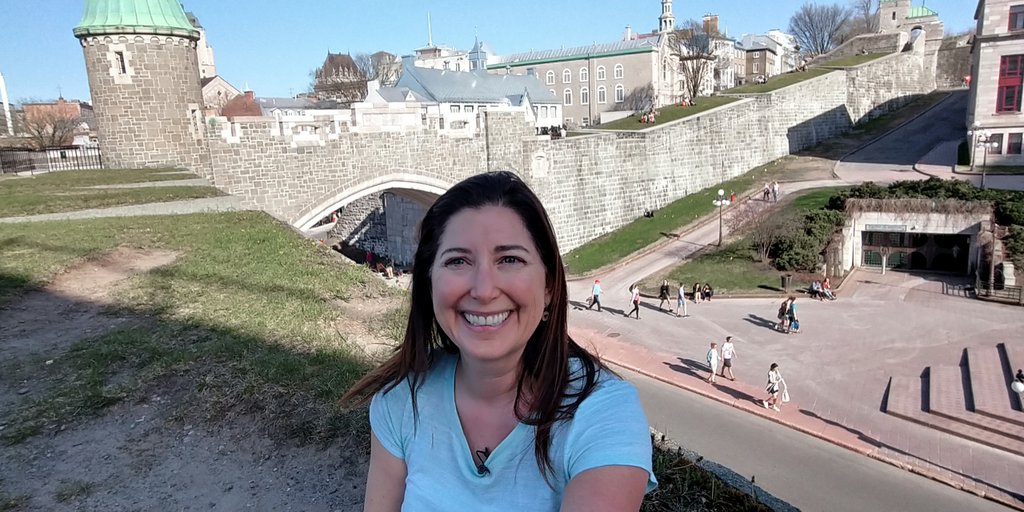
I loved walking on the ancient Wall of Québec City, which is a UNESCO and National Historic Site. The walls surround Upper Town of Old Québec and were built between 1608 and 1871 under both British and French regimes. Thank you to our fantastic guide,  Sharon Frenette and Québec Original.

VIDEOWander the walls in Québec City

During our day tour outside the city, we went to

*Albert Gilles Copper Art Studio: At the Copper Art Studio just after Montmorency Falls, you can discover the Museum Albert Gilles. We had a guided tour from copper ore to copper art and a «Repoussé» demonstration about the Art of Copper. I loved making my own copper art and learning about the art we would see at the Basilique de Ste -Anne de Beaupré. Make sure to see the exhibit of Christorama: The Life of Christ told in 50 silver panels. Do not miss Tea Time with their special canelé cake which is made in copper pans.

*Canyon Sainte-Anne and Air Canon: Would you fly over a waterfall in the Air Canyon? It is the first of its kind in Canada.

*Shrine of Sainte-Anne-de-Beaupré with the art of Mr. Gilles

*Lunch at Auberge Baker

*Montmorency Falls

*IIe d’Orleans

VIDEOWant to Explore Around Québec City?

Where did we eat?

​I loved the rooftop view from the ​Penthouse of Hotel 71, in Old Quebec City​. The building used to be ​the National Bank of Canada’s first head office in Quebec City. ​The penthouse kitchen is in the old vault! ​I loved the art in the lobby and Italian dinner at Il Matto​ Restaurant.

VIDEO:  Dinner at Hotel 71

I loved eating my breakfast and my special dinner at Auberge Saint Antoine’s signature restaurant, Chez Muffy!

My visit to Québec City was so enjoyable! I cannot wait to return. I might come back for Winter Carnival. Enjoy all 20 of my Canada videos here:

Lisa on the walls of Quebec City

See more on We Said Go Travel.

Walking on the Walls in Québec City Read More »