fbpx

May 16, 2018

This Girl Is On Fire

The evening that Israeli singer Netta Barzilai won Eurovision 2018, my son and I began to watch the biopic “Pelé: Birth of a Legend,” the early life of the renowned African-Brazilian soccer player.

Pelé grew up poor in 1950s Brazil and faced continual racism from Europeans and lighter-skinned Brazilians. But from an early age, his parents taught him to face life with dignity: “Don’t feel doubt or shame,” his father tells him in the film. “Have the courage to embrace who you really are.”

Pelé revolutionized soccer for Brazilians — inspiring a pride in the country’s uniqueness. “We don’t all play the same,” says a coach in the film, “but that’s what makes us who we are.”

A similar message of embracing both excellence and difference can be felt in a video that my son, Alexander, and I stumbled upon a few weeks ago. Angelica Hale, 9, won the “Golden Buzzer” on NBC’s “America’s Got Talent” last year for her magnificent rendition of Alicia Keys’ “Girl on Fire.”

I must confess: I’m not a watcher of talent shows. But I have personally found this video deeply inspiring, even more so after reading that Angelica, who is part Filipino, had to undergo a life-saving kidney transplant at age 4. Fearless and resolute, she both belted out and personified the lyrics:

“She’s got both feet on the ground;

And she’s burning it down.”

This is feminism, I told Alexander. A young girl can get up on stage and make a song even more layered and soulful than the original recording (sorry, Alicia). Moreover, achieving something great is far more empowering than playing the victim. Angelica, like Pelé, has no interest in being a victim. Both don’t want the world to feel sorry for them: They want the world to love them for their unique, outstanding gifts.

“I love my country,” she told an audience that has been taught to hate her country.

Somehow, 25-year-old Netta was able to combine all of these sentiments into a magical song, “Toy,” and performance that, despite itself, took Europe’s breath away.

“Look at me, I’m a beautiful creature;

I don’t care about your modern-day preachers.”

“Toy” is also a song about female empowerment, but perhaps even more, it’s about owning your individuality. “Thank you for choosing different, for accepting differences between us, for celebrating diversity,” Netta told the massive Eurovision audience in her acceptance speech.

But Netta clearly has no patience for the victimhood part of today’s #MeToo politics: “I’m not your toy, you stupid boy.” Nor does she have time for an identity politics that has no space for Jews. “I love my country,” she told an audience that has been taught to hate her country. “Next time, in Jerusalem.”

Whether the Europeans who voted for her got the deeper message is less important than the fact that they voted for Israel, despite every effort made by BDSers to prevent this. And Israel won by doing what Israel does best: bringing light into the world. Teaching the politically correct that individuality, creativity — inspiration — is not politically incorrect. That in fact, not becoming what others want us to be is our greatest strength.

Netta, like Pelé and Angelica, doesn’t want the world’s pity — or the world’s harassment. In fact, she included what could be construed as a word of warning for haters: “Wonder woman, don’t you ever forget; You’re divine and he’s about to regret.”

In the Pelé film, a Swedish coach calls the darker-skinned Brazilians “abnormal.” Israelis — Jews — have been called that and much worse. We don’t need to fabricate victimhood — but we also have no desire to wallow in it.

The Jewish people are not the world’s toy, to be taken out and abused when it’s having a bad day. “Have the courage to embrace who you really are,” Pelé’s father tells him in the film. It’s well past time that Jews did precisely that. Enough begging the left’s “social justice warriors” to include us.

Not surprisingly, these tolerant, compassionate folks were quick to try to shame Netta after she won, bizarrely calling her performance “cultural appropriation.” And some of Europe’s leftist pols saw Netta’s victory as a great opportunity to call for renewed boycotts against Israel. (So is “justice” their motivation — or jealousy? I get so confused with these compassionate types.)

Netta is not responding to the haters.  And why should she? She’s too busy “lighting up the night.” World, get used to it.


Karen Lehrman Bloch is an author and cultural critic.

This Girl Is On Fire Read More »

Reverse Hasbara

I once broke up with someone for calling me a “Zionist pig.”

Let’s call him Nir. We met through mutual friends, exchanged phone numbers, and then met up at a bar.

We asked each other the usual first date questions (How many siblings? What kind of music do you like?) and had a few laughs. At one point, he stopped the conversation and said, “How about we rate our date on a scale of 1 to 10?” The question made me nervous, but I figured that he wouldn’t have asked me if he wasn’t having as good a time as I was. “I’d give it an 8 out of 10,” I said.  “Just eight?” he asked. “I was going to say nine, but OK. Fine. Have it your way.” I laughed. He laughed. I was sold.

The only catch was that he didn’t live in Israel. He was one of those Israelis who lives in Berlin. A documentary filmmaker, he was in Tel Aviv conducting some interviews for a film he was working on about a little-known Israeli poet. He would be in the country only for a week — and then again in a few months, and then again a few months after that.

It didn’t slow us down. We played house while he was in town and talked on the phone when he wasn’t. I was hoping he would move back to Tel Aviv but also decided to go visit him in Berlin. If I liked it there, I thought, maybe that would be something we could talk about.

In the public’s perception, Israel is an idea rather than a place. This is so even among those who love Israel.

Of course, that was not how things played out. Our Tel Aviv romance didn’t translate to Berlin. This was immediately noticeable when I arrived. There was something different about his attitude — something cold and distant — but I couldn’t yet understand what or why it was.

In any event, I was on vacation and wanted to enjoy myself. We went out to bars and clubs at night and, during the day, I wanted to sightsee. It was my sightseeing trips that first clued me as to the reason Nir had cooled on me. He was happy to go along with me to Tempelhof, but scoffed when I wanted to go to the Holocaust memorial and teased me for being a Jewish cliché. He wanted to join me when I went to see the Berlin Wall, but laughed at me when I went to the Jewish museum.

The week passed tensely. Our past intimacy and ease were gone, and I was frustrated. But the day before I was to fly back to Tel Aviv, it all came into focus when we met a group of his friends. We encountered them by chance. Until then he had not introduced me to anyone. “This is Matthew,” he said. “He’s a Zionist pig and lives in Israel.”

I stifled whatever shock I felt and put on a smile, though I was blushing. One woman, incredulous, asked me if I was really a Zionist. I laughed and my eyes widened. Zionist is one of those words that I like to define before discussing. Otherwise you wind up having two simultaneous discussions with someone about two completely separate things. “Yes?” I said. “Well … you know … it’s …”

“Like, is that why you moved to Israel?”

I laughed again. “I moved to Israel,” I said, “because I love Tel Aviv.”

This seemed to be as good an evasion as any. The conversation drifted and eventually my “friend” and I were on our own again.

“I think I’m going to take a walk,” I said. “Alone.”

And off I went.

I’ve been thinking about this incident lately, as well as what followed it, in the wake of actress Natalie Portman’s decision to sit out an Israeli awards ceremony because of “recent events” in Israel. The news was shocking to many people. How could a Jerusalem-born woman who holds dual citizenship do something that so resembles what the Boycott, Divestment and Sanctions movement does?

For me, however, Portman’s actions were not so shocking. I recognized them right away for what they were: reverse hasbara.

Hasbara is an Israeli-ism that refers to Israel PR. It means “explanation” and is a sort of Israeli cultural directive — the idea that wherever you are, if you are a Jew or an Israeli, it is your obligation to counter anti-Israel bias and spread a pro-Israel narrative.

Less talked about is reverse hasbara, something that Israeli leftists and Israel-supporting liberals feel compelled to do when they are around non-Israeli and non-Israel-supporting people. Reverse hasbara means explaining to people that you (despite the fact that you either live in Israel, immigrated to Israel or are from Israel) are not an Arab-hating fascist. The assumption is that this is what progressives will think of you if you don’t explain otherwise. I’m not sure this assumption is true but I’ve been in a few situations where I wanted to hedge my bets.

As a graduate of Sarah Lawrence College, a super-progressive liberal arts college just north of Manhattan, and also as a queer person, my liberal stance on most issues easily can be  guessed. This can lead some of my American friends to call into question my love of Israel. Why is it that, although I’m left on every other issue in the world, I’m right on Israel?

It’s a fair question. My answer would be that I’m not right on Israel, and that I don’t relate to Israel as an “issue” on which one can be right or left. I relate to Israel as a place. It is the place where I live and it is a place that has been good to me. Connected to Israel are all sorts of political issues, and on these I generally fall on the left side of the spectrum. But I see Israel as more than the sum of its headlines.

That said, many people do not. And yes, I am guilty of reverse hasbara. Last New Year’s Eve, I was at a party with friends in New York and found myself grumbling about Israeli Prime Minister Benjamin Netanyahu. Not because I cared to have a political conversation at that moment, but because I wanted my friends to know that I was still the same progressive Matthew they knew from Sarah Lawrence.

I’ve often wondered about reverse hasbara and why it is that so many of us feel the need to engage in it. It’s not as if American leftists have to wander around the world apologizing for everything President Donald Trump says. There is a natural separation in people’s minds between aspects of American life: the life of its cities, its people, its government and its military.

With Israel, there is no such separation. All are lumped together.

In the public’s perception, Israel is an idea rather than a place. This is so even among those who love Israel. I’ve met several devoted American Zionists who have no sense of (or love for) Israel the place. They love the Jewish state — but do they love this Jewish state?

Similarly, among Israel’s critics, Israel is little more than an ideology that must be disavowed.

Nir, I realized, had been carefully building a life for himself in Berlin based on reverse hasbara. And then I showed up — not only an Israeli person but an Israeli by choice. When we ran into his friends, he was put on the spot — caught between selves. He had two options in that moment. And he chose the second one. He threw me under the bus.

Leaving Israel is perhaps the strongest form of reverse hasbara there is. “Yes, I’m from that place. But I left. Because of recent events.” There’s something tragic about it. No one should feel ashamed of being from a certain country, and no one should assume anyone’s politics based on their passport.

I had a few other friends living in Berlin. As I walked away from Nir and the “Zionist pig” incident, I texted one of them to ask if I could crash at his place. Nir also was messaging me to ask if I was upset. I told him we could talk about it the next day. I would be heading back to Israel in the afternoon and needed to get my things anyways before heading to the airport.

We met at Nir’s place the next morning. I packed my bag and then we strolled to Tempelhof park and sat in the grass. He apologized. I accepted his apology. We understood quietly that our week together in Berlin would be our last week together anywhere. We moved onto other subjects of conversation — like his movie. It was mostly finished and he would soon be screening it.

“I was wondering,” he said, “if I should put something at the beginning of the film. A kind of dedication that says I’m against the occupation.”

“Why would you do that?” I asked. “The movie has nothing to do with the occupation.”

“Well, it sort of does,” he said. “It’s about Israel.”

“OK,” I said. “But why do you really want to put that disclaimer there? It seems a little unnecessary if you ask me.”

“I dunno,” he said. “Just so everyone knows how I feel.”


Matthew Schultz is a writer living and working in Tel Aviv.

Reverse Hasbara Read More »

Attention Deficit Dog Disorder

Ever since I bought my dog his own electronic device, I can’t get him to put it down and play with me, even when I’m holding out a treat. He’s surly, sullen and not very fun.

Marshmallow used to be the happiest dog, friendly toward adults, ecstatic around children, on easy, intimate terms with every other dog — and their private parts — in the neighborhood. He’d trot down the street, head high, big, black tail waving back and forth like a flag — all of this happening 18 inches off the ground. He’s a dachshund-spaniel mix, a rescue, a long, low-riding mutt. He brought into my life the loyalty and fluffy-love dogs are famous for, and something else: gratitude that I had saved him.

Why should my dog be the only member of my family without his own electronic device, I asked myself? The internet has something for everyone. I saw an app promising to teach dogs to growl, “I rrrrrove ru!” Marshmallow deserved to express his love in words. Plus, watching videos of real dogs doing tricks could inspire him to try harder to get trained. I’d be so proud. Or so I thought.

Instead, now he barely looks up when I come home. He’s too busy playing Virtual Squirrel, an endless rotation of cute, cartoon rodents waiting to be chased up a tree with a tap on the nose-activated screen. He can’t pay attention to anything for more than four seconds. We were playing a (now rare) game of fetch. He was tearing after a tennis ball when his iPhone buzzed. He skidded to a stop, ball erased from his mind, and bolted toward the phone. It was a notification from Slipper Nanny; his (virtual) master was home. Time to fetch the slippers.

Day and night he lies there, legs splayed out behind him, motionless except for his nose, tapping that stupid screen. He keeps leveling up in Slipper Nanny, bringing his virtual master ever-more-elaborate slip-on footwear. It started with white house slippers, then black, then white embroidered, then black embroidered. Then Dearfoam, then pink fur, then slippers with rhinestones. Who is this virtual master who wears jewel-encrusted slippers? And why am I getting ads for Dearfoam quilted booties on all my devices? Yesterday, my son began hectoring me for a pair of Dearfoam velour slides.

It’s like he’s forgotten thousands of years of genetic programming because of a single electronic device.

“The ad said it would be like walking on clouds!” he said.

“You don’t wear the slippers I bought you last week,” I said.

“Mommy won’t let me walk on clouds!” he wailed.

At first, I chose games I thought Marshmallow would enjoy: “Virtual Car Ride,” “Idle Iditarod” and that one where a huge dog bowl gets filled with steak, then whipped cream, then Doritos. Now I’m seeing charges on my AmEx for videos I didn’t authorize. “Bloody Squirrel”? “Hot Kitty”? “Bodacious Bitches in Love”?

When I tried to take away the phone, Marshmallow snapped at my hand. It’s like he’s forgotten thousands of years of genetic programming because of a single electronic device. It happened so fast, and I feel powerless to stop it. Nothing I offer is as exciting as the virtual, unattended butcher shops, green meadows and slow-moving rodents. A dog may be man’s best friend, but technology has become my dog’s favorite companion.

Last night, while I was scanning and bagging my groceries, I had a thought: A dog is not indispensable. Couldn’t canine love be automated? Improved? Perhaps I could find an electronic dog, a dog robot, a Dobot. He’d be happier to see me than a real dog, and more talented — able to sit and roll over, and also somersault from front to back. I could choose his fur, which wouldn’t shed all over my white couch. He’d have self-cleaning teeth and could be programmed not to bark at people leaving parties late at night.

I’d feel bad returning Marshmallow to the shelter, but he’d find another home. Probably. Anyway, I need to think of my needs, not the welfare of every living dog on the planet, especially a rescue who already has shown himself incapable of remaining endeared to his first owner. But a bespoke best friend, a Dobot? That’s the dog for these days.


Wendy Paris is a writer living in Los Angeles. She is the author of “Splitopia: Dispatches From Today’s Good Divorce and How to Part Well.”

Attention Deficit Dog Disorder Read More »

Excerpts: Prager on Exodus

Exodus 23.16: “[And you shall observe] the Feast of the Harvest, of the first fruits of your work, of what you sow in the field …”

This is the holiday of Shavuot, the holiday that takes place at the time of the first harvest. Often referred to as Pentecost, Shavuot is the Hebrew word for “weeks.” This holiday of “Weeks” was so named because the Torah commands it be celebrated exactly seven weeks after the first day of Passover. In addition to its agricultural significance, Shavuot marks the Jewish people’s receiving the Torah.

The Unique Moral Power of Empathy

The law against wronging the stranger ends with the words, “for you were strangers in the land of Egypt.”

It is a fact of life we can only fully empathize with other people when we have experienced what they have experienced. That is why the Torah commands love of the stranger by reminding the Israelis about their own painful experience as strangers in Egypt.

I personally learned this truth about empathy after undergoing a period of serious, sometimes disabling, physical pain. I realized that when listening to, or reading about, people in pain, one can, and of course should, sympathize with them; but unless one has experienced similar pain, it is not possible to truly empathize with them.

Exodus 25.9: “Exactly as I show you — the pattern of the Tabernacle and the pattern of all its furnishings — so shall you make it.”

This is one of those verses in the Torah that does not seem particularly significant, but is actually one of the most significant.

Regarding religion, the Torah provides guidelines on how to lead a religious life. While there is room for spontaneity in religion — prayer being an obvious example — such spontaneity must be within the context of the Torah’s ethical monotheism. In our time, many people believe they need no guidance on how to express religiosity or, as many put it, “spirituality.” They attempt to be religious without adhering to any religious standards or even just to biblical ethical monotheism.

The great lesson of this verse is individuals and societies need ethical, moral, artistic, and religious standards that transcend them or there will be no more ethics, morality, art, or good religion.

Was Animal Sacrifice in the Torah Immoral?

People today eat beef and chicken without thinking twice about the life of the animal taken. In the world of the Torah, however, the killing and eating of animals was taken extremely seriously and imbued with sanctity. Moreover, the animals sacrificed were not subject to the cruelties of modern slaughter-houses or factory farming, the fate of the large majority of animals eaten in our time.

In light of that, only a vegetarian could morally object to the sacrificial system — and any such objection would have to be made against every secular or religious society that allowed meat eating.

Of course, religious sacrifice today does not involve giving up livestock. It involves giving up money and time. In terms of money, this is generally understood to mean financial contributions to religious institutions and other charities. In terms of time, it means engaging in Bible study.

Exodus 31.16: “The Israelite people shall keep the Sabbath, observing the Sabbath throughout the ages as a covenant for all time.”

By keeping the Sabbath, the Jewish people affirm they have a covenantal relationship with God. Prior to the giving of the Ten Commandments and its command of the Sabbath, circumcision served as the sign of the covenant. However, circumcision is not unique to Jews; it has been practiced all over the world. And though circumcision remains a cornerstone of Judaism, it is the Sabbath that serves as the chief sign of the unique relationship between God and Israel. Furthermore, while circumcision applies only to males, the Sabbath applies to both men and women. And, of course, in terms of influencing people’s behavior, circumcision is a one-time act, while the Sabbath is observed weekly. The late Pinchas Peli, a prominent Israeli theologian and dear friend, once noted a seventy-year-old Jew has spent ten years observing the Sabbath.

Excerpts: Prager on Exodus Read More »

Dennis Prager Talks About Interpreting Torah

Dennis Prager, author of “Exodus: God, Slavery, and Freedom,” responded in writing to questions posed by the Jewish Journal.

Jewish Journal: What inspired you undertake a book of your own about the biblical Book of Exodus?

Dennis Prager: I have been teaching the Torah since my early 20s — more than 40 years. I believe it is the greatest book ever written, and that it has the most insightful answers to the great questions of life. And most important to me, I believe it provides the only solution to evil.

It was once the most revered collection of texts in our society. Virtually everyone was biblically literate to at least some degree; its principles were central to shaping the freest and most prosperous country the world has ever seen. But since the 1960s, the dominant secular culture has rendered the Bible irrelevant.

The Jewish mission is to bring the values and wisdom of the Torah to the world. I want to do that to the best of my ability.

I began teaching the Torah verse by verse in the early 1990s at the University of Judaism, now the American Jewish University. Despite the fact that I was a Jew teaching Torah at a Jewish university, half my students were non-Jews. This confirmed to me what I said at the beginning of each semester: “Either the Torah has something to say to everybody, or it has nothing to say to Jews.” The idea the Torah only has something to say to Jews is as untenable as the idea that Shakespeare has something only to say to the English or Beethoven only speaks to Germans.

That teaching took 18 years, and the recordings of those sessions were bought by thousands of people in many countries. Joel Alperson, a Jew who credits my Torah teaching with his coming to believe in God and Judaism, had the hundreds of recordings transcribed and edited. His dream was to see a written edition of this commentary.

I told him I would write a new commentary — not just an edited edition of the courses — if Joseph Telushkin, the co-author my first two books — “The Nine Questions People Ask About Judaism” and “Why the Jews? The Reason for Antisemitism” — would serve as editor. He is.

The five volumes will come out over five years.

JJ: Do you regard Exodus as the most important book in the Bible?

DP: I began with Exodus because it contains the Ten Commandments. If the world lived by the Ten Commandments, the world would be a beautiful place. That’s almost all it would take.

In a brilliant play on words, the rabbis of the Talmud explained that the hatred of the Jews emanates from Sinai. “Hatred” in Hebrew is seenah, “Sinai” in Hebrew is pronounced seenai — the words sound almost identical.

The ancient rabbis were right: Jew-haters have always hated the Jews for introducing a morally judging God into the world. My argument to my fellow Jews is this: If Sinai is the root of Jew-hatred, bringing the world to Sinai is the solution to Jew-hatred. And the way to accomplish that, in my view, is to explain its brilliance and profundity.

In addition, Exodus deals with just about every important issue: slavery, treatment of animals, fear of God, God’s goodness, how to treat the stranger, and much more.

“In the commentary, I show over and over that the Torah is too great and too different from everything that preceded it to believe it is man-made.“

JJ: Some Jewish commentators have objected to the “universalizing” of the Passover seder by including the suffering of oppressed peoples of other faiths and cultures. Do you share these concerns? Do you think the story of the Exodus belongs as much to African-Americans as it does to Jews?

DP: The Exodus is about God taking Israel out of Egypt. No one should change that narrative. But, like the rest of Torah, the Exodus is relevant to non-Jews — and not only African-Americans. Thomas Jefferson and Benjamin Franklin designed a Great Seal of the United States which depicted the Jews leaving Egypt. That’s how central the Torah was to the Founders: They saw America as a second Israel. And just as Israel left Egypt, Americans left Europe.

JJ: Like many of your readers, I was a devoted listener to “Religion on the Line” on KABC. I recall one broadcast during which a Protestant minister on the panel asked you what Jewish denomination you belonged to, and the rabbi on the panel jokingly said: “Dennis belongs to a branch of Judaism called ‘Pragerism.’ ” How would you describe your Jewish identity and affiliation today?

DP: Then and today my identity has been the same — a deeply religious Jew, though not strictly Orthodox. I believe the Jews are God’s chosen people and the Torah ultimately comes from God. In the commentary, I show over and over that the Torah is too great and too different from everything that preceded it to believe it is man-made. One example: The Jews are constantly depicted negatively in the Torah (and non-Jews are repeatedly depicted positively). There is no national or religious history in the world that so depicts its own people.

JJ: Many of us also recall when you were the director of the institution now known as the Brandeis-Bardin Institute, which was devoted to Jewish education and community-building. Today, you address a radio audience and a readership that extends far outside the Jewish community. What called you to your present role in media and education? How does your Jewish background affect the work you do in addressing a non-Jewish audience?

DP: Even when I was involved solely in Jewish work, my aim was to bring the insights of the Torah and Judaism to the larger world.

I repeatedly tell my listeners that the Torah and Judaism are the foundation of my views. Apparently, this has aroused enough interest in enough people to render “The Rational Bible” one of the best-selling nonfiction books in America today, and one of the best-selling Bible commentaries ever.

It is hard for me to imagine an open-minded Jew or non-Jew, atheist or believer, not being challenged to take God and the Torah more seriously. As one woman put it, “It gives an intelligent person permission to believe.”

JJ: What is “The Rational Bible,” and how does your new book fit into the series? Will you write additional volumes on other books of the Bible? Which ones?

DP: “The Rational Bible” is the title of what will be the five volumes of my commentary on the first five books of the Bible, the Torah. The name refers to the fact that I use reason, not faith, to explain everything in the Torah.

JJ: What is Prager University and how does “The Rational Bible” fit into the mission of Prager University?

DP: Prager University, PragerU as it is often referred to, is an Internet-based website presenting five-minute videos by some of the world’s finest thinkers — Pulitzer Prize winners, professors at leading universities, former prime ministers — on almost every subject outside of the natural sciences and math. It concisely presents ideas that are rarely heard at most Western universities. Examples would include a moral defense of capitalism, the legality of Israel’s founding, and rational arguments for God and the Bible. “The Rational Bible” obviously fits in the latter category. PragerU had 600 million views last year, and is on track to have over a billion views this year. Most of its viewers are under 35.

Dennis Prager Talks About Interpreting Torah Read More »

A Rational View of the Torah

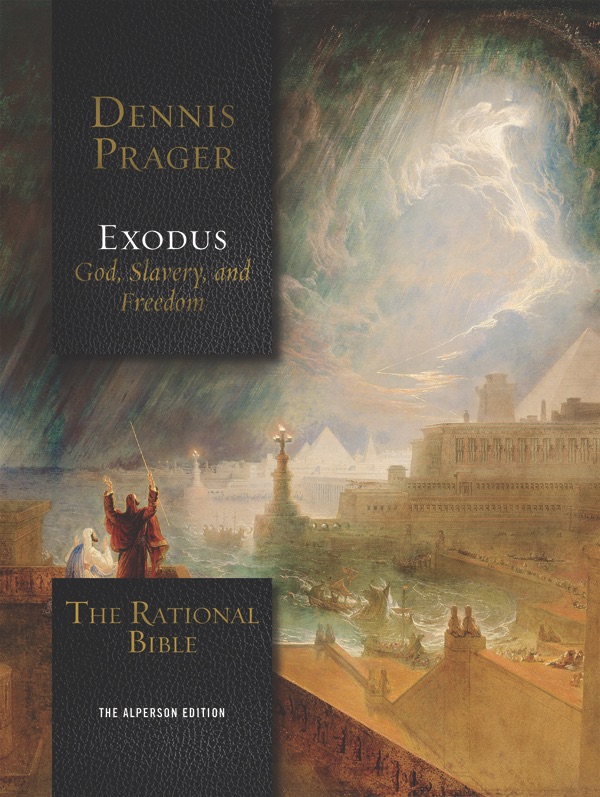
Shavuot is a festival with three names: the Feast of Weeks, the Day of the First Fruits, and the Harvest Feast. Scholars tell us that Shavuot, as observed in ancient Israel, marked the end of the barley harvest and the beginning of the wheat harvest. And yet, starting in the third century C.E., according to the Encyclopedia Judaica, a “remarkable transformation” took place — Shavuot came to be wholly reinterpreted as the anniversary of the giving of the Torah on Mount Sinai. By the Middle Ages, it was customary for young children to start their Jewish studies on Shavuot. So the observance of Shavuot is an appropriate moment take a fresh look at the Torah through the eyes of Dennis Prager in “Exodus: God, Slavery, and Freedom” (Regnery Faith).

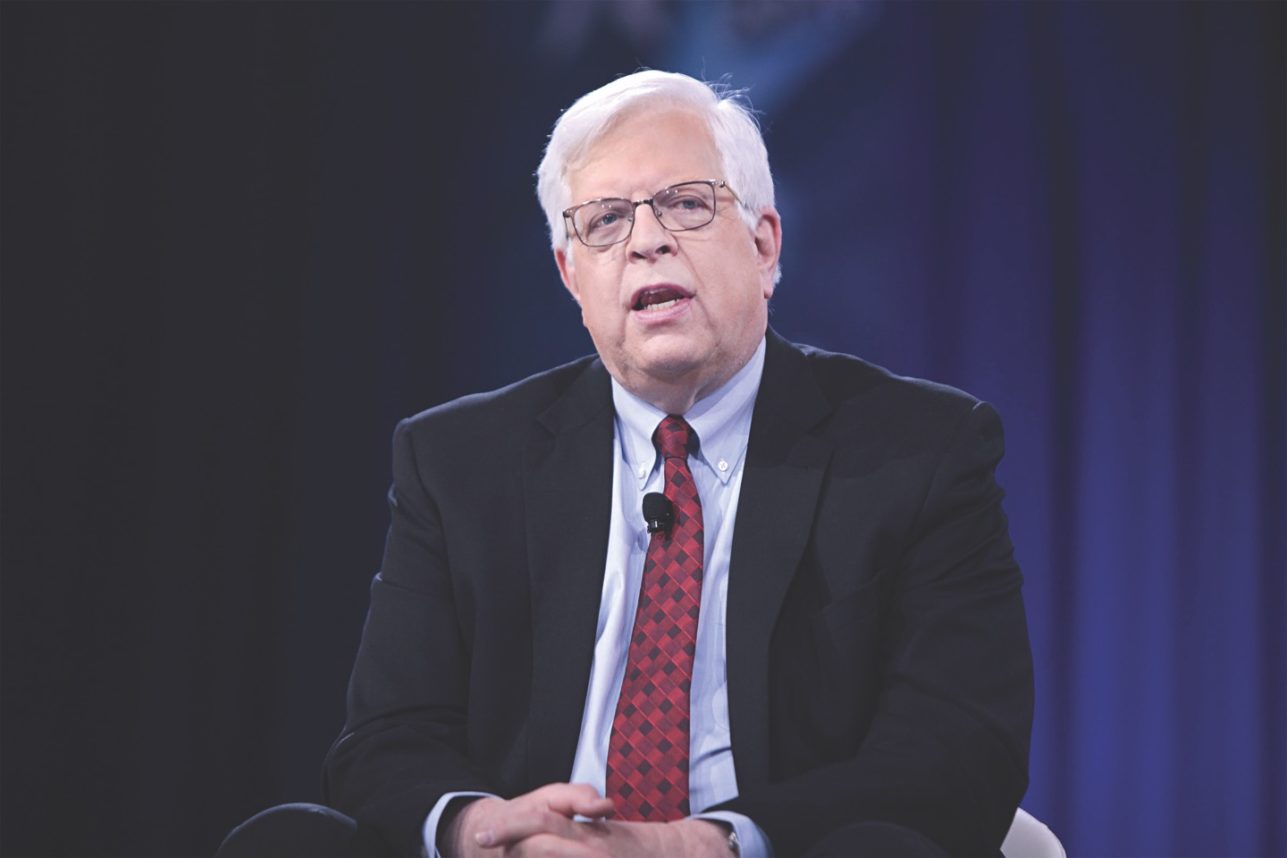
Prager, of course, is already a media celebrity. He is best known as a conservative radio commentator and the author of “Think a Second Time” and many other best-selling books about Judaism, politics and ethics. He is the founder of Prager University, an online showcase for short video segments on topics ranging from “Gun Rights for Women” to “Gender Identity: Why All the Confusion?” Now he has launched a series of biblical commentaries that he calls “The Rational Bible,” and the first title in the series is his commentary of the Book of Exodus.

It’s a handsome volume, beautifully printed and bound. Starting with the updated and streamlined translation of Exodus that first was published by the Jewish Publication Society (JPS) in 1985, Prager interlays the biblical text with his own explanations, elaborations and annotations. The volume is edited by Rabbi Joseph Telushkin, whom Prager first met in high school and with whom Prager has co-authored some of his best-known books, including their inaugural effort, “The Nine Questions People Ask About Judaism.” In appreciation for the supportive role that Joel Alperson played in the development of “Exodus,” the book is dubbed “The Alperson Edition.”

The distinctive voice that we hear in our heads as we read his version of Exodus belongs to Prager alone. Born in 1948, he has spent most of his life in the study of Torah, and he is never shy about sharing what he knows and what he thinks. When he disagrees with the fine points of the JPS translation, for example, he says so. He insists that he is always deferential to the divine writ: “When I differ with the Torah, I think the Torah is right and I am wrong,” he quips. Yet the raison d’etre of Prager’s book, like every other work of scriptural exegesis since antiquity, is the effort to explain what the Torah actually says and means.

By way of example, when we read the biblical commandment to observe Pesach, Sukkot and Shavuot (which is described in Exodus 23:16 as “the Feast of the Harvest, of the first fruits of your work, of what you sow in the field”), Prager points out that Shavuot is the least widely observed of the three pilgrimage festivals. “One reason is it has the fewest rituals associated with it,” he explains. “We are physical beings living in a physical universe; physical expression — which is what ritual is — matters. And Passover and Succot are replete with rituals.” And he ventures the opinion that “moderns relate far more to the idea of freedom (Passover) than to a holiday celebrating the giving of the Torah.” Yet the association between Shavuot and the giving of the Law on Mount Sinai is nowhere explicitly mentioned in the Torah itself.

Fans of Prager’s contributions to the Jewish Journal when he served as a columnist may be surprised to find that his new book is entirely free of the sometimes harsh rhetoric that he deployed against Jews whom he characterizes as “leftists.” One reason for Prager’s kinder and gentler approach may be the providence of his new book. “Exodus” is published by Regnery Faith, a publishing house that is owned by Salem Media Group, which also produces and distributes Prager’s radio show; Salem targets “audiences interested in Christian and family-themed content and conservative values.” So Prager strikes a notably ecumenical stance in the pages of “Exodus,” and he is apparently mindful that many of his readers will be non-Jews.

Prager does not dwell on what are essentially theological arguments. Rather, he is a strict moralist in the best sense of the word because he demands good behavior from everyone, regardless of their religious beliefs or practices.

Indeed, the preface to his new book includes separate sections that are variously addressed to Jewish readers, Christian readers, and nonreligious readers. Strikingly, Prager announces that it was the nonbeliever he had in mind in composing his commentaries. “With every passing generation in the West, fewer and fewer people believe in God, let alone in the Bible,” he writes. “This is a catastrophe for the West, and it is a tragedy for you.” Although he insists that he does not have a “parochial agenda,” Prager is plainspoken about his religious agenda. “I want as many people as possible to take the Torah seriously, to entertain the possibility that it is God-given, or, at the very least, to understand why so many rational people do.”

Exactly here is where two fundamental ideas collide. Prager invites his readers to approach the ancient text from a place of reason — that’s why he calls his series “The Rational Bible” — and yet he insists that the reader also must embrace the article of faith that the Bible is the revealed word of God rather than the work of human hands and minds. For most of readers who pick up the book, embracing these two notions at the same time will not be a challenging experience. The nonbelievers whom Prager had in mind when he wrote the book, however, may feel that he is begging the question.

“I am convinced the Torah is divine, meaning God, not man, is its ultimate source,” he continues. “The Torah is so utterly different — morally, theologically, and in terms of wisdom — from anything else preceding it and, for that matter, from anything written since, that a reasonable person would have to conclude either moral supermen or God was responsible for it.”

Prager does not dwell on what are essentially theological arguments. Rather, he is a strict moralist in the best sense of the word because he demands good behavior from everyone, regardless of their religious beliefs or practices, or the absence thereof, and he extracts from the Book of Exodus a code of conduct that he believes to be universal. His commentary on the writings from the ancient past is often hot-wired to contemporary reality, and that’s why his explanation of Exodus 23:8 (“Do not take bribes …”), for instance, points directly at the benighted world in which we live today.

“Corruption is the primary reason that societies fail to thrive,” he writes. “In Angola, for example, I saw rows of unfinished modern apartment buildings — unfinished because governmental officials were not offered sufficient bribes to allow completion of those buildings. To most people, corruption sounds bad, but most people do not recognize how devastating it actually is. The Torah does.”

Thus, Prager does not argue that we ought to obey the Ten Commandments because the Bible tells us that they are the word of God; rather, he argues that they amount to a civilizing code of conduct. “You shall not commit adultery” (Exodus 20:13) is included in the Ten Commandments, he argues, because “it is indispensable to forming and maintaining higher civilization.” He seems to express a degree of compassion for adulterers: “No one knows what goes on in anyone else’s marriage. And if we did, we might often well understand why one or the other sought love outside the marriage.” But his bottom-line argument is that “no higher civilization can be created or can endure that condones adultery,” and he assigns the same importance to five of the Ten Commandments, all of which “are intended to safeguard a foundation of civilization: life, family, property, truth, and justice.”

The Torah, according to Dennis Prager, is not the only way to understand the origin, meaning and purpose of the Bible in general or the Book of Exodus in particular. Prager joins a chorus of commentators, uncountable in number, that reaches back into distant antiquity and continues to attract new members. From all of us who regard the Torah as a living document, whether it was written by the finger of God or the hands of human beings, Prager deserves our praise for calling his readers back to the Bible.


Jonathan Kirsch, book editor of the Jewish Journal, is the author of, among other titles, “Moses: A Life.”

A Rational View of the Torah Read More »

When the Timely Fights the Timeless

What do the riots at the Gaza border have to do with the Jewish festival of Shavuot? What does the dramatic and historic move of the U.S. Embassy to Jerusalem have to do with the custom of baking cheesecakes for Shavuot, or the ritual of learning Torah all night?

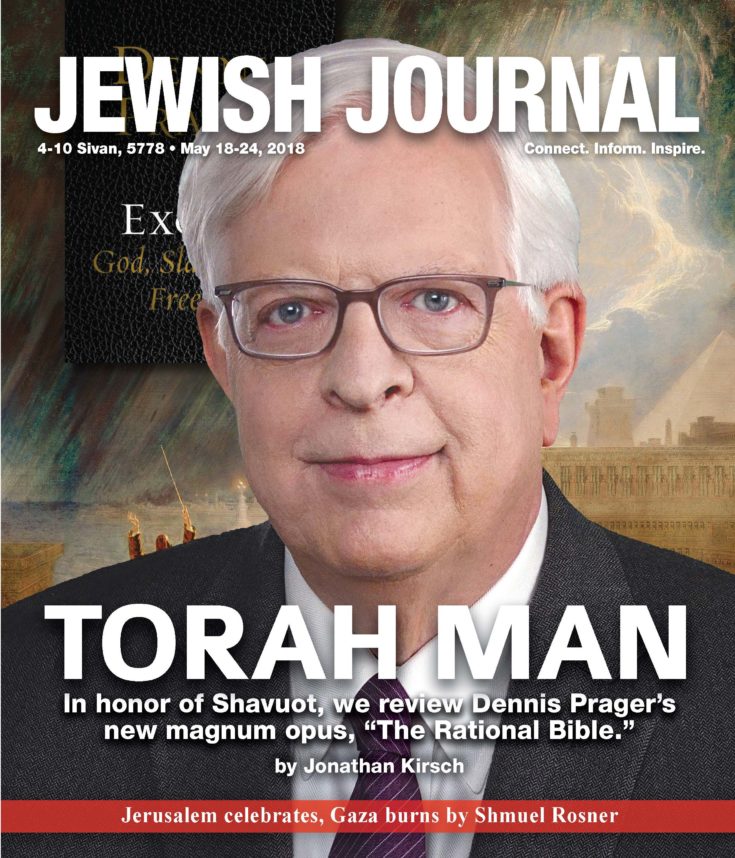
One of the dilemmas of Jewish journalism is what to do when the timely interferes with the timeless. We decided several months ago that Shavuot would be our cover story for this week. Since the festival commemorates the receiving of the Torah at Sinai some 3,300 years ago, it coincided perfectly with the release of Dennis Prager’s new book, “The Rational Bible.”

So, that was the plan — we would honor a holiday of Torah by reviewing a new book about the Torah.

And then, of course, reality intruded. The timeless Torah got ambushed by the timely news.

In fact, rarely do I recall a time period with so much consequential news — from the U.S. backing out of the Iran nuclear deal to the move of the U.S. Embassy to Jerusalem to the violent riots at the Gaza border, and, yes, even to Israel’s victory at the Eurovision Song Contest, when 200 million viewers watched Netta Barzilai take home the grand prize with an irresistible song that featured the memorable line, “I’m not your toy, you stupid boy.”

As we shoot down the rapids of this never-ending news cycle, Judaism comes to remind us that there are little coves on the side of the river that are waiting for us to pitch a tent, light a fire and appreciate the beauty and complexity around us.

Can a cover that commemorates an event from 3,300 years ago survive so much hot news? I can think of at least three timely cover stories we could have done instead of the one on Shavuot.

And yet, we decided to stick with the Shavuot cover. Why? For one thing, it reminds us that there’s more to life than news. News is sexy. It’s an adrenalin rush, a sugar high. I have a few trusted news sites that I know will give me a news hit every 15 minutes or so.

And when I don’t go to them, they come to me, either through a Twitter feed or an email blast or any other number of digital bursts.

All day long, I get hit with news items, mostly about politics, the Jewish world and Hollywood. And here’s the crazy part — I don’t complain. I’m used to it. It makes me feel like I’m always in the know. When I meet people, I feel empowered because I know “what’s going on” about the important issues in the world.

How can a 3,300-year-old story compete with all those hot news stories, especially an ancient story that offers us the same traditions and rituals year after year, without fault? Is there value to a story that is always there, a story that is rooted in eternity?

One of the best metaphors I ever heard about the challenge of parenting was, “Give your kids roots and wings.” As I interpret that statement, the “timeless” provides the roots and the “timely” provides the wings.

In a crazy world that keeps going faster and faster, the timeless is what keeps us grounded. Perhaps the best example is Shabbat, that ancient ritual that compels us to slow down and reconnect with our roots and our humanity.

Maybe that is one essential question of Shavuot — trying to understand why and how a news story can still be newsworthy after 3,300 years.

At the recent Milken Global Summit, I was immersed in a throng of high-achieving innovation junkies who offered smart and sophisticated answers to society’s ills. It was impressive. And yet, one of the most popular panels was one about life longevity — how to slow down and learn habits that will increase both the quality and length of your life.

When I spoke to one of the panelists, Arianna Huffington, after her talk, one of the first words out of her mouth was, “Shabbat.” She told me that her new movement, Thrive Global, is eager to start a “Shabbat track” because this Jewish ritual of weekly renewal is just what the world needs right now.

The news will keep coming at us, whether we like it or not. We’ll celebrate when the news is good, we’ll be sad when it’s bad, we’ll be confused when it’s good and bad, we’ll argue over whether it’s good or bad, and then we’ll all wait for the next hit.

As we shoot down the rapids of this never-ending news cycle, Judaism comes to remind us that there are little coves on the side of the river that are waiting for us to pitch a tent, light a fire and appreciate the beauty and complexity around us.

One of those little coves is the festival of Shavuot, when we recall that day when our ancestors gathered in a desert and accepted a book that we still study today. Maybe that is one essential question of Shavuot — trying to understand why and how a news story can still be newsworthy after 3,300 years.

When the Timely Fights the Timeless Read More »

Report: Iranian Organizations Offers $100,000 for Destruction of U.S. Jerusalem Embassy

An Iranian organization has offered $100,000 for the new United States embassy in Jerusalem to be destroyed.

According to the Washington Free Beacon, the Iranian Justice Seeker Student Movement has been distributing posters that state in English, Farsi and Arabic, “The Student Justice Movement will support anybody who destroy the illegal American embassy in Jerusalem.” The poster also states there would be a “$100,000 prize” as an incentive for the embassy’s destruction.

The Farsi news aggregate site University Student News Network, which first reported on the poster’s existence, wrote in their report on the matter, “It is necessary to mention that the steps by [President] Trump to transfer the US Embassy to Holy Qods [Jerusalem] has led to the anger and hatred of Muslims and liberators throughout the world.”

The U.S. embassy in Jerusalem officially opened on May 14.

“President Trump, by recognizing history, you have made history,” Israeli Prime Minister Benjamin Netanyahu said during a ceremony celebrating the opening of the embassy. “In Jerusalem, King David established Jerusalem as a capital 3,000 years ago. King Solomon later built the Temple, and over 2,000 years later, we got to hear the sentence ‘The Temple Mount is in our hands.’ We are here in Jerusalem, and we are here to stay.”

Tens of thousands of Palestinians rioted at the Israel-Gaza border in response on the same day, resulting in at least 58 dead. Hamas and Islamic Jihad have admitted that several of the victims were part of their respective terror organizations. Hamas also reportedly forced Gazans to riot.

Report: Iranian Organizations Offers $100,000 for Destruction of U.S. Jerusalem Embassy Read More »

White House Urges Qatar to End Support of Iran’s Terror Proxies

The Trump administration reportedly urged Qatar on May 12 to cease supporting Iran’s terror proxies after email unveiled ties between the two.

The Telegraph is reporting that they have seen emails between Qatari officials and the likes of Hezbollah leader Hassan Nasrallah and Iranian Quds Force leader Qasem Solemani as being warm. Included in these emails are ransom payments from Qatar to Shia militias in Iraq to release members of Qatar’s royal family.

“What these emails show is that a number of senior Qatari government officials have developed cordial relations with senior figures in Iran’s Revolutionary Guard, as well as a number of Iranian-sponsored terrorist organizations,” a senior US security official told the Telegraph. “At a time when the US government is trying to persuade Iran to end its support for terror groups in the Middle East, we do not believe it is helpful that Qatar continues to have ties with such organizations.”

The emails reflect the growing ties between Iran and Qatar, driven by trade relations as Qatar’s relations with Saudi Arabia and the United Arab Emirates (UAE) have soured.

The Trump administration calling for Qatar to end such ties is among their latest efforts to put economic pressure on the regime in Tehran after President Trump announced the United States’ exit from the Iran nuclear deal. On May 15, the administration announced that they would be slapping Iran’s central bank with sanctions for being used as a vehicle to funnel funds between Iran’s Revolutionary Guards and Hezbollah.

“It is appalling, but not surprising, that Iran’s senior-most banking official would conspire with the IRGC-QF to facilitate funding of terror groups like Hezbollah, and it undermines any credibility he could claim in protecting the integrity of the institution as a central bank governor,” Treasury Secretary Mnuchin said in a statement.  “The United States will not permit Iran’s increasingly brazen abuse of the international financial system. The global community must remain vigilant against Iran’s deceptive efforts to provide financial support to its terrorist proxies.”

If the Trump administration can find a way to end Qatar’s funding of Iran’s terror proxies as well as its ties with Iran in general, it would help them in cracking down on Iran’s financial support of terrorism.


White House Urges Qatar to End Support of Iran’s Terror Proxies Read More »

Week of May 18, 2018

Week of May 18, 2018 Read More »