fbpx

May 3, 2018

A Criminal Sin

From his initial descent down the escalator at Trump Tower to his absence at the White House Correspondents’ Dinner Trump has displayed on an uncanny ability to dominate the headlines in the American press. What Trump does, or doesn’t do, manages to suck up virtually all the media’s attention relegating context, explanations, and perspectives on the flow of events to a footnote in the coverage, if any mention at all.

On most issues, his musings and diatribes need little context for most people to discern their falsity—they are often blatant lies, exaggerations and mischaracterizations that are fairly obvious to anyone who is not a died in the wool trumpkin (here is an analysis of one of his “most comprehensively disproven tweets”). His now proven lies regarding payments to Stormy Daniels, his incessant attacks on the FBI, the Justice Department, the intelligence community, Robert Mueller, James Comey, and anyone who disagrees withhim speak for themselves; no help is needed to decipher his victimized mind at play. He misrepresents reality at a rate of 6.5 untruths per day  (according to a study by the Washington Post) most of his lies are on topics that don’t go to how Americans view themselves, their communities or their country

What is more troublesome are his characterizations of complex issues where his untruths are harder to discern and their impact truly insidious. In particular, his negative narrative of crime in America is truly dangerous with serious and bizarre policy implications.

On the issue of crime, Trump’s dystopian description of crime in America during his presidential campaign was particularly outrageous.

I’ll be able to make sure that when you walk down the street in your inner city, or wherever you are, you’re not going to be shot….your child isn’t going to be shot.

His constant refrain alleging rampant crime in American cities, his disdain for predominantly Black communities, his decrying of Mexican immigrants as murderers and thugs combined to gin up fear of crime across the country and provided a useful vehicle for his claim to be the savior who can keep us all safe.

His campaign rhetoric was topped off by his dark inaugural speech and the bizarre assertion that, “This American carnage stops right here and stops right now.”

Where Trump’s predecessors tried to calm fears and unwarranted anxiety (e.g. FDR’s “the only thing we have to fear is fear itself”) this president raises illusory boogeymen to stoke fear and division.

The reality of crime in America over the past few decades is precisely the opposite of the “carnage” scenario that the president has trumpeted. In a recent piece in The New Yorker, Adam Gopnik described what is really going on,

In the city [New York] where more than 2,000 people used to be murdered each year, 328 were killed in 2014, the lowest tally since the first half of the twentieth century.” (Last year, the tally was still lower.) It wasn’t just New York. Violent crime fell in Atlanta, Dallas, Los Angeles, and Washington, and not by a little but by a lot.

More important, the quality of life changed dramatically, particularly for the most vulnerable. Sharkey, studying the crime decline in six American cities, concludes, “As the degree of violence has fallen, the gap between the neighborhoods of the poor and nonpoor has narrowed.” In Cleveland in the eighties, the level of violence in poor neighborhoods was about seventy per cent higher than in the rest of the city; by 2010, that number had dropped to twenty-four per cent. The reduction of fear allowed much else to blossom: “Subway cars, commuter lines, and buses in U.S. cities filled up, as residents and commuters became more willing to leave their cars behind and travel to and from work together.. . . Fans came back to Yankee Stadium in the Bronx, and just as many began to show up for night games as for day games.” The big city was revived. From Portland, Maine, to Portland, Oregon, the transformation of America’s inner cities from wastelands to self-conscious espresso zones became the comedy of our time.

The data aren’t hidden, this reality is being lived by most Americans (the overall crime rate in Los Angeles is the lowest it has been since the 1950s and 60s), yet Trump has embedded this pernicious notion of carnage into the psyche of many who have become increasingly fearful. Gopnik helps explain the phenomenon (watch his recent appearance on CNN here).

Yet little trace of this transformation troubles our art, or even much of our public discourse. Our pundits either take the great crime decline for granted or focus on the troubles it has helped create, like high housing prices in San Francisco or Brooklyn. Even when we pay attention to the comedy, we rarely look at the cause.

****

This lack of appreciation is partly a question of media attention-deficit disorder: if there is little news value in Dog Bites Man, there is none whatever in Dog Does Not Bite Man. It is part of the neutral unseen background of events, even if there had previously been an epidemic of dog bites. But it’s hard for those who didn’t live through the great crime wave of the sixties, seventies, and eighties to fully understand the scale or the horror of it, or the improbability of its end.

Not only do the media ignore what doesn’t happen, there is little percentage in rational candidates questioning the claimed increase in the incidence of crime, no matter how minimal the rate. There are always victims with heart-rending stories, pointing out how anomalous crimes are wins few friends.

The media ignore the profound transformation, candidates avoid countering the hyperbolic assertions, advertisers for burglar alarm systems and security devices bombard the airwaves with commercial depicting break ins and violent crimes and all the while the numbers for those crimes remain at historic lows.

Gopnik speculates as to why we are experiencing this profound transformation,

An epidemic of violence was resolved without addressing what were thought to be its underlying disorders. We cured the crime wave without fixing “the broken black family,” that neocon bugaboo. For that matter, we cured it without greater income equality or even remotely solving the gun problem. The story of the crime decline is about the wisdom of single steps and small sanities. We could end cholera—in London, they did—without really understanding how cholera bacteria work. We have curbed crime without knowing how we did it, perhaps simply by doing it in many ways at once. It is possible to see this as a kind of humanist miracle, a lesson about the self-organizing and, sometimes, self-healing capacities of human communities that’s as humbling, in its way, as any mystery that faith can offer.

Given the transformation of America that we are living through what we need is a courageous politician to wake us up to this reality, to decry the demagoguery and dissembling that surrounds the issue and acknowledge that so much of our energy, resources and fears are incorrectly targeted.

Trump is manifestly not that politician—he is a good part of the ailment, he is clearly not the cure.

A Criminal Sin Read More »

Moving & Shaking: LAJFF, Friends of IDF and More

The 13th annual Los Angeles Jewish Film Festival (LAJFF) kicked off with a sold-out opening night gala on April 25 at the Ahrya Fine Arts theater.

The event paid tribute to the legendary African-American and Jewish entertainer Sammy Davis Jr. and featured a screening of “Sammy Davis Jr.: I’ve Gotta
Be Me.”

The Sam Pollard-directed documentary examines the life and career of Davis, who was a child star, member of the Rat Pack and civil rights activist before his death in 1990 at the age of 64. Those interviewed in the film include Whoopi Goldberg, Billy Crystal, Kim Novak and Jerry Lewis.

Speaking from a podium in the theater, LAJFF Director Hilary Helstein welcomed the crowd to the festival.

Beverly Hills Vice Mayor John Mirisch and Los Angeles City Councilman Paul Koretz presented Helstein with proclamations on behalf of Beverly Hills and Los Angeles, respectively.

In an interview on the red carpet, Ken Davitian, co-star of the film “The Samuel Project,” said Davis transcended racial boundaries.

“He broke the barriers of these Black guys who could hang around with white guys [such as Frank Sinatra and Dean Martin] and they were actually having a ball,” Davitian said. “They had a fun time; they all had the talent; they were able to do stuff other people can’t do and they liked doing it with each other and it didn’t matter if it was an Italian guy or a Black guy.”

“Or a Jewish guy,” Helstein said, standing alongside Davitian.

“A Jewish Black guy,” Davitian said.

Rabbi Jerry Cutler of Creative Arts Temple described Davis as a “great man and a great entertainer.”

Local comedian Avi Liberman, whose film, “Land of Milk and Funny,” screened at the festival, said he has always appreciated Davis’s contributions to the arts. He called Davis “one of the greatest all-around performers ever.”

Additional attendees included actor Hal Linden, star of “The Samuel Project,” which premiered at the festival on April 28; George Schlatter, who produced the breakthrough series “Rowan & Martin’s Laugh-In”; Manny, Davis’ son with his widow, Altovise; and Kat Kramer, the daughter of acclaimed filmmaker Stanley Kramer.

After the screening, Hollywood historian and Davis archivist Stan Taffel moderated a panel discussion.

The LAJFF is co-sponsored by Tribe Media Corp., parent company of the Jewish Journal.

Friends of Israel Defense Forces Western Region President Tony Rubin and IDF Sgt. Yaniv attended a Yom HaZikaron celebration at the Saban Theatre. Photo by Positive Vibes Productions.

Approximately 1,000 members of the Los Angeles community gathered on April 17 at the Steve Tisch Cinema Center at the Saban Theatre to commemorate Yom HaZikaron, Israel’s Memorial Day for fallen soldiers and victims of terror.

Friends of the Israel Defense Forces (FIDF), the Temple of the Arts and the Consulate General of Israel in Los Angeles organized the community-wide night of remembrance, ahead of Israel’s 70th Independence Day.

“Over the last 70 years, we have faced countless challenges threatening our existence as an independent sovereign country,” Consul General of Israel in Los Angeles Sam Grundwerg said. “In the face of current threats stands the Israel Defense Forces and the resilient nature of the Israeli people. Their courage and spirit guarantees the security and the continuity of our nation. We bow our heads because we know that Israel is here because of them.”

More than 50 local schools, synagogues and organizations partnered for this community event. The ceremony honored the memories of Israel’s fallen service members and paid tribute to the men and women in uniform who defend Israel and Jews around the world.

“As we prepare to celebrate 70 years of a strong and independent Israel, we must acknowledge that we are able to do so because of the bravery and sacrifice of the men and women of the IDF,” FIDF National Board Member and Western Region President Tony Rubin said. “Seven decades later, these heroes must continue to fight for the survival of the Jewish state. We are forever in their debt.”

An Israel Defense Forces sergeant led the community in praying for the safety of those in Israel and the men and women of the IDF. He mourned the 26,780 fallen soldiers and victims of terror by reciting the Mourner’s Kaddish.

Additional guests included L.A. Councilman David Ryu; Rubin’s wife, Linda; Temple of the Arts President James Blatt and FIDF Western Region Executive Director Jenna Griffin.

From left: Noah Pollak; Leah Yadegar; Yael Lerman; StandWithUs (SWU) President Esther Renzer; Professor Robbie Sabel and Jonathan Bell attend the inaugural SWU Legal Dinner. Photo by Dustin Thompson Photography.

Hebrew University of Jerusalem law professor Robbie Sabel delivered a lecture about how international law is on Israel’s side at the StandWithUs inaugural Legal Dinner on April 26.

Appearing at The Mark on Pico boulevard, Sabel told the audience that the Boycott, Divestment and Sanctions (BDS) movement is rooted in “a hatred of Jews” and that while the likes of Syrian President Bashar Assad, Hamas and Hezbollah may not care about international law, international law does play an important role when it comes to defending Israel.

One such role for international law is that it gives Israel international legitimacy, as Sabel pointed out that it was a League of Nations agreement that helped lead to the Balfour Declaration in 1917.

“You won’t find a mention of this League of Nations agreement by propagandists,” Sabel said.

Sabel added that international law is important for negotiations, especially when it comes to particular phrases in agreements, citing particular wording in an agreement between Israel and Egypt that basically left the Gaza Strip as part of Israel during the time of the British Mandate.

On the issue of settlements, Sabel argued that they were actually legal under international law because international law states that occupation applies only when a country is occupying an “enemy state,” and there is no official Palestinian state.

“We’ve got to try and combat this attempt… to undermine Israel’s legitimacy,” Sabel said.

Also, StandWithUs thanked the Jewish Community Foundation of Los Angeles for providing a three-year grant of $75,000 each year to StandWithUs’s JD Fellowship program, which educates participants on how to use legal advocacy to advance the pro-Israel cause.

Pro-Israel activist Noah Pollak, StandWithUs President Esther Renzer and Director of StandWithUs’ J.D. Fellowship Program Leah Yadegar spoke at the dinner as well. Among those in attendance included Israeli-American Council Chairman Adam Milstein. 

Aaron Bandler, Contributing Writer

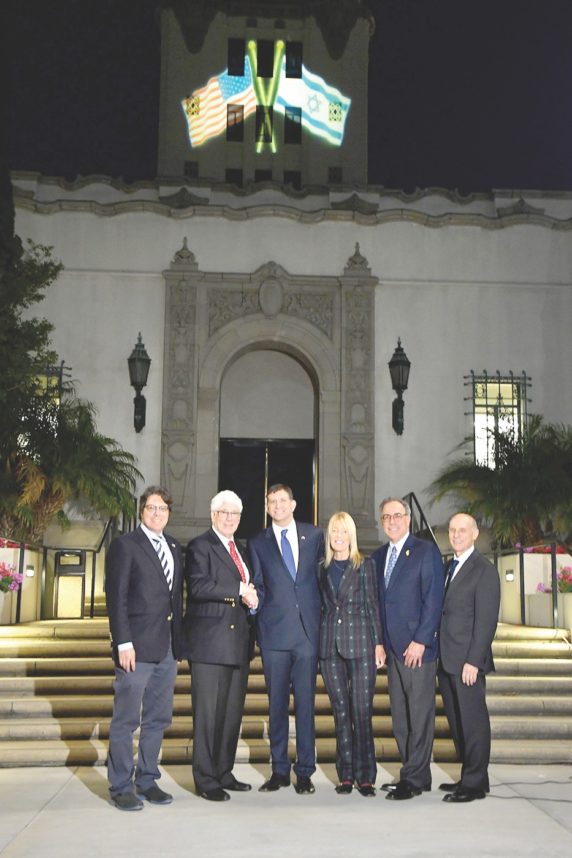
From left: On the occasion of Israel’s 70th birthday, Beverly Hills Vice Mayor John Mirisch; Beverly Hills Mayor Julian Gold; Consul General of Israel in Los Angeles Sam Grundwerg; and Beverly Hills City Councilmembers Lili Bosse, Lester Friedman; and Robert Wunderlich celebrated the Israel-Beverly Hills partnership at Beverly Hills City Hall. Photo by Vince Bucci.

The city of Beverly Hills projected the U.S. and Israel flags on Beverly Hills City Hall in honor of Israel’s 70th Independence Day and in celebration of the city’s strong ties and support for the state of Israel.

“We thank the city of Beverly Hills for the amazing show of friendship and the unwavering support throughout the years,” Consul General of Israel in Los Angeles Sam Grundwerg said during the April 18 ceremony.

Those in attendance included Beverly Hills Vice Mayor John Mirisch; Beverly Hills Mayor Julian Gold; and Beverly Hills City Councilmembers Lili Bosse, Lester Friedman and Robert Wunderlich.

The relationship between the city of Beverly Hills and the State of Israel is multifaceted, including on water preservation, security and arts and culture. The city also has helped push back against the Boycott, Divestment and Sanctions movement against Israel.

That same day, a Yom HaAtzmaut celebration organized by Bnei Akiva of Los Angeles at Santa Monica High School drew 1,100 people, including students from Gindi Maimonides Academy, Harkham Hillel Hebrew Academy, Yavneh Hebrew Academy, Emek Hebrew Academy, Shalhevet High School, YULA Boys and Girls High Schools and Harkham-GAON Academy.

“It is a privilege to speak to this audience in particular, because you are the next generation,” Grundwerg said, addressing the students. “You are the Jewish leaders of tomorrow.”

Moving & Shaking: LAJFF, Friends of IDF and More Read More »

TABLE FOR FIVE: Five Takes on the Weekly Parsha, Emor

PARSHA: EMOR, LEVITICUS 22:18-21

Speak unto Aaron, and to his sons, and unto all the children of Israel, and say unto them: Whosoever he be of the house of Israel, or of the strangers in Israel, that bringeth his offering, whether it be any of their vows, or any of their freewill-offerings, which are brought unto the Lord for a burnt-offering; that ye may be accepted, ye shall offer a male without blemish, of the beeves, of the sheep, or of the goats. But whatsoever hath a blemish, that shall ye not bring; for it shall not be acceptable for you. And whosoever bringeth a sacrifice of peace-offerings unto the Lord in fulfilment of a vow clearly uttered, or for a freewill-offering, of the herd or of the flock, it shall be perfect to be accepted; there shall be no blemish therein.

Rabbanit Alissa Thomas-Newborn
B’nai David-Judea Congregation

“Any person” — Jews and non-Jews — may bring an offering to God’s Mishkan (Rashi, Vayikra 22:25). And on the other hand, we see that the parameters of what this offering must be are quite strict: “any animal with a blemish” will not be acceptable for you. Why does God simultaneously open his Mishkan to all, and close it — limiting what may be brought into it?

In doing so, God reveals two powerful Jewish values that apply in the Mishkan and in our lives: inclusion and exclusion. We all live in the tension between the two on a daily basis. We are called to be welcoming — opening our hearts, homes and beyond to anyone who wants to share in the holy endeavor of serving God, as well as to anyone who needs us. We also are called to establish moral and spiritual standards, follow Jewish legal guidelines, uphold communal norms that unite us and distinguish us from the rest of the world.

In this tension, there is a profound wisdom: The Torah does not choose between these two values, but integrates them both into our worship of God. The trick is to know when we must live in both at once, and when we must draw from one more than the other. How we apply the tools of inclusion and exclusion — for better and for worse — will define our holiness and our fulfillment of God’s will.

Rabbi Drew Kaplan

I am often surprised at how easy return policies are these days. No longer does the customer need to offer a specific reason why he or she is returning an item to the store. Whether the item to be returned has a rip, a hole, is discolored, smelly or has some other defect, it will be accepted. While growing up, I thought an item had to have a defect to qualify for a store’s return guidelines. Nowadays, return policies often don’t require a reason for the return. The whim of the customer is sufficient.

When bringing animal offerings, God is requesting the children of Israel bring defect-free animal offerings. Although one could say that God does not wish to be bothered to have to return the item, we could also look at this expectation from another perspective.

The requirement that the offering be “pleasing to us” also prompts us to consider what a blemished offering says about us and our standards. We are the ones bringing the offering — whether native-born or otherwise. Our offering reflects on us. Whether one works in selling goods or in selling services, offering substandard products should never be an aspiration. Taking pride in what we have to offer is pleasing to us. That is an appropriate aspiration.

In everything we offer to fellow humans or to God, we should strive to make the offering pleasing to them and to us, as well.

Allison Josephs
Jew in the City/Project Makom

This parsha is intense. Stoning, harlots, blasphemy. As an Orthodox Jew who chose this lifestyle in her teens, I skim a parsha like this and think, “Wait, what did I sign up for?” Then I get to the end and see maybe the most misunderstood line from the Torah and suddenly feel better.

“An eye for an eye, a tooth for a tooth.” People think that this means that the punishment for damaging someone’s eye is to have the same done to the perpetrator, but that is not what is going on here.

The Talmud tells us that the punishment is actually monetary restitution. So why then does the Torah make it seem like it’s a literal part that’s exchanged?

According to Maimonides, while we would never harm someone’s body, the person who caused the damage should realize how serious destroying a body part is, lest a rich guy go around poking out eyes and handing out cash.

Which brings me back to the first issue — my discomfort with the topics of the parsha. I made the mistake of just picking up the book and expecting to understand it right away. But the Torah is not meant to be read in a peripheral way. In an era of sound bites, we often make the mistake of treating the Torah similarly. But if we do, not only do we grossly misunderstand it, we also miss the chance to experience its richness and all of its layers.

Rabbi Daniel Bouskila
Sephardic Educational Center

While the term “ger” literally is translated as “stranger,” halachah eventually came to use that term for converts, that unique class of dedicated individuals who willingly enter the covenant and become part of the Jewish people. With “ger” meaning “convert,” this week’s parsha welcomes converts to participate in some of the most important rituals in the Torah — the sacrifices and offerings: “When any man of the house of Israel, or the converts (ger) amongst them, presents a burnt offering as his offering for any of the votive, or any freewill offerings that they offer to the Lord.” As a sign of unity between those originally of “the house of Israel” and “the converts amongst them,” the Talmud (Menachot 104b) comments on the Torah’s use of the word “they,” saying that the fact that the Torah formulates the verse as “they offer” (asher yakrivu) teaches “that these offerings may be brought jointly.” The born Jew and the convert stand in unison to bring a sacred offering unto God. In his book on the talmudic sage Hillel, Rabbi Joseph Telushkin discusses Hillel’s welcoming attitude toward converts, stating that we need to adopt Hillel’s attitudes today: “The (welcoming) approach I am advocating is consistent, I believe, not only with Hillel’s teachings, but also with that of the late Sephardic Chief Rabbi of Israel, Ben-Zion Uziel, who argued for a policy of greater openness to potential converts.” The Torah welcomes the convert, so did Hillel, and so did Rabbi Uziel. It’s our turn.

Eli Fink
Jewish Journal

I always thought it was quite snobby of God to accept only perfectly unblemished animals. Could it be that physical imperfections are displeasing to God? Like a cosmic Hercule Poirot returning his breakfast eggs because they are not perfectly symmetrical, as seen in the recent “Murder on the Orient Express” film?

Recently, my son asked me about “A Separate Peace” by John Knowles — one of my favorite books — a brilliant parable about adolescence and life. One message of the book is that there is no place for perfection in our imperfect world. We all have flaws and we are all broken in some way. All the characters in the book are flawed except for the exceptional Phineas. He is perfect. Phineaes is not for this world — so he dies. Our world is for the broken people.

Sin happens when we forget that imperfection is normal. No one is perfect and our goal should not be perfection. Instead, our goal should be to always struggle with our imperfections and never to give up on improving ourselves.

That is why we sacrifice only physically perfect animals to God. Like Phineas, they are not for this world. Our world is a world of people who make mistakes and have flaws. When we need to repent, we sacrifice a symbol of this mirage of perfection to remind ourselves that we are perfectly imperfect in every way. We send our fantasy of perfection to God so that we may remain in this world to continue our holy work of living.

TABLE FOR FIVE: Five Takes on the Weekly Parsha, Emor Read More »

Letters to the Editor: Natalie Portman, Teen Mental Health, and Millennials and the Holocaust

Natalie Portman’s Israel Decision

Is Natalie Portman wrong about not visiting Israel to pick up the Genesis Prize? Right? Justified? Anti-Israel? Playing into the hands of the Boycott, Divestment and Sanctions group? Influential people are lining up on both sides. But strategically, it’s the wrong conversation. There is a bigger, more critical and worrisome story beneath the surface of the Portman controversy that supporters of Israel and believers in Zionism have to wrap their heads around.

Powerful people like her, the people they influence and too many of the next generation are distancing themselves from the current Israeli establishment. We can vociferously argue the drawbacks and merits of everyone’s beliefs, but the fact is we are in danger of losing these people. And we cannot lose them. The ramifications are too great.

If Israel were a product and we were the marketers who saw a growing trend among important segments of the market, that consumers no longer were buying as they once did, we would be doing everything we could to understand why and what needed to be done to shore up our marketplace.

Instead, we just argue, write, voice outrage, support and offer many opinions. All the while, as the marketplace continues to hemorrhage.

Is our job as Israel-lovers to just to keep talking, writing and having conversation? Or is it to understand our marketplace and take action?

Gary Wexler via email

Portman’s refusal to accept her Genesis Prize in Israel makes me very sad. I used to adore her, and now I can’t watch her. Leftist conflict with Israel isn’t new, but do liberals really think they can just turn their backs on Israel and remain Jews, and that their children and grandchildren will still be Jewish? When the Babylonian exiles returned to Jerusalem, those who stayed behind, the first Diaspora, showed great deference and support in rebuilding the Jewish state despite serious controversy. And ever since, Diaspora Jews have cherished the Holy Land.

The miracle of Jewish survival has occurred in part because we don’t just believe in God, we have a deal with God, a covenant, based on our allegiance to the Promised Land. This connection has inspired Jewish hopes and pride, and kept our people together for 4,000 years. Now, as Jews by the thousands make aliyah to escape persecution, and Iran threatens Israel with a three-front war, “progressives” here and in Europe relentlessly slander Israel.

Rueben Gordon via email


Teen Mental Health Help in L.A.

Regarding your story “Making Teen Mental Health a Priority,” (April 27) help for teens with mental health issues is in our own backyard.

Didi Hirsch Mental Health Services (DHMSH) transforms lives by providing quality mental health care and substance abuse treatment from 11 sites and in nearly 100 schools. The agency helps almost 100,000 adults and children throughout Southern California each year. Its suicide prevention center — the first in the nation to provide 24/7 crisis counseling — receives more than 80,000 calls on its crisis line annually and provides support groups for people who have lost loved ones to suicide or have attempted it.

My late mother-in-law, Beatrice Stern, closest of friends with Didi Hirsch and a former DHMSH board member, took a leading role in sparking positive conversations about mental illness by establishing the DHMSH Erasing the Stigma Leadership Awards. What began as a small fundraising luncheon has grown into a large dinner, which last week honored musician Rick Springfield, actor Oliver Platt, pro football player Joe Barksdale and the Born This Way Foundation for their work toward erasing the stigma of mental illness.

Marilyn Stern, Westwood


Liberal Democrats, by Definition

I come from a long line liberal Jewish Democrats. When I married my husband, (who is Jewish), I married out of the “faith” because he is a Republican. I read to him Karen Lehrman Bloch’s column “I Am a Liberal. Are You?” (April 20) to verify his stance on each point she highlighted. He agreed with every line. Turns out Republicans can be liberals, too.

Jan Burns via email


Emotional Links to Israel

Thank you, David Suissa, for reminding me of why I swell with pride when hearing of Israel’s great accomplishments, and why my heart aches when I hear of Israel’s sorrows (“A ‘Better’ Word for Israel,” April 20). Having been born and raised in the United States, and having lived my entire life here, I needed that reminder of why. What an eloquent column that shines the light on two big words: fair and unfair.

Pamela Galanti, Chatsworth


Cartoonist Is Off Base

In light of President Donald Trump’s success at staring down nuclear missiles from North Korea, producing amazingly low unemployment numbers (especially among the poor and most vulnerable), the growth of the stock market and Gross National Product, decimating ISIS, moving the American Embassy to Jerusalem, raising workers’ pay and bonuses through tax cuts, and confirming federal judges, the “Trump Derangement Syndrome” cartoon by Steve Greenberg in your April 27 issue was particularly disgusting.

Warren Scheinin via email


The Amazing Metuka Benjamin

Metuka Benjamin could have achieved super success as a leader in politics, business or any leadership role she could have chosen (“Milken Schools President Is Moving On,” April 27). Consumed by her intense love of the Jewish people and the State of Israel, in particular, she applied her skills, talents and magnetic personality to the building of Jewish schools and the relationship with the State of Israel, not just in words and emotions, but with action. She envisioned and built one of the largest Jewish schools in the U.S., complete with a “living bridge” to Israel as a laboratory of Jewish and Zionist identity for Los Angeles students.
For people serious about the relationship between Israel and our 18- to 26-year-olds, Benjamin is just beginning, again. You may want to follow her next move. Stay tuned.

Howard Gelberd via email


Millennials and the Holocaust

The recent Claims Conference study that revealed millennials’ lack of knowledge about the Holocaust is, as Stephen Smith pointed out, due to “an uneven educational environment” (“Mandate to End Holocaust Ignorance,” April 20). The question is: What to do about it? While eight states have Holocaust Study “mandates” that vary in nature — and approximately half of the states have Holocaust teaching “recommendations” — should all states, via federal legislation, particularly, require Holocaust instruction?

One facet of the foregoing is the all-too-often failure to provide financing for Holocaust curriculum implementation. Without dollars for teacher in-servicing, materials and associated educational costs, just how “even” can Holocaust instruction become?

California is a perfect example of an unfunded, via taxes (1986 forward), but funded, via contributions (post 2002, for several years) mandate. Fortunately, for millions of California students, organizations such as Stephen Smith’s USC Shoah Foundation provide rich, ongoing, accessible Holocaust study resources. Still, a national “mandate” without means (i.e., teacher training and related funding costs) should make us cautious about what we wish for.

Bill Younglove, Lakewood


The Middle East Powder Keg

Iran having a base of military operations in Syria must never be allowed (“Collision Course,” April 27). This not only puts Israel at risk, but world peace, as well.

Add Russia’s involvement in the area and you have a recipe for a catastrophe.

George Vreeland Hill via email

Letters to the Editor: Natalie Portman, Teen Mental Health, and Millennials and the Holocaust Read More »

Amanda Berman: Can progressives also be Zionists?

[iframe style=”border:none” src=”//html5-player.libsyn.com/embed/episode/id/6552106/height/100/width/480/thumbnail/yes/render-playlist/no/theme/custom/tdest_id/689387/custom-color/dfdfdf” height=”100″ width=”480″ scrolling=”no” allowfullscreen webkitallowfullscreen mozallowfullscreen oallowfullscreen msallowfullscreen]

Amanda Berman, founder of the Zioness movement, discusses the opposition liberal Zionists have faced within the progressive movement, and how her new movement is working to change that.

Check out this episode!

Amanda Berman: Can progressives also be Zionists? Read More »

“To Be Holy!” Simple But Not So Easy – Parashat Emor

There’s a story told that “Rabbi Shimon ben Shetach commissioned his disciples to buy him a camel from an Arab. When they brought him the animal, they announced that they’d found a precious stone in its collar, expecting their master to share in their joy.

‘Did the seller know of this gem?’ asked Rabbi Shimon. On being answered in the negative, he said angrily, ‘Do you think me a barbarian that I should take advantage of the letter of the law by which the gem is mine together with the camel? Return the gem to the Arab immediately.’”

When the Arab received it back, he said: “Blessed be the God of Shimon ben Shetach! Blessed be the God of Israel!” (Devarim Rabbah 3:3)

When my sons were young, their mother and I told them that what they did, how they behaved, and the way they spoke to and treated others outside the home reflects not only on them, but on us, their parents, and on our family name. We reminded them to be honest, kind, and modest, and to embody those values always.

I often tell Rabbi Shimon’s story to children and remind them that what we do not only says much about who we are, but about our families and the Jewish people.

Until the modern period when communal values changed broadly, the most respected Jew in the community wasn’t the wealthiest and most politically influential, nor the celebrity, business maven, professional, or financial benefactor. Rather, the highest moral, ethical, and religious virtues were expected to be emulated by the Torah scholar, but even the scholar struggled mightily against the yetzer hara (“the evil inclination”).

Here is Maimonides’ description of what’s expected of the great Torah scholar:

“…When a person …is a great scholar, noted for her/his piety, people will talk about her/him, even if the deeds that s/he has committed are not offenses in the strict sense. Such a person is guilty of profaning the divine name (hillul ha-Shem), if s/he, for instance, makes a purchase and does not immediately pay for it, in the case where s/he has the money and the sellers demand it, but s/he stalls them; or if s/he indulges in riotous behavior and in keeping undesirable company; or if s/he speaks roughly to her/his fellows and does not receive them courteously but shows her/his temper and the like. All is in accordance with her/his status as a scholar. S/he must endeavor to be scrupulously strict in her/his behavior and go beyond the letter of the law. If s/he does this, speaking kindly to her/his fellows, showing her/himself sociable and amiable with the welcome for everyone, taking insult but not giving it; respect them, even those who make light of her/him; in all her/his actions until all praise and love her/him, enraptured by her/his deed – such a person has sanctified the name of God (Kiddush ha-Shem). Regarding such a person scripture states: ‘You are my servant, Israel, in whom I will be gloried.’” (Moses ben Maimon, Yesodei Ha-Torah 5:11)

RAMBAM taught that “Sanctifying God’s Name – Kiddush Ha-Shem” includes business ethics, conduct in mundane affairs, refinement of behavior and public demeanor, kindness and humility before people and God.

Except for the rare individual, we’re all a continuing battleground between two yetzers (i.e. good and evil inclinations) and we must choose. For too many of us, base instinct rules. We’re driven by need, desire, greed, jealousy, envy, lust, anger, impatience, fear, and hate. Others have an easier time being kind and generous, and they struggle less. But we all struggle.

The reason Torah study is determinative for the scholar (and is important for everyone) is because we find ourselves everywhere in the text. Every human instinct and virtue is addressed.

Anyone who says that Torah is irrelevant to his/her life is hiding something. To the contrary, the opposite is true. It’s there in Torah that we discover our deepest selves, a sense of meaning and purpose that sustains and strengthens us for noble ends.

Shabbat Shalom!


“To Be Holy!” Simple But Not So Easy – Parashat Emor Read More »