The United Nations Human Rights Council (UNHRC) passed a series of anti-Israel resolutions on Mar. 23, most notably one that calls for an arms embargo against Israel.
The Jerusalem Post reports that the arms embargo resolution asserted that Israel was in violation of international law for their supposed occupation of East Jerusalem, therefore the international community should follow international law and “end users known or likely to use the arms in the commission of serious violations of international humanitarian and/or human rights law.” The resolution passed by a margin 27 to 4 and 15 abstentions.
Other anti-Israel resolutions passed by the UNHRC on Mar. 23 included declaring that Israel should withdraw from the Golan Heights, ending the building of settlements in Judea and Samaria and a return to pre-1967 borders.
The United States opposed all of the anti-Israel resolutions and countered with a resolution that nixed the UNHRC’s required weekly bashing of Israel.
“When the Human Rights Council treats Israel worse than North Korea, Iran, and Syria, it is the Council itself that is foolish and unworthy of its name. It is time for the countries who know better to demand changes,” U.S. Ambassador to the U.N. Nikki Haley said in a statement. “Many countries agree that the Council’s agenda is grossly biased against Israel, but too few are willing to fight it. When that happens, as it did today, the Council fails to fulfill its duty to uphold human rights around the world.”
“The United States continues to evaluate our membership in the Human Rights Council. Our patience is not unlimited. Today’s actions make clear that the organization lacks the credibility needed to be a true advocate for human rights.”
Amb. Haley: When the Human Rights Council treats Israel worse than North Korea, Iran, & Syria, it is the Council itself that is foolish and unworthy of its name…Today’s actions make clear that the organization lacks the credibility needed to be a true advocate for human rights. pic.twitter.com/AvjAMFrmsu
Haley has repeatedly criticized the U.N. for singling out Israel while ignoring the likes of North Korea, Iran and Syria. U.N. Watch has noted “that the UNHRC is filled with representatives from countries like Cuba, China and Saudi Arabia that are swimming in multiple human rights abuses.”
In February, Rep. Joe Wilson (R-SC) called for a boycott against the UNHRC.
“Putting it in context with the lack of attention to nations such as North Korea, where you have more starvation and torture and the ultimate totalitarian regime, where you have in Cuba a lack of freedoms and the abuses of human rights and dignity, and sadly this particular council has focused I believe in a very anti-Semitic and anti-Israel way of focusing condemnations on the democracy of Israel,” Wilson told the Free Beacon.
Last weekend, Temple Akiba’s Confirmation Class travelled to Washington D.C. to lobby before our elected officials on behalf of the Union for Reform Judaism (URJ). Our teens studied current issues, such as disability rights, homelessness, immigration, gun violence, Israel advocacy, LGBTQ rights, and much more.
We learned about speaking truth to power.
We learned that each voice makes a difference.
We learned that justice is a responsibility we pursue – not one for which we pray.
And we learned that our moment in time is now. Because, as Rabbi Hillel asked, “if not now, when?”
With love and Shalom,
Rabbi Zach Shapiro
A change in perspective can shift the focus of our day – and even our lives. We have an opportunity to harness “a moment in time,” allowing our souls to be both grounded and lifted. This blog shows how the simplest of daily experiences can become the most meaningful of life’s blessings. All it takes is a moment in time. Rabbi Zach Shapiro is the Spiritual Leader of Temple Akiba, a Reform Jewish Congregation in Culver City, CA. He earned his B.A. in Spanish from Colby College in 1992, and his M.A.H.L. from HUC-JIR in 1996. He was ordained from HUC-JIR – Cincinnati, in 1997.
Rabbi Julie Schonfeld announced on Mar. 23 that she will be stepping down from her position as chief executive officer (CEO) and executive vice president of the Rabbinical Assembly (RA).
In a letter to her colleagues, Schonfeld wrote that she has decided to not have her contract renewed so she can take on “new challenges.” On January 1, 2019, Schonfeld will partake in a six-month sabbatical and will officially step down on June 30, 2019.
“I feel extremely fortunate that, because the Rabbinical Assembly has such a small staff, but sits at a crossroads of so many sectors, that my tenure here gave me the opportunity to learn and to lead in so many different arenas,” Schonfeld wrote. “I had the opportunity to work at high levels of public life, with governments and NGOs, dealing with matters of complex negotiation and even more complex communications.”
Schonfeld touted how she helped lead the effort to bring “the Lev Shalem series to fruition.”
“Conservative Judaism’s founding and fundamental lesson is that in order to thrive, our community and its institutions must repeatedly reinvent themselves,” Schonfeld wrote. “The Rabbinical Assembly is a wonderful and important organization that can effectively support rabbis at all stages of our careers. I leave our organization more deeply convinced than ever of its value.”
Phillip Scheim, president of the RA, sent an email to the RA that stated, “We are grateful to Rabbi Julie Schonfeld for her 17 years of service to the RA, including nine years as our Executive Vice President/CEO. Julie’s leadership has been recognized world-wide in her advocacy for Masorti values and concerns, and our Assembly has been strengthened through her efforts and achievements.”
“We wish Julie continued achievement and derekh tzelahah, as she explores new opportunities, and know that her voice, her wisdom and her dedication will continue to energize, uplift and inspire the Jewish world and society at large.”
The RA will be forming a committee to find a replacement for Schonfeld.
Schonfeld has spent 17 years on the RA, where she was initially the Director of Rabbinical Development and then named as executive vice president in 2009. Schonfeld also served on the Council for Faith-Based and Neighborhood Partnerships during the Obama administration and deemed as “one of the 50 most influential Rabbis in America” by Newsweek.
The Taylor Force Act was signed into law on Mar. 23, as it was included in the $1.3 trillion spending bill to fund the government.
President Trump officially signed the spending bill in a signing ceremony, stating that while he had multiple reservations about the overall bill, it needed to be signed for the defense spending.
When the bill passed the Senate on Mar. 22, Sen. Lindsey Graham (R-SC), one of the authors of the Taylor Force Act, hailed the law as “one of the most significant pieces of legislation I’ve been involved with.”
“The powerful message from the Force family, along with effort from the pro-Israel community led by Sander Gerber, have made this possible,” Graham said.
The Taylor Force Act, named after the United States veteran who was murdered by a Palestinian terrorist in March 2016, ends funding to the Palestinian Authority (PA) until they stop providing financial incentives for Palestinian to commit acts of terror against Jews.
“The Taylor Force Act was made possible in part due to the work of two of the IAC’s biggest supporters — Haim Saban and Sheldon Adelson – representing both sides of the aisle to promote this important legislation,” the Israeli-American Coalition (IAC) for Action said in a statement. “Despite their political differences on some other issues, Mr. Saban and Mr. Adelson worked hand-in-hand to promote broad bipartisan support for this bill and prevent American taxpayer dollars from continuing to subsidize terror.”
Additionally, AIPAC lauded the bill for giving $3.1 billion to Israel for security assistance, $705.8 million for “missile defense cooperation” between Israel and the U.S. and $47.5 million to help Israel fight against Hamas’ use of tunnels for terror.
As the Journal has previously reported, the PA provided $347 million to Palestinian terrorists and their families in 2017, giving them well beyond what the average Palestinian earns per month if they murder Jews. The U.S. gave the PA $357 million in 2016.
19th Century English scientist Francis Galton invented the dog whistle to message canines at high decibel levels and great distances. In 2018, it seems political dog whistles are manipulating humans with ugly messages.
When President Trump praised departing Chief Economic Adviser Gary Cohn, but also described him as a “globalist,” the president was accused of using an anti-Semitic dog whistle. That was nonsense, but it resonates when applied to a tweetstorm by Ann Coulter smearing every high profile Jew, right and left, as insufficiently patriotic “globalists.” Racking up thousands of “likes,” including from Neo-Nazis, Coulter lit up right-wing web sites, 4Chan and on Gab.ai, a micro-blogging service that does not censor hate speech.
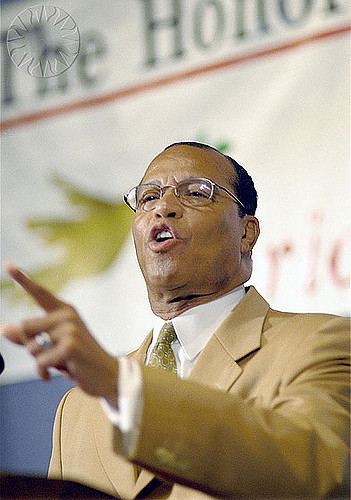
If the extreme right developed hyper-acute canine hearing, the political left, is deaf and dumb. A case in point is their reaction to perennial anti-Semite, Reverend Louis Farrakhan. Born in 1933, the year Hitler came to power, he’s still going strong in his eighties spewing hatred of Jews and Israel.
Farrakhan’s favorite “Black Muslim” theological riff -inherited from NOI’s founder Elijah Muhammad, is the fantastic notion that “the evil white race” was invented by the Mecca-born mad scientist “Yakub” (Jacob) on the Aegean island of “Pelan”. Farrakhan keeps pushing the odious fantasy, even though Elijah Muhammad’s own son long ago repudiated it.
Farrakhan’s allure extends to many elites. Veteran Chicago pol, Congressman Danny Davis, declared: “I personally know [Farrakhan], I’ve been to his home, done meetings, participated in events with him. I don’t regard Louis Farrakhan as an aberration or anything, I regard him as an outstanding human being.” Asked specifically about Farrakhan’s history of anti-Semitic statements, “Davis was dismissive and said that many people in politics have a history of inflammatory comments.” But then Congressman Davis backtracked, stating that he would like to know what Farrakhan has said about Jews “recently.” Now, Davis has belatedly criticized Farrakhan.
Davis’ waffling is not surprising since he represents inner city Chicago neighborhoods, long Nation of Islam strongholds. But what about Farrakhan’s intergenerational political romance with Tamika Mallory, co-chair of January 2017’s Women’s March against the incoming Trump Administration? Mallory, an avowed Farrakhan admirer attended his recent annual Saviour’s Day Address and had her photo taken with him. Rather than apologize, she doubled down, comparing Farrakhan to Jesus and proudly shared her attendance on Instagram.
The left/right divide over Farrakhan came to a head on The View. “It’s not just that she attended,” co-host Meghan McCain stated. “She posted a photo to Instagram calling Farrakhan G.O.A.T. which means greatest of all time.”
When Valerie Jarrett jumped in to say that leaders sometimes have to work with people they disagree with, citing the Koch brothers and Rupert Murdoch, McCain rejected the comparisons … “There’s a difference between meeting with someone who was a hate leader…He(Farrakhan) is in the same vein, to me, as David Duke. If you are so hateful and you think Hitler was a great man, I don’t think you deserve a platform.”
In 2018, there are obvious ideological differences between Farrakhan and White racist anti-Semites who marched in Charlottesville. Yet Nation of Islam and American Nazis like George Lincoln Rockwell started informally collaborating in the early 1960s, as did Holocaust Denier Willis Carto in the 1980s. Today, white racist Charlottesville organizer Richard Spencer wants to meet with Farrakhan to work together toward “the sort of self-determination we and the broader Alt-Right support.”
At his recent Saviour’s Day Address, Farrakhan escalated his attacks declaring the “powerful Jews…are my enemy… “Farrakhan has pulled the cover off the eyes of the Satanic Jew and I’m here to say your time is up, your world is through. You good Jews better separate because the satanic ones will take you to hell with them because that’s where they are headed.” At the Academy Awards “time is up” means one thing. To Farrakhan it represents his everlasting threat against the Jewish people.
All this is happening as extreme right European nationalists are using variations on Holocaust Denial to rewrite their nations’ history, seeking to whitewash the crimes of collaborators during the Nazi Holocaust. Across the continent from France to Poland, far-rightists are mainstream power players. A few days ago, exiled While House political adviser Steve Bannon, seeking to become the dog whisperer of the far right on both sides of the Atlantic, lauded these movements in a speech before Marine Le Pen’s Nationalist Front in Paris.
To stop the hate from poisoning America, Conservatives must lead the way in repudiating the vile anti-Semitic dog whistle. Progressives must also finally denounce Farrakhan’s Jew-hatred.
Rabbi Abraham Cooper is Associate Dean and Director of Global Social Action for the Simon Wiesenthal Center. Dr. Harold Brackman, a historian is a consultant to the Simon Wiesenthal Center.
Carl, Heather and I agree with Emily Summers from Deer Valley Resort and highly recommend the hot Buttermilk biscuits with honey butter at Tupelo! We cannot wait to eat them and everything else again!
Carl and Heather raved about the Beef with Barley made with Nirman Ranch Sirloin which they both said was nearly like risotto! They loved it. I had the tasty Mary’s Airline Chicken which had great spices and was so juicy. This chicken is cooked by Sous-vide which uses hot water immersion to cook food slowly over a long period and then you have succulent and tender meat.
Next time we are eating the tempting desserts FIRST!
Thank you to Chef Matthew Harris, the entire team and especially our server, Sean O.
After skiing all day, are you wondering where to dine?
Heather, Carl and I loved POWDER at the Waldorf Astoria Park City. The Red bicycle wheat and beer batter bread with black Hawaiian sea salt and Wisconsin butter was a delicious beginning. I loved the carrot ginger citrus bisque!
We shared the simple artisan greens and the wood grilled cauliflower. It was hard for me to share a taste of my buttermilk fried organic chicken, because it is so outrageously good! Heather loved the guajilli rubbed buffalo tenderloin and Carl highly recommended his unique Ora king salmon from Tasman, New Zealand. See more photos on Facebook.
Thank you to Chef Michael Zachman, Nick, Ryan and of course, Danielle!
“Powder is the ideal location to gather for breakfast, lunch, après, dinner and drinks with unique fresh and flavorful menu offerings for the entire family. We offer indoor private dining and additional outdoor season seating with views of the pool and scenic outdoor courtyard.”
They have been voted the United States’ Best Ski Hotel and Top Three World’s Best Ski Hotel 2017 at the World Ski Awards™ ceremony in Kitzbühel, Austria. The World Ski Awards™ is the only global initiative to recognize, reward and celebrate excellence in ski tourism. This year, a record number of votes were cast by ski consumers from across the globe – over 1.5 million!
People often ask me, “Can you drink in Utah?” YES YOU CAN!
At High West, you can have Whiskey that is distilled in Utah and was named Whiskey Distiller of the Year in 2016! They make craft spirits which you can find in 49 states and internationally but it might be best if you come in and taste them yourself with some fantastic food. I love that for Pioneer Day they make the historic Mormon whiskey recipe! YES! Mormons used to drink and have their own whiskey recipe.
Carl and Heather loved the smoked cheddar, bacon and jalapeno mac but my favorite was the warm corn and pepper salad. What else to eat? The Bison Burger with caramelized onions and the chicken schnitzel. YUM! Oh and try the pretzels too!
HighWest FACTS:
2006 High West Becomes Utah’s First Legal Distillery since 1870. Yippee Ki-Yay!
2009 High West Saloon in Park City opens
2015 High West Distillery on Blue Sky opens - Marks the beginning of a new High West era.
2016 High West is Named Distiller of the Year by Whisky Advocate
Whether you live near Main Street, Park City, Utah or you are in town to ski and celebrate, I can promise the food, service and company will be fantastic at Firewood Park City. We chose to go there to celebrate my very first art sale at Artworks Park City. Carl, Heather and I were ready to enjoy our evening but were unprepared for the great lengths the team would go to accomodate us. I have several food challenges which were no problem at Firewood. We dined on incredible food and even tasted new things that quickly became favorites.
Wondering about some of my other favorites? Read my article about Amazing Meals, my story in Trivago and watch my Park City videos.
More about my skiing adventures with National Ability Center in
What should you serve a mourner at the Consolation meal?
The first indication of a specific food to be served to a mourner is found in Genesis 25:30 where Jacob is found to be boiling lentils (lentils have been found as carbonated remains alongside human habitation approximately 11,000 BCE in Greece and the Middle East) on the day his grandfather Abraham died. Why are mourners served lentils?
Explains the TB BB 16:B (YD 378:9; Gen R.63:14 ) because they are round like a wheel, and mourning/sorrow is like a wheel – it touches everyone sooner or later.
In addition, just as lentils have no “mouth” or opening but are smoothly round, so, too, the mourners have no “mouth” to speak; they are struck with their inability to speak due to their shock and sorrow at having their loved ones die. The feeling of losing a loved one is often the lowest – the most lonely a person will ever be.
This is the reason why mourners do not greet visitors, and visitors should not greet mourners unless the mourner communicates first. It allows the mourner to experience as much or as little “company” as they are able, without actually being alone. Having the mourner make the first move certainly eases the pain for everyone.
The custom evolved to serve round foods (bagels/pita and eggs are the ones I have seen most often in houses of mourning after returning from a funeral, but also black olives, sharp spicy foods, and high octane alcohol in an Iraqi /Kurdistani house of mourning) to symbolize the cyclical and continuous nature of life.
Eggs are often used these days for this purpose, as the egg is the only food that hardens more the longer it is cooked, and symbolizes that one must learn to steel oneself and be resilient when death occurs. The eggshell is fragile so perhaps the message is that while we are fragile we must also be resilient. In addition, eggs are a symbol of rebirth; indicating the cyclical nature of life. The egg is also completely sealed and has no opening, similar to the lentil. Some have the tradition that the egg is shelled by others and not by the mourner.
The tradition also developed that whatever round food is served is passed from one mourner to the next as a sign of mutual grief based on Lamentations 1:17, “Zion stretches forth her hand.”
(I find this to be in startling contrast to the tradition of not passing the shovel hand to hand while filling the grave; rather, the shovel is put down and the next person picks it up; perhaps the death of a loved one is unique to each person but the grief of losing that person is a common one.)
Another aspect of the condolence meal is that it is the second formal expression of consolation. The first is the parallel rows of friends and relatives through which the bereaved walks through as they depart the graveside. That is a silent tribute, but it is eloquent testimony that we share the mourner’s anguish. The second stage of condolence takes us one step closer to the mourner in his state of misery; we move from the role of spectator to that of participant, from sentiment to service. We bring the mourner the sustenance of life, figuratively and literally. The next step is the Shiva visitation; it’s time for the beginning of the mourners remerging into society and perhaps verbalizing their feelings of loss.
Just to end on a positive note, I will quote Psalm 30:11; “you have turned for me my mourning into dancing, you have loosed my sackcloth and girded me with gladness.” Mourning turns into joy. May it be so.
Isaac Pollak is President and CEO of an international marketing business for almost 4 decades at this point. He holds graduate degrees in Marketing, Industrial Psychology, Art History, and Jewish Material Culture from City College, LIU, JTS, and Columbia University. He has been a student in the Gamliel Institute, and serves as a consultant to the institution. He has been the rosh/head of a Chevrah Kadisha on the upper East Side of Manhattan, NYC, for over 3 decades, and is an avid collector of Chevrah Kadisha material cultural items, having several hundred in his own collection. He serves as chairperson of the Acquisition Committee for Traditional Material Culture at the Jewish Museum in NYC. Born and raised in NYC, married, with 3 children and 5 grandchildren (and more soon!).
Isaac has written for Expired And Inspired multiple times over the years, contributing a wide variety of entries, many scholarly and detailed with sources on history and tradition.
Isaac Pollak
___________
Gamliel Café
Gamliel Students are invited to an informal online monthly session, held monthly. On the third THURSDAY of each month, different person(s) will offer a short teaching or share some thoughts on a topic of interest to them, and those who are online will have a chance to respond, share their own stories and information, and build our Gamliel Institute community connections. This initiative is being headed up by Rena Boroditsky and Rick Light. You should receive email reminders monthly. The next scheduled session of the Gamliel Café is March 15th with a discussion led by Dan Fendel.
Register now for our 2018 series, Your’re Gonna Miss Me When I’m Gone: Jewish Practices of Remembrance. The series features Rabbi Stuart Kelman, Rabbi SaraLeya Schley, Maharat Victoria Sutton, Rabbi Yonatan Cohen, and Jacob Klein of Keshet. They will be discussing topics such as Sephardic Customs, Understanding the Mourners Kaddish, an Alternative Yizkor Service, Disenfranchised Grief, and Trans Day of Remembrance, all relating to remembrance and memory.
The series began Sunday evening, February 4, and will continue on Sunday evenings, generally one session per month, at 8 PM Eastern time and 5 PM Pacific time. Each session runs approximately 90 minutes. Upcoming sessions are:
April 8: Jewish Trans Day of Remembrance – Jacob Klein
April 29: Disengranchised Grief – Rabbi Yonatan Cohen
May 27: An Alternative Yizkor Service – Rabbi SaraLeya Schley
If you cannot attend a session, no worries! They are recorded and made available to those registered.
Registration for Taste of Gamliel is mandatory to access the sessions. The sessions are free, but there is a suggested minimum donation of $36 for the entire series.
Those registered will be sent the information on how to connect to the sessions. To register, click here: register.
_______________
Gamliel Institute Course 1
Chevrah Kadisha: History, Origins, & Evolution
This course will begin April 3rd and run for 12 weeks. Register now at https://www.jewish-funerals.org/gamreg. If you want to know how the Chevrah Kadisha developed and why we do what we do today, this is for you!
_______________
Gamliel Continuing Education Courses
Gamliel students should be on the lookout for information on a series of Gamliel Continuing Education Courses, advanced sessions focusing in on different topics. These will be in groups of three sessions each quarter (three consecutive weeks), with different topics addressed in each series. The goal is to look at these topics in more depth than possible during the core courses. The first course took place in Fall 2017, focusing on Psalms.
The next course will be April 25, May 2nd and May 9th, and will look at death as seen in the Zohar, taught by Beth Huppin.
Registration is required, and there will be a tuition charge of $72 for the three sessions. Contact us for information, by email info@jewish-funerals.org, or call 410-733-3700, or simply register online at www.jewish-funerals.org/gamreg/.
_____________________
16th annual Kavod v’Nichum Chevrah Kadisha and Jewish Cemetery Conference and Gamliel Day of Learning
Mark your calendar and hold the dates! June 3-5, 2018, in the Washington D.C. area. Click here to register
Location – The conference will be at Congregation Beth El in Bethesda, Maryland (just north of Washington, DC)
Dates and Times – The main part of the conference will be from noon on Sunday June 3 to 1pm on Tuesday June 5, 2018. There will be tours and hands-on workshops on Sunday morning.
The Gamliel Day of Learning will be from Tuesday at 2pm through Wednesday at noon. You will not want to miss this – we have arranged for Erica Brown to teach at this event on Tuesday – this day of learning is going to be fantastic!
Who Should Attend? Consider attending the conference if you:
are interested in the fields of community organizing, consumer advocacy, bikkur cholim, chaplaincy,rabbinic texts, thanatology, hospice care, grief therapy, funeral direction, cemetery management, and legacy planning
recognize the importance of liturgy and ritual in ensuring that the spiritual dimension of the end-of-life continuum is appreciated, and that the work of the Chevrah Kadisha is done with full regard for the respect and dignity of all involved
want to learn more about the entire end-of-life continuum – dealing with life-threatening illness, legacy and preparation of ethical wills, preparing for death and at the time of death, care for the body- taharahand shmirah, care for relatives and friends, funeral and burial, mourning, grieving, remembering and providing comfort – with underlying themes of communal obligation, care for the poor and elderly, consumer protection, and Jewish continuity.
believe it is essential to shift the culture surrounding continuum-of-life issues in the Jewish community – from an attitude of denial and neglect around death, to a more open attitude towards death that includes increasing awareness, acceptance, and healthy integration into family and community life.
want to participate in the development of a strong Jewish corps of professionals and volunteers to become communal leaders who work to inspire, support, organize, teach, and advocate for the full range of Chevrah Kadisha work in synagogues and communities.
Workshop Leaders – If you are interested, or know someone else who might be interested in leading a workshop, suggest it to us with a short paragraph of explanation – send to info@Jewish-funerals.org
Organization Pricing – is available if three or more members of an organization are attending the whole conference and the organization has paid membership dues of $180. You can cover the cost of organizational membership right on the registration form. Even if you don’t have three members attending the conference, we appreciate your organization’s support as a member. Books – This year you can pre-order and pre-pay for books right on the registration form.
Exhibits – If you, or someone you know, would like to exhibit at the conference, let us know by sending us an email – info@Jewish-funerals.org
Meals – In addition to Sunday brunch, we provide six supervised Kosher meals as part of the conference registration. Please let us know if you have allergies or special dietary needs.
Flights – Many cities have direct flights to National (DCA), Baltimore Washington (BWI) and Dulles (IAD).
Ground Transport – Direct connections to the Metro are available from National Airport. We’ll update the website mid-January with additional ground transportation options.
Hotel – We have negotiated a great hotel rate at American Inn. Contact them at 301-656-9300 and give them group booking code KNG or email or phone our hotel contact MinoliMinoli.Muhandiramge@baywoodhotels.com who is at extension 111. Our group rate is $139 plus 13% tax per room per night for singles or doubles. There are a limited number of doubles.
Home Hospitality – will be available. Let us know if you are interested.
Shabbat – If you would like to be connected to a family for Shabbat dinner, home hospitality, and synagogue services, let us know.
Refunds: 90% of the registration fee will be refunded if you cancel in writing before May 1; 80% before May 15; 50% May 15 or later, only if you have a really good excuse!
_____________________
DONATIONS
Donations are always needed and most welcome to support the work of Kavod v’Nichum and the Gamliel Institute, helping us to bring you the annual conference, offer community trainings, provide scholarships to students, refurbish and update course materials, expand our teaching, support programs such as Taste of Gamliel, the Gamliel Café, and the Gamliel Continuing Education courses, provide and add to online resources, encourage and support communities in establishing, training, and improving their Chevrah Kadisha, and assist with many other programs and activities.
You can donate online at http://jewish-funerals.org/gamliel-institute-financial-support or by snail mail to: either Kavod v’Nichum, or to The Gamliel Institute, both c/o David Zinner, Executive Director, Kavod v’Nichum, 8112 Sea Water Path, Columbia, MD 21045. Kavod v’Nichum [and the Gamliel Institute] is a recognized and registered 501(c)(3) organization, and donations may be tax-deductible to the full extent provided by law. Call 410-733-3700 if you have any questions or want to know more about supporting Kavod v’Nichum or the Gamliel Institute.
If you would like to receive the periodic Kavod v’Nichum Newsletter by email, or be added to the Kavod v’Nichum Chevrah Kadisha & Jewish Cemetery email discussion list, please be in touch and let us know at info@jewish-funerals.org.
Be sure to check out the Kavod V’Nichum website at www.jewish-funerals.org, and for information on the Gamliel Institute, courses planned, and student work in this field also visit the Gamliel.Institute website.
RECEIVE NOTICES WHEN THIS BLOG IS UPDATED and When Other Relevant Items are published!
If you have an idea for an entry you would like to submit to this blog, please be in touch. Email J.blair@jewish-funerals.org. We are always interested in original unpublished materials that would be of interest to our readers, relating to the broad topics surrounding the continuum of Jewish preparation, planning, rituals, rites, customs, practices, activities, and celebrations approaching the end of life, at the time of death, during the funeral, in the grief and mourning process, and in comforting those dying and those mourning, as well as the actions and work of those who address those needs, including those serving in Bikkur Cholim, Caring Committees, the Chevrah Kadisha, as Shomrim, funeral providers, in funeral homes and mortuaries, and operators and maintainers of cemeteries.