fbpx

February 23, 2018

Surviving Khojaly: Painful to Remember, Impossible to Forget
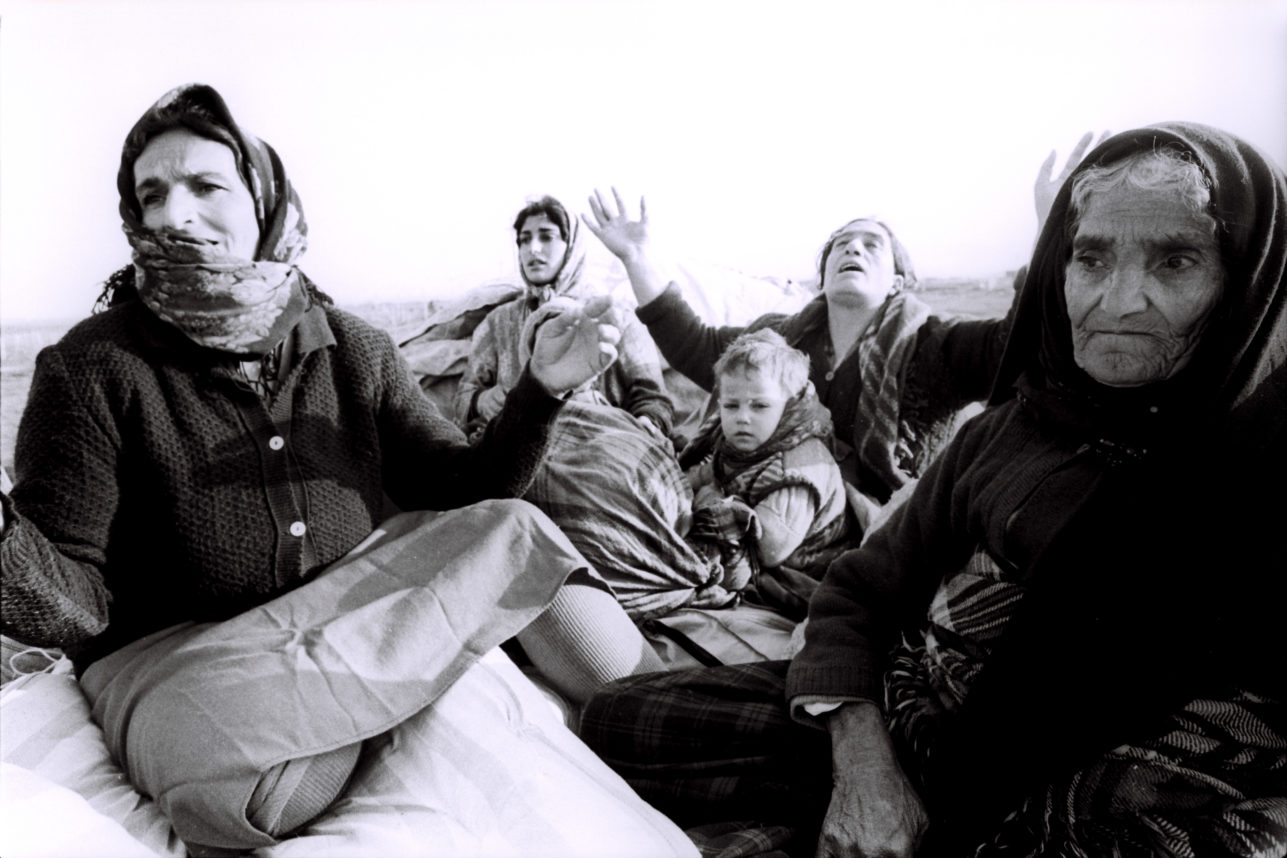
Azerbaijani refugees from Karabakh in the early 1990s. Photo courtesy of Ilgar Jafarov


Over the years, I’ve had repeated surgeries on my spine, which was badly damaged by torture. I’ve also traveled around the world to share my story, so that more of the world might understand what happened at that frosty night of February 25 of 1992 in the Azerbaijani town of Khojaly, and so it is never forgotten. I even traveled to Los Angeles a few years ago, to meet with leaders and members of the Jewish community, to connect and to share testimony of what happened to me and to my country. Although I would give anything to forget the horrors I experienced in the torture camp as a 20 year old captive of the Armenian army. However I know it’s better this way – better for me to heal and better for the world to know.

Why is knowing about such tragedies as the Khojaly Massacre so important? Well, look at the world today. Look at what is happening to Muslims in Myanmar. Look at what is happening to children in Syria. This world too easily forgets the insanity of cruelty and inhumanity that still plagues it to this day. If survivors do not speak out and share their stories, forgetting will be even more of a problem, and remembering will be harder to do.

I think of the Holocaust, and how the many survivors are passing on, aging out of a world that still badly needs their presence, and their stories, to keep us remembering. So many were victimized by the incomparable cruelty of man. So many lives were ripped from the world. So many children were never born to mothers that never had the chance to even conceive them – instead they perished in the gas chambers, by the bullets, the torture, the starvation, and in the ovens.

No matter the pain I feel to remember, I know I cannot forget what happened, and I must do all I can to make sure others remember too.

We must remember the eve of February 25, and the morning of February 26, 1992, when Armenian invaders shot indiscriminately at men, women, children, the elderly, brutally killing 613 of them – all as we attempted to flee from our homes, under siege, into the forest, toward safety. We must remember the bodies of toddlers strewn across the valley, and the many families that will never recover from a loss such as that. When Armenian soldiers decided to invade my homeland of Azerbaijan, in their attempt to take land and lives, they held back no cruelty. They unleashed the maximum hate. They wanted us to remember.

And at the same time, they wanted the world to forget. They tore down our homes, our monuments, our history. They built Armenian buildings as if they had always been there; as if we had never existed. Not only in Khojaly, but across the entire Karabakh region of Azerbaijan, where I, and so many, had long called home. Where I, and so many, can still no longer return, not to reclaim, not to visit the burial sites of the dead – not for the sake of our lives. To this day, they guard our land with their bullets and their terror. Despite international condemnation, from the United Nations, the European Court of Human Rights, members of the United States Congress, Governors, and too many faith leaders to count, they continue their unlawful occupation.

And for their lies and trickery, I will never stop sharing my story. For the life of my daughter and all daughters and sons that deserve a safe, honest world to grow up in, I will keep sharing. For the love of my homeland, and for the memories of so many not lucky enough to survive, I will keep sharing. I will keep sharing as long as I am in this world; here, nearly 3 decades since I survived capture and torture. I will continue telling the world about Khojaly until justice has been served.

Surviving Khojaly: Painful to Remember, Impossible to Forget Read More »

The Khojaly Massacre: Reflections by an Azerbaijani Jew

Survivor of the Khojaly Massacre mourning the death of her family members

February 25/26 is a difficult time for us in Azerbaijan, and for all Azerbaijanis around the world. It is a day when we remember the Khojaly Massacre, one of the most brutal incidents of inhumane warfare to take place in modern times. It is a day when we commemorate what happened in 1992, in the Nagorno-Karabakh region of Azerbaijan, in the town of Khojaly. In the early 1990s, supported by powerful allies, Armenia managed to invade approximately 20% of Azerbaijan’s sovereign territory. United Nations Security Council condemned this illegal military occupation that was accompanied by total ethnic cleansing of the occupied lands of their indigenous Azerbaijani population (over 800,000 of them). Sadly, to this day, the occupation continues, and the international community does nothing to make Armenia comply with international law.

But what happened that night of February 25/26, 1992 in Khojaly was much more than an act of occupation. What happened in Khojaly was a brutal massacre. Hundreds of totally innocent, unarmed Azerbaijanis were gunned down while fleeing the Armenian army. They were gunned down like animals in a field: men, women, and children.

As an Azerbaijani Jew, I feel especially sensitive about such an incident of inhumanity in modern time, in my modern country, decades after the Holocaust, with so many years of “Never Again” already behind us. It is hard to believe human beings were still capable of such atrocities, but as we know, even today, violence and cruelty ensues, in many countries around the world. We have such a responsibility to make good on that promise, and yet the world continues to challenge our commitment. A few years ago, Israel’s President Reuven Rivlin addressed this very issue at the United Nations General Assembly, on International Holocaust Remembrance Day. He challenged the gathering of world leaders, asking: ““[I]s our struggle, the struggle of this Assembly, against genocide, effective enough? Was it effective enough then in Bosnia? Was it effective in preventing the killing of Azerbaijanis in Khojaly? Of Afghans by the Taliban? Is it effective enough today in Syria? Or in the face of the atrocities of Boko Haram in Nigeria? Are we shedding too many tears and taking too little action?” He understood what the Khojaly Massacre is – something that should never have happened. Something that goes against the grain of morality, of what is right in the world, of the most basic tenets of humanity.

It’s not surprising to me that the President of Israel could shed some light on Khojaly, and on Azerbaijan in general. Azerbaijan and Israel share particularly strong and lasting ties. Azerbaijan and Jews do as well. I speak from my own experience as leader of the 2,000-year old Mountainous Jewish community in Azerbaijan, but also base this sentiment on history. Azerbaijan has a bold and lasting history of protecting, honoring, and celebrating Jewish life and Judaism. During the Holocaust, Azerbaijan was a renowned safe haven for Jews, accepting as many as could make it to our land, and fighting the Nazis until their defeat, on the Russian front. For centuries before the Holocaust, during many incidents of European and regional anti-Semitism, Azerbaijan served as a safe haven for Jews then too.

In 1992, during the invasion and occupation of Azerbaijan, many Azerbaijani Jews volunteered and fought against the Armenian insurgents. One that stands out in particular is Albert Agarunov, a renowned hero in our nation, and someone who is becoming more well known across the world because of his unusual and remarkable story, and his great heroism. A Mountainous Jew, Albert was a marvelous sharpshooter, and was successful at defeating and evading the Armenian militants for much of the war. He was so skilled as a sharp-shooter, the Armenians placed the highest bounty on his head of any Azerbaijani. Sadly, Albert was killed by an Armenian bullet as he had left the safety of his tank, exposed to the insurgents so he could navigate the tank around the bodies of murdered fellow Azerbaijanis. His last act was an act of respect and kindness, and he is revered and titled as a National Hero in Azerbaijan, buried at our famous Martyrs Lane in the capital city of Baku, remembered adoringly by all Azerbaijani people.

Yes, this time of year is a difficult time, as an Azerbaijani and as a Jew, remembering this great tragedy. Thankfully, we have survivors who share their experience and supportive services to continue their healing process. Thankfully, we are a nation that can carry on as a land of peace and tolerance despite the intolerance and cruelty others have caused us to endure. Thankfully, we have the support of great nations, such as the State of Israel, the United States and many others, to continue pushing Armenia to take responsibility and to leave the occupied Karabakh region; our land they so brutally took and still refuse to leave. I hope it will not be long from now that we have more to be thankful for, and that the story of Khojaly and the entire region will have a new chapter; one without occupiers, one that has the thousands of residents returning home, even after so many years.

The Khojaly Massacre: Reflections by an Azerbaijani Jew Read More »

Report: Broward County Sheriff Criticized for Hiring Political Supporters

A new report is claiming that the sheriff of Broward County in Florida is being criticized for hiring of political supporters.

According to the Sun-Sentinel, Sheriff Scott Israel has hired 10 workers to “community outreach” roles since 2013 to gloat about the sheriff office’s success. The sum of their salaries add up to $634,479.

The report also states that Israel also hired “former colleagues from Fort Lauderdale Police Department” to key positions in the office.

Israel’s political opponents have argued that Israel’s community outreach hires amount to utilizing the office as part of his campaign and diverts money from essential law enforcement resources. They also argue that his hiring of former colleagues is a sign of favoritism that discourages employees that aren’t in his inner circle.

When confronted on these hires, Israel brushed off the criticism.

“What have I done differently than Don Shula or Abraham Lincoln or Martin Luther King, Ghandi?” Israel told the Sun-Sentinel. “Men and women who assume leadership roles surround themselves with people who are loyal, who they can depend on and who they appreciate their skill set.”

Israel also claimed that people were only leveling criticism at him because of how successful his office has been.

“Lions don’t care about the opinions of sheep,” Israel snarked with the Games of Thrones reference.

The report comes amidst questions about the Broward County Sheriff’s office after the school resource officer at Majorie Stoneman Douglas, Scot Peterson, resigned from doing nothing at the shooting. It was also recently reported that the officer didn’t provide investigators with any information about the shooter when they approached him in 2016. Three other officers from the sheriff’s office were also on the campus during the shooting, but did nothing.

Additionally, police officers from neighboring Coral Springs were the first arrive to on the scene of the shooting, not the Broward County Sheriff’s Office, something that the office reportedly didn’t acknowledge:

Reason’s Robby Soave wrote, “Given the appalling failures that took place at Israel’s office, the “sheep” might like the “lion” some questions. Perhaps he could answer them in a less condescending and authoritarian fashion.”

Report: Broward County Sheriff Criticized for Hiring Political Supporters Read More »

U.S. Jerusalem Embassy to Open in May

The new United States embassy in Jerusalem will open its doors in May, when Israel celebrates its 70th year of independence.

The State Department announced the timing of the move to Congress on Feb. 23, and told the Times of Israel, “The Embassy will initially be located in Arnona [in south Jerusalem], on a compound that currently houses the consular operations of Consulate General Jerusalem. At least initially, it will consist of the ambassador and a small team.”

The new embassy is scheduled to open on May 14, the 70th anniversary of Israel’s independence. The timing is not coincidental.

“This decision will turn Israel’s 70th Independence Day into an even bigger celebration,” Israeli Prime Minister Benjamin Netanyahu said in a statement. “Thank you President Trump for your leadership and friendship.”

In response to the announcement, Palestine Liberation Organization (PLO) Secretary-General Saeb Ekrat called it a “flagrant violation of international law and agreements” and “provocative to the feelings of all Arabs and Muslims.” Hamas spokesman Abd al-Latif al-Kanou claimed that the move will be “a trigger for an explosion of the entire region in the face of Israel.”

President Trump first announced the move in December, when he declared that Jerusalem is the capital of Israel. The move has been met condemnation worldwide and “days of rage” protests, but the Trump administration has held firm on the move.

“The United States knows the Palestinian leadership was very unhappy with the decision to move our embassy to Jerusalem,” U.S. Ambassador to the United Nations Nikki Haley told the U.N. on Feb. 20. “You don’t have to like that decision. You don’t have to praise it. You don’t even have to accept it. But know this: that decision will not change.”

U.S. Jerusalem Embassy to Open in May Read More »

Report: Obama Admin Forged Secret Deal Waiving Sanctions on Iranian Propaganda Outlet

The Trump administration reportedly waived sanctions on Iran’s chief propaganda outlet due to a secret deal forged between the Obama administration and the Iranian regime.

According to the Washington Free Beacon, the Obama administration and Iranian regime came to an agreement in 2013 where the State Department would waive sanctions on the Islamic Republic of Iran Broadcasting (IRIB) every six months provided that the IRIB ceased its practice of censoring content.

Secretary of State Rex Tillerson decided to waive sanctions on the IRIB yet again in January, even though there is evidence that the Iranian propaganda outlet continues to jam “broadcasts and other signals it finds objectionable.”

“This waiver is vital to the national security of the United States because it furthers the free flow of information into Iran, a key element of the president’s new U.S. strategy on lran,” Tillerson told Congress.

Iranian dissidents and protestors were furious at the decision, as the Trump administration had promised to slap the IRIB with a new batch of sanctions. Tillerson’s State Department seems to think that the secret agreement needed to be upheld.

According to the Center for Human Rights in Iran, the IRIB has a penchant for “jamming international satellite broadcasts” in addition to local broadcasts. The IRIB also broadcasts coerced confessions from prisoners, show trials and other propaganda from the Iranian regime.

“IRIB continues to be a central tool of state repression; it has not earned the continuation of the waiver,” Hadi Ghaemi, executive director of the International Campaign for Human Rights in Iran, told the Center for Human Rights in Iran in 2014.

Report: Obama Admin Forged Secret Deal Waiving Sanctions on Iranian Propaganda Outlet Read More »

I Forget What This Poem is About - A Poem for Haftarah Tetzaveh / Shabbat Zachor by Rick Lupert

I Forget What This Poem is About – A Poem for Haftarah Tetzaveh / Shabbat Zachor by Rick Lupert

Shabbat of Remembrance –
I’m having trouble remembering
all the things I’m told

my biological DVR should hold.
I have a vague memory of
standing at a mountain

but the details of what
I was supposed to do with
Amalek’s sheep are fuzzy.

Kill them all? Can that be right?
That doesn’t sound like me.
Is this why Saul almost lost

his anointed job? Because he
wouldn’t kill the sheep? I had to
look up the word prostrate

because I forgot what it meant
or maybe I never knew. I can’t
put my face on the floor for

every mistake. It’s so dirty like
the floor of the sea was, which I
remember every time I

put on my shoes. Or dirty
like the gallows after Haman and
his sons hung there for days.

I eat a three sided cookie
to remember this because
nothing paints a picture like food.

Haman and his great great
no-one really knows ancestor Agag
their names written on our shoes.

Our mandate – to wipe them
from our memories, as every year
we remember them.


God Wrestler: a poem for every Torah Portion by Rick LupertLos Angeles poet Rick Lupert created the Poetry Super Highway (an online publication and resource for poets), and hosted the Cobalt Cafe weekly poetry reading for almost 21 years. He’s authored 21 collections of poetry, including “God Wrestler: A Poem for Every Torah Portion“, “I’m a Jew, Are You” (Jewish themed poems) and “Feeding Holy Cats” (Poetry written while a staff member on the first Birthright Israel trip), and most recently “Donut Famine” (Rothco Press, December 2016) and edited the anthologies “A Poet’s Siddur: Shabbat Evening“,  “Ekphrastia Gone Wild”, “A Poet’s Haggadah”, and “The Night Goes on All Night.” He writes the daily web comic “Cat and Banana” with fellow Los Angeles poet Brendan Constantine. He’s widely published and reads his poetry wherever they let him.

I Forget What This Poem is About – A Poem for Haftarah Tetzaveh / Shabbat Zachor by Rick Lupert Read More »

Daily Roundtable collection: Netanyahu, Silverman, Tamimi

This is a collection of few of the short comments I wrote for the Daily Roundtable this week. If you are not yet subscribed to this great Jewish Journal feature, you ought to consider it, and get it to your mailbox every morning, six days a week. Go here to sign up.

On why Netanyahu is still strong in the polls, amid the many scandals:

Looking at the polls from the last two days one has no choice but to reach one of two conclusions:

  1. The public is slow witted. It takes time for him to digest the events of the last couple of days and do what you’d expect him to do: show less support for the ruling party and its head.
  2. The public doesn’t care. Israelis indeed understand the meaning of recent revelations, and choose to ignore them, either because they are not bothered by corruption, or because they have more important considerations (such as: corruption aside, Netanyahu is a great PM).

For now, the result is self-evident: the leaders of the coalition take their cue from the public and stick with the PM.

On Sarah Silverman’s support for Palestinian attacker Ahed Tamimi:

Much like Sarah Silverman – adorable as a comedian, less so as a policy maven – I too understand that Palestinian attackers such as Ahed Tamimi have reasons for their “rage”. I also understand that some impartial observers might conclude that “her rage” justifies her means – like slapping an IDF officer. So maybe Silverman choose to be an impartial observer when she thinks about Israel. She can do that, if she wants to. What she can’t do is have it both ways: be an impartial observer AND claim the mantle of being a friend of Israel’s.

If you are a friend, an attacker of an Israeli soldier is not someone you try to understand, it is someone you want captured and punished. Sometimes, with friends, things are quite simple.

On the decision to put Tamimi on trial:

With all due respect to international courts of public opinion, Israel has its soldiers to think about. These young men and women are sent to confront terrorism and violence by us. These young men and women are the sons and daughters of Israelis. So Israel must defend itself in the international court of public opinion, but first it must defend its soldiers from attacks and humiliations. It must show that no mistreatment of an Israeli soldier goes unpunished.

Failing to defend them will be much more detrimental to Israel’s security than the PR damage that it might suffer because of the trial. Failing to defend them will be morally unforgiveable, much more than putting a violence-happy Palestinian teen on trial.

On Israel’s Supreme Court new appointments:

The Minister of Justice made it a cause to alter the course of the Supreme Court. Naturally, it is a cause that some Israelis dread, and some heartily support. Those dreading it, try to make it seem sinister, when in fact, there is nothing beyond trivial about it.

The source of confusion surrounding Supreme Court appointments in Israel is simple: Israel pretends to have a strictly professional court, when in fact it is clear that ideological tendencies play a role in both appointments of judges and later in their decisions. Thus, a certain Arab justice is not a realistic nominee not because of his ethnicity. He is an unrealistic nominee because of his presumed ideological tendencies.


Daily Roundtable collection: Netanyahu, Silverman, Tamimi Read More »

Rosner’s Torah Talk: Parashat Tetzaveh with Rabbi Fred Morgan

Rabbi Fred Morgan AM has lived in the United States, England and Australia.  He was Lecturer in the Religions of India at the University of Bristol before entering the Leo Baeck College, London, where he received rabbinic s’mikhah in 1984.  He has served congregations in Britain, Hungary and Australasia.  In 2013, he was made Emeritus at Temple Beth Israel in Melbourne, Australia’s flagship Progressive synagogue, after 16 years as Senior Rabbi.  Since then Rabbi Morgan has been Professorial Fellow at the Australian Catholic University, coordinator of the Grass Roots Dialogue Project for the Council of Christians and Jews in Victoria, and Movement Rabbi for the Union for Progressive Judaism in Australia, New Zealand, and Asia.  He has lectured and published extensively on Jewish and interfaith themes.  In 2014 he was made a Member of the Order of Australia for his service to the Jewish Community and interfaith dialogue. He is married to Sue and they have three children and a grandchild.

This week’s Torah Portion – Parashat Tetzaveh (Exodus 27:20-30:10) – continues giving us the instructions concerning the tabernacle, focusing on the role of the priesthood. Our discussion focuses on the relation between the ‘Ner Tamid’ – the perpetual light of the Temple – and the elaborate description of the clothing of the priests.

Other talks on Parshat Tetzaveh:

Rabbi Gil Steinlauf

Rabbi Peter Stein

Rabbi Alvan Kaunfer


Rosner’s Torah Talk: Parashat Tetzaveh with Rabbi Fred Morgan Read More »