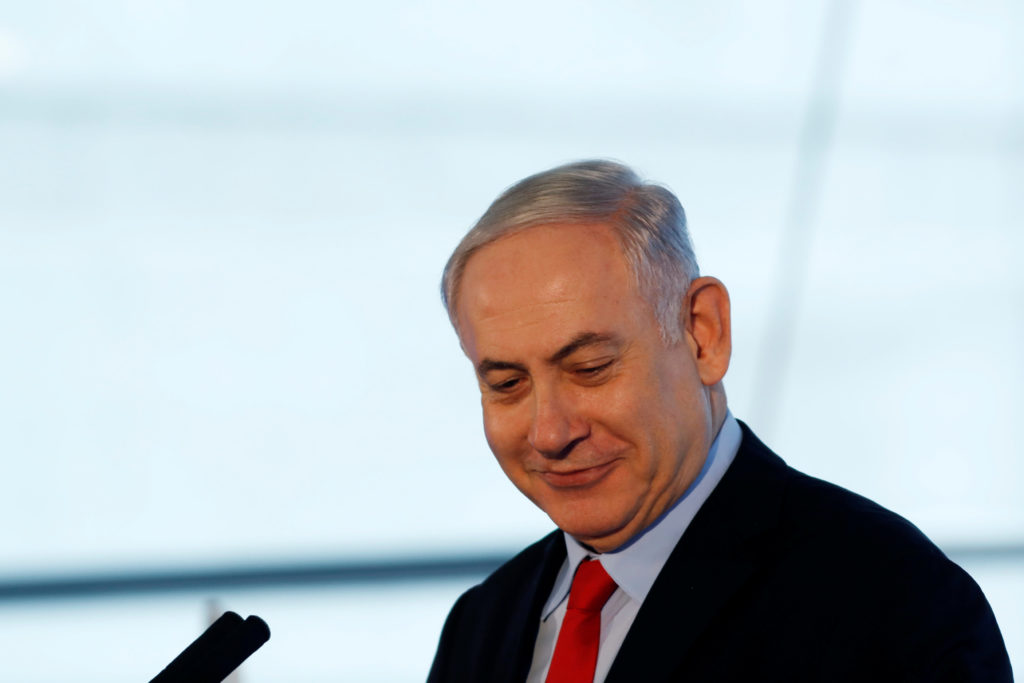
Israeli-American journalist Caroline Glick argued in a Feb. 14 column that the Israeli police’s recommendation of indicting Israeli Prime Minister Benjamin Netanyahu over charges of corruption are “bogus” and are indicative of a grudge that the Israeli police have against Netanyahu.
The first case, Investigation 1000, involves Netanyahu allegedly accepting gifts from Hollywood movie mogul Arnon Milchen in exchange for Netanyahu supporting an extension of a law that exempts Israelis from paying taxes on income they earned elsewhere. Netanyahu is also said to have supported Milchen in possible business deals with Israeli television stations as well as urged then-Secretary of State John Kerry to renew Milchen’s U.S. visa.
Click argued in her column that with exception of advocating for Milchen’s visa renewal, Netanyahu never really acted on Milchen’s interests, and the visa renewal advocacy was justifiable.
“Milchen himself has a long record of service to Israel’s Mossad — its foreign spy service — and reportedly has contributed significantly to Israel’s defense,” Glick wrote. “Netanyahu claims that he acted out of respect for Milchen’s long service to Israel’s security. In addition, Israel’s late president and prime minister, left-wing icon Shimon Peres, also intervened on Milchen’s behalf with U.S. authorities.”
Investigation 2000, the second case, involves Netanyahu allegedly discussing a deal with Yediot Ahoronot publisher Arnon Mozes in which Mozes would have provided more positive coverage of Netanyahu if he supported a bill that would have hampered the circulation of Yediot Ahoronot’s competitor, Israel Hayom.
While there is a recording of the conversation, Glick notes that there is no evidence the discussed deal ever occurred, as Netanyahu vocally opposed the bill that Mozes wanted passed. In fact, “Netanyahu disbanded his government and the Knesset and called new elections a bit more than a year into his term” to ensure that the bill never saw the light of day.
“In other words, the police are recommending that Netanyahu be indicted for a conversation that went nowhere, which he recorded,” Glick wrote. “And the police are not investigating 42 out of the 43 lawmakers that supported a move that would have given Mozes everything he asked Netanyahu for, but didn’t receive, while the 43rd lawmaker was subject merely to a brief interrogation.”
Glick then pointed out that Israeli police have investigated Netanyahu and his wife multiple times during his stints as prime minister and none of them have ever produced anything substantial. She also noted that Israeli police chief Roni Alscheich leveled baseless claims against Netanyahu in a recent interview, including that the prime minister sent out private investigators against the police and that Netanyahu attempted to bribe Alscheich.
“Even the police’s most fervent media supporters were aghast at Alsheich’s allegations – coupled with the fact that he has refused to investigate any of them,” Glick wrote. “To summarize: just as the police were set to announce their recommendations, Alsheich made clear that he has a personal vendetta against Netanyahu and is prepared to overthrow his government.”
Glick concluded her column by noting that the Israeli Knesset has no way to provide oversight over the Israeli police, which differentiates it from the U.S. Congress’ oversight powers of the FBI.
This year’s flu season is one of the nastiest ever, and according to the Centers for Disease Control, it’s the worst since the big flu epidemic of 2009. And lest you get too comfortable and think you’ve escaped it, remember that flu season lasts through May.
I refuse to be sidelined with the flu this year, so besides getting a flu shot back in November, I have been vigilant against germs, with a bottle of hand sanitizer as my constant companion. It’s hard to control the pesky viruses and bacteria as you’re out and about, but at least there are some things you can do to minimize the risk at home.
Sanitize what gets touched
Think about what gets touched throughout the day — doorknobs, light switches, cabinet handles, refrigerator doors and remote controls. They’re usually touched by multiple people, and they are teaming with germs. Flu viruses can stay on hard surfaces for up to 24 hours, so wipe them down with sanitizing wipes regularly.
Don’t share phones
Phones are one big germ party because you touch them with your fingers and cradle them to your face. Even if you’re the only person who uses your phone, it’s still a good idea to clean it frequently with a sanitizing wipe. And if your household shares a landline, clean that phone every time someone uses it. Better yet, don’t go near it. It’s probably telemarketers calling, anyway.
Clean tabletops
It’s gross to think about, but surfaces like desks and tables can contain up to 400 times more bacteria than a toilet seat. I’m not surprised by that figure. My desk is usually littered with a combination of cookie crumbs, used Kleenex and dog toys. Disinfect these surfaces before sitting down to work or eat. The same goes for desks and tabletops at your place of work.
Take off your shoes
The bottoms of your shoes are collecting bacteria all day long, so don’t bring those germs into your house. Take off your shoes upon entering, and if you really must wear shoes indoors, designate a pair of house shoes that never go outside. Wash your doormat regularly, as well, as they’re germ traps.
Beware of towels and sponges
Every time someone wipes their hands on a kitchen towel or runs a sponge across a countertop, germs can be spread. During flu season, use paper towels to wipe your hands instead of the communal towel hanging from the oven door. And sanitize your sponge on a regular basis by zapping it for a minute in the microwave, or put it in a hot cycle in your dishwasher.
Replace bed linens
If someone in your household is sick, replace the bed linens daily. And when you’re carrying the linens to the washer, don’t hold them against your body. Keep them at a distance, and wear gloves if you have them. I don’t mean to make you act like a hazmat technician, but the flu is serious business.
Tissues in every room
Have a box of tissue in every room so that every sneeze or cough goes into a tissue rather than into the air. Then throw away the tissue immediately. I like the step down trash cans with a lid — the germs are trapped in the canister and you don’t have to touch it. If you can’t get to a tissue in time, sneeze into your elbow.
Use a humidifier
Influenza germs spread more easily in dry air conditions, so raising the humidity level in your home can make it less likely for the virus to survive and spread. Using a humidifier also moistens the cilia, those tiny hairs inside your nose, helping them to ward off bacteria and germs.
Jonathan Fong is the author of “Walls That Wow,” “Flowers That Wow” and “Parties That Wow,” and host of “Style With a Smile” on YouTube. You can see more of his do-it-yourself projects at jonathanfongstyle.com.
On Presidents Day weekend, join Rabbi Lisa Edwards for coffee, dessert and a wide-ranging conversation about Abraham Lincoln’s relationship with Jews. Using as a guide the 2016 book “Lincoln and the Jews” by Jonathan Sarna and Benjamin Shapell, as well as other publications, Edwards will discuss the mutual affinity between Lincoln and Jews. Whether battling the anti-Jewish sentiment common in his time or insisting that there be Jewish chaplains for the first time in the U.S. military, America’s 16th president became known as a friend to Jews. 8-9 p.m. Free. Beth Chayim Chadashim, 6090 W. Pico Blvd., Los Angeles. (323) 931-7023. bcc-la.org.
SAT FEB 17
“JOACHIM PRINZ: I SHALL NOT BE SILENT”
Joachim Prinz was a young rabbi in Berlin who spoke out against the Nazis until he was expelled in 1937. After arriving in the United States, he witnessed racism against Blacks and realized the American ideal was not a reality. He became a leader in the civil rights movement and a friend and confidant of the Rev. Martin Luther King Jr. After the screening of a documentary on the rabbi, there will be a discussion with Rabbi Aryeh Cohen, professor of rabbinic literature at American Jewish University; Rev. D. Najuma Smith Pollard, founding pastor of Word of Encouragement Community Church; and Wolf Gruner, who holds the Shapell-Guerin Chair of Jewish studies at USC. 7:30 p.m. $12. Temple Beth Am, 1039 S. La Cienega Blvd., Los Angeles. (310) 652-7353. tbala.org.
SUN FEB 18
MEET KNISH
Get ready to meet the hottest Jewish singles in Los Angeles. Queue up the jukebox. Kick back with a crafted cocktail. Dress to impress. From the team that presents the annual Christmas Eve MatzoBall. 9 p.m.-2 a.m. $30 general admission, $199 VIP annual membership. The Parlour Room, 6423 Yucca St., Los Angeles. eventbrite.com.
NOA
Noa
Achinoam Nini, known internationally as Noa, makes a rare Southern California concert appearance showcasing the most popular songs from her 26-year recording career, spanning 15 international albums and several Israeli releases, including her latest recording, “Love Medicine.” Selections will be sung in English, Hebrew and Arabic. One of Israel’s leading singer-songwriters, Noa wrote lyrics to and recorded the hit theme song for the 1998 Academy Award-winning film “Life Is Beautiful.” She sings in six languages and has collaborated with symphony orchestras around the world. She also is involved in the Israel Peace Initiative, Yalla Young Leaders and IsraAid. 7 p.m. $20 for Cal State Los Angeles students, staff and faculty; $25 for other students; $30, $40, $50 for others. The Luckman Fine Arts Complex, 5151 State University Drive, Los Angeles. (323) 343-6600. luckmanarts.org.
MON FEB 19
MANY VOICES, ONE SONG
Gindi Maimonides Academy celebrates its 50th anniversary with a Jewish music festival featuring Avraham Fried, Shlomi Shabat, Cantor Yitzchak Meir Helfgot, Baruch Levine, Simcha Leiner and a 60-piece orchestra. Food available for purchase during the show. Seating, other than VIP tickets, is first come, first served. Tickets start at $25. Doors open at 5:30 p.m., show at 6:30 p.m. The Wiltern, 3790 Wilshire Blvd., Los Angeles. (310) 659-2456. maimonidesla.com
TUE FEB 20
“THE CHALLENGES OF TRUMP’S AMERICA”
Washington Post conservative columnist Jennifer Rubin discusses “The Challenges of Trump’s America: A Conservative’s View on Trump,” a conversation with former U.S. Congressman Mel Levine and former Los Angeles County Supervisor Zev Yaroslavsky. 7:30 p.m. Free. Temple Israel of Hollywood, 7300 Hollywood Blvd., Los Angeles. (323) 876-8330. tioh.org/rsvp.
ILIZA SHLESINGER
The Jewish funny lady performs her irreverent brand of stand-up comedy, examining friendship, singlehood and relationships. 8 p.m. $25. Flappers Comedy Club, 102 E. Magnolia Blvd., Burbank. (818) 845-9721. flapperscomedy.com.
BARAK LURIE
Conservative radio show host Barak Lurie discusses “Atheism Kills,” his new, nonfiction book that attacks atheism and the dangers of a world without God. Lurie, who regularly speaks about politics and matters of God on KRLA-AM (870), is a member of many conservative and pro-Israel boards, including Prager U, StandWithUs, the Jewish National Fund and the American Freedom Alliance. 7:30-9:30 p.m. $18 presale, $25 door. IAC Shepher Community Center, 6530 Winnetka Ave., Woodland Hills. (818) 451-1201. israeliamerican.org/los-angeles/baraklurie.
WED FEB 21
FAREED ZAKARIA
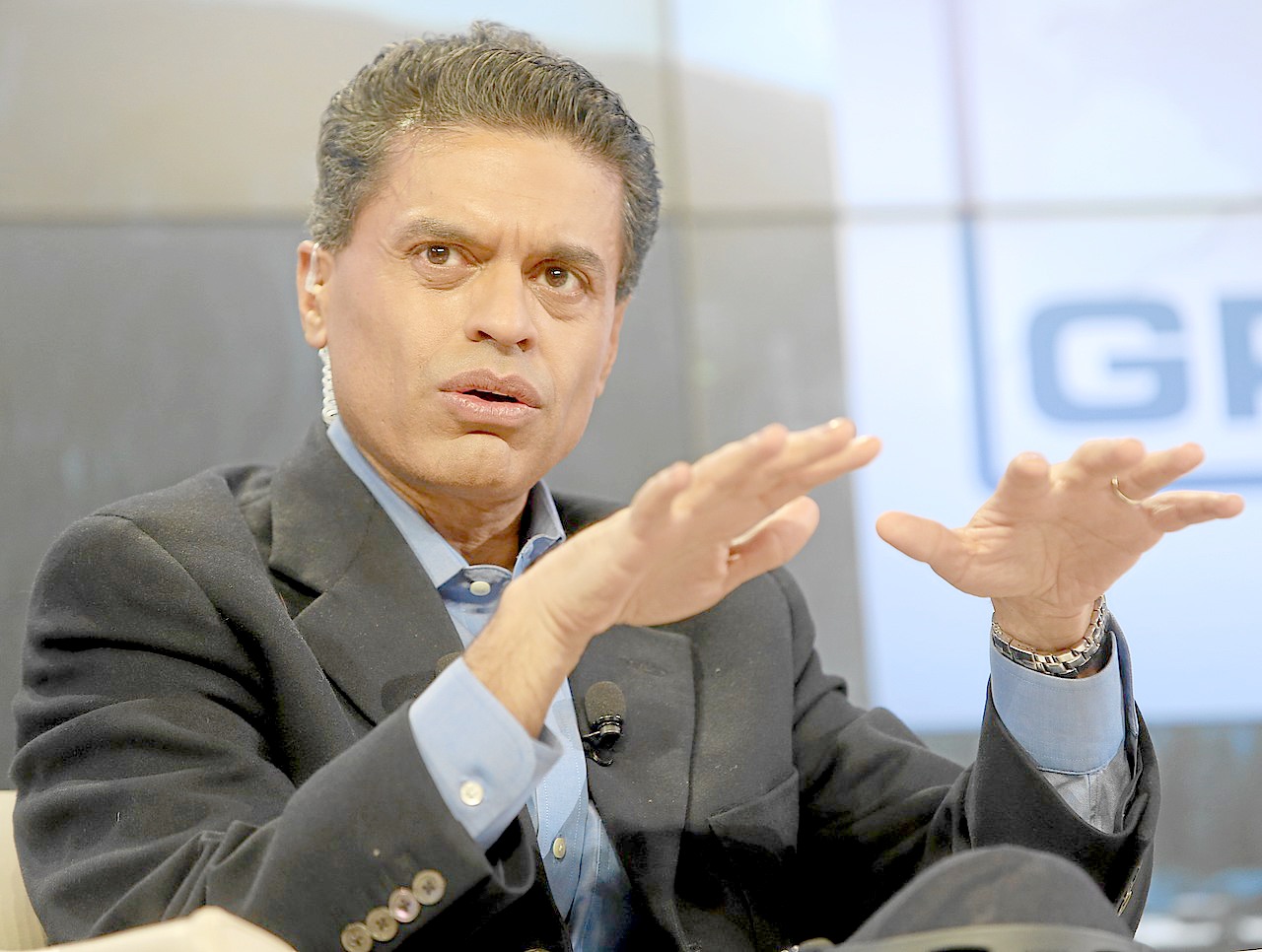
Fareed Zakaria
CNN’s Fareed Zakaria delivers the 2018 Daniel Pearl Memorial Lecture, an annual event celebrating the life of the late journalist. The host of CNN’s “Fareed Zakaria GPS,” the network’s flagship international affairs program, is respected for his analysis, his ability to spot economic and political trends, and his good humor, wit and unique approach to international relations. Kal Raustiala, a professor at the UCLA School of Law and the UCLA International Institute, moderates. 4:30 p.m. $35. Schoenberg Hall, Room 1100, UCLA, 445 Charles E. Young Drive, Los Angeles. (310) 206-6365. tinyurl.com/pearlzakaria.
THU FEB 22
“AMY”
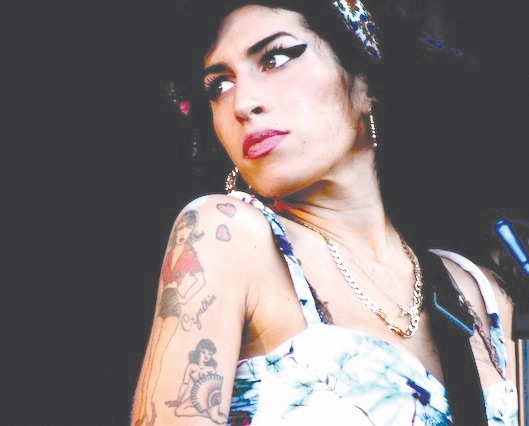
Amy Winehouse
Before her 2011 death from alcohol poisoning, Jewish singer-songwriter Amy Winehouse garnered critical acclaim for her vintage R&B-blues sound, jazz-influenced vocals and personal lyrics, as displayed on singles like “Rehab.” A screening of “Amy,” the Oscar-winning 2015 documentary about Winehouse’s brief life and career, features archival footage and personal testimonies. After the screening, Andy Besser, former executive director of the Jewish rehabilitation organization Beit T’Shuvah, leads a discussion. Popcorn and dessert served. 6:45 p.m. seating, 7 p.m. screening. Free. Kehillat Israel, 16019 W. Sunset Blvd., Los Angeles. (310) 459-2328. ourki.org.
AYELET GUNDAR-GOSHEN
Acclaimed Israeli novelist Ayelet Gundar-Goshen discusses her latest thriller, “Waking Lions.” The book — winner of the 2017 Jewish Quarterly-Wingate Prize and one of The New York Times’ 100 Notable Books for 2017 — grapples with the influx of African migrants into Israel. Its story follows an Israeli doctor who, while driving one night, hits an Eritrean refugee and leaves him for dead on the side of the road. An exploration of the tension between the privileged and the unseen follows. 7:15 p.m. Free. UCLA Fowler Museum, Lenart Auditorium, 308 Charles E. Young Drive, Los Angeles. writersblocpresents.com/main/ayelet-gundar-goshen.
“BAD RABBI AND OTHER STRANGE BUT TRUE STORIES FROM THE YIDDISH PRESS”
Eddy Portnoy
Eddy Portnoy, who received his doctorate from the Jewish Theological Seminary with a dissertation on Yiddish cartoons, discusses his book, “Bad Rabbi,” an underground history of downwardly mobile Jews from the seamy underbellies of New York and Warsaw, the two major centers of Yiddish culture before World War II. The book features stories of drunks, thieves, murderers, wrestlers and poets plucked from Yiddish newspapers. Sarah Abrevaya Stein, a Sephardic studies professor at UCLA, moderates. The UCLA Klezmer Ensemble performs. 4-5:30 p.m. Free. 314 Royce Hall, UCLA, Los Angeles. (310) 267-5327. cjs.ucla.edu.
RABBI STEVE LEDER
Wilshire Boulevard Temple Senior Rabbi Steve Leder teaches about how to live a life worthy of one’s suffering as he discusses his latest book, “More Beautiful Than
Before: How Suffering Transforms Us,” with Sarah Brokaw, daughter of television journalist Tom Brokaw. The 2017 book guides readers through pain’s stages of surviving, healing and growing. Meanwhile, Leder draws on his years of experience counseling others through life’s difficult moments, including the death of a loved one, divorce or illness. Light bites and validated parking provided. 6-8 p.m. Free. Tower Cancer Research Foundation offices, 8767 Wilshire Blvd., Suite 401, Beverly Hills. RSVP required at brooke@towercancer.org or (310) 299-8470. towercancer.org/events.
AVRAHAM BURG
Avraham Burg, a prominent Israeli opinion maker, the son of a Holocaust survivor and former speaker of Israel’s legislature, has spent much of his life shaping Israel’s story. He discusses his new book, “In Days to Come: A New Hope for Israel,” which chronicles Israel’s highs and lows over the past five decades and weaves in his personal journey from a child in the world of religious Zionism to a paratrooper in the Israeli army, to the speaker of the Knesset. 6:30 p.m. VIP wine and cheese reception with the author, 7:30 p.m. lecture. $10 lecture only, $30 includes VIP reception. AmericanJewish University, Shapiro Synagogue, 15600 Mulholland Drive, Los Angeles. (310) 476-9777. aju.edu.
“PASSING THE TORCH — FROM SELMA TO TODAY”
Former U.S. United Nations Ambassador Andrew Young, Bernard Lafayette Jr. and Clarence B. Jones, three pivotal figures of the 1960s civil rights movement, along with James Perkins Jr., Selma’s first African-American mayor, and moderator Jessie Kornberg, president and CEO of the Jewish legal aid agency Bet Tzedek, discuss lessons learned from the civil rights movement. They reflect on how the Selma-to-Montgomery march and other key actions led to the Voting Rights Act of 1965, then consider strategies that can transform racist and unjust public policy today. 7:30 p.m. $12 general, $10 Skirball members and full-time students. Skirball Cultural Center, 2701 N. Sepulveda Blvd., Los Angeles. (310) 440-4500. skirball.org.
TONY KUSHNER
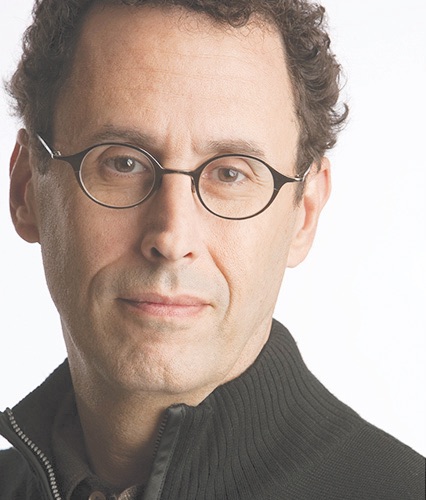
Tony Kushner
The acclaimed Jewish playwright and screenwriter, who wrote the screenplay for Steven Spielberg’s Oscar-winning “Lincoln,” discusses “The Lincoln Legacy: The Man and His Presidency.” He appears in conversation with best-selling author Sarah Vowell as they examine the 16th U.S. president’s life’s work and legacy. 8 p.m. $29–$59. Royce Hall, UCLA, 340 Royce Drive, Los Angeles. (310) 825-2101. cap.ucla.edu
In the aftermath of another horrible and heartbreaking mass shooting at an American school, the same political game took place that always takes place. That game breaks down into three stages: before the facts come in, once the facts are in, and the actual political debate.
Before The Facts Come In. Before the facts come in, proponents of gun control point at foreign countries and the lack of mass shootings in those countries and suggest that Congress ought to do something — anything, really — to make it more difficult for evil people to obtain guns. They do not specify what that something is. But it must be a law, and it must restrict law-abiding citizens’ access to guns. Furthermore, any Congressperson who opposes such unspecified laws is the tool of the “gun industry.”
Meanwhile, those who oppose gun control urge caution until we know the facts; often they offer thoughts and prayers. Proponents of gun control then mock those thoughts and prayers in order to imply that gun control opponents don’t care about dead children, and merely want to avoid responsibility by throwing the problem at God.
The Facts Come In. As the facts come in, proponents of gun control maintain their staunch advocacy for their position, but are often forced to acknowledge that their preferred measures wouldn’t have done anything to stop the shootings at issue. That doesn’t stop them from clubbing about the ears gun control opponents, who maintain that gun control measures must be tailored toward stopping actual events.
Meanwhile, opponents of gun control usually suggest two measures: mental health screening that would take dangerous people off the streets and into treatment, and security in schools. These are rejected out of hand by gun control proponents, who say they don’t want those who are mentally ill avoiding treatment in order to avoid the consequences of such treatment, and add that placing security in schools would somehow “militarize” the school environment.
The Political Debate. Congress usually proposes some measure of gun control. That measure of gun control is usually far more unpopular in specifics than it was in theory; it usually restricts rights most Americans care about, and fails to properly target the underlying problem at issue. Such measures almost universally fail. When they do pass, they show little evidence of impact on mass shootings.
So, where does all of this leave us?
Here’s what we know. The shooter used an AR-15, the most common rifle in the United States. The shooter was on the radar of school authorities, and he was reportedly in frequent contact with the police; he was reported to the FBI as well, but follow-up was apparently insufficient. People warned authorities about him, and they didn’t do anything or couldn’t do anything. That’s probably the best place to start looking for answers.
The shooter’s gun was obtained legally. He had never been arrested; it’s difficult to think of a way to prevent the sale of a gun to a person with a clean record without a mass gun ban or confiscation. He also had a gas mask and grenades — and it’s unclear where he obtained the grenades. We could look at stronger prosecution of straw buyers, as Jim Geraghty of National Review suggests, but that wouldn’t have helped in this case.
So, where do we go from here? Obviously, I think that we ought to consider security in schools as a first step — I went to a Jewish high school in Los Angeles that received bomb threats at least twice a year; the building next door was scoped out by mass shooter Buford Furrow, but he left thanks to security there. It’s not too much to ask that we place armed security at our schools, as Israel does.
But this much is clear: snap Twitter excoriations focused on casting aspersions at the character of our political opposition tears our country apart right when we need to come together in comfort. We have an unfortunate tendency to roll our eyes when people say they’re waiting for the facts, whether we’re discussing mass shootings or terrorist attacks; I’ve done it, too. But waiting for facts is the responsible thing to do. And as the facts come in, perhaps better solutions will make themselves clearer.
From the dawn of time — or at least for the past two centuries — it seems as if Jews have been obsessed with finding the answers to three monumental questions:
1. Why are we here?
2. How should we live our lives?
3. Was Alexander Hamilton Jewish?
While discussion and study continues about the first two questions, the third question was addressed in knowledgeable and entertaining fashion on Feb. 7 at Beth Jacob Congregation in Beverly Hills. Before a packed and enthusiastic audience, Rabbi Meir Soloveichik discussed the question with law professor Andrew Porwancher.
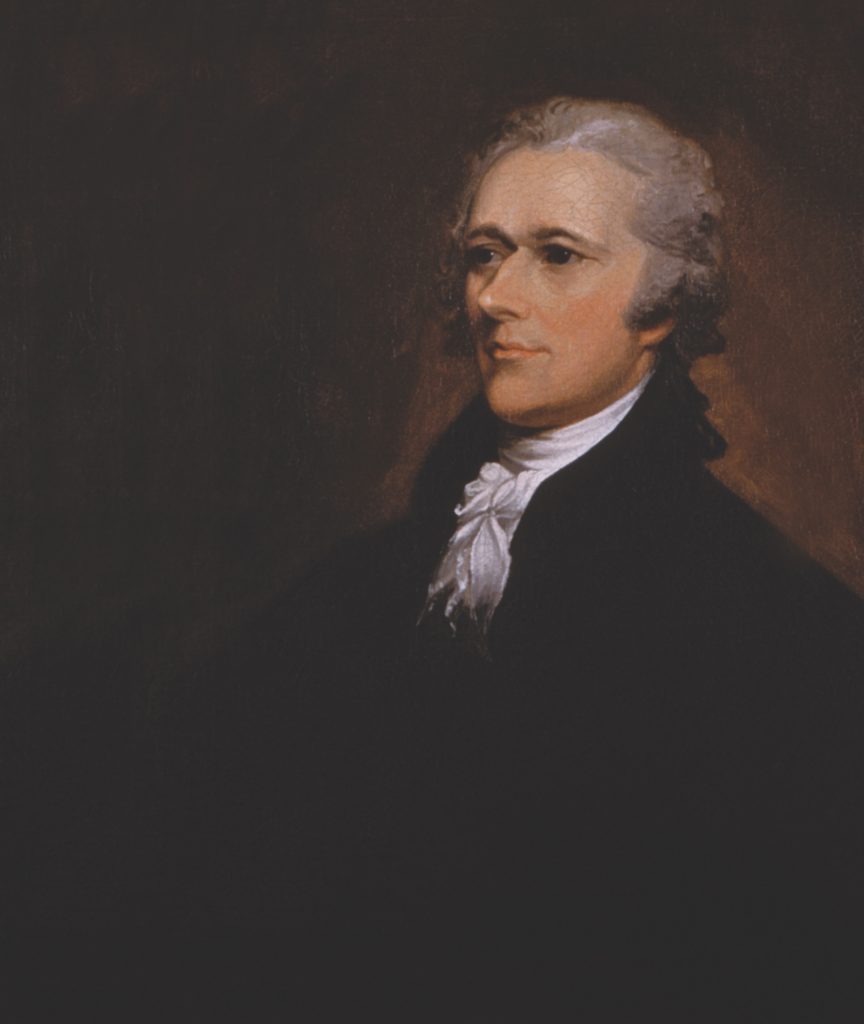
Generations of biographers have written that Hamilton — a Revolutionary War hero, co-author of “The Federalist Papers,” the first secretary of the treasury and the subject of a boffo Broadway musical — was a Christian. But Soloveichik and Porwancher, who came armed with a load of supporting archival research, made their case that Hamilton was, in fact, born and raised as a Jew.
The two scholars are well-qualified to expound upon this topic. Porwancher is an associate professor of law at the University of Oklahoma, where he teaches legal history. He earned his doctorate from Cambridge, his master’s from Brown and his bachelor’s from Northwestern. He is currently at work on “The Jewish Founding Father: Alexander Hamilton’s Hidden Life” (under contract with Harvard University Press).
Soloveichik is director of the Zahava and Moshael Straus Center for Torah and Western Thought and rabbi of Congregation Shearith Israel in New York City. He graduated summa cum laude from Yeshiva College and in 2010 received his doctorate in religion from Princeton University. Rabbi Soloveichik has lectured throughout the U.S., Europe and Israel on topics relating to Jewish theology, bioethics, wartime ethics and Jewish-Christian relations.
Why do these two learned gentlemen believe Hamilton was Jewish?
At his Jewish school, Hamilton learned to recite the Ten Commandments in Hebrew.
For starters, Hamilton’s mother, Rachel Faucette, was married off by her mother to Jewish merchant Johann Michael Lavien (a variant of the Jewish name “Levine”) on the Danish-controlled Caribbean island of St. Croix in 1745, a time when Danish law would have required her conversion to Judaism before the wedding. She left Lavien in the early 1750s and lived with James Hamilton on the island of Nevis in the British West Indies. She bore two sons out of wedlock with James Hamilton, one of whom was Alexander, who was born around 1755. This would mean that, according to Jewish law, Alexander Hamilton was born a Jew. Also, while growing up on Nevis, Alexander attended a Jewish school.
Historians have discounted all of these points, arguing that Lavien was not recorded as a Jew in Danish records, and that Alexander Hamilton only attended the Jewish school due to his illegitimate birth, which kept him from being baptized or attending a Christian school. But parish records from Nevis show that infants born out of wedlock were indeed baptized. Plus, observed Porwancher, “None of St. Croix’s Jews were identified in the records as Jews.” He added, “If Alexander wasn’t Jewish, he would have to be the first person in history whose mother was named Rachel Lavien, and who went to a Jewish school, but who wasn’t Jewish. It was simply not a designated category in the island’s registers.”
In his research, Porwancher found a plethora of evidence linking Alexander Hamilton to Judaism, including from one of Alexander Hamilton’s grandsons, who referred to Johann Lavien as “rich Danish Jewish.” Also at his Jewish school, Hamilton learned to recite the Ten Commandments in Hebrew.
Complicating the matter, Porwancher said, is that Hamilton apparently cut his ties to Judaism at the age of 13, when his mother died, not wanting to align himself with what he perceived to be a second-class religious status.
Rabbi Meir Soloveichik. Photo by Lulu Krakauer.Andrew Porwancher. Photo by Lulu Krakauer.
Even so, Porwancher’s and others’ research has revealed numerous ties Hamilton had to Judaism throughout his career. Fighting in the American Revolution and serving as George Washington’s aide-de-camp, Hamilton studied the history of European Jewish banking. While doing so, he formulated the idea of financing the Revolution through credit, an idea which eventually proved successful. In addition, Hamilton was the only Founding Father willing, via his law practice, to represent Jewish clients. And in his copy of Washington’s Farewell Address, he put forth the idea of religious liberty as crucial to the young nation’s vitality.
“It was in Hamilton’s America that an orphan from the Caribbean could become secretary of the treasury,” Porwancher said. “It was in Hamilton’s America that Jews could have equal opportunities and rights.”
“The heart of Hamilton’s story was dispossession,” Porwancher added. Just as the Jews had been dispossessed from their various homelands throughout history, so Hamilton, due to his illegitimacy, had been dispossessed of his inheritance and, despite his accomplishments, always identified with outsiders.
Hamilton was repeatedly accused of promoting practices that benefited Jews. If true, Hamilton’s practices would appear to have been consistent with a European trend at the time, according to “The Hebrew Republic” by Eric Nelson, a book Porwancher recommended. Nelson argues that the familiar story of modern political thought in the West resulting from secularization is wrong. Rather, Nelson contends, it was the Christian encounter with Hebrew sources that led to a radical transformation.
Nelson further argues that Christian scholars began to regard the Hebrew Bible as a political constitution designed by God for the children of Israel. Newly created rabbinic materials became authoritative guides to the institutions and practices of the perfect republic and central features of modern political thought emerged from an attempt to emulate a constitution designed by God.
Even though the Jewish population in colonial America was small, it is telling that the Founding Fathers realized the importance of freedom of worship for even this small minority. In George Washington’s 1790 letter to the Touro Synagogue in Rhode Island, he affirmed his resolve that bigotry would have no place in America and that Jews would not be a tolerated minority but would “possess alike liberty of conscience and immunities of citizenship.”
That commitment has withstood the test of time and surely we have Alexander Hamilton’s ties to Judaism to thank, at least in part, for it.
Mark Miller is a humorist and journalist who has performed stand-up comedy on TV and written on various sitcom staffs. His first book, a collection of his humor essays on dating and romance, is “500 Dates: Dispatches From the Front Lines of the Online Dating Wars.”
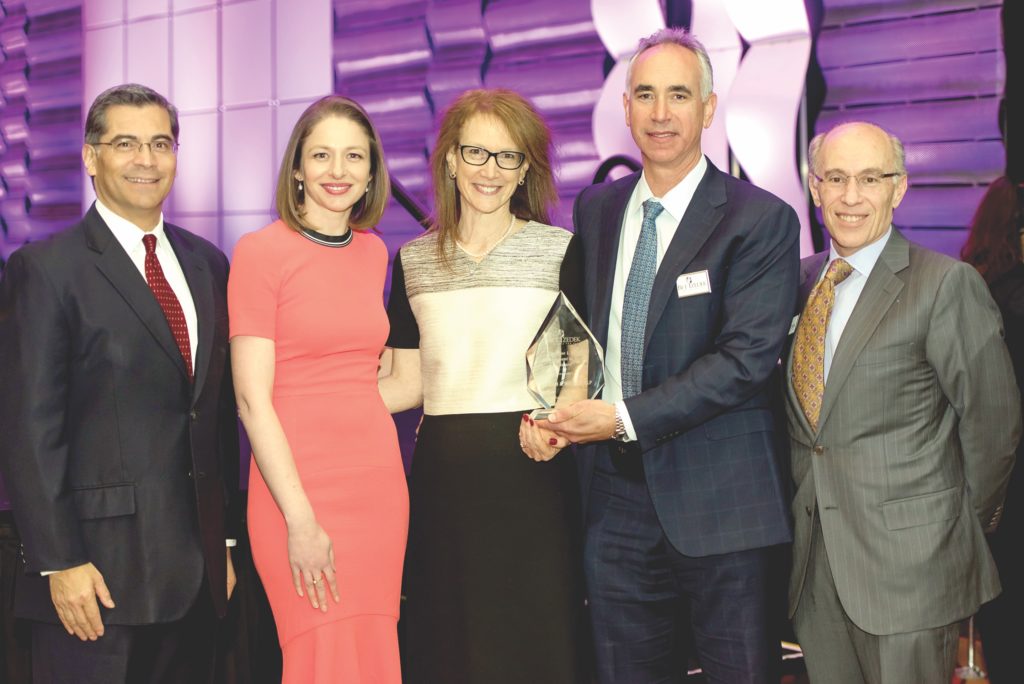
More than 1,000 people attended the Bet Tzedek annual gala on Feb. 1 at the JW Marriott Los Angeles L.A. Live, which raised more than $2.2 million for the pro bono legal aid agency.
Bet Tzedek provides free, comprehensive legal services for low-income individuals and families in Los Angeles.
Honorees included Kim Selfon, who received the Jack H. Skirball Community Justice Award; the law firm of Latham & Watkins, which received the Rose L. Schiff Commitment to Justice Award, presented by California Attorney General Xavier Becerra to the firm’s vice chair, Ora Fisher; John Ly, who received the Rebecca Nichols Emerging Leader Award, presented by Brian Sun, partner-in-charge at the Los Angeles office of the Jones Day law firm; and E. Randol Schoenberg, an attorney and former president of the Los Angeles Museum of the Holocaust, who received the Luis Lainer Founder’s Award, presented by David Lash, managing counsel for pro bono work at the O’Melveny & Myers law firm.
“The Bet Tzedek annual gala dinner is a powerful statement that ensuring equal justice for all is not just a tagline, it’s an ongoing commitment of our community to provide free legal services to those that need them most,” said Bet Tzedek President and CEO Jessie Kornberg.
After the gala, more than 100 young professionals gathered at The Mixing Room at the JW Marriott for the Bet Tzedek New Leadership Council After Party, which raises funds for, and awareness of, the work of Bet Tzedek.
California Attorney General Xavier Becerra addressed approximately 60 people at Young Israel of Century City (YICC) last week. YICC Senior Rabbi Elazar Muskin (right) introduced Becerra. Photo by Ryan Torok
California Attorney General Xavier Becerra appeared at Young Israel of Century City (YICC) on the evening of Feb. 6 for a wide-ranging discussion on immigration, homelessness, mental illness and Israel.
Addressing about 60 people in the YICC social hall, Becerra called himself a “strong ally and supporter of Israel.”
“We endanger the fight for Israel if we make it a partisan issue in the U.S.,” he said to applause.
Asked about Democrats’ sometimes critical views of Israel, Becerra, a Democrat said Republicans were to blame for turning Israel into a partisan issue.
“Most of the Democrats I know have been strongly supportive of Israel,” he said.
Becerra began the evening with a discussion of immigration, saying the term “sanctuary cities” is a term of art. With no official legal definition, “sanctuary cities” generally describes cities whose law enforcement agencies do not cooperate with, but do not interfere with, federal law enforcement in identifying and deporting undocumented immigrants, he said.
An American of Mexican descent, Becerra became California’s chief law officer in 2017, after his predecessor Kamala Harris’ election to the U.S. Senate.
During a Q-and-A after the presentation, an audience member, who said his brother had a mental illness, asked Becerra what elected officials were doing to help people like his brother.
Becerra acknowledged the dearth of services for the mentally ill but did not have an answer. Instead, he drew a connection between untreated mental illness and the rise in homelessness.
Notable attendees at the event included YICC Senior Rabbi Elazar Muskin, YICC Past President Mark Goldenberg and Pico Shul Rabbi Yonah Bookstein.
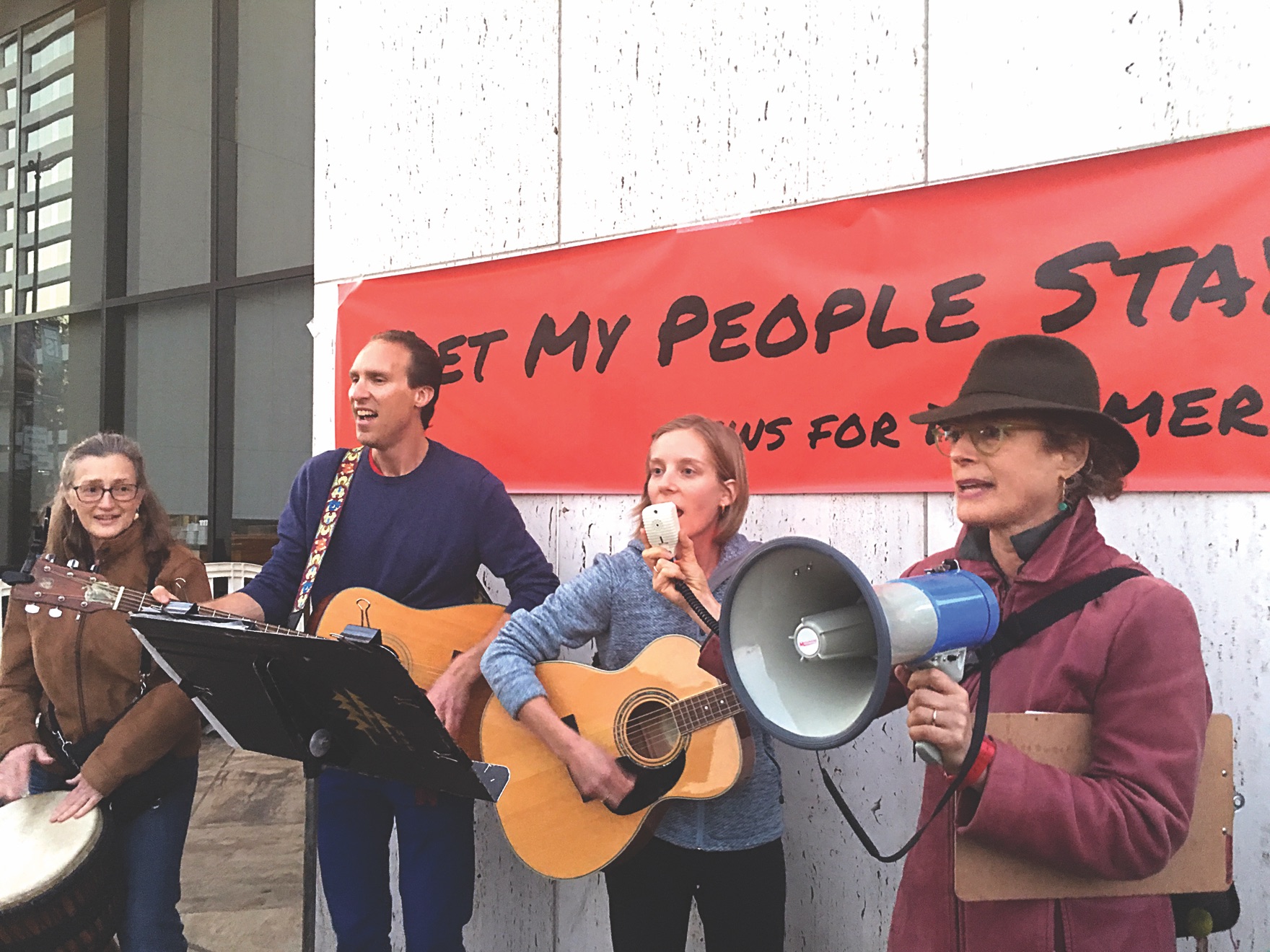
From left: Marcia Brous, Steven Wynbrandt, Ariel Wolpe and Stacie Chaiken sing at a Jews for Dreamers rally at the West L.A. office of Sen. Dianne Feinstein. Photo by Ryan Torok
More than 100 Jews gathered Feb. 6 for a rally in support of recipients of Deferred Action for Childhood Arrivals, or DACA, outside the West Los Angeles office of U.S. Senator Dianne Feinstein at Sepulveda and Santa Monica boulevards.
“Let my people stay,” the protestors chanted.
The lively rally, organized by Leo Baeck Temple, the secular Sholem Community and Bend the Arc: A Jewish Partnership for Justice, drew Rabbi Aryeh Cohen, part-time rabbi-in-residence at Bend the Arc; Cohen’s wife, Andrea Hodos, program co-director at NewGround: A Muslim Jewish Partnership for Change; Rabbi Sarah Bassin, associate rabbi at Temple Emanuel of Beverly Hills; Rachel Sumekh, founder of Swipe Out Hunger; Hillel at UCLA Director Emeritus Rabbi Chaim Seidler-Feller; and Marcia and Rick Brous, the parents of IKAR Senior Rabbi Sharon Brous.
While Marcia Brous banged a bongo drum, Rick Brous held a sign that read, “Republican for Dreamers.”
“I’m an American before I’m a Republican, and I can’t stand our current president,” Rick Brous said. “I think it is important for everybody to support Dreamers, not just Jews. It is the right thing to do.”
Sumekh, for her part, said she felt good being around likeminded people.
“Normally, I feel this when I’m listening to my podcasts, and now I get to feel this rage with hundreds of people,” she said.
Sumekh said she empathizes with young, undocumented immigrants because her mother fled Iran at the age of 21 “with a dream.”
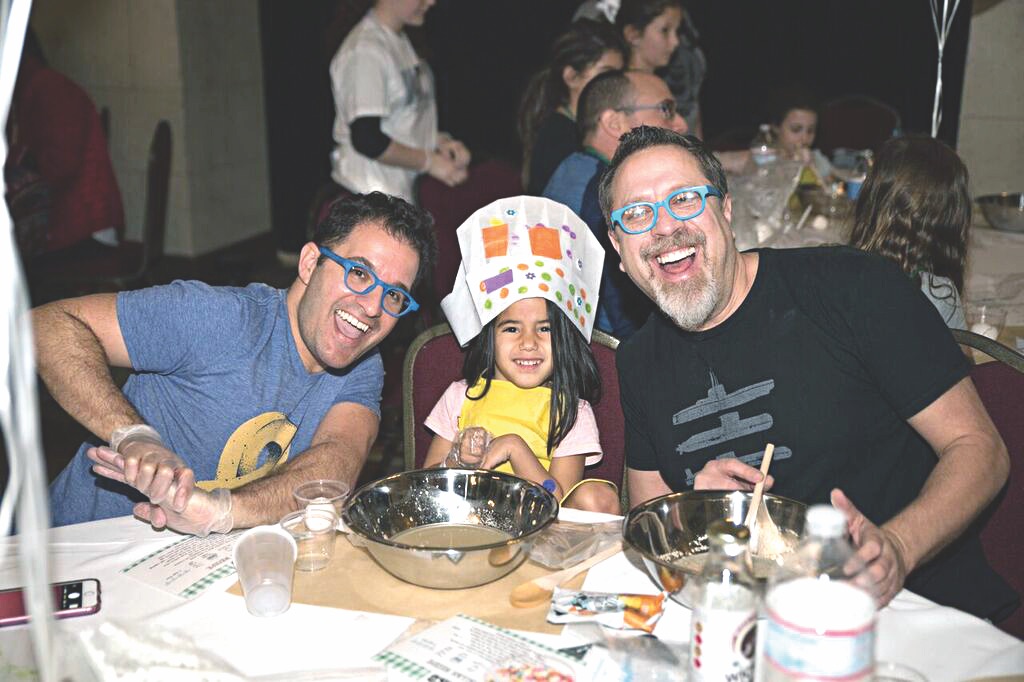
LA Kids Challah Bake participants complete the first stage of making their challah dough: adding yeast to warm water. Photo by Ricardo Cornejo
On the morning of Feb. 4, Super Bowl Sunday, about 200 people turned out for a different kind of food-centered tradition: the second annual LA Kids Challah Bake at The Majestic Downtown in Los Angeles.
Event organizer Brocha Yemini said “people who affiliate with the Jewish religion” were invited to participate. She added that she was pleasantly surprised by the diversity of the attendees and heartened by the number who had never before attempted to make challah.
“That was one of our goals,” said Yemini, director of Camp Gan Israel, one of the event’s sponsors.
She said she hoped that many of the newbies would now feel confident enough to attempt making challah at home.
“Challah is delicious,” she said. “It’s something that is loved by all. We want to have unity through challah.”
She and her sister, Rochie Yemini, were inspired to start the event in December 2016 by a similar, albeit larger program in New York. They held the inaugural bake event at the Chabad Israel Center on South Robertson Boulevard in the Pico-Robertson neighborhood. While they considered that event a success, they wanted to make sure everyone — affiliated Jews, unaffiliated Jews and interfaith families — felt welcome. So, they sought out a nonreligious venue for this year’s festivities.
Sarah Klegman, a writer and co-founder of Challah Hub, a local artisan challah delivery company, and Whitney Fisch, director of counseling at Milken Community School’s upper-school campus and creator of the Jewhungry blog, served as hosts and kept the proceedings lively with a competitive challah trivia game. But when they asked about the mitzvah of separating the challah, the hafrashat challah, the otherwise rambunctious crowd that included many school-age children grew quiet. The practice involves separating a small piece of dough after the flour, yeast and wet ingredients have been combined but before the dough is braided. Historically, these olive-size pieces of dough were offerings to temple priests, but these days the practice is to burn them.
Brocha Yemini said that when everyone joined together in blessing the challah, with their eyes closed, it was “a special moment.”
Then it was on to the braiding. Every child made a challah to take home and a second one to be delivered the following day to Jewish Family Service of Los Angeles, whose representative, Kitty Glass, spoke to the crowd about the organization’s work.
Not surprisingly, given the age of the young bakers, chocolate chips and sprinkles proved to be the challah toppings of choice. Raisins, not so much.
— Leslee Komaiko, Contributing Writer
From left: Jewish Family Service Los Angeles (JFSLA) Vice President Susie Forer-Dehry, “Laughing Matters” co-chairs Linda Levine and Wendy Silver; JFSLA board member Tami Stapf; JFSLA board chair Shana Passman; and JFSLA President and CEO Eli Veitzer attend “Laughing Matters,” a benefit for JFSLA, at the Laugh Factory. Photo by Michael Sidman
More than 200 Angelenos filled the Laugh Factory in Hollywood on Feb. 6 for Jewish Family Service of Los Angeles’ (JFSLA) sixth annual “Laughing Matters” fundraiser, which features well-known stand-up comedians and benefits the organization’s domestic violence services.
“We are so grateful for the support of our community who came together to make this ‘Laughing Matters’ a night to remember,” JFSLA President and CEO Eli Veitzer told the Journal.
Originally founded in 1854 as the Hebrew Benevolent Society, JFSLA offers a broad range of services, including financial assistance and emotional support services for Holocaust survivors, mental health and addiction counseling, and citywide food drives.
This year’s lineup of comedians included Orny Adams, Preacher Lawson and John Mendoza, who performed their sets but also took time to stress the importance of assisting survivors of domestic violence.
The headliner was actor, comedian and talk show host Arsenio Hall, best known for hosting “The Arsenio Hall Show.”
Over the previous five annual events, proceeds from tickets, donations and auctions have raised more than $300,000.
This year, Veitzer said, “Thanks to our co-chairs, Linda Levine and Wendy Silver, we raised over $75,000 to support domestic violence services provided by JFS Hope, formerly known as the Family Violence Project.”
Tickets were $200 per person.
With counseling centers in North Hollywood and Pico-Robertson, two crisis hotlines and three residential shelters, JFSLA offers a continuum of care, from counseling and case management to housing assistance and job-readiness skills for survivors of domestic violence.
The evening also included a light dinner buffet and a live auction.
“And let them make Me a sanctuary that I may dwell among them. Exactly as I show you — the pattern of the Tabernacle and the pattern of all its furnishings — so shall you make it.”
Rabbi David Saiger Milken Community Schools
Ron Swanson in TV’s “Parks and Recreation,” played by Nick Offerman, is a curmudgeonly parks director who is vehemently anti-government and anti-pretty much anything institutional, including religion. As a hobbyist carpenter and builder, he’s forced to admit, while attending a wedding in a church: “Say what you will about organized religion, but those [people] knew how to construct an edifice.”
Swanson and I may disagree on the value of organized religion, but we agree on the value of a well-designed edifice. However, there are edifices and then there are edifices. The Torah recognizes the allure of building something grand and beautiful. The Tower of Babel was grand and beautiful, presumably, but its purpose was to give others and/or ourselves the false impression that we are (like?) gods. It was the ultimate expression of hubris.
But some edifices, however grand and beautiful, truly allow God to dwell among us. Put differently, some edifices allow us to access the most spiritual, empathic and even humble parts of ourselves. To me, the operative words of our verse are “that [God] may dwell.” The Tabernacle isn’t the dwelling place of the human ego, it’s the dwelling place of spiritual values. The Tabernacle was the anti-Babel — an edifice constructed not to express the desires of powerful men, but an edifice that puts the ego in check and creates space for God, for the Godly parts of ourselves.
When I enter a space to pray or to reflect, be the space humble or grand, my question is: Is this a Tower of Babel, or is this a Tabernacle?
Rabbi Jocee Hudson Temple Israel of Hollywood
One of the most profound shifts in my understanding of God has been inspired by feminist theologians, who have taught that God is not a hierarchical power judging from above, but rather an animating power radiating from within.
“Does God judge me?” I am asked versions of this question often in my work as a rabbi. And it’s a question I will admit to asking myself. “Is God angry with me? Is God punishing me?”
These are difficult questions because they unearth hard truths in our emotional landscapes: we are imperfect, life can be devastating and confusing and, in the face of uncertainty, we may find ourselves desperate for answers.
And let them make Me a sanctuary that I may dwell among them.
In response to these tough questions, I remind myself of this bit of Torah.
There is a divine spark in each of us, which links us one to the other and to our deepest selves. This divine spark, which dwells among us, within us, is not a source of judgment or punishment. This divine spark is a nurturing, connective force that has the power to bring us shalom and shleimut, peace and wholeness. When we pray or meditate or allow our minds to quiet, this is the light, the echo, that emerges.
There is much of God I cannot know. There is so much of God I can feel. The truest sanctuaries we build make space for both realities.
Our friend Ziporah Bank likes to say, “If you’re walking through a desert and find 10 rocks lined up in a row, you know someone did that. Nature doesn’t randomly create such rows. Likewise, a universe filled with ordered beauty, from galaxies to gladioluses, doesn’t just happen. Someone did that.”
In our verse, God has already told Moses to open the first capital campaign by inviting “every person whose heart inspires him” to donate materials for a new synagogue. Its architect is the Holy One Himself, who now shows His design to Moses.
Our verse reads, “Exactly as I show you — the pattern of the Tabernacle…” but there are no dashes in the Torah. So read it, “I show you the pattern.” This pattern is the mark of God eternally dwelling in our midst. Most people would walk by Ziporah’s row of rocks without a second thought, particularly when troubled by a business problem or worrisome relative.
If we open ourselves to the possibility of Divine purpose, however, we can eventually become like Reb Zusha of Anipoli, who would regularly collapse to the ground, overwhelmed by the stars in the night sky, and the loving Hand that placed them there.
Rabbi Nicole Guzik Sinai Temple
We are the lens through which our children see the world.
At dinner, our three children were giggling and laughing. Assuming the kids weren’t paying attention, my husband and I discussed our health. The words “lose weight” entered the conversation. Our daughter’s head popped up and she said, “I want to lose weight, too.” She is 6 years old.
We included her in a discussion about healthy eating and living, but lingering was the shock of our 6-year-old mirroring our language and behavior. Although it was a positive talk about ways to be healthy, the lesson was clear: The younger generation forms opinions, attitudes and behaviors based on how the older generation models and performs.
If we want our daughter to love herself, then we must intentionally model ways to do just that.
The Italian commentator Umberto Cassuto elucidates, “…[W]e shall explain in detail how the very design of the Tabernacle was able to inspire the people with the confident feeling that the Lord was present in their midst.”
Meaning, the pattern of the Tabernacle was to deliberately remind the children of Israel that God was watching and God was present. The architectural design of the Tabernacle provided a model of life for the Israelites to mirror. In understanding that God was close, so came the ability to develop a core of strength and a heart of faith.
We serve as our children’s Tabernacle. Let our words and actions allow for their growth — spiritual, physical, emotional.
Hypercreative, infinite and original designer of innumerable worlds seeks meaningful relationship with finite, corporeal being with intent to build a home together. Heaven is nice but it’s time to get down to earth.
Blueprints, materials, real estate … everything is prepared and ready for implementation. All that’s needed is your willingness to take this forward — with passion, with love, with wisdom, with wonder — and with total dedication to invest every talent you have into making something truly awesome happen.
Together, we can make the world beautiful again. Even more beautiful than when I first made it. Way more. We will fit infinite light into finite space. We’ll reveal transcendent oneness in fine, precise detail. We’ll unveil divine beauty in everyday human life.
I’ve got the resources. You provide the human life.
Just call, wherever you are, however you are. I’ve been waiting to meet you for way too long.
UPDATE 1: Law enforcement officials have stated that they have yet to find any connections between suspected shooter Nikolas Cruz and white supremacist group Republic of Florida, according to the Tallahassee Democrat.
UPDATE 2: Jordan Jereb, who leads the Republic of Florida (ROF) white supremacist group, is now walking back his claim that Cruz was involved with ROF.
Original Story:
Nikolas Cruz, the suspect behind the Feb. 14 Marjory Stoneman Douglas High School shooting in Florida, was reportedly involved with a white supremacist organization.
Jordan Jereb, who leads a white nationalist group called Republic of Florida (ROF), told the Anti-Defamation League (ADL) that Cruz had been to at least one of the group’s training sessions. Jereb claimed that ROF had nothing to do with the shooting itself.
Jereb told the same thing to the Associated Press (AP), but added that Cruz’s shooting was likely done on Valentine’s Day because he was dealing with “trouble with a girl.” Jereb also told the AP that “he didn’t know Cruz personally.”
ROF, which is based in Tallahassee, advocates for the creation of a “white ethnostate” in Florida. They engage their members in paramilitary training; their website states they will “fight to the death” to accomplish their goal. Below is one of their training videos:
School shooting suspect Nikolas Cruz reportedly trained with the "Republic of Florida" white-nationalist militia; this video shows ROF members in fatigues drilling and saluting each other. Some of the lyrics: "They call me Nazi / and I'm proud of it." https://t.co/5B5n7s52Cq
Jereb himself was arrested in 2016 after allegedly threatening a staffer to Florida Gov. Rick Scott (R).
Prior reports indicated that Cruz had made derogatory comments about Islam and once wore a Donald Trump hat. People who knew him described him as a loner who had previously threatened students. Cruz was expelled from the school.
CNN’s Jake Tapper noted that there were Cruz had multiple red flags that weren’t really acted upon:
Sept 2017, FBI was told of shooter's "I'm going to be a professional school shooter" post on Youtube. FBI said today its agents couldn't ID him — though he had posted under his name with same unusual spelling. 1/
2/ By that time, Sept 2017, the shooter had: * been suspended from school for fights and for bringing ammunition to school; * been expelled for disciplinary reasons; * bought a gun (Feb 2017)
3/ The shooter's social media footprint was also fairly disturbing by the time the FBI heard the complaint about his Youtube posting. And he posted under his own name.
4/ In July 2017, under a news clip about the doctor who shot up the Bronx hospital where he used to work, someone posting under the shooter's name wrote:"Man I can do so much better"
5/ One month AFTER the complaint to the FBI, under a video of a Trump supporter being pushed around, someone with the same name as the shooter posted: "I whana shoot people with my Ar-15"
I’d like to think about 2017 as the year when I finally woke up. My head was pulled out of the sand, my eyes were opened, and the cold water of reality splashed and hit my face. Was this painful, yes, but I am beyond grateful for this new awakening. Prior to this instance, I would not have considered myself to be blissfully ignorant. I never shied away from volunteer work, was involved in organizations aimed at protecting animals, and tried to be a good global citizen by moving from pescatarian diet (of around 20 years) to vegan lifestyle. I have also had the privilege of living in extremely progressive places where the liberal ways were widely acceptable. I guess that I just did not really feel threatened.
But, all of this changed… I guess that I owe this debt of gratitude to the current commander in chief. As he took helm at the White House, I started to see, like many other people I know, that my rights as a woman were in jeopardy. It was time stand up – it was time to take to notice and to really take action. I joined the local chapter of the National Organization for Women, became our team’s liaison for the Advocacy Committee for the National Council of Jewish Women|LA, and was appointed to the Women’s Advisory Board (for the city in which I live). When discussing important advocacy initiatives, as well as state legislation, it quickly became painfully clear as to how prevalent human trafficking has been and continues to be.
One starts to think – how is this possible?! It is 2018, and there is already the 13th amendment to the United States that abolished slavery. In the past, I had thought that modern day slavery was something that happens elsewhere. I ignorantly assumed that it was very much like the movie Taken. But, that is not the case… Human trafficking within the United States is way more common than many of us would care to acknowledge.
When I started to take notice, it became all too real and too close to home. In July 2017, there was a huge ring busted in California – the 13 victims who were female minors were being openly sold for sex. This was reported across many different news outlets – when we’re paying attention, the truth is not hard to find. This ring of child exploitation was happening in Los Angeles County. Per California State Attorney General Xavier Becerra, “Human trafficking, which includes sex and labor trafficking, is one of the fasting growing crimes in the world. Its reach is not limited to foreign countries. In California, human trafficking is reported here in our state more than in any other.” The National Human Trafficking Hotline shows that California does in fact have the highest number of reported cases in the country, followed by Texas and Florida.
So, one might start to wonder why California of all places?! Well, beyond being incredibly progressive, we’re also perfectly poised. Traffickers are attracted to California because of its booming and constantly growing economy: California has been ranked as one of the top 10 global economies. There are people who are willing and able to spend tens of thousands of dollars to purchase another human: A sick and twisted real life example of supply and demand. We also border another country, and have multiple international airports and shipping ports. California is also home to many immigrants, some who may be here illegally, and are fearful to come forward.
Despite of this, there is actually hope. There are volunteers, like myself, who go to places like bars, strip clubs, airports and other places that could be considered prime for trafficking, and we put up posters in plain sight for all to see. These posters are in 3 languages, and they have numbers to call and text to report possible trafficking or to ask for help. Towards the end of 2017, Governor Brown also passed legislation making it mandatory for such posters to be placed in hotels and motels. Even before this law passed, Los Angeles City Attorney Mike Feuer investigated a motel that was a hot bed for such activity, and he then won a substantial settlement for the City of Los Angeles.
Will human trafficking continue to be an issue? Well, I think that the answer is yes. However, I think that what is so important is that there is some hope. We have governmental leadership and law enforcement supporting our efforts, and actively pursuing those who are using such services. Under the LA Country Board of Supervisors “first responder protocol,” LA sheriff’s deputies but offer them access to resources to keep them off the streets and instead target customers for arrest. The LA sheriff’s department also plans to join Cities Empowered Against Sexual Exploitation (CEASE), a network operating in several cities that aims to cut the sex trafficking trade by 20 percent over two years. And, even more recently in 2018, there was another statewide sting: “Teams from throughout California have joined the Los Angeles County Sheriff’s Department to come down hard on business as usual for the pimps, exploiters and those who believe that it’s acceptable to buy another human being for sexual purposes,” Los Angeles County Sheriff Jim McDonnell said. “The message we hope to send to the traffickers is: Don’t do business in Los Angeles County or the state of California, because we will find you and prosecute you to the fullest extent of the law.” I could not have put it better myself.
Amanda Caroline Bleich is an advertising technology specialist by day, hot yoga enthusiast by night, and a human and animal rights advocate and activist by soul calling. Amanda is also a member of the National Council of Jewish Women, Los Angeles’ Advocacy Committee.
The parallels are obvious. Though both US President Donald Trump and Israeli Prime Minister Benjamin Netanyahu deserve due process, their narcissism has resulted in similar behavior and potential criminal charges being waged against them.
This week we have learned that there is solid evidence that Bibi has engaged in bribery, fraud, and breach of the public trust. His response has been to attack the police and his political enemies as conducting a witch-hunt.
Trump has throughout his presidency attacked the FBI and intelligence services, the courts, the free and independent press, the independent investigator, and any opponent or critic as conducting a witch-hunt against him.
After a painstaking year and a half investigation by the Israeli police, the police issued a non-binding recommendation that there is credible evidence that the Prime Minister has engaged in bribery, fraud and breach of trust in two separate cases.
Case 1000 involves Netanyahu receiving $286,000 in cigars and champagne as gifts primarily from Israeli mogul Arnon Milchin in exchange for Netanyahu pushing to extend the so-called “Milchin law” that cuts taxes for Israelis who make their money outside of Israel for another 10 years. Bibi had appealed to former Secretary of State John Kerry to institute this provision.
Case 2000 involves Bibi trying to make a deal with the owner of Israel’s second-largest newspaper, Yidiot Achronot, that he would get favorable coverage if he would persuade Israel Hayom’s owner Sheldon Adelson, who owns the largest free newspaper in the country, to not publish on weekends. Though the deal was never made, the conspiracy to manipulate the press is considered by many in Israel to be a criminal offense.
In response to the accusations by the police this week, Netanyahu defended himself as a loyal servant of the Jewish people and State of Israel, as a former commando in the IDF, as a former UN Ambassador, and as Prime Minister who always put the interests of Israel first. He accused everyone involved in these two cases and the opposition of trying to get rid of him for political purposes. His main Likud whip accused current opposition leader Yair Lapid, when he was Finance Minister in Bibi’s government, of being a “malshin” (a “rat” which according to Halacha carries a death sentence and was the justification that Yigal Amir used when he assassinated Prime Minister Yitzhak Rabin).
Lapid met at the request of the police for one hour in this year and a half investigation to answer the question about whether Bibi pressured him to act on behalf of Milchin when he was finance minister. Lapid answered honestly.
It remains to be seen what will happen in these two cases, and the Israeli Attorney General, Amichai Mandelblit (from the Likud party and an honest man and public servant) may take months to go over the evidence provided by the police.
Many are saying that if an indictment is brought against the Prime Minister, he should resign immediately. There is precedent in Israel for this so it isn’t out of the realm of possibility. PM Rabin resigned the first time he was Prime Minister in the 1970s when an illegal checking account was discovered in the name of his wife Leah during the time that Rabin served in Washington, D.C. as Israel’s Ambassador to the United States. More recently, former PM Ehud Olmert resigned when he was indicted and later convicted of bribery. He served time in prison for his crime.
Bibi and Trump really are two peas in a pod of narcissistic self-aggrandizement. Each equates himself with the “state” and seems to think that each is above the law and basic ethics.
Like Trump, Bibi is using the cynicism that appeals to his voters who don’t believe in the governmental system as a base upon which to attack the very system that distinguishes Israel as a democracy, the only democracy in the Middle East.
We will have to wait for the independent counsel in the US and the Attorney General in Israel to finish their work and make their determinations. If it is decided that Trump and Netanyahu are culpable and guilty, both should resign their office. Anyone in their respective parties who sides with the guilty party once a determination is made ought to be defeated handily in the next election.