fbpx

February 12, 2018

Report: Conditions in Syrian Palestinian Refugee Camp Are ‘Horrific’

A new report describes the Yarmoulk Palestinian refugee camp in Syria as “horrific,” yet it is never talked about because it can’t be used as a bludgeon against Israel.

According to the Gatestone Institute, the Syrian Army and the Popular Front for the Liberation of Palestine – General Command (PFLP-GC) has been blocking food and medicine from entering the country since 2013, while ISIS has been terrorizing refugees in the camp since 2015. The Sunni terror group frequently conducts public executions over fabricated crimes, pillages homes in the camp and keeps the refugees trapped in the camp.

Additionally, it has been over 1,237 days since the camp last had running water.

There has been a total of 204 Palestinians who have died in the camp as a result of the lack of food and water since the Syrian Army imposed their siege on the camp. Even more telling is the fact that the number of refugees in the Yarmouk camp has dramatically declined from over 100,000 in 2011 to 13,000 in 2014.

Overall, 3,645 Palestinians have been killed in Syria since 2011 and tens of thousands have fled the country as well.

Palestinian refugee camps in various countries are generally in putrid condition; according to a 2012 Washington Post report the camps in Lebanon feature “unspeakable” living conditions and the Lebanese government deprives the Palestinian refugees in the country of rights. Palestinian refugees in Iraq have been slaughtered by Shiite militias since the fall of Saddam Hussein.

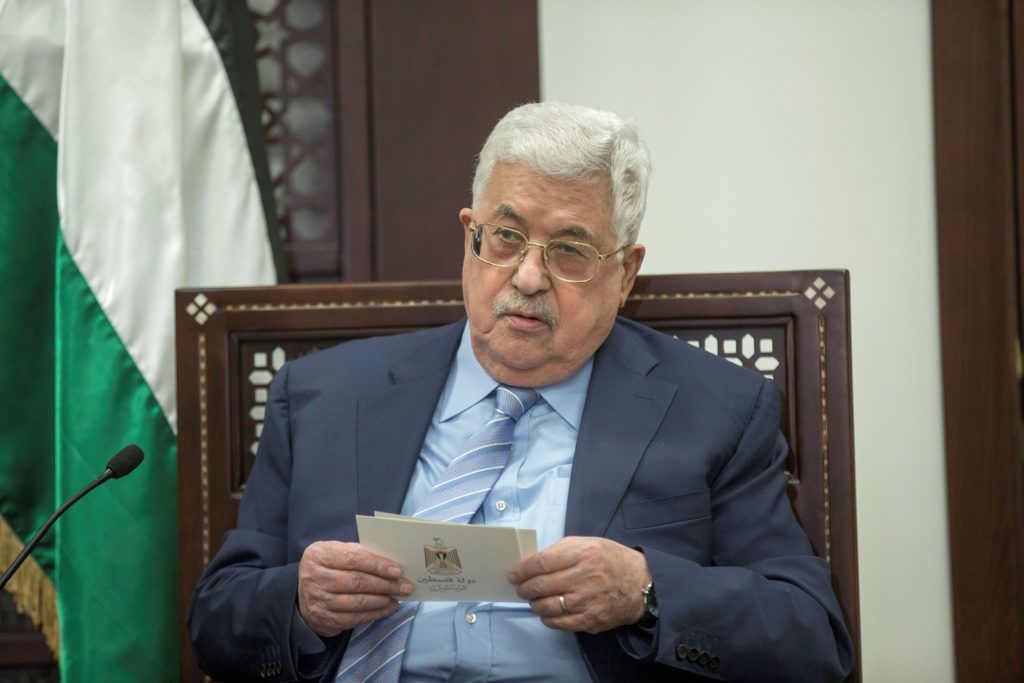
As the Gatestone Institute report points out, Palestinian Authority President Mahmoud Abbas is nowhere to be found when it comes to the Palestinian refugees suffering in these Arab countries. The report criticizes Abbas for being more interested in going after President Trump’s Jerusalem move and splurging $50 million on a presidential plane instead of helping the Palestinian refugees.

“In his view, the needs of his people are the responsibility of the world,” journalist Khaled Abu Toameh wrote. “He wants everyone but himself to continue funneling financial aid to the Palestinians. For him, delivering a speech before the EU Parliament or the UN General Assembly easily takes precedence over the Palestinians who are dying due to lack of medicine and food. With such leaders, the Palestinians do not need enemies.”

The Palestinian refugee issue stems from 1947, when Arabs leaders spurned a United Nations resolution that would have created a neighboring Arab state beside Israel. At the behest of Arab leaders, thousands of Palestinians left their homes; in 1948 Israel encouraged the Palestinians to stay in the country and those that did enjoy freedoms that they wouldn’t get anywhere else in the Middle East.

The Palestinians that fled have been mired in refugee camps as Arab countries have shown little interest in welcoming them into their population, as instead they rail against Israel and call for the Palestinian “right to return” into Israel. Times of Israel blogger John C. Landa argued that the camps radicalize Palestinian inhabitants and teach them “that the Jews are to blame for their plight.”

The refugees are pawns in a campaign to demonize Israel,” Landa wrote. “Like Palestinians who are set up as ‘human shields’ when Hamas jihadists launch rockets from Gaza into Israel, they are exploited and victimized to promote a simple but distorted narrative:  there is misery here, and the Jews must be blamed.”

Report: Conditions in Syrian Palestinian Refugee Camp Are ‘Horrific’ Read More »

Is War Brewing Between Israel and Iran? Here’s What You Need to Know.

Israel struck several Iranian targets in Syria over the weekend, leading to speculation that Israel and Iran are on the verge of war.

The weekend’s events began with Iran launching an unmanned aerial vehicle (UAV), more commonly known as a drone, from Syria and into Israel on the morning of Feb. 10. The drone was subsequently shot down by an Israeli helicopter; Israel proceeded to launch raids in Syria targeting the command center that Iran operated the drone from.

During the raids, Syria was able to down an Israeli F-16 through anti-aircraft missiles; Israel responded by unleashing a flurry of attacks against 122 Iranian and Syrian targets primarily close to Damascus. The Israel Defense Forces (IDF) estimate that they extinguished close to 50 percent of Syrian President Bashar al-Assad’s air defenses in the attacks.

The pilot and navigator in the downed F-16 were able to survive due to ejecting from the jet before the anti-aircraft missile struck the jet. It’s not yet known what exactly the Iranians had planned with the drone; Iran is claiming that it was related to self-defense.

“The government and army of Syria as an independent country have a legitimate right to defend [the country’s] territorial integrity and counter any type of foreign aggression,” Iranian Foreign Ministry Spokeman Bahram Qassemi told state television.

The drone was reportedly derived from the U.S. drone that Iran captured in 2011.

“We dealt severe blows to the Iranian and Syrian forces,” Israeli Prime Minister Benjamin Netanyahu said. “We made it unequivocally clear to everyone that our rules of action have not changed one bit. We will continue to strike at every attempt to strike at us.”

Tensions between Israel and Iran have been rising since Iran has ramped up their presence in Syria following the decline of ISIS, even going as far as building a military base in Syria. This is also coinciding with Assad tightening his grip on power, raising the very real possibility that the Syrian dictator could look to reclaim the Golan Heights, which has been occupied by Israel since 2011. Additionally, a bloody conflict between Israel and the Iranian proxy Hezbollah appears to be inevitable.

All of this points to further conflicts between Israel and Iran’s Shia crescent, with the U.S. being notably missing in the conflict as they focus on exterminating the remnants of ISIS. Consequently, Israel may have to turn to Russia, an ally of Iran and Syria, to be the mediator of the conflict, as Russia has been pulling all the strings in Syria in the absence of the U.S.

“We need to prepare ourselves operationally and intelligence-wise for the mounting threat,” IDF chief Amit Fisher told Israeli forces. “The big test will be the test of war.”

Is War Brewing Between Israel and Iran? Here’s What You Need to Know. Read More »

[WATCH] A Very Special Love Story: Danielle and Shlomo

It’s been nearly four years since Danielle, 26, and Shlomo Meyers, 32, tied the knot. The couple, who have Down syndrome, met via a matchmaker in 2012. After two years of dating, Shlomo finally popped the question. Eight months later, they were married at the Warner Center Marriott Woodland Hills, surrounded by hundreds of friends and family members. It was a hot June day, but they both agreed it was the best day of their lives.

Today, Danielle and Shlomo are your typical Orthodox couple living in the Pico-Robertson area. She wears a head covering, and he wears a yarmulke.

Both have jobs in the Jewish community, Shlomo as a physical education assistant at Maimonides Academy and Danielle as a preschool aide at Yeshiva Aharon Yaakov Ohr Eliyahu Academy. Danielle volunteers regularly at ETTA (a nonprofit that provides a wide spectrum of services for Jewish adults with special needs) – “because I grew up with them” – where she gets to teach Zumba at ETTA’s summer camp.  For Shlomo, who moved to Los Angeles to be with Danielle (his family lives in Chicago), he’s still adapting to life in the city. “I have to live far, far away from my own family,” Shlomo said. “It is hard to move away from your family. It’s bittersweet.” Shlomo hopes to pursue a career in public speaking and become even more connected with the local Jewish community this year, and Danielle hopes to teach more Zumba classes at ETTA’s summer camp this year.

As they steer through life, they serve as support for one another. “My favorite thing in life is to see her smile,” Shlomo said about Danielle, who was sitting beside him, beaming.


[WATCH] A Very Special Love Story: Danielle and Shlomo Read More »

Episode 76 – Uri Geller: Spoon Bender and Spy

“There is no spoon.” Remember that line from the “The Matrix”? Neo walks into the Oracle’s house to discover a monk-child sitting cross-legged on the carpet. The kid holds up a spoon and begins to seemingly bend it with his mind. He hands it to Neo and urges him to realize the truth, “There is no spoon.”

In August 1973, the CIA conducted a study at the Stanford Research Institute in Menlo Park, California. Just to be clear, this is in reality, not in the movie. That study conducted by the CIA documented the unique abilities of a young man. After 7 days of tests, the study concluded that this young man had “demonstrated his paranormal perceptual ability in a convincing and unambiguous way.”

Uri Geller became popular in Israel in the late 60s early 70s. Within a few years he’d become an international sensation, bending spoons for television audiences worldwide and even appearing on The Tonight Show with Johnny Carson in 1973. That appearance was a humiliation as Uri described it and almost caused him to pack up his bags and go home for good.

Uri Geller claims to have paranormal abilities, ranging from the psychokinetic to the telepathic. Of course, there is much skepticism, not excluding our own, but to paraphrase Uri’s own son: whichever way you look at this, there’s a fascinating story here!

Today, here in the studio, there is a spoon. And here to bend it is Uri Geller himself.

RSS Subscribe

Direct Download

Episode 76 – Uri Geller: Spoon Bender and Spy Read More »